Structure of kissing arrangements in {mathbb R}¹² and a place for the 841st sphere
Pith reviewed 2026-06-26 19:07 UTC · model grok-4.3
The pith
Kissing arrangements of 840 spheres in R^12 admit positive-dimensional families of 48-systems, yielding infinitely many non-isometric examples and a numerical 841-sphere arrangement.
A machine-rendered reading of the paper's core claim, the machinery that carries it, and where it could break.
Core claim
Kissing arrangements of size 840 in R^12 with fixed bridge vectors admit 48-systems: positive-dimensional families of configurations for the 48 varying vectors in each 60-point block. Consequently there exist infinitely many pairwise non-isometric kissing arrangements of size 840. This block flexibility supplies initial configurations for logarithmic Riesz-energy optimization that numerically realize a kissing arrangement of size 841.
What carries the argument
48-systems: positive-dimensional families of 48-vector configurations that complete each 60-point block while keeping all inner products with the fixed bridge vectors at or below the kissing threshold.
If this is right
- Continuous families of 840-kissing arrangements exist in R^12.
- Infinitely many pairwise non-isometric 840-kissing arrangements exist in R^12.
- Structurally informed initialization reaches a kissing arrangement of size 841 by Riesz-energy minimization.
- The local geometry around known 840-arrangements contains positive-dimensional freedom inside the 60-point blocks.
Where Pith is reading between the lines
- Similar block decompositions with variable subsystems might produce larger kissing arrangements in other dimensions once analogous bridge structures are identified.
- The numerical 841 example indicates that the maximum kissing number in R^12 is at least 841, but proving local optimality would still be required.
- Alternative choices of bridge vectors or different 1-factorizations could admit even larger variable blocks and therefore still bigger arrangements.
Load-bearing premise
The 48-systems remain valid non-overlapping configurations across a positive-dimensional parameter range and the numerical Riesz-energy optimizer produces a configuration whose minimum distance meets the kissing requirement.
What would settle it
An explicit choice of parameters inside a claimed 48-system for which at least one vector overlaps a bridge vector, or a verification that the reported 841-sphere configuration contains at least one pair of spheres with inner product strictly larger than the kissing bound.
Figures

read the original abstract
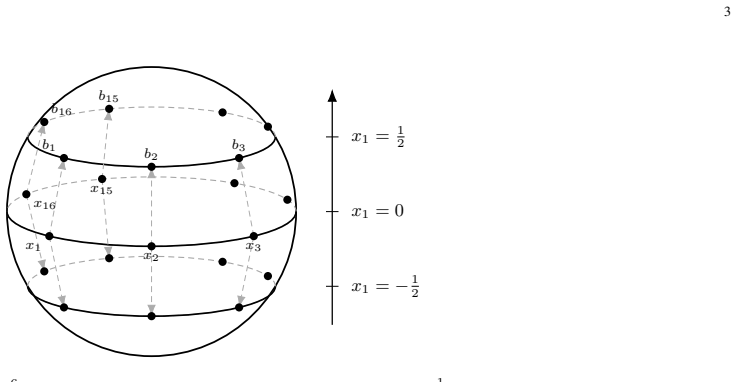
Most currently known kissing arrangements of size $840$ in $\mathbb R^{12}$ share a common structure. They consist of $60$ vectors supported on $\mathbb R^6\times\{\mathbf 0\}$, another $60$ vectors supported on $\{\mathbf 0\}\times\mathbb R^6$, and $720$ additional \emph{bridge vectors}. The bridge vectors encode the interaction between the two six-dimensional factors and are constructed from the unique $1$-factorization of the complete graph $K_6$. In this paper we investigate kissing arrangements of this type while keeping the bridge vectors fixed. We show that each $60$-point block admits substantial flexibility: $12$ of its vectors may be chosen as the signed coordinate vectors $\pm e_i$, while the remaining $48$ vectors may vary within a positive-dimensional family of configurations, which we call $48$-systems. As a consequence, we obtain infinitely many pairwise non-isometric kissing arrangements of size $840$ in $\mathbb R^{12}$. The geometric freedom revealed by these constructions provides new insight into the local structure of extremal configurations. Exploiting this structure, we develop a specialized initialization scheme for logarithmic Riesz energy optimization. Starting from such structurally informed initial configurations, we numerically construct a kissing arrangement of size $841$ in $\mathbb R^{12}$.
Editorial analysis
A structured set of objections, weighed in public.
Referee Report
Summary. The paper examines kissing arrangements of 840 unit spheres in R^12 that decompose into two 60-point sets supported on orthogonal 6-dimensional subspaces together with 720 bridge vectors constructed from the unique 1-factorization of K_6. Keeping the bridges fixed, it asserts that each 60-point block admits a 12-dimensional signed-basis subset together with a positive-dimensional family of configurations for the remaining 48 vectors (termed 48-systems). This flexibility is claimed to produce infinitely many pairwise non-isometric 840-arrangements. The same structural freedom is then used to generate initial configurations for a logarithmic Riesz-energy optimizer, which numerically yields a kissing arrangement of size 841.
Significance. If the geometric claims are established, the construction supplies an explicit positive-dimensional family of 840-kissing arrangements and thereby new information on the local geometry of extremal packings in R^12. The numerical production of a 841-configuration from structurally informed initials is a concrete computational advance that could, if rigorously validated, improve the known lower bound. The paper receives credit for grounding the bridges in the 1-factorization and for the reproducible initialization scheme, both of which are concrete strengths.
major comments (2)
- [Abstract / 48-systems construction] Abstract and the section introducing 48-systems: the claim that the 48-vector families remain valid kissing configurations (inner products with the fixed bridge vectors and among themselves at least 1/2) for a positive-dimensional open set of parameters is asserted geometrically but not accompanied by explicit lower bounds or an interval of validity. Continuity of the distance functions alone does not guarantee that the feasible set has positive dimension in the interior.
- [Numerical optimization section] Numerical construction of the 841-arrangement: the manuscript reports a Riesz-energy optimizer output but supplies neither the achieved minimum inner product, error bars on the distances, nor convergence diagnostics confirming that all pairwise distances meet or exceed the kissing threshold. This leaves the 841 claim dependent on an unverified numerical minimum.
minor comments (2)
- [Introduction] Notation for the bridge vectors and the 1-factorization should be introduced with an explicit reference or short recap of the K_6 factorization used, to make the fixed-bridge assumption self-contained.
- [48-systems] The manuscript would benefit from a short table listing the dimension of the parameter space for a single 48-system and the number of independent constraints imposed by the bridge inner-product conditions.
Simulated Author's Rebuttal
We thank the referee for the detailed and constructive report. Below we respond point by point to the major comments, indicating how we will revise the manuscript accordingly.
read point-by-point responses
-
Referee: [Abstract / 48-systems construction] Abstract and the section introducing 48-systems: the claim that the 48-vector families remain valid kissing configurations (inner products with the fixed bridge vectors and among themselves at least 1/2) for a positive-dimensional open set of parameters is asserted geometrically but not accompanied by explicit lower bounds or an interval of validity. Continuity of the distance functions alone does not guarantee that the feasible set has positive dimension in the interior.
Authors: We agree that providing explicit lower bounds would make the argument more transparent. The geometric construction of the 48-systems is based on a specific parameterization that allows us to derive explicit bounds on the inner products. In the revised version, we will include these bounds and specify an interval of validity for the parameters, thereby confirming that the set of valid configurations has positive dimension. revision: yes
-
Referee: [Numerical optimization section] Numerical construction of the 841-arrangement: the manuscript reports a Riesz-energy optimizer output but supplies neither the achieved minimum inner product, error bars on the distances, nor convergence diagnostics confirming that all pairwise distances meet or exceed the kissing threshold. This leaves the 841 claim dependent on an unverified numerical minimum.
Authors: We acknowledge the need for more rigorous reporting of the numerical results. In the revised manuscript, we will include the achieved minimum inner product value, error estimates on the distances, and convergence diagnostics from the optimizer to confirm that the configuration satisfies the kissing condition. revision: yes
Circularity Check
No circularity: explicit geometric parameterization from external 1-factorization yields independent infinite family; numerical 841 is optimization, not derivation
full rationale
The paper constructs 48-systems by fixing 12 signed basis vectors and deforming the remaining 48 while holding bridge vectors constant (taken from the known unique 1-factorization of K_6, an external combinatorial fact). The infinite non-isometric family follows directly from the positive-dimensional parameter space of these deformations, with no equation reducing a claimed output to a fitted input by construction. The 841-sphere claim is obtained via numerical Riesz-energy minimization initialized from these configurations, not a closed-form prediction. No self-citations are load-bearing for the central claims, and no ansatz or uniqueness theorem is smuggled in. The derivation chain is self-contained against external benchmarks.
Axiom & Free-Parameter Ledger
Reference graph
Works this paper leans on
-
[1]
Das problem der dreizehn kugeln,
K. Sch ¨utte and B. L. van der Waerden, “Das problem der dreizehn kugeln,”Mathematische Annalen, vol. 125, no. 1, pp. 325–334, Dec 1952. [Online]. Available: https://doi.org/10.1007/BF01343127
-
[2]
The problem of the twenty-five spheres,
O. R. Musin, “The problem of the twenty-five spheres,”Russian Mathematical Surveys, vol. 58, no. 4, pp. 794–795, Aug. 2003
2003
-
[3]
On bounds for packings inn-dimensional Euclidean space,
V . I. Levenshte ˘ın, “On bounds for packings inn-dimensional Euclidean space,”Sov. Math., Dokl., vol. 20, pp. 417–421, 1979
1979
-
[4]
New bounds on the number of unit spheres that can touch a unit sphere in n dimensions,
A. Odlyzko and N. Sloane, “New bounds on the number of unit spheres that can touch a unit sphere in n dimensions,”Journal of Combinatorial Theory, Series A, vol. 26, no. 2, pp. 210–214, 1979. [Online]. Available: https://www.sciencedirect.com/science/article/pii/0097316579900748
arXiv 1979
-
[5]
A. Korkine and G. Zolotareff, “Sur les formes quadratiques,”Mathematische Annalen, vol. 6, no. 3, pp. 366–389, Sep 1873. [Online]. Available: https://doi.org/10.1007/BF01442795
-
[6]
Sphere packings and error-correcting codes,
J. Leech and N. J. A. Sloane, “Sphere packings and error-correcting codes,”Canadian Journal of Mathematics, vol. 23, no. 4, p. 718–745, 1971
1971
-
[7]
What are all the best sphere packings in low dimensions?
J. H. Conway and N. J. A. Sloane, “What are all the best sphere packings in low dimensions?”Discrete & Computational Geometry, vol. 13, no. 3, pp. 383–403, Jun 1995. [Online]. Available: https://doi.org/10.1007/BF02574051
-
[8]
Highly symmetric lines,
M. Ganzhinov, “Highly symmetric lines,”Linear Algebra and its Applications, vol. 722, pp. 12–37, 2025. [Online]. Available: https: //www.sciencedirect.com/science/article/pii/S0024379525001946
2025
-
[9]
New lower bounds for contact numbers in small dimensions,
V . A. Zinov’ev and T. Ericson, “New lower bounds for contact numbers in small dimensions,”Probl. Inf. Transm., vol. 35, no. 4, pp. 287–294, 1999
1999
-
[10]
Improved kissing numbers in seventeen through twenty-one dimensions,
H. Cohn and A. Li, “Improved kissing numbers in seventeen through twenty-one dimensions,” 2026. [Online]. Available: https://arxiv.org/abs/2411.04916
arXiv 2026
-
[11]
A new lower bound for the kissing number in 19 dimensions,
B. S. Ho, “A new lower bound for the kissing number in 19 dimensions,” 2026. [Online]. Available: https://arxiv.org/abs/2603.10425
arXiv 2026
-
[12]
Alphaevolve: A coding agent for scientific and algorithmic discovery,
A. Novikov, N. V ˜u, M. Eisenberger, E. Dupont, P.-S. Huang, A. Z. Wagner, S. Shirobokov, B. Kozlovskii, F. J. R. Ruiz, A. Mehrabian, M. P. Kumar, A. See, S. Chaudhuri, G. Holland, A. Davies, S. Nowozin, P. Kohli, and M. Balog, “Alphaevolve: A coding agent for scientific and algorithmic discovery,” 2025. [Online]. Available: https://arxiv.org/abs/2506.13131
Pith/arXiv arXiv 2025
-
[13]
Harnessing the collective intelligence of ai agents in the wild for new discoveries,
F. Bianchi, Y . Kwon, A. Pappu, and J. Zou, “Harnessing the collective intelligence of ai agents in the wild for new discoveries,” 2026. [Online]. Available: https://arxiv.org/abs/2606.10402
Pith/arXiv arXiv 2026
-
[14]
R. Takhanov and S. Yun, “Classification of independent sets in signed johnson graphs and applications to kissing arrangements,” 2026. [Online]. Available: https://arxiv.org/abs/2606.03299
Pith/arXiv arXiv 2026
-
[15]
Variations on five-dimensional sphere packings,
H. Cohn and I. Rajagopal, “Variations on five-dimensional sphere packings,” 2026. [Online]. Available: https://arxiv.org/abs/2412.00937
arXiv 2026
discussion (0)
Sign in with ORCID, Apple, or X to comment. Anyone can read and Pith papers without signing in.