On a variational model for phase transformation in SiO2 glass
Pith reviewed 2026-06-26 19:01 UTC · model grok-4.3
The pith
A variational model treats SiO2 glass compaction under pressure as a binary phase transformation of volume fractions.
A machine-rendered reading of the paper's core claim, the machinery that carries it, and where it could break.
Core claim
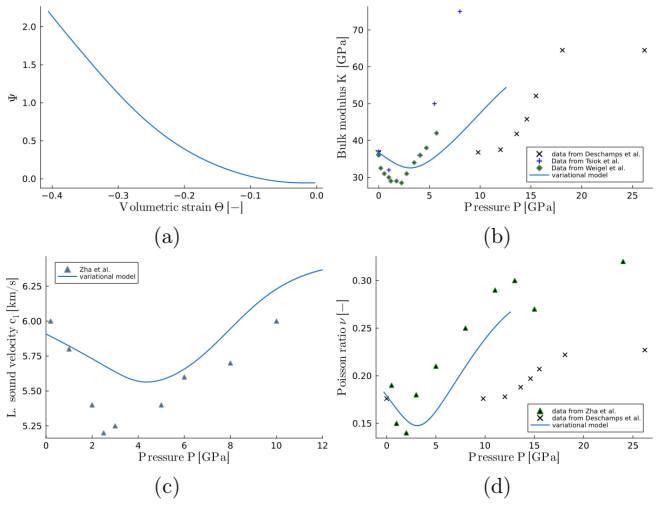
The central claim is that the compaction of SiO2 glass can be captured by a variational model of binary phase transformation in which two volume fractions coexist, producing the observed reduction in elastic moduli and the complex inelastic response under pressure, with the resulting predictions matching experimental data closely.
What carries the argument
Variational framework for multi-phase transformations in inelastic materials, restricted here to a binary phase transformation that resolves only volume fractions.
If this is right
- The model directly relates measured drops in elastic moduli to the volume fraction change during compaction.
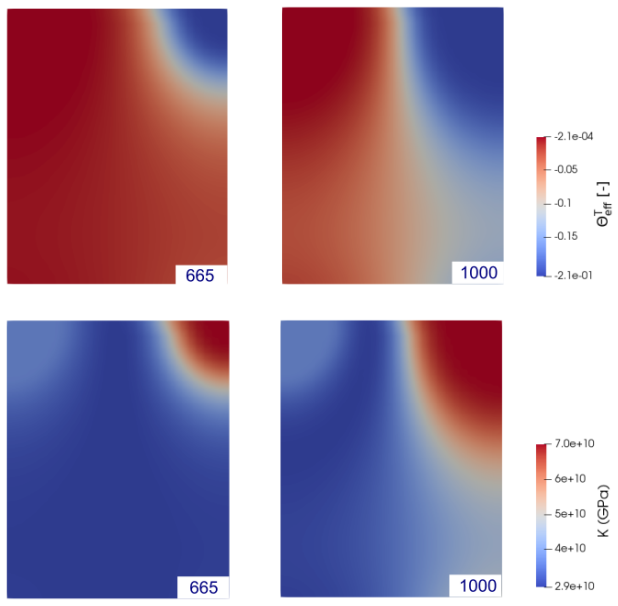
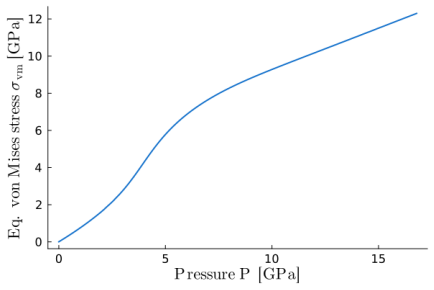
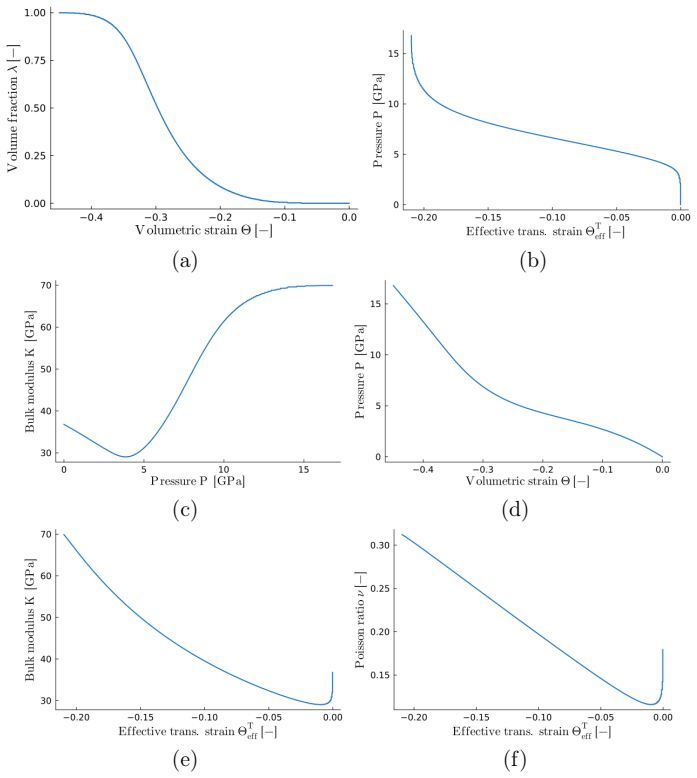
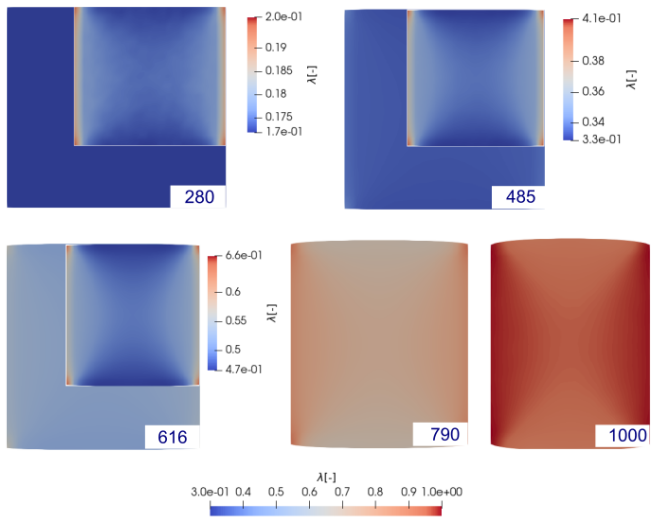
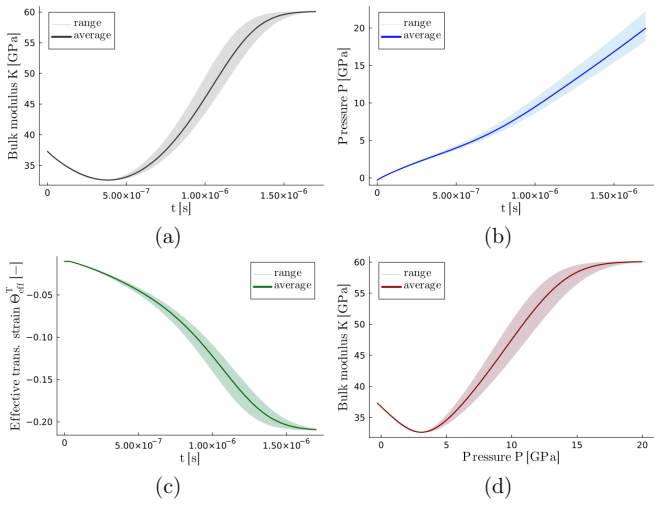
- Numerical simulations illustrate how pressure drives the coexistence of the two phases and the resulting inelastic behavior.
- The framework reproduces experimental stress-strain responses without needing explicit microstructure geometry.
Where Pith is reading between the lines
- The same binary-volume-fraction approach might be tested on other glasses that exhibit similar sigmoidal compaction curves.
- Adding a sub-model for microstructure evolution could later link local patterns such as disclinations to the macroscopic moduli changes.
- Relaxing the isothermal assumption would allow exploration of temperature-dependent shifts in the transformation pressure.
Load-bearing premise
The typical sigmoidal stress response is interpreted as the signature of a binary phase transformation occurring under isothermal conditions, with only volume fractions resolved.
What would settle it
New hydrostatic compression experiments that measure elastic moduli and volume change versus pressure and yield curves that deviate systematically from the model's predictions.
Figures
read the original abstract
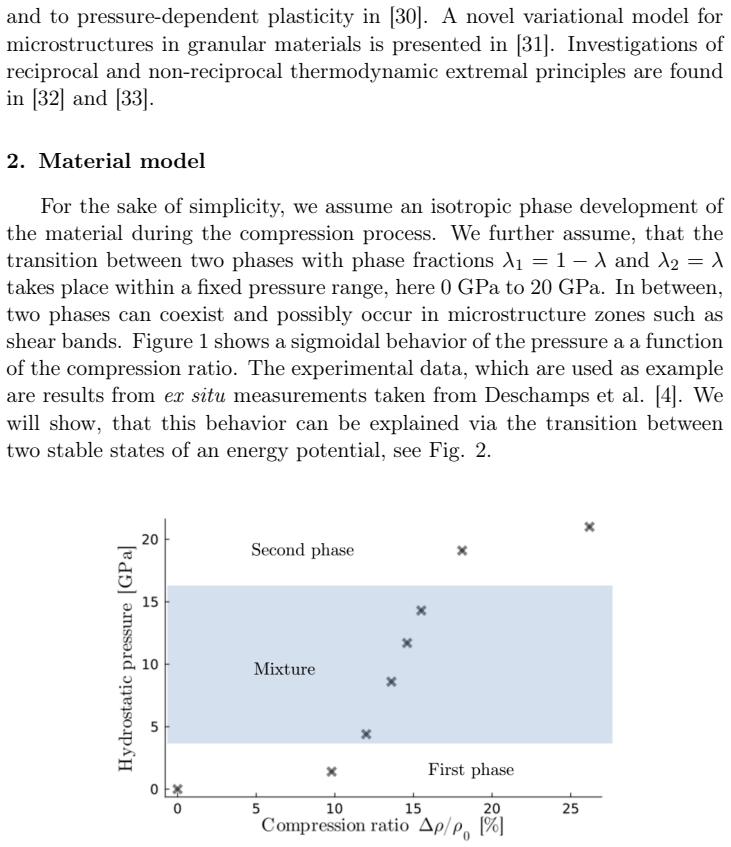
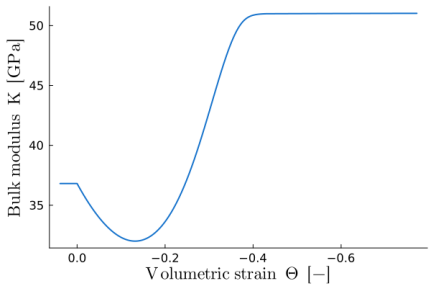
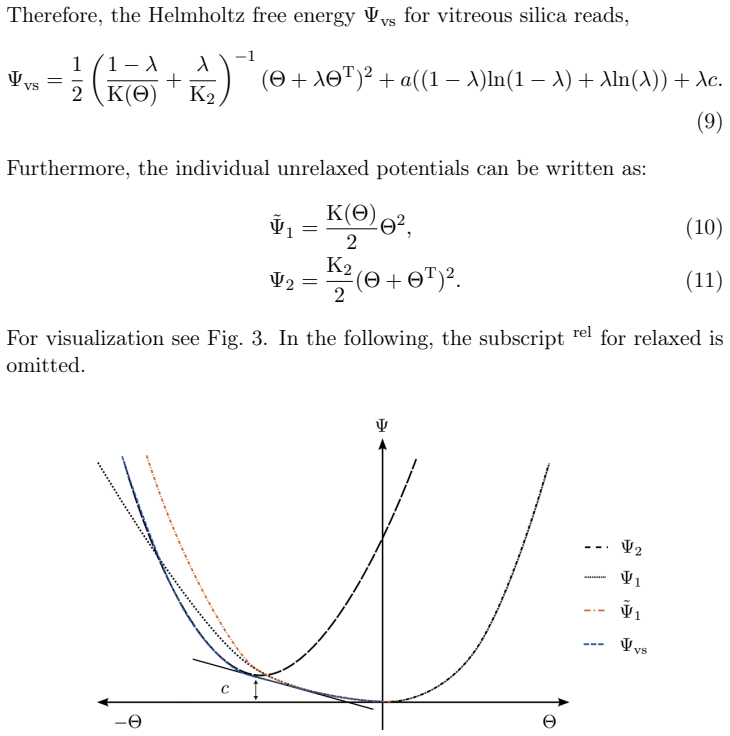
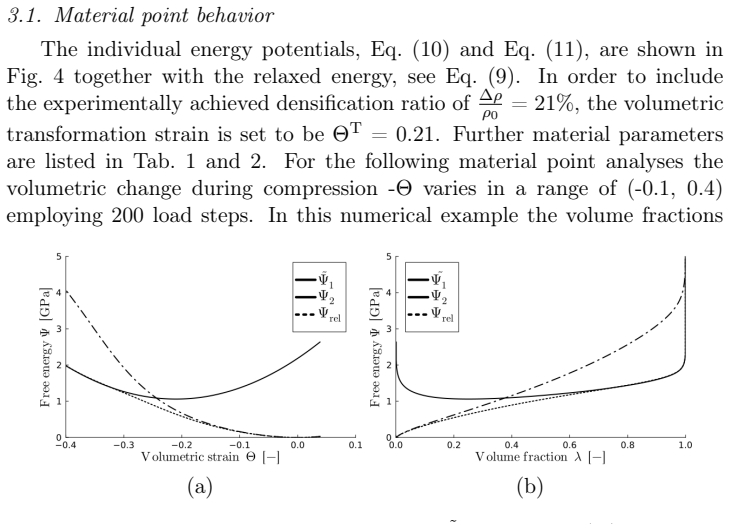
The compaction mechanisms of SiO2 glass under pressure include under certain conditions a specific reduction of the elastic moduli and a complex inelastic behavior whose nature is not yet fully understood. In our work we establish a variational framework describing the evolution of SiO2 glass under hydrostatic pressure. Based on a previous work that presents a model for multi-phase transformations in inelastic materials, we assume isothermal conditions during a compaction process and interpret the typical sigmoidal stress response as indicator of a binary phase transformation. During the process, two volume fractions coexist macroscopically and microstructures such as shear bands or disclination pattern develop in between. We restrict our approach to resolve only the volume fractions, not the corresponding microstructures. Nevertheless, the resulting model is shown to match experimental findings very well. Numerical examples successfully illustrate the relationship between the changes in the elastic moduli and the corresponding change in volume with respect to pressure.
Editorial analysis
A structured set of objections, weighed in public.
Referee Report
Summary. The manuscript develops a variational framework for the evolution of SiO2 glass under hydrostatic pressure by extending a prior multi-phase transformation model. It assumes strictly isothermal conditions and treats the observed sigmoidal stress response as direct evidence of a binary phase transformation in which two volume fractions coexist macroscopically. The approach solves only for these volume fractions (not microstructures) and claims that the resulting model matches experimental compaction data well, while numerical examples illustrate the coupling between changes in elastic moduli and volume with respect to pressure.
Significance. If the binary-phase and isothermal assumptions hold, the work would supply a thermodynamically consistent variational description of compaction that directly links modulus reduction to evolving volume fractions. The numerical demonstration of this modulus-volume relationship is a concrete strength. However, the significance remains conditional because the central claim of good experimental agreement rests on an unverified modeling choice whose support is not shown through equations, data, or error metrics.
major comments (2)
- [Abstract] Abstract: the claim that 'the resulting model is shown to match experimental findings very well' is load-bearing for the paper's contribution, yet the abstract (and available text) supplies neither the governing equations, the experimental data sets, error bars, nor any quantitative comparison that would allow assessment of the match.
- [Abstract] Modeling assumptions (as stated in the abstract): the interpretation of the sigmoidal hydrostatic response as an indicator of binary isothermal phase transformation is the foundational modeling step; without additional justification, comparison to alternative mechanisms (distributed defects, mild thermal excursions), or independent experimental confirmation of the binary character, the variational construction risks solving an ill-posed problem even if its numerics are stable.
minor comments (1)
- The explicit restriction to volume fractions (rather than microstructures) is stated but could be accompanied by a brief discussion of how this truncation still permits prediction of the observed modulus-volume coupling.
Simulated Author's Rebuttal
We thank the referee for the careful reading and constructive comments. Below we respond point by point to the major comments, indicating planned revisions where appropriate.
read point-by-point responses
-
Referee: [Abstract] Abstract: the claim that 'the resulting model is shown to match experimental findings very well' is load-bearing for the paper's contribution, yet the abstract (and available text) supplies neither the governing equations, the experimental data sets, error bars, nor any quantitative comparison that would allow assessment of the match.
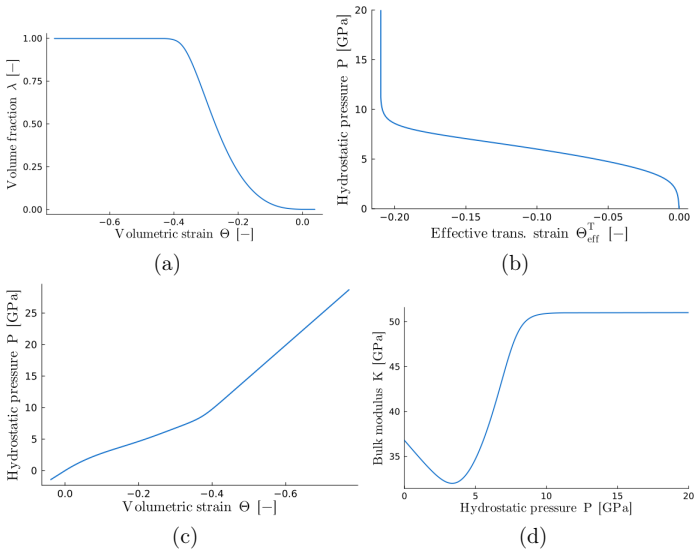
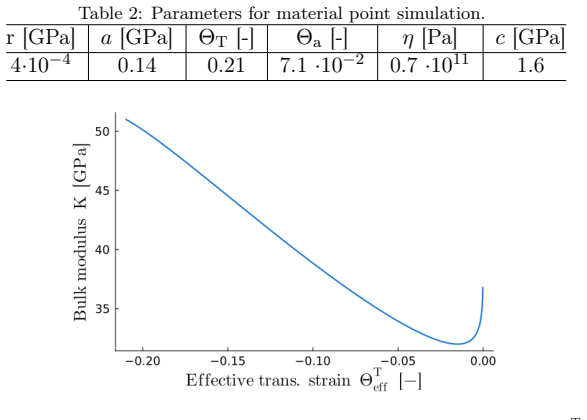
Authors: The abstract summarizes the principal result. The governing equations appear in Section 2, where the variational framework is extended from the cited prior multi-phase model. Experimental data sets for SiO2 compaction under hydrostatic pressure are introduced in Section 3, and quantitative comparisons (volume change, elastic moduli evolution, and error metrics) are reported in Section 4 together with Figures 5–7 and Table 2. To improve accessibility we will revise the abstract to add a brief clause referencing these sections and the reported agreement. revision: yes
-
Referee: [Abstract] Modeling assumptions (as stated in the abstract): the interpretation of the sigmoidal hydrostatic response as an indicator of binary isothermal phase transformation is the foundational modeling step; without additional justification, comparison to alternative mechanisms (distributed defects, mild thermal excursions), or independent experimental confirmation of the binary character, the variational construction risks solving an ill-posed problem even if its numerics are stable.
Authors: The binary-phase and isothermal assumptions are stated explicitly and rest on two elements: (i) the sigmoidal shape of the hydrostatic stress–strain curve, which is widely interpreted in the SiO2 literature as macroscopic two-phase coexistence, and (ii) the direct extension of the thermodynamically consistent multi-phase variational model developed in our earlier work. The present formulation solves only for the volume fractions, not the microstructures, and the numerical results demonstrate that the resulting modulus–volume coupling reproduces the experimental trends. While alternative mechanisms such as distributed defects remain possible, the binary model supplies a variational structure that is consistent with the observed data. We will add a short paragraph in the introduction that justifies the modeling choice, cites supporting experimental interpretations, and briefly notes alternative mechanisms with references. revision: yes
Circularity Check
No significant circularity; derivation relies on external experimental validation
full rationale
The paper explicitly adopts a modeling assumption (isothermal binary phase transformation to explain sigmoidal response) drawn from a prior framework and restricts itself to volume fractions, then demonstrates that the resulting variational model matches experimental compaction data. No quoted equation or step reduces a claimed prediction or result to its own inputs by construction. The self-citation to the multi-phase model supplies the variational structure but does not substitute for the independent experimental matching reported in the abstract. This is the normal case of a modeling paper whose central claim is tested against external benchmarks rather than being definitionally forced.
Axiom & Free-Parameter Ledger
axioms (2)
- domain assumption Isothermal conditions during compaction process
- ad hoc to paper Sigmoidal stress response indicates binary phase transformation
Reference graph
Works this paper leans on
-
[1]
Mysen, P
B. Mysen, P. Richet, Chapter 5 - silica, in: B. Mysen, P. Richet (Eds.), SilicateGlassesandMelts(SecondEdition), secondeditioned., Elsevier, 2019, pp. 143–183. URL:https://www.sciencedirect.com/science/ article/pii/B9780444637086000053
2019
-
[2]
K. Trachenko, M. T. Dove, Compressibility, kinetics, and phase tran- sition in pressurized amorphous silica, Phys. Rev. B 67 (2003) 064107. URL:https://link.aps.org/doi/10.1103/PhysRevB.67.064107
-
[3]
O. B. Tsiok, V. V. Brazhkin, A. G. Lyapin, L. G. Khvostantsev, Log- arithmic kinetics of the amorphous-amorphous transformations in SiO2 and GeO2 glasses under high pressure, Phys. Rev. Lett. 80 (1998) 999–
1998
-
[4]
URL:https://link.aps.org/doi/10.1103/PhysRevLett.80. 999
-
[5]
T. Deschamps, J. Margueritat, C. Martinet, A. Mermet, B. Cham- pagnon, Elastic moduli of permanently densified silica glasses, Scientific reports 4 (2014) 7193. doi:10.1038/srep07193
-
[6]
Petitgirard, C
S. Petitgirard, C. Sahle, C. Weis, K. Gilmore, G. Spiekermann, J. Tse, M.Wilke, C.Cavallari, V.Cerantola, C.Sternemann, Magmaproperties at deep earth’s conditions from electronic structure of silica 9 (2019) 32–
2019
-
[7]
doi:10.7185/geochemlet.1902
-
[8]
J. Du, A. Cormack, The medium range structure of sodium silicate glasses: a molecular dynamics simulation, Journal of Non-Crystalline Solids 349 (2004) 66–79. URL:https://www.sciencedirect.com/ science/article/pii/S0022309304007963, glass Science for High Technology. 16th University Conference on Glass Science. 28
2004
-
[9]
Molnár, P
G. Molnár, P. Ganster, A. Tanguy, E. Barthel, G. Kermouche, Densi- fication dependent yield criteria for sodium silicate glasses – an atom- istic simulation approach, Acta Materialia 111 (2016) 129–137. URL: https://www.sciencedirect.com/science/article/pii/S1359645 416302154
2016
-
[10]
L. Huang, J. Kieffer, Amorphous-amorphous transitions in silica glass. i. reversible transitions and thermomechanical anomalies, Phys. Rev. B 69 (2004) 224203. URL:https://link.aps.org/doi/10.1103/PhysR evB.69.224203
-
[11]
Parallelization of 3d mpdata algorithm using many graphics processors,
F. Liebau, Structural Chemistry of Silicates, Springer Berlin, Heidel- berg, 1985. URL:https://link.springer.com/book/10.1007/978-3 -642-50076-3
-
[12]
Pabst, E
W. Pabst, E. Gregorova, Elastic properties of silica polymorphs - a review, Ceramics - Silikaty 57 (2013) 167–184. URL:https://www.ce ramics-silikaty.cz/2013/pdf/2013_03_167.pdf
2013
-
[13]
Huang, J
L. Huang, J. Kieffer, Molecular dynamics study of cristobalite silica using a charge transfer three-body potential: Phase transformation and structural disorder, The Journal of Chemical Physics 118 (2003) 1487–
2003
-
[14]
URL:https://doi.org/10.1063/1.1529684
-
[15]
L. P. Dávila, M.-J. Caturla, A. Kubota, B. Sadigh, T. Díaz de la Rubia, J. F. Shackelford, S. H. Risbud, S. H. Garofalini, Transformations in the medium-range order of fused silica under high pressure, Phys. Rev. Lett. 91 (2003) 205501. URL:https://link.aps.org/doi/10.1103/P hysRevLett.91.205501
work page doi:10.1103/p 2003
-
[16]
Deschamps, C
T. Deschamps, C. Martinet, D. de Ligny, B. Champagnon, Elastic anomalous behavior of silica glass under high-pressure: In-situ raman study, Journal of Non-Crystalline Solids 355 (2009) 1095–1098. URL: https://www.sciencedirect.com/science/article/pii/S0022309 309001926, siO2, Advanced Dielectrics and Related Devices
2009
-
[17]
S. Bruns, T. Uesbeck, S. Fuhrmann, M. Tarrago, L. Wondraczek, D. De Ligny, K. Durst, Indentation densification of fused silica assessed by raman spectroscopy and constitutive finite element analysis, Journal of the American Ceramic Society 103 (2020). doi:10.1111/jace.17024
-
[18]
Keryvin, J.-X
V. Keryvin, J.-X. Meng, S. Gicquel, J.-P. Guin, L. Charleux, J.-C. Sanglebœuf, P. Pilvin, T. Rouxel, G. Le Quilliec, Constitutive modeling 29 of the densification process in silica glass under hydrostatic compression, Acta Materialia 62 (2014) 250–257. URL:https://www.sciencedirec t.com/science/article/pii/S1359645413007520
2014
-
[19]
C.Sonneville, A.Mermet, B.Champagnon, C.Martinet, J.Margueritat, D. de Ligny, T. Deschamps, F. Balima, Progressive transformations of silica glass upon densification, The Journal of Chemical Physics 137 (2012) 124505. URL:https://doi.org/10.1063/1.4754601
-
[20]
T. Rouxel, H. Ji, T. Hammouda, A. Moréac, Poisson’s ratio and the densification of glass under high pressure, Phys. Rev. Lett. 100 (2008) 225501. URL:https://link.aps.org/doi/10.1103/PhysRevLett.1 00.225501
-
[21]
C. Li, L. Zhang, L. Sun, C. Wu, D. Duan, Q. Lin, J. Ding, Z. Jiang, A finite element study on the effects of densification on fused silica underindentation, CeramicsInternational46(2020)26861–26870.URL: https://www.sciencedirect.com/science/article/pii/S0272884 220321751
2020
-
[22]
Schill, S
W. Schill, S. Heyden, S. Conti, M. Ortiz, The anomalous yield behavior of fused silica glass, Journal of the Mechanics and Physics of Solids 113 (2018) 105–125. URL:https://www.sciencedirect.com/science/ar ticle/pii/S0022509617309158
2018
-
[23]
H. Wolf, D. König, T. Triantafyllidis, Experimental investigation of shear band patterns in granular material, Journal of Structural Geology 25 (2003) 1229–1240. URL:https://www.sciencedirect.com/scienc e/article/pii/S0191814102001633
2003
-
[24]
S. Dinkelacker-Steinhoff, K. Hackl, A general model of microstruc- ture evolution including phase transformation in elasto-plastic mate- rials, PAMM 24 (2024) e202400024. URL:https://onlinelibrary. wiley.com/doi/abs/10.1002/pamm.202400024
-
[25]
S. Dinkelacker-Steinhoff, K. Hackl, A variational multi-phase model for elastoplastic materials with microstructure evolution, 2026. URL:http s://arxiv.org/abs/2602.17492.arXiv:2602.17492
arXiv 2026
-
[26]
Ortiz, L
M. Ortiz, L. Stainier, The variational formulation of viscoplastic con- stitutive updates, Comput. Methods Appl. Mech. Eng. 171 (1999) 419– 444. 30
1999
-
[27]
A. Mielke, Energetic formulation of multiplicative elasto-plasticity using dissipation distances, Contin. Mech. Thermodyn. 15 (2003) 351–382. URL:https://doi.org/10.1007/s00161-003-0120-x. doi:10.1007/ s00161-003-0120-x
-
[28]
C. Miehe, M. Lambrecht, Analysis of microstructure development in shearbands by energy relaxation of incremental stress potentials: large- strain theory for standard dissipative solids, Internat. J. Numer. Meth- ods Engrg. 58 (2003) 1–41. URL:http://dx.doi.org/10.1002/nme.7
-
[29]
C. Miehe, M. Lambrecht, E. Gürses, Analysis of material instabilities in inelastic solids by incremental energy minimization and relaxation methods: evolvingdeformationmicrostructuresinfiniteplasticity, Jour- nal of the Mechanics and Physics of Solids 52 (2004) 2725–2769. URL: https://www.sciencedirect.com/science/article/pii/S0022509 60400105X. doi:https...
-
[30]
Kochmann, K
D. Kochmann, K. Hackl, The evolution of laminates in finite crystal plasticity: a variational approach, Continuum Mech. Therm. 23 (2011) 63–85
2011
-
[31]
Govindjee, K
S. Govindjee, K. Hackl, R. Heinen, An upper bound to the free energy of mixing by twin-compatible lamination forn-variant martensitic phase transformations, Contin. Mech. Thermodyn. 18 (2007) 443–453
2007
-
[32]
Waimann, P
J. Waimann, P. Junker, K. Hackl, A coupled dissipation functional for modeling the functional fatigue in polycrystalline shape memory alloys, Eur. J. Mech. Solids 55 (2016) 110–121
2016
-
[33]
F. Behr, G. Dolzmann, K. Hackl, G. Jezdan, Analytical and numerical relaxation results for models in soil mechanics, Continuum Mechanics and Thermodynamics 35 (2023) 1–23. doi:10.1007/s00161-023-01225 -9
-
[34]
M. S. Khan, K. Hackl, Modeling of Microstructures in a Cosserat Continuum Using Relaxed Energies: Analytical and Numerical As- pects, Springer International Publishing, Cham, 2021, pp. 57–87. URL: https://doi.org/10.1007/978-3-030-90051-9_3. doi:10.1007/97 8-3-030-90051-9_3
-
[35]
K. Hackl, F. D. Fischer, G. A. Zickler, J. Svoboda, Are onsager’s recip- rocal relations necessary to apply thermodynamic extremal principles?, 31 Journal of the Mechanics and Physics of Solids 135 (2020) 103780. URL: https://www.sciencedirect.com/science/article/pii/S0022509 619306878. doi:https://doi.org/10.1016/j.jmps.2019.103780
-
[36]
K. Hackl, F. Fischer, J. Svoboda, On the treatment of non-reciprocal rate-independent kinetics via thermodynamic extremal principles, Jour- nal of the Mechanics and Physics of Solids 145 (2020) 104149. URL: https://www.sciencedirect.com/science/article/pii/S0022509 620303823. doi:https://doi.org/10.1016/j.jmps.2020.104149
-
[37]
G. Kermouche, E. Barthel, D. Vandembroucq, P. Dubujet, Mechanical modeling of indentation-induced densification in amorphous silica, Acta Materialia 56 (2008). doi:10.1016/j.actamat.2008.03.010
-
[38]
F. Birch, Finite strain isotherm and velocities for single-crystal and polycrystalline nacl at high pressures and 300°k, Journal of Geophysical Research: Solid Earth 83 (1978) 1257–1268. URL:https://agupubs. onlinelibrary.wiley.com/doi/abs/10.1029/JB083iB03p01257. doi:https://doi.org/10.1029/JB083iB03p01257
-
[39]
Mielke, Deriving new evolution equations for microstructures via relaxation of variational incremental problems, Comput
A. Mielke, Deriving new evolution equations for microstructures via relaxation of variational incremental problems, Comput. Methods Appl. Mech. Engreg. 193 (2004) 5095–5127
2004
-
[40]
Wang, The elastic properties, elastic models and elastic perspectives of metallic glasses, Progress in Materials Science 57 (2012)
W. Wang, The elastic properties, elastic models and elastic perspectives of metallic glasses, Progress in Materials Science 57 (2012). doi:10.101 6/j.pmatsci.2011.07.001
2012
-
[41]
M. Merklein, I. V. Kabakova, A. Zarifi, B. J. Eggleton, 100 years of brillouin scattering: Historical and future perspectives, Applied Physics Reviews 9 (2022) 041306. URL:https://doi.org/10.1063/5.009548 8
-
[42]
M. Grimsditch, Experimental studies of elastic properties of crystals by brillouin scattering, Physica B+C 150 (1988) 271–275. URL:https:// www.sciencedirect.com/science/article/pii/0378436388901325
arXiv 1988
-
[43]
C. Weigel, A. Polian, M. Kint, B. Rufflé, M. Foret, R. Vacher, Vitreous silica distends in helium gas: Acoustic versus static compressibilities, Physical review letters 109 (2012) 245504. doi:10.1103/PhysRevLett. 109.245504. 32
-
[44]
C.-s. Zha, R. J. Hemley, H.-k. Mao, T. S. Duffy, C. Meade, Acoustic velocities and refractive index of SiO2 glass to 57.5 gpa by brillouin scattering, Phys. Rev. B 50 (1994) 13105–13112. URL:https://link .aps.org/doi/10.1103/PhysRevB.50.13105. 33
discussion (0)
Sign in with ORCID, Apple, or X to comment. Anyone can read and Pith papers without signing in.