Direct large-area observation of subsurface plastic activity in conditioned copper electrodes
Pith reviewed 2026-06-26 20:03 UTC · model grok-4.3
The pith
Conditioned copper electrodes show ~75% higher intragrain misorientation than unexposed regions, indicating subsurface dislocations as the basis of high-field conditioning.
A machine-rendered reading of the paper's core claim, the machinery that carries it, and where it could break.
Core claim
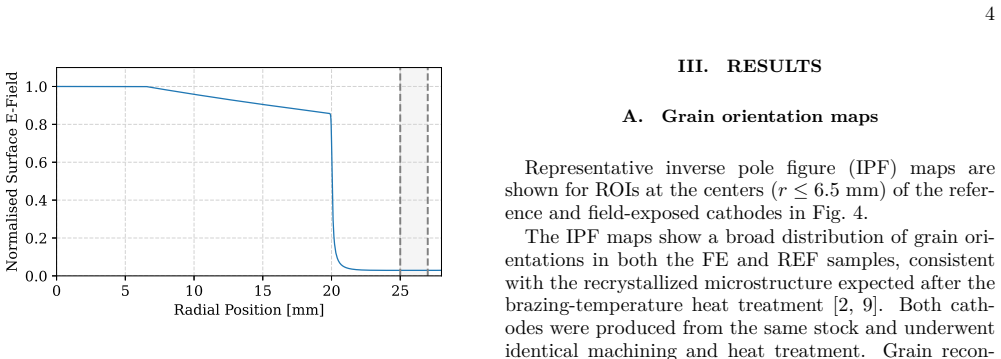
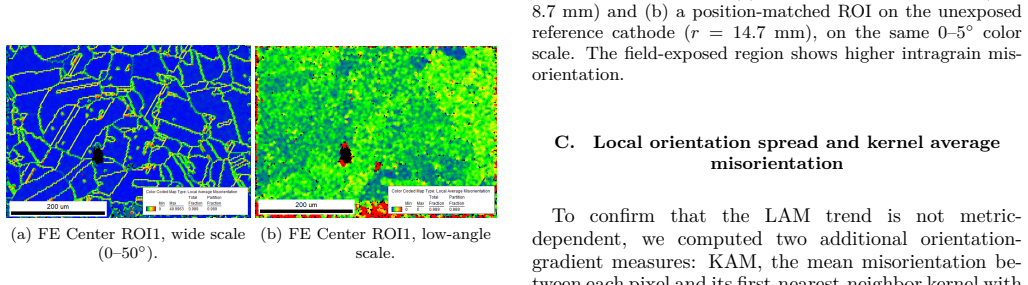
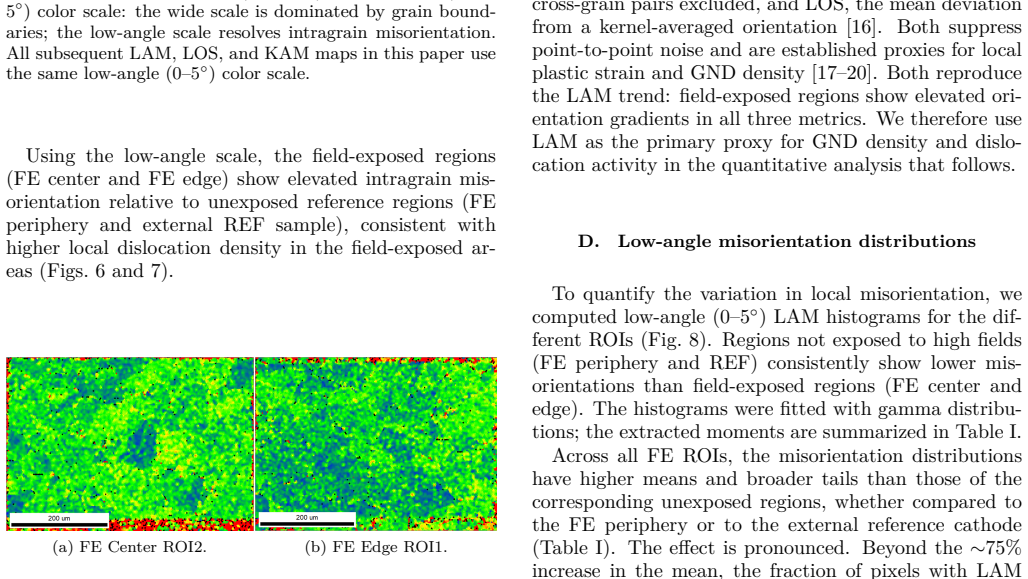
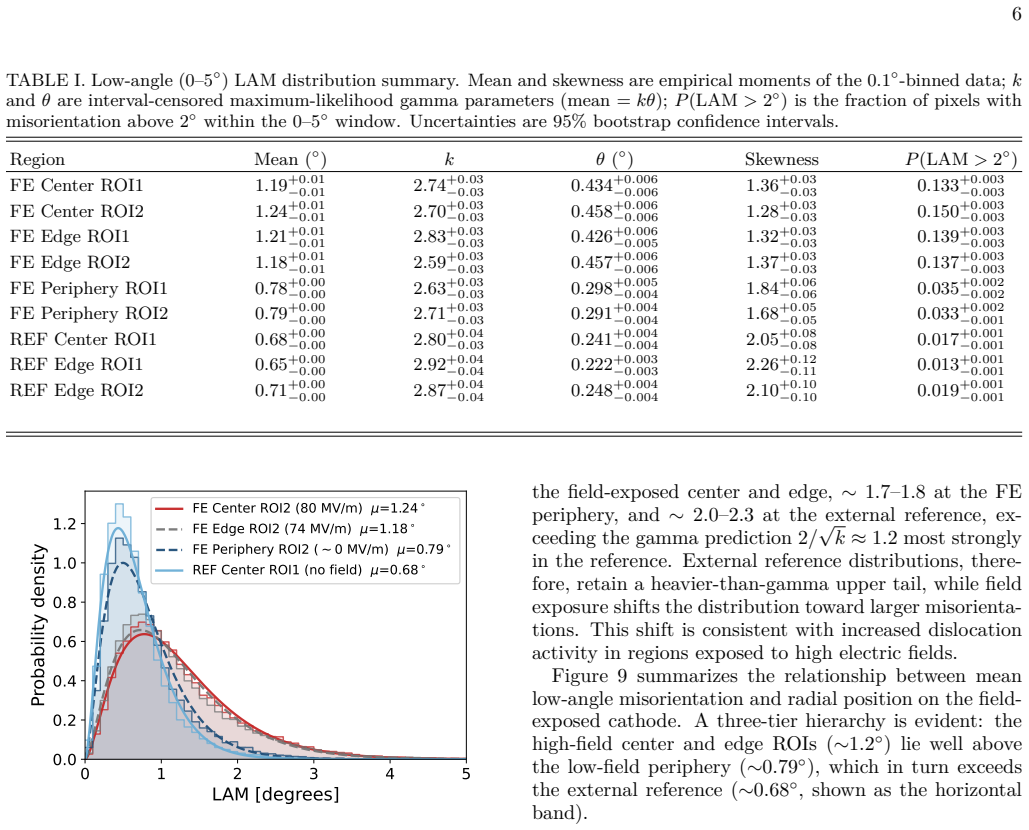
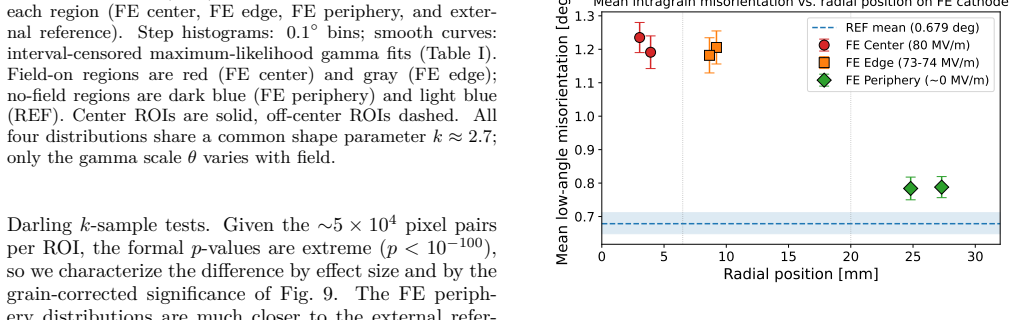
The central claim is that large-area EBSD maps on a copper cathode conditioned at pulsed DC fields up to ~80 MV/m reveal a ~75% increase in mean intragrain misorientation in field-exposed regions compared with unexposed references. This difference is reproduced by three independent misorientation metrics, confirmed by Kolmogorov-Smirnov tests, and separates into three spatial tiers (high-field center and edge, low-field periphery, unexposed reference) that match the profile of the conditioning-state variable E_S from Monte Carlo simulations, thereby identifying the evolving subsurface dislocation population as a candidate physical basis of conditioning.
What carries the argument
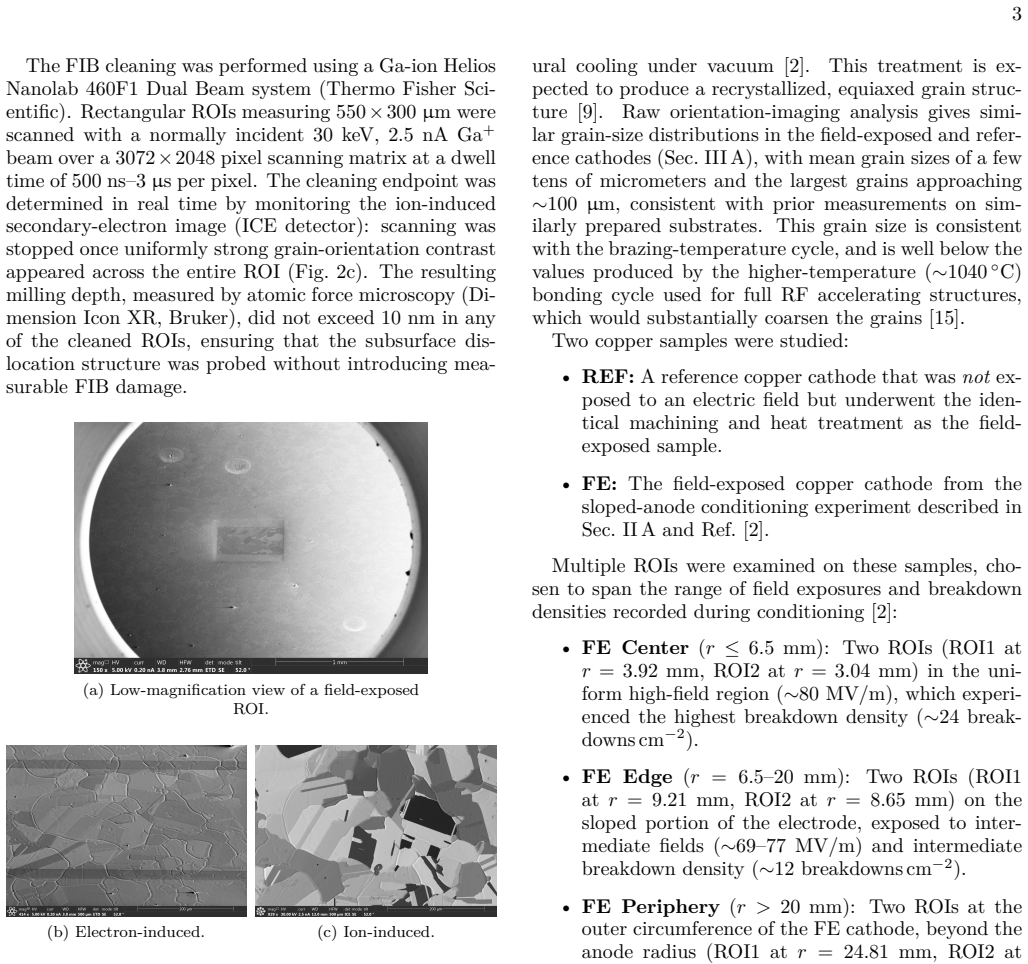
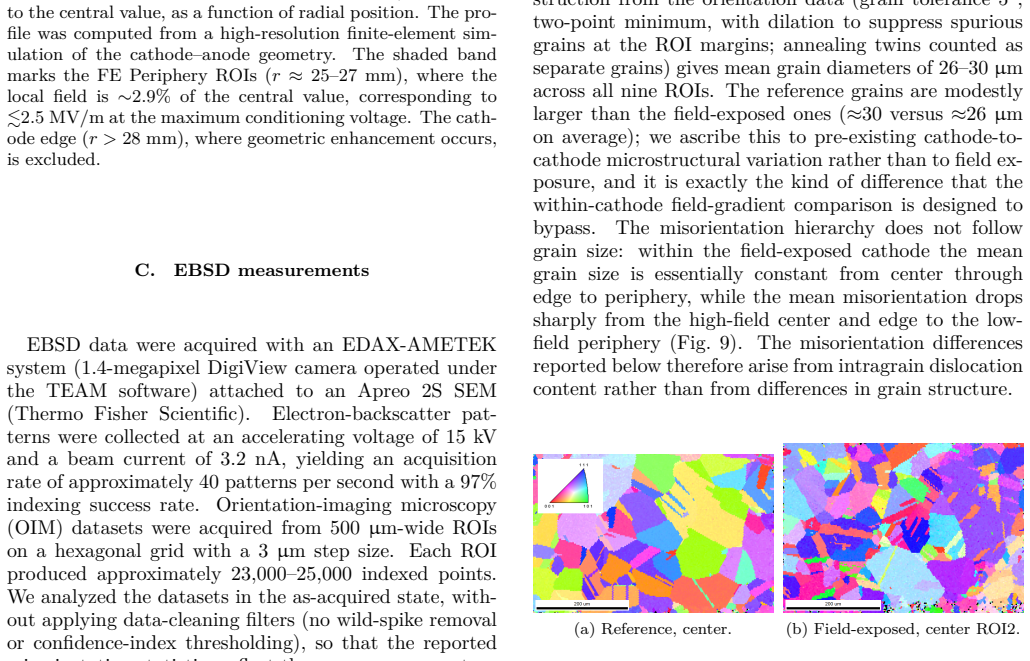
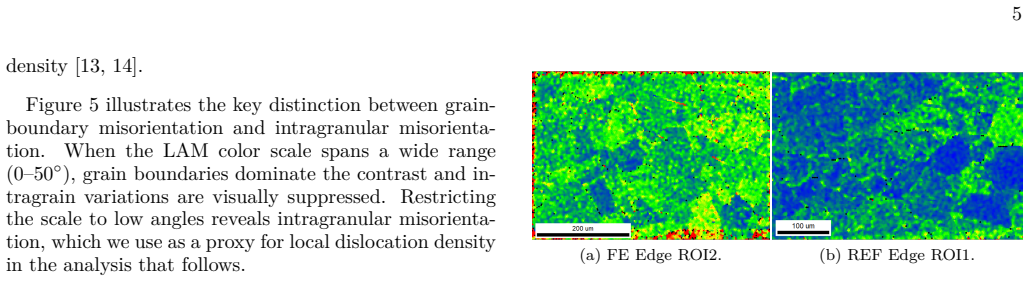
Electron backscatter diffraction (EBSD) mapping of intragrain misorientation across nine regions spanning a controlled field-exposure gradient on a single sloped-anode copper cathode.
If this is right
- Subsurface dislocation density increases with local field exposure during conditioning.
- The conditioning-state variable E_S from Monte Carlo simulations correctly predicts the spatial tiers of observed structural change.
- Misorientation metrics can serve as a direct proxy for tracking conditioning progress across large electrode areas.
- Large-area EBSD provides a new experimental route to test models of plastic activity in high-gradient copper structures.
Where Pith is reading between the lines
- If the misorientation signal is confirmed as dislocation-driven, conditioning protocols could be optimized by pre-selecting copper with lower initial dislocation content.
- The graded-exposure method on a single sample could be extended to map how different surface finishes or alloying affect the dislocation response.
- Breakdown or field-emission sites might show localized spikes in misorientation that precede observable damage.
- Deeper subsurface profiling after conditioning could test whether the dislocation activity remains confined near the surface or propagates further.
Load-bearing premise
The measured intragrain misorientation arises primarily from subsurface dislocation activity induced by the conditioning field rather than from surface contamination, polishing artifacts, or other variables introduced by the sloped-anode geometry and sample preparation.
What would settle it
Repeating the EBSD measurements on identically conditioned electrodes prepared without the sloped-anode geometry or with subsurface layers exposed by controlled etching and finding no significant misorientation difference between exposed and reference regions.
Figures



read the original abstract
High-field conditioning is the process by which radio-frequency structures in particle accelerators and other high-gradient devices reach their operating fields, yet the underlying physical mechanism remains an open question. Models and indirect measurements point to subsurface dislocation dynamics, but large-area structural measurements have been missing. We present electron backscatter diffraction measurements spanning millimeter-scale regions on a copper cathode conditioned at pulsed direct-current fields up to $\sim$80~MV/m in a sloped-anode geometry, which imposes a known gradient of field exposure across a single electrode. Across nine regions of interest spanning this exposure range, the mean intragrain misorientation of field-exposed regions exceeds that of unexposed references by $\sim$75\%; the difference is reproduced by three independent misorientation metrics and confirmed by Kolmogorov--Smirnov tests. To our knowledge, this is the first large-area observation of structural differences between conditioned and unconditioned regions of a high-field electrode. The misorientation separates into three tiers (high-field center and edge, low-field periphery, and unexposed reference) that match the spatial profile of the conditioning-state variable $E_S$ predicted by Monte Carlo simulations. These observations point to the evolving subsurface dislocation population as a candidate physical basis of conditioning.
Editorial analysis
A structured set of objections, weighed in public.
Referee Report
Summary. The manuscript reports the first large-area EBSD measurements spanning millimeter-scale regions on a copper cathode conditioned at pulsed DC fields up to ~80 MV/m in a sloped-anode geometry that imposes a known exposure gradient. Across nine regions of interest, the mean intragrain misorientation in field-exposed areas exceeds unexposed references by ~75%, reproduced by three independent metrics and confirmed by Kolmogorov-Smirnov tests. The misorientation separates into three spatial tiers that match the profile of the conditioning-state variable E_S from prior Monte Carlo simulations, interpreted as evidence that evolving subsurface dislocation populations underlie high-field conditioning.
Significance. If the attribution to field-driven subsurface dislocations is confirmed after artifact controls, the work would supply the first direct large-area structural link between conditioning and dislocation dynamics, addressing a gap between models and indirect measurements. The single-sample gradient geometry and multi-metric statistical approach are strengths; the tiered spatial match to prior E_S predictions adds a falsifiable element without introducing new free parameters inside this study.
major comments (2)
- [Abstract] Abstract: the central claim that the ~75% misorientation increase arises primarily from subsurface dislocation activity induced by the conditioning field (rather than surface contamination, polishing artifacts, or sloped-geometry effects) is load-bearing for the interpretation, yet the abstract provides no description of controls that isolate the exposure gradient from region-dependent preparation steps while preserving the gradient.
- [Abstract] Abstract: quantitative results (75% difference, three metrics, KS tests) are stated without accompanying error analysis, raw data, or exclusion criteria, preventing verification of the statistical robustness and reproducibility of the reported differences.
minor comments (1)
- [Abstract] Abstract: the precise definitions and formulas for the three independent misorientation metrics should be stated explicitly to allow independent reproduction.
Simulated Author's Rebuttal
We thank the referee for the positive overall assessment and for highlighting these points on the abstract. We address each major comment below and have revised the abstract accordingly.
read point-by-point responses
-
Referee: [Abstract] Abstract: the central claim that the ~75% misorientation increase arises primarily from subsurface dislocation activity induced by the conditioning field (rather than surface contamination, polishing artifacts, or sloped-geometry effects) is load-bearing for the interpretation, yet the abstract provides no description of controls that isolate the exposure gradient from region-dependent preparation steps while preserving the gradient.
Authors: We agree that a concise reference to the controls strengthens the abstract. The revised abstract now includes the clause 'using unexposed reference regions on the same electrode together with the imposed exposure gradient to control for preparation artifacts.' Full methodological details of these controls remain in the Methods section; the revision does not alter the central interpretation. revision: yes
-
Referee: [Abstract] Abstract: quantitative results (75% difference, three metrics, KS tests) are stated without accompanying error analysis, raw data, or exclusion criteria, preventing verification of the statistical robustness and reproducibility of the reported differences.
Authors: Abstract length limits preclude raw data or full exclusion criteria (these appear in Methods and Supplementary Information). We have added a parenthetical uncertainty estimate (±15% standard error across the nine regions) to the reported ~75% difference in the revised abstract. The three metrics and Kolmogorov-Smirnov tests are retained; we consider this sufficient to indicate robustness at the abstract level while preserving readability. revision: partial
Circularity Check
No circularity: empirical EBSD data compared to prior external Monte Carlo simulations
full rationale
The paper's central claims rest on direct large-area EBSD measurements of intragrain misorientation (three metrics, KS tests) across a field-exposure gradient imposed by sloped-anode geometry. The reported ~75% elevation and tiered spatial separation are presented as observations, with the match to E_S described as correspondence to predictions from prior Monte Carlo simulations (not derived or fitted inside this work). No equations, parameter fits, or self-citations reduce any reported result to its own inputs by construction. The derivation chain is self-contained against external benchmarks.
Axiom & Free-Parameter Ledger
axioms (2)
- domain assumption Intragrain misorientation metrics from EBSD reliably indicate subsurface dislocation activity in copper under high-field exposure
- standard math Kolmogorov–Smirnov tests are appropriate and sufficient to establish differences between misorientation distributions
Reference graph
Works this paper leans on
-
[1]
Wuensch, S
W. Wuensch, S. Calatroni, F. Djurabekova, A. Kyrit- sakis, and Y. Ashkenazy, Fundamentals of vacuum break- down in high-field systems, Reviews of Modern Physics 98, 025004 (2026)
2026
-
[2]
V. M. Bjelland, W. L. Millar, M. Kildemo, and W. Wuen- sch, Role of the local electric-field in high-field condition- ing of DC electrodes: Numerical and experimental in- sights (2026), arXiv:2606.21259 [physics.acc-ph]
Pith/arXiv arXiv 2026
-
[3]
Serafim, S
C. Serafim, S. Calatroni, F. Djurabekova, R. Pea- cock, V. Bjelland, A. T. Perez-Fontenla, W. Wuensch, A. Grudiev, S. Sgobba, A. Lombardi, and E. Sargsyan, Effects of H − low beam irradiation and high field pulsing tests in different metals, Physical Review Accelerators and Beams 28, 013101 (2025)
2025
-
[4]
Nordlund and F
K. Nordlund and F. Djurabekova, Defect model for the dependence of breakdown rate on external electric fields, Physical Review Special Topics – Accelerators and Beams 15, 071002 (2012)
2012
-
[5]
E. Z. Engelberg, Y. Ashkenazy, and M. Assaf, Stochas- tic model of breakdown nucleation under intense electric fields, Physical Review Letters 120, 124801 (2018)
2018
-
[6]
E. Z. Engelberg, A. B. Yashar, Y. Ashkenazy, M. Assaf, and I. Popov, Theory of electric field breakdown nucle- ation due to mobile dislocations, Physical Review Accel- erators and Beams 22, 083501 (2019)
2019
-
[7]
E. Z. Engelberg, J. Paszkiewicz, R. Peacock, S. Lach- mann, Y. Ashkenazy, and W. Wuensch, Dark current spikes as an indicator of mobile dislocation dynamics un- der intense dc electric fields, Physical Review Accelera- tors and Beams 23, 123501 (2020)
2020
-
[8]
Jacewicz, I
M. Jacewicz, I. Profatilova, Y. Ashkenazy, S. Calatroni, I. Popov, P. Szaniawski, and W. Wuensch, Surface and sub-surface modifications of copper electrodes exposed to electric high-field conditioning at cryogenic tempera- tures, Journal of Applied Physics 137, 193302 (2025)
2025
-
[9]
Korsbäck, F
A. Korsbäck, F. Djurabekova, L. M. Morales, I. Pro- fatilova, E. R. Castro, W. Wuensch, S. Calatroni, and T. Ahlgren, Vacuum electrical breakdown conditioning study in a parallel plate electrode pulsed dc system, Phys- ical Review Accelerators and Beams 23, 033102 (2020)
2020
-
[10]
Degiovanni, W
A. Degiovanni, W. Wuensch, and J. Giner Navarro, Com- parison of the conditioning of high gradient accelerating structures, Physical Review Accelerators and Beams 19, 032001 (2016)
2016
-
[11]
Mughrabi, Cyclic slip irreversibilities and the evo- lution of fatigue damage, Metallurgical and Materials Transactions B 40, 431 (2009)
H. Mughrabi, Cyclic slip irreversibilities and the evo- lution of fatigue damage, Metallurgical and Materials Transactions B 40, 431 (2009)
2009
-
[12]
S. E. Stanzl-Tschegg, H. Mughrabi, and B. M. Schön- bauer, Life time and cyclic slip of copper in the VHCF regime, International Journal of Fatigue 29, 2050 (2007)
2050
-
[13]
Pantleon, Resolving the geometrically necessary dis- location content by conventional electron backscatter diffraction, Scripta Materialia 58, 994 (2008)
W. Pantleon, Resolving the geometrically necessary dis- location content by conventional electron backscatter diffraction, Scripta Materialia 58, 994 (2008)
2008
-
[14]
P. J. Konijnenberg, S. Zaefferer, and D. Raabe, Assess- ment of geometrically necessary dislocation levels derived by 3d ebsd, Acta Materialia 99, 402 (2015)
2015
-
[15]
Profatilova, W
I. Profatilova, W. Wuensch, and S. Calatroni, Behaviour of copper during initial conditioning in the pulsed DC system, CLIC Note CLIC-Note-1145 (CERN, 2019)
2019
-
[16]
E. M. Lehockey, Y.-P. Lin, and O. E. Lepik, Map- ping residual plastic strain in materials using electron backscatter diffraction, in Electron Backscatter Diffrac- tion in Materials Science , edited by A. J. Schwartz, M. Kumar, and B. L. Adams (Kluwer Academic/Plenum Publishers, New York, 2000) pp. 247–264
2000
-
[17]
Kamaya, A smoothing filter for misorientation map- ping obtained by ebsd, Materials Transactions 51, 1516 (2010)
M. Kamaya, A smoothing filter for misorientation map- ping obtained by ebsd, Materials Transactions 51, 1516 (2010). 10
2010
-
[18]
Zribi, H
Z. Zribi, H. H. Ktari, F. Herbst, V. Optasanu, and N. Njah, Ebsd, xrd and srs characterization of a casting al-7wt%si alloy processed by equal channel angular ex- trusion: Dislocation density evaluation, Materials Char- acterization 153, 190 (2019)
2019
-
[19]
N. S. De Vincentis, A. Roatta, R. E. Bolmaro, and J. W. Signorelli, Ebsd analysis of orientation gradients developed near grain boundaries, Materials Research 22, e20180412 (2019)
2019
-
[20]
D. P. Field, P. B. Trivedi, S. I. Wright, and M. Kumar, Analysis of local orientation gradients in deformed single crystals, Ultramicroscopy 103, 33 (2005)
2005
-
[21]
J. K. Mackenzie, Second paper on statistics associated with the random disorientation of cubes, Biometrika 45, 229 (1958)
1958
-
[22]
Groma, G
I. Groma, G. Györgyi, and B. Kocsis, Debye screening of dislocations, Physical Review Letters 96, 165503 (2006)
2006
-
[23]
F. Yue, Y. Jia, M. Zhang, H. Song, S. Zhang, W. Guo, Z. Zhang, and J. Pang, Research on very high cycle fa- tigue behavior of pure copper, Materials Today Commu- nications 44, 112109 (2025)
2025
-
[24]
A. P. Zhilyaev, A. A. Samigullina, A. A. Nazarov, and E. R. Shayakhmetova, Structure evolution in coarse- grained nickel under ultrasonic treatment, Materials Sci- ence and Engineering: A 731, 231 (2018)
2018
-
[25]
Bagchi and D
S. Bagchi and D. Perez, Atomistic modeling of the cou- pling between electric field and bulk plastic deformation in fcc metals, Physical Review Accelerators and Beams 25, 033101 (2022)
2022
-
[26]
Bagchi, E
S. Bagchi, E. Simakov, and D. Perez, Formation of field- induced breakdown precursors on metallic electrode sur- faces, Frontiers in Physics 12, 1353658 (2024)
2024
-
[27]
J. J. Huopana and S. T. Heikkinen, Thermo-structural analysis of the rf-induced pulsed surface heating of the CLIC accelerating structures, CLIC Note CLIC-Note-702 (CERN, 2006) cERN-OPEN-2007-002
2006
-
[28]
Laurent, S
L. Laurent, S. Tantawi, V. Dolgashev, C. Nantista, Y. Hi- gashi, M. Aicheler, S. Heikkinen, and W. Wuensch, Ex- perimental study of rf pulsed heating, Physical Review Special Topics – Accelerators and Beams 14, 041001 (2011)
2011
-
[29]
Aicheler, S
M. Aicheler, S. Sgobba, G. Arnau-Izquierdo, M. Ta- borelli, S. Calatroni, H. Neupert, and W. Wuensch, Evo- lution of surface topography in dependence on the grain orientation during surface thermal fatigue of polycrys- talline copper, International Journal of Fatigue 33, 396 (2011)
2011
-
[30]
Conrad, Electroplasticity in metals and ceramics, Ma- terials Science and Engineering: A 287, 276 (2000)
H. Conrad, Electroplasticity in metals and ceramics, Ma- terials Science and Engineering: A 287, 276 (2000)
2000
-
[31]
D. A. Hughes, D. C. Chrzan, Q. Liu, and N. Hansen, Scal- ing of misorientation angle distributions, Physical Re- view Letters 81, 4664 (1998)
1998
-
[32]
N. P. Gurao and S. Suwas, Generalized scaling of mis- orientation angle distributions at meso-scale in deformed materials, Scientific Reports 4, 5641 (2014)
2014
-
[33]
Ashkenazy, I
Y. Ashkenazy, I. Popov, V. M. Bjelland, W. L. Millar, and W. Wuensch, EBSD datasets for: Direct large-area observation of subsurface plastic activity in conditioned copper electrodes (2026), dataset, Zenodo. 11 Appendix A: Graphical summary 12 Cu cathode 6.5 20 r [mm] Sloped anode Center 80 MV/m Edge 69 77 MV/m Periphery 2.5 MV/m (a) Sloped-anode geometry...
2026
discussion (0)
Sign in with ORCID, Apple, or X to comment. Anyone can read and Pith papers without signing in.