Global Multi-ion Solar Wind Model. I. Ion Temperatures
Pith reviewed 2026-06-26 19:27 UTC · model grok-4.3
The pith
A global multi-ion solar wind model driven by turbulence reproduces observed preferential heating of heavy ions like oxygen.
A machine-rendered reading of the paper's core claim, the machinery that carries it, and where it could break.
Core claim
The multi-ion solar wind model, which incorporates low-frequency reflection-driven incompressible turbulence and partitions its dissipation to electrons and ions via stochastic heating together with linear Landau and transit-time damping, reproduces the heavy-ion preferential heating seen in both remote-sensing and in-situ observations even when the magnetic field is reduced to a simple dipole configuration.
What carries the argument
Energy partitioning of turbulence dissipation to electrons and ions based on stochastic heating and linear Landau and transit-time damping.
If this is right
- The same partitioning rules can be applied to other minor ions to generate testable temperature and flow predictions across the heliosphere.
- Extending the model to include differential streaming between ion species becomes a direct next step without changing the turbulence framework.
- Global maps of ion temperatures from the transition region to 1 AU can be produced for comparison with additional spacecraft data.
- The approach demonstrates that simplified magnetic geometries suffice for initial validation of multi-ion heating effects.
Where Pith is reading between the lines
- If the partitioning holds, turbulence alone may account for most observed ion temperature differences once streaming is added.
- The model could be run with observed photospheric magnetic fields to check whether it reproduces fast versus slow wind distinctions in ion temperatures.
- Similar turbulence partitioning might be tested in laboratory or astrophysical plasmas containing multiple ion species.
Load-bearing premise
The energy partitioning of the turbulence dissipation to the electrons and various ions based on stochastic heating and linear Landau and transit-time damping is assumed to be accurate enough to produce the observed temperature ratios without differential streaming.
What would settle it
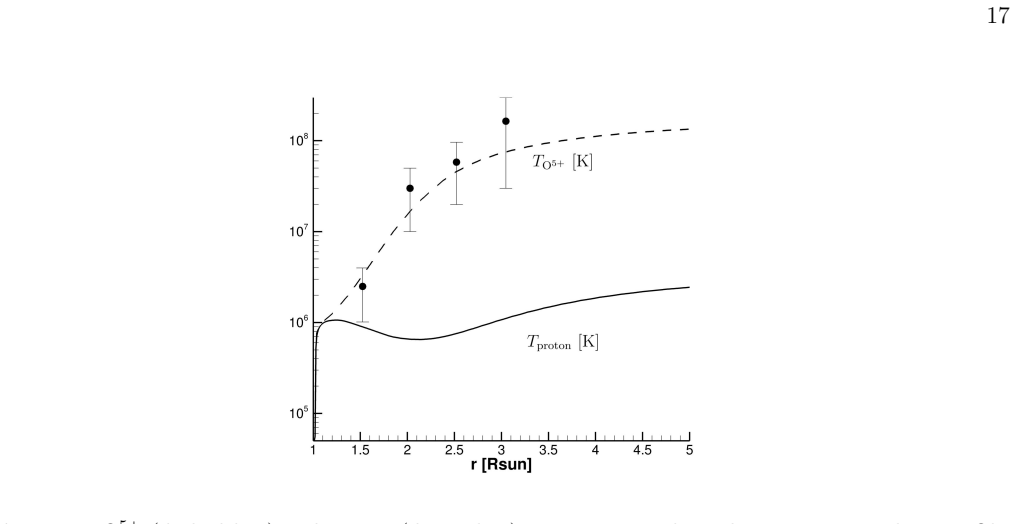
A systematic mismatch between the model's oxygen temperature as a function of height in the corona and the UVCS line-width measurements at the same locations would falsify the central claim.
Figures

read the original abstract
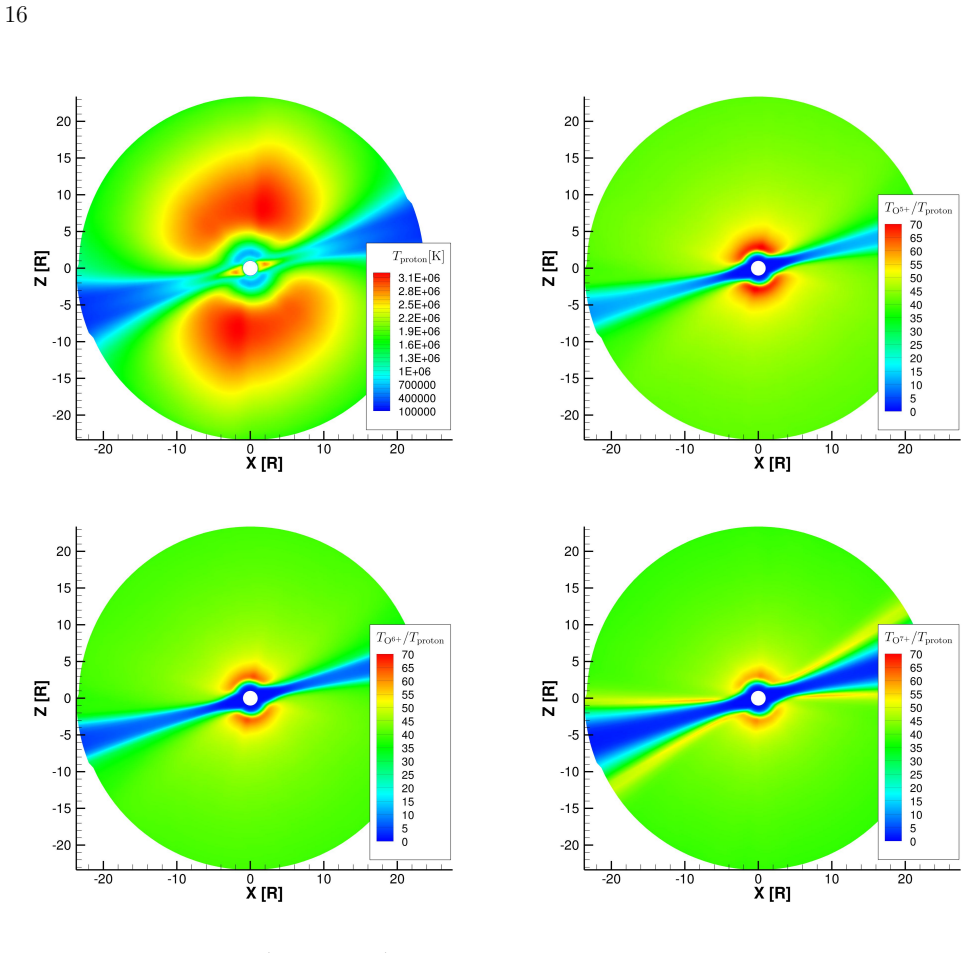
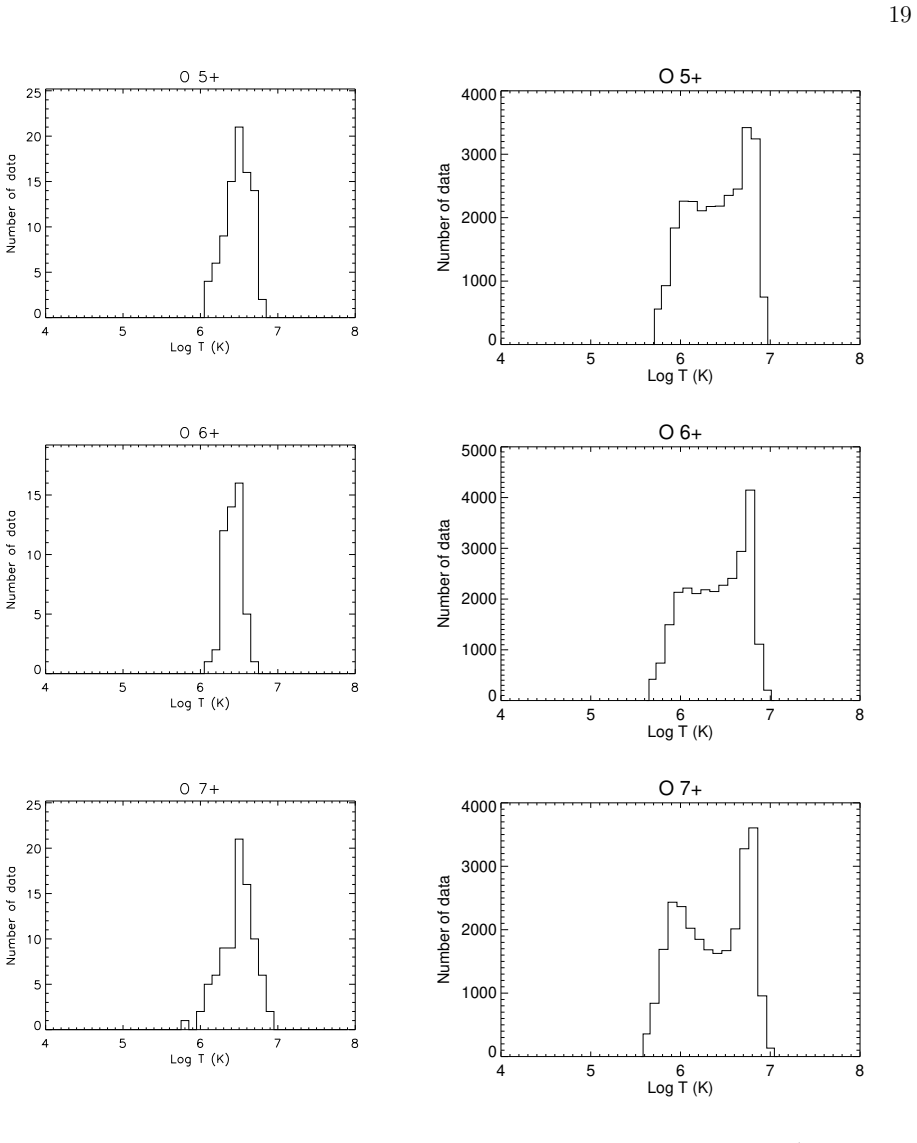
Over the past several decades, observations have shown that minor ions have a higher temperature and flow faster than protons in the solar wind. Theories based on turbulence have been developed that can explain many of these observed phenomena. We present our first step in developing a global multi-ion solar wind model with turbulence by including ion temperatures but not yet including differential streaming. The extent of this model is from the lower transition region (50,000 K temperature) to the corona and inner heliosphere. It uses low-frequency, reflection-driven incompressible turbulence to address coronal heating and solar wind acceleration. The energy partitioning of the turbulence dissipation to the electrons and various ions is based on stochastic heating and linear Landau and transit-time damping. In order to test the validity of our approach we have carried out a three-dimensional simulation of the solar corona and the solar wind using an idealized dipole magnetic field configuration, calculated the Oxygen temperature across the entire domain, and compared it to measurements obtained from the UltraViolet Coronagraph Spectrometer (UVCS) on the Solar and Heliospheric Observatory (SOHO) satellite and with the Solar Wind Ion Composition Spectrometer (SWICS) on board Advanced Composition Explorer (ACE). The comparison shows that even with the simplified magnetic field configuration the multi-ion model predictions reproduce the heavy-ion preferential heating phenomena in both remote-sensing and in-situ observations.
Editorial analysis
A structured set of objections, weighed in public.
Referee Report
Summary. The manuscript presents the first part of a global multi-ion solar wind model that includes ion temperatures (but not differential streaming) from the lower transition region to the inner heliosphere. It employs low-frequency, reflection-driven incompressible turbulence to model coronal heating and solar wind acceleration, with energy partitioning to electrons and ions determined by stochastic heating and linear Landau and transit-time damping. A 3D simulation using an idealized dipole magnetic field is performed to compute oxygen temperatures, which are then compared to UVCS/SOHO remote-sensing and SWICS/ACE in-situ observations. The authors conclude that the model reproduces the observed heavy-ion preferential heating phenomena despite the simplified magnetic field configuration.
Significance. Should the central claim be substantiated, this work represents an important advancement in multi-fluid solar wind modeling by demonstrating that turbulence dissipation mechanisms can account for preferential minor ion heating in a global context. The direct comparison to both remote and in-situ data for oxygen temperatures strengthens the potential utility for understanding solar wind composition and energetics.
major comments (2)
- [Abstract] Abstract: The reproduction of preferential heating is claimed based on the energy partitioning scheme, but the model explicitly omits differential streaming, which is observed in the solar wind and known to modify resonance conditions and damping rates in multi-ion plasmas. The manuscript does not provide evidence or sensitivity tests showing that the T_O / T_p ratios are insensitive to this omission, making the validation against observations potentially incomplete.
- [Model description (energy partitioning)] The assumption that all ions share the same bulk velocity underpins the linear damping rates and stochastic heating calculations; without a demonstration that restoring observed differential streaming would not materially alter the partitioning to oxygen versus protons, the match to UVCS and SWICS data cannot be taken as confirmation of the turbulence scheme.
minor comments (1)
- [Abstract] The abstract states the model extends 'from the lower transition region (50,000 K temperature)' but does not specify the exact lower boundary conditions or how the transition region is coupled to the turbulence driver.
Simulated Author's Rebuttal
We thank the referee for their constructive comments and for recognizing the potential significance of this work. We address the two major comments regarding differential streaming below.
read point-by-point responses
-
Referee: [Abstract] Abstract: The reproduction of preferential heating is claimed based on the energy partitioning scheme, but the model explicitly omits differential streaming, which is observed in the solar wind and known to modify resonance conditions and damping rates in multi-ion plasmas. The manuscript does not provide evidence or sensitivity tests showing that the T_O / T_p ratios are insensitive to this omission, making the validation against observations potentially incomplete.
Authors: The manuscript is explicitly framed as the first step in a multi-ion model that includes ion temperatures but omits differential streaming (as stated in the abstract and introduction). The central demonstration is that the chosen turbulence dissipation mechanisms can produce preferential oxygen heating consistent with UVCS and SWICS data even under this approximation and with an idealized magnetic field. We agree that differential streaming can modify resonance conditions and that a sensitivity study would be desirable; however, implementing differential streaming requires substantial additional model development that is reserved for a follow-up paper. In the revised manuscript we will (i) rephrase the abstract to avoid any implication of full validation and (ii) add a dedicated paragraph in the discussion section that states the limitation and outlines the planned extension. revision: partial
-
Referee: [Model description (energy partitioning)] The assumption that all ions share the same bulk velocity underpins the linear damping rates and stochastic heating calculations; without a demonstration that restoring observed differential streaming would not materially alter the partitioning to oxygen versus protons, the match to UVCS and SWICS data cannot be taken as confirmation of the turbulence scheme.
Authors: The common-bulk-velocity assumption is stated in Section 2 as part of the present implementation. The energy-partitioning scheme is therefore computed under that approximation, and the comparison to observations is offered as evidence that the scheme is at least plausible, not as a complete confirmation. We will expand the model-description section to discuss the implications of the assumption more explicitly and to reference the forthcoming inclusion of differential streaming. A quantitative demonstration of insensitivity would again require the extended model and is therefore outside the scope of this initial study. revision: partial
Circularity Check
No significant circularity; model outputs compared to independent observations without fitted parameters.
full rationale
The abstract describes a turbulence-based multi-ion model whose energy partitioning follows from stochastic heating and linear damping rates. It then compares the resulting Oxygen temperatures to UVCS/SWICS data as a validation test. No equations or text in the provided material indicate that the partitioning coefficients, heating rates, or temperature ratios were adjusted to the same dataset used for comparison. The central claim therefore rests on the physical assumptions of the dissipation channels rather than on a self-referential fit or self-citation chain. This is the normal, non-circular case.
Axiom & Free-Parameter Ledger
axioms (2)
- domain assumption Low-frequency, reflection-driven incompressible turbulence addresses coronal heating and solar wind acceleration
- domain assumption Stochastic heating plus linear Landau and transit-time damping correctly partitions turbulence energy among electrons and ions
Reference graph
Works this paper leans on
-
[1]
Abbo, L., Ofman, L., Antiochos, S. K., et al. 2016, SSRv, 201, 55, doi: 10.1007/s11214-016-0264-1
-
[2]
2005, ApJL, 626, L37, doi: 10.1086/431649
Boldyrev, S. 2005, ApJL, 626, L37, doi: 10.1086/431649
-
[3]
Buergi, A. 1992, J. Geophys. Res., 97, 3137, doi: 10.1029/91JA02833
-
[4]
1986, SoPh, 103, 347, doi: 10.1007/BF00147835
Buergi, A., & Geiss, J. 1986, SoPh, 103, 347, doi: 10.1007/BF00147835
-
[5]
Cane, H. V., & Richardson, I. G. 2003, Journal of Geophysical Research (Space Physics), 108, 1156, doi: 10.1029/2002JA009817
-
[6]
Chandran, B. D. G., Dennis, T. J., Quataert, E., & Bale, S. D. 2011, ApJ, 743, 197, doi: 10.1088/0004-637X/743/2/197 21
-
[7]
2010, ApJ, 720, 503, doi: 10.1088/0004-637X/720/1/503
Quataert, E., & Germaschewski, K. 2010, ApJ, 720, 503, doi: 10.1088/0004-637X/720/1/503
-
[8]
Cranmer, S. R., Panasyuk, A. V., & Kohl, J. L. 2008, ApJ, 678, 1480, doi: 10.1086/586890 Del Zanna, G., Dere, K. P., Young, P. R., &
-
[9]
2021, ApJ, 909, 38, doi: 10.3847/1538-4357/abd8ce
Landi, E. 2021, ApJ, 909, 38, doi: 10.3847/1538-4357/abd8ce
-
[10]
Dmitruk, P., Matthaeus, W. H., Milano, L. J., et al. 2002, ApJ, 575, 571, doi: 10.1086/341188
-
[11]
2005, ApJ, 624, 402, doi: 10.1086/428938
Leer, E. 2005, ApJ, 624, 402, doi: 10.1086/428938
-
[12]
Doschek, G. A., & Gursky, H. 1992, ApJS, 81, 387, doi: 10.1086/191698
-
[13]
Gloeckler, G., Cain, J., Ipavich, F. M., et al. 1998, SSRv, 86, 497, doi: 10.1023/A:1005036131689
-
[14]
1995, ApJ, 438, 763, doi: 10.1086/175121
Goldreich, P., & Sridhar, S. 1995, ApJ, 438, 763, doi: 10.1086/175121
-
[15]
Hansteen, V. H., Leer, E., & Holzer, T. E. 1997, ApJ, 482, 498, doi: 10.1086/304111
-
[16]
Hollweg, J. V. 1978, Reviews of Geophysics and Space Physics, 16, 689, doi: 10.1029/RG016i004p00689
-
[17]
Hollweg, J. V. 1986, J. Geophys. Res., 91, 4111, doi: 10.1029/JA091iA04p04111
-
[18]
Isenberg, P. A. 1984, J. Geophys. Res., 89, 6613, doi: 10.1029/JA089iA08p06613
-
[19]
Isenberg, P. A., & Hollweg, J. V. 1982, J. Geophys. Res., 87, 5023, doi: 10.1029/JA087iA07p05023
-
[20]
Klein, K. G., & Howes, G. G. 2015, Physics of Plasmas, 22, 032903, doi: 10.1063/1.4914933
-
[21]
Klein, K. G., Howes, G. G., & Brown, C. R. 2025, Research Notes of the American Astronomical Society, 9, 102, doi: 10.3847/2515-5172/add1c2
-
[22]
Kohl, J. L., Esser, R., Gardner, L. D., et al. 1995, SoPh, 162, 313, doi: 10.1007/BF00733433
-
[23]
Zurbuchen, T. H., & Fisk, L. A. 2012a, ApJL, 758, L21, doi: 10.1088/2041-8205/758/1/L21
-
[24]
Zurbuchen, T. H., & Fisk, L. A. 2012b, ApJ, 761, 48, doi: 10.1088/0004-637X/761/1/48
-
[25]
2008, ApJ, 682, 667, doi: 10.1086/588809 Lie-Svendsen, Ø., Hansteen, V
Li, B., & Li, X. 2008, ApJ, 682, 667, doi: 10.1086/588809 Lie-Svendsen, Ø., Hansteen, V. H., & Leer, E. 2003, ApJ, 596, 621, doi: 10.1086/377640
-
[26]
Lionello, R., Downs, C., Mason, E. I., et al. 2023, ApJ, 959, 77, doi: 10.3847/1538-4357/ad00be
-
[27]
Lionello, R., Linker, J. A., & Miki´ c, Z. 2009, ApJ, 690, 902, doi: 10.1088/0004-637X/690/1/902
-
[28]
2007, ApJ, 655, 269, doi: 10.1086/509884 Miki´ c, Z., Downs, C., Linker, J
Lithwick, Y., Goldreich, P., & Sridhar, S. 2007, ApJ, 655, 269, doi: 10.1086/509884 Miki´ c, Z., Downs, C., Linker, J. A., et al. 2018, Nature Astronomy, 2, 913, doi: 10.1038/s41550-018-0562-5
-
[29]
D., Antonucci, E., Newmark, J., et al
Moses, J. D., Antonucci, E., Newmark, J., et al. 2020, Nature Astronomy, 4, 1134, doi: 10.1038/s41550-020-1156-6
-
[30]
2015, Annales Geophysicae, 33, 47, doi: 10.5194/angeo-33-47-2015 22
Giordano, S. 2015, Annales Geophysicae, 33, 47, doi: 10.5194/angeo-33-47-2015 22
-
[31]
2018, Journal of Space Weather and Space Climate, 8, A35, doi: 10.1051/swsc/2018020
Pomoell, J., & Poedts, S. 2018, Journal of Space Weather and Space Climate, 8, A35, doi: 10.1051/swsc/2018020
-
[32]
Richardson, I. G., & Cane, H. V. 2010, SoPh, 264, 189, doi: 10.1007/s11207-010-9568-6
-
[33]
Rivera, Y. J., Klein, K. G., Wang, J. H., et al. 2025, ApJL, 990, L60, doi: 10.3847/2041-8213/adfa97
-
[34]
1953, Physical Review, 89, 977, doi: 10.1103/PhysRev.89.977
Spitzer, L., & H¨ arm, R. 1953, Physical Review, 89, 977, doi: 10.1103/PhysRev.89.977
-
[35]
Szente, J., Landi, E., Manchester, IV, W. B., et al. 2019, ApJS, 242, 1, doi: 10.3847/1538-4365/ab16d0
-
[36]
Szente, J., Landi, E., & van der Holst, B. 2022, ApJ, 926, 35, doi: 10.3847/1538- 4357/ac391810.1002/essoar.10508664.1
-
[37]
2023, ApJS, 269, 37, doi: 10.3847/1538-4365/ad0232 T´ oth, G., van der Holst, B., Sokolov, I
Szente, J., Landi, E., & van der Holst, B. 2023, ApJS, 269, 37, doi: 10.3847/1538-4365/ad0232 T´ oth, G., van der Holst, B., Sokolov, I. V., et al. 2012, Journal of Computational Physics, 231, 870, doi: 10.1016/j.jcp.2011.02.006 van der Holst, B., Sokolov, I. V., Meng, X., et al. 2014, ApJ, 782, 81, doi: 10.1088/0004-637X/782/2/81 van der Holst, B., Huang...
-
[38]
P., Adhikari, L., & Zhao, L.-L
Wang, B.-B., Zank, G. P., Adhikari, L., & Zhao, L.-L. 2022, ApJ, 928, 176, doi: 10.3847/1538-4357/ac596e
-
[39]
Wraback, E. M., Manchester, IV, W. B., Landi, E., & Szente, J. 2026, ApJ, 996, 65, doi: 10.3847/1538-4357/ae1a7a
-
[40]
Zhao, L., Zurbuchen, T. H., & Fisk, L. A. 2009, Geophys. Res. Lett., 36, L14104, doi: 10.1029/2009GL039181
discussion (0)
Sign in with ORCID, Apple, or X to comment. Anyone can read and Pith papers without signing in.