Steady-state Stellar Winds Driven by Recombination
Pith reviewed 2026-06-26 19:12 UTC · model grok-4.3
The pith
Recombination energy alone is unlikely to launch steady stellar winds from near a star's surface.
A machine-rendered reading of the paper's core claim, the machinery that carries it, and where it could break.
Core claim
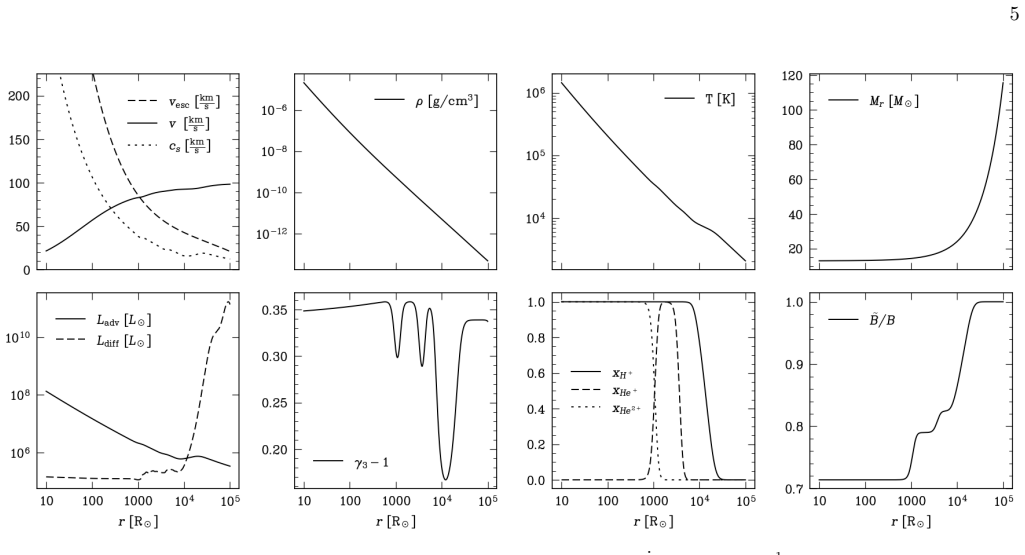
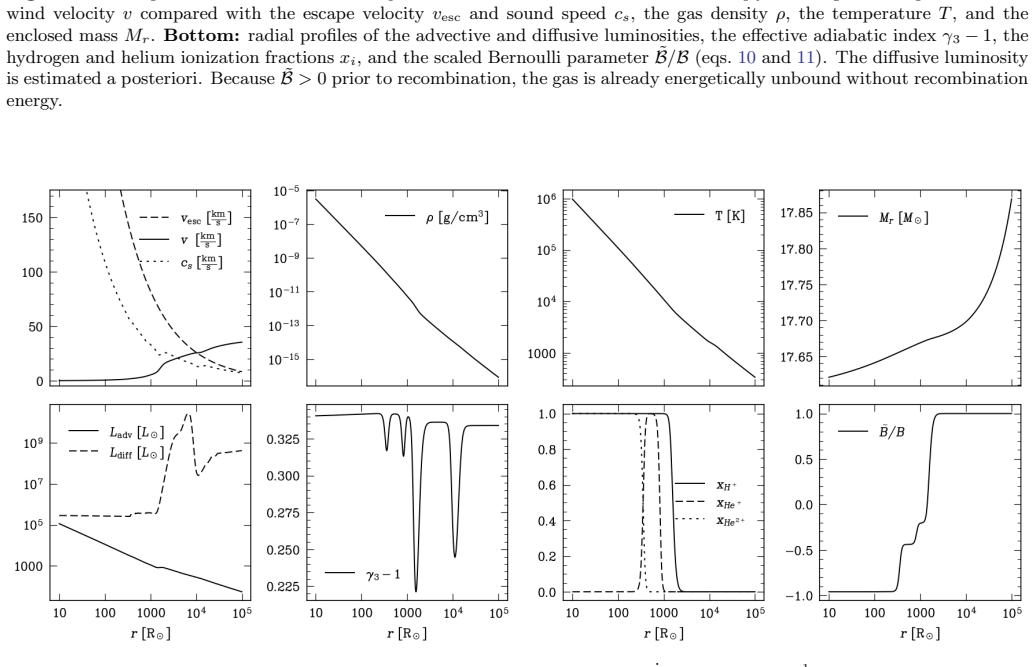
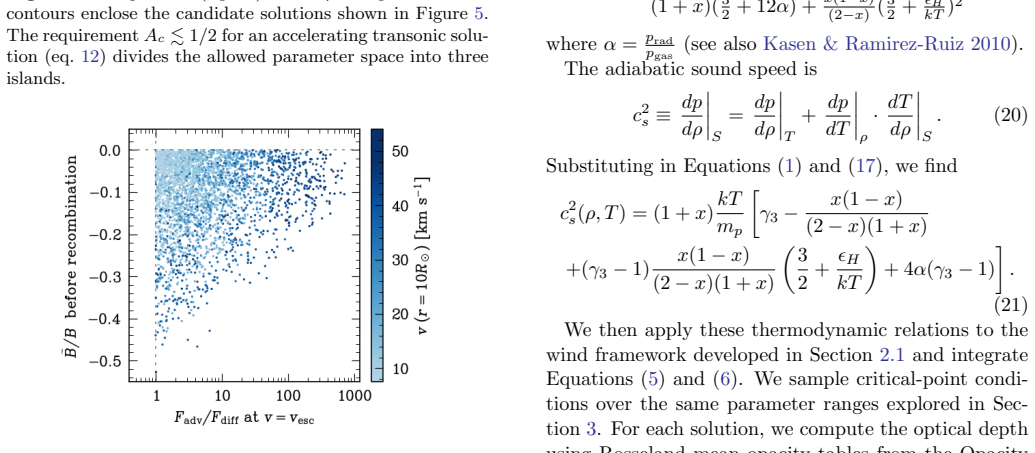
Using steady-state adiabatic solutions with a tabulated equation of state, the authors show that recombination energy alone is unlikely to produce steady stellar winds. Only a small fraction of solutions satisfy the conditions that the gas is gravitationally bound prior to recombination and that the released energy remains trapped until the flow becomes unbound. The valid solutions require outflow velocities ≳10 km s^{-1} at 10 R_⊙, inconsistent with a wind launched from a hydrostatic star. Recombination can, however, accelerate and unbind a pre-existing outflow generated by processes such as binary orbital decay, producing mass-loss rates of ∼ M_⊙ yr^{-1}.
What carries the argument
The dual classification criterion that requires both gravitational binding before recombination and trapping of the released energy until the flow unbinds, applied to families of adiabatic wind solutions.
If this is right
- Recombination cannot by itself explain mass ejection during common-envelope evolution through steady winds.
- In most of parameter space the gas is already unbound without recombination or loses the released energy by radiative diffusion while still bound.
- The small set of valid solutions requires outflow velocities too high to be launched from a hydrostatic stellar surface.
- Recombination can still act on a pre-existing outflow from binary orbital decay to reach mass-loss rates of order one solar mass per year.
Where Pith is reading between the lines
- Other mechanisms such as binary orbital energy must first lift the gas for recombination to finish the unbinding in a steady flow.
- The steady-state adiabatic assumption leaves open whether time-dependent or radiative-transfer effects could enlarge the fraction of valid solutions.
- This finding narrows the possible roles of recombination in eruptive stellar events to secondary acceleration rather than primary launch.
Load-bearing premise
A wind counts as recombination-driven only if the gas starts gravitationally bound and the recombination energy remains trapped until the flow becomes unbound.
What would settle it
Discovery of a steady wind with outflow velocity below 10 km/s at 10 solar radii that originates from a hydrostatic star and is powered solely by recombination energy.
Figures



read the original abstract
Hydrogen and helium recombination energy has been proposed as a potential driver of mass ejection in common-envelope evolution and other eruptive stellar phenomena. We investigate whether recombination can by itself launch a steady, transonic wind from near a stellar surface. Using a tabulated equation of state, we explore steady-state, adiabatic wind solutions over a broad range of stellar mass, density, and temperature. We classify a wind as recombination-driven only if the gas is gravitationally bound prior to recombination and if the released energy remains trapped until the flow becomes unbound. Only a small fraction of the solutions satisfy both conditions. In most cases, the gas is either already unbound without recombination or loses the released energy through radiative diffusion while still bound. The subset of valid solutions require outflow velocities $\gtrsim 10\,{\rm km\,s^{-1}}$ at $10\,R_\odot$, inconsistent with a wind launched from a hydrostatic star. We conclude that recombination energy alone is unlikely to produce steady stellar winds. It can, however, accelerate and unbind a pre-existing outflow generated by processes such as binary orbital decay, producing mass-loss rates of $\sim \rm M_\odot\,yr^{-1}$.
Editorial analysis
A structured set of objections, weighed in public.
Referee Report
Summary. The manuscript investigates whether hydrogen and helium recombination energy can alone drive steady, transonic stellar winds from near a stellar surface. Using a tabulated equation of state, the authors compute a broad parameter survey of steady adiabatic wind solutions and classify a solution as recombination-driven only when the gas is gravitationally bound prior to recombination and the released energy remains trapped until the flow becomes unbound. They report that only a small fraction of solutions satisfy both filters; the valid subset requires outflow velocities ≳10 km s^{-1} at 10 R_⊙, which is inconsistent with launch from a hydrostatic star. The authors conclude that recombination energy alone is unlikely to produce steady stellar winds but can accelerate and unbind a pre-existing outflow, yielding mass-loss rates ~M_⊙ yr^{-1}.
Significance. If the numerical results and filtering hold, the work supplies a quantitative, reproducible argument that recombination cannot be the sole driver of steady winds, with direct relevance to common-envelope evolution and eruptive mass-loss models. The explicit two-condition classification and the use of tabulated EOS constitute a clear, falsifiable framework that strengthens the assessment relative to purely analytic estimates.
major comments (2)
- [Abstract and §3 (parameter survey)] The central claim rests on the two filtering conditions (gravitationally bound pre-recombination; energy trapped until unbound). These criteria are load-bearing for which solutions are counted as valid, yet the manuscript provides no quantitative test of how the fraction of valid solutions changes if either condition is relaxed or replaced by an alternative definition of 'recombination-driven'.
- [Methods and results sections describing the wind integration] The adiabatic wind solutions incorporate a tabulated EOS, but the trapping condition requires an assessment of radiative diffusion while the flow is still bound. Without explicit equations or numerical implementation details for the diffusion timescale relative to the flow time (e.g., in the methods or appendix), it is not possible to verify that the reported small fraction of valid solutions is robust rather than an artifact of the diffusion approximation.
minor comments (1)
- [Abstract] The abstract states the velocity threshold as ≳10 km s^{-1} at 10 R_⊙; the corresponding figure or table that quantifies this threshold across the valid solutions should be referenced explicitly.
Simulated Author's Rebuttal
We thank the referee for their thoughtful comments, which highlight important aspects of our classification scheme and methods. We address each major comment below and will revise the manuscript accordingly to improve transparency and robustness.
read point-by-point responses
-
Referee: [Abstract and §3 (parameter survey)] The central claim rests on the two filtering conditions (gravitationally bound pre-recombination; energy trapped until unbound). These criteria are load-bearing for which solutions are counted as valid, yet the manuscript provides no quantitative test of how the fraction of valid solutions changes if either condition is relaxed or replaced by an alternative definition of 'recombination-driven'.
Authors: We agree that quantifying the sensitivity of the valid-solution fraction to the precise definitions of the two conditions would strengthen the central claim. In the revised manuscript we will add a sensitivity analysis (new subsection in §3 or appendix) that relaxes the binding threshold by ±20% and varies the trapping criterion (e.g., diffusion-to-flow time ratio from >1 to >0.5), reporting the resulting changes in the fraction of valid solutions. This will demonstrate that the conclusion remains robust under reasonable alternative definitions. revision: yes
-
Referee: [Methods and results sections describing the wind integration] The adiabatic wind solutions incorporate a tabulated EOS, but the trapping condition requires an assessment of radiative diffusion while the flow is still bound. Without explicit equations or numerical implementation details for the diffusion timescale relative to the flow time (e.g., in the methods or appendix), it is not possible to verify that the reported small fraction of valid solutions is robust rather than an artifact of the diffusion approximation.
Authors: The referee is correct that the current manuscript lacks sufficient detail on the implementation of the trapping condition. We will revise the Methods section to supply the explicit equations used for the radiative diffusion timescale, its comparison to the flow timescale, and the numerical criterion applied during the wind integration. These additions will allow readers to verify the robustness of the reported fraction of valid solutions. revision: yes
Circularity Check
No significant circularity
full rationale
The paper performs a parameter survey of steady adiabatic wind solutions using a tabulated EOS, then applies two explicit, upfront classification criteria (gas gravitationally bound prior to recombination; recombination energy trapped until the flow is unbound) to determine which solutions count as recombination-driven. The reported outcome—that only a small fraction pass both filters and that valid cases require v ≳ 10 km s^{-1} at 10 R_⊙—follows directly from applying these stated filters to the computed solutions. No parameter is fitted to a target result and then relabeled as a prediction, no load-bearing premise reduces to a self-citation, and the derivation chain is self-contained against the survey itself.
Axiom & Free-Parameter Ledger
axioms (2)
- domain assumption The wind solutions are steady-state and adiabatic.
- domain assumption Radiative diffusion can remove recombination energy while the gas is still bound.
Forward citations
Cited by 1 Pith paper
-
Transonic Solutions for Recombination-Driven Stellar Winds
Analytical stationary isentropic solution to spherically symmetric Euler equations for recombination-driven stellar winds with derived mass-loss rates applied to evolved stars.
Reference graph
Works this paper leans on
-
[1]
Resolving the (Debate About) Nozzle Shocks in Tidal Disruption Events
Andalman, Z. L., Quataert, E., Coughlin, E. R., & Nixon, C. J. 2025, arXiv e-prints, arXiv:2512.08928, doi: 10.48550/arXiv.2512.08928
work page internal anchor Pith review Pith/arXiv arXiv doi:10.48550/arxiv.2512.08928 2025
-
[2]
Badnell, N. R., Bautista, M. A., Butler, K., et al. 2005, MNRAS, 360, 458, doi: 10.1111/j.1365-2966.2005.08991.x
-
[3]
2017, A&A, 600, A137, doi: 10.1051/0004-6361/201629594
Freytag, B., Liljegren, S., & H¨ ofner, S. 2017, A&A, 600, A137, doi: 10.1051/0004-6361/201629594
-
[4]
2018, MNRAS, 478, 1818, doi: 10.1093/mnras/sty1178
Grichener, A., Sabach, E., & Soker, N. 2018, MNRAS, 478, 1818, doi: 10.1093/mnras/sty1178
-
[5]
2018, MNRAS, 477, 2349, doi: 10.1093/mnras/sty794
Iaconi, R., De Marco, O., Passy, J.-C., & Staff, J. 2018, MNRAS, 477, 2349, doi: 10.1093/mnras/sty794
-
[6]
2018, The Astrophysical Journal Letters, 858, L24, doi: 10.3847/2041-8213/aac101
Ivanova, N. 2018, The Astrophysical Journal Letters, 858, L24, doi: 10.3847/2041-8213/aac101
-
[7]
2013, A&A Rv, 21, 59, doi: 10.1007/s00159-013-0059-2
Ivanova, N., Justham, S., Chen, X., et al. 2013, A&A Rv, 21, 59, doi: 10.1007/s00159-013-0059-2
-
[8]
2010, The Astrophysical Journal, 714, 155, doi: 10.1088/0004-637X/714/1/155
Kasen, D., & Ramirez-Ruiz, E. 2010, The Astrophysical Journal, 714, 155, doi: 10.1088/0004-637X/714/1/155
-
[9]
Kuruwita, R. L., Staff, J., & De Marco, O. 2016, MNRAS, 461, 486, doi: 10.1093/mnras/stw1414
-
[10]
Lau, M. Y. M., Hirai, R., Gonz´ alez-Bol´ ıvar, M., et al. 2022, MNRAS, 512, 5462, doi: 10.1093/mnras/stac049
-
[11]
Lau, M. Y. M., Hirai, R., Price, D. J., Mandel, I., & Bate, M. R. 2025, A&A, 699, A274, doi: 10.1051/0004-6361/202554782
-
[12]
2025, arXiv e-prints, arXiv:2510.14875, doi: 10.48550/arXiv.2510.14875
Ma, J.-Z., Justham, S., Pakmor, R., et al. 2025, arXiv e-prints, arXiv:2510.14875, doi: 10.48550/arXiv.2510.14875
-
[13]
H., Abdallah, Jr., J., Clark, R
Magee, N. H., Abdallah, Jr., J., Clark, R. E. H., et al. 1995, in Astronomical Society of the Pacific Conference Series, Vol. 78, Astrophysical Applications of Powerful New Databases, ed. S. J. Adelman & W. L. Wiese, 51
1995
-
[14]
2009, A&A, 508, 1539, doi: 10.1051/0004-6361/200912598
Marigo, P., & Aringer, B. 2009, A&A, 508, 1539, doi: 10.1051/0004-6361/200912598
-
[15]
Nandez, J. L. A., & Ivanova, N. 2016, MNRAS, 460, 3992, doi: 10.1093/mnras/stw1266
-
[16]
Ohlmann, S. T., R¨ opke, F. K., Pakmor, R., & Springel, V. 2015, The Astrophysical Journal Letters, 816, L9, doi: 10.3847/2041-8205/816/1/L9 Paczy´ nski, B. 1969, AcA, 19, 1 Paczy´ nski, B., & Zi´ o lkowski, J. 1968, AcA, 18, 255
-
[17]
Passy, J.-C., De Marco, O., Fryer, C. L., et al. 2012, ApJ, 744, 52, doi: 10.1088/0004-637X/744/1/52
-
[18]
A., De Marco, O., Iaconi, R., Chamandy, L., & Price, D
Reichardt, T. A., De Marco, O., Iaconi, R., Chamandy, L., & Price, D. J. 2020, MNRAS, 494, 5333, doi: 10.1093/mnras/staa937
-
[19]
Ricker, P. M., & Taam, R. E. 2012, ApJ, 746, 74, doi: 10.1088/0004-637X/746/1/74
-
[20]
2017, MNRAS, 472, 4361, doi: 10.1093/mnras/stx2272
Sabach, E., Hillel, S., Schreier, R., & Soker, N. 2017, MNRAS, 472, 4361, doi: 10.1093/mnras/stx2272
-
[21]
Sand, C., Ohlmann, S. T., Schneider, F. R. N., Pakmor, R., & R¨ opke, F. K. 2020, A&A, 644, A60, doi: 10.1051/0004-6361/202038992
-
[22]
2018, The Astrophysical Journal Letters, 863, L14, doi: 10.3847/2041-8213/aad736
Soker, N., Grichener, A., & Sabach, E. 2018, The Astrophysical Journal Letters, 863, L14, doi: 10.3847/2041-8213/aad736
-
[23]
E., De Marco, O., Macdonald, D., et al
Staff, J. E., De Marco, O., Macdonald, D., et al. 2016, MNRAS, 455, 3511, doi: 10.1093/mnras/stv2548
-
[24]
2024, Nature, 633, 323, doi: 10.1038/s41586-024-07836-9
Vlemmings, W., Khouri, T., Bojnordi Arbab, B., De Beck, E., & Maercker, M. 2024, Nature, 633, 323, doi: 10.1038/s41586-024-07836-9
discussion (0)
Sign in with ORCID, Apple, or X to comment. Anyone can read and Pith papers without signing in.