An Ultramassive White Dwarf with a Likely Oxygen-Neon Core
Pith reviewed 2026-06-26 19:09 UTC · model grok-4.3
The pith
Measurements of an ultramassive white dwarf favor an oxygen-neon core with Bayes factor 2.7.
A machine-rendered reading of the paper's core claim, the machinery that carries it, and where it could break.
Core claim
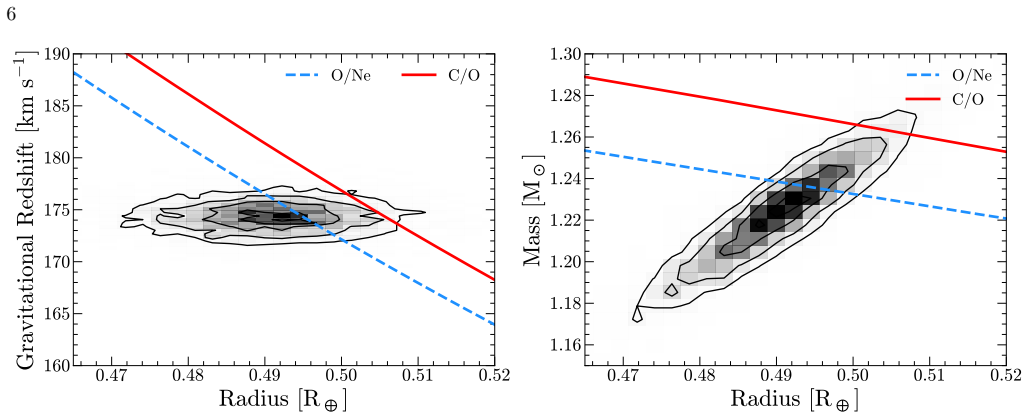
The central claim is that the mass of 1.226 solar masses and radius of 0.491 Earth radii for this ultramassive white dwarf, derived from gravitational redshifts and photometry, align better with oxygen-neon core models than carbon-oxygen core models according to state-of-the-art relations, with a Bayes factor of 2.7. This indicates the white dwarf is likely structurally incapable of producing a Type Ia supernova and provides evidence that white dwarfs passing the Q-branch without cooling delay have oxygen-neon cores.
What carries the argument
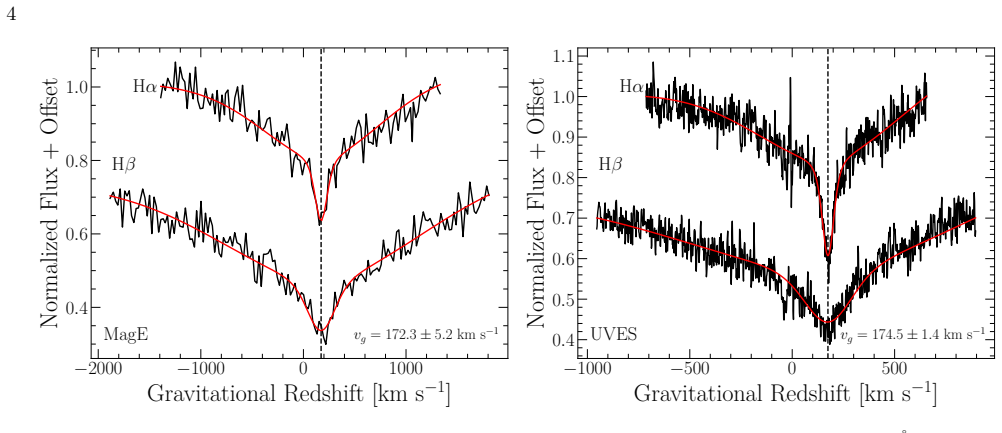
Gravitational redshift from UVES and MagE spectra paired with photometric constraints, compared against mass-radius relations that distinguish between carbon-oxygen and oxygen-neon cores in ultramassive white dwarfs.
If this is right
- This white dwarf is likely structurally incapable of producing a Type Ia supernova.
- White dwarfs which pass through the Q-branch without experiencing a delay in cooling compared to the normal white dwarf cooling sequence likely have oxygen-neon cores.
- Core composition of ultramassive white dwarfs can be probed observationally through mass and radius measurements despite the photosphere being the outermost layer.
Where Pith is reading between the lines
- Additional ultramassive white dwarfs with similar measurements could test how common oxygen-neon cores are among high-mass white dwarfs.
- This finding may inform models of white dwarf evolution and the contribution of different core types to supernova rates.
- Connections between cooling behavior on the Q-branch and core composition could be explored in other stellar populations.
Load-bearing premise
The state-of-the-art mass-radius relations accurately capture the structural differences between carbon-oxygen and oxygen-neon cores at the measured mass and radius without large systematic model errors.
What would settle it
Revised mass-radius relations for ultramassive white dwarfs that incorporate different input physics and show no preference or a preference for carbon-oxygen cores at this mass and radius would falsify the conclusion.
Figures

read the original abstract
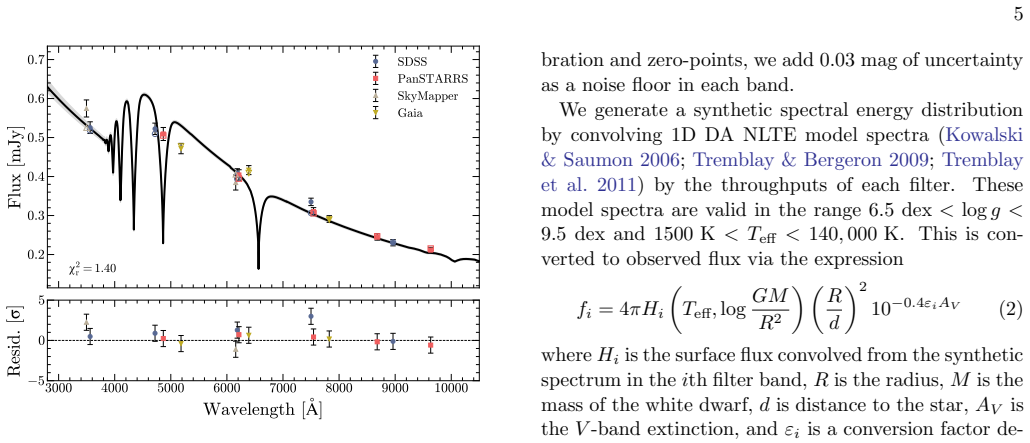
The core composition of ultramassive white dwarfs remains an open question in stellar evolution. The carbon content of white dwarf cores is critical to their role as progenitors of Type Ia supernovae. However, because the stellar photosphere only extends to the outermost layer of the star, observational probes of core compositions are limited. Here we present gravitational redshift measurements of an ultramassive white dwarf, SDSS J060851.44-005950.3, which indicate the likely presence of an oxygen-neon core. We measure the mass ($1.226_{-0.025}^{+0.024} M_\odot$) and radius ($0.491_{-0.009}^{+0.009}~R_\oplus$) of the white dwarf using gravitational redshifts from high-resolution UVES and MagE spectra paired with independent constraints from photometry. By comparing to state-of-the-art mass-radius relations for ultramassive white dwarfs, we find preference for a oxygen-neon core over a carbon-oxygen core, with a Bayes factor of $2.7$. This is a white dwarf which is likely structurally incapable of producing a Type Ia supernova, according to current understanding of supernova physics. This object provides evidence that white dwarfs which pass through the Q-branch without experiencing a delay in cooling compared to the normal white dwarf cooling sequence likely have oxygen-neon cores.
Editorial analysis
A structured set of objections, weighed in public.
Referee Report
Summary. The manuscript reports gravitational redshift measurements of the ultramassive white dwarf SDSS J060851.44-005950.3 using high-resolution spectra from UVES and MagE, combined with photometric constraints, yielding a mass of 1.226 +0.024/-0.025 M⊙ and radius of 0.491 ±0.009 R⊕. Comparison to state-of-the-art mass-radius relations for ultramassive white dwarfs shows a Bayes factor of 2.7 in favor of an oxygen-neon core over carbon-oxygen, implying the white dwarf is likely not a Type Ia supernova progenitor and supporting ONe cores for objects passing the Q-branch without cooling delay.
Significance. If robust, this provides direct observational evidence on core composition for an ultramassive white dwarf, addressing a key open question in stellar evolution and Type Ia supernova progenitor channels. The independent gravitational-redshift mass/radius determination is a methodological strength.
major comments (2)
- [Abstract and model-comparison section] The Bayes factor of 2.7 provides only mild preference. The manuscript does not appear to marginalize over or quantify systematic uncertainties in the adopted external mass-radius relations (e.g., core crystallization, envelope assumptions, or equation-of-state differences) that could be comparable to the ~2% observational errors and shift the Bayes factor across or below unity.
- [Results/Discussion on mass-radius comparison] The central claim of 'likely' ONe core rests on treating the literature tracks as fixed; without testing multiple independent track sets or propagating model errors into the likelihood, the result is sensitive to the fidelity of those specific relations at ~1.23 M⊙.
minor comments (2)
- Ensure consistent notation for asymmetric uncertainties (e.g., 1.226_{-0.025}^{+0.024}) across text, tables, and figures.
- A supplementary figure or table showing the likelihood or posterior comparison between the CO and ONe models would improve clarity of the Bayes-factor result.
Simulated Author's Rebuttal
We thank the referee for the careful and constructive report. The comments correctly identify limitations in the strength of the model comparison and the treatment of theoretical uncertainties. We respond to each major comment below and indicate the revisions planned for the manuscript.
read point-by-point responses
-
Referee: [Abstract and model-comparison section] The Bayes factor of 2.7 provides only mild preference. The manuscript does not appear to marginalize over or quantify systematic uncertainties in the adopted external mass-radius relations (e.g., core crystallization, envelope assumptions, or equation-of-state differences) that could be comparable to the ~2% observational errors and shift the Bayes factor across or below unity.
Authors: We agree that a Bayes factor of 2.7 corresponds to only mild evidence on standard interpretive scales. The current analysis adopts the published mass-radius relations at face value and does not marginalize over their internal modeling choices. In the revised manuscript we will expand the model-comparison section (and update the abstract accordingly) to state explicitly that the Bayes factor is mild, to list the main systematic assumptions in the adopted relations (crystallization, envelope mass, equation of state), and to note that variations at the level of the observational errors could in principle move the factor below unity. We will also add a short paragraph discussing why a full marginalization over these systematics lies outside the scope of the present observational study. revision: yes
-
Referee: [Results/Discussion on mass-radius comparison] The central claim of 'likely' ONe core rests on treating the literature tracks as fixed; without testing multiple independent track sets or propagating model errors into the likelihood, the result is sensitive to the fidelity of those specific relations at ~1.23 M⊙.
Authors: The manuscript relies on the most recent published ultramassive white-dwarf tracks available at the time of submission. We acknowledge that the result is therefore sensitive to the fidelity of those particular relations and that no alternative independent sets were tested. In revision we will qualify the discussion by (i) reiterating that the conclusion is conditional on the adopted tracks, (ii) citing the primary references and their stated assumptions, and (iii) noting that future comparisons with independent model grids would be valuable. Full propagation of model errors into the likelihood would require access to the underlying grids and is not feasible within this work. revision: partial
Circularity Check
No circularity: mass-radius comparison uses independent measurements against external literature relations
full rationale
The derivation measures mass (1.226 +0.024/-0.025 M⊙) and radius (0.491 ±0.009 R⊕) from gravitational redshifts in UVES/MagE spectra plus independent photometry. These observables are then compared to pre-existing state-of-the-art mass-radius tracks for ONe vs CO cores published by other groups, yielding a Bayes factor of 2.7. No equation or step reduces the core-composition inference to a parameter fitted from the same dataset, nor does any load-bearing premise rest on a self-citation chain. The result is therefore a direct test against external model predictions rather than a self-referential construction.
Axiom & Free-Parameter Ledger
axioms (2)
- domain assumption Gravitational redshift from the spectra directly yields surface gravity and thus mass-radius without significant contamination from rotation, magnetic fields, or other effects.
- domain assumption Published mass-radius relations for ultramassive white dwarfs correctly encode the structural distinction between carbon-oxygen and oxygen-neon cores at ~1.23 solar masses.
Reference graph
Works this paper leans on
-
[1]
Adelman-McCarthy, J. K., Ag¨ ueros, M. A., Allam, S. S., et al. 2007, ApJS, 172, 634, doi: 10.1086/518864
-
[2]
Althaus, L. G., C´ orsico, A. H., Camisassa, M. E., et al. 2023, MNRAS, 523, 4492, doi: 10.1093/mnras/stad1720
-
[3]
G., Gil-Pons, P., C´ orsico, A
Althaus, L. G., Gil-Pons, P., C´ orsico, A. H., et al. 2021, A&A, 646, A30, doi: 10.1051/0004-6361/202038930
-
[4]
2024, ApJ, 963, 17, doi: 10.3847/1538-4357/ad2168
Arseneau, S., Chandra, V., Hwang, H.-C., et al. 2024, ApJ, 963, 17, doi: 10.3847/1538-4357/ad2168
-
[5]
Arseneau, S. M., Hermes, J. J., Camisassa, M. E., Raddi, R., & Bauer, E. B. 2026, ApJ, 1000, 297, doi: 10.3847/1538-4357/ae4c4b
-
[6]
Arseneau, S. M., Hermes, J. J., Zakamska, N. L., et al. 2025, ApJ, 991, 190, doi: 10.3847/1538-4357/adf8dd Astropy Collaboration, Robitaille, T. P., Tollerud, E. J., et al. 2013, A&A, 558, A33, doi: 10.1051/0004-6361/201322068 Astropy Collaboration, Price-Whelan, A. M., Sip˝ ocz, B. M., et al. 2018, AJ, 156, 123, doi: 10.3847/1538-3881/aabc4f Astropy Coll...
-
[7]
2021, AJ, 161, 147, doi: 10.3847/1538-3881/abd806
Demleitner, M., & Andrae, R. 2021, AJ, 161, 147, doi: 10.3847/1538-3881/abd806
work page internal anchor Pith review doi:10.3847/1538-3881/abd806 2021
-
[8]
2018, AJ, 156, 58, doi: 10.3847/1538-3881/aacb21
Mantelet, G., & Andrae, R. 2018, AJ, 156, 58, doi: 10.3847/1538-3881/aacb21
-
[9]
2025, ApJ, 984, 197, doi: 10.3847/1538-4357/adc300
Batziou, E., Glas, R., Janka, H.-T., et al. 2025, ApJ, 984, 197, doi: 10.3847/1538-4357/adc300
-
[10]
B., Dotter, A., Conroy, C., et al
Bauer, E. B., Dotter, A., Conroy, C., et al. 2026, ApJS, 283, 41, doi: 10.3847/1538-4365/ae401e B´ edard, A., Bergeron, P., Brassard, P., & Fontaine, G. 2020, ApJ, 901, 93, doi: 10.3847/1538-4357/abafbe B´ edard, A., Blouin, S., & Cheng, S. 2024, Nature, 627, 286, doi: 10.1038/s41586-024-07102-y
-
[11]
2021, ApJL, 911, L5, doi: 10.3847/2041-8213/abf14b
Blouin, S., Daligault, J., & Saumon, D. 2021, ApJL, 911, L5, doi: 10.3847/2041-8213/abf14b
-
[12]
2025, ApJ, 988, 32, doi: 10.3847/1538-4357/addc70
Caliskan, O., Uzundag, M., Kilic, M., et al. 2025, ApJ, 988, 32, doi: 10.3847/1538-4357/addc70
-
[13]
2024, A&A, 683, A101, doi: 10.1051/0004-6361/202348344
Rebassa-Mansergas, A. 2024, A&A, 683, A101, doi: 10.1051/0004-6361/202348344
-
[14]
Camisassa, M. E., Althaus, L. G., Koester, D., et al. 2022, MNRAS, 511, 5198, doi: 10.1093/mnras/stac348
-
[15]
Camisassa, M. E., Althaus, L. G., C´ orsico, A. H., et al. 2019, A&A, 625, A87, doi: 10.1051/0004-6361/201833822
-
[16]
Castanheira, B. G., & Kepler, S. O. 2009, MNRAS, 396, 1709, doi: 10.1111/j.1365-2966.2009.14855.x
-
[17]
Castanheira, B. G., Kepler, S. O., Kleinman, S. J., Nitta, A., & Fraga, L. 2010, MNRAS, 405, 2561, doi: 10.1111/j.1365-2966.2010.16633.x —. 2013, MNRAS, 430, 50, doi: 10.1093/mnras/sts474
-
[18]
2025, ApJ, 991, 64, doi: 10.3847/1538-4357/adf745
Castro-Tapia, M., & Cumming, A. 2025, ApJ, 991, 64, doi: 10.3847/1538-4357/adf745
-
[19]
Chambers, K. C., Magnier, E. A., Metcalfe, N., et al. 2016, arXiv e-prints, arXiv:1612.05560, doi: 10.48550/arXiv.1612.05560
work page internal anchor Pith review Pith/arXiv arXiv doi:10.48550/arxiv.1612.05560 2016
-
[20]
Chandra, V., Hwang, H.-C., Zakamska, N. L., & Cheng, S. 2020, ApJ, 899, 146, doi: 10.3847/1538-4357/aba8a2
-
[21]
Cheng, S., Cummings, J. D., & M´ enard, B. 2019, ApJ, 886, 100, doi: 10.3847/1538-4357/ab4989
-
[22]
Cheng, S., Cummings, J. D., M´ enard, B., & Toonen, S. 2020, ApJ, 891, 160, doi: 10.3847/1538-4357/ab733c
-
[23]
2016, ApJ, 823, 102, doi: 10.3847/0004-637X/823/2/102
Choi, J., Dotter, A., Conroy, C., et al. 2016, ApJ, 823, 102, doi: 10.3847/0004-637X/823/2/102 C´ orsico, A. H., De Ger´ onimo, F. C., Camisassa, M. E., &
work page internal anchor Pith review doi:10.3847/0004-637x/823/2/102 2016
-
[24]
Althaus, L. G. 2019, A&A, 632, A119, doi: 10.1051/0004-6361/201936698
-
[25]
Crumpler, N. R., Chandra, V., Zakamska, N. L., et al. 2024, ApJ, 977, 237, doi: 10.3847/1538-4357/ad8ddc
-
[26]
Curd, B., Gianninas, A., Bell, K. J., et al. 2017, MNRAS, 468, 239, doi: 10.1093/mnras/stx320
-
[27]
Darbha, S., Metzger, B. D., Quataert, E., et al. 2010, MNRAS, 409, 846, doi: 10.1111/j.1365-2966.2010.17353.x De Ger´ onimo, F. C., C´ orsico, A. H., Althaus, L. G.,
-
[28]
Wachlin, F. C., & Camisassa, M. E. 2019, A&A, 621, A100, doi: 10.1051/0004-6361/201833789 De Ger´ onimo, F. C., Uzundag, M., Rebassa-Mansergas, A., et al. 2025, ApJL, 980, L9, doi: 10.3847/2041-8213/adad73
-
[29]
2000, in Society of Photo-Optical Instrumentation Engineers (SPIE) Conference Series, Vol
Kotzlowski, H. 2000, in Society of Photo-Optical Instrumentation Engineers (SPIE) Conference Series, Vol. 4008, Optical and IR Telescope Instrumentation and Detectors, ed. M. Iye & A. F. Moorwood, 534–545, doi: 10.1117/12.395512
-
[30]
Lau, H. H. B. 2015, MNRAS, 446, 2599, doi: 10.1093/mnras/stu2180
-
[31]
1996, ApJ, 472, 783, doi: 10.1086/178106
Dominguez, I., Straniero, O., Tornambe, A., & Isern, J. 1996, ApJ, 472, 783, doi: 10.1086/178106
-
[32]
2016, ApJS, 222, 8, doi: 10.3847/0067-0049/222/1/8
Dotter, A. 2016, ApJS, 222, 8, doi: 10.3847/0067-0049/222/1/8
work page internal anchor Pith review doi:10.3847/0067-0049/222/1/8 2016
-
[33]
Dotter, A., Bauer, E. B., Park, M., et al. 2026, ApJS, 283, 64, doi: 10.3847/1538-4365/ae48f3
-
[34]
J., Liebert, J., Koester, D., et al
Eisenstein, D. J., Liebert, J., Koester, D., et al. 2006, AJ, 132, 676, doi: 10.1086/504424 9
-
[35]
El-Badry, K., Rix, H.-W., & Heintz, T. M. 2021, MNRAS, 506, 2269, doi: 10.1093/mnras/stab323
-
[36]
Williams, K. A. 2010, ApJ, 712, 585, doi: 10.1088/0004-637X/712/1/585
-
[37]
Foreman-Mackey, D., Hogg, D. W., Lang, D., & Goodman, J. 2013, PASP, 125, 306, doi: 10.1086/670067 Gaia Collaboration, Prusti, T., de Bruijne, J. H. J., et al. 2016, A&A, 595, A1, doi: 10.1051/0004-6361/201629272 Gaia Collaboration, Brown, A. G. A., Vallenari, A., et al. 2018, A&A, 616, A1, doi: 10.1051/0004-6361/201833051 —. 2021, A&A, 649, A1, doi: 10.1...
-
[38]
Heintz, T. M., Hermes, J. J., El-Badry, K., et al. 2022, ApJ, 934, 148, doi: 10.3847/1538-4357/ac78d9
-
[39]
Heintz, T. M., Hermes, J. J., Tremblay, P.-E., et al. 2024, ApJ, 969, 68, doi: 10.3847/1538-4357/ad479b
-
[40]
Hermes, J. J., Kepler, S. O., Castanheira, B. G., et al. 2013, ApJL, 771, L2, doi: 10.1088/2041-8205/771/1/L2
-
[41]
Hollands, M. A., Tremblay, P. E., G¨ ansicke, B. T., et al. 2020, Nature Astronomy, 4, 663, doi: 10.1038/s41550-020-1028-0
-
[42]
2009, A&A, 501, 941, doi: 10.1051/0004-6361/200811191
Holmberg, J., Nordstr¨ om, B., & Andersen, J. 2009, A&A, 501, 941, doi: 10.1051/0004-6361/200811191
-
[43]
Hwang, H.-C., & Zakamska, N. L. 2025, ApJ, 991, 226, doi: 10.3847/1538-4357/adfa1c
-
[44]
2024, ApJ, 974, 12, doi: 10.3847/1538-4357/ad6905
Jewett, G., Kilic, M., Bergeron, P., et al. 2024, ApJ, 974, 12, doi: 10.3847/1538-4357/ad6905
-
[45]
2025, ApJ, 994, 255, doi: 10.3847/1538-4357/ae100a
Jewett, G., Kilic, M., Moss, A., et al. 2025, ApJ, 994, 255, doi: 10.3847/1538-4357/ae100a
-
[46]
Kanaan, A., Nitta, A., Winget, D. E., et al. 2005, A&A, 432, 219, doi: 10.1051/0004-6361:20041125
-
[47]
2023, A&A, 674, A5, doi: 10.1051/0004-6361/202244220
Katz, D., Sartoretti, P., Guerrier, A., et al. 2023, A&A, 674, A5, doi: 10.1051/0004-6361/202244220
-
[48]
Kilic, M., Moss, A. G., Kosakowski, A., et al. 2023, MNRAS, 518, 2341, doi: 10.1093/mnras/stac3182
-
[49]
A., Rix, H.-W., Aerts, C., et al
Kollmeier, J. A., Rix, H.-W., Aerts, C., et al. 2026, AJ, 171, 52, doi: 10.3847/1538-3881/ae0576
-
[50]
Kowalski, P. M., & Saumon, D. 2006, ApJL, 651, L137, doi: 10.1086/509723
-
[51]
Lauffer, G. R., Romero, A. D., & Kepler, S. O. 2018, MNRAS, 480, 1547, doi: 10.1093/mnras/sty1925
-
[52]
2024, ApJS, 270, 29, doi: 10.3847/1538-4365/ad12c1
Limongi, M., Roberti, L., Chieffi, A., & Nomoto, K. 2024, ApJS, 270, 29, doi: 10.3847/1538-4365/ad12c1
-
[53]
2014, ARA&A, 52, 107, doi: 10.1146/annurev-astro-082812-141031
Maoz, D., Mannucci, F., & Nelemans, G. 2014, ARA&A, 52, 107, doi: 10.1146/annurev-astro-082812-141031
-
[54]
Marshall, J. L., Burles, S., Thompson, I. B., et al. 2008, in Society of Photo-Optical Instrumentation Engineers (SPIE) Conference Series, Vol. 7014, Ground-based and Airborne Instrumentation for Astronomy II, ed. I. S. McLean & M. M. Casali, 701454, doi: 10.1117/12.789972
-
[55]
Morton, D. C. 1991, ApJS, 77, 119, doi: 10.1086/191601
-
[56]
Napiwotzki, R., Karl, C. A., Lisker, T., et al. 2020, A&A, 638, A131, doi: 10.1051/0004-6361/201629648
-
[57]
1991, ApJL, 367, L19, doi: 10.1086/185922
Nomoto, K., & Kondo, Y. 1991, ApJL, 367, L19, doi: 10.1086/185922
-
[58]
Onken, C. A., Wolf, C., Bessell, M. S., et al. 2024, PASA, 41, e061, doi: 10.1017/pasa.2024.53 Ould Rouis, L. B., Hermes, J. J., Guidry, J. A., et al. 2026, ApJ, 999, 146, doi: 10.3847/1538-4357/ae4222
-
[59]
Piro, A. L., & Thompson, T. A. 2014, ApJ, 794, 28, doi: 10.1088/0004-637X/794/1/28
-
[60]
2022, A&A, 658, A22, doi: 10.1051/0004-6361/202141837
Raddi, R., Torres, S., Rebassa-Mansergas, A., et al. 2022, A&A, 658, A22, doi: 10.1051/0004-6361/202141837
-
[61]
2025, A&A, 695, A131, doi: 10.1051/0004-6361/202452135
Raddi, R., Rebassa-Mansergas, A., Torres, S., et al. 2025, A&A, 695, A131, doi: 10.1051/0004-6361/202452135
-
[62]
Rawat, N. S., Sonith, L. S., Kamath, U. S., et al. 2026, MNRAS, 547, stag361, doi: 10.1093/mnras/stag361
-
[63]
2026, arXiv e-prints, arXiv:2604.15939
Rebassa-Mansergas, A., Tejero-G´ omez, I., & Raddi, R. 2026, arXiv e-prints, arXiv:2604.15939. https://arxiv.org/abs/2604.15939
Pith/arXiv arXiv 2026
-
[64]
Romero, A. D., Kepler, S. O., C´ orsico, A. H., Althaus, L. G., & Fraga, L. 2013, ApJ, 779, 58, doi: 10.1088/0004-637X/779/1/58
-
[65]
Rowan, D. M., Tucker, M. A., Shappee, B. J., & Hermes, J. J. 2019, MNRAS, 486, 4574, doi: 10.1093/mnras/stz1116
-
[66]
Schlafly, E. F., & Finkbeiner, D. P. 2011, ApJ, 737, 103, doi: 10.1088/0004-637X/737/2/103
work page internal anchor Pith review doi:10.1088/0004-637x/737/2/103 2011
-
[67]
2021, ApJ, 906, 53, doi: 10.3847/1538-4357/abc87e
Schwab, J. 2021, ApJ, 906, 53, doi: 10.3847/1538-4357/abc87e
-
[68]
Shen, K. J. 2015, ApJL, 805, L6, doi: 10.1088/2041-8205/805/1/L6
-
[69]
J., Bildsten, L., Kasen, D., & Quataert, E
Shen, K. J., Bildsten, L., Kasen, D., & Quataert, E. 2012, ApJ, 748, 35, doi: 10.1088/0004-637X/748/1/35
-
[70]
Shen, K. J., Blouin, S., & Breivik, K. 2023, ApJL, 955, L33, doi: 10.3847/2041-8213/acf57b
-
[71]
2007, A&A, 476, 893, doi: 10.1051/0004-6361:20078132
Siess, L. 2007, A&A, 476, 893, doi: 10.1051/0004-6361:20078132
-
[72]
Starrfield, S., Iliadis, C., & Hix, W. R. 2008, in Classical Novae, ed. M. F. Bode & A. Evans, Vol. 43, 77–101, doi: 10.1017/CBO9780511536168.006
-
[73]
Starrfield, S., Iliadis, C., Timmes, F. X., et al. 2012, Bulletin of the Astronomical Society of India, 40, 419, doi: 10.48550/arXiv.1210.6086 10
work page internal anchor Pith review Pith/arXiv arXiv doi:10.48550/arxiv.1210.6086 2012
-
[74]
D., Toonen, S., Zapartas, E., Justham, S., & G¨ ansicke, B
Temmink, K. D., Toonen, S., Zapartas, E., Justham, S., & G¨ ansicke, B. T. 2020, A&A, 636, A31, doi: 10.1051/0004-6361/201936889
-
[75]
2012, A&A, 546, A70, doi: 10.1051/0004-6361/201218966
Toonen, S., Nelemans, G., & Portegies Zwart, S. 2012, A&A, 546, A70, doi: 10.1051/0004-6361/201218966
-
[76]
Tremblay, P. E., & Bergeron, P. 2009, ApJ, 696, 1755, doi: 10.1088/0004-637X/696/2/1755
-
[77]
E., Bergeron, P., & Gianninas, A
Tremblay, P. E., Bergeron, P., & Gianninas, A. 2011, ApJ, 730, 128, doi: 10.1088/0004-637X/730/2/128
-
[78]
Tremblay, P.-E., Fontaine, G., Gentile Fusillo, N. P., et al. 2019, Nature, 565, 202, doi: 10.1038/s41586-018-0791-x
-
[79]
Wegg, C., & Phinney, E. S. 2012, MNRAS, 426, 427, doi: 10.1111/j.1365-2966.2012.21394.x
-
[80]
Wu, C., Xiong, H., & Wang, X. 2022, MNRAS, 512, 2972, doi: 10.1093/mnras/stac273 11 APPENDIX A.CORNER PLOT We use a likelihood function based on that of Raddi et al. (2025) and Arseneau et al. (2026): lnL(T eff, R, d, AV , M) =− 1 2 nX i=1 " (fi,obs −f i(θ))2 σ2 fi + ln 2πσ2 fi # − 1 2 (1/d−ϖ) 2 σ2ϖ + ln 2πσ2 ϖ + 2 lnd − 1 2 (AV −A V,NGF)2 (0.05AV,NGF)2 +...
discussion (0)
Sign in with ORCID, Apple, or X to comment. Anyone can read and Pith papers without signing in.