Fireworks at Cosmic Dawn: relieving BAO-CMB tensions with the Pop III.1 Flash
Pith reviewed 2026-06-26 19:35 UTC · model grok-4.3
The pith
Pop III.1 stars can drive an early reionization flash at z=20 that produces CMB optical depth 0.087 while keeping pkSZ below SPT limits.
A machine-rendered reading of the paper's core claim, the machinery that carries it, and where it could break.
Core claim
Within the Pop III.1 framework, self-regulating ionizing feedback imposes a minimum source separation of ∼1 cMpc that limits large-scale ionization fluctuations, thereby allowing a flash ionization phase centered at z=20 to realize an optical depth τ=0.087 while remaining below the most conservative 2σ upper limits on pkSZ power from recent South Pole Telescope data.
What carries the argument
Self-regulating ionizing feedback from Pop III.1 stars that enforces a minimum source separation of ∼1 cMpc and thereby suppresses large-scale ionization fluctuations.
If this is right
- The model produces the higher optical depth needed to allow a sub-minimal neutrino mass sum when CMB data are combined with DESI BAO measurements.
- The flash ionization phase remains consistent with Lyα forest constraints that require reionization to end late.
- The reduced source clustering keeps pkSZ power below the most conservative 2σ SPT upper limits.
- Early reionization scenarios with weakly clustered sources become viable candidates for resolving BAO-CMB tensions.
Where Pith is reading between the lines
- Similar minimum-separation mechanisms could be tested in other early-source populations that also need to avoid overproducing pkSZ.
- The required source spacing may leave distinct signatures in the 21 cm power spectrum at cosmic dawn that future arrays could target.
- If Pop III.1 stars are the progenitors of the first supermassive black holes, the same feedback that sets their separation may also shape early black-hole growth rates.
Load-bearing premise
Self-regulating ionizing feedback from Pop III.1 stars imposes a minimum source separation of about 1 cMpc that is large enough to suppress large-scale ionization fluctuations below current pkSZ limits.
What would settle it
A measurement of pkSZ power on scales around 3000 that exceeds the model's predicted amplitude, or a confirmed optical depth significantly below 0.087, would falsify the central claim.
Figures

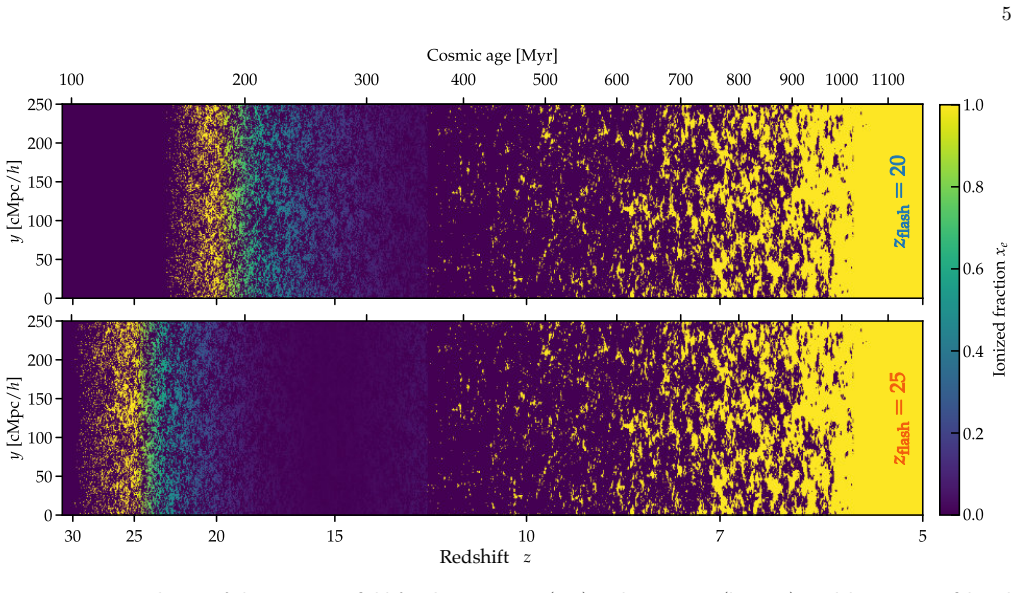
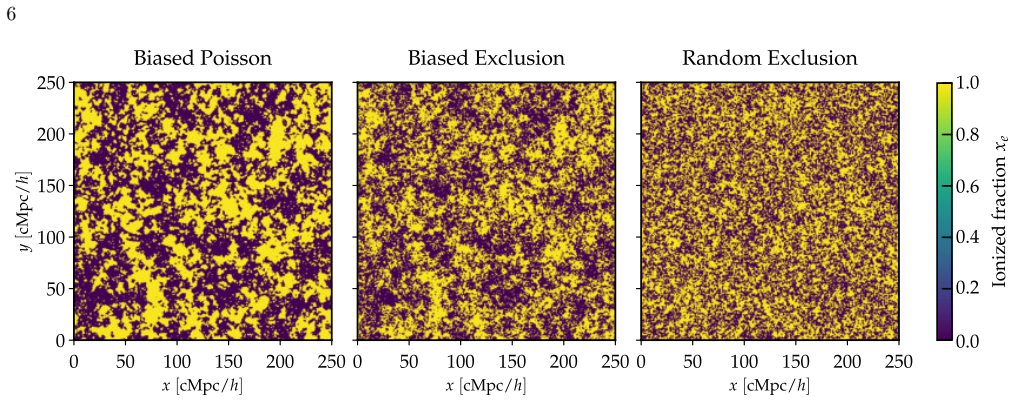
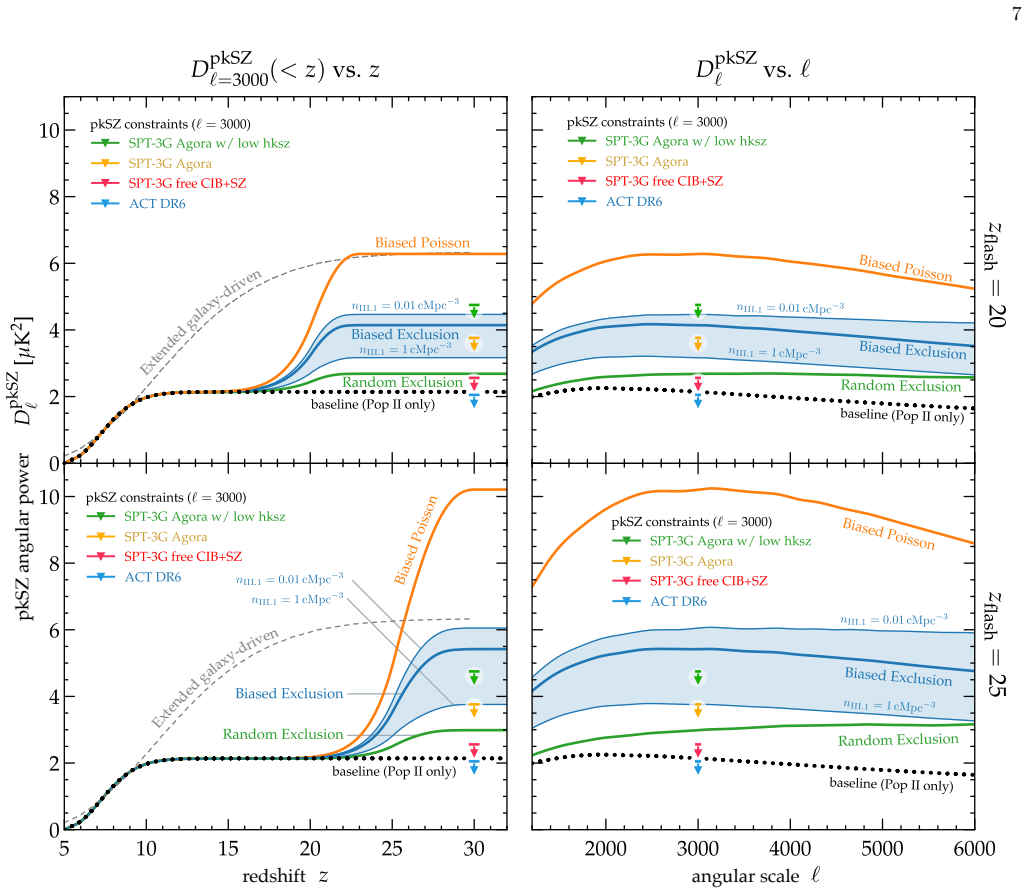
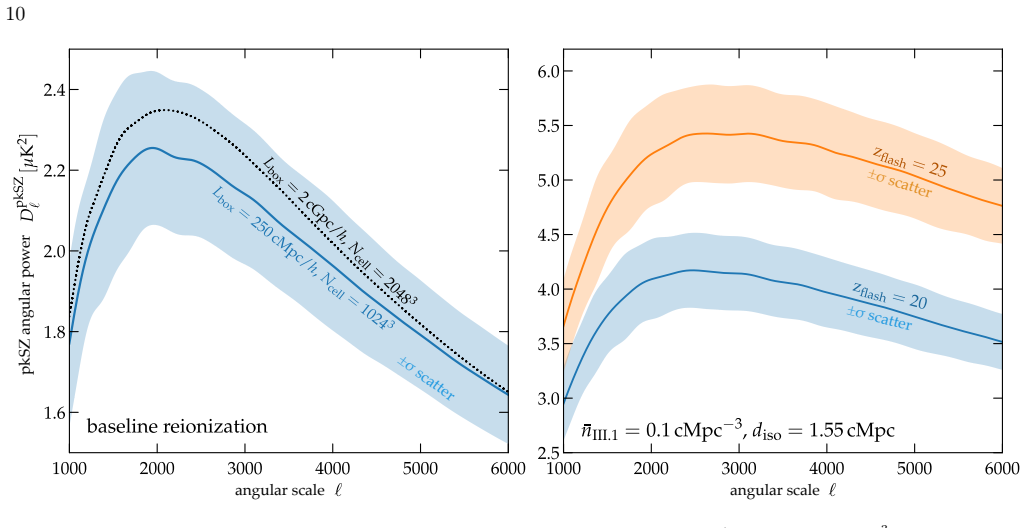
read the original abstract
A Cosmic Microwave Background (CMB) optical depth of $\tau \sim 0.09$, several $\sigma$ in excess of the latest Planck low-$\ell$ EE polarization measurement, has been proposed as a way to reconcile the preference for a sub-minimal neutrino mass sum in a combined analysis with CMB and Dark Energy Spectroscopic Instrument (DESI) three-year data. Reionization, however, is not just probed by $\tau$. It is also constrained by Ly$\alpha$ forest observations that indicate a late end of reionization, and the patchy kinetic Sunyaev-Zel'dovich (pkSZ) effect which prefers a short duration. We explore whether an early phase of reionization can achieve a high $\tau$ while remaining consistent with both Ly$\alpha$ forest and pkSZ constraints. As a concrete example, we consider supermassive Pop III.1 stars, dark-matter-powered metal-free stars proposed as progenitors of supermassive black holes. Within this framework, self-regulating ionizing feedback imposes a minimum source separation of $\sim 1 \, \text{cMpc}$, consequently limiting large-scale ionization fluctuations and reducing the pkSZ power on observationally relevant scales. Our fiducial model realizes an optical depth of $\tau = 0.087$ with a Pop III.1-driven flash ionization phase centered at $z = 20$, while evading the most conservative $2\sigma$ upper limits on the pkSZ signal from the most recent South Pole Telescope data release. More broadly, our findings motivate further exploration of early reionization models with weakly clustered sources as a possible resolution of tensions between BAO and CMB measurements.
Editorial analysis
A structured set of objections, weighed in public.
Referee Report
Summary. The manuscript proposes that an early flash reionization phase centered at z=20, driven by supermassive metal-free Pop III.1 stars, can produce a CMB optical depth τ=0.087 to help reconcile the BAO-CMB tension in neutrino mass sum when combined with DESI data, while self-regulated ionizing feedback enforcing a minimum source separation of ∼1 cMpc limits large-scale ionization fluctuations enough to keep the patchy kSZ power below the most conservative 2σ SPT upper limit, remaining consistent with Lyα forest indications of late reionization end.
Significance. If the central assumptions on source separation and its effect on pkSZ hold, the work provides a concrete astrophysical mechanism to resolve reported tensions between Planck CMB and DESI BAO without new physics, by invoking weakly clustered early sources. It supplies an explicit fiducial model achieving the target τ while referencing recent SPT data. This motivates broader exploration of early reionization scenarios. The result is of moderate significance given the reliance on a non-standard source population whose feedback properties remain to be validated.
major comments (2)
- [Abstract] Abstract (paragraph on feedback and source separation): the claim that the ∼1 cMpc minimum separation 'consequently limiting large-scale ionization fluctuations and reducing the pkSZ power' is load-bearing for consistency with SPT limits, yet the manuscript provides no explicit mapping from this scale to the ionization power spectrum, bubble-size distribution, or the velocity-weighted kSZ integral; without this derivation it is unclear whether fluctuations on k∼0.05–0.5 h Mpc⁻¹ remain below the quoted bound for the adopted τ.
- [Fiducial model] Fiducial model section: τ=0.087 is presented as realized by the Pop III.1 flash at z=20, but no details are given on the optical-depth integral, the assumed ionizing photon production rate, or error propagation from variations in feedback strength and source properties; this leaves open whether the value is a first-principles prediction or tuned to the tension target.
minor comments (2)
- [Introduction] The term 'Pop III.1' and the properties of these supermassive metal-free stars should be defined with a reference to the originating literature at first appearance.
- [Abstract] The abstract states both τ∼0.09 and the fiducial τ=0.087; a brief clarification on how the specific value relates to the range needed for tension relief would improve readability.
Simulated Author's Rebuttal
We thank the referee for their constructive and detailed comments. We address each major comment below and commit to revisions that will improve the clarity and completeness of the presentation.
read point-by-point responses
-
Referee: [Abstract] Abstract (paragraph on feedback and source separation): the claim that the ∼1 cMpc minimum separation 'consequently limiting large-scale ionization fluctuations and reducing the pkSZ power' is load-bearing for consistency with SPT limits, yet the manuscript provides no explicit mapping from this scale to the ionization power spectrum, bubble-size distribution, or the velocity-weighted kSZ integral; without this derivation it is unclear whether fluctuations on k∼0.05–0.5 h Mpc⁻¹ remain below the quoted bound for the adopted τ.
Authors: We agree that an explicit derivation would make the argument more transparent. In the revised manuscript we will insert a short subsection (or expanded paragraph) that maps the self-regulated minimum separation of ∼1 cMpc to the resulting bubble-size distribution, the suppression of the ionization power spectrum on scales k∼0.05–0.5 h Mpc⁻¹, and the consequent reduction in the velocity-weighted pkSZ integral. This addition will confirm that the pkSZ amplitude remains below the most conservative 2σ SPT limit for the fiducial τ. revision: yes
-
Referee: [Fiducial model] Fiducial model section: τ=0.087 is presented as realized by the Pop III.1 flash at z=20, but no details are given on the optical-depth integral, the assumed ionizing photon production rate, or error propagation from variations in feedback strength and source properties; this leaves open whether the value is a first-principles prediction or tuned to the tension target.
Authors: The quoted τ follows from integrating the ionization history generated by the Pop III.1 flash model with an ionizing-photon production rate calibrated to the expected stellar properties. We will expand the Fiducial model section to display the explicit optical-depth integral, state the adopted photon production rate, and include a brief sensitivity analysis showing how modest variations in feedback strength shift τ. This will clarify that the target value is a direct output of the model rather than an ad-hoc adjustment. revision: yes
Circularity Check
No significant circularity; model outputs are computed from stated inputs without reduction to tautology.
full rationale
The paper introduces a concrete model (Pop III.1 flash centered at z=20 together with a minimum source separation of ~1 cMpc imposed by self-regulating feedback) and reports the resulting optical depth τ=0.087 and pkSZ power as direct consequences of that model. The separation value is motivated by the feedback framework rather than tuned after the fact solely to suppress pkSZ; the τ value is likewise an output of the chosen reionization history. No quoted equation or step equates a prediction to its own input by construction, nor does any load-bearing premise rest exclusively on an unverified self-citation. The derivation therefore remains self-contained as an exploratory consistency check against external data sets (Planck τ, Lyα forest, SPT pkSZ).
Axiom & Free-Parameter Ledger
free parameters (2)
- minimum source separation =
~1 cMpc
- flash redshift center =
z=20
axioms (1)
- domain assumption Standard ΛCDM cosmology and reionization observables (Lyα forest end, pkSZ amplitude) are correctly measured and interpreted
invented entities (1)
-
Pop III.1 supermassive metal-free stars
no independent evidence
Reference graph
Works this paper leans on
-
[1]
Adam, R., et al. 2016, Astron. Astrophys., 596, A108, doi: 10.1051/0004-6361/201628897
-
[2]
2025, arXiv e-prints, arXiv:2504.20338, doi: 10.48550/arXiv.2504.20338
Ahlen, S., Aviles, A., Cartwright, B., et al. 2025, arXiv e-prints, arXiv:2504.20338, doi: 10.48550/arXiv.2504.20338
-
[3]
Ahn, K., Iliev, I. T., Shapiro, P. R., et al. 2012, ApJL, 756, L16, doi: 10.1088/2041-8205/756/1/L16
-
[4]
Ahn, K., & Shapiro, P. R. 2021, ApJ, 914, 44, doi: 10.3847/1538-4357/abf3bf
-
[5]
Banik, N., Tan, J. C., & Monaco, P. 2019, Mon. Not. Roy. Astron. Soc., 483, 3592, doi: 10.1093/mnras/sty3298
-
[6]
Becker, G. D., Bolton, J. S., Madau, P., et al. 2015, MNRAS, 447, 3402, doi: 10.1093/mnras/stu2646
-
[7]
Becker, G. D., Bolton, J. S., Zhu, Y., & Hashemi, S. 2024, MNRAS, 533, 1525, doi: 10.1093/mnras/stae1918
-
[8]
D., D’Aloisio, A., Christenson, H
Becker, G. D., D’Aloisio, A., Christenson, H. M., et al. 2021, MNRAS, 508, 1853, doi: 10.1093/mnras/stab2696
-
[9]
2025, JCAP, 10, 082, doi: 10.1088/1475-7516/2025/10/082
Beringue, B., et al. 2025, JCAP, 10, 082, doi: 10.1088/1475-7516/2025/10/082
-
[10]
Birkinshaw, M. 1999, Phys. Rept., 310, 97, doi: 10.1016/S0370-1573(98)00080-5
-
[11]
Bosman, S. E. I., Davies, F. B., Becker, G. D., et al. 2022, MNRAS, 514, 55, doi: 10.1093/mnras/stac1046
-
[12]
Cain, C., D’Aloisio, A., Gangolli, N., & Becker, G. D. 2021, ApJL, 917, L37, doi: 10.3847/2041-8213/ac1ace 11
- [13]
-
[14]
Cammelli, V., Monaco, P., Tan, J. C., et al. 2025, MNRAS, 536, 851, doi: 10.1093/mnras/stae2663
-
[15]
2003, ApJ, 591, 12, doi: 10.1086/375217
Cen, R. 2003, ApJ, 591, 12, doi: 10.1086/375217
-
[16]
2026, https://arxiv.org/abs/2601.20551
Chaubal, P., et al. 2026, https://arxiv.org/abs/2601.20551
arXiv 2026
-
[17]
Chen, N., Trac, H., Mukherjee, S., & Cen, R. 2023, Astrophys. J., 943, 138, doi: 10.3847/1538-4357/ac8481
-
[18]
2025, arXiv e-prints, arXiv:2505.00659, doi: 10.48550/arXiv.2505.00659
Chen, S.-F., & Zaldarriaga, M. 2025, arXiv e-prints, arXiv:2505.00659, doi: 10.48550/arXiv.2505.00659
-
[19]
2026, PASA, 43, e046, doi: 10.1017/pasa.2026.10166
Cohon, J., Cain, C., Windhorst, R., et al. 2026, PASA, 43, e046, doi: 10.1017/pasa.2026.10166
-
[20]
DESI DR2 Results II: Measurements of Baryon Acoustic Oscillations and Cosmological Constraints
Craig, N., Green, D., Meyers, J., & Rajendran, S. 2024, Journal of High Energy Physics, 2024, 97, doi: 10.1007/JHEP09(2024)097 DESI Collaboration. 2025, arXiv e-prints, arXiv:2503.14738, doi: 10.48550/arXiv.2503.14738
work page internal anchor Pith review Pith/arXiv arXiv doi:10.1007/jhep09(2024)097 2024
-
[21]
2025, arXiv e-prints, arXiv:2508.21069, doi: 10.48550/arXiv.2508.21069
Elbers, W. 2025, arXiv e-prints, arXiv:2508.21069, doi: 10.48550/arXiv.2508.21069
-
[22]
Constraints on Neutrino Physics from DESI DR2 BAO and DR1 Full Shape
Elbers, W., Aviles, A., Noriega, H. E., et al. 2025, arXiv e-prints, arXiv:2503.14744, doi: 10.48550/arXiv.2503.14744
work page internal anchor Pith review Pith/arXiv arXiv doi:10.48550/arxiv.2503.14744 2025
-
[23]
Fujimoto, S., Naidu, R. P., Chisholm, J., et al. 2025, arXiv e-prints, arXiv:2501.11678, doi: 10.48550/arXiv.2501.11678
-
[24]
Furlanetto, S., & Loeb, A. 2005, Astrophys. J., 634, 1, doi: 10.1086/429080
-
[25]
Gaikwad, P., Haehnelt, M. G., Davies, F. B., et al. 2023, MNRAS, 525, 4093, doi: 10.1093/mnras/stad2566
-
[26]
Garcia-Gallego, O., Iršič, V., Haehnelt, M. G., & Bolton, J. S. 2025, arXiv e-prints, arXiv:2510.00107, doi: 10.48550/arXiv.2510.00107
-
[27]
Greif, T. H., & Bromm, V. 2006, MNRAS, 373, 128, doi: 10.1111/j.1365-2966.2006.11017.x
-
[28]
Jhaveri, T., Karwal, T., & Hu, W. 2025, Phys. Rev. D, 112, 043541, doi: 10.1103/6vd2-rbfn
-
[29]
2026, arXiv e-prints, arXiv:2601.09644, doi: 10.48550/arXiv.2601.09644
Kageura, Y., Ouchi, M., Naokawa, F., et al. 2026, arXiv e-prints, arXiv:2601.09644, doi: 10.48550/arXiv.2601.09644
-
[30]
Keating, L. C., Weinberger, L. H., Kulkarni, G., et al. 2020, MNRAS, 491, 1736, doi: 10.1093/mnras/stz3083
-
[31]
Klessen, R. S., & Glover, S. C. O. 2023, Ann. Rev. Astron. Astrophys., 61, 65, doi: 10.1146/annurev-astro-071221-053453
-
[32]
Kogut, A., Spergel, D. N., Barnes, C., et al. 2003, ApJS, 148, 161, doi: 10.1086/377219
-
[33]
Komatsu, E., Smith, K. M., Dunkley, J., et al. 2011, ApJS, 192, 18, doi: 10.1088/0067-0049/192/2/18
work page internal anchor Pith review doi:10.1088/0067-0049/192/2/18 2011
-
[34]
Kulkarni, G., Keating, L. C., Haehnelt, M. G., et al. 2019, MNRAS, 485, L24, doi: 10.1093/mnrasl/slz025
-
[35]
2025, arXiv e-prints, arXiv:2504.14419, doi: 10.48550/arXiv.2504.14419
Kumar, U., Ajith, A., & Verma, A. 2025, arXiv e-prints, arXiv:2504.14419, doi: 10.48550/arXiv.2504.14419
-
[36]
Lewis, J. S. W., Ocvirk, P., Sorce, J. G., et al. 2022, MNRAS, 516, 3389, doi: 10.1093/mnras/stac2383
-
[37]
Loeb, A., & Furlanetto, S. R. 2013, The First Galaxies in the Universe (Princeton University Press)
2013
-
[38]
2025, https://arxiv.org/abs/2507.17817
Lopez, G., D’Aloisio, A., & Cain, C. 2025, https://arxiv.org/abs/2507.17817
arXiv 2025
-
[39]
2025, JCAP, 11, 062, doi: 10.1088/1475-7516/2025/11/062
Louis, T., et al. 2025, JCAP, 11, 062, doi: 10.1088/1475-7516/2025/11/062
-
[40]
Loverde, M., & Weiner, Z. J. 2024, JCAP, 2024, 048, doi: 10.1088/1475-7516/2024/12/048
-
[41]
McKee, C. F., & Tan, J. C. 2008, ApJ, 681, 771, doi: 10.1086/587434
-
[42]
Miranda, V., Lidz, A., Heinrich, C. H., & Hu, W. 2017, MNRAS, 467, 4050, doi: 10.1093/mnras/stx306
- [43]
-
[44]
2020, Monthly Notices of the Royal Astronomical Society, 494, 3080–3094, doi: 10.1093/mnras/staa894
Nasir, F., & D’Aloisio, A. 2020, Monthly Notices of the Royal Astronomical Society, 494, 3080–3094, doi: 10.1093/mnras/staa894
-
[45]
Natarajan, A., Tan, J. C., & O’Shea, B. W. 2009, ApJ, 692, 574, doi: 10.1088/0004-637X/692/1/574
-
[46]
Oh, S. P., & Haiman, Z. 2003, Mon. Not. Roy. Astron. Soc., 346, 456, doi: 10.1046/j.1365-2966.2003.07103.x
-
[47]
Omori, Y. 2024, Mon. Not. Roy. Astron. Soc., 530, 5030, doi: 10.1093/mnras/stae1031
-
[48]
Park, H., Shapiro, P. R., Komatsu, E., et al. 2013, Astrophys. J., 769, 93, doi: 10.1088/0004-637X/769/2/93
-
[49]
Petkova, M. A., Tan, J. C., Singh, J., et al. 2026, arXiv e-prints, arXiv:2605.28777. https://arxiv.org/abs/2605.28777
Pith/arXiv arXiv 2026
-
[50]
Phillips, P. R. 1995, ApJ, 455, 419, doi: 10.1086/176589 Planck Collaboration. 2020, A&A, 641, A6, doi: 10.1051/0004-6361/201833910
-
[51]
2024, arXiv e-prints, arXiv:2412.00799, doi: 10.48550/arXiv.2412.00799
Qin, Y., Mesinger, A., Prelogović, D., et al. 2024, arXiv e-prints, arXiv:2412.00799, doi: 10.48550/arXiv.2412.00799
-
[52]
Raghunathan, S., Ade, P. A. R., Anderson, A. J., et al. 2024, PhRvL, 133, 121004, doi: 10.1103/PhysRevLett.133.121004
-
[53]
Reichardt, C. L., Patil, S., Ade, P. A. R., et al. 2021, ApJ, 908, 199, doi: 10.3847/1538-4357/abd407
-
[54]
1991, ApJ, 372, 21, doi: 10.1086/169950
Rephaeli, Y., & Lahav, O. 1991, ApJ, 372, 21, doi: 10.1086/169950
-
[55]
Ross, S. M. 2014, Introduction to Probability Models, 11th edn. (Academic Press)
2014
-
[56]
Sailer, N., Farren, G. S., Ferraro, S., & White, M. 2026, Phys. Rev. Lett., 136, 081002, doi: 10.1103/6r54-8lv4
-
[57]
Sanati, M., Devriendt, J., Martin-Alvarez, S., Slyz, A., & Tan, J. C. 2025a, MNRAS, 544, 4317, doi: 10.1093/mnras/staf2000
-
[58]
Sanati, M., Tan, J. C., Devriendt, J., et al. 2025b, MNRAS, 542, 1532, doi: 10.1093/mnras/staf1313
-
[59]
Schauer, A. T. P., Liu, B., & Bromm, V. 2019, ApJL, 877, L5, doi: 10.3847/2041-8213/ab1e51
-
[60]
Singh, J., Monaco, P., & Tan, J. C. 2023, Mon. Not. Roy. Astron. Soc., 525, 969, doi: 10.1093/mnras/stad2346 12
-
[61]
Spergel, D. N., Verde, L., Peiris, H. V., et al. 2003, ApJS, 148, 175, doi: 10.1086/377226
-
[62]
Spina, B., Bosman, S. E. I., Davies, F. B., Gaikwad, P., & Zhu, Y. 2024, A&A, 688, L26, doi: 10.1051/0004-6361/202450798
-
[63]
Spolyar, D., Freese, K., & Gondolo, P. 2008, Phys. Rev. Lett., 100, 051101, doi: 10.1103/PhysRevLett.100.051101
-
[64]
Strande, S., Cai, H., Tatineni, M., et al. 2021, in Practice and Experience in Advanced Research Computing 2021: Evolution Across All Dimensions, PEARC ’21 (New York, NY, USA: Association for Computing Machinery), doi: 10.1145/3437359.3465588
-
[65]
Sunyaev, R. A., & Zeldovich, Y. B. 1970, Ap&SS, 7, 3, doi: 10.1007/BF00653471
-
[66]
Tan, J. C. 2025, Astrophys. J. Lett., 989, L47, doi: 10.3847/2041-8213/adf8da
-
[67]
Tan, J. C., & Komatsu, E. 2025, https://arxiv.org/abs/2510.19647
Pith/arXiv arXiv 2025
-
[68]
C., Singh, J., Cammelli, V., et al
Tan, J. C., Singh, J., Cammelli, V., et al. 2024, in 17th Marcel Grossmann Meeting: On Recent Developments in Theoretical and Experimental General Relativity, Gravitation, and Relativistic Field Theories. https://arxiv.org/abs/2412.01828
arXiv 2024
-
[69]
Topalakis, K., Nandal, D., & Tan, J. C. 2025, https://arxiv.org/abs/2510.00216
arXiv 2025
-
[70]
Trac, H., Chen, N., Holst, I., Alvarez, M. A., & Cen, R. 2022, Astrophys. J., 927, 186, doi: 10.3847/1538-4357/ac5116
-
[71]
Tristram, M., Banday, A. J., Douspis, M., et al. 2024, A&A, 682, A37, doi: 10.1051/0004-6361/202348015
-
[72]
2026, ApJ, 997, 86, doi: 10.3847/1538-4357/ae232b
Umeda, H., Ouchi, M., Kageura, Y., et al. 2026, ApJ, 997, 86, doi: 10.3847/1538-4357/ae232b
-
[73]
2023, arXiv e-prints, arXiv:2306.00487, doi: 10.48550/arXiv.2306.00487
Umeda, H., Ouchi, M., Nakajima, K., et al. 2023, arXiv e-prints, arXiv:2306.00487, doi: 10.48550/arXiv.2306.00487
-
[74]
Venditti, A., Munoz, J. B., Bromm, V., et al. 2025, arXiv e-prints, arXiv:2505.20263, doi: 10.48550/arXiv.2505.20263
-
[75]
Visbal, E., Bryan, G. L., & Haiman, Z. 2020, ApJ, 897, 95, doi: 10.3847/1538-4357/ab994e
-
[76]
2025, Nature, 639, 897, doi: 10.1038/s41586-025-08779-5
Witstok, J., Jakobsen, P., Maiolino, R., et al. 2025, Nature, 639, 897, doi: 10.1038/s41586-025-08779-5
-
[77]
2021, MNRAS, 508, 2784, doi: 10.1093/mnras/stab2815
Wu, X., McQuinn, M., Eisenstein, D., & Iršič, V. 2021, MNRAS, 508, 2784, doi: 10.1093/mnras/stab2815
-
[78]
Zaldarriaga, M. 1997, Phys. Rev. D, 55, 1822, doi: 10.1103/PhysRevD.55.1822
-
[79]
Zhu, Y., Becker, G. D., Christenson, H. M., et al. 2023, ApJ, 955, 115, doi: 10.3847/1538-4357/aceef4
-
[80]
Zhu, Y., Becker, G. D., Bosman, S. E. I., et al. 2024, MNRAS, 533, L49, doi: 10.1093/mnrasl/slae061
discussion (0)
Sign in with ORCID, Apple, or X to comment. Anyone can read and Pith papers without signing in.