Effects of the Background Magnetic Field on Flux Rope Eruptions
Pith reviewed 2026-06-26 18:50 UTC · model grok-4.3
The pith
An antiparallel background magnetic field lowers the free-energy threshold for flux rope eruption but does not guarantee a successful coronal mass ejection.
A machine-rendered reading of the paper's core claim, the machinery that carries it, and where it could break.
Core claim
Simulations demonstrate that an antiparallel background field reduces the magnetic free-energy threshold required for eruption relative to parallel configurations, enables earlier breakout reconnection that drives a rapid exponential rise phase, and shortens the duration of flare reconnection, yet still permits a failed eruption in one instance.
What carries the argument
Three MHD simulations that hold the active-region flux rope fixed while changing only the background magnetic field orientation, then track free energy, acceleration profile, torus-instability criterion, and the timing of breakout versus flare reconnection.
If this is right
- Breakout reconnection, not the torus instability, initiates the rapid-rise phase in the successful cases.
- Antiparallel background fields produce faster flare reconnection of shorter total duration.
- Eruption outcome (CME versus confined flare) cannot be predicted from free energy alone when background orientation varies.
- The background field must be included when classifying whether a given active-region flux rope will erupt.
Where Pith is reading between the lines
- Real-time vector magnetograms of the quiet-Sun field surrounding active regions could improve forecasts of whether an observed flux rope will produce a geoeffective CME.
- The same background-orientation dependence may explain why some flux ropes in decaying active regions erupt while others remain confined even at comparable free energies.
- Extending the simulations to include a wider range of background tilt angles would map the full boundary between successful and failed eruptions.
Load-bearing premise
The chosen initial magnetic configurations and the MHD equations capture the dominant reconnection and instability processes without numerical effects that would change whether an eruption succeeds or fails.
What would settle it
A solar active region whose measured background field is antiparallel yet requires higher free energy to erupt than the parallel case, or whose parallel background allows eruption at lower energy than predicted.
Figures





read the original abstract
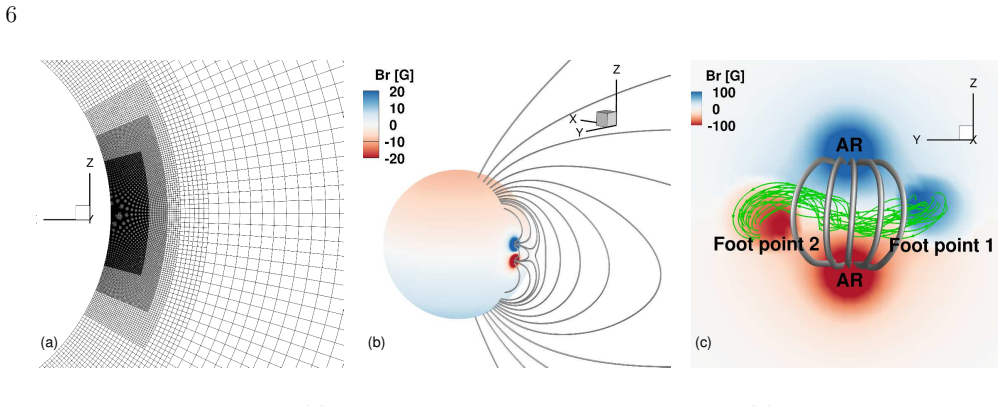
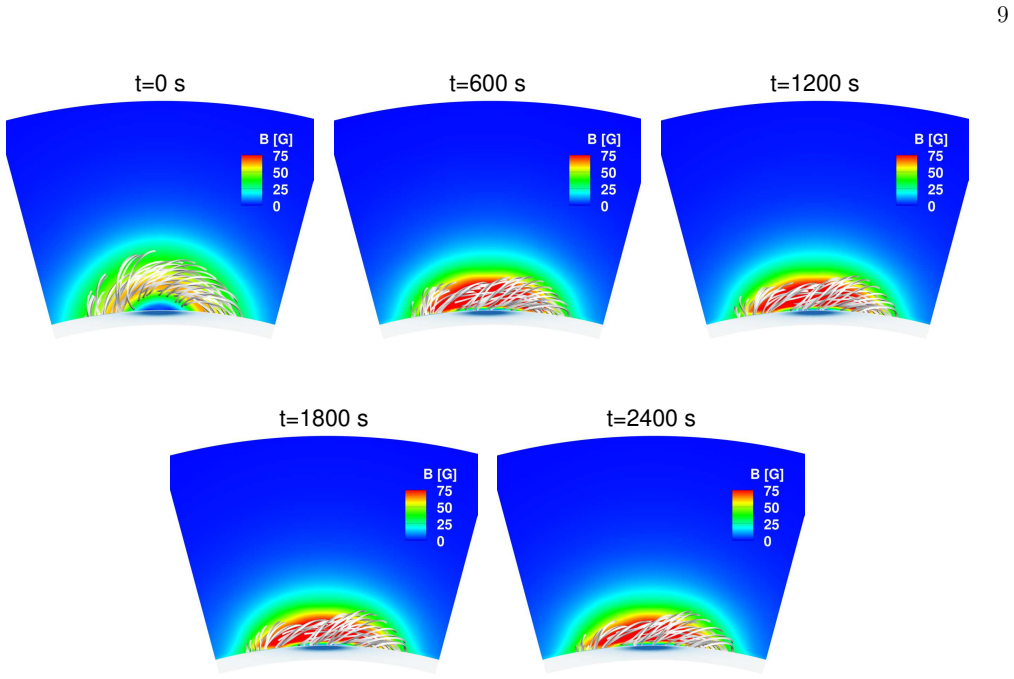
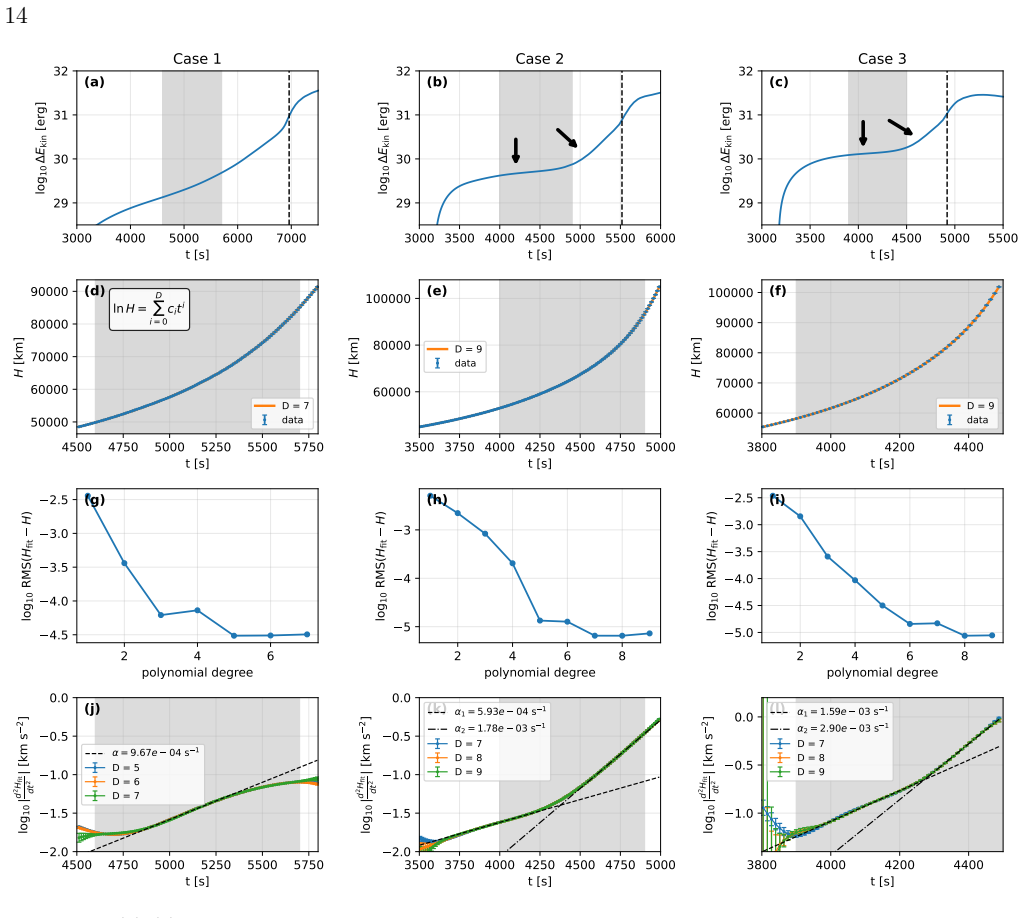
Solar eruptive events are generally believed to involve magnetic flux ropes (MFR), formed either in the pre-eruptive phase of the event or during the eruption itself. These MFR eruptions exhibit significant complexity and variations due to the interplay of the physical mechanisms involved, in particular magnetic reconnection and ideal instabilities. This work considers the effect of the background magnetic field on the nature of eruptions with pre-existing MFRs. We used a new MHD model to simulate the whole MFR eruption process, including the pre-eruptive stage and the initiation. Three simulations were performed, all of which used an identical bipolar active region, but with different background magnetic fields in the three cases. The simulations resulted in two successful eruptions (CMEs) and one failed eruption (a confined flare). We analyzed the energetics and the acceleration of the MFR in detail, and found a transition to a rapid exponential rise phase in two of the simulations. We also calculated the criterion for the torus instability and the timing of the breakout and flare reconnections. Our results show that the rapid exponential rise phase is likely due to breakout reconnection. We conclude that a background field antiparallel to the active-region field lowers the magnetic free-energy threshold for eruption; but, does not guarantee a successful eruption. We also found that an antiparallel background field leads to faster flare reconnection, but of shorter duration. Our findings underscore the importance of the background magnetic field in understanding CMEs.
Editorial analysis
A structured set of objections, weighed in public.
Referee Report
Summary. The manuscript reports results from three MHD simulations of pre-existing magnetic flux ropes embedded in a bipolar active region, each with a different background magnetic field. Two cases produce successful eruptions (CMEs) while one produces a confined flare. The authors conclude that an antiparallel background field lowers the free-energy threshold for eruption (but does not guarantee success) and produces faster yet shorter-duration flare reconnection, with the rapid exponential rise phase attributed to breakout reconnection.
Significance. If the results hold after addressing numerical concerns, the work demonstrates the role of background field orientation in modulating eruption thresholds and reconnection dynamics via forward simulations, which could inform observational interpretations of CME initiation and the interplay between ideal instabilities and reconnection.
major comments (2)
- [Abstract and simulation description paragraph] Abstract and simulation description paragraph: the central claims on lowered eruption threshold and altered reconnection timing rest on differences across three runs, but no grid resolution, explicit resistivity, or convergence tests are reported. In ideal MHD the only reconnection is numerical; without these checks the attribution of outcomes to background-field orientation rather than discretization effects cannot be verified.
- [Results section on flare reconnection and torus instability criterion] Results section on flare reconnection and torus instability criterion: the reported differences in reconnection speed/duration and the success/failure classification are load-bearing for the conclusions, yet the manuscript provides no quantitative error analysis or resolution study to confirm that the measured reconnection rates and eruption outcomes are insensitive to numerical diffusivity.
minor comments (2)
- Specify the precise orientations and strengths of the three background fields relative to the active-region field, including any vector components or decay profiles used.
- Clarify whether the new MHD code employs any explicit resistivity or relies solely on numerical diffusion, and state the grid resolution employed in each run.
Simulated Author's Rebuttal
We thank the referee for the constructive report and the opportunity to address the numerical concerns. We agree that additional details on resolution and convergence are needed to strengthen the attribution of results to the background field. We respond point-by-point below and will revise accordingly.
read point-by-point responses
-
Referee: [Abstract and simulation description paragraph] Abstract and simulation description paragraph: the central claims on lowered eruption threshold and altered reconnection timing rest on differences across three runs, but no grid resolution, explicit resistivity, or convergence tests are reported. In ideal MHD the only reconnection is numerical; without these checks the attribution of outcomes to background-field orientation rather than discretization effects cannot be verified.
Authors: We agree that the original manuscript does not report grid resolution, explicit resistivity (none is used), or convergence tests. All runs employ the same ideal MHD setup on identical grids, so numerical diffusivity is the same across cases; the observed differences in eruption success and reconnection timing therefore cannot be numerical artifacts of differing discretizations. In the revised manuscript we will add an explicit numerical methods subsection stating the grid resolution, domain size, and code scheme, together with a limited resolution-doubling test on one case to confirm that the qualitative classification (eruptive vs. confined) and the relative timing of breakout versus flare reconnection remain unchanged. revision: yes
-
Referee: [Results section on flare reconnection and torus instability criterion] Results section on flare reconnection and torus instability criterion: the reported differences in reconnection speed/duration and the success/failure classification are load-bearing for the conclusions, yet the manuscript provides no quantitative error analysis or resolution study to confirm that the measured reconnection rates and eruption outcomes are insensitive to numerical diffusivity.
Authors: We acknowledge the absence of quantitative error bars or a dedicated resolution study for the reconnection-rate time series. Because the three simulations share identical numerical parameters, any systematic bias from numerical diffusivity affects all runs equally and cannot explain the systematic dependence on background-field orientation. In revision we will (i) report the grid resolution and numerical diffusivity estimate, (ii) add a short resolution-convergence subsection showing that the exponential-rise phase and the relative durations of flare reconnection are preserved at higher resolution, and (iii) include a simple energy-conservation diagnostic as a quantitative check on numerical dissipation. Full quantitative convergence of every metric would require additional runs that exceed our current resources, but the evidence we can provide will be sufficient to support the main conclusions. revision: partial
Circularity Check
No significant circularity; results from independent forward simulations
full rationale
The paper reports outcomes from three new MHD simulations that vary only the background field orientation while holding the active-region flux rope fixed. Conclusions on free-energy thresholds, eruption success/failure, and reconnection timing/duration are extracted directly from the simulated time series (energetics, acceleration profiles, reconnection timing). No equations, fitted parameters, or self-citations are shown that reduce any reported 'prediction' or criterion to the input data by construction. The derivation chain consists of forward integration under stated initial conditions; it does not contain self-definitional loops, fitted-input renamings, or load-bearing self-citation chains. This is the normal non-circular case for simulation-based studies.
Axiom & Free-Parameter Ledger
axioms (1)
- domain assumption Magnetohydrodynamic equations govern the evolution of plasma and magnetic fields in the solar corona
Reference graph
Works this paper leans on
-
[1]
Antiochos, S. K. 2013, ApJ, 772, 72, doi: 10.1088/0004-637X/772/1/72
-
[2]
Antiochos, S. K., Dahlburg, R. B., & Klimchuk, J. A. 1994, ApJL, 420, L41, doi: 10.1086/187158
-
[3]
Antiochos, S. K., DeVore, C. R., & Klimchuk, J. A. 1999, ApJ, 510, 485, doi: 10.1086/306563
-
[4]
Aulanier, G., T¨ or¨ ok, T., D´ emoulin, P., & DeLuca, E. E. 2010, ApJ, 708, 314, doi: 10.1088/0004-637X/708/1/314
-
[5]
1978, MHD instabilities
Bateman, G. 1978, MHD instabilities
1978
-
[6]
2023, ApJL, 951, L35, doi: 10.3847/2041-8213/acdef5 23
Chen, J., Cheng, X., Kliem, B., & Ding, M. 2023, ApJL, 951, L35, doi: 10.3847/2041-8213/acdef5 23
-
[7]
Chen, P. F. 2011, Living Reviews in Solar Physics, 8, 1, doi: 10.12942/lrsp-2011-1
-
[8]
2023, ApJ, 959, 67, doi: 10.3847/1538-4357/ad09d8
Chen, Y., Cheng, X., Chen, J., Dai, Y., & Ding, M. 2023, ApJ, 959, 67, doi: 10.3847/1538-4357/ad09d8
-
[9]
1928, Mathematische Annalen, 100, 32, doi: 10.1007/BF01448839
Courant, R., Friedrichs, K., & Lewy, H. 1928, Mathematische Annalen, 100, 32, doi: 10.1007/BF01448839
-
[10]
Dahlin, J. T., Antiochos, S. K., Qiu, J., & DeVore, C. R. 2022a, ApJ, 932, 94, doi: 10.3847/1538-4357/ac6e3d
-
[11]
Dahlin, J. T., Antiochos, S. K., Wyper, P. F., Qiu, J., & DeVore, C. R. 2025, ApJ, 993, 31, doi: 10.3847/1538-4357/ae03c5
-
[12]
Dahlin, J. T., DeVore, C. R., & Antiochos, S. K. 2022b, ApJ, 941, 79, doi: 10.3847/1538-4357/ac9e5a D´ emoulin, P., & Aulanier, G. 2010, ApJ, 718, 1388, doi: 10.1088/0004-637X/718/2/1388
-
[13]
DeVore, C. R., & Antiochos, S. K. 2008, ApJ, 680, 740, doi: 10.1086/588011
-
[14]
Downs, C., Warmuth, A., Long, D. M., et al. 2021, ApJ, 911, 118, doi: 10.3847/1538-4357/abea78
-
[15]
2010, ApJ, 719, 728, doi: 10.1088/0004-637X/719/1/728
Fan, Y. 2010, ApJ, 719, 728, doi: 10.1088/0004-637X/719/1/728
-
[16]
2016, ApJ, 824, 93, doi: 10.3847/0004-637X/824/2/93
Fan, Y. 2016, ApJ, 824, 93, doi: 10.3847/0004-637X/824/2/93
-
[17]
2017, ApJ, 844, 26, doi: 10.3847/1538-4357/aa7a56
Fan, Y. 2017, ApJ, 844, 26, doi: 10.3847/1538-4357/aa7a56
-
[18]
Fan, Y., & Gibson, S. E. 2007, ApJ, 668, 1232, doi: 10.1086/521335
-
[19]
Fisher, G. H. 2024, ApJ, 975, 206, doi: 10.3847/1538-4357/ad7f53
-
[20]
Forbes, T. G. 2000, J. Geophys. Res., 105, 23153, doi: 10.1029/2000JA000005
-
[21]
Forbes, T. G., & Isenberg, P. A. 1991, ApJ, 373, 294, doi: 10.1086/170051
-
[22]
E., Foster, D., Burkepile, J., de Toma, G., & Stanger, A
Gibson, S. E., Foster, D., Burkepile, J., de Toma, G., & Stanger, A. 2006, ApJ, 641, 590, doi: 10.1086/500446
-
[23]
Gibson, S. E., & Low, B. C. 1998, ApJ, 493, 460, doi: 10.1086/305107
-
[24]
Gombosi, T. I., De Zeeuw, D. L., Powell, K. G., et al. 2003, Space Plasma Simulation, 247, doi: 10.1007/3-540-36530-3 12
-
[25]
Hood, A. W., & Priest, E. R. 1981, Geophysical and Astrophysical Fluid Dynamics, 17, 297, doi: 10.1080/03091928108243687
-
[26]
Isenberg, P. A., Forbes, T. G., & Demoulin, P. 1993, ApJ, 417, 368, doi: 10.1086/173319
-
[27]
2021, Nature Astronomy, 5, 1126, doi: 10.1038/s41550-021-01414-z
Jiang, C., Feng, X., Liu, R., et al. 2021, Nature Astronomy, 5, 1126, doi: 10.1038/s41550-021-01414-z
-
[28]
Jin, M., Schrijver, C. J., Cheung, M. C. M., et al. 2016, ApJ, 820, 16, doi: 10.3847/0004-637X/820/1/16
-
[29]
Karpen, J. T., Antiochos, S. K., & DeVore, C. R. 2012, ApJ, 760, 81, doi: 10.1088/0004-637X/760/1/81
-
[30]
Kliem, B., Lin, J., Forbes, T. G., Priest, E. R., & T¨ or¨ ok, T. 2014, ApJ, 789, 46, doi: 10.1088/0004-637X/789/1/46
-
[31]
2006, PhRvL, 96, 255002, doi: 10.1103/PhysRevLett.96.255002
Kliem, B., & T¨ or¨ ok, T. 2006, PhRvL, 96, 255002, doi: 10.1103/PhysRevLett.96.255002
-
[32]
2004, SoPh, 219, 169, doi: 10.1023/B:SOLA.0000021798.46677.16
Lin, J. 2004, SoPh, 219, 169, doi: 10.1023/B:SOLA.0000021798.46677.16
-
[33]
Lin, J., & Forbes, T. G. 2000, J. Geophys. Res., 105, 2375, doi: 10.1029/1999JA900477
-
[34]
A., Miki´ c, Z., Lionello, R., et al
Linker, J. A., Miki´ c, Z., Lionello, R., et al. 2003, Physics of Plasmas, 10, 1971, doi: 10.1063/1.1563668
-
[35]
Liu, W., Sokolov, I. V., Zhao, L., et al. 2025, ApJ, 985, 82, doi: 10.3847/1538-4357/adc4e3
-
[36]
Luhmann, J. G., & Zurbuchen, T. H. 2008, ApJ, 683, 1192, doi: 10.1086/589738
-
[37]
Mackay, D. H., DeVore, C. R., & Antiochos, S. K. 2014, ApJ, 784, 164, doi: 10.1088/0004-637X/784/2/164
-
[38]
Manchester, W., Kilpua, E. K. J., Liu, Y. D., et al. 2017, SSRv, 212, 1159, doi: 10.1007/s11214-017-0394-0
-
[39]
Manchester, W. B., Gombosi, T. I., Roussev, I., et al. 2004, Journal of Geophysical Research (Space Physics), 109, A01102, doi: 10.1029/2002JA009672
-
[40]
Martin, S. F. 1998, SoPh, 182, 107, doi: 10.1023/A:1005026814076
-
[41]
McIntosh, P. S. 1972, Reviews of Geophysics and Space Physics, 10, 837, doi: 10.1029/RG010i003p00837 Miki´ c, Z., Downs, C., Linker, J. A., et al. 2018, Nature Astronomy, 2, 913, doi: 10.1038/s41550-018-0562-5
-
[42]
M., & Filippov, B
Molodenskii, M. M., & Filippov, B. P. 1987, Soviet Ast., 31, 564 24
1987
-
[43]
Moore, R. L., & Roumeliotis, G. 1992, in IAU Colloquium 133: Eruptive Solar Flares, ed. Z. Svestka, B. V. Jackson, & M. E. Machado, Vol. 399, 69, doi: 10.1007/3-540-55246-4 79
-
[44]
1995, ApJL, 451, L83, doi: 10.1086/309688
Shibata, K., Masuda, S., Shimojo, M., et al. 1995, ApJL, 451, L83, doi: 10.1086/309688
-
[45]
Singh, T., Yalim, M. S., & Pogorelov, N. V. 2018, ApJ, 864, 18, doi: 10.3847/1538-4357/aad3b4
-
[46]
Sokolov, I. V., & Gombosi, T. I. 2023, ApJ, 955, 126, doi: 10.3847/1538-4357/aceef5
-
[47]
Sokolov, I. V., Holst, B. v. d., Manchester, W. B., et al. 2021, ApJ, 908, 172, doi: 10.3847/1538-4357/abc000
-
[48]
S., & D´ emoulin, P
Titov, V. S., & D´ emoulin, P. 1999, A&A, 351, 707
1999
-
[49]
S., T¨ or¨ ok, T., Mikic, Z., & Linker, J
Titov, V. S., T¨ or¨ ok, T., Mikic, Z., & Linker, J. A. 2014, ApJ, 790, 163, doi: 10.1088/0004-637X/790/2/163 T¨ or¨ ok, T., & Kliem, B. 2007, Astronomische Nachrichten, 328, 743, doi: 10.1002/asna.200710795 T¨ or¨ ok, T., Downs, C., Linker, J. A., et al. 2018, ApJ, 856, 75, doi: 10.3847/1538-4357/aab36d T¨ or¨ ok, T., Lugaz, N., Lee, C. O., et al. 2023, ...
-
[50]
Webb, D. F., & Howard, T. A. 2012, Living Reviews in Solar Physics, 9, 3, doi: 10.12942/lrsp-2012-3
-
[51]
2004, Journal of Geophysical Research (Space Physics), 109, A07105, doi: 10.1029/2003JA010282
Yashiro, S., Gopalswamy, N., Michalek, G., et al. 2004, Journal of Geophysical Research (Space Physics), 109, A07105, doi: 10.1029/2003JA010282
discussion (0)
Sign in with ORCID, Apple, or X to comment. Anyone can read and Pith papers without signing in.