The Effects of Energy Conservation in Simulating Solar Eruptions
Pith reviewed 2026-06-26 16:27 UTC · model grok-4.3
The pith
Simulations of solar eruptions using energy-conserving numerics yield more than twice the kinetic energy of those using non-conserving schemes.
A machine-rendered reading of the paper's core claim, the machinery that carries it, and where it could break.
Core claim
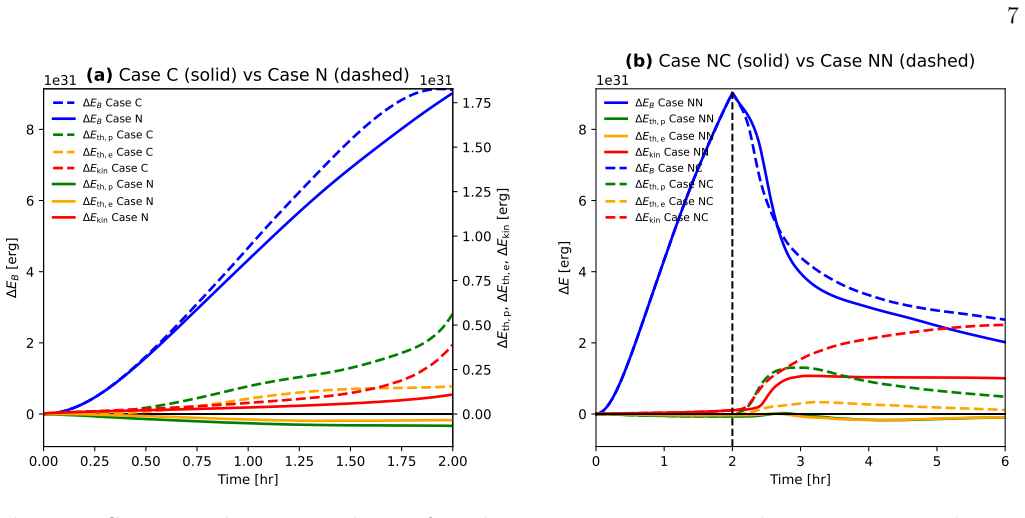
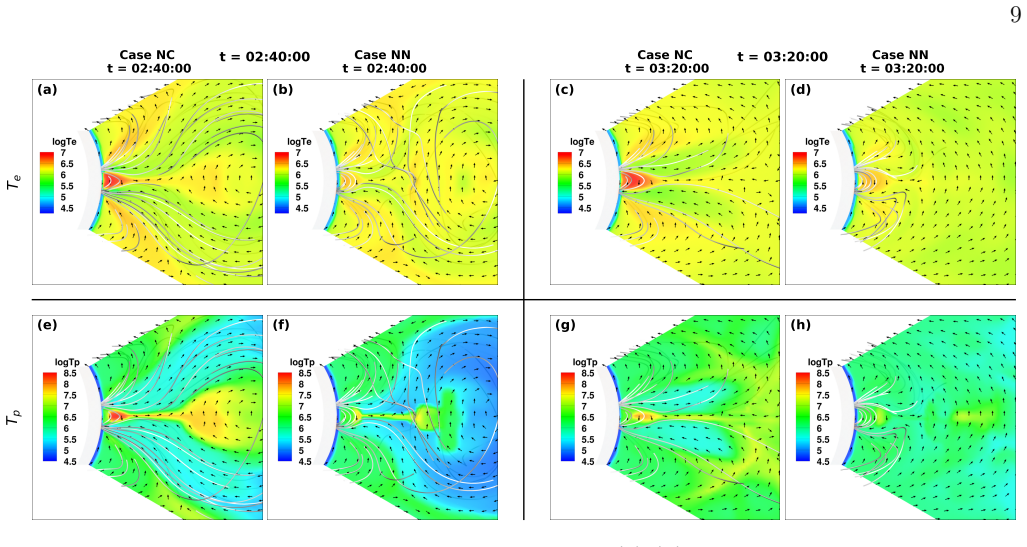
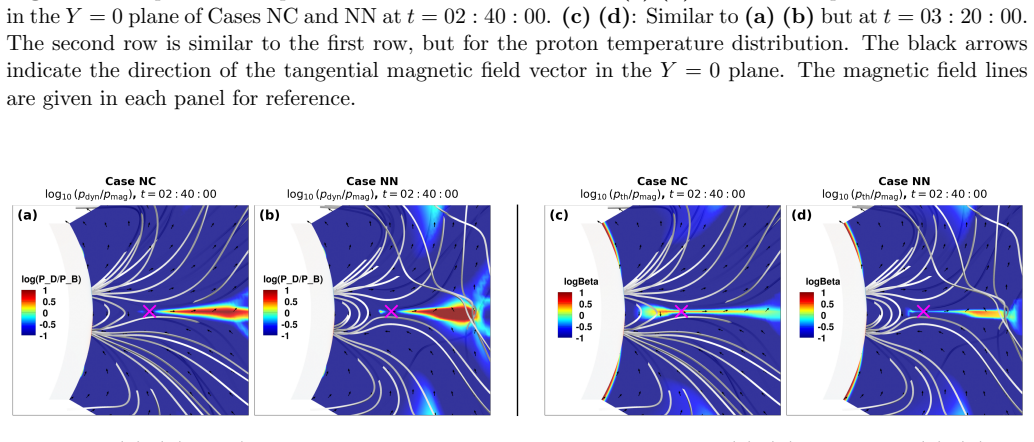
The use of an energy-conservative scheme produces a factor greater than 2 difference in the final kinetic energy of the simulated CME, with the energy substantially larger in the conservative case. The increase in thermal energy is comparable to the increase in kinetic energy. Flare reconnection and the associated growth in kinetic energy terminate earlier with the non-conservative scheme. The plasma thermodynamics plays a critical role in the flare reconnection, with the thermal pressure gradient in the current sheet slowing down the reconnection.
What carries the argument
The thermal pressure gradient inside the flare current sheet, which continues to slow reconnection only when the energy equation is solved conservatively.
If this is right
- Strict energy-conservative numerics are required for reliable space weather modeling of CMEs.
- The partitioning of energy between thermal and kinetic forms in eruptions cannot be captured without a conservative energy scheme.
- Plasma thermodynamics inside the current sheet controls the duration and efficiency of flare reconnection.
- Non-conservative schemes systematically underestimate the kinetic energy delivered by solar eruptions.
Where Pith is reading between the lines
- If the same factor-of-two kinetic energy difference appears in simulations initialized with complex, asymmetric active regions, the requirement for conservative schemes would apply to operational forecasts.
- Other global MHD codes that simulate solar eruptions may need to re-examine their energy-equation discretization for similar hidden effects on reconnection timing.
- Direct comparison of simulated CME speeds and masses against observed events could test whether conservative runs align more closely with measured kinetic energies.
Load-bearing premise
The initial magnetic field is a simple, symmetric active region.
What would settle it
Re-running the identical symmetric active region setup in AWSoM with both schemes and measuring whether the conservative run shows reconnection persisting longer and final kinetic energy exceeding the non-conservative run by more than a factor of two.
Figures
read the original abstract
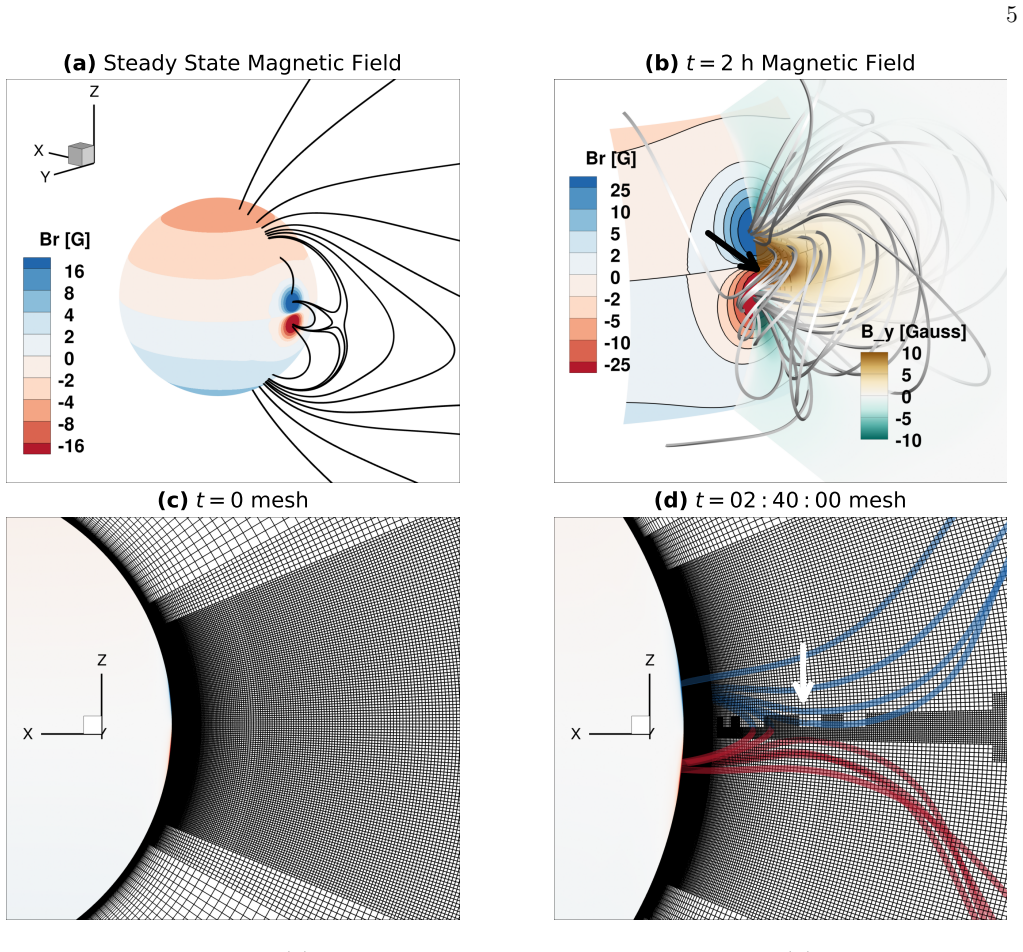
Strict energy conservation is, perhaps, the most basic principle in all physics, but has proven to be difficult to satisfy in numerical simulations of solar eruptions. The Alfv\'en Wave Solar atmosphere Model (AWSoM) is used to perform a rigorous comparison of CME simulations whose only difference is the use of a conservative vs. non-conservative scheme for the energy equation. A simple, symmetric active region is assumed for the initial magnetic field. As expected, the different numerical schemes result in very different plasma thermal energy, but surprisingly, we also find a factor $>2$ difference in the final kinetic energy, with the energy substantially larger in the energy-conservative scheme. The increase in thermal energy is comparable to the increase in kinetic energy in the conservative simulation. Our analysis reveals that the flare reconnection and increase of kinetic energy terminate earlier with the non-conservative scheme. We conclude that the plasma thermodynamics plays a critical role in the flare reconnection, with the thermal pressure gradient in the current sheet slowing down the reconnection. Our results imply that using strict energy-conservative numerics is critical for space weather modeling of CMEs and for understanding the CME energy budget partitioning.
Editorial analysis
A structured set of objections, weighed in public.
Referee Report
Summary. The manuscript uses the AWSoM model to compare CME simulations that differ only in the numerical treatment of the energy equation (conservative vs. non-conservative). It reports that the conservative scheme produces substantially higher thermal energy and more than twice the final kinetic energy, with flare reconnection and kinetic-energy growth terminating earlier in the non-conservative run. The authors conclude that plasma thermodynamics, specifically the thermal pressure gradient in the current sheet, critically controls reconnection rate, and therefore that strict energy conservation is essential for space-weather modeling of CMEs.
Significance. If the numerical experiment and causal interpretation hold, the result would show that the choice of energy scheme can alter simulated CME energetics by a factor of two and change reconnection duration, with direct consequences for energy-budget partitioning and space-weather forecasts. The work isolates the energy-scheme effect via a controlled side-by-side comparison.
major comments (2)
- [Abstract] Abstract: the stated mechanism—that the thermal pressure gradient in the current sheet slows reconnection—is inconsistent with the reported outcomes. The conservative scheme yields higher thermal energy yet later termination of reconnection; a slowing effect from higher thermal pressure would instead predict earlier termination, undermining the causal claim.
- [Abstract] Abstract: the initial condition is restricted to a simple, symmetric active region. Because the central claim concerns the importance of energy conservation for general space-weather modeling, it is necessary to demonstrate that the factor-of-two difference and the thermodynamic control of reconnection persist for more complex, observationally realistic active regions.
minor comments (1)
- [Abstract] The abstract refers to a 'rigorous comparison' but does not mention resolution studies, convergence tests, or quantitative error analysis; these details should be added to the methods section to support the numerical claims.
Simulated Author's Rebuttal
We thank the referee for the thoughtful and detailed review. The comments highlight important issues with the causal interpretation and the scope of the initial conditions. We address each below.
read point-by-point responses
-
Referee: [Abstract] Abstract: the stated mechanism—that the thermal pressure gradient in the current sheet slows reconnection—is inconsistent with the reported outcomes. The conservative scheme yields higher thermal energy yet later termination of reconnection; a slowing effect from higher thermal pressure would instead predict earlier termination, undermining the causal claim.
Authors: We agree that the proposed causal mechanism in the abstract is inconsistent with the reported timing. The conservative scheme produces both higher thermal energy and later termination of reconnection, which contradicts a simple picture in which elevated thermal pressure slows reconnection and causes earlier termination. The data instead indicate that energy conservation permits sustained reconnection over a longer interval. We will revise the abstract to remove the specific claim that the thermal pressure gradient slows reconnection and instead report the empirical result that strict energy conservation extends flare reconnection duration, leading to substantially higher final kinetic energy. The revised abstract will also note that the precise thermodynamic control mechanism requires further investigation. revision: yes
-
Referee: [Abstract] Abstract: the initial condition is restricted to a simple, symmetric active region. Because the central claim concerns the importance of energy conservation for general space-weather modeling, it is necessary to demonstrate that the factor-of-two difference and the thermodynamic control of reconnection persist for more complex, observationally realistic active regions.
Authors: The study intentionally employs a simple, symmetric active region to isolate the numerical effect of the energy scheme in a controlled setting free of confounding topological complexity. This choice allows a clean demonstration that the choice of energy discretization alone can alter final kinetic energy by more than a factor of two. While we acknowledge that broader applicability to realistic, multi-polar active regions would strengthen the space-weather implications, performing such additional simulations lies outside the scope of the present work. We will add an explicit limitations paragraph stating that the reported factor-of-two difference has been demonstrated only for the idealized case and that extension to complex active regions remains an important topic for future study. revision: no
Circularity Check
No circularity: direct numerical scheme comparison
full rationale
The paper reports results from a controlled side-by-side numerical experiment in the AWSoM model, differing only in the energy-equation discretization (conservative vs. non-conservative). Differences in thermal energy, kinetic energy, and reconnection termination time are direct simulation outputs, not quantities fitted to data or renamed from prior results. No self-citations are invoked to justify uniqueness or to smuggle in an ansatz; the central claim about thermodynamics affecting reconnection follows from inspecting the runs rather than reducing to an input by construction. The idealized initial field is explicitly stated as an assumption, not derived.
Axiom & Free-Parameter Ledger
axioms (1)
- domain assumption Numerical schemes for the energy equation can be implemented as strictly conservative or non-conservative
Reference graph
Works this paper leans on
-
[1]
Akmal, A., Raymond, J. C., Vourlidas, A., et al. 2001, ApJ, 553, 922, doi: 10.1086/320971
-
[2]
Antiochos, S. K. 2013, ApJ, 772, 72, doi: 10.1088/0004-637X/772/1/72
-
[3]
Antiochos, S. K., & Sturrock, P. A. 1978, ApJ, 220, 1137, doi: 10.1086/155999
-
[4]
Antonucci, E., & Dennis, B. R. 1983, SoPh, 86, 67, doi: 10.1007/BF00157175
-
[5]
Antonucci, E., Gabriel, A. H., & Dennis, B. R. 1984, ApJ, 287, 917, doi: 10.1086/162749
-
[6]
Aschwanden, M. J., Caspi, A., Cohen, C. M. S., et al. 2017, ApJ, 836, 17, doi: 10.3847/1538-4357/836/1/17
-
[7]
2015, ApJL, 811, L1, doi: 10.1088/2041-8205/811/1/L1
Krucker, S. 2015, ApJL, 811, L1, doi: 10.1088/2041-8205/811/1/L1
-
[8]
Chandran, B. D. G., Dennis, T. J., Quataert, E., & Bale, S. D. 2011, ApJ, 743, 197, doi: 10.1088/0004-637X/743/2/197
-
[9]
Chen, P. F. 2011, Living Reviews in Solar Physics, 8, 1, doi: 10.12942/lrsp-2011-1
-
[10]
2001, ApJ, 557, 351, doi: 10.1086/321662
Strachan, L., & Peres, G. 2001, ApJ, 557, 351, doi: 10.1086/321662
-
[11]
Dahlin, J. T., DeVore, C. R., & Antiochos, S. K. 2022, ApJ, 941, 79, doi: 10.3847/1538-4357/ac9e5a
-
[12]
2016, Living Reviews in Solar Physics, 13, 3, doi: 10.1007/s41116-016-0002-5
Desai, M., & Giacalone, J. 2016, Living Reviews in Solar Physics, 13, 3, doi: 10.1007/s41116-016-0002-5
-
[13]
Downs, C., Warmuth, A., Long, D. M., et al. 2021, ApJ, 911, 118, doi: 10.3847/1538-4357/abea78
-
[14]
Drake, J. F., Swisdak, M., Phan, T. D., et al. 2009, Journal of Geophysical Research (Space Physics), 114, A05111, doi: 10.1029/2008JA013701
-
[15]
Eastwood, J. P., Phan, T. D., Drake, J. F., et al. 2026, ApJ, 996, 140, doi: 10.3847/1538-4357/ae1fe1
-
[16]
Emslie, A. G., Kucharek, H., Dennis, B. R., et al. 2004, Journal of Geophysical Research (Space Physics), 109, A10104, doi: 10.1029/2004JA010571
-
[17]
2017, ApJ, 844, 26, doi: 10.3847/1538-4357/aa7a56
Fan, Y. 2017, ApJ, 844, 26, doi: 10.3847/1538-4357/aa7a56
-
[18]
Forbes, T. G., & Isenberg, P. A. 1991, ApJ, 373, 294, doi: 10.1086/170051
-
[19]
Gombosi, T. I., De Zeeuw, D. L., Powell, K. G., et al. 2003, Space Plasma Simulation, 247, doi: 10.1007/3-540-36530-3 12
-
[20]
2010, in Astrophysics and Space Science Proceedings, Vol
Gopalswamy, N., Akiyama, S., Yashiro, S., & M¨ akel¨ a, P. 2010, in Astrophysics and Space Science Proceedings, Vol. 19, Magnetic Coupling between the Interior and Atmosphere of the Sun, ed. S. S. Hasan & R. J. Rutten, 289–307, doi: 10.1007/978-3-642-02859-5 24
-
[21]
Gosling, J. T. 1993, J. Geophys. Res., 98, 18937, doi: 10.1029/93JA01896
-
[22]
Hanneman, W. J., & Reeves, K. K. 2014, ApJ, 786, 95, doi: 10.1088/0004-637X/786/2/95
-
[23]
Hollweg, J. V. 1978, Reviews of Geophysics and Space Physics, 16, 689, doi: 10.1029/RG016i004p00689
-
[24]
W., Hildner, E., & Van Hollebeke, M
Kahler, S. W., Hildner, E., & Van Hollebeke, M. A. I. 1978, SoPh, 57, 429, doi: 10.1007/BF00160116
-
[25]
Karpen, J. T., Antiochos, S. K., & DeVore, C. R. 2012, ApJ, 760, 81, doi: 10.1088/0004-637X/760/1/81
-
[26]
1993, in Numerical Methods for Advection-Diffusion Problems, ed
Koren, B. 1993, in Numerical Methods for Advection-Diffusion Problems, ed. C. Vreugdenhil & B.Koren (Vieweg, Braunschweig), 117
1993
-
[27]
Landi, E., Young, P. R., Dere, K. P., Del Zanna, G., & Mason, H. E. 2013, ApJ, 763, 86, doi: 10.1088/0004-637X/763/2/86
-
[28]
Lionello, R., Linker, J. A., & Miki´ c, Z. 2009, ApJ, 690, 902, doi: 10.1088/0004-637X/690/1/902 13
-
[29]
Liu, W., Sokolov, I. V., Zhao, L., et al. 2025, ApJ, 985, 82, doi: 10.3847/1538-4357/adc4e3
-
[30]
Liu, X., Liu, W., Manchester, IV, W. B., et al. 2026, ApJ, 997, 243, doi: 10.3847/1538-4357/ae290f
-
[31]
McKenzie, D. E., & Hudson, H. S. 1999, ApJL, 519, L93, doi: 10.1086/312110
-
[32]
Miller, J. A., Cargill, P. J., Emslie, A. G., et al. 1997, J. Geophys. Res., 102, 14631, doi: 10.1029/97JA00976
-
[33]
2011, PhRvL, 107, 185001, doi: 10.1103/PhysRevLett.107.185001
Ono, Y., Tanabe, H., Hayashi, Y., et al. 2011, PhRvL, 107, 185001, doi: 10.1103/PhysRevLett.107.185001
-
[34]
2024, A&A, 683, A208, doi: 10.1051/0004-6361/202348088
Pesce-Rollins, M., Klein, K.-L., Krucker, S., et al. 2024, A&A, 683, A208, doi: 10.1051/0004-6361/202348088
-
[35]
Powell, K. G., Roe, P. L., Linde, T. J., Gombosi, T. I., & De Zeeuw, D. L. 1999, Journal of Computational Physics, 154, 284, doi: 10.1006/jcph.1999.6299
-
[36]
Murphy, N. A. 2019, ApJ, 887, 103, doi: 10.3847/1538-4357/ab4ce8
-
[37]
Russell, A. J. B., Polito, V., Testa, P., De Pontieu, B., & Belov, S. A. 2025, ApJL, 990, L39, doi: 10.3847/2041-8213/adf74a
-
[38]
Sachdeva, N., van der Holst, B., Manchester, W. B., et al. 2019, ApJ, 887, 83, doi: 10.3847/1538-4357/ab4f5e
-
[39]
Sachdeva, N., T´ oth, G., Manchester, W. B., et al. 2021, ApJ, 923, 176, doi: 10.3847/1538-4357/ac307c
-
[40]
Schatten, K. H., Wilcox, J. M., & Ness, N. F. 1969, SoPh, 6, 442, doi: 10.1007/BF00146478
-
[41]
2022, ApJ, 928, 34, doi: 10.3847/1538-4357/ac52ab
Shi, T., Manchester, IV, W., Landi, E., et al. 2022, ApJ, 928, 34, doi: 10.3847/1538-4357/ac52ab
-
[42]
2024, ApJ, 961, 60, doi: 10.3847/1538-4357/ad0df2
Shi, T., Manchester, W., Landi, E., et al. 2024, ApJ, 961, 60, doi: 10.3847/1538-4357/ad0df2
-
[43]
V., van der Holst, B., Oran, R., et al
Sokolov, I. V., van der Holst, B., Oran, R., et al. 2013, ApJ, 764, 23, doi: 10.1088/0004-637X/764/1/23
-
[44]
1953, Physical Review, 89, 977, doi: 10.1103/PhysRev.89.977
Spitzer, L., & H¨ arm, R. 1953, Physical Review, 89, 977, doi: 10.1103/PhysRev.89.977
-
[45]
Stanzione, D., West, J., Evans, R. T., et al. 2020, in Practice and Experience in Advanced Research Computing 2020: Catch the Wave (Association for Computing Machinery), 106–111, doi: 10.1145/3311790.3396656 T¨ or¨ ok, T., Downs, C., Linker, J. A., et al. 2018, ApJ, 856, 75, doi: 10.3847/1538-4357/aab36d T´ oth, G., van der Holst, B., & Huang, Z. 2011, Ap...
-
[46]
2020, A&A, 644, A172, doi: 10.1051/0004-6361/202039529
Warmuth, A., & Mann, G. 2020, A&A, 644, A172, doi: 10.1051/0004-6361/202039529
-
[47]
Wraback, E. M., Manchester, IV, W. B., Landi, E., & Szente, J. 2026, ApJ, 996, 65, doi: 10.3847/1538-4357/ae1a7a
-
[48]
1997, ApJL, 474, L61, doi: 10.1086/310429
Yokoyama, T., & Shibata, K. 1997, ApJL, 474, L61, doi: 10.1086/310429
discussion (0)
Sign in with ORCID, Apple, or X to comment. Anyone can read and Pith papers without signing in.