PMO Polaris CO survey. II. Where is the dust?
Pith reviewed 2026-06-26 17:17 UTC · model grok-4.3
The pith
In the Polaris Flare, CO-associated dust makes up 20-40% of total dust mass while broad warm HI contributes none.
A machine-rendered reading of the paper's core claim, the machinery that carries it, and where it could break.
Core claim
CO-associated dust accounts for 20--40% of the total dust mass, whereas dust in the broad HI (warm neutral medium, WNM) component is negligible. Instead, HI-associated dust concentrates primarily within the narrow cold neutral medium (CNM) and a distinct, ultra-narrow component with a velocity width comparable to the HI spectral resolution. Residual dust at atomic-to-molecular (HI--CO) interfaces contributes 4--10% to the global dust mass, but exceeds 25% at molecular cloud boundaries, confirming a substantial presence of CO-dark molecular gas. The velocity fields of dust-associated HI closely match those of CO.
What carries the argument
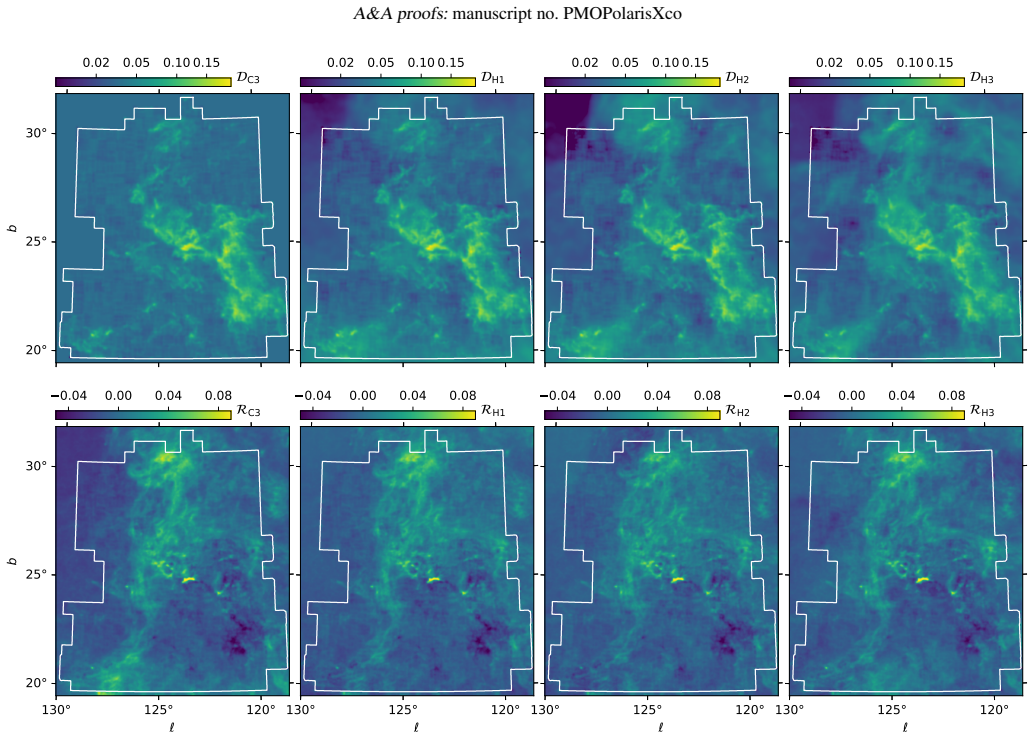
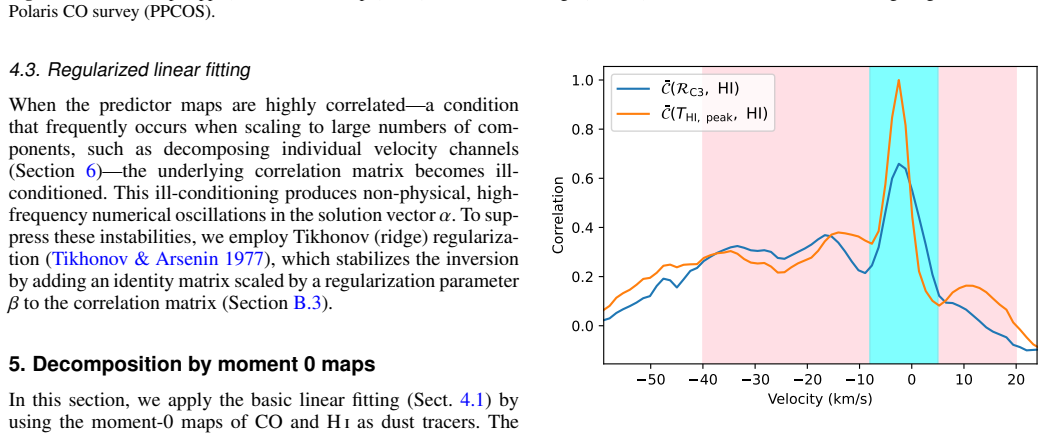
Multi-technique linear decomposition using full-spectrum fitting and regularization to separate dust contributions from overlapping CO and HI velocity components.
If this is right
- Dust growth and survival occur mainly in CO-emitting gas and narrow cold HI rather than warm neutral medium.
- CO-dark molecular gas is concentrated at HI-CO interfaces and dominates dust mass locally at cloud boundaries.
- Dynamical coupling exists between CO gas and surrounding cold neutral medium as shown by matching velocity fields.
- A stepwise schematic describes how multi-phase structures link molecular formation with dust growth.
Where Pith is reading between the lines
- The same decomposition could be tested on other nearby clouds to measure typical CO-dark gas fractions across environments.
- The ultra-narrow HI component may mark a distinct cold phase where dust and molecules first form.
- Negligible warm HI dust implies dust is rapidly incorporated into denser phases during cloud assembly.
- Interface dust excess suggests molecular cloud boundaries are active sites for both gas conversion and grain growth.
Load-bearing premise
The linear decomposition accurately isolates dust mass from each velocity component without bias from unmodeled gas phases or nonlinear emission effects.
What would settle it
Detection of substantial dust mass tied to the broad HI velocity component, or velocity mismatch between dust-associated HI and CO, would contradict the reported fractions and couplings.
Figures




read the original abstract
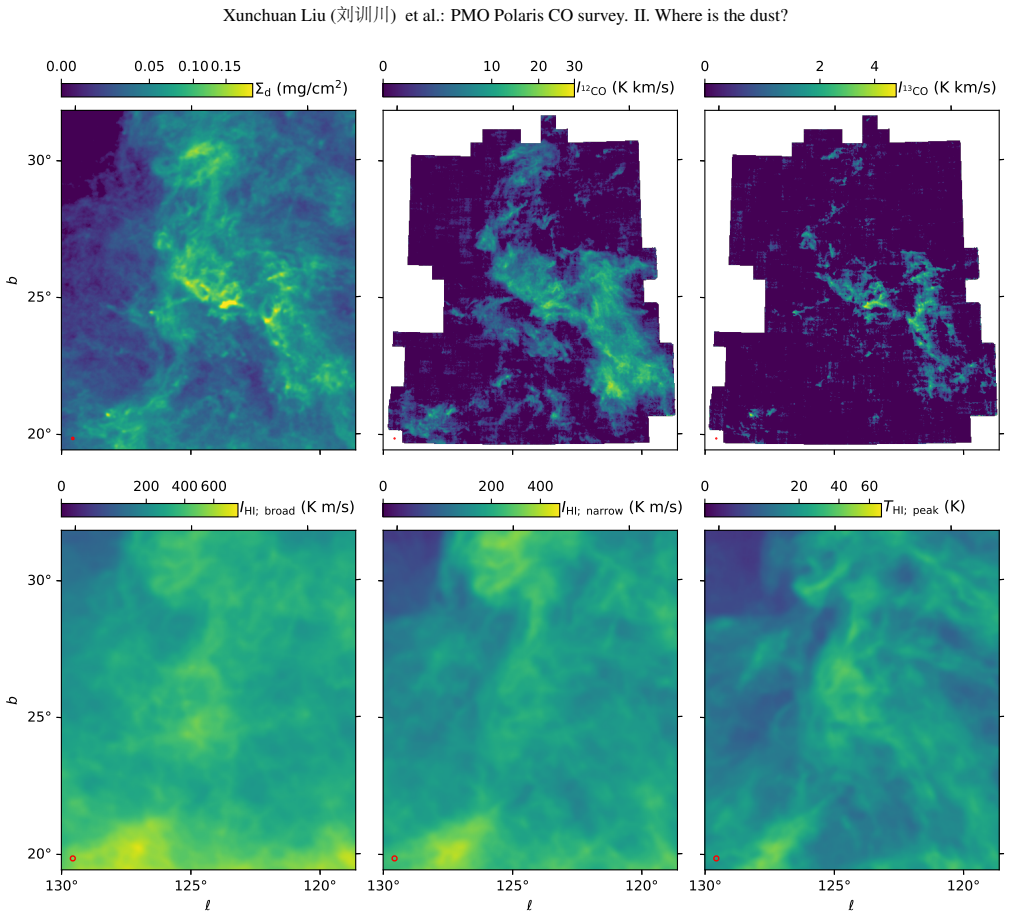
Dust plays critical chemical and dynamical roles in the interstellar medium (ISM), but its specific association with molecular and atomic gas remains difficult to isolate. Combining the PMO Polaris CO Survey (PPCOS), EBHIS \ion{H}{I} data, and \textit{Planck} dust maps, this study investigates dust distributions across multiple gas components in the Polaris Flare. We employ multi-technique linear decomposition -- including full-spectrum fitting and a regularization approach -- to reconstruct the dust distribution from multi-component gas emissions. This framework quantifies dust contributions from CO-associated, \ion{H}{I}-associated, and CO-dark molecular gas phases. CO-associated dust accounts for 20--40\% of the total dust mass, whereas dust in the broad \ion{H}{I} (warm neutral medium, WNM) component is negligible. Instead, \ion{H}{I}-associated dust concentrates primarily within the narrow cold neutral medium (CNM) and a distinct, ultra-narrow component with a velocity width comparable to the \ion{H}{I} spectral resolution. Residual dust at atomic-to-molecular (\ion{H}{I}--CO) interfaces contributes 4--10\% to the global dust mass, but exceeds 25\% at molecular cloud boundaries, confirming a substantial presence of CO-dark molecular gas. Furthermore, the velocity fields of dust-associated \ion{H}{I} closely match those of CO, indicating active dynamical coupling between CO-emitting gas and the surrounding CNM. Guided by these results, we present a stepwise schematic cartoon illustrating the coupling between multi-phase gas structures, molecular formation, and dust growth.
Editorial analysis
A structured set of objections, weighed in public.
Referee Report
Summary. The paper analyzes dust mass partitioning in the Polaris Flare by combining the PMO Polaris CO Survey, EBHIS HI spectra, and Planck dust maps. It applies multi-technique linear decomposition (full-spectrum fitting plus regularization) to attribute dust to CO-associated gas (20–40 % of total dust mass), HI-associated gas (negligible in the broad WNM component, dominant in narrow CNM and an ultra-narrow component whose width matches the HI resolution), and HI–CO interface regions (4–10 % globally, >25 % at cloud boundaries). The work also reports velocity-field alignment between dust-associated HI and CO, and presents a schematic of multi-phase coupling.
Significance. If the linear decomposition is shown to be robust, the quantitative partitioning supplies concrete observational constraints on the fraction of dust locked in CO-dark molecular gas and on the dynamical coupling between CNM and CO-emitting gas. The interface excess at cloud boundaries is a falsifiable prediction that could be tested with higher-resolution data.
major comments (2)
- [Abstract / Methods] Abstract and methods description: the headline percentages (CO dust 20–40 %, WNM negligible, CNM+ultra-narrow dominance, interface 4–10 %) are obtained from a regularized linear decomposition whose stability is not demonstrated. No validation against synthetic cubes, no propagation of fitting-parameter uncertainties, and no sensitivity tests to the regularization strength or velocity-width thresholds are reported. These omissions directly affect the reliability of every quoted mass fraction.
- [Abstract] The linear model assumes dust surface brightness is strictly proportional to each gas tracer’s column density. Potential temperature-dependent emissivity changes or grain-growth effects at the HI–CO interface are not quantified; if present even at the 10 % level they would systematically shift the partitioned masses, especially for the ultra-narrow component whose width is comparable to the spectral resolution.
minor comments (2)
- [Abstract] The abstract states that the velocity fields of dust-associated HI “closely match” those of CO; a quantitative metric (e.g., correlation coefficient or velocity centroid difference map) would strengthen this claim.
- [Abstract] Notation for the ultra-narrow component should be defined explicitly (velocity width threshold, how it is distinguished from the CNM) rather than described only as “comparable to the HI spectral resolution.”
Simulated Author's Rebuttal
We thank the referee for the constructive report and recommendation for major revision. We agree that additional demonstrations of method stability and discussion of model assumptions will improve the manuscript. Our point-by-point responses are below.
read point-by-point responses
-
Referee: [Abstract / Methods] Abstract and methods description: the headline percentages (CO dust 20–40 %, WNM negligible, CNM+ultra-narrow dominance, interface 4–10 %) are obtained from a regularized linear decomposition whose stability is not demonstrated. No validation against synthetic cubes, no propagation of fitting-parameter uncertainties, and no sensitivity tests to the regularization strength or velocity-width thresholds are reported. These omissions directly affect the reliability of every quoted mass fraction.
Authors: We agree that explicit validation of the decomposition stability is needed. In the revised manuscript we will add a dedicated Methods subsection describing (i) tests on synthetic cubes with known input components, (ii) Monte-Carlo propagation of fitting-parameter uncertainties, and (iii) sensitivity runs varying regularization strength and velocity-width thresholds. Results will be shown in a new appendix. These additions directly address the reliability of the reported mass fractions. revision: yes
-
Referee: [Abstract] The linear model assumes dust surface brightness is strictly proportional to each gas tracer’s column density. Potential temperature-dependent emissivity changes or grain-growth effects at the HI–CO interface are not quantified; if present even at the 10 % level they would systematically shift the partitioned masses, especially for the ultra-narrow component whose width is comparable to the spectral resolution.
Authors: The proportionality assumption is standard for linear decompositions, yet we acknowledge possible systematic biases. We will insert a quantitative discussion estimating the impact of temperature-dependent emissivity and grain-growth effects at the ~10 % level, with particular attention to the interface and ultra-narrow components. The interface excess remains consistent across independent fitting techniques, which we will emphasize as supporting evidence that the result is not driven solely by unaccounted emissivity variations. revision: partial
Circularity Check
No significant circularity; results derive from external data via standard fitting
full rationale
The paper's central results (CO dust 20-40%, negligible WNM dust, CNM+ultra-narrow dominance, 4-10% interface contribution) are obtained by applying linear decomposition, full-spectrum fitting, and regularization to independent external datasets (PMO Polaris CO Survey, EBHIS HI, Planck dust maps). These steps solve for component-specific dust-to-gas ratios from observed emissions without reducing the outputs to the inputs by definition, without renaming known results, and without load-bearing self-citations or author-imported uniqueness theorems. The derivation chain remains self-contained against external benchmarks and does not exhibit any of the enumerated circularity patterns.
Axiom & Free-Parameter Ledger
free parameters (2)
- regularization parameter
- velocity width thresholds for CNM/WNM
axioms (1)
- domain assumption Dust emission is a linear sum of contributions from distinct gas phases
Reference graph
Works this paper leans on
-
[1]
The Effelsberg-Bonn HI Survey: Milky Way gas. First data release
The Effelsberg-Bonn H I Survey: Milky Way gas. First data release. , keywords =. doi:10.1051/0004-6361/201527007 , archivePrefix =. 1512.05348 , primaryClass =
work page internal anchor Pith review Pith/arXiv arXiv doi:10.1051/0004-6361/201527007
-
[2]
HI4PI: A full-sky HI survey based on EBHIS and GASS
HI4PI: A full-sky H I survey based on EBHIS and GASS. , keywords =. doi:10.1051/0004-6361/201629178 , archivePrefix =. 1610.06175 , primaryClass =
work page internal anchor Pith review Pith/arXiv arXiv doi:10.1051/0004-6361/201629178
-
[3]
Planck 2013 results. XI. All-sky model of thermal dust emission. , keywords =. doi:10.1051/0004-6361/201323195 , archivePrefix =. 1312.1300 , primaryClass =
work page internal anchor Pith review Pith/arXiv arXiv doi:10.1051/0004-6361/201323195 2013
-
[4]
The Polaris Flare: Extensive Molecular Gas near the North Celestial Pole. , keywords =. doi:10.1086/185705 , adsurl =
-
[5]
, keywords =
A composite large-scale CO survey at high galactic latitudes in the second quadrant. , keywords =
-
[6]
Large-field CO (J = 1 - 0) observations toward SNR G150.3+4.5. , keywords =. doi:10.1051/0004-6361/202449353 , archivePrefix =. 2403.19788 , primaryClass =
-
[7]
The Five-Hundred-Meter Aperture Spherical Radio Telescope (FAST) Project
The Five-Hundred Aperture Spherical Radio Telescope (fast) Project. International Journal of Modern Physics D , keywords =. doi:10.1142/S0218271811019335 , archivePrefix =. 1105.3794 , primaryClass =
work page internal anchor Pith review Pith/arXiv arXiv doi:10.1142/s0218271811019335
-
[8]
The Arecibo Legacy Fast ALFA Survey. I. Science Goals, Survey Design, and Strategy. , keywords =. doi:10.1086/497431 , archivePrefix =. astro-ph/0508301 , primaryClass =
work page internal anchor Pith review Pith/arXiv arXiv doi:10.1086/497431
-
[9]
Optical Observing Conditions at Delingha Station
Optical Observing Conditions at Delingha Station. , keywords =. doi:10.1088/1538-3873/128/968/105003 , archivePrefix =. 1602.00838 , primaryClass =
work page internal anchor Pith review Pith/arXiv arXiv doi:10.1088/1538-3873/128/968/105003
-
[10]
The Operation of Multi-beam Receiver of Delingha 13.7m Telescope , journal =. 2021 , issn =. doi:https://doi.org/10.1016/j.chinastron.2021.11.008 , url =
-
[11]
IEEE Transactions on Terahertz Science and Technology , keywords =
Development of Superconducting Spectroscopic Array Receiver: A Multibeam 2SB SIS Receiver for Millimeter-Wave Radio Astronomy. IEEE Transactions on Terahertz Science and Technology , keywords =. doi:10.1109/TTHZ.2012.2213818 , adsurl =
-
[12]
Infrared Emission from Interstellar Dust. IV. The Silicate-Graphite-PAH Model in the Post-Spitzer Era. , keywords =. doi:10.1086/511055 , archivePrefix =. astro-ph/0608003 , primaryClass =
work page internal anchor Pith review Pith/arXiv arXiv doi:10.1086/511055
-
[13]
Planck intermediate results. XLVIII. Disentangling Galactic dust emission and cosmic infrared background anisotropies. , keywords =. doi:10.1051/0004-6361/201629022 , archivePrefix =. 1605.09387 , primaryClass =
work page internal anchor Pith review Pith/arXiv arXiv doi:10.1051/0004-6361/201629022
-
[14]
C2H N=1-0 and N2H+ J=1-0 observations of Planck Galactic cold clumps
C _ 2 H N = 1 - 0 and N _ 2 H ^ + J = 1 - 0 observations of Planck Galactic cold clumps. , keywords =. doi:10.1051/0004-6361/201834411 , archivePrefix =. 1901.01124 , primaryClass =
work page internal anchor Pith review Pith/arXiv arXiv doi:10.1051/0004-6361/201834411 1901
-
[15]
The Milky Way Imaging Scroll Painting (MWISP): Project Details and Initial Results from the Galactic Longitudes of 25. 8-49. 7. , keywords =. doi:10.3847/1538-4365/aaf1c8 , archivePrefix =. 1901.00285 , primaryClass =
work page internal anchor Pith review Pith/arXiv arXiv doi:10.3847/1538-4365/aaf1c8 1901
-
[16]
Ito, Yasushi. Delaunay Triangulation. Encyclopedia of Applied and Computational Mathematics. 2015. doi:10.1007/978-3-540-70529-1_314
-
[17]
and Cristobal, G
Pech-Pacheco, J.L. and Cristobal, G. and Chamorro-Martinez, J. and Fernandez-Valdivia, J. , booktitle=. Diatom autofocusing in brightfield microscopy: a comparative study , year=
-
[18]
Gass: The Parkes Galactic All-Sky Survey. I. Survey Description, Goals, and Initial Data Release. , keywords =. doi:10.1088/0067-0049/181/2/398 , archivePrefix =. 0901.1159 , primaryClass =
work page internal anchor Pith review Pith/arXiv arXiv doi:10.1088/0067-0049/181/2/398
-
[19]
, year = 2009, month = sep, volume =
The Hi Distribution of the Milky Way. , year = 2009, month = sep, volume =. doi:10.1146/annurev-astro-082708-101823 , adsurl =
-
[20]
Properties of cold and warm HI gas phases derived from a Gaussian decomposition of HI4PI data
Properties of cold and warm H I gas phases derived from a Gaussian decomposition of HI4PI data. , keywords =. doi:10.1051/0004-6361/201833146 , archivePrefix =. 1806.04085 , primaryClass =
work page internal anchor Pith review Pith/arXiv arXiv doi:10.1051/0004-6361/201833146
-
[21]
Polycyclic Aromatic Hydrocarbons, Anomalous Microwave Emission, and their Connection to the Cold Neutral Medium. , keywords =. doi:10.3847/1538-4357/ac5cbd , archivePrefix =. 2111.03067 , primaryClass =
-
[22]
Cold Milky Way Hi gas in filaments
Cold Milky Way HI Gas in Filaments. , keywords =. doi:10.3847/0004-637X/821/2/117 , archivePrefix =. 1602.07604 , primaryClass =
work page internal anchor Pith review Pith/arXiv arXiv doi:10.3847/0004-637x/821/2/117
-
[23]
II - Results and interpretation
An Effelsberg - Green Bank galactic H I absorption line survey. II - Results and interpretation. , keywords =
-
[24]
Weighing the Local Interstellar Medium Using Gamma Rays and Dust. , keywords =. doi:10.1103/PhysRevLett.130.161002 , archivePrefix =. 2208.11704 , primaryClass =
-
[25]
HI4PI-based estimates of the local diffuse CO-dark H _ 2 distribution
H I filaments are cold and associated with dark molecular gas. HI4PI-based estimates of the local diffuse CO-dark H _ 2 distribution. , keywords =. doi:10.1051/0004-6361/202037602 , archivePrefix =. 2004.14630 , primaryClass =
-
[26]
HI Narrow Line Absorption in Dark Clouds
H I Narrow Self-Absorption in Dark Clouds. , keywords =. doi:10.1086/346227 , archivePrefix =. astro-ph/0206396 , primaryClass =
work page internal anchor Pith review Pith/arXiv arXiv doi:10.1086/346227
-
[27]
Atomic Hydrogen in the Milky Way: A Stepping Stone in the Evolution of Galaxies. , keywords =. doi:10.1146/annurev-astro-052920-104851 , archivePrefix =. 2307.08464 , primaryClass =
-
[28]
The Dark Molecular Gas. , keywords =. doi:10.1088/0004-637X/716/2/1191 , archivePrefix =. 1004.5401 , primaryClass =
work page internal anchor Pith review Pith/arXiv arXiv doi:10.1088/0004-637x/716/2/1191
-
[29]
A FAST survey of H I narrow-line self-absorptions in Planck Galactic cold clumps guided by HC _ 3 N. , keywords =. doi:10.1051/0004-6361/202141477 , archivePrefix =. 2112.13717 , primaryClass =
-
[30]
Evolution of OH and CO-dark Molecular Gas Fraction Across a Molecular Cloud Boundary In Taurus
Evolution of OH and CO-Dark Molecular Gas Fraction across a Molecular Cloud Boundary in Taurus. , keywords =. doi:10.3847/0004-637X/819/1/22 , archivePrefix =. 1601.03165 , primaryClass =
work page internal anchor Pith review Pith/arXiv arXiv doi:10.3847/0004-637x/819/1/22
-
[31]
Quantification of molecular cloud structure using the Delta -variance. , keywords =. doi:10.1051/0004-6361:20000292 , adsurl =
-
[32]
, year = 1994, month = jan, volume =
Abundances in the Interstellar Medium. , year = 1994, month = jan, volume =. doi:10.1146/annurev.aa.32.090194.001203 , adsurl =
-
[33]
The Intrinsic Abundance Ratio and X-factor of CO Isotopologues in L 1551 Shielded from FUV Photodissociation. , keywords =. doi:10.3847/0004-637X/826/2/193 , archivePrefix =. 1605.03467 , primaryClass =
work page internal anchor Pith review Pith/arXiv arXiv doi:10.3847/0004-637x/826/2/193
-
[34]
The CO-to-H2 Conversion Factor
The CO-to-H _ 2 Conversion Factor. , keywords =. doi:10.1146/annurev-astro-082812-140944 , archivePrefix =. 1301.3498 , primaryClass =
work page internal anchor Pith review Pith/arXiv arXiv doi:10.1146/annurev-astro-082812-140944
-
[35]
Strang, Gilbert , biburl =
-
[36]
and Arsenin, Vasiliy Y
Tikhonov, Andrey N. and Arsenin, Vasiliy Y. , biburl =
-
[37]
, keywords =
On the fractal structure of molecular clouds. , keywords =
-
[38]
Multiscale Decomposition of Astronomical Maps: A Constrained Diffusion Method. , keywords =. doi:10.3847/1538-4365/ac4bc4 , archivePrefix =. 2201.05484 , primaryClass =
-
[39]
Turbulence in cascading: Origin of the variance and skewness of density function
Turbulence in virtual: Origin of the variance and skewness of density function. arXiv e-prints , keywords =. doi:10.48550/arXiv.2502.20458 , archivePrefix =. 2502.20458 , primaryClass =
work page internal anchor Pith review Pith/arXiv arXiv doi:10.48550/arxiv.2502.20458
-
[40]
Disentangling the independently controllable factors of variation by interacting with the world
Interstellar Dust Grains. , keywords =. doi:10.1146/annurev.astro.41.011802.094840 , archivePrefix =. astro-ph/0304489 , primaryClass =
work page internal anchor Pith review Pith/arXiv arXiv doi:10.1146/annurev.astro.41.011802.094840
-
[41]
Dust/gas correlations from Herschel Observations
Dust/gas correlations from Herschel observations. , keywords =. doi:10.1051/0004-6361/201014575 , archivePrefix =. 1005.2537 , primaryClass =
work page internal anchor Pith review Pith/arXiv arXiv doi:10.1051/0004-6361/201014575
-
[42]
Variations between Dust and Gas in the Diffuse Interstellar Medium
Variations between Dust and Gas in the Diffuse Interstellar Medium. , keywords =. doi:10.1088/0004-637X/811/2/118 , archivePrefix =. 1508.07889 , primaryClass =
work page internal anchor Pith review Pith/arXiv arXiv doi:10.1088/0004-637x/811/2/118
-
[43]
Monthly Notices of the Royal Astronomical Society , volume =
Hirashita, Hiroyuki and Harada, Nanase , title =. Monthly Notices of the Royal Astronomical Society , volume =. 2017 , month =. doi:10.1093/mnras/stx118 , url =
-
[44]
Optically thick HI does not dominate dark gas in the local ISM
Optically Thick H I Does Not Dominate Dark Gas in the Local ISM. , keywords =. doi:10.3847/1538-4357/aaccfe , archivePrefix =. 1806.01300 , primaryClass =
work page internal anchor Pith review Pith/arXiv arXiv doi:10.3847/1538-4357/aaccfe
-
[45]
A High Resolution Study of the HI-H2 Transition across the Perseus Molecular Cloud
A High-resolution Study of the H I-H _ 2 Transition across the Perseus Molecular Cloud. , keywords =. doi:10.1088/0004-637X/748/2/75 , archivePrefix =. 1110.2745 , primaryClass =
work page internal anchor Pith review Pith/arXiv arXiv doi:10.1088/0004-637x/748/2/75
-
[46]
H I Narrow Self-Absorption in Dark Clouds: Correlations with Molecular Gas and Implications for Cloud Evolution and Star Formation. , keywords =. doi:10.1086/428032 , archivePrefix =. astro-ph/0412427 , primaryClass =
work page internal anchor Pith review Pith/arXiv arXiv doi:10.1086/428032
-
[47]
A Survey of H I Narrow Self-absorption in Molecular Cores. , keywords =. doi:10.1088/0004-637X/724/2/1402 , adsurl =
-
[48]
The Formation of Milky Way ``Bones'': Ubiquitous HI Narrow Self-absorption Associated with CO Emission. , keywords =. doi:10.3847/2041-8213/ad77ce , archivePrefix =. 2409.01895 , primaryClass =
-
[49]
GASKAP -- The Galactic ASKAP Survey
GASKAP-The Galactic ASKAP Survey. , keywords =. doi:10.1017/pasa.2012.003 , archivePrefix =. 1207.0891 , primaryClass =
work page internal anchor Pith review Pith/arXiv arXiv doi:10.1017/pasa.2012.003 2012
-
[50]
VizieR Online Data Catalog (other) , keywords =
VizieR Online Data Catalog: The FAST all sky H I survey (FASHI) (Zhang+, 2024). VizieR Online Data Catalog (other) , keywords =
2024
-
[51]
2018, IEEE Microwave Magazine, 19, 112, doi: 10.1109/MMM.2018.2802178
FAST in Space: Considerations for a Multibeam, Multipurpose Survey Using China's 500-m Aperture Spherical Radio Telescope (FAST). IEEE Microwave Magazine , keywords =. doi:10.1109/MMM.2018.2802178 , archivePrefix =. 1802.03709 , primaryClass =
-
[52]
, year = 1971, month = jan, volume =
Surface Recombination of Hydrogen Molecules. , year = 1971, month = jan, volume =. doi:10.1086/150754 , adsurl =
-
[53]
, year = 2009, month = sep, volume =
Complex Organic Interstellar Molecules. , year = 2009, month = sep, volume =. doi:10.1146/annurev-astro-082708-101654 , adsurl =
-
[54]
The Dust Attenuation Law in Galaxies. , keywords =. doi:10.1146/annurev-astro-032620-021933 , archivePrefix =. 2001.03181 , primaryClass =
-
[55]
Interstellar dust and extinction. , keywords =. doi:10.1146/annurev.aa.28.090190.000345 , adsurl =
-
[56]
A Broadband Study of Galactic Dust Emission
A broadband study of galactic dust emission. , keywords =. doi:10.1051/0004-6361:20065835 , archivePrefix =. astro-ph/0611606 , primaryClass =
work page internal anchor Pith review Pith/arXiv arXiv doi:10.1051/0004-6361:20065835
-
[57]
Carbon Monoxide and Dust Column Densities: The Dust-to-Gas Ratio and Structure of Three Giant Molecular Cloud Cores. , keywords =. doi:10.1086/304986 , adsurl =
-
[58]
Planck intermediate results. XXVIII. Interstellar gas and dust in the Chamaeleon clouds as seen by Fermi LAT and Planck. , keywords =. doi:10.1051/0004-6361/201424955 , archivePrefix =. 1409.3268 , primaryClass =
work page internal anchor Pith review Pith/arXiv arXiv doi:10.1051/0004-6361/201424955
-
[59]
Dark gas in the solar neighnorhood from extinction data
Dark gas in the solar neighborhood from extinction data. , keywords =. doi:10.1051/0004-6361/201118740 , archivePrefix =. 1205.3384 , primaryClass =
work page internal anchor Pith review Pith/arXiv arXiv doi:10.1051/0004-6361/201118740
-
[60]
CO-dark gas and molecular filaments in Milky Way type galaxies
CO-dark gas and molecular filaments in Milky Way-type galaxies. , keywords =. doi:10.1093/mnras/stu616 , archivePrefix =. 1403.1589 , primaryClass =
work page internal anchor Pith review Pith/arXiv arXiv doi:10.1093/mnras/stu616
-
[61]
The relation between gas and dust in the Taurus Molecular Cloud
The Relation Between Gas and Dust in the Taurus Molecular Cloud. , keywords =. doi:10.1088/0004-637X/721/1/686 , archivePrefix =. 1007.5060 , primaryClass =
work page internal anchor Pith review Pith/arXiv arXiv doi:10.1088/0004-637x/721/1/686
-
[62]
An All-sky 3D Dust Map Based on Gaia and LAMOST. , keywords =. doi:10.3847/1538-4365/adea39 , archivePrefix =. 2509.07640 , primaryClass =
-
[63]
The Boston University-Five College Radio Astronomy Observatory Galactic Ring Survey
The Boston University-Five College Radio Astronomy Observatory Galactic Ring Survey. , keywords =. doi:10.1086/500091 , archivePrefix =. astro-ph/0602160 , primaryClass =
work page internal anchor Pith review Pith/arXiv arXiv doi:10.1086/500091
-
[64]
The Milky Way in Molecular Clouds: A New Complete CO Survey
The Milky Way in Molecular Clouds: A New Complete CO Survey. , keywords =. doi:10.1086/318388 , archivePrefix =. astro-ph/0009217 , primaryClass =
work page internal anchor Pith review Pith/arXiv arXiv doi:10.1086/318388
-
[65]
Striations in molecular clouds: Streamers or MHD waves?
Striations in molecular clouds: streamers or MHD waves?. , keywords =. doi:10.1093/mnras/stw1881 , archivePrefix =. 1607.08615 , primaryClass =
work page internal anchor Pith review Pith/arXiv arXiv doi:10.1093/mnras/stw1881
-
[66]
The interstellar cold dust observed by COBE
The interstellar cold dust observed by COBE. , keywords =. doi:10.48550/arXiv.astro-ph/9812474 , archivePrefix =. astro-ph/9812474 , primaryClass =
work page internal anchor Pith review Pith/arXiv arXiv doi:10.48550/arxiv.astro-ph/9812474
-
[67]
, keywords =
PRONAOS observations of MCLD 123.5 + 24.9: cold dust in the Polaris cirrus cloud. , keywords =
-
[68]
From filamentary clouds to prestellar cores to the stellar IMF: Initial highlights from the Herschel Gould Belt Survey. , keywords =. doi:10.1051/0004-6361/201014666 , archivePrefix =. 1005.2618 , primaryClass =
work page internal anchor Pith review Pith/arXiv arXiv doi:10.1051/0004-6361/201014666
-
[69]
The Three-mm Ultimate Mopra Milky Way Survey. I. Survey Overview, Initial Data Releases, and First Results. , keywords =. doi:10.1088/0004-637X/812/1/6 , archivePrefix =. 1507.05095 , primaryClass =
work page internal anchor Pith review Pith/arXiv arXiv doi:10.1088/0004-637x/812/1/6
-
[70]
FOREST unbiased Galactic plane imaging survey with the Nobeyama 45 m telescope (FUGIN). I. Project overview and initial results. , keywords =. doi:10.1093/pasj/psx061 , archivePrefix =. 1707.05981 , primaryClass =
work page internal anchor Pith review Pith/arXiv arXiv doi:10.1093/pasj/psx061
-
[71]
A network of velocity-coherent filaments formed by supersonic turbulence in a very-high-velocity H I cloud. Nature Astronomy , keywords =. doi:10.1038/s41550-025-02605-8 , archivePrefix =. 2502.10897 , primaryClass =
-
[72]
, year = 2015, month = aug, volume =
Molecular Clouds in the Milky Way. , year = 2015, month = aug, volume =. doi:10.1146/annurev-astro-082214-122324 , adsurl =
-
[73]
Turbulence and star formation in molecular clouds. , keywords =. doi:10.1093/mnras/194.4.809 , adsurl =
-
[74]
Larson's third law and the universality of molecular cloud structure
Larson's third law and the universality of molecular cloud structure. , keywords =. doi:10.1051/0004-6361/201015282 , archivePrefix =. 1008.4251 , primaryClass =
work page internal anchor Pith review Pith/arXiv arXiv doi:10.1051/0004-6361/201015282
-
[75]
PMO Polaris CO survey. I. A 100 deg ^2 view of the Polaris Flare , author=. 2026 , eprint=
2026
discussion (0)
Sign in with ORCID, Apple, or X to comment. Anyone can read and Pith papers without signing in.