Structure-Oriented Randomized Neural Networks for Poisson-Nernst-Planck and Poisson-Nernst-Planck-Navier-Stokes Systems
Pith reviewed 2026-06-26 16:27 UTC · model grok-4.3
The pith
A structure-oriented randomized neural network solves Poisson-Nernst-Planck systems iteratively while enforcing positivity, mass matching, and divergence-free velocity by construction.
A machine-rendered reading of the paper's core claim, the machinery that carries it, and where it could break.
Core claim
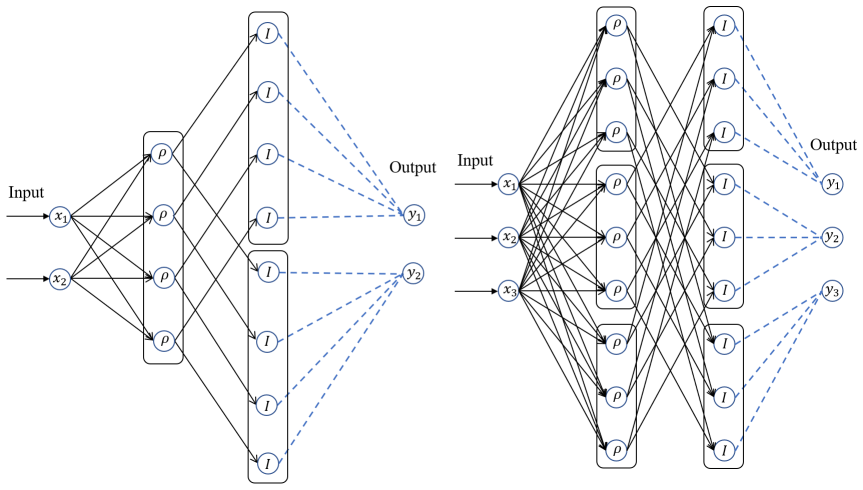
The SO-RaNN framework solves the PNP and PNP-NS systems by iteratively applying randomized neural networks to decoupled linearized subproblems in space and time, with a pointwise positivity cut-off, interpolated discrete mass-scaling factors, SAV-type post-processing for the auxiliary variable, and SP-RaNN for the velocity field that enforces divergence-free condition pointwise. Residual-based error estimates are obtained for the raw solvers, a conditional local-in-time convergence result is established for the raw outer Picard iteration of the PNP system, and approximation results are given for the SP-RaNN space and the associated Oseen-type problem.
What carries the argument
Structure-oriented randomized neural network (SO-RaNN) that solves decoupled linearized subproblems iteratively in a space-time framework, augmented by pointwise positivity cut-off, discrete mass-scaling, SAV post-processing, and SP-RaNN for divergence-free velocity.
If this is right
- Exact mass matching holds at the selected correction instants with approximate preservation between them.
- The SAV post-processing produces monotonicity of the auxiliary variable under the ideal update.
- The velocity field from SP-RaNN satisfies the incompressibility constraint pointwise.
- Residual-based estimates bound the approximation error for the raw uncorrected RaNN solvers of each linearized subproblem.
- Conditional error statements hold for the linearized Oseen-type problem in the PNP-NS case.
Where Pith is reading between the lines
- The space-time randomized network approach may reduce the need for traditional time-stepping stability restrictions in long-time ion-transport simulations.
- The same correction structure could be tested on related drift-diffusion systems that require strict positivity and conservation.
- Extending the conditional convergence analysis to a global-in-time result would remove the locality restriction on the time interval.
- Manufactured-solution accuracy does not yet address whether the method remains stable under realistic boundary conditions with strong advection.
Load-bearing premise
The raw outer Picard iteration of the PNP system converges locally in time under the specific conditions stated for that result.
What would settle it
A concrete PNP simulation in which the outer Picard iteration diverges or loses positivity despite satisfying the paper's stated conditions on the time interval and initial data.
Figures




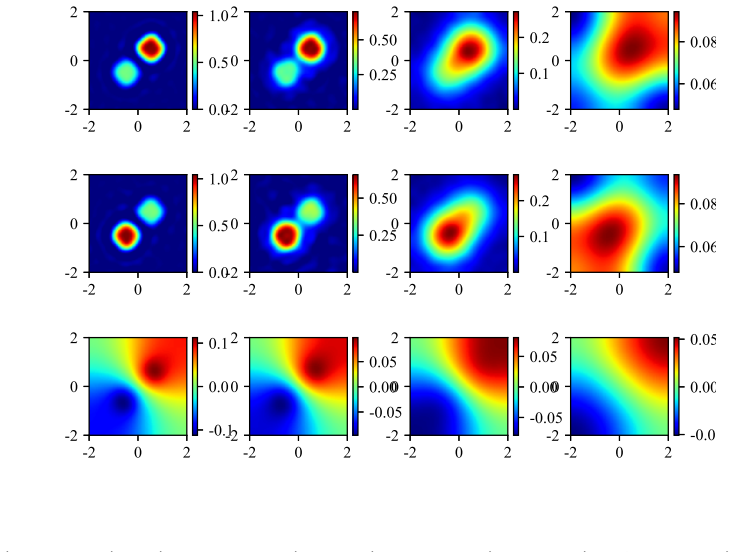
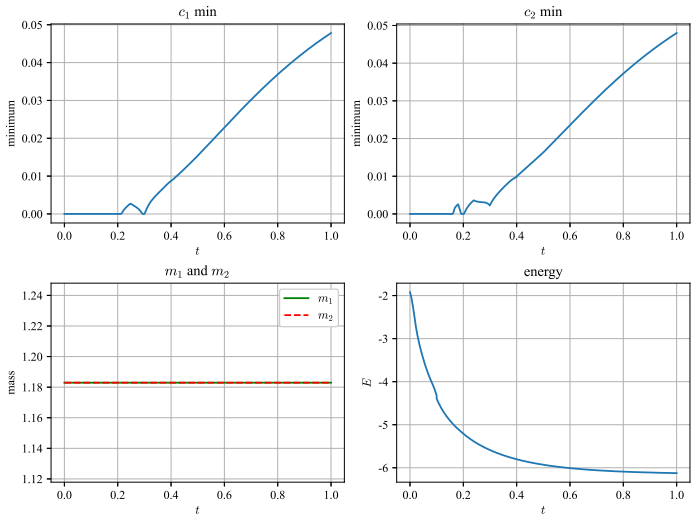
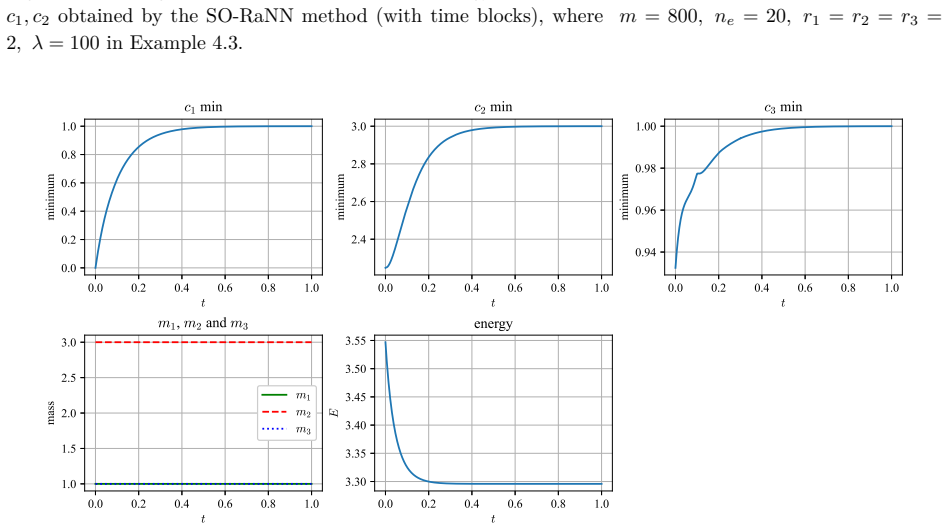
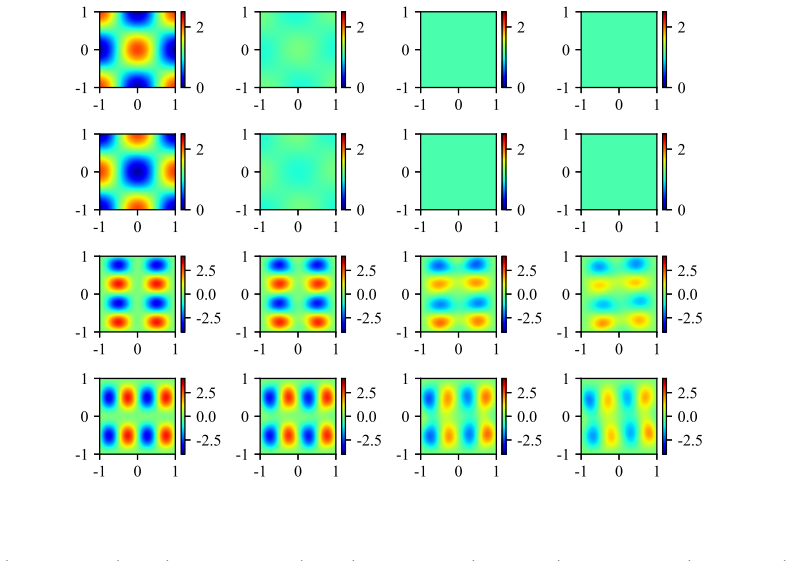
read the original abstract
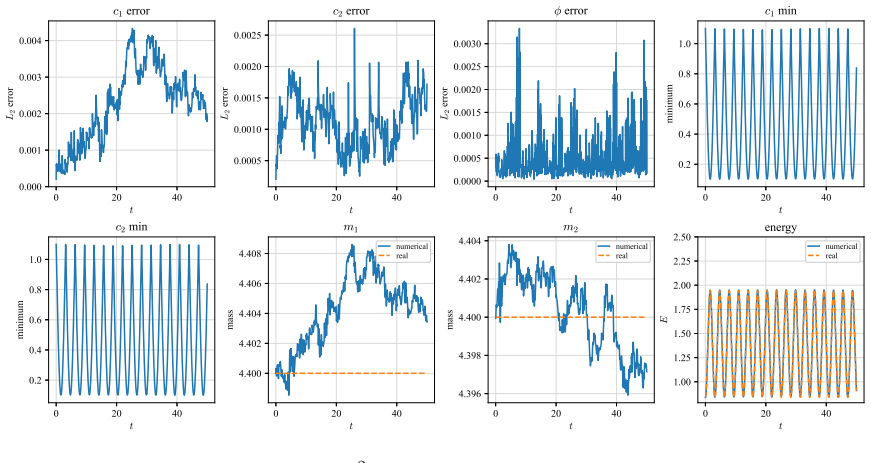
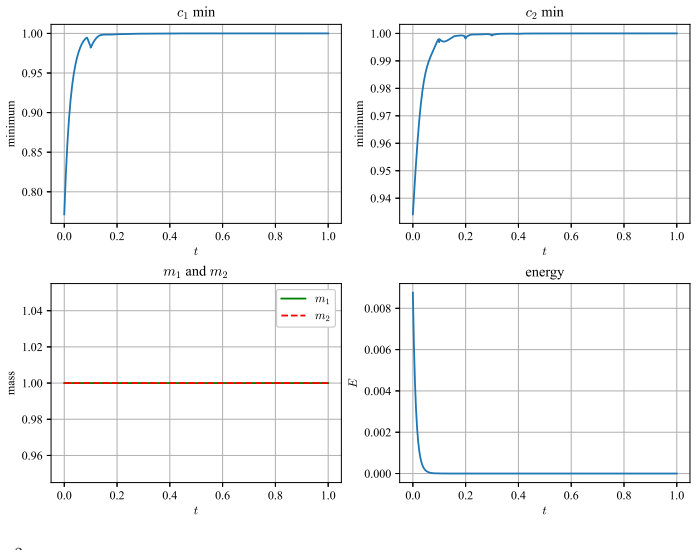
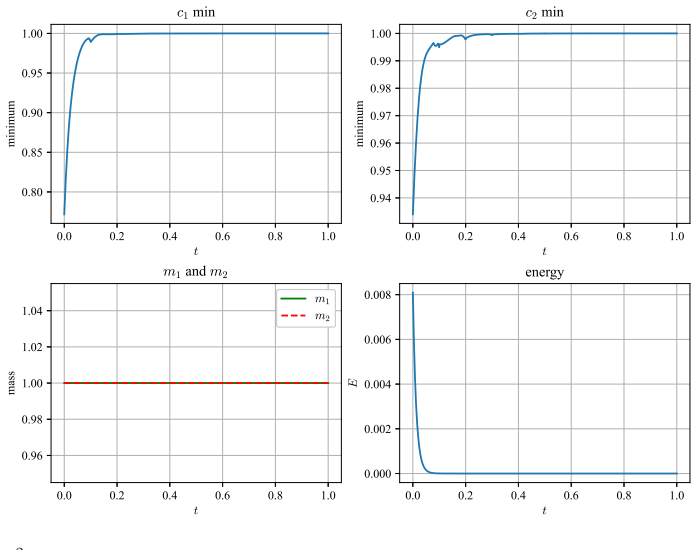
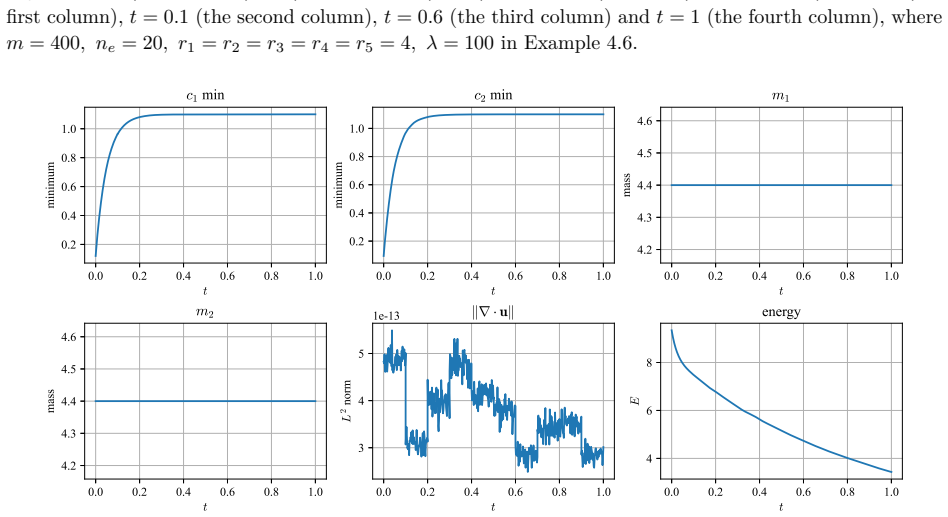
We develop a structure-oriented randomized neural network framework, termed SO-RaNN, for the Poisson-Nernst-Planck (PNP) system and the Poisson-Nernst-Planck-Navier-Stokes (PNP-NS) system. The decoupled linearized subproblems are solved iteratively by randomized neural networks in a space-time framework. For the concentration variables, a pointwise cut-off is used to enforce positivity at the value level, and discrete mass-scaling factors are computed at selected correction instants and interpolated in time, so as to ensure exact mass matching at those instants and to promote approximate mass preservation between them. To introduce an auxiliary discrete dissipation mechanism, we further employ an SAV-type post-processing correction, which yields monotonicity of the SAV auxiliary variable under the ideal SAV update. For the PNP-NS system, a structure-preserving randomized neural network (SP-RaNN) is used for the velocity field, so that the velocity approximation satisfies the incompressibility constraint pointwise by construction. On the theoretical side, we derive residual-based estimates for the raw, uncorrected RaNN solvers of the linearized subproblems, formulate a conditional local-in-time convergence result for the raw outer Picard iteration of the PNP system, and analyze the value-level positivity correction together with the mass-correction and SAV post-processing steps. For the PNP-NS system, we establish an approximation result for the SP-RaNN space and provide a conditional error statement for the corresponding linearized Oseen-type problem. Numerical experiments demonstrate approximation accuracy in the source-driven manufactured tests and illustrate the intended value-level positivity correction, selected-time mass matching, computed free-energy curves based on the final gauge-fixed potential, and divergence-free approximation in benchmark tests.
Editorial analysis
A structured set of objections, weighed in public.
Referee Report
Summary. The paper develops a structure-oriented randomized neural network (SO-RaNN) framework for the Poisson-Nernst-Planck (PNP) and Poisson-Nernst-Planck-Navier-Stokes (PNP-NS) systems. Decoupled linearized subproblems are solved iteratively via randomized NNs in a space-time setting. Positivity is enforced by pointwise cut-off, mass is matched exactly at selected instants via discrete scaling factors with interpolation, and an SAV-type post-processing is applied for monotonicity of the auxiliary variable. For PNP-NS, SP-RaNN enforces pointwise divergence-free velocity. Theoretical contributions include residual-based estimates for the raw RaNN solvers, a conditional local-in-time convergence result for the outer Picard iteration of PNP, analyses of the corrections, an approximation result for the SP-RaNN space, and a conditional error statement for the linearized Oseen problem. Numerical experiments illustrate accuracy on source-driven manufactured solutions and benchmark tests, including positivity, mass matching, free-energy curves, and divergence-free properties.
Significance. If the conditional convergence holds under verifiable conditions and the numerical results prove robust across regimes, the framework would offer a mesh-free alternative for these nonlinear electrodiffusion systems while preserving key structures (positivity, mass, dissipation, incompressibility). The combination of randomized NNs with explicit value-level and post-processing corrections, together with the derivation of residual estimates and the SP-RaNN construction, represents a concrete technical contribution that could be useful for related transport problems. The conditional nature of the main convergence result, however, limits the strength of the theoretical support.
major comments (2)
- [Abstract and theoretical analysis section on the PNP system] Abstract and theoretical analysis section on the PNP system: the conditional local-in-time convergence result for the raw outer Picard iteration is load-bearing for the claim that the decoupled linearized subproblems can be solved iteratively to obtain a solution of the nonlinear system. The specific conditions (e.g., small enough time interval, bound on the Lipschitz constant of the nonlinearity, or control on the residual of the linearized subproblems) are not stated explicitly, so it is impossible to verify whether they hold in the regimes of interest; violation would remove the theoretical justification for the iterative solver.
- [Theoretical analysis for the PNP-NS system] Theoretical analysis for the PNP-NS system: the conditional error statement for the linearized Oseen-type problem likewise depends on unspecified conditions. Without explicit hypotheses, the approximation result for the SP-RaNN space cannot be assessed for practical applicability, which is central to the divergence-free velocity claim.
minor comments (2)
- The abstract would be clearer if it briefly indicated the nature of the conditions under which the Picard convergence holds.
- [Methods section] Notation for the discrete mass-scaling factors and the SAV auxiliary variable should be introduced with a short table or explicit definitions in the methods section to aid readability.
Simulated Author's Rebuttal
We thank the referee for the careful reading and the constructive comments on the theoretical analysis. We address the two major comments point by point below.
read point-by-point responses
-
Referee: [Abstract and theoretical analysis section on the PNP system] Abstract and theoretical analysis section on the PNP system: the conditional local-in-time convergence result for the raw outer Picard iteration is load-bearing for the claim that the decoupled linearized subproblems can be solved iteratively to obtain a solution of the nonlinear system. The specific conditions (e.g., small enough time interval, bound on the Lipschitz constant of the nonlinearity, or control on the residual of the linearized subproblems) are not stated explicitly, so it is impossible to verify whether they hold in the regimes of interest; violation would remove the theoretical justification for the iterative solver.
Authors: We agree that the hypotheses underlying the conditional local-in-time convergence result for the outer Picard iteration are not stated explicitly enough to permit direct verification. In the revised manuscript we will insert a remark immediately after the theorem statement that lists the precise assumptions: a sufficiently small time-interval length T, an a-priori bound on the Lipschitz constant of the nonlinearity (derived from the maximum principle for the concentrations), and a uniform control on the residuals of the linearized subproblems. These conditions are the standard ones for local Picard convergence of semilinear parabolic systems; we will also indicate how they can be checked a posteriori from the numerical data. revision: yes
-
Referee: [Theoretical analysis for the PNP-NS system] Theoretical analysis for the PNP-NS system: the conditional error statement for the linearized Oseen-type problem likewise depends on unspecified conditions. Without explicit hypotheses, the approximation result for the SP-RaNN space cannot be assessed for practical applicability, which is central to the divergence-free velocity claim.
Authors: We concur that the hypotheses for the conditional error estimate on the linearized Oseen problem must be written out explicitly. The revision will add a paragraph stating the required smallness conditions on the time step, the data norms, and the velocity field that guarantee stability of the linearization. With these hypotheses stated, the approximation result for the SP-RaNN space (which already encodes the pointwise divergence-free constraint) can be evaluated directly for the regimes of interest. revision: yes
Circularity Check
No significant circularity; derivation chain is self-contained
full rationale
The paper presents the SO-RaNN framework, residual-based estimates for linearized subproblems, a conditional local-in-time convergence result for the outer Picard iteration, and analyses of positivity/mass/SAV corrections plus SP-RaNN for divergence-free velocity as independent contributions. These steps are formulated and derived from the problem structure and standard numerical analysis techniques without reducing any central claim to a fitted parameter renamed as prediction, a self-definitional loop, or a load-bearing self-citation chain. The conditional convergence is explicitly labeled as such and does not rely on prior author results that would force the outcome by construction. No ansatz is smuggled via citation, and no known empirical pattern is merely renamed. The derivation therefore stands on its own stated assumptions and estimates.
Axiom & Free-Parameter Ledger
Reference graph
Works this paper leans on
-
[1]
Arendt and S
W. Arendt and S. Monniaux, Maximal regularity for non-autonomous Robin boundary conditions, Mathematische Nachrichten 289 (2016), 1325-1340
2016
-
[2]
A. R. Barron, Universal approximation bounds for superpositions of a sigmoidal function, IEEE Trans- actions on Information Theory 39 (1993), 930-945
1993
-
[3]
M. Z. Bazant, K. Thornton, A. Ajdari, Diffuse-charge dynamics in electrochemical systems, Physical Review E 70 (2004), 021506
2004
-
[4]
Biler, W
P. Biler, W. Hebisch, and T. Nadzieja, The Debye system: existence and large time behavior of solutions, Nonlinear Analysis: Theory, Methods & Applications 23 (1994), 1189–1209
1994
-
[5]
Bonilla and J
J. Bonilla and J. V. Gutiérrez-Santacreu, Physics-based stabilized finite element approximations of the Poisson–Nernst–Planck equations, Computer Methods in Applied Mechanics and Engineering 443 (2025), 118035
2025
-
[6]
J. Chen, X. Chi, W. E and Z. Yang, Bridging Traditional and Machine Learning-based Algorithms for Solving PDEs: The Random Feature Method, Journal of Machine Learning 1 (2022), 268-298
2022
-
[7]
Chen and H
T. Chen and H. Chen, Universal approximation to nonlinear operators by neural networks with arbitrary activation functions and its application to dynamical systems, IEEE Transactions on Neural Networks 6 (1995), 911–917
1995
-
[8]
Choi, and M
H.-W. Choi, and M. Paraschivoiu, Advanced hybrid-flux approach for output bounds of electro-osmotic flows: adaptive refinement and direct equilibrating strategies, Microfluidics and Nanofluidics 2 (2006), 154–170
2006
-
[9]
Dang and F
H. Dang and F. Wang, Local Randomized Neural Networks with Hybridized Discontinuous Petrov- Galerkin Methods for Stokes-Darcy Flows, Physics of Fluids 36 (2024), 087138
2024
-
[10]
H. Dang, F. Wang and S. Jiang, Adaptive Growing Randomized Neural Networks for Solving Partial Differential Equations, (2024), arXiv: 2408.17225v3
arXiv 2024
-
[11]
Dehghan, Z
M. Dehghan, Z. Gharibi and R. Ruiz-Baier, Optimal Error Estimates of Coupled and Divergence-Free Virtual Element Methods for the Poisson–Nernst–Planck/Navier–Stokes Equations and Applications in Electrochemical Systems, Journal of Scientific Computing 94 (2023), 72
2023
-
[12]
J. Ding, Z. Wang and S. Zhou, Structure-preserving and efficient numerical methods for ion transport, Journal of Computational Physics 418 (2020) 109597. 46
2020
-
[13]
L. Dong, D. He, Y. Qin and Z. Zhang, A positivity-preserving, linear, energy stable and convergent numerical scheme for the Poisson–Nernst–Planck (PNP) system, Journal of Computational and Applied Mathematics 444 (2024), 115784
2024
-
[14]
Dong and Z
S. Dong and Z. Li, Local extreme learning machines and domain decomposition for solving linear and nonlinear partial differential equations, Computer Methods in Applied Mechanics and Engineering 387 (2021), 114129
2021
-
[15]
Dong and Y
S. Dong and Y. Wang. A method for computing inverse parametric PDE problems with random-weight neural networks. Journal of Computational Physics 489 (2023), 112263
2023
-
[16]
W. E and B. Yu, The deep Ritz method: A deep learning-based numerical algorithm for solving varia- tional problems, Communications in Mathematics and Statistics 6 (2018), 1–12
2018
-
[17]
Eisenberg, Ionic channels in biological membranes-electrostatic analysis of a natural nanotube, Con- temporary Physics 39 (1998), 447–466
B. Eisenberg, Ionic channels in biological membranes-electrostatic analysis of a natural nanotube, Con- temporary Physics 39 (1998), 447–466
1998
-
[18]
Fu and Z
G. Fu and Z. Xu, High-order space–time finite element methods for the Poisson–Nernst–Planck equa- tions: positivity and unconditional energy stability, Computer Methods in Applied Mechanics and En- gineering 395 (2022) 115031
2022
-
[19]
Gajewski, K
H. Gajewski, K. Göger, On the basic equations for carrier transport in semiconductors, Journal of Mathematical Analysis and Applications 113 (1986), 12–35
1986
-
[20]
D. He, K. Pan and X. Yue, A Positivity Preserving and Free Energy Dissipative Difference Scheme for the Poisson–Nernst–Planck System, Journal of Scientific Computing 81 (2019), 436-458
2019
-
[21]
Hu and X
J. Hu and X. Huang, A fully discrete positivity-preserving and energy-dissipative finite difference scheme for Poisson–Nernst–Planck equations, Numerische Mathematik 145 (2020), 77-115
2020
-
[22]
Huang and J
F. Huang and J. Shen, Bound/positivity preserving and energy stable scalar auxiliary variable schemes for dissipative systems: applications to Keller-Segel and Poisson-Nernst-Planck equations, SIAM Journal on Scientific Computing 43 (2021), A1832–A1857
2021
-
[23]
Huang, Q
G. Huang, Q. Zhu and C. K. Siew, Extreme learning machine: theory and applications, Neurocomputing 70 (2006), 489–501
2006
-
[24]
Igelnik and Y.H
B. Igelnik and Y.H. Pao, Stochastic choice of basis functions in adaptive function approximation and the functional-link net, IEEE Transactions on Neural Networks 6 (1995), 1320–1329
1995
-
[25]
J. W. Jerome, Analysis of Charge Transport: A Mathematical Study of Semiconductor Devices, Springer, Berlin, 1996
1996
-
[26]
X. Jin, S. Cai, H. Li and G. E. Karniadakis, NSFnets (Navier-Stokes flow nets): Physics-informed neural networks for the incompressible Navier-Stokes equations, Journal of Computational Physics 426 (2021), 109951
2021
-
[27]
N. Kajiwara, Maximal Lp Lq regularity for the Stokes equations with various boundary conditions in the half space, arXiv: 2201.05306
-
[28]
Li and F
Y. Li and F. Wang, Local randomized neural networks with finite difference methods for interface problems, Journal of Computational Physics 529 (2025), 113847. 47
2025
-
[29]
Y. Li, F. Wang and L. Li, Structure-preserving Randomized Neural Networks for Incompressible Mag- netohydrodynamics Equations, (2026), arXiv: 2603.01102
arXiv 2026
-
[30]
J. L. Lions and E. Magenes, Non-Homogeneous Boundary Value Problems and Applications, Vol. I, Springer-Verlag, Berlin–Heidelberg–New York, 1972
1972
-
[31]
Liu and Z
H. Liu and Z. Wang, A free energy satisfying finite difference method for Poisson–Nernst–Planck equa- tions, Journal of Computational Physics 268 (2014), 362–376
2014
-
[32]
L. Lu, X. Meng, Z. Mao, and G. E. Karniadakis, DeepXDE: A Deep Learning Library for Solving Differential Equations, SIAM Review 63 (2021), 208-228
2021
-
[33]
Markowich, C
P. Markowich, C. Ringhofer, and C. Schmeiser, Semiconductor Equations, Springer, New York, 1990
1990
-
[34]
Moseley, A
B. Moseley, A. Markham and T. Nissen-Meyer, Finite basis physics-informed neural networks (FBPINNs): a scalable domain decomposition approach for solving differential equations, Advances in Computational Mathematics 49 (2023), 62
2023
-
[35]
Nernst, Die elektromotorische wirksamkeit der jonen, Zeitschrift Fur Physikalische Chemie 4 (1889), 129–181
W. Nernst, Die elektromotorische wirksamkeit der jonen, Zeitschrift Fur Physikalische Chemie 4 (1889), 129–181
-
[36]
M. Pan, S. Liu, W. Zhu, F. Jiao and D. He, A linear, second-order accurate, positivity-preserving and unconditionally energy stable scheme for the Navier–Stokes–Poisson–Nernst–Planck system, Communi- cations in Nonlinear Science and Numerical Simulation 131 (2024), 107873
2024
-
[37]
Y. Pao, G. Park and D. Sobajic, Learning and generalization characteristics of the random vector functional-link net, Neurocomputing 6 (1994), 163–180
1994
-
[38]
Planck, Ueber die erregung von electricität und Wärme in electrolyten, Annalen der Physik und Chemie 275 (1890), 161-186
M. Planck, Ueber die erregung von electricität und Wärme in electrolyten, Annalen der Physik und Chemie 275 (1890), 161-186
-
[39]
Raissi, P
M. Raissi, P. Perdikaris and G. E. Karniadakis, Physics-informed neural networks: A deep learning framework for solving forward and inverse problems involving nonlinear partial differential equations, Journal of Computational Physics 378 (2019), 686–707
2019
-
[40]
Raymond, Stokes and Navier–Stokes equations with nonhomogeneous boundary conditions, An- nales de l’Institut Henri Poincaré C, Analyse non linéaire 24 (2007), 921-951
J.-P. Raymond, Stokes and Navier–Stokes equations with nonhomogeneous boundary conditions, An- nales de l’Institut Henri Poincaré C, Analyse non linéaire 24 (2007), 921-951
2007
-
[41]
Schmuck, Analysis of the Navier-Stokes-Nernst-Planck-Poisson system, Mathematical Models and Methods in Applied Sciences 19 (2009), 993-1014
M. Schmuck, Analysis of the Navier-Stokes-Nernst-Planck-Poisson system, Mathematical Models and Methods in Applied Sciences 19 (2009), 993-1014
2009
-
[42]
Shang, F
Y. Shang, F. Wang and J. Sun, Randomized neural network with petrov–galerkin methods for solving linear and nonlinear partial differential equations, Communications in Nonlinear Science and Numerical Simulation 127 (2023), 107518
2023
-
[43]
Shang, A
Y. Shang, A. Heinlein, S. Mishra and Fei Wang, Overlapping Schwarz Preconditioners for Randomized Neural Networks with Domain Decomposition, Computer Methods in Applied Mechanics and Engineer- ing 442 (2025), 118011
2025
-
[44]
J. Shen, J. Xu and J. Yang, The scalar auxiliary variable (SA V) approach for gradient flows, Journal of Computational Physics 353 (2018), 407–416
2018
-
[45]
Shen and J
J. Shen and J. Xu, Unconditionally positivity preserving and energy dissipative schemes for Poisson– Nernst–Planck equations, Numerische Mathematik 148 (2021), 671-697. 48
2021
-
[46]
Sheng and C
H. Sheng and C. Yang, PFNN: A penalty-free neural network method for solving a class of second- order boundary-value problems on complex geometries, Journal of Computational Physics 428 (2021), 110085
2021
-
[47]
Shibata and R
Y. Shibata and R. Shimada, On the Stokes equation with Robin boundary condition, Advanced Studies in Pure Mathematics 47 (2007), 341-348
2007
-
[48]
Sirignano and K
J. Sirignano and K. Spiliopoulos, DGM: A deep learning algorithm for solving partial differential equa- tions, Journal of Computational Physics 375 (2018), 1339–1364
2018
-
[49]
J. Sun, S. Dong and F. Wang, Local randomized neural networks with discontinuous galerkin methods for partial differential equations, Journal of Computational and Applied Mathematics 445 (2024), 115830
2024
-
[50]
Sun and F
J. Sun and F. Wang, Local Randomized Neural Networks with Discontinuous Galerkin Methods for KdV-type and Burgers Equations, Communications in Nonlinear Science and Numerical Simulation 150 (2025), 108957
2025
-
[51]
Tong and Y
F. Tong and Y. Cai, Positivity preserving and mass conservative projection method for the Poisson- Nernst-Planck equation, SIAM Journal on Numerical Analysis 62 (2024), 2004-2024
2024
-
[52]
Wang and S
Y. Wang and S. Dong, An extreme learning machine-based method for computational PDEs in higher dimensions, Computer Methods in Applied Mechanics and Engineering 418 (2024), 116578
2024
-
[53]
Xu and Z
Z. Xu and Z. Sheng, Subspace method based on neural networks for solving the partial differential equation, Computers & Mathematics with Applications 195 (2025), 109-138
2025
-
[54]
Y. Yang and F. Wang, Adaptive-distribution randomized neural networks for PDEs: A low-dimensional distribution-learning framework, (2026), arXiv:2604.23999
Pith/arXiv arXiv 2026
-
[55]
Z. Yu, J. Shen, C. Wang and Q. Cheng, A Decoupled Structure Preserving Scheme for the Poisson- Nernst-Planck Navier-Stokes Equations and its Error Analysis, Journal of Scientific Computing 104 (2025), 105
2025
-
[56]
Zhang, F
Z. Zhang, F. Bao, L. Ju and G. Zhang, Transferable neural networks for partial differential equations, Journal of Scientific Computing 99 (2024), 2
2024
-
[57]
Zhou and C
X. Zhou and C. Xu, Efficient time-stepping schemes for the Navier-Stokes-Nernst-Planck-Poisson equa- tions, Computer Physics Communications 289 (2023), 108763. 49
2023
discussion (0)
Sign in with ORCID, Apple, or X to comment. Anyone can read and Pith papers without signing in.