Autoregressive Modelling and Synthetic Generation of High-Fidelity, Statistically Equivalent 3D Microstructures for As-Manufactured Misalignments in Fiber-Reinforced Composites
Pith reviewed 2026-06-26 15:24 UTC · model grok-4.3
The pith
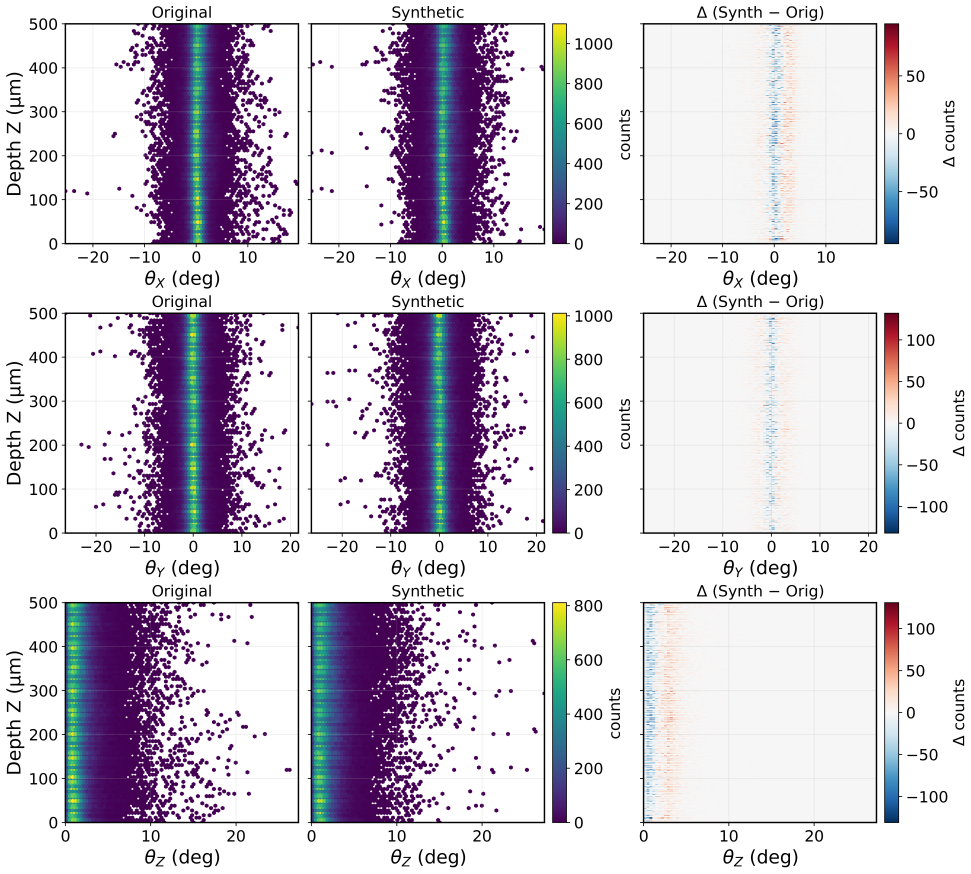
A Bayesian-calibrated stochastic model with copula dependence and autoregressive continuity generates about 2400 statistically equivalent 3D fiber microstructures from X-ray CT data.
A machine-rendered reading of the paper's core claim, the machinery that carries it, and where it could break.
Core claim
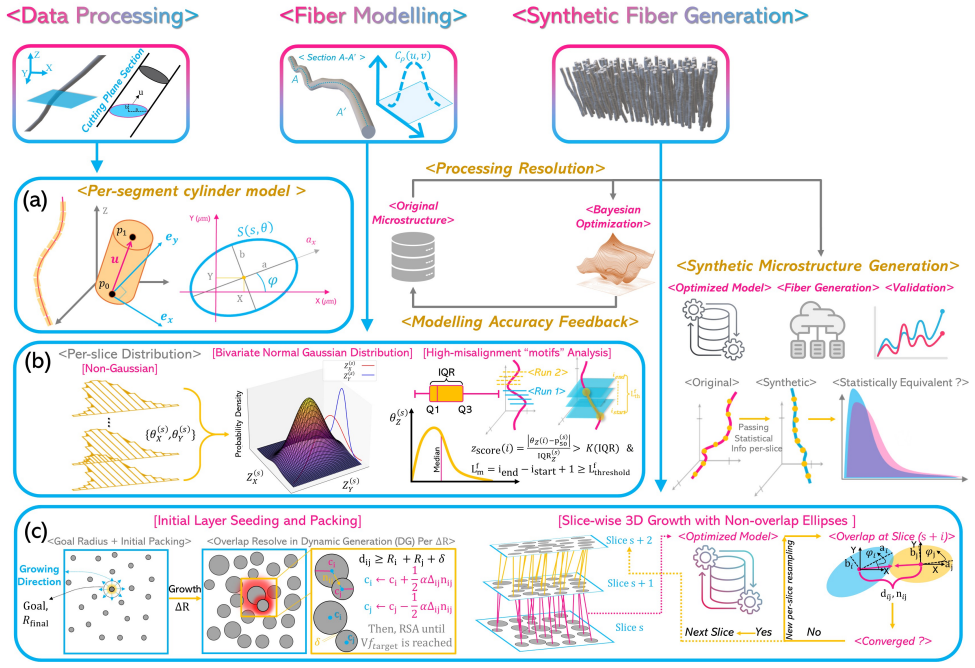
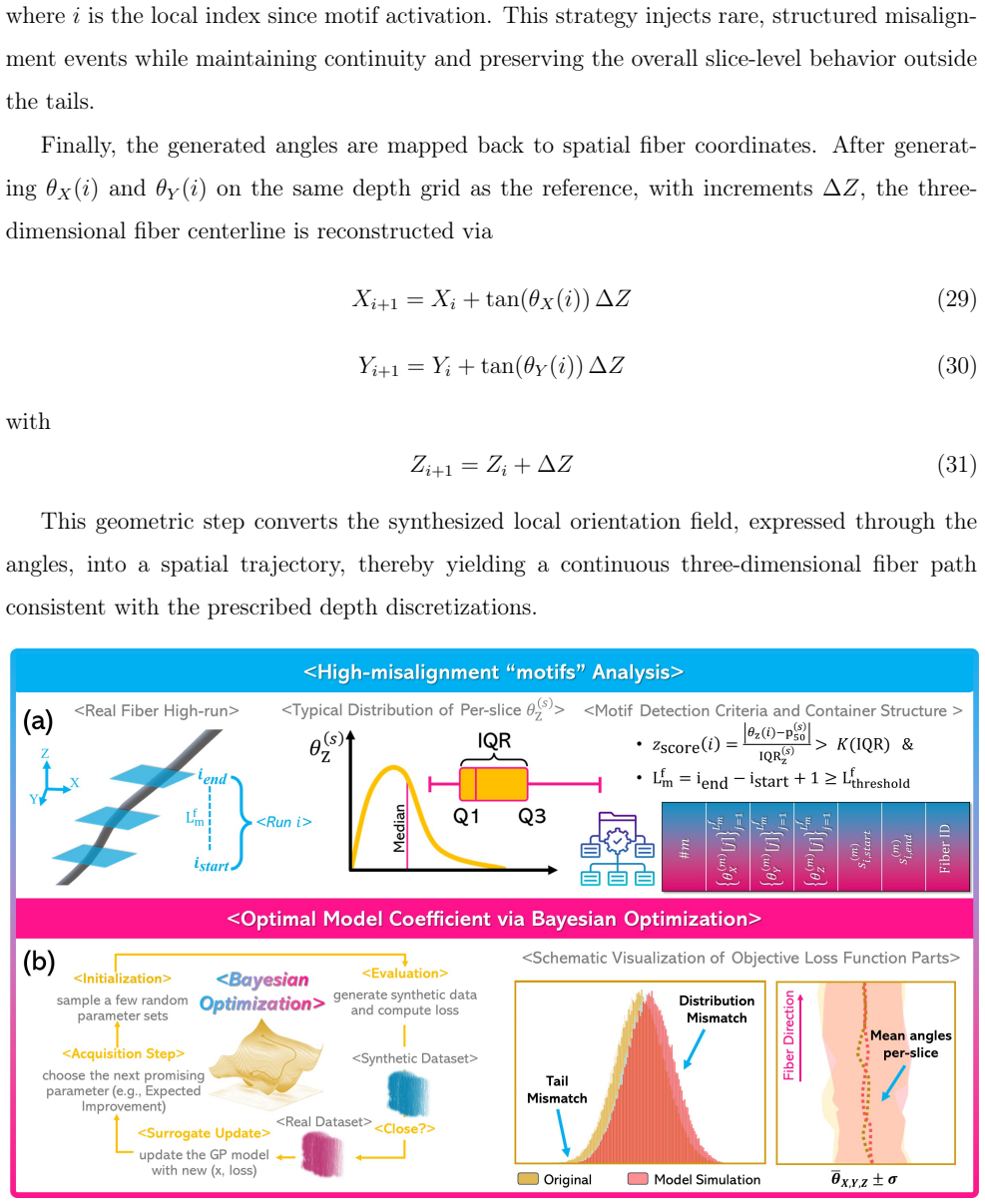
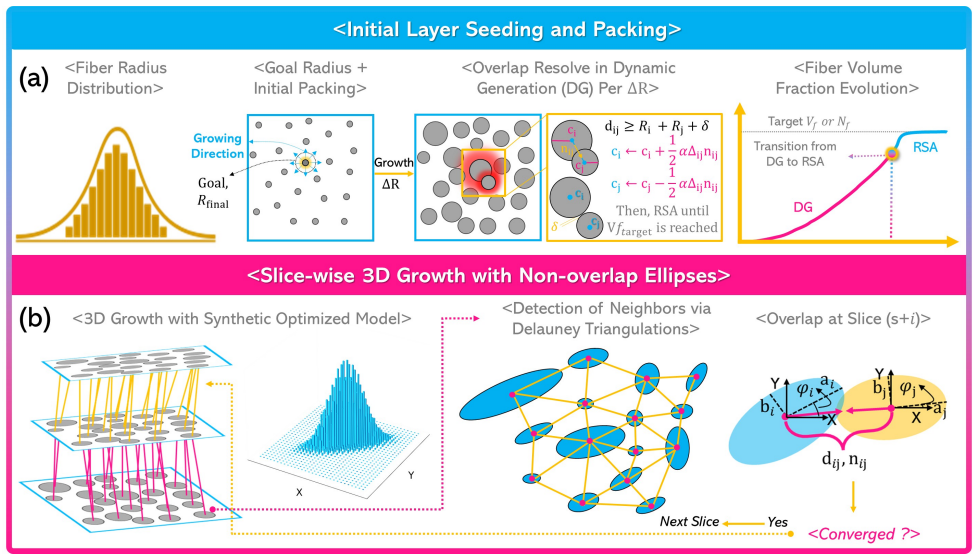
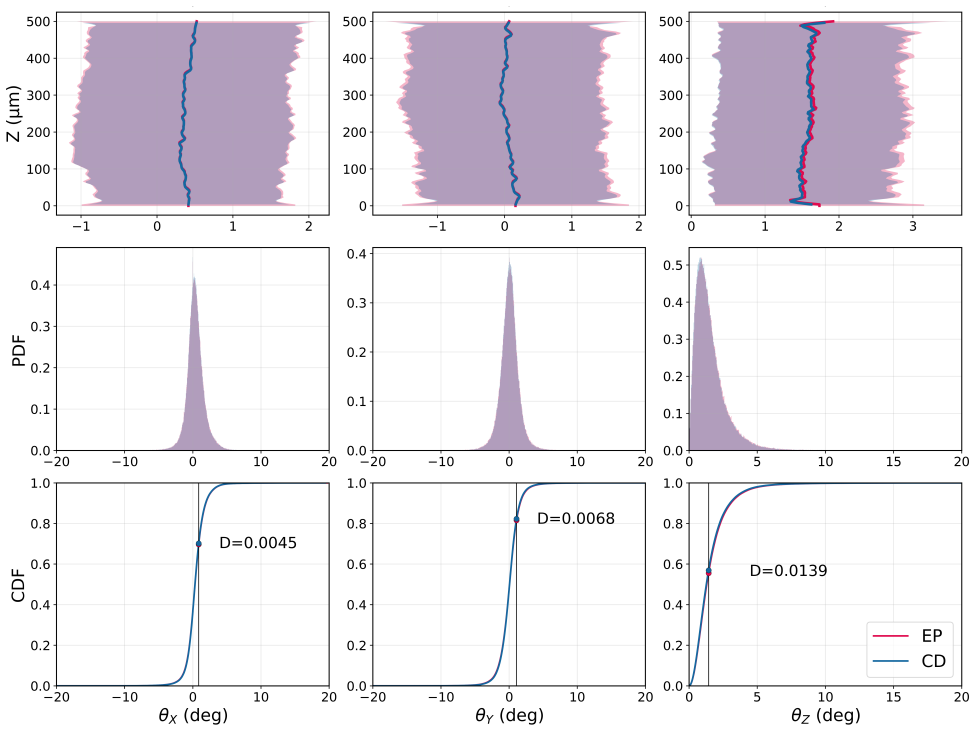
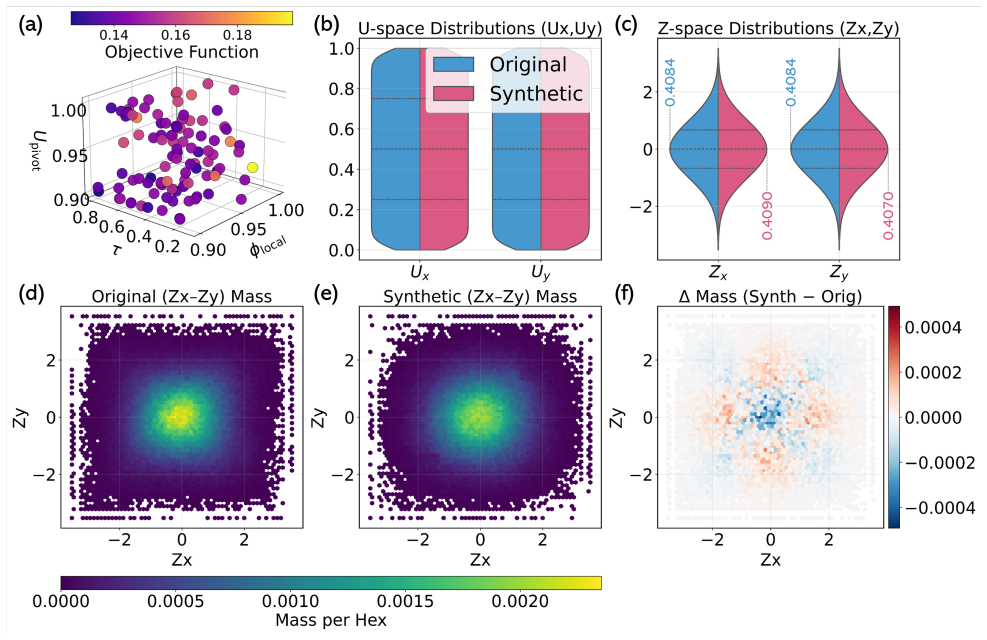
The integrated framework processes X-ray-μCT observations to extract per-slice and per-fiber in-plane and out-of-plane misalignment profiles along fiber depth, constructs a stochastic model that captures slice-wise distributions and depth-wise evolution through copula-based in-plane dependence, latent autoregressive continuity, and rare extreme-misalignment motifs, calibrates the model hyperparameters using Bayesian optimization to achieve close agreement with deviations generally below 10 percent, and couples the model to a physical generation strategy that begins with variable-radius fiber seeding and proceeds through iterative slice-by-slice 3D growth with Delaunay-based neighbourhood con
What carries the argument
The copula-based in-plane dependence combined with latent autoregressive continuity that models slice-wise misalignment distributions and their depth-wise evolution.
If this is right
- The framework supplies a scalable route for producing simulation-ready fiber composite microstructures for virtual testing and analysis.
- Generated microstructures remain non-overlapping and radius-augmented while matching the original statistical descriptors.
- The pipeline supports creation of large numbers of synthetic fibers (approximately 2400 demonstrated) that preserve fidelity to experimental CT observations.
- Bayesian optimization of the model hyperparameters yields close agreement with observed distributions.
Where Pith is reading between the lines
- If the calibrated model generalizes to new manufacturing conditions, the same pipeline could generate variant microstructures for parametric studies of how misalignment statistics influence composite performance.
- The slice-by-slice growth scheme with contact resolution could be extended to incorporate additional geometric constraints such as fiber waviness observed in other imaging modalities.
- Because the generation begins from a statistical layer rather than direct replication, the approach allows controlled variation of rare extreme-misalignment motifs to study their isolated effect on simulated mechanical response.
Load-bearing premise
The copula-based in-plane dependence and latent autoregressive continuity, after Bayesian calibration to the same CT dataset, sufficiently represent the true depth-wise evolution of misalignments without missing physical mechanisms or overfitting to the training statistics.
What would settle it
Extract misalignment statistics from a fresh, independent X-ray-μCT scan of comparable fiber-reinforced composite material and compare them to the statistics of microstructures generated by the calibrated model; systematic deviations exceeding 10 percent would falsify the claim of statistical equivalence.
Figures


read the original abstract
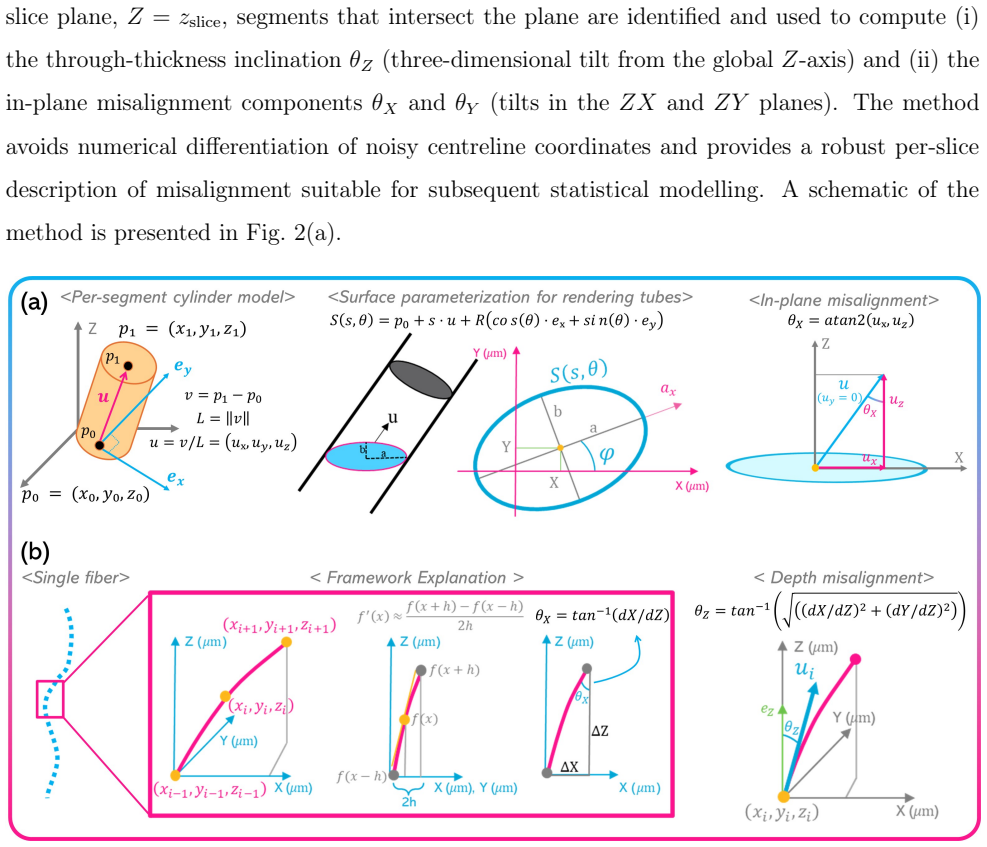
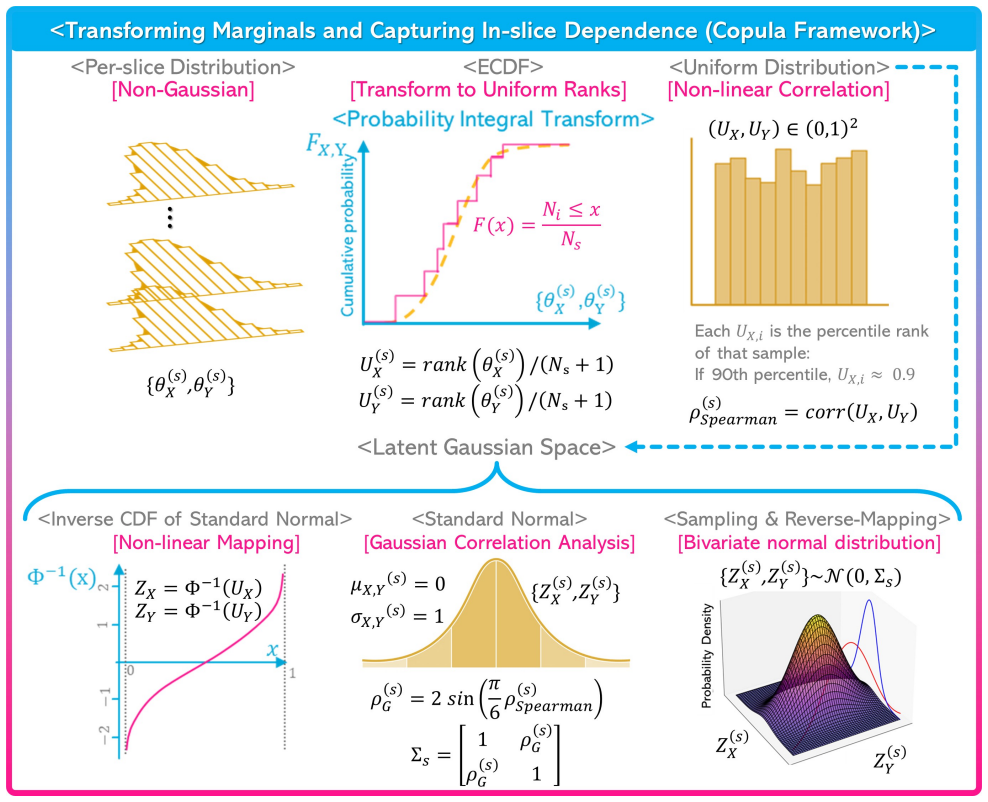
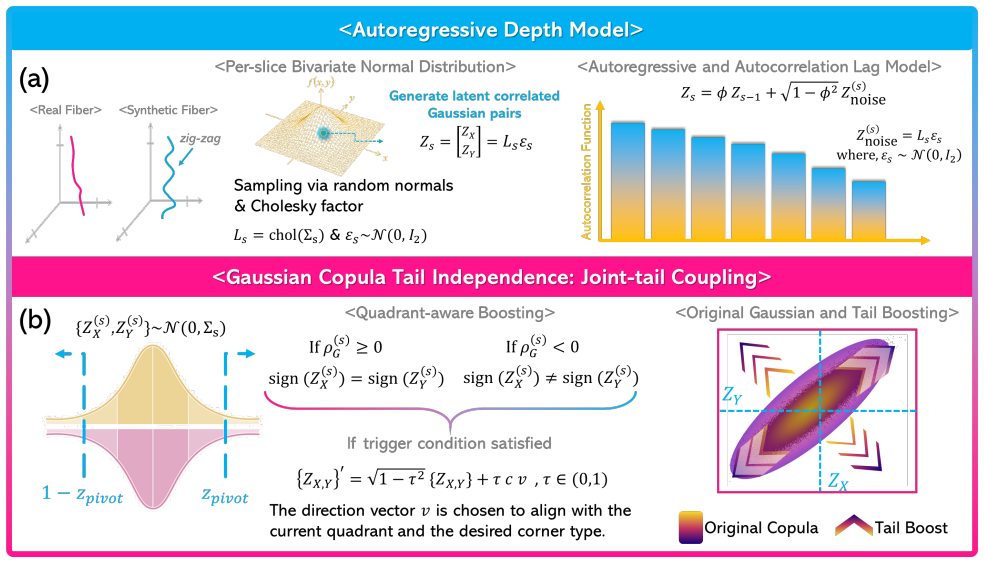
This study presents an integrated framework for processing, modelling, and generating statistically representative three-dimensional fiber microstructures from experimental X-ray-$\mu$CT observations. First, an analytical slice-segment ellipse-intersection method is introduced to extract per-slice and per-fiber in-plane and out-of-plane misalignment profiles along the fiber depth. These descriptors are then used to construct a stochastic model that captures slice-wise misalignment distributions and their depth-wise evolution through, copula-based in-plane dependence, latent autoregressive continuity, and rare extreme-misalignment motifs. The model hyperparameters are calibrated using Bayesian optimization, achieving close agreement with the original statistical descriptors, with deviations generally below 10\%. The optimized statistical model is coupled with a physical generation strategy that begins with variable-radius fiber seeding layer and proceeds through an iterative slice-by-slice 3D growth scheme, where the statistical layer guides fiber evolution and Delaunay-based neighbourhood construction with ellipse-based contact resolution ensures non-overlapping, radius-augmented synthetic microstructures. The framework successfully generates about 2400 synthetic fibers while preserving strong statistical fidelity to the original X-ray-$\mu$CT data. The proposed pipeline provides a promising and scalable route for generating statistically equivalent, geometrically admissible, and simulation-ready fiber composite microstructures for virtual testing and analysis.
Editorial analysis
A structured set of objections, weighed in public.
Referee Report
Summary. The paper presents an integrated framework for extracting per-fiber misalignment profiles from X-ray μCT data of fiber-reinforced composites via an analytical ellipse-intersection method, constructing a stochastic model that combines slice-wise distributions, copula-based in-plane dependence, latent autoregressive continuity for depth-wise evolution, and rare extreme motifs, calibrating hyperparameters via Bayesian optimization to achieve <10% deviation from the original descriptors, and then generating ~2400 synthetic non-overlapping 3D microstructures through a variable-radius seeding and iterative slice-by-slice growth process with Delaunay neighborhood and ellipse contact resolution for use in virtual testing.
Significance. If the statistical equivalence claim holds under independent validation, the work would provide a scalable route to produce simulation-ready, geometrically admissible synthetic microstructures that match experimental statistics without direct imaging of every specimen, supporting larger-scale virtual testing of as-manufactured composites. The combination of data-driven statistical modeling with physical non-overlap constraints is a constructive contribution, though the current calibration workflow limits the strength of the equivalence evidence.
major comments (2)
- [Abstract] Abstract: The central claim of 'strong statistical fidelity' and 'statistically equivalent' microstructures rests on agreement (deviations generally below 10%) achieved after Bayesian optimization of model hyperparameters directly to the statistical descriptors extracted from the same μCT dataset. No independent test specimens, held-out validation sets, cross-validation procedure, or out-of-sample error metrics are described, so the reported fidelity is produced by the fitting process itself rather than an independent check; this is load-bearing for the equivalence assertion.
- [Abstract] Abstract and generation description: The latent autoregressive continuity and copula dependence are calibrated to reproduce the training statistics; without reported tests on whether these structures capture unmodeled manufacturing-induced spatial correlations or generalize to new specimens, it remains unclear whether the generated microstructures would preserve fidelity on metrics or physical mechanisms not used in calibration.
minor comments (1)
- [Abstract] The abstract states that ~2400 synthetic fibers are generated but provides no corresponding count or volume fraction for the original μCT dataset, making it difficult to assess the scale of the reproduction task.
Simulated Author's Rebuttal
We thank the referee for the constructive feedback highlighting the validation aspects of our statistical equivalence claims. We respond to each major comment below.
read point-by-point responses
-
Referee: [Abstract] Abstract: The central claim of 'strong statistical fidelity' and 'statistically equivalent' microstructures rests on agreement (deviations generally below 10%) achieved after Bayesian optimization of model hyperparameters directly to the statistical descriptors extracted from the same μCT dataset. No independent test specimens, held-out validation sets, cross-validation procedure, or out-of-sample error metrics are described, so the reported fidelity is produced by the fitting process itself rather than an independent check; this is load-bearing for the equivalence assertion.
Authors: We agree that the reported agreement results from Bayesian optimization of hyperparameters to the statistical descriptors extracted from the single μCT dataset, without held-out validation sets, cross-validation, or out-of-sample metrics. The fidelity measure is therefore in-sample. The model structure draws on physical considerations of fiber continuity, yet this does not substitute for independent testing. In revision we will qualify the abstract language to describe the microstructures as 'statistically consistent with the calibration descriptors' and add a limitations paragraph clarifying the in-sample nature of the reported agreement. revision: yes
-
Referee: [Abstract] Abstract and generation description: The latent autoregressive continuity and copula dependence are calibrated to reproduce the training statistics; without reported tests on whether these structures capture unmodeled manufacturing-induced spatial correlations or generalize to new specimens, it remains unclear whether the generated microstructures would preserve fidelity on metrics or physical mechanisms not used in calibration.
Authors: The latent autoregressive and copula components are calibrated exclusively to the observed training statistics, and no explicit tests for unmodeled spatial correlations or generalization to new specimens are included. The slice-by-slice physical growth procedure enforces non-overlap constraints that lie outside the statistical calibration. We will revise the manuscript to state the intended scope of equivalence more precisely and to note that assessment of fidelity on additional metrics or independent specimens would require further experimental data. revision: yes
Circularity Check
Bayesian calibration of copula/autoregressive hyperparameters to the identical μCT descriptors makes reported <10% fidelity expected by construction
specific steps
-
fitted input called prediction
[Abstract]
"These descriptors are then used to construct a stochastic model that captures slice-wise misalignment distributions and their depth-wise evolution through, copula-based in-plane dependence, latent autoregressive continuity, and rare extreme-misalignment motifs. The model hyperparameters are calibrated using Bayesian optimization, achieving close agreement with the original statistical descriptors, with deviations generally below 10%. ... The framework successfully generates about 2400 synthetic fibers while preserving strong statistical fidelity to the original X-ray-μCT data."
Descriptors extracted from the μCT dataset are used both to build the model and to calibrate its hyperparameters via Bayesian optimization. The subsequent generation step is then evaluated against those exact same descriptors, so the reported close agreement is the direct output of the fitting process rather than an independent check or out-of-sample prediction.
full rationale
The paper extracts statistical descriptors from the μCT data, constructs the model using those descriptors, calibrates hyperparameters via Bayesian optimization to achieve close agreement with the same descriptors, and then reports the generated microstructures as preserving strong statistical fidelity (deviations generally below 10%). This directly matches the fitted_input_called_prediction pattern: the central fidelity claim reduces to in-sample reproduction after fitting rather than independent validation. No self-citation load-bearing, self-definitional, or other enumerated circular patterns are present in the quoted text. The generation procedure itself is described separately but the reported equivalence is forced by the calibration step.
Axiom & Free-Parameter Ledger
free parameters (1)
- model hyperparameters
axioms (2)
- domain assumption Copula functions adequately capture the joint distribution of in-plane misalignment components within each slice
- domain assumption A latent autoregressive process sufficiently describes the continuity and evolution of misalignment profiles along fiber depth
Reference graph
Works this paper leans on
-
[1]
J. Zhang, G. Lin, U. Vaidya, H. Wang, Past, present and future prospective of global carbon fibre composite developments and applications, Composites Part B: Engineering 250 (2023) 110463.doi:https://doi.org/10.1016/j.compositesb.2022.110463. URLhttps://www.sciencedirect.com/science/article/pii/S1359836822008368
-
[3]
jun Li, J
A. jun Li, J. jun Zhang, F. zhou Zhang, L. Li, S. peng Zhu, Y. hua Yang, Effects of fiber and matrix properties on the compression strength of carbon fiber reinforced polymer composites, New Carbon Materials 35 (6) (2020) 752–761.doi:https://doi.org/10. 1016/S1872-5805(20)60526-1. URLhttps://www.sciencedirect.com/science/article/pii/S1872580520605261
2020
-
[4]
B. A. Bednarcyk, J. Aboudi, S. M. Arnold, Analysis of fiber clustering in composite materi- als using high-fidelity multiscale micromechanics, International Journal of Solids and Struc- tures 69-70 (2015) 311–327.doi:https://doi.org/10.1016/j.ijsolstr.2015.05.019. URLhttps://www.sciencedirect.com/science/article/pii/S0020768315002358
-
[5]
A. Maligno, N. Warrior, A. Long, Effects of inter-fibre spacing on damage evolution in unidirectional (ud) fibre-reinforced composites, European Journal of Mechanics - A/Solids 28 (4) (2009) 768–776.doi:https://doi.org/10.1016/j.euromechsol.2008.10.009. URLhttps://www.sciencedirect.com/science/article/pii/S0997753808001113
-
[6]
M. Alves, C. Cimini Junior, S. Ha, Fiber waviness and its effect on the mechanical perfor- mance of fiber reinforced polymer composites: An enhanced review, Composites Part A: Applied Science and Manufacturing 149 (2021) 106526.doi:https://doi.org/10.1016/ j.compositesa.2021.106526. URLhttps://www.sciencedirect.com/science/article/pii/S1359835X21002487 42
arXiv 2021
-
[7]
P. Kulkarni, K. D. Mali, S. Singh, An overview of the formation of fibre waviness and its effect on the mechanical performance of fibre reinforced polymer composites, Composites Part A: Applied Science and Manufacturing 137 (2020) 106013.doi:https://doi.org/ 10.1016/j.compositesa.2020.106013. URLhttps://www.sciencedirect.com/science/article/pii/S1359835X20302529
-
[8]
H. Ahmadian, M. Yang, A. Nagarajan, S. Soghrati, Effects of shape and misalignment of fibers on the failure response of carbon fiber reinforced polymers, Computational Mechanics 63 (5) (2019) 999–1017.doi:10.1007/s00466-018-1634-1. URLhttps://doi.org/10.1007/s00466-018-1634-1
-
[10]
M. Yadav, N. P. Yelve, T. Gries, A. Tewari, Multiscale investigation of winding tension on porosity, misalignment, and mechanical performance of filament-wound cfrp composites, Composites Science and Technology 271 (2025) 111340.doi:https://doi.org/10.1016/ j.compscitech.2025.111340. URLhttps://www.sciencedirect.com/science/article/pii/S0266353825003082
arXiv 2025
-
[11]
W. Zhang, J. Zou, M. Liu, Z. Han, Y. Xiong, B. Liang, N. Hu, W. Zhang, Investigating the role of fibre-matrix interfacial degradation on the ageing process of carbon fibre-reinforced polymer under hydrothermal conditions, Composites Science and Technology 259 (2025) 110922.doi:https://doi.org/10.1016/j.compscitech.2024.110922. URLhttps://www.sciencedirect...
-
[12]
Joo, S.-H
J.-H. Joo, S.-H. Kim, Y.-J. Yim, J.-S. Bae, M.-K. Seo, Interfacial interlocking of carbon fiber-reinforced polymer composites: A short review, Polymers 17 (3) (2025).doi:10. 3390/polym17030267. URLhttps://www.mdpi.com/2073-4360/17/3/267 43
2025
-
[13]
T. Takahashi, M. Ueda, K. Iizuka, A. Yoshimura, T. Yokozeki, Simulation on kink-band formation during axial compression of a unidirectional carbon fiber-reinforced plastic con- structed by x-ray computed tomography images, Advanced Composite Materials 28 (4) (2019) 347–363.doi:10.1080/09243046.2018.1555387. URLhttps://doi.org/10.1080/09243046.2018.1555387
-
[14]
L. Varandas, G. Catalanotti, A. Melro, R. Tavares, B. Falzon, Micromechanical modelling of the longitudinal compressive and tensile failure of unidirectional composites: The effect of fibre misalignment introduced via a stochastic process, International Journal of Solids and Structures 203 (2020) 157–176.doi:https://doi.org/10.1016/j.ijsolstr.2020. 07.022...
-
[15]
M. Ueda, Y. Suzuki, S. T. Pinho, Estimation of axial compressive strength of unidirectional carbon fiber-reinforced plastic considering the variability of fiber misalignment, Composites Part A: Applied Science and Manufacturing 175 (2023) 107821.doi:https://doi.org/ 10.1016/j.compositesa.2023.107821. URLhttps://www.sciencedirect.com/science/article/pii/S1...
-
[16]
T. Sebaey, G. Catalanotti, C. Lopes, N. O’Dowd, Computational micromechanics of the effect of fibre misalignment on the longitudinal compression and shear properties of ud fibre-reinforced plastics, Composite Structures 248 (2020) 112487.doi:https://doi.org/ 10.1016/j.compstruct.2020.112487. URLhttps://www.sciencedirect.com/science/article/pii/S0263822320311685
-
[18]
S. Krishnappa, S. Gururaja, Compressive failure mechanisms in unidirectional fiber rein- forced polymer composites with embedded wrinkles, Composites Part B: Engineering 284 44 (2024) 111688.doi:https://doi.org/10.1016/j.compositesb.2024.111688. URLhttps://www.sciencedirect.com/science/article/pii/S1359836824005006
-
[19]
G. Han, Z. Guan, X. Li, R. Ji, S. Du, The failure mechanism of carbon fiber-reinforced composites under longitudinal compression considering the interface, Science and En- gineering of Composite Materials 24 (3) (2017) 429–437 [cited 2026-04-08].doi:doi: 10.1515/secm-2015-0057. URLhttps://doi.org/10.1515/secm-2015-0057
-
[20]
M. Bishara, M. Vogler, R. Rolfes, Revealing complex aspects of compressive failure of polymer composites – part ii: Failure interactions in multidirectional laminates and vali- dation, Composite Structures 169 (2017) 116–128, in Honor of Prof. Leissa.doi:https: //doi.org/10.1016/j.compstruct.2016.10.091. URLhttps://www.sciencedirect.com/science/article/pi...
-
[21]
A. T. Zehnder, V. Patel, T. J. Rose, Micro-ct imaging of fibers in composite laminates under high strain bending, Experimental Techniques 44 (5) (2020) 531–540.doi:10.1007/ s40799-020-00374-9. URLhttps://doi.org/10.1007/s40799-020-00374-9
-
[22]
D.-W. Kim, J. H. Lim, S.-W. Kim, Y. Kim, Micro-computed tomography-aided modeling for misaligned and noncircular fibers of unidirectional composites and validation under a transverse tensile loading, Composites Science and Technology 212 (2021) 108879.doi: https://doi.org/10.1016/j.compscitech.2021.108879. URLhttps://www.sciencedirect.com/science/article/...
-
[24]
M. Mehdikhani, C. Breite, Y. Swolfs, M. Wevers, S. V. Lomov, L. Gorbatikh, Combin- ing digital image correlation with x-ray computed tomography for characterization of fiber 45 orientation in unidirectional composites, Composites Part A: Applied Science and Manufac- turing 142 (2021) 106234.doi:https://doi.org/10.1016/j.compositesa.2020.106234. URLhttps:/...
-
[25]
S. Gomarasca, D. Peeters, B. Atli-Veltin, C. Dransfeld, Characterising microstructural or- ganisation in unidirectional composites, Composites Science and Technology 215 (2021) 109030.doi:https://doi.org/10.1016/j.compscitech.2021.109030. URLhttps://www.sciencedirect.com/science/article/pii/S0266353821003869
-
[26]
T. Zheng, F. Jia, Z. Wang, Z. Chen, F. Guo, L. Guo, Statistical characteristics of realistic fiber misalignments of unidirectional composites: Fitting distributions and scanning length effects, Thin-Walled Structures 206 (2025) 112621.doi:https://doi.org/10.1016/j. tws.2024.112621. URLhttps://www.sciencedirect.com/science/article/pii/S0263823124010619
work page doi:10.1016/j 2025
-
[27]
Y. Lee, T. Chatziathanasiou, C. Breite, M. Mehdikhani, Y. Swolfs, M. N. Mavrogordato, S. M. Spearing, I. Sinclair, Correlating fibre break development with fibre misalignment and resin-rich pockets using in situ holotomography, Composites Part A: Applied Science and Manufacturing 200 (2026) 109361.doi:https://doi.org/10.1016/j.compositesa. 2025.109361. UR...
-
[28]
S. Gomarasca, D. Peeters, B. Atli-Veltin, T. Slange, G. Ratouit, C. Dransfeld, Charac- terising pore networks and their interrelation with the fibre architecture in unidirectional composites, Composites Part A: Applied Science and Manufacturing 190 (2025) 108669. doi:https://doi.org/10.1016/j.compositesa.2024.108669. URLhttps://www.sciencedirect.com/scien...
-
[30]
T. Takahashi, A. Todoroki, C. Kawamura, R. Higuchi, T. Sugiyama, T. Miyanaga, K. Hat- tori, M. Ueda, T. Yokozeki, M. Honda, Unidirectional cfrp kinking under uniaxial compres- sion modeled using synchrotron radiation computed tomography imaging, Composite Struc- tures 289 (2022) 115458.doi:https://doi.org/10.1016/j.compstruct.2022.115458. URLhttps://www.s...
-
[31]
Z. Zhao, H. Wu, M. Zhang, S. Fu, K. Zhu, Fiber orientation reconstruction from sem images of fiber-reinforced composites, Applied Sciences 13 (6) (2023).doi:10.3390/app13063700. URLhttps://www.mdpi.com/2076-3417/13/6/3700
-
[32]
G. Seon, A. Makeev, A computer graphics-based method for efficient generation of 3d micromodels of cfrps and investigation of the effect of random fiber misalignment phase on fiber-direction compressive strength, Composites Science and Technology 277 (2026) 111545.doi:https://doi.org/10.1016/j.compscitech.2026.111545. URLhttps://www.sciencedirect.com/scie...
-
[33]
G. Catalanotti, T. Sebaey, An algorithm for the generation of three-dimensional statistically representative volume elements of unidirectional fibre-reinforced plastics: Focusing on the fibres waviness, Composite Structures 227 (2019) 111272.doi:https://doi.org/10.1016/ j.compstruct.2019.111272. URLhttps://www.sciencedirect.com/science/article/pii/S026382...
arXiv 2019
-
[34]
T. Sebaey, G. Catalanotti, N. O’Dowd, A microscale integrated approach to measure and model fibre misalignment in fibre-reinforced composites, Composites Science and Technol- ogy 183 (2019) 107793.doi:https://doi.org/10.1016/j.compscitech.2019.107793. URLhttps://www.sciencedirect.com/science/article/pii/S0266353819316537
-
[35]
A. Kumar, A. DasGupta, A. Jain, Microstructure generation algorithm and micromechanics of curved fiber composites with random waviness, International Journal of Solids and Struc- tures 289 (2024) 112625.doi:https://doi.org/10.1016/j.ijsolstr.2023.112625. URLhttps://www.sciencedirect.com/science/article/pii/S002076832300522X
-
[36]
J. He, F. Zheng, W. Ma, G. Zhou, G. Fan, Z. Chen, Z. Liu, D. Li, Statistical modeling of 3d fiber geometry in pultruded gfrp composite: A multi-scale approach, Composites Sci- ence and Technology 256 (2024) 110734.doi:https://doi.org/10.1016/j.compscitech. 47 2024.110734. URLhttps://www.sciencedirect.com/science/article/pii/S026635382400304X
-
[37]
C. Lauff, M. Schneider, T. Böhlke, Microstructure generation of long fiber reinforced hybrid composites using the fused sequential addition and migration method, Journal of Thermo- plastic Composite Materials 38 (8) (2025) 2855–2893.arXiv:https://doi.org/10.1177/ 08927057251314425,doi:10.1177/08927057251314425. URLhttps://doi.org/10.1177/08927057251314425
-
[38]
Y. Zhou, Z. Yan, P. Hubert, An artifactual fibre overlap removal algorithm for micro- computed tomography image post-processing and 3d microstructure generation with graph- ics processing unit acceleration, Materials and Design 247 (2024) 113376.doi:https: //doi.org/10.1016/j.matdes.2024.113376. URLhttps://www.sciencedirect.com/science/article/pii/S026412...
-
[39]
Delft High Performance Computing Centre (DHPC), DelftBlue Supercomputer (Phase 2), https://www.tudelft.nl/dhpc/ark:/44463/DelftBluePhase2(2024)
2024
-
[40]
A. Heinen, A. Valdesogo, Spearman rank correlation of the bivariate student t and scale mixtures of normal distributions, Journal of Multivariate Analysis 179 (2020) 104650.doi: https://doi.org/10.1016/j.jmva.2020.104650. URLhttps://www.sciencedirect.com/science/article/pii/S0047259X20302311
-
[41]
A. V. Metcalfe, P. S. Cowpertwait, Introductory Time Series with R, Use R!, Springer New York, NY, New York, NY, 2009.doi:10.1007/978-0-387-88698-5. URLhttps://michaelakratofil.com/files/2009_Book_ IntroductoryTimeSeriesWithR.pdf
-
[42]
J. D. Hamilton, Time Series Analysis, Princeton University Press, Princeton, NJ, 1994, chapter 3, pages 45, 48.doi:https://doi.org/10.1515/9780691218632. URLhttps://princeton.edu
-
[43]
R. Lanzafame, T. van Woudenberg, S. Verhagen, Modelling, Uncertainty and Data for Engineers (MUDE), Delft University of Technology, Delft, Netherlands, 2024, cC BY 4.0. 48 doi:10.5281/zenodo.16236358. URLhttps://mude.citg.tudelft.nl/book/2024
-
[44]
M. A. Raja, S. H. Lim, D. Jeon, S. Bae, W. Oh, I. Yang, D. Kang, J. Ha, H. E. Lee, I.-K. Oh, S. Kim, S. S. Kim, Thin, uniform, and highly packed multifunctional structural carbon fiber composite battery lamina informed by solid polymer electrolyte cure kinetics, ACS Applied Materials & Interfaces 16 (43) (2024) 59128–59142, pMID: 39255971.arXiv: https://d...
-
[45]
M. A. Raja, W. Kim, W. Kim, S. H. Lim, S. S. Kim, Computational micromechanics and machine learning-informed design of composite carbon fiber-based structural battery for multifunctional performance prediction, ACS Applied Materials & Interfaces 17 (13) (2025) 20125–20137, pMID: 39988802.arXiv:https://doi.org/10.1021/acsami.4c19073,doi: 10.1021/acsami.4c1...
discussion (0)
Sign in with ORCID, Apple, or X to comment. Anyone can read and Pith papers without signing in.