Qiskit Code Migration with LLMs
Pith reviewed 2026-06-26 16:22 UTC · model grok-4.3
The pith
Taxonomy-based RAG lets LLMs migrate Qiskit code across versions with fewer hallucinations than direct prompting.
A machine-rendered reading of the paper's core claim, the machinery that carries it, and where it could break.
Core claim
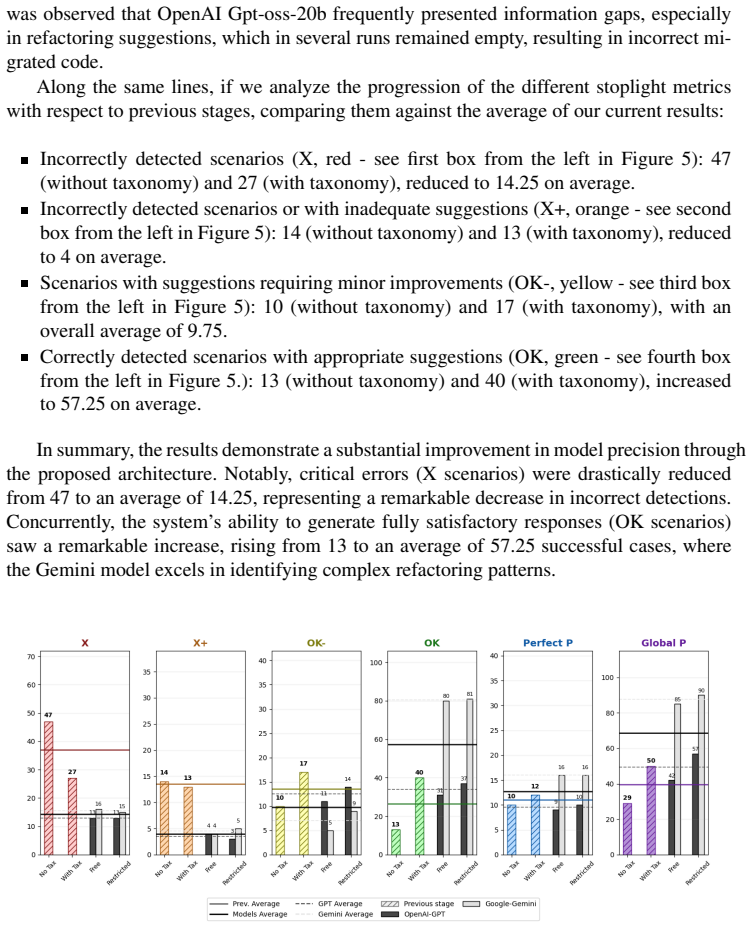
The central claim is that a hybrid LLM plus RAG system, supplied with an automatically generated taxonomy of version-specific migration scenarios, produces more reliable and less hallucinated refactoring suggestions than standard LLM prompting when moving Qiskit code between releases; the restrictive retrieval variant yields the clearest gains, and one tested model outperforms the other on complex cases.
What carries the argument
The automatically generated taxonomy of migration scenarios, which supplies version-specific structured knowledge to the retrieval step so the model only draws from verified patterns rather than its general training.
If this is right
- The restrictive retrieval scheme measurably lowers hallucination rates compared with unconstrained retrieval.
- Google Gemini Flash-2.5 detects complex refactoring scenarios more reliably than the other tested model under the same taxonomy setup.
- The resulting assistants can mitigate API obsolescence and keep quantum algorithms runnable across framework updates.
- The approach flattens the learning curve for developers working in a fast-changing quantum software environment.
Where Pith is reading between the lines
- The same taxonomy-plus-restrictive-RAG pattern could be applied to migration tasks in other rapidly evolving libraries outside quantum computing.
- If the taxonomy generation step itself can be made self-correcting, the method would become less dependent on the initial quality of the extracted scenarios.
- A natural next measurement would be to track how often the produced migrations actually compile and pass tests on real hardware after the suggested changes.
Load-bearing premise
An automatically generated taxonomy will contain complete and accurate version-specific knowledge that steers the models without missing edge cases or introducing its own errors.
What would settle it
Run the system on a set of Qiskit migration cases deliberately chosen to include an edge-case pattern absent from the generated taxonomy; if the model then produces a hallucinated or incorrect refactoring that matches the missing pattern, the claim fails.
Figures
read the original abstract
The rapid evolution of Quantum Development Kits (QDKs) introduces a specific form of technical debt that compromises code maintainability and hinders software reuse. In the specialized domain of Quantum Software Engineering (QSE), this challenge is intensified by the scarcity of high-quality training data and the high volatility of emerging frameworks, which often lead general-purpose Large Language Models (LLMs) to produce unreliable or hallucinated results. This paper proposes a hybrid approach integrating LLMs with Retrieval-Augmented Generation (RAG) to automate the migration of Qiskit code across versions. The proposed methodology enhances the precision and reliability of migration suggestions by leveraging an automatically generated taxonomy of migration scenarios as the structured, version-specific knowledge source to guide the models. The approach is implemented through an automated, extensible workflow evaluating LLMs (Google Gemini Flash-2.5 and OpenAI Gpt-oss-20b) under different retrieval schemes (unconstrained and restrictive). Results demonstrate that the taxonomy-based RAG architecture, particularly under the restrictive scheme, significantly reduces hallucinations and improves descriptive quality, with Google Gemini Flash-2.5 showing superior performance in detecting complex refactoring scenarios. These findings confirm the potential of this data-centric methodology to foster technological independence and provide robust, intelligent assistants that mitigate API obsolescence, ensuring the long-term availability of quantum algorithms within a rapidly shifting ecosystem and flattening the learning curve within Quantum Software Engineering (QSE).
Editorial analysis
A structured set of objections, weighed in public.
Referee Report
Summary. The paper proposes a hybrid LLM+RAG method for migrating Qiskit code across versions. It uses an automatically generated taxonomy of migration scenarios as structured knowledge to guide models (Gemini Flash-2.5 and GPT-oss-20b) under unconstrained vs. restrictive retrieval schemes, claiming that the taxonomy-based RAG (especially restrictive) significantly reduces hallucinations, improves descriptive quality, and that Gemini excels at complex refactoring detection.
Significance. If the empirical claims hold after proper validation, the work would offer a practical, extensible workflow for handling rapid API evolution in quantum software engineering, where training data scarcity makes general LLMs unreliable; the data-centric emphasis on version-specific taxonomies could generalize to other volatile frameworks.
major comments (2)
- [Taxonomy generation subsection] Taxonomy generation subsection (likely §3 or §4): the automated workflow is presented as supplying complete, accurate version-specific knowledge that steers LLMs and reduces hallucinations, yet no validation against ground truth (precision/recall vs. official Qiskit docs, coverage of deprecated patterns or edge-case refactorings, or expert review) is reported; without this, the restrictive RAG scheme could propagate rather than mitigate taxonomy errors, directly undermining the central performance claims.
- [Evaluation section] Evaluation section: positive results for hallucination reduction and quality improvement are asserted for Gemini Flash-2.5 under the restrictive scheme, but no quantitative metrics, baselines, dataset details, error bars, or statistical comparisons are supplied, leaving the strongest_claim unverifiable.
minor comments (2)
- [Abstract] Abstract states results at a high level without any numbers or dataset size; this should be expanded with at least summary statistics even if full tables appear later.
- [Methodology] Notation for the two retrieval schemes (unconstrained/restrictive) should be defined explicitly on first use with a short example of how the taxonomy is injected.
Simulated Author's Rebuttal
We thank the referee for the constructive and detailed comments. We address each major point below and commit to revisions that strengthen the verifiability of the taxonomy and evaluation claims while preserving the core contribution of the taxonomy-guided RAG workflow.
read point-by-point responses
-
Referee: [Taxonomy generation subsection] Taxonomy generation subsection (likely §3 or §4): the automated workflow is presented as supplying complete, accurate version-specific knowledge that steers LLMs and reduces hallucinations, yet no validation against ground truth (precision/recall vs. official Qiskit docs, coverage of deprecated patterns or edge-case refactorings, or expert review) is reported; without this, the restrictive RAG scheme could propagate rather than mitigate taxonomy errors, directly undermining the central performance claims.
Authors: We agree that explicit validation of the automatically generated taxonomy is required to support the claim that it supplies reliable version-specific knowledge. The current manuscript describes the LLM-assisted extraction process from release notes but does not report precision/recall or coverage metrics. In the revision we will add a dedicated validation subsection that (1) constructs a ground-truth set of migration scenarios from official Qiskit documentation and deprecation lists for two representative version pairs, (2) computes precision, recall, and coverage against this ground truth, and (3) discusses any residual edge cases. This will allow readers to assess whether taxonomy errors could propagate under the restrictive RAG scheme. revision: yes
-
Referee: [Evaluation section] Evaluation section: positive results for hallucination reduction and quality improvement are asserted for Gemini Flash-2.5 under the restrictive scheme, but no quantitative metrics, baselines, dataset details, error bars, or statistical comparisons are supplied, leaving the strongest_claim unverifiable.
Authors: We acknowledge that the evaluation section in the submitted draft relies primarily on illustrative examples and aggregate qualitative observations rather than fully specified quantitative results. In the revised manuscript we will expand the evaluation section to include: (i) explicit dataset statistics (number of migration tasks, version pairs, and code snippets), (ii) quantitative hallucination rates obtained by fact-checking model outputs against official Qiskit documentation, (iii) descriptive-quality scores from a small-scale human evaluation, (iv) direct comparison against the unconstrained LLM and standard RAG baselines, and (v) error bars and statistical significance tests across repeated runs. These additions will render the performance claims verifiable. revision: yes
Circularity Check
No circularity: empirical method with external evaluation
full rationale
The paper describes an empirical workflow for taxonomy-based RAG to migrate Qiskit code, evaluated on external LLMs (Gemini Flash-2.5, GPT-oss-20b) under different retrieval schemes. No derivation chain, equations, first-principles predictions, or fitted parameters exist. The taxonomy is generated automatically as input to the method, not derived from or equivalent to the reported outcomes. No self-citations are load-bearing for any central claim, and results are presented as experimental findings rather than constructed equivalences. This is a standard non-circular empirical proposal.
Axiom & Free-Parameter Ledger
Reference graph
Works this paper leans on
-
[1]
Yetiştiren, Burak and Özsoy, Işık and Ayerdem, Miray and Tüzün, Eray , month = oct, year =. Evaluating the. doi:10.48550/arXiv.2304.10778 , abstract =
-
[2]
Aragonés-Soria, Yaiza and Oriol, Manuel , month = apr, year =. Proceedings of the 5th. doi:10.1145/3643667.3648222 , abstract =
-
[3]
Nikolov, Stoyan and Codecasa, Daniele and Sjovall, Anna and Tabachnyk, Maxim and Chandra, Satish and Taneja, Siddharth and Ziftci, Celal , month = jan, year =. How is. doi:10.48550/arXiv.2501.06972 , abstract =
-
[4]
Refactoring-vs-
Nicoll, Lydia , file =. Refactoring-vs-
-
[5]
Expert Systems with Applications , author =
Exploring. Expert Systems with Applications , author =. 2024 , pages =. doi:10.1016/j.eswa.2024.123602 , abstract =
-
[6]
Pomian, Dorin and Bellur, Abhiram and Dilhara, Malinda and Kurbatova, Zarina and Bogomolov, Egor and Bryksin, Timofey and Dig, Danny , month = apr, year =. Together. doi:10.48550/arXiv.2401.15298 , abstract =
-
[7]
Refactoring to. Proc. ACM Softw. Eng. , author =. 2024 , doi =. doi:10.1145/3643776 , abstract =
-
[8]
IEEE International Conference on Software Maintenance and Evolution , author =
Next-. IEEE International Conference on Software Maintenance and Evolution , author =. 2024 , doi =. doi:10.1109/icsme58944.2024.00034 , abstract =
-
[9]
2025 , note =
Automated. 2025 , note =
2025
-
[10]
In: International Conference on Cluster Computing Workshops (CLUSTER Workshops)
2024 IEEE International Conference on Cluster Computing Workshops (CLUSTER Workshops) , author =. 2024 , doi =. doi:10.1109/clusterworkshops61563.2024.00029 , abstract =
-
[11]
International Conference on Software Engineering Research and Applications , author =
Improving. International Conference on Software Engineering Research and Applications , author =. 2024 , doi =. doi:10.1109/sera61261.2024.10685589 , abstract =
-
[12]
Context-. arXiv.org , author =. 2024 , doi =. doi:10.48550/arxiv.2409.16739 , abstract =
-
[13]
Baumgartner, Nils and Iyenghar, Padma and Schoemaker, Timo and Pulvermüller, Elke , month = jan, year =. Electronics , publisher =. doi:10.3390/electronics13091644 , abstract =
-
[14]
TransAgent: Enhancing LLM-Based Code Translation via Fine-Grained Execution Alignment
Yuan, Zhiqiang and Chen, Weitong and Wang, Hanlin and Yu, Kai and Peng, Xin and Lou, Yiling , month = oct, year =. doi:10.48550/arXiv.2409.19894 , abstract =
work page internal anchor Pith review Pith/arXiv arXiv doi:10.48550/arxiv.2409.19894
-
[15]
Cordeiro, Jonathan and Noei, Shayan and Zou, Ying , month = nov, year =. An. doi:10.48550/arXiv.2411.02320 , abstract =
-
[16]
Almeida, Aylton and Xavier, Laerte and Valente, Marco Tulio , month = oct, year =. Automatic. Proceedings of the 18th. doi:10.1145/3674805.3690746 , abstract =
-
[17]
Maveli, Nickil and Vergari, Antonio and Cohen, Shay B. , month = aug, year =. What can. doi:10.48550/arXiv.2408.11081 , abstract =
-
[18]
Sahoo, Pranab and Singh, Ayush Kumar and Saha, Sriparna and Jain, Vinija and Mondal, Samrat and Chadha, Aman , month = feb, year =. A. doi:10.48550/arXiv.2402.07927 , abstract =
work page internal anchor Pith review Pith/arXiv arXiv doi:10.48550/arxiv.2402.07927
-
[19]
Dupuis, Nicolas and Buratti, Luca and Vishwakarma, Sanjay and Forrat, Aitana Viudes and Kremer, David and Faro, Ismael and Puri, Ruchir and Cruz-Benito, Juan , month = may, year =. Qiskit. doi:10.48550/arXiv.2405.19495 , abstract =
-
[20]
Zhao, Jianjun , month = jun, year =. On. doi:10.48550/arXiv.2306.10517 , abstract =
-
[21]
Deng, Yihe and Zhang, Weitong and Chen, Zixiang and Gu, Quanquan , month = apr, year =. Rephrase and. doi:10.48550/arXiv.2311.04205 , abstract =
-
[22]
doi:10.48550/arXiv.2310.20329 , abstract =
Li, Kaixin and Hu, Qisheng and Zhao, Xu and Chen, Hui and Xie, Yuxi and Liu, Tiedong and Xie, Qizhe and He, Junxian , month = feb, year =. doi:10.48550/arXiv.2310.20329 , abstract =
-
[23]
Shirafuji, Atsushi and Rahman, Md Mostafizer and Amin, Md Faizul Ibne and Watanobe, Yutaka , month = nov, year =. Program. 2023 12th. doi:10.1109/iCAST57874.2023.10359288 , abstract =
-
[24]
Khojah, Ranim and Neto, Francisco Gomes de Oliveira and Mohamad, Mazen and Leitner, Philipp , month = dec, year =. The. doi:10.48550/arXiv.2412.20545 , abstract =
-
[25]
Huynh, Nam and Lin, Beiyu , month = mar, year =. A
-
[26]
Quantum computing in the NISQ era and beyond,
Quantum. Quantum , author =. 2018 , note =. doi:10.22331/q-2018-08-06-79 , abstract =
work page internal anchor Pith review doi:10.22331/q-2018-08-06-79 2018
-
[27]
Guo, Xiaoyu and Zhao, Jianjun and Zhao, Pengzhan , month = jan, year =. On. doi:10.48550/arXiv.2401.14913 , abstract =
-
[28]
Svore, Krysta M. and Geller, Alan and Troyer, Matthias and Azariah, John and Granade, Christopher and Heim, Bettina and Kliuchnikov, Vadym and Mykhailova, Mariia and Paz, Andres and Roetteler, Martin , month = feb, year =. Q\#:. Proceedings of the. doi:10.1145/3183895.3183901 , abstract =
-
[29]
ACM SIGPLAN Notices , author =
Quipper:. ACM SIGPLAN Notices , author =. 2013 , note =. doi:10.1145/2499370.2462177 , abstract =
-
[30]
Javadi-Abhari, Ali and Treinish, Matthew and Krsulich, Kevin and Wood, Christopher J. and Lishman, Jake and Gacon, Julien and Martiel, Simon and Nation, Paul D. and Bishop, Lev S. and Cross, Andrew W. and Johnson, Blake R. and Gambetta, Jay M. , month = jun, year =. Quantum computing with. doi:10.48550/arXiv.2405.08810 , abstract =
work page internal anchor Pith review Pith/arXiv arXiv doi:10.48550/arxiv.2405.08810
-
[31]
2025 , note =
Qiskit/qiskit , copyright =. 2025 , note =
2025
-
[32]
Zhao, Jianjun , month = mar, year =. Some. doi:10.48550/arXiv.2103.08815 , abstract =
-
[33]
Alrubaye, Hussein and Alshoaibi, Deema and Alomar, Eman and Mkaouer, Mohamed Wiem and Ouni, Ali , month = oct, year =. How. doi:10.48550/arXiv.1907.07724 , abstract =
-
[34]
Islam, Mohayeminul and Jha, Ajay Kumar and Nadi, Sarah and Akhmetov, Ildar , month = may, year =. 2023. doi:10.1109/MSR59073.2023.00075 , abstract =
-
[35]
Proceedings of the ACM on Software Engineering , author =
Characterizing. Proceedings of the ACM on Software Engineering , author =. 2024 , note =. doi:10.1145/3643731 , abstract =
-
[36]
Noei, Shayan and Li, Heng and Zou, Ying , month = apr, year =. Detecting. doi:10.48550/arXiv.2404.06572 , abstract =
-
[37]
Xu, Zhaowei and Ying, Mingsheng and Ying, Shenggang , month = dec, year =. A. doi:10.48550/arXiv.1812.00349 , abstract =
work page internal anchor Pith review Pith/arXiv arXiv doi:10.48550/arxiv.1812.00349
-
[38]
doi:10.48550/arXiv.2205.03866 , abstract =
Guo, Jingzhe and Lou, Huazhe and Li, Riling and Fang, Wang and Liu, Junyi and Long, Peixun and Ying, Shenggang and Ying, Mingsheng , month = nov, year =. doi:10.48550/arXiv.2205.03866 , abstract =
-
[39]
Ali, Shaukat and Arcaini, Paolo and Wang, Xinyi and Yue, Tao , month = apr, year =. Assessing the. 2021 14th. doi:10.1109/ICST49551.2021.00014 , abstract =
-
[40]
Ramalho, Neilson Carlos Leite and Souza, Higor Amario de and Chaim, Marcos Lordello , month = oct, year =. Testing and. doi:10.48550/arXiv.2405.09178 , abstract =
-
[41]
Li, Gushu and Zhou, Li and Yu, Nengkun and Ding, Yufei and Ying, Mingsheng and Xie, Yuan , month = may, year =. Proq:. doi:10.48550/arXiv.1911.12855 , abstract =
-
[42]
A PennyLane-Centric Dataset to Enhance LLM-based Quantum Code Generation using RAG
Asif, Haider and Basit, Abdul and Innan, Nouhaila and Kashif, Muhammad and Marchisio, Alberto and Shafique, Muhammad , month = mar, year =. doi:10.48550/arXiv.2503.02497 , abstract =
work page internal anchor Pith review Pith/arXiv arXiv doi:10.48550/arxiv.2503.02497
-
[43]
Software and Systems Modeling , author =
Code generation for classical-quantum software systems modeled in. Software and Systems Modeling , author =. 2025 , keywords =. doi:10.1007/s10270-024-01259-w , abstract =
-
[44]
Qiskit 1.0 release summary
-
[45]
IEEE Transactions on Software Engineering , author =. 2022 , note =. doi:10.1109/TSE.2020.3007722 , abstract =
-
[46]
Jin, Haolin and Chen, Huaming and Lu, Qinghua and Zhu, Liming , month = jan, year =. Towards. doi:10.48550/arXiv.2501.11354 , abstract =
-
[47]
Nation, Paul D. and Saki, Abdullah Ash and Brandhofer, Sebastian and Bello, Luciano and Garion, Shelly and Treinish, Matthew and Javadi-Abhari, Ali , month = feb, year =. Benchmarking the performance of quantum computing software , url =. doi:10.48550/arXiv.2409.08844 , abstract =
-
[48]
Quantum , author =. 2023 , note =. doi:10.22331/q-2023-07-20-1062 , abstract =
-
[49]
Quantum Science and Technology , author =
t\. Quantum Science and Technology , author =. 2021 , note =. doi:10.1088/2058-9565/ab8e92 , abstract =
-
[50]
Quantum Science and Technology , author =
staq --. Quantum Science and Technology , author =. 2020 , note =. doi:10.1088/2058-9565/ab9359 , abstract =
-
[51]
Bengesi, Staphord and El-Sayed, Hoda and Sarker, Md Kamruzzaman and Houkpati, Yao and Irungu, John and Oladunni, Timothy , month = nov, year =. Advancements in. doi:10.48550/arXiv.2311.10242 , abstract =
-
[52]
In Proceedings of the 2024 CHI Conference on Human Factors in Computing Systems (CHI ’24)
Weisz, Justin D. and He, Jessica and Muller, Michael and Hoefer, Gabriela and Miles, Rachel and Geyer, Werner , month = may, year =. Design. Proceedings of the. doi:10.1145/3613904.3642466 , abstract =
-
[53]
GitHub , file =
Qiskit extensions , url =. GitHub , file =
-
[54]
OpenAI and Achiam, Josh and Adler, Steven and Agarwal, Sandhini and Ahmad, Lama and Akkaya, Ilge and Aleman, Florencia Leoni and Almeida, Diogo and Altenschmidt, Janko and Altman, Sam and Anadkat, Shyamal and Avila, Red and Babuschkin, Igor and Balaji, Suchir and Balcom, Valerie and Baltescu, Paul and Bao, Haiming and Bavarian, Mohammad and Belgum, Jeff a...
work page internal anchor Pith review Pith/arXiv arXiv doi:10.48550/arxiv.2303.08774
-
[55]
Rozière, Baptiste and Gehring, Jonas and Gloeckle, Fabian and Sootla, Sten and Gat, Itai and Tan, Xiaoqing Ellen and Adi, Yossi and Liu, Jingyu and Sauvestre, Romain and Remez, Tal and Rapin, Jérémy and Kozhevnikov, Artyom and Evtimov, Ivan and Bitton, Joanna and Bhatt, Manish and Ferrer, Cristian Canton and Grattafiori, Aaron and Xiong, Wenhan and Défoss...
work page internal anchor Pith review Pith/arXiv arXiv doi:10.48550/arxiv.2308.12950
-
[56]
Team, Gemini and Georgiev, Petko and Lei, Ving Ian and Burnell, Ryan and Bai, Libin and Gulati, Anmol and Tanzer, Garrett and Vincent, Damien and Pan, Zhufeng and Wang, Shibo and Mariooryad, Soroosh and Ding, Yifan and Geng, Xinyang and Alcober, Fred and Frostig, Roy and Omernick, Mark and Walker, Lexi and Paduraru, Cosmin and Sorokin, Christina and Tacch...
work page internal anchor Pith review Pith/arXiv arXiv doi:10.48550/arxiv.2403.05530
-
[57]
Isakov, Sergei V. and Kafri, Dvir and Martin, Orion and Heidweiller, Catherine Vollgraff and Mruczkiewicz, Wojciech and Harrigan, Matthew P. and Rubin, Nicholas C. and Thomson, Ross and Broughton, Michael and Kissell, Kevin and Peters, Evan and Gustafson, Erik and Li, Andy C. Y. and Lamm, Henry and Perdue, Gabriel and Ho, Alan K. and Strain, Doug and Boix...
-
[58]
Google AI for Developers , file =
Gemma 3 model overview , url =. Google AI for Developers , file =
-
[59]
NIM , file =
google / gemma-3-27b-it , url =. NIM , file =
-
[60]
Ziftci, Celal and Nikolov, Stoyan and Sjövall, Anna and Kim, Bo and Codecasa, Daniele and Kim, Max , month = apr, year =. Migrating. doi:10.1145/3696630.3728542 , abstract =
-
[62]
Dalzell, Alexander M. and McArdle, Sam and Berta, Mario and Bienias, Przemyslaw and Chen, Chi-Fang and Gilyén, András and Hann, Connor T. and Kastoryano, Michael J. and Khabiboulline, Emil T. and Kubica, Aleksander and Salton, Grant and Wang, Samson and Brandão, Fernando G. S. L. , month = oct, year =. Quantum algorithms:. doi:10.48550/arXiv.2310.03011 , ...
-
[63]
Shin, Seung Yeob and Pastore, Fabrizio and Bianculli, Domenico , month = apr, year =. Quantum. doi:10.48550/arXiv.2504.05204 , abstract =
-
[64]
d'Aloisio, Giordano and Fortz, Sophie and Hanna, Carol and Fortunato, Daniel and Bensoussan, Avner and Mendiluze Usandizaga, Eñaut and Sarro, Federica , month = oct, year =. Exploring. Proceedings of the 18th. doi:10.1145/3674805.3690753 , abstract =
-
[65]
Software Quality Journal , author =. 2022 , keywords =. doi:10.1007/s11219-021-09574-x , abstract =
-
[66]
Retrieval-Augmented Generation for Knowledge-Intensive NLP Tasks
Lewis, Patrick and Perez, Ethan and Piktus, Aleksandra and Petroni, Fabio and Karpukhin, Vladimir and Goyal, Naman and Küttler, Heinrich and Lewis, Mike and Yih, Wen-tau and Rocktäschel, Tim and Riedel, Sebastian and Kiela, Douwe , month = apr, year =. Retrieval-. doi:10.48550/arXiv.2005.11401 , abstract =
work page internal anchor Pith review Pith/arXiv arXiv doi:10.48550/arxiv.2005.11401 2005
-
[67]
Taxonomy of migration scenarios for
Suárez, José Manuel and Bibbó, Luís Mariano and Bogado, Joaquín and Fernandez, Alejandro , month = jun, year =. Taxonomy of migration scenarios for. doi:10.48550/arXiv.2506.07135 , abstract =
-
[68]
Suárez, José Manuel and Bibbó, Luis Mariano and Bogado, Joaquin and Fernandez, Alejandro , month = jun, year =. Automatic. doi:10.48550/arXiv.2506.14535 , abstract =
-
[69]
Retrieval-Augmented Generation for Large Language Models: A Survey
Gao, Yunfan and Xiong, Yun and Gao, Xinyu and Jia, Kangxiang and Pan, Jinliu and Bi, Yuxi and Dai, Yi and Sun, Jiawei and Wang, Meng and Wang, Haofen , month = mar, year =. Retrieval-. doi:10.48550/arXiv.2312.10997 , abstract =
work page internal anchor Pith review Pith/arXiv arXiv doi:10.48550/arxiv.2312.10997
-
[70]
jose-manuel-suarez/qiskit\_rag , url =
-
[71]
Leveraging Passage Retrieval with Generative Models for Open Domain Question Answering
Izacard, Gautier and Grave, Edouard , month = feb, year =. Leveraging. doi:10.48550/arXiv.2007.01282 , abstract =
work page internal anchor Pith review Pith/arXiv arXiv doi:10.48550/arxiv.2007.01282 2007
-
[72]
Communications of the ACM , author =
Low-. Communications of the ACM , author =. 2023 , note =. doi:10.1145/3587691 , abstract =
-
[73]
Proceedings of the VLDB Endowment , author =. 2025 , note =. doi:10.14778/3746405.3746427 , abstract =
-
[74]
jose-manuel-suarez/qiskit\_rag , copyright =
Suárez, José Manuel , month = oct, year =. jose-manuel-suarez/qiskit\_rag , copyright =
-
[75]
and Ali, Syed Sufiyan and Devendrababu, Shalini and Ganesan, Adarsh , month = aug, year =
Pathak, Param and Tarakeshwar, K. and Ali, Syed Sufiyan and Devendrababu, Shalini and Ganesan, Adarsh , month = aug, year =. The. doi:10.48550/arXiv.2508.12245 , abstract =
-
[76]
Vishwakarma, Sanjay and Harkins, Francis and Golecha, Siddharth and Bajpe, Vishal Sharathchandra and Dupuis, Nicolas and Buratti, Luca and Kremer, David and Faro, Ismael and Puri, Ruchir and Cruz-Benito, Juan , month = jun, year =. Qiskit. doi:10.48550/arXiv.2406.14712 , abstract =
-
[77]
Gill, Sukhpal Singh and Cetinkaya, Oktay and Marrone, Stefano and Claudino, Daniel and Haunschild, David and Schlote, Leon and Wu, Huaming and Ottaviani, Carlo and Liu, Xiaoyuan and Machupalli, Sree Pragna and Kaur, Kamalpreet and Arora, Priyansh and Liu, Ji and Farouk, Ahmed and Song, Houbing Herbert and Uhlig, Steve and Ramamohanarao, Kotagiri , year =....
-
[78]
Vector embedding of multi-modal texts: a tool for discovery? , shorttitle =
Plale, Beth and Jyesta, Sai Navya and Withana, Sachith , month = sep, year =. Vector embedding of multi-modal texts: a tool for discovery? , shorttitle =. doi:10.48550/arXiv.2509.08216 , abstract =
-
[79]
and Roy, Banani and Schneider, Kevin A
Mandal, Ashis Kumar and Nadim, Md and Roy, Chanchal K. and Roy, Banani and Schneider, Kevin A. , month = feb, year =. Quantum. doi:10.48550/arXiv.2502.08925 , abstract =
-
[80]
Khan, Arif Ali and Taibi, Davide and Akbar, Muhammad Azeem , month = apr, year =. Advancing. doi:10.48550/arXiv.2403.11670 , abstract =
-
[81]
Minaee, Shervin and Mikolov, Tomas and Nikzad, Narjes and Chenaghlu, Meysam and Socher, Richard and Amatriain, Xavier and Gao, Jianfeng , month = mar, year =. Large. doi:10.48550/arXiv.2402.06196 , abstract =
work page internal anchor Pith review Pith/arXiv arXiv doi:10.48550/arxiv.2402.06196
discussion (0)
Sign in with ORCID, Apple, or X to comment. Anyone can read and Pith papers without signing in.