A Consistent Comparison of Intracluster Light Assembly in Simulations I. Redshift Evolution and Progenitor Galaxies
Pith reviewed 2026-06-26 16:49 UTC · model grok-4.3
The pith
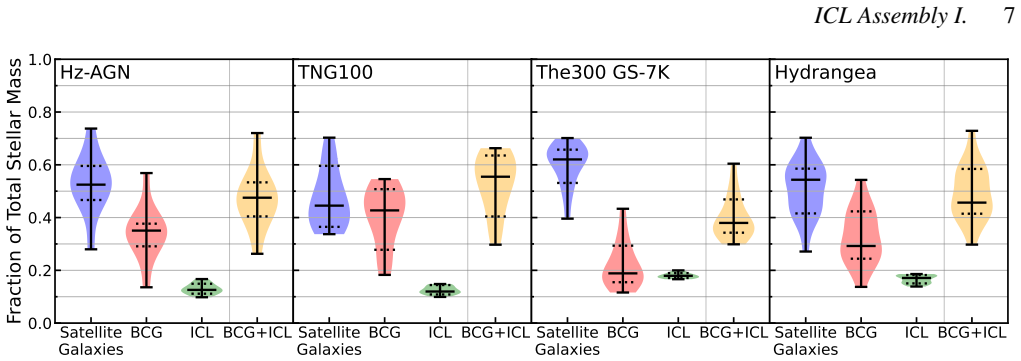
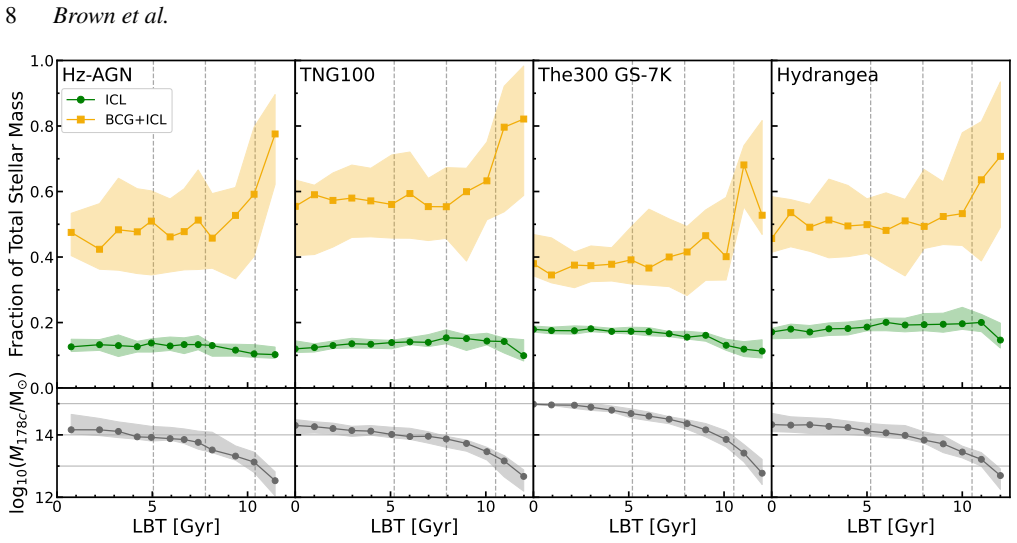
A consistent way of identifying intracluster light produces matching fractions of 0.1-0.2 across four simulations and shows no evolution from redshift 2 to the present.
A machine-rendered reading of the paper's core claim, the machinery that carries it, and where it could break.
Core claim
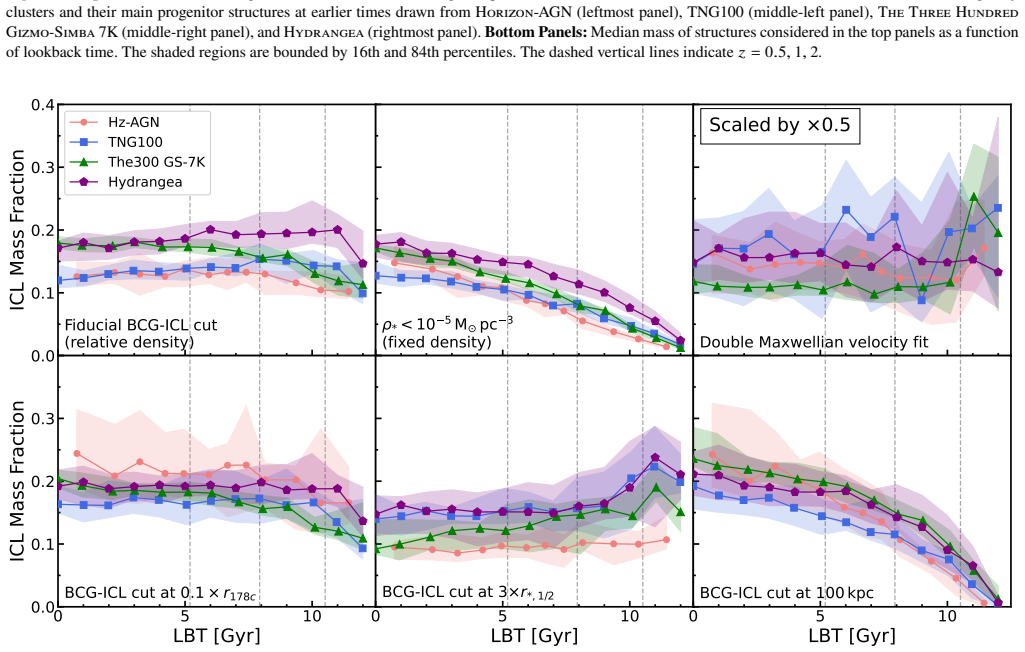
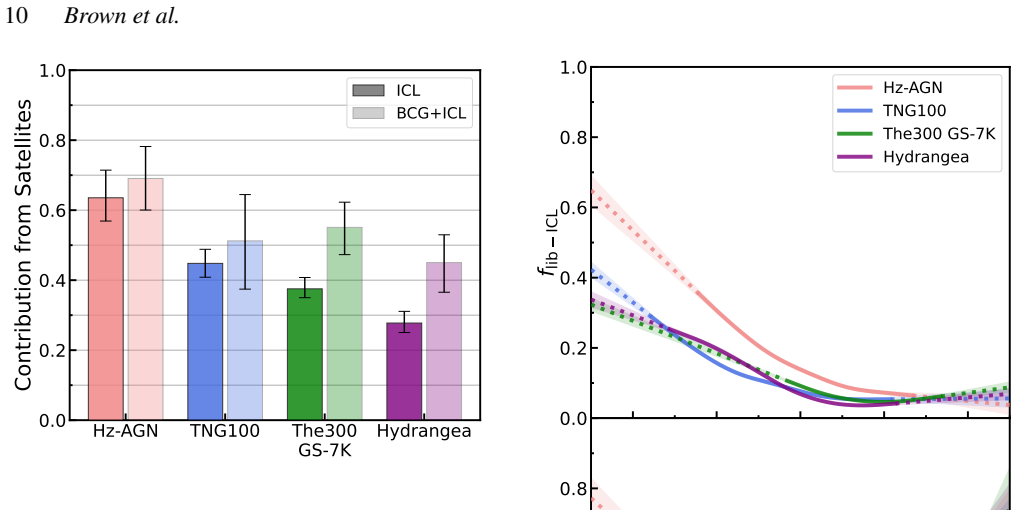
For the fiducial ICL definition the four simulations produce consistent z approximately 0 stellar mass fractions of about 0.1 to 0.2. Tracking the progenitors of z approximately 0 clusters back to z greater than or equal to 2 reveals no significant change in average ICL mass fractions. Alternative definitions make the absolute fraction highly sensitive to the chosen boundary, but a single consistent identification method removes discrepancies between the simulations. Lower-mass satellites contribute slightly more relative to their own mass, yet the infalling satellite mass function sets which galaxies dominate, so most ICL stars come from systems with infall stellar masses above 10^10 solar
What carries the argument
The homogenized ICL identification framework that applies identical criteria to separate diffuse light, central galaxy, and satellites in every simulation.
If this is right
- ICL assembly histories look similar across different simulation codes once the identification method is standardized.
- Under the fiducial definition the average ICL mass fraction stays roughly constant from redshift greater than 2 to the present day.
- The dominant ICL contribution comes from satellites that entered the cluster with stellar masses above 10^10 solar masses.
- Whether the ICL fraction appears to decrease toward higher redshift depends entirely on the exact boundary chosen between ICL and the central galaxy.
Where Pith is reading between the lines
- Observers comparing real cluster data to simulations will need to match the exact ICL definition used in the models.
- The early assembly of ICL implied by the lack of evolution could be tested by measuring ICL fractions in clusters observed at redshift 1 to 2.
- The result that intermediate-mass satellites dominate suggests that surveys of infalling galaxies in clusters can predict the ICL content.
Load-bearing premise
Applying the same identification rules to all simulations does not create definition-dependent biases that differ systematically between the codes.
What would settle it
Running the identical identification procedure on a new set of simulations and finding large differences in the measured ICL fractions would show the consistency result does not hold.
Figures
read the original abstract
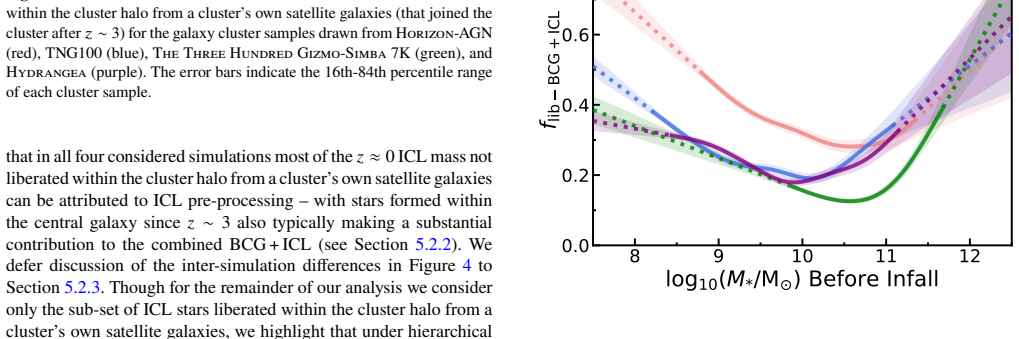
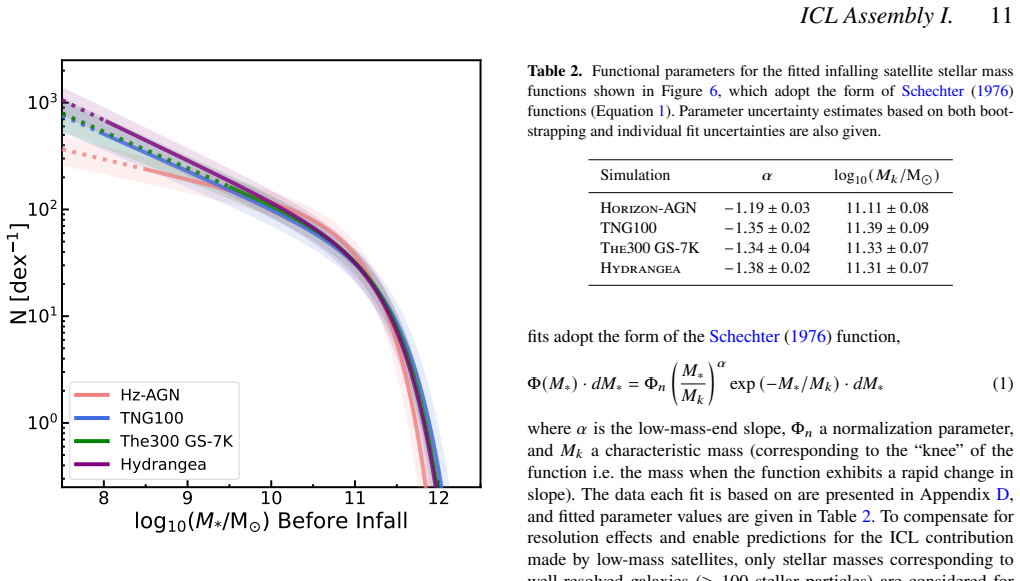
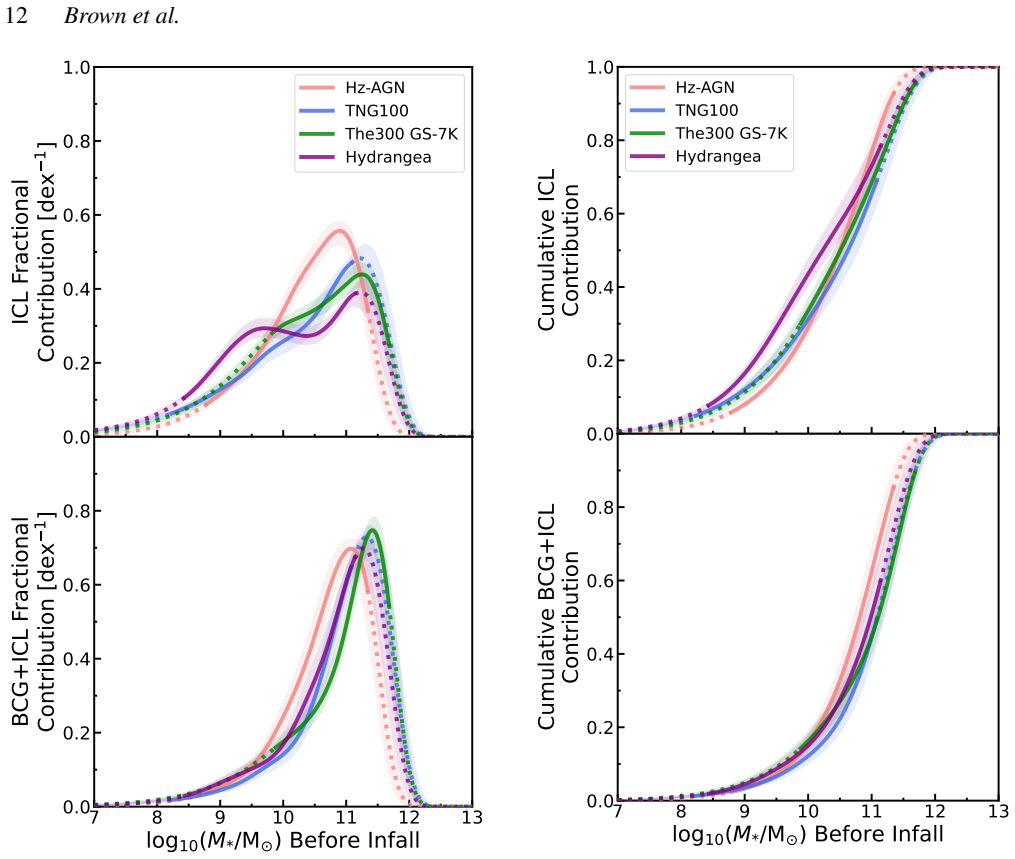
The tidal stripping of satellite galaxies and the stellar detritus ejected during galaxy mergers builds up a diffuse stellar component in galaxy clusters known as the intracluster light (ICL). We investigate ICL assembly in cluster-mass haloes ($M_{178c}\sim10^{14}-10^{15}$ M$_\odot$) using four different hydrodynamical simulations (Horizon-AGN, TNG100, The Three Hundred Gizmo-Simba 7K, and Hydrangea) under a homogenized ICL identification framework. For our fiducial ICL definition we obtain broadly consistent $z\approx0$ ICL stellar mass fractions ($\sim0.1-0.2$) and, by tracking the progenitors of $z\approx0$ clusters back to $z\gtrsim2$, find no significant evolution in average ICL mass fractions. Alternative approaches for distinguishing the ICL from the central galaxy show the absolute ICL fraction to be highly sensitive to adopted definition, but we never find any significant inter-simulation discrepancies when implementing a consistent methodology to identify the ICL. Whether the average ICL mass fraction falls with increasing redshift or does not evolve is determined by the ICL definition adopted. By tracing $z\approx0$ ICL stars back to their progenitor galaxies, we find that lower-mass satellites typically make slightly larger ICL contributions relative to their mass in every considered simulation, but which galaxies make the dominant contribution to the ICL is primarily controlled by the infalling satellite mass function. Most ICL stars sourced from satellite galaxies are therefore expected to originate from galaxies with infall stellar masses above $\sim10^{10}$ M$_\odot$ and largely within $10^{10.5}-10^{11.5}$ M$_\odot$.
Editorial analysis
A structured set of objections, weighed in public.
Referee Report
Summary. The paper compares intracluster light (ICL) assembly across four hydrodynamical simulations (Horizon-AGN, TNG100, The Three Hundred Gizmo-Simba, Hydrangea) in cluster-mass haloes using a single homogenized ICL identification framework. For the fiducial definition it reports consistent z≈0 ICL stellar mass fractions (~0.1-0.2), no significant redshift evolution when tracking z≈0 cluster progenitors back to z≳2, high sensitivity of absolute fractions to the choice of ICL definition, and that ICL stars are sourced primarily from satellites with infall stellar masses ≳10^10 M_⊙ (peaking in 10^10.5-10^11.5 M_⊙).
Significance. If the homogenized framework is shown to be robust against code-specific biases, the work supplies a useful cross-code benchmark demonstrating that ICL fractions and their lack of redshift evolution are not strongly sensitive to differences in resolution, feedback, or merger tracking once identification criteria are fixed. The progenitor-tracing analysis and the demonstration that the satellite mass function largely controls which galaxies dominate ICL contributions are concrete, falsifiable results that can guide both simulation interpretation and observational comparisons.
major comments (2)
- [fiducial definition and alternative approaches] Fiducial definition and alternative approaches section: the central claim of no significant inter-simulation discrepancies rests on the assumption that identical distance/binding thresholds classify particles equivalently across codes whose stellar particle distributions differ in spatial extent and binding-energy histograms due to resolution and feedback variations; the manuscript does not report a quantitative test (e.g., overlap integrals or threshold-variation matrices per code) of definition-code interaction terms.
- [redshift evolution] Redshift-evolution analysis (progenitor tracking to z≳2): the statement that average ICL mass fractions show no significant evolution is definition-dependent, yet the paper does not supply per-definition error budgets or bootstrap uncertainties on the redshift trend that would allow readers to judge whether the “no evolution” result for the fiducial case is statistically distinguishable from mild decline.
minor comments (2)
- [abstract] The abstract states “broadly consistent” fractions without quoting the precise numerical range or the number of clusters per simulation; a table or explicit interval would improve clarity.
- Notation for the ICL mass fraction (e.g., f_ICL) should be defined once at first use and used consistently thereafter rather than alternating with descriptive phrases.
Simulated Author's Rebuttal
We thank the referee for their thoughtful comments on our manuscript. We address the major comments point by point below, and have revised the manuscript accordingly where appropriate.
read point-by-point responses
-
Referee: [fiducial definition and alternative approaches] Fiducial definition and alternative approaches section: the central claim of no significant inter-simulation discrepancies rests on the assumption that identical distance/binding thresholds classify particles equivalently across codes whose stellar particle distributions differ in spatial extent and binding-energy histograms due to resolution and feedback variations; the manuscript does not report a quantitative test (e.g., overlap integrals or threshold-variation matrices per code) of definition-code interaction terms.
Authors: We agree that a direct quantitative assessment of how the definition interacts with code-specific particle distributions would strengthen the robustness claim. While the consistency of ICL fractions across the four simulations when applying identical criteria provides indirect support for the lack of strong code-dependent biases, we did not include explicit tests such as overlap integrals or per-code threshold variation matrices in the original manuscript. In the revised version, we will add an appendix with threshold sensitivity tests applied to each simulation to quantify any potential definition-code interactions. revision: yes
-
Referee: [redshift evolution] Redshift-evolution analysis (progenitor tracking to z≳2): the statement that average ICL mass fractions show no significant evolution is definition-dependent, yet the paper does not supply per-definition error budgets or bootstrap uncertainties on the redshift trend that would allow readers to judge whether the “no evolution” result for the fiducial case is statistically distinguishable from mild decline.
Authors: We agree that including per-definition error budgets or bootstrap uncertainties would help readers evaluate the statistical significance of the no-evolution result. The original manuscript presents the average trends without these quantitative uncertainties. We will update the analysis and figures in the revised manuscript to include bootstrap uncertainties on the redshift evolution of ICL fractions for both the fiducial and alternative definitions. revision: yes
Circularity Check
No significant circularity; results extracted directly from simulation data under chosen definition
full rationale
The paper applies an externally chosen homogenized ICL identification framework uniformly across four independent hydrodynamical simulations (Horizon-AGN, TNG100, Gizmo-Simba, Hydrangea). Reported z≈0 ICL stellar mass fractions (∼0.1-0.2) and lack of redshift evolution are obtained by direct tracking of stellar particles and progenitors in the simulation outputs, without any fitted parameters, self-definitional equations, or load-bearing self-citations that reduce the claims to tautologies. Alternative definitions are tested for sensitivity but do not alter the inter-simulation consistency finding. This is self-contained against external benchmarks and matches the default expectation of no circularity.
Axiom & Free-Parameter Ledger
axioms (1)
- domain assumption Hydrodynamical simulations correctly capture the tidal stripping and merger processes that build ICL
Reference graph
Works this paper leans on
-
[1]
ApJ , author =. 2010 , pages =. doi:10.1088/0004-637X/708/2/946 , number =
-
[2]
Monthly Notices of the Royal Astronomical Society , author =
Haloes gone. MNRAS , author =. 2011 , pages =. doi:10.1111/j.1365-2966.2011.18858.x , language =
-
[3]
First results from the. MNRAS , author =. 2019 , pages =. doi:10.1093/mnras/stz2306 , abstract =
work page internal anchor Pith review doi:10.1093/mnras/stz2306 2019
-
[4]
First results from the. MNRAS , author =. 2018 , pages =. doi:10.1093/mnras/sty618 , language =
work page internal anchor Pith review doi:10.1093/mnras/sty618 2018
-
[5]
First results from the. MNRAS , author =. 2018 , pages =. doi:10.1093/mnras/stx3304 , language =
-
[6]
First results from the IllustrisTNG simulations: radio haloes and magnetic fields
First results from the IllustrisTNG simulations: radio haloes and magnetic fields. , keywords =. doi:10.1093/mnras/sty2206 , archivePrefix =. 1707.03396 , primaryClass =
work page internal anchor Pith review Pith/arXiv arXiv doi:10.1093/mnras/sty2206
-
[7]
The growth of intracluster light in. MNRAS , author =. 2021 , pages =. doi:10.1093/mnras/stab065 , abstract =
-
[8]
Computational Astrophysics and Cosmology , keywords =
The IllustrisTNG simulations: public data release. Computational Astrophysics and Cosmology , keywords =. doi:10.1186/s40668-019-0028-x , archivePrefix =. 1812.05609 , primaryClass =
-
[9]
The growth of brightest cluster galaxies in the. MNRAS , author =. 2023 , pages =. doi:10.1093/mnras/stad586 , abstract =
-
[10]
Intergalactic stars in z 0.25 galaxy clusters: systematic properties from stacking of. MNRAS , author =. 2005 , pages =. doi:10.1111/j.1365-2966.2005.08817.x , abstract =
-
[11]
Photometric. ApJS , author =. 2021 , pages =. doi:10.3847/1538-4365/abcda6 , abstract =
-
[12]
Substructures in hydrodynamical cluster simulations , volume =. MNRAS , author =. 2009 , pages =. doi:10.1111/j.1365-2966.2009.15034.x , language =
-
[13]
Disruption of bound clusters by photoionization
Subhaloes going. MNRAS , author =. 2012 , pages =. doi:10.1111/j.1365-2966.2012.20947.x , language =
-
[14]
Monthly Notices of the Royal Astronomical Society , author =
X-ray spectroscopy of the. MNRAS , author =. 2011 , pages =. doi:10.1111/j.1365-2966.2011.18526.x , language =
-
[15]
M., Stebbins, A., Annis, J., et al
The. ApJ , author =. 2007 , pages =. doi:10.1086/523101 , language =
-
[16]
2009, A&A, 498, L33, doi: 10.1051/0004-6361/200911841
A weak lensing study of the. A&A , author =. 2009 , pages =. doi:10.1051/0004-6361/200911841 , abstract =
-
[17]
Steinhardt, Charles L. , year =. Do. doi:10.48550/ARXIV.2402.03423 , abstract =
-
[18]
h5py/h5py: 3.8.0-aarch64-wheels , copyright =
Collette, Andrew and Kluyver, Thomas and Caswell, Thomas A and Tocknell, James and Kieffer, Jerome and Jelenak, Aleksandar and Scopatz, Anthony and Dale, Darren and Chen and VINCENT, Thomas and Einhorn, Matt and. h5py/h5py: 3.8.0-aarch64-wheels , copyright =
-
[19]
The tidal stripping of satellites , volume =. MNRAS , author =. 2006 , pages =. doi:10.1111/j.1365-2966.2005.09861.x , abstract =
-
[20]
The Astrophysical Journal , author =
The. ApJ , author =. 2022 , pages =. doi:10.3847/1538-4357/ac7c74 , abstract =
work page internal anchor Pith review doi:10.3847/1538-4357/ac7c74 2022
-
[21]
Nat Methods , author =. 2020 , pages =. doi:10.1038/s41592-019-0686-2 , abstract =
-
[22]
Array programming with. Nature , author =. 2020 , pages =. doi:10.1038/s41586-020-2649-2 , abstract =
-
[23]
On. MNRAS , author =. 1952 , pages =. doi:10.1093/mnras/112.2.195 , language =
-
[24]
Formation and incidence of shell galaxies in the. MNRAS , author =. 2018 , pages =. doi:10.1093/mnras/sty1932 , language =
-
[25]
Monthly Notices of the Royal Astronomical Society , author =
Self-regulated growth of supermassive black holes by a dual jet-heating active galactic nucleus feedback mechanism: methods, tests and implications for cosmological simulations:. MNRAS , author =. 2012 , pages =. doi:10.1111/j.1365-2966.2011.20236.x , language =
-
[26]
Disruption of satellite galaxies in simulated groups and clusters: the roles of accretion time, baryons, and pre-processing , volume =. MNRAS , author =. 2019 , pages =. doi:10.1093/mnras/stz361 , abstract =
-
[27]
and Hatch, N
Kluge, M. and Hatch, N. A. and Montes, M. and Golden-Marx, J. B. and Gonzalez, A. H. and Cuillandre, J.-C. and Bolzonella, M. and Lançon, A. and Laureijs, R. and Saifollahi, T. and Schirmer, M. and Stone, C. and Boselli, A. and Cantiello, M. and Sorce, J. G. and Marleau, F. R. and Duc, P.-A. and Sola, E. and Urbano, M. and Ahad, S. L. and Bahé, Y. M. and ...
-
[28]
The importance of mock observations in validating galaxy properties for cosmological simulations , volume =. MNRAS , author =. 2021 , pages =. doi:10.1093/mnras/stab2722 , abstract =
-
[29]
An analytic expression for the luminosity function for galaxies. , volume =. ApJ , author =. 1976 , pages =. doi:10.1086/154079 , language =
-
[30]
Characterizing the intracluster light over the redshift range 0.2 <. MNRAS , author =. 2023 , pages =. doi:10.1093/mnras/stad469 , abstract =
-
[31]
doi:10.5281/zenodo.1208724 , publisher =
pyGAM: Generalized Additive Models in Python. doi:10.5281/zenodo.1208724 , publisher =
-
[32]
The. ApJ , author =. 2006 , pages =. doi:10.1086/506176 , abstract =
-
[33]
Is diffuse intracluster light a good tracer of the galaxy cluster matter distribution? , volume =. MNRAS , author =. 2021 , pages =. doi:10.1093/mnras/staa3680 , abstract =
-
[34]
Formation Channels of Diffuse Lights in Groups and Clusters over Time. , keywords =. doi:10.3847/1538-4357/ad4a52 , archivePrefix =. 2405.08061 , primaryClass =
-
[35]
Smoothing and. Anal. Chem. , author =. 1964 , pages =. doi:10.1021/ac60214a047 , language =
-
[36]
The progenitors of the intra-cluster light and intra-cluster globular clusters in galaxy groups and clusters , volume =. MNRAS , author =. 2024 , pages =. doi:10.1093/mnras/stae848 , abstract =
-
[37]
The. MNRAS , author =. 2016 , pages =. doi:10.1093/mnras/stw2265 , language =
work page internal anchor Pith review doi:10.1093/mnras/stw2265 2016
-
[38]
The Horizon-AGN simulation: evolution of galaxy properties over cosmic time
The Horizon-AGN simulation: evolution of galaxy properties over cosmic time. , keywords =. doi:10.1093/mnras/stx126 , archivePrefix =. 1605.09379 , primaryClass =
work page internal anchor Pith review Pith/arXiv arXiv doi:10.1093/mnras/stx126
-
[39]
Characterising the intra-cluster light in The Three Hundred simulations. , keywords =. doi:10.1051/0004-6361/202348474 , archivePrefix =. 2401.08283 , primaryClass =
-
[40]
ApJ , author =. 2011 , pages =. doi:10.1088/0004-637X/732/1/48 , number =
-
[41]
Preparing for low surface brightness science with the. MNRAS , author =. 2024 , pages =. doi:10.1093/mnras/stad3810 , abstract =
-
[42]
The. ApJ , author =. 2023 , pages =. doi:10.3847/1538-4357/acfd25 , abstract =
-
[43]
Does the virial mass drive the intra-cluster light?:. A&A , author =. 2023 , pages =. doi:10.1051/0004-6361/202245530 , abstract =
-
[44]
2020, ApJS, 247, 43, doi: 10.3847/1538-4365/ab733b
Structure of. ApJS , author =. 2020 , pages =. doi:10.3847/1538-4365/ab733b , abstract =
-
[45]
ApJ , author =. 2020 , pages =. doi:10.3847/1538-4357/aba3cb , abstract =
-
[46]
Astrophys Space Sci , author =
Is there a black hole in the center of the. Astrophys Space Sci , author =. 2024 , pages =. doi:10.1007/s10509-024-04270-1 , abstract =
-
[47]
The origin and properties of intracluster stars in a rich cluster , volume =. MNRAS , author =. 2004 , pages =. doi:10.1111/j.1365-2966.2004.08312.x , abstract =
-
[48]
The importance of mergers for the origin of intracluster stars in cosmological simulations of galaxy clusters , volume =. MNRAS , author =. 2007 , pages =. doi:10.1111/j.1365-2966.2007.11568.x , language =
-
[49]
ApJ , author =. 2009 , pages =. doi:10.1088/0004-637X/699/2/1518 , language =
-
[50]
ApJ , author =. 2017 , pages =. doi:10.3847/1538-4357/834/1/16 , abstract =
-
[51]
First results from the. MNRAS , author =. 2018 , pages =. doi:10.1093/mnras/stx3040 , language =
work page internal anchor Pith review doi:10.1093/mnras/stx3040 2018
-
[52]
First results from the. MNRAS , author =. 2019 , pages =. doi:10.1093/mnras/stz2338 , abstract =
-
[53]
The. PASP , author =. 1951 , pages =. doi:10.1086/126318 , language =
-
[54]
Disruption of bound clusters by photoionization
Intergalactic stellar populations in intermediate redshift clusters:. MNRAS , author =. 2012 , pages =. doi:10.1111/j.1365-2966.2012.21924.x , abstract =
-
[55]
ApJ , author =. 2012 , pages =. doi:10.1088/0004-637X/757/1/48 , abstract =
-
[56]
Shredded. ApJ , author =. 2007 , pages =. doi:10.1086/519787 , abstract =
-
[57]
The. ApJ , author =. 2007 , pages =. doi:10.1086/510149 , abstract =
-
[58]
The. ApJ , author =. 2021 , pages =. doi:10.3847/1538-4357/abddb6 , abstract =
-
[59]
ApJ , author =. 2014 , pages =. doi:10.1088/0004-637X/794/2/137 , number =
-
[60]
Intragroup and. Proc. IAU , author =. 2015 , pages =. doi:10.1017/S1743921315006857 , abstract =
-
[61]
Spectroscopic. ApJ , author =. 2020 , pages =. doi:10.3847/1538-4357/ab845c , abstract =
-
[62]
https://iopscience.iop.org/article/10.3847/1538-4357/aa8403/pdf , url =
-
[63]
Characterizing. ApJ , author =. 2017 , pages =. doi:10.3847/1538-4357/aa8403 , abstract =
-
[64]
Lost but not forgotten: intracluster light in galaxy groups and clusters , volume =. MNRAS , author =. 2018 , pages =. doi:10.1093/mnras/stx2946 , language =
-
[65]
The Formation of the Brightest Cluster Galaxy and Intracluster Light in Cosmological N-body Simulations with the Galaxy Replacement Technique. , keywords =. doi:10.3847/1538-4357/aca890 , archivePrefix =. 2212.02510 , primaryClass =
-
[66]
Quantifying the origin and distribution of intracluster. MNRAS , author =. 2017 , pages =. doi:10.1093/mnras/stx401 , abstract =
-
[67]
First results from the. MNRAS , author =. 2018 , pages =. doi:10.1093/mnras/stx3112 , abstract =
work page internal anchor Pith review doi:10.1093/mnras/stx3112 2018
-
[68]
Stellar splashback: the edge of the intracluster light , volume =. MNRAS , author =. 2020 , pages =. doi:10.1093/mnras/staa3590 , abstract =
-
[69]
Simulations of the formation, evolution and clustering of galaxies and quasars , volume =. Nature , author =. 2005 , pages =. doi:10.1038/nature03597 , language =
-
[70]
The different growth pathways of Brightest Cluster Galaxies and the Intra-Cluster Light
The different growth pathways of brightest cluster galaxies and intracluster light. , keywords =. doi:10.1093/mnras/sty1518 , archivePrefix =. 1806.01480 , primaryClass =
work page internal anchor Pith review Pith/arXiv arXiv doi:10.1093/mnras/sty1518
-
[71]
MNRAS , author =. 2003 , pages =. doi:10.1046/j.1365-8711.2003.05589.x , language =
-
[72]
Building merger trees from cosmological. A&A , author =. 2009 , pages =. doi:10.1051/0004-6361/200911787 , number =
-
[73]
The origin and implications of dark matter anisotropic cosmic infall on ≈. MNRAS , author =. 2004 , pages =. doi:10.1111/j.1365-2966.2004.07883.x , language =
-
[74]
Surface photometry of brightest cluster galaxies and intracluster stars in Λ. MNRAS , author =. 2015 , pages =. doi:10.1093/mnras/stv1042 , language =
-
[75]
Intracluster light at the. MNRAS , author =. 2018 , pages =. doi:10.1093/mnras/stx2847 , language =
-
[76]
Theoretical. ApJ , author =. 2019 , pages =. doi:10.3847/1538-4357/aaf41f , abstract =
-
[77]
Dark. ApJ , author =. 2019 , pages =. doi:10.3847/1538-4357/ab0dfd , abstract =
-
[78]
Identifying the discs, bulges, and intra-halo light of simulated galaxies through structural decomposition , volume =. MNRAS , author =. 2023 , pages =. doi:10.1093/mnras/stad3341 , abstract =
-
[79]
Mock. ApJ , author =. 2023 , pages =. doi:10.3847/1538-4357/ad05ca , abstract =
-
[80]
The cosmological constant and dark energy , volume =. Rev. Mod. Phys. , author =. 2003 , pages =. doi:10.1103/RevModPhys.75.559 , language =
discussion (0)
Sign in with ORCID, Apple, or X to comment. Anyone can read and Pith papers without signing in.