Nonlinear Geotechnical Analysis Using a Polygonal Cell-Based Smoothed Finite Element Framework
Pith reviewed 2026-06-26 16:13 UTC · model grok-4.3
The pith
The polygonal cell-based smoothed finite element method accurately predicts nonlinear geotechnical responses on flexible meshes.
A machine-rendered reading of the paper's core claim, the machinery that carries it, and where it could break.
Core claim
The proposed polygonal CS-FEM, combining Wachspress interpolation with cell-based strain smoothing via boundary integration, accurately models nonlinear geomaterial behavior through incremental elasto-plastic updates for the Mohr-Coulomb and Duncan-Chang models, delivering reliable predictions of displacement, stress, plastic strain, bearing capacity, and factor of safety across benchmark and engineering cases.
What carries the argument
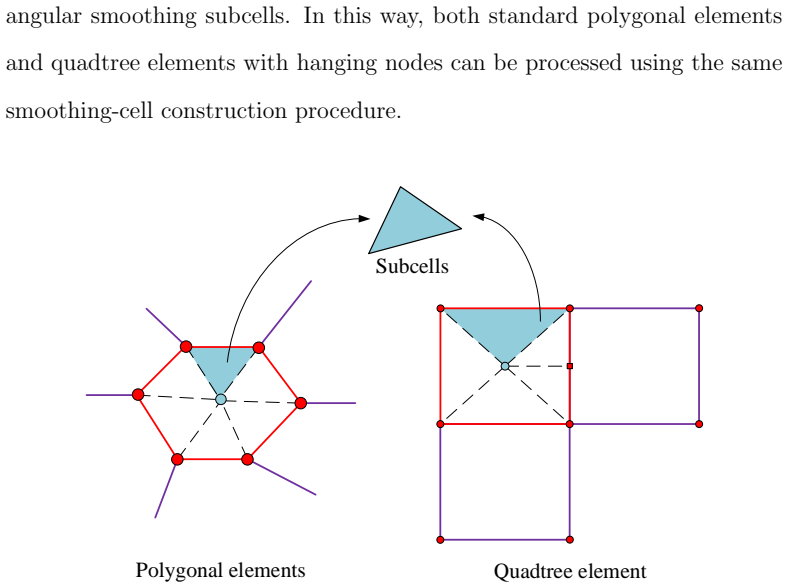
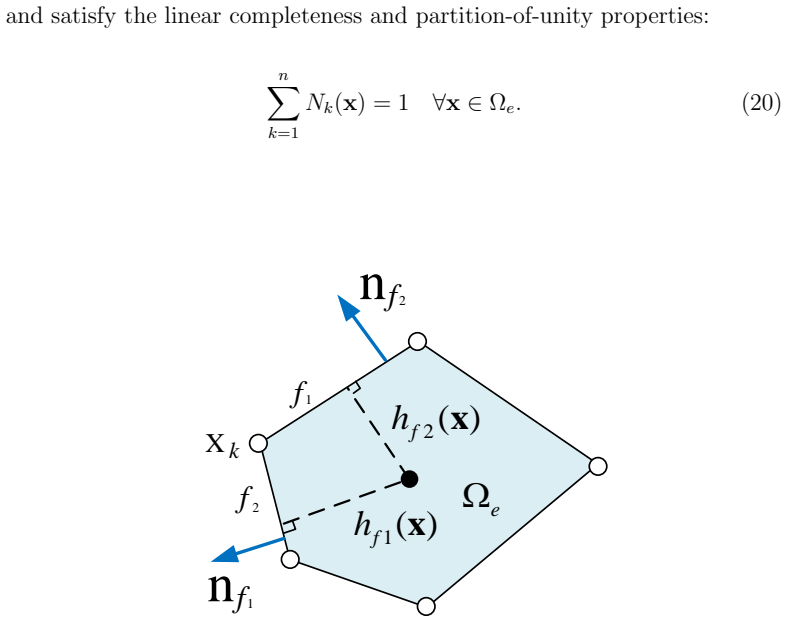
Cell-based strain smoothing evaluated by boundary integration over polygonal smoothing subcells, which forms the smoothed strain-displacement matrix without direct shape-function derivatives.
If this is right
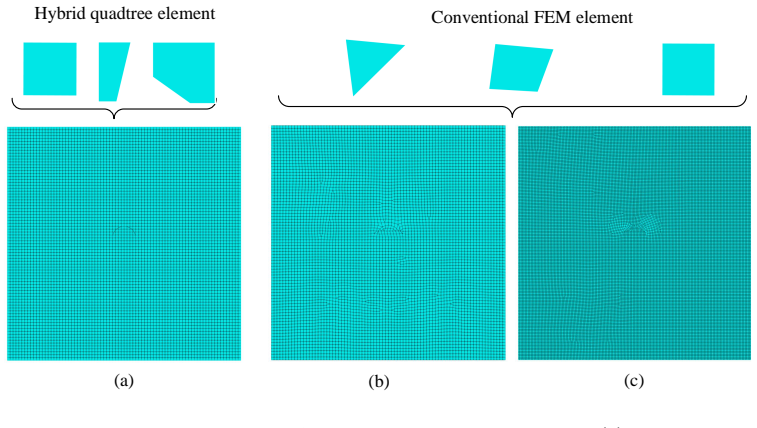
- The formulation unifies handling of standard polygonal meshes and hybrid quadtree meshes with hanging nodes.
- Improved mesh flexibility supports complex geometries and staged construction in geotechnical analysis.
- Computational efficiency increases while maintaining accuracy in predicting key engineering quantities.
- Standard ABAQUS user element subroutine enables practical implementation for nonlinear problems.
Where Pith is reading between the lines
- Similar boundary-integration smoothing could simplify other finite element formulations involving high-order or polygonal elements.
- The method's stability in elasto-plastic updates suggests applicability to dynamic or coupled hydro-mechanical geotechnical simulations.
- Hybrid mesh capabilities might facilitate automatic mesh refinement in regions of high plastic strain.
Load-bearing premise
The boundary integration for the smoothed strain-displacement matrix stays accurate and stable when used with incremental elasto-plastic constitutive updates in staged-construction scenarios.
What would settle it
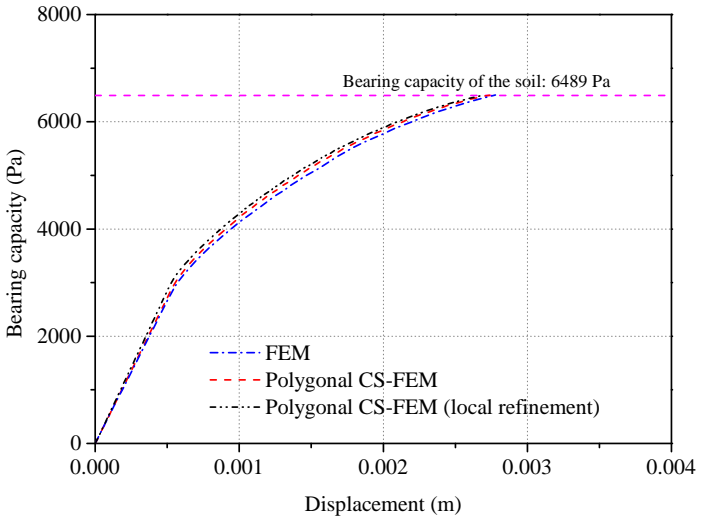
Running the strip footing benchmark and finding that the predicted bearing capacity deviates substantially from the analytical Prandtl solution or established finite element results would indicate the method does not hold.
Figures









read the original abstract
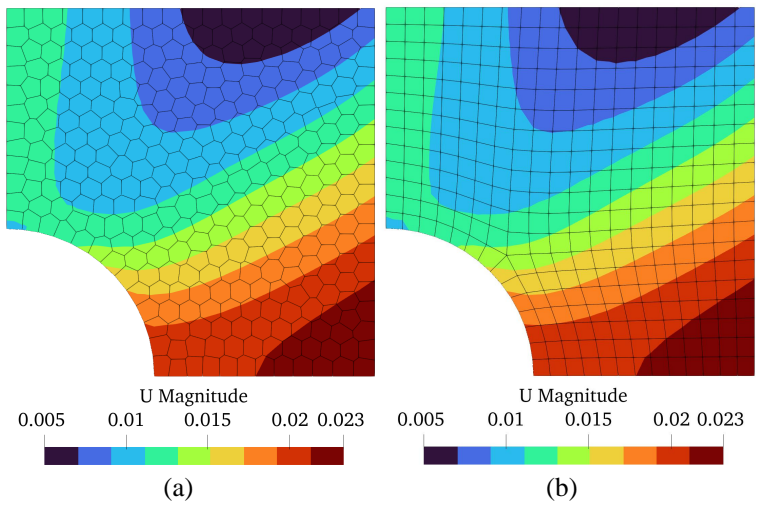
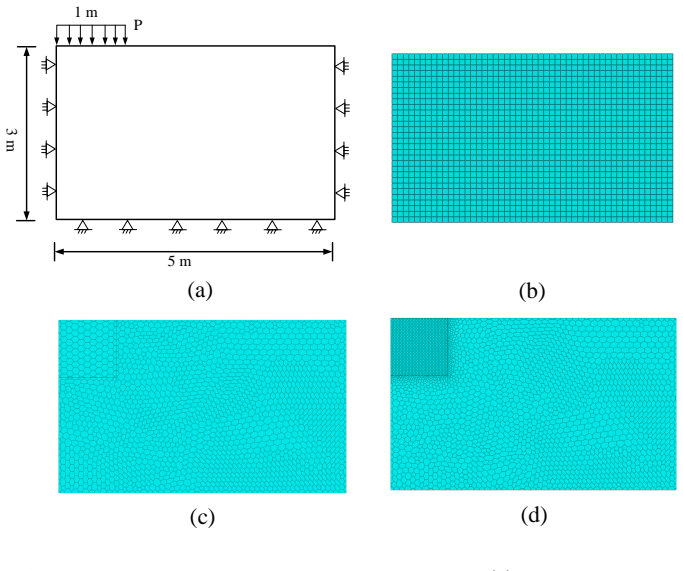
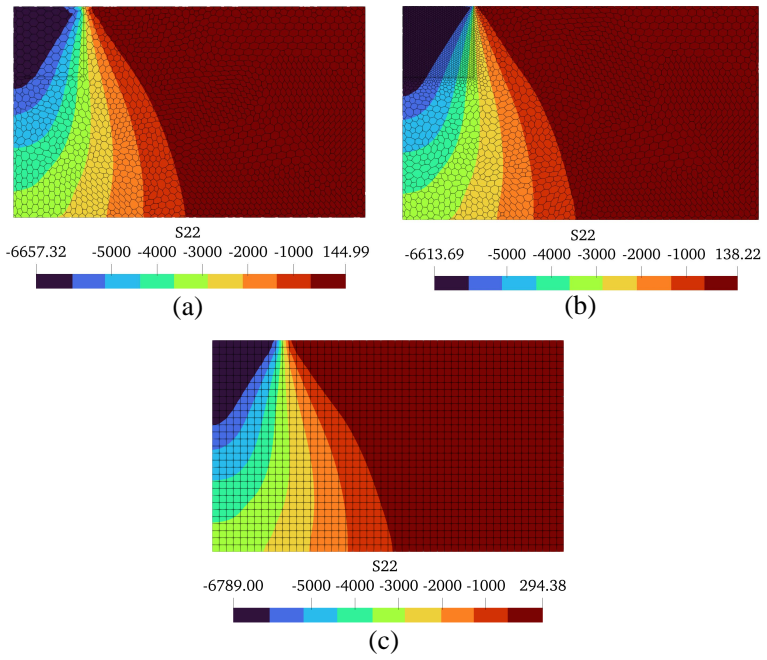
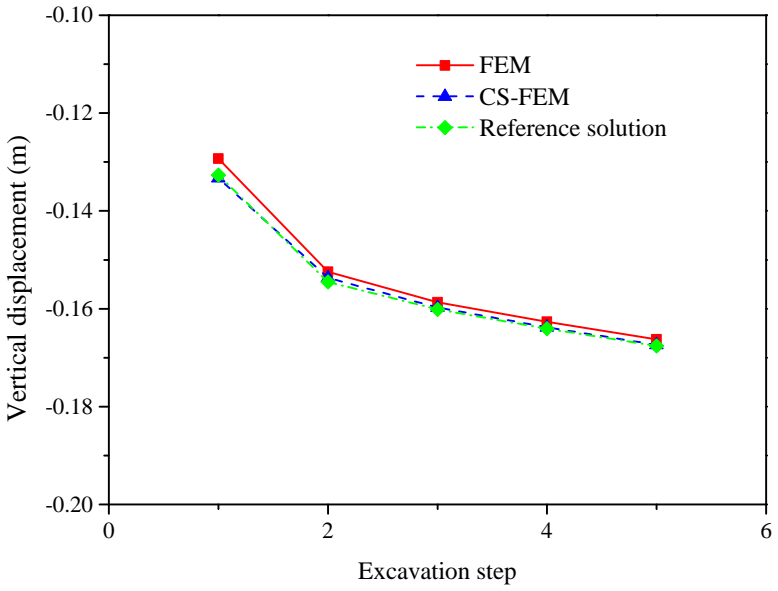
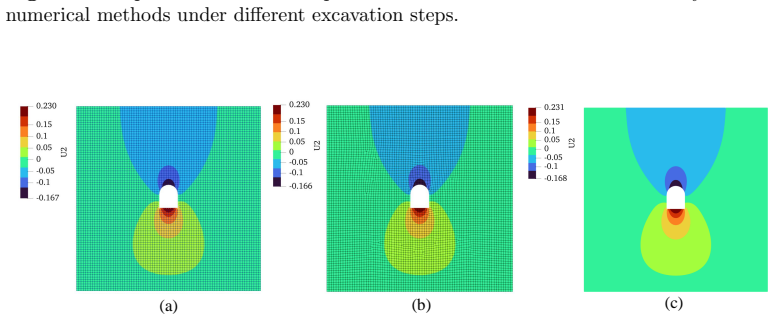
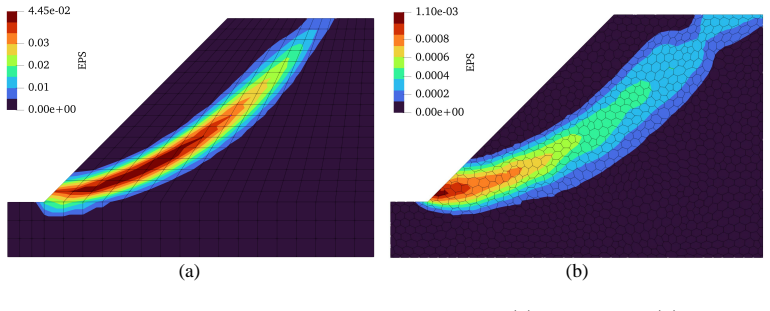
Nonlinear geotechnical analysis often involves complex geometries, staged construction, local failure, and mesh-dependent stress and plastic strain responses. This study develops a polygonal cell-based smoothed finite element method (CS-FEM) for nonlinear geotechnical analysis and implements it in ABAQUS through the user element subroutine. The proposed method combines Wachspress interpolation with cell-based strain smoothing, in which the smoothed strain--displacement matrix is evaluated by boundary integration over polygonal smoothing subcells. This formulation avoids direct calculation of shape-function derivatives inside polygonal elements and enables standard polygonal meshes and hybrid quadtree meshes with hanging nodes to be handled in a unified framework. Nonlinear geomaterial behavior is incorporated through incremental elasto-plastic constitutive updates, including the Mohr--Coulomb model and the Duncan--Chang model. Several benchmark and engineering examples, including a perforated plate, strip footing, core rockfill dam, tunnel excavation, and slope stability problems, are presented for verification. The results show that the proposed method accurately predicts displacement, stress, plastic strain, bearing capacity, and factor of safety, while providing improved mesh flexibility and computational efficiency for nonlinear geotechnical analysis.
Editorial analysis
A structured set of objections, weighed in public.
Referee Report
Summary. The manuscript develops a polygonal cell-based smoothed finite element method (CS-FEM) using Wachspress interpolation for nonlinear geotechnical analysis. The smoothed strain-displacement matrix is formed exclusively via boundary integration over polygonal subcells and implemented in ABAQUS through a user element subroutine. Nonlinear behavior is handled via incremental elasto-plastic updates with Mohr-Coulomb and Duncan-Chang models. Verification is claimed on examples including a perforated plate, strip footing, core rockfill dam, tunnel excavation, and slope stability problems, with the central claim that the method accurately predicts displacement, stress, plastic strain, bearing capacity, and factor of safety while offering improved mesh flexibility and computational efficiency.
Significance. If the accuracy and stability claims hold under the nonlinear constitutive updates, the work would provide a practical unified framework for polygonal and hybrid quadtree meshes in geotechnical simulations involving complex geometries and staged loading, extending smoothed FEM techniques to incremental plasticity without interior shape-function derivatives.
major comments (2)
- [Verification examples] Verification examples section: the abstract asserts that the method 'accurately predicts' displacements, stresses, plastic strains, bearing capacity, and factors of safety across multiple benchmarks, yet no quantitative error measures, convergence rates, L2 norms, or direct comparisons against established FEM or analytical solutions are referenced. This absence prevents assessment of whether the central accuracy claim is supported by the data.
- [Method formulation] Method formulation (smoothed B-matrix construction): the cell-based smoothing produces a constant strain operator per subcell via boundary integration. When the constitutive response is replaced by incremental elasto-plastic return mapping (Mohr-Coulomb or Duncan-Chang), the tangent modulus can vary spatially inside a subcell due to partial yielding or loading history. The manuscript provides no analysis or numerical test demonstrating that the boundary integral remains variationally consistent once the material tangent is no longer uniform, which is load-bearing for stability in the staged-construction and local-failure scenarios highlighted in the abstract.
minor comments (1)
- [Abstract] The abstract states that the approach provides 'improved mesh flexibility and computational efficiency' but does not report any timing or degree-of-freedom comparisons against standard FEM on the same meshes.
Simulated Author's Rebuttal
We thank the referee for the constructive comments. Below we address each major comment point by point.
read point-by-point responses
-
Referee: [Verification examples] Verification examples section: the abstract asserts that the method 'accurately predicts' displacements, stresses, plastic strains, bearing capacity, and factors of safety across multiple benchmarks, yet no quantitative error measures, convergence rates, L2 norms, or direct comparisons against established FEM or analytical solutions are referenced. This absence prevents assessment of whether the central accuracy claim is supported by the data.
Authors: The manuscript presents verification through direct comparisons in figures for displacements, stresses, and engineering quantities such as bearing capacity and factor of safety against reference FEM or analytical solutions. While explicit quantitative error norms are not provided in tables, the visual and quantitative agreement in the plots supports the accuracy claims. To fully address the concern, we will add a table with L2 error norms and convergence rates for the perforated plate and strip footing examples in the revised version. revision: yes
-
Referee: [Method formulation] Method formulation (smoothed B-matrix construction): the cell-based smoothing produces a constant strain operator per subcell via boundary integration. When the constitutive response is replaced by incremental elasto-plastic return mapping (Mohr-Coulomb or Duncan-Chang), the tangent modulus can vary spatially inside a subcell due to partial yielding or loading history. The manuscript provides no analysis or numerical test demonstrating that the boundary integral remains variationally consistent once the material tangent is no longer uniform, which is load-bearing for stability in the staged-construction and local-failure scenarios highlighted in the abstract.
Authors: In the proposed CS-FEM, the strain is assumed constant within each smoothing subcell, and the elasto-plastic constitutive update is performed using this constant strain for the subcell. This maintains the formulation's consistency at the subcell level. The numerical examples, including those with staged loading and local failure, show stable convergence without oscillations. We will include additional discussion on this aspect and a supporting numerical test in the revision. revision: partial
Circularity Check
No significant circularity; derivation relies on standard CS-FEM and constitutive assumptions
full rationale
The paper presents a polygonal CS-FEM formulation using Wachspress interpolation and boundary-integrated smoothed strains, then applies standard incremental elasto-plastic models (Mohr-Coulomb, Duncan-Chang) and verifies against independent benchmarks. No step reduces a claimed prediction or result to a quantity defined or fitted by the authors themselves. Self-citations, if present, are not load-bearing for the central claims, which rest on established finite-element theory and external verification examples. The method is self-contained against external benchmarks.
Axiom & Free-Parameter Ledger
axioms (2)
- standard math Standard assumptions of the finite element method for small-strain continuum mechanics hold for the polygonal elements.
- domain assumption The Mohr-Coulomb and Duncan-Chang models accurately represent the nonlinear geomaterial response in the tested regimes.
Reference graph
Works this paper leans on
-
[1]
Smoothed Finite Element Methods , author =. 2010 , publisher =. doi:10.1201/EBK1439820278 , isbn =
-
[2]
Computational Mechanics , volume =
A smoothed finite element method for mechanics problems , author =. Computational Mechanics , volume =. 2007 , doi =
2007
-
[3]
and Liu, Gui-Rong , journal =
Zeng, W. and Liu, Gui-Rong , journal =. Smoothed finite element methods (. 2018 , doi =
2018
-
[4]
Finite elements in analysis and design , volume=
An n-sided polygonal smoothed finite element method (nSFEM) for solid mechanics , author=. Finite elements in analysis and design , volume=. 2007 , publisher=
2007
-
[5]
Liu, Gui-Rong and Nguyen-Thoi, Trung and Lam, K. Y. , journal =. An edge-based smoothed finite element method (
-
[6]
Nguyen-Thoi, Trung and Vu-Do, H. C. and Rabczuk, Timon and Nguyen-Xuan, Hung , journal =. A node-based smoothed finite element method (. 2010 , doi =
2010
-
[7]
Computers & Structures , volume =
Analysis of elastic--plastic problems using edge-based smoothed finite element method , author =. Computers & Structures , volume =
-
[8]
International Journal for Numerical Methods in Engineering , volume =
Smooth finite element methods: Convergence, accuracy and properties , author =. International Journal for Numerical Methods in Engineering , volume =. 2008 , doi =
2008
-
[9]
International Journal for Numerical Methods in Engineering , volume =
On the equivalence between the cell-based smoothed finite element method and the virtual element method , author =. International Journal for Numerical Methods in Engineering , volume =
-
[10]
Applied Mathematical Modelling , volume=
An effective fracture analysis method based on the virtual crack closure-integral technique implemented in CS-FEM , author=. Applied Mathematical Modelling , volume=. 2016 , publisher=
2016
-
[11]
International journal for numerical methods in engineering , volume=
Natural neighbour Galerkin methods , author=. International journal for numerical methods in engineering , volume=. 2001 , publisher=
2001
-
[12]
1975 , publisher =
A Rational Finite Element Basis , author =. 1975 , publisher =
1975
-
[13]
Computer Aided Geometric Design , volume =
Mean value coordinates , author =. Computer Aided Geometric Design , volume =
-
[14]
International Journal for Numerical Methods in Engineering , volume =
Conforming polygonal finite elements , author =. International Journal for Numerical Methods in Engineering , volume =
-
[15]
Archives of Computational Methods in Engineering , volume =
Recent advances in the construction of polygonal finite element interpolants , author =. Archives of Computational Methods in Engineering , volume =
-
[16]
Finite Elements in Analysis and Design , volume =
Adaptive computations on conforming quadtree meshes , author =. Finite Elements in Analysis and Design , volume =
-
[17]
Structural and Multidisciplinary Optimization , volume=
PolyMesher: a general-purpose mesh generator for polygonal elements written in Matlab , author=. Structural and Multidisciplinary Optimization , volume=. 2012 , publisher=
2012
-
[18]
and Pereira, Anderson and Menezes, Ivan F
Talischi, Cameron and Paulino, Glaucio H. and Pereira, Anderson and Menezes, Ivan F. M. , journal =. 2012 , doi =
2012
-
[19]
Teknisk Ukeblad , volume =
The principle of effective stress , author =. Teknisk Ukeblad , volume =
-
[20]
Mohr, Otto , journal =
-
[21]
Essai sur une application des r
Coulomb, Charles-Augustin de , booktitle =. Essai sur une application des r. 1776 , publisher =
-
[22]
2005 , publisher =
The Finite Element Method: Its Basis and Fundamentals , author =. 2005 , publisher =
2005
-
[23]
2006 , publisher =
Finite Element Procedures , author =. 2006 , publisher =
2006
-
[24]
2003 , publisher=
The finite element method: linear static and dynamic finite element analysis , author=. 2003 , publisher=
2003
-
[25]
2013 , publisher=
The finite element method: a practical course , author=. 2013 , publisher=
2013
-
[26]
Stress Analysis , editor =
Displacement and equilibrium models in the finite element method , author =. Stress Analysis , editor =. 1965 , publisher =
1965
-
[27]
Soils and Foundations , volume =
Finite element slope stability analysis by shear strength reduction technique , author =. Soils and Foundations , volume =
-
[28]
Slope stability analysis by strength reduction , author =. G. 1999 , doi =
1999
-
[29]
1990 , publisher =
Limit Analysis in Soil Mechanics , author =. 1990 , publisher =
1990
-
[30]
2018 , publisher =
The Scaled Boundary Finite Element Method: Introduction to Theory and Implementation , author =. 2018 , publisher =
2018
-
[31]
Computer Methods in Applied Mechanics and Engineering , volume =
A scaled boundary polygon formulation for elasto-plastic analyses , author =. Computer Methods in Applied Mechanics and Engineering , volume =
-
[32]
Geotechnical and Geological Engineering , volume =
A non-linear scaled boundary finite-element analysis applied to geotechnical problems , author =. Geotechnical and Geological Engineering , volume =. 2019 , doi =
2019
-
[33]
2010 , organization =
Abaqus User Subroutines Reference Manual , author =. 2010 , organization =
2010
-
[34]
International Journal of Computational Methods , volume=
Development of user element routine (UEL) for cell-based smoothed finite element method (CSFEM) in Abaqus , author=. International Journal of Computational Methods , volume=. 2020 , publisher=
2020
-
[35]
International Journal of Computational Methods , volume=
An ABAQUS implementation of the cell-based smoothed finite element method (CS-FEM) , author=. International Journal of Computational Methods , volume=. 2020 , publisher=
2020
-
[36]
International Journal for Numerical Methods in Engineering , volume=
An element-based formulation for ES-FEM and FS-FEM models for implementation in standard solid mechanics finite element codes for 2D and 3D static analysis , author=. International Journal for Numerical Methods in Engineering , volume=. 2023 , publisher=
2023
-
[37]
Finite Elements in Analysis and Design , volume =
Elasto-plastic cell-based smoothed finite element method solving geotechnical problems , author =. Finite Elements in Analysis and Design , volume =. 2026 , doi =
2026
-
[38]
Archives of Computational Methods in Engineering , volume=
Small strains in soil constitutive modeling , author=. Archives of Computational Methods in Engineering , volume=. 2022 , publisher=
2022
-
[39]
International Journal of Plasticity , volume =
A thermodynamics-based hyperelastic-plastic coupled model unified for unbonded and bonded soils , author =. International Journal of Plasticity , volume =
-
[40]
Canadian Geotechnical Journal , volume =
A unified constitutive model for instantaneous elastic--plastic and time-dependent creep behaviour of gravelly soils under complex loading , author =. Canadian Geotechnical Journal , volume =
-
[41]
Advances in Civil Engineering , volume =
Progressive Failure Analysis of Soil Slope with Strain Softening Behavior Based on Peridynamics , author =. Advances in Civil Engineering , volume =
-
[42]
Applied Mathematical Modelling , volume =
On progressive failure of sand considering fabric evolution with micropolar hypoplastic model , author =. Applied Mathematical Modelling , volume =
-
[43]
Part I---A framework for surface mesh optimization , author =
Achieving finite element mesh quality via optimization of the Jacobian matrix norm and associated quantities. Part I---A framework for surface mesh optimization , author =. International Journal for Numerical Methods in Engineering , volume =. 2000 , doi =
2000
-
[44]
Engineering with Computers , volume =
Distortion and quality measures for validating and generating high-order tetrahedral meshes , author =. Engineering with Computers , volume =. 2015 , doi =
2015
-
[45]
International Journal of Computational Methods , volume=
A fast cell-smoothed finite element method for solving static--dynamic problems using a hybrid quadtree mesh , author=. International Journal of Computational Methods , volume=. 2025 , publisher=
2025
-
[46]
International journal for numerical methods in Engineering , volume=
A face-based smoothed finite element method (FS-FEM) for 3D linear and geometrically non-linear solid mechanics problems using 4-node tetrahedral elements , author=. International journal for numerical methods in Engineering , volume=. 2009 , publisher=
2009
-
[47]
Engineering Analysis with Boundary Elements , volume =
Two-dimensional seepage analysis using a polygonal cell-based smoothed finite element method , author =. Engineering Analysis with Boundary Elements , volume =
-
[48]
International journal for numerical methods in Engineering , volume=
Theoretical aspects of the smoothed finite element method (SFEM) , author=. International journal for numerical methods in Engineering , volume=. 2007 , publisher=
2007
-
[49]
2013 , school=
MATLAB FEM Code-From Elasticity to Plasticity , author=. 2013 , school=
2013
-
[50]
2012 , publisher=
Limit analysis in soil mechanics , author=. 2012 , publisher=
2012
-
[51]
Soils and foundations , volume=
Finite element slope stability analysis by shear strength reduction technique , author=. Soils and foundations , volume=. 1992 , publisher=
1992
-
[52]
International journal for numerical methods in engineering , volume=
Substepping schemes for the numerical integration of elastoplastic stress--strain relations , author=. International journal for numerical methods in engineering , volume=. 1987 , publisher=
1987
discussion (0)
Sign in with ORCID, Apple, or X to comment. Anyone can read and Pith papers without signing in.