Atmospheric diversity of sub-Neptunes from formation with rock, water, and soot
Pith reviewed 2026-06-26 15:32 UTC · model grok-4.3
The pith
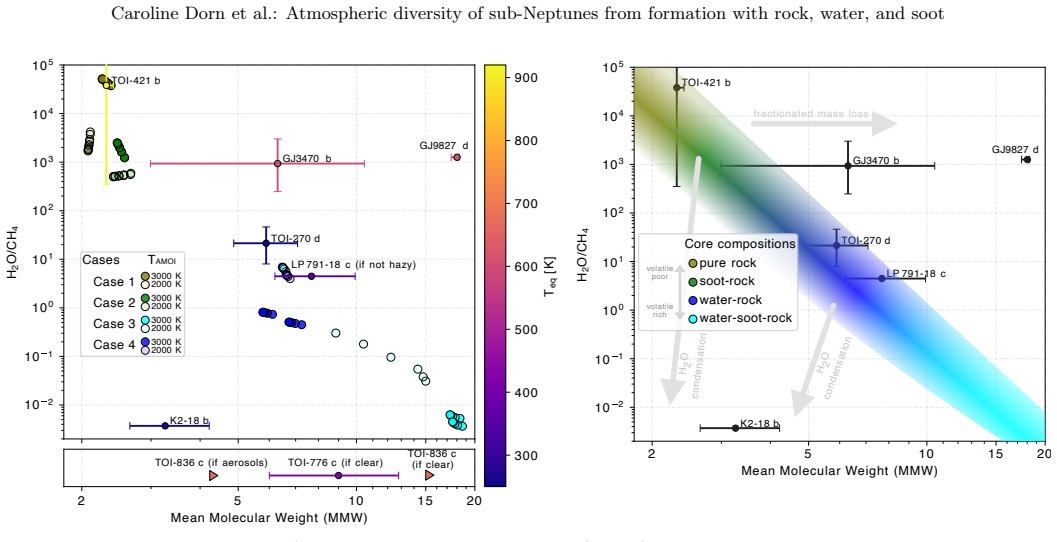
Sub-Neptune atmospheres carry chemical fingerprints of their rock, water, and soot building blocks that the H2O/CH4 ratio and mean molecular weight can diagnose together.
A machine-rendered reading of the paper's core claim, the machinery that carries it, and where it could break.
Core claim
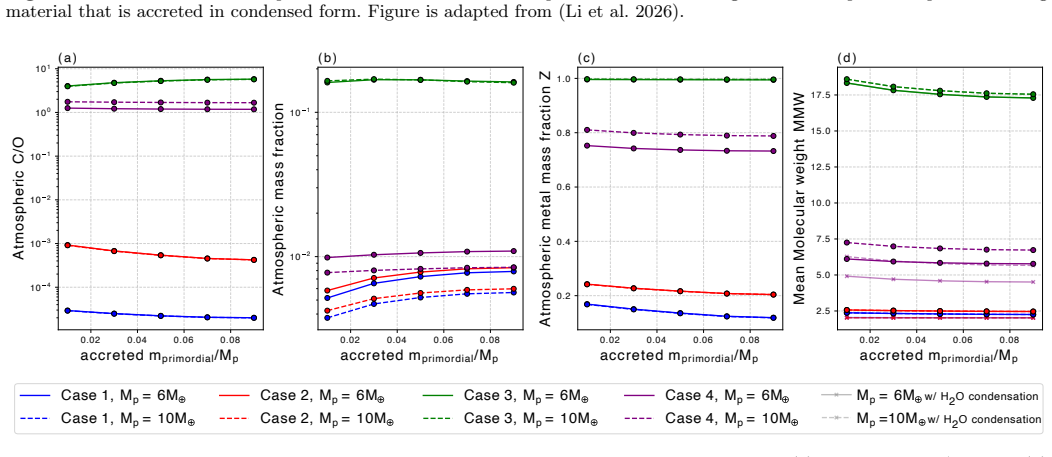
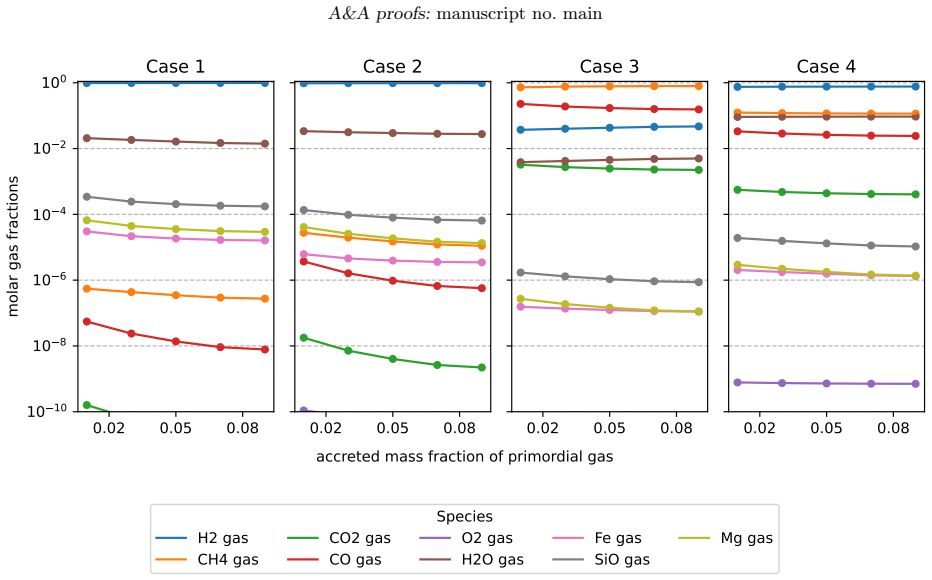
Planets formed from water-poor material produce atmospheres strongly depleted in carbon-bearing species, with log(CH4) and log(CO2) below -4. Planets assembled from water-rich building blocks naturally develop methane- and carbon-dioxide-rich atmospheres with elevated metal mass fractions and C/O ratios. The presence of refractory carbon further enhances methane production and can lead to methane-dominated atmospheres. The ratio H2O/CH4 combined with the mean molecular weight provides a two-dimensional diagnostic linking atmospheric composition to formation environment, with departures explained by water condensation or fractionated mass loss.
What carries the argument
The two-dimensional diagnostic of the H2O/CH4 ratio together with mean molecular weight that maps observed atmospheric composition back to the initial proportions of rock, water, and soot.
If this is right
- Water-rich formation without soot explains the atmospheres of K2-18b and TOI-270d.
- Water-poor formation inside the water ice line matches TOI-421b and GJ3470b.
- Soot in the building blocks further increases methane and can produce methane-dominated atmospheres.
- Departures from the main trends arise from water condensation in temperate cases or fractionated atmospheric mass loss.
Where Pith is reading between the lines
- The diagnostic could be tested on additional JWST targets to map formation locations across the sub-Neptune population.
- If core-envelope mixing proves common, it would weaken the direct mapping from observed ratios to initial building-block proportions.
- The framework predicts specific C/O ratio ranges that future high-precision spectroscopy could check against formation models.
Load-bearing premise
The final atmospheric composition is set only by the initial proportions of rock, water, and soot under global chemical equilibrium, without dominant post-formation processes such as core-envelope mixing or atmospheric escape changing the link.
What would settle it
A sub-Neptune observation where the measured H2O/CH4 ratio and mean molecular weight fall outside the ranges predicted for any combination of rock, water, and soot fractions, after accounting for condensation or mass loss.
Figures

read the original abstract
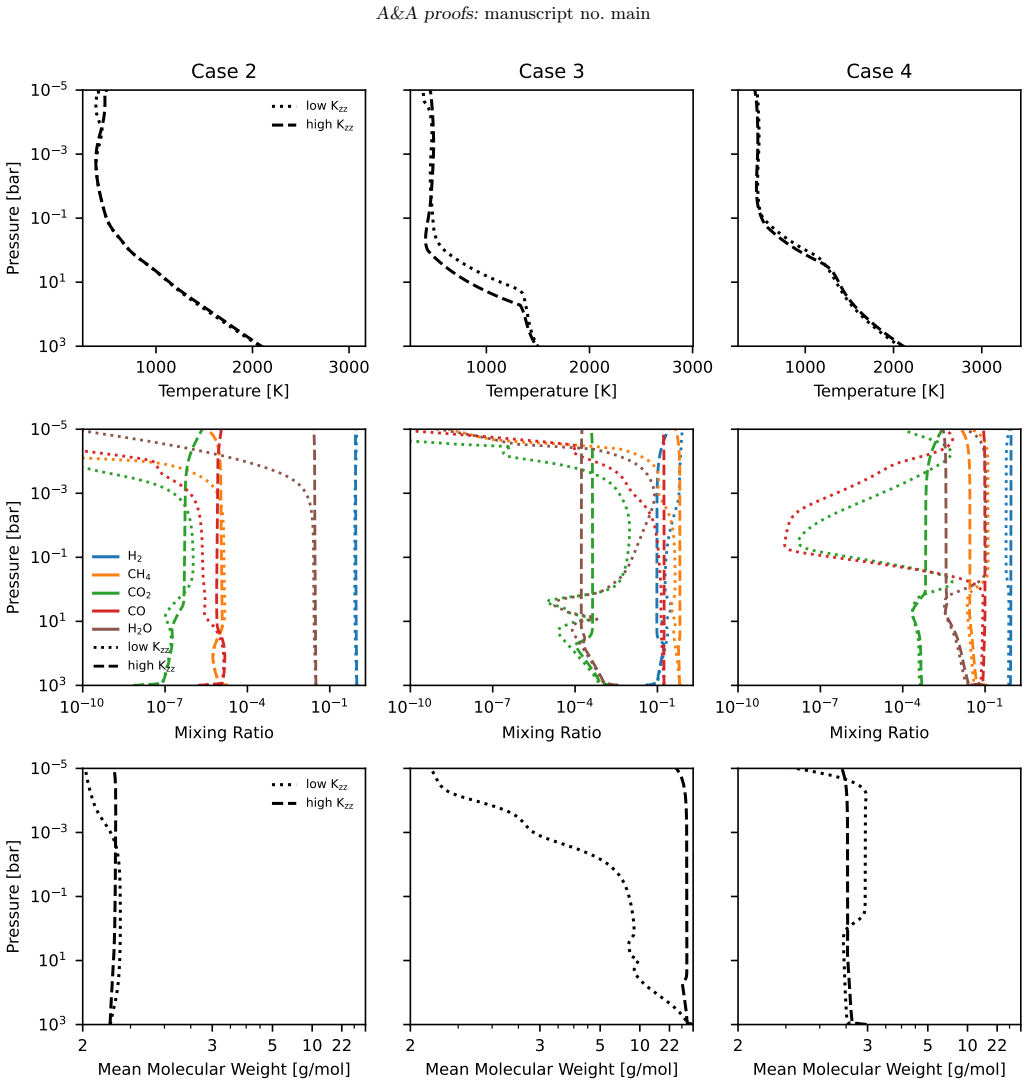
Recent JWST detections of CH4 and CO2 in sub-Neptune atmospheres point to a link between atmospheric composition and the nature of planetary building blocks - rock, water, or refractory carbon ("soot") - yet this connection remains poorly understood. Here we investigate how different formation environments shape the coupled interior and atmospheric compositions of sub-Neptunes. We model planets assembled from varying proportions of rock, water, and soot and compute the global chemical equilibrium and the overlying atmospheric structure. We find that planets formed from water-poor material produce atmospheres strongly depleted in carbon-bearing species, with log(CH4) and log(CO2) below -4. In contrast, planets assembled from water-rich building blocks naturally develop methane- and carbon-dioxide-rich atmospheres with elevated metal mass fractions and C/O ratios. The presence of refractory carbon (soot) further enhances methane production and can lead to methane-dominated atmospheres. Comparison with JWST observations suggests that water-rich formation is sufficient to explain K2-18b and TOI-270d with no soot component required, while TOI-421b and GJ3470b are consistent with water-poor formation inside the water ice line. The ratio H2O/CH4 combined with the mean molecular weight (MMW) provides a powerful two-dimensional diagnostic linking atmospheric composition to formation environment, with departures from the predicted trends explained by water condensation in temperate atmospheres or fractionated atmospheric mass loss.
Editorial analysis
A structured set of objections, weighed in public.
Referee Report
Summary. The manuscript models sub-Neptunes assembled from varying proportions of rock, water, and soot building blocks, computes global chemical equilibrium compositions and atmospheric structures, and concludes that water-rich formation produces CH4/CO2-rich atmospheres with elevated metal fractions while water-poor formation yields carbon-depleted atmospheres. It proposes the H2O/CH4 ratio combined with mean molecular weight as a two-dimensional diagnostic linking atmospheric properties to formation environment and matches specific JWST targets (K2-18b and TOI-270d to water-rich; TOI-421b and GJ3470b to water-poor), attributing departures to condensation or fractionated loss.
Significance. If the formation-to-atmosphere mapping holds, the work supplies a concrete interpretive framework for JWST sub-Neptune spectra that directly ties observed molecular ratios and MMW to initial building-block proportions, which would be a useful advance for the field. The systematic variation of rock/water/soot fractions and the explicit two-dimensional diagnostic are positive features.
major comments (1)
- [Comparison with JWST observations] The central claim that the H2O/CH4–MMW diagnostic reliably links observed atmospheres to formation conditions rests on the assumption that post-formation processes (core-envelope mixing, energy-limited escape with fractionation) remain sub-dominant. The abstract notes that departures can be explained by condensation or fractionated loss, yet no quantitative assessment is given of how these processes would displace the model loci for the matched planets (K2-18b, TOI-270d, TOI-421b, GJ3470b). This is load-bearing for the diagnostic's applicability.
Simulated Author's Rebuttal
We thank the referee for their constructive feedback and for recognizing the potential value of the H2O/CH4–MMW diagnostic. We address the single major comment below and agree that additional quantitative analysis is warranted.
read point-by-point responses
-
Referee: The central claim that the H2O/CH4–MMW diagnostic reliably links observed atmospheres to formation conditions rests on the assumption that post-formation processes (core-envelope mixing, energy-limited escape with fractionation) remain sub-dominant. The abstract notes that departures can be explained by condensation or fractionated loss, yet no quantitative assessment is given of how these processes would displace the model loci for the matched planets (K2-18b, TOI-270d, TOI-421b, GJ3470b). This is load-bearing for the diagnostic's applicability.
Authors: We agree that the lack of quantitative assessment of post-formation processes is a limitation for the robustness of the diagnostic. The manuscript currently provides only qualitative attribution of departures to condensation or fractionated loss. In revision we will add order-of-magnitude calculations (drawing on published escape and condensation models) showing how these processes would displace the loci of K2-18b, TOI-270d, TOI-421b and GJ3470b in the H2O/CH4–MMW plane, thereby testing whether the formation-environment interpretation remains viable. revision: yes
Circularity Check
No significant circularity; forward models derive diagnostic from explicit inputs
full rationale
The paper varies rock/water/soot proportions as explicit inputs, applies standard chemical equilibrium to compute atmospheric compositions and structures, and extracts the H2O/CH4–MMW trend as an emergent model result. No step reduces an output to a fitted parameter or self-citation by construction; the diagnostic is presented as a consequence of the forward modeling rather than presupposed. Assumptions about sub-dominant post-formation processes are stated openly but do not create definitional circularity. The derivation chain remains self-contained against external benchmarks.
Axiom & Free-Parameter Ledger
free parameters (1)
- proportions of rock, water, and soot
axioms (1)
- domain assumption Global chemical equilibrium determines the coupled interior and atmospheric compositions
Reference graph
Works this paper leans on
-
[1]
2025, The As- trophysical Journal, 985, L10, doi:10.3847/2041-8213/add010
Ahrer, E.-M., Radica, M., Piaulet-Ghorayeb, C., et al. 2025, The As- trophysical Journal, 985, L10, doi:10.3847/2041-8213/add010
-
[2]
Anderson, D. E., Bergin, E. A., Blake, G. A., et al. 2017, The Astro- physical Journal, 845, 13, doi:10.3847/1538-4357/aa7da1
-
[3]
P., Piet, H., Siebert, J., & Ryerson, F
Badro, J., Brodholt, J. P., Piet, H., Siebert, J., & Ryerson, F. J. 2015, Proceedings of the National Academy of Sciences, 112, 12310, doi:10.1073/pnas.1505672112
-
[4]
G., Welbanks, L., Schlawin, E., et al
Beatty, T. G., Welbanks, L., Schlawin, E., et al. 2024, The Astrophys- ical Journal Letters, 970, L10, doi:10.3847/2041-8213/ad55e9
-
[5]
2024, arXiv e-prints, arXiv:2403.03227, doi:10.48550/arXiv.2403
Benneke, B., Roy, P.-A., Coulombe, L.-P., et al. 2024, JWST Reveals CH4, CO2, and H2O in a Metal-rich Miscible Atmosphere on a Two-Earth-Radius Exoplanet, arXiv, doi:10.48550/arXiv.2403. 03325
-
[6]
Bergin, E., Cleeves, L. I., Crockett, N., & Blake, G. 2014, Faraday Discussions, 168, 61, doi:10.1039/C4FD00003J
-
[7]
Bergin, E. A., Blake, G. A., Ciesla, F., Hirschmann, M. M., & Li, J. 2015, Proceedings of the National Academy of Sciences, 112, 8965, doi:10.1073/pnas.1500954112
-
[8]
Bergin, E. A., Kempton, E. M.-R., Hirschmann, M., et al. 2023, The Astrophysical Journal Letters, 949, L17, doi:10.3847/2041-8213/ acd377
-
[9]
Blanchard, I., Rubie, D. C., Jennings, E. S., et al. 2022, Earth and Planetary Science Letters, 580, 117374, doi:10.1016/j.epsl.2022. 117374
-
[10]
Bower, D. J., Thompson, M. A., Hakim, K., Tian, M., & Sossi, P. A. 2025, Diversity of rocky planet atmospheres in the C-H-O-N-S-Cl system with interior dissolution, non-ideality, and condensation: Application to TRAPPIST-1e and sub-Neptunes, arXiv, doi:10. 48550/arXiv.2507.00499
arXiv 2025
-
[11]
Burn, R., Bali, K., Dorn, C., Luque, R., & Grimm, S. L. 2024, Water- rich sub-Neptunes and rocky super Earths around different Stars: Radii shaped by Volatile Partitioning, Formation, and Evolution, arXiv, doi:10.48550/arXiv.2411.16879
-
[12]
Chakrabarty, A., & Mulders, G. D. 2024, The Astrophysical Journal, 966, 185, doi:10.3847/1538-4357/ad3802
-
[13]
Davenport, B., Kempton, E. M.-R., Nixon, M. C., et al. 2025, ApJ, 984, L44, doi:10.3847/2041-8213/adcd76
-
[14]
Dorn, C., Hinkel, N. R., & Venturini, J. 2017, Astronomy & Astro- physics, 597, A38, doi:10.1051/0004-6361/201628749
-
[15]
2021, The Astrophysical Journal Letters, 922, L4, doi:10.3847/2041-8213/ac33af
Dorn, C., & Lichtenberg, T. 2021, The Astrophysical Journal Letters, 922, L4, doi:10.3847/2041-8213/ac33af
-
[17]
A., Cottrell, E., Hauri, E., Lee, K
Fischer, R. A., Cottrell, E., Hauri, E., Lee, K. K. M., & Le Voyer, M. 2020, Proceedings of the National Academy of Sciences, 117, 8743, doi:10.1073/pnas.1919930117
-
[18]
2026, Nature, 650, 60, doi:10.1038/ s41586-025-09970-4
Gilmore, T., & Stixrude, L. 2026, Nature, 650, 60, doi:10.1038/ s41586-025-09970-4
2026
-
[19]
2026, A New Global Chemical Equilibrium Code: Refractory Element Signatures in Super-Earths and Sub-Neptunes.https://arxiv.org/abs/2605
Grimm, S., Steinmeyer, M.-L., Werlen, A., et al. 2026, A New Global Chemical Equilibrium Code: Refractory Element Signatures in Super-Earths and Sub-Neptunes.https://arxiv.org/abs/2605. 07833v1
2026
-
[20]
L., Malik, M., Kitzmann, D., et al
Grimm, S. L., Malik, M., Kitzmann, D., et al. 2021, The Astrophys- ical Journal Supplement Series, 253, 30, doi:10.3847/1538-4365/ abd773
-
[21]
2004, Geophysical Research Letters, 31, doi:10.1029/2003GL019380
Hirao, N., Kondo, T., Ohtani, E., Takemura, K., & Kikegawa, T. 2004, Geophysical Research Letters, 31, doi:10.1029/2003GL019380
-
[22]
Hirschmann, M. M. 2012, Earth and Planetary Science Letters, 341- 344, 48, doi:10.1016/j.epsl.2012.06.015
-
[23]
2024, 683, L2, doi: 10.1051/0004-6361/202348238 16
Holmberg, M., & Madhusudhan, N. 2024, Astronomy & Astrophysics, 683, L2, doi:10.1051/0004-6361/202348238
-
[24]
W., Vazan, A., Chariton, S., Prakapenka, V
Horn, H. W., Vazan, A., Chariton, S., Prakapenka, V. B., & Shim, S.-H. 2025, Nature, 646, 1069, doi:10.1038/s41586-025-09630-7
-
[25]
Hu, R., Bello-Arufe, A., Tokadjian, A., et al. 2025, A water-rich in- terior in the temperate sub-Neptune K2-18 b revealed by JWST, arXiv, doi:10.48550/arXiv.2507.12622
-
[26]
S., Fegley Jr., B., Schaefer, L., & Gaidos, E
Kite, E. S., Fegley Jr., B., Schaefer, L., & Gaidos, E. 2016, The As- trophysical Journal, 828, 80, doi:10.3847/0004-637X/828/2/80
-
[27]
Krishnamurthy, V., Hirano, T., Gaidos, E., et al. 2023, Monthly No- tices of the Royal Astronomical Society, 521, 1210, doi:10.1093/ mnras/stad404 Article number, page 12 Caroline Dorn et al.: Atmospheric diversity of sub-Neptunes from formation with rock, water, and soot
2023
-
[28]
2017, Astronomy & Astrophysics, 598, A98, doi:10.1051/0004-6361/201629140
Leconte, J., Selsis, F., Hersant, F., & Guillot, T. 2017, Astronomy & Astrophysics, 598, A98, doi:10.1051/0004-6361/201629140
-
[29]
2024, A&A, 686, A131, doi:10.1051/0004-6361/202348928
Leconte, J., Spiga, A., Clément, N., et al. 2024, A&A, 686, A131, doi:10.1051/0004-6361/202348928
-
[30]
Lee, E. K. H., Werlen, A., & Dorn, C. 2025, The Astrophysical Journal Letters, 990, L43, doi:10.3847/2041-8213/adfe62
-
[31]
Li, J., Bergin, E. A., Hirschmann, M. M., et al. 2026, The Astrophys- ical Journal Letters, 997, L29, doi:10.3847/2041-8213/ae29a6
-
[32]
Li, Y., Vočadlo, L., Sun, T., & Brodholt, J. P. 2020, Nature Geo- science, 13, 453, doi:10.1038/s41561-020-0578-1
-
[33]
2025, The Astrophysical Journal Letters, 990, L35, doi:10.3847/2041-8213/adfcc8
Lin, Z., & Seager, S. 2025, The Astrophysical Journal Letters, 990, L35, doi:10.3847/2041-8213/adfcc8
-
[34]
Luo, H., Dorn, C., & Deng, J. 2024, Nature Astronomy, 8, 1399, doi:10.1038/s41550-024-02347-z Madhusudhan,N.,Sarkar,S.,Constantinou,S.,etal.2023,TheAstro- physical Journal Letters, 956, L13, doi:10.3847/2041-8213/acf577
-
[35]
2017, Monthly Notices of the Royal Astronomical Society, 472, 447, doi:10.1093/mnras/stx1666
Mahapatra, G., Helling, C., & Miguel, Y. 2017, Monthly Notices of the Royal Astronomical Society, 472, 447, doi:10.1093/mnras/stx1666
-
[36]
Malik, M., Kitzmann, D., Mendonça, J. M., et al. 2019, The Astro- nomical Journal, 157, 170, doi:10.3847/1538-3881/ab1084
-
[37]
Malik, M., Grosheintz, L., Mendonça, J. M., et al. 2017, The Astro- nomical Journal, 153, 56, doi:10.3847/1538-3881/153/2/56
-
[38]
2022, A&A, 665, A12, doi:10.1051/0004-6361/202243359
Markham, S., Guillot, T., & Stevenson, D. 2022, A&A, 665, A12, doi:10.1051/0004-6361/202243359
-
[39]
D., et al
Miozzi, F., Shahar, A., Young, E. D., et al. 2025, Nature, doi:10. 1038/s41586-025-09816-z
2025
-
[40]
Misener, W., & Schlichting, H. E. 2022, Monthly Notices of the Royal Astronomical Society, 514, 6025, doi:10.1093/mnras/stac1732
-
[41]
Nixon, M. C., Somers, R. S., Savel, A. B., et al. 2025, The Astrophys- ical Journal, 995, 95, doi:10.3847/1538-4357/ae17c8
-
[42]
Parker, L. T., Mendonça, J. M., Diamond-Lowe, H., et al. 2025, Lim- its on the atmospheric metallicity and aerosols of the sub-Neptune GJ 3090 b from high-resolution CRIRES+ spectroscopy, arXiv, doi:10.48550/arXiv.2503.16608
-
[43]
A window for water-hydrogen demixing on warm metal-rich sub-Neptunes
Piaulet-Ghorayeb, C., Thorngren, D. P., Kempton, E. M.-R., et al. 2025, A window for water-hydrogen demixing on warm metal-rich sub-Neptunes, arXiv, doi:10.48550/arXiv.2512.01805
work page internal anchor Pith review Pith/arXiv arXiv doi:10.48550/arxiv.2512.01805 2025
-
[44]
Piaulet-Ghorayeb, C., Benneke, B., Radica, M., et al. 2024, ApJL, 974, L10, doi:10.3847/2041-8213/ad6f00 Rigby,F.E.,Madhusudhan,N.,Sarkar,S.,etal.2025,AJWSTTrans- missionSpectrumoftheTemperateSub-NeptuneTOI-732c,arXiv, doi:10.48550/arXiv.2512.15844
-
[45]
E., Pica-Ciamarra, L., Holmberg, M., et al
Rigby, F. E., Pica-Ciamarra, L., Holmberg, M., et al. 2024, The As- trophysical Journal, 975, 101, doi:10.3847/1538-4357/ad6c38
-
[46]
Using observations of escaping H/He to constrain the atmospheric composition of sub-Neptunes
Rogers, J. G., Owen, J. E., Schreyer, E., & Kirk, J. 2026, Using obser- vations of escaping H/He to constrain the atmospheric composition of sub-Neptunes, arXiv, doi:10.48550/arXiv.2601.14254
work page internal anchor Pith review Pith/arXiv arXiv doi:10.48550/arxiv.2601.14254 2026
-
[47]
Rogers, L. A., & Seager, S. 2010, The Astrophysical Journal, 712, 974, doi:10.1088/0004-637X/712/2/974
-
[48]
2025, Nature Astronomy, 1, doi:10.1038/s41550-025-02723-3
Roy, P.-A., Benneke, B., Fournier-Tondreau, M., et al. 2025, Nature Astronomy, 1, doi:10.1038/s41550-025-02723-3
-
[49]
Schlichting, H. E., & Young, E. D. 2022, The Planetary Science Jour- nal, 3, 127, doi:10.3847/PSJ/ac68e6
-
[50]
Schmidt, S. P., MacDonald, R. J., Tsai, S.-M., et al. 2025, The Astro- nomical Journal, 170, 298, doi:10.3847/1538-3881/ae019a
-
[51]
2024, The Astrophysical Journal, 975, 14, doi:10.3847/1538-4357/ad7461
Seo, C., Ito, Y., & Fujii, Y. 2024, The Astrophysical Journal, 975, 14, doi:10.3847/1538-4357/ad7461
-
[52]
J., Ballmer, M
Spaargaren, R. J., Ballmer, M. D., Bower, D. J., Dorn, C., & Tackley, P. J. 2020, Astronomy & Astrophysics, 643, A44, doi:10.1051/ 0004-6361/202037632
2020
-
[53]
Steinmeyer, M.-L., Dorn, C., Werlen, A., & Grimm, S. L. 2026, Coupled thermal-chemical evolution models of sub-Neptunes re- veal atmospheric signatures of their formation location, arXiv, doi:10.48550/arXiv.2601.21377
work page internal anchor Pith review Pith/arXiv arXiv doi:10.48550/arxiv.2601.21377 2026
-
[54]
Stock, J. W., Kitzmann, D., Patzer, A. B. C., & Sedlmayr, E. 2018, Monthly Notices of the Royal Astronomical Society, doi:10.1093/ mnras/sty1531 Suárez-Andrés, L., Israelian, G., Hernández, J. I. G., et al. 2018, Astronomy & Astrophysics, 614, A84, doi:10.1051/0004-6361/ 201730743
-
[55]
2021, Nature Communi- cations, 12, 2588, doi:10.1038/s41467-021-22035-0
Tagawa, S., Sakamoto, N., Hirose, K., et al. 2021, Nature Communi- cations, 12, 2588, doi:10.1038/s41467-021-22035-0
-
[56]
2009, Geochimica et Cos- mochimica Acta Supplement, 73, A1321.https://ui.adsabs
Terasaki, H., Ohtani, E., Sakai, T., et al. 2009, Geochimica et Cos- mochimica Acta Supplement, 73, A1321.https://ui.adsabs. harvard.edu/abs/2009GeCAS..73Q1321T/abstract
2009
-
[57]
Teske, J., Batalha, N. E., Wallack, N. L., et al. 2025, JWST COM- PASS: NIRSpec/G395H Transmission Observations of TOI-776 c, a 2 Rearth M Dwarf Planet, arXiv, doi:10.48550/arXiv.2502.20501 Tsai,S.-M.,Lyons,J.R.,Grosheintz,L.,etal.2017,TheAstrophysical Journal Supplement Series, 228, 20, doi:10.3847/1538-4365/228/ 2/20
-
[58]
Valatsou, M., Dorn, C., Marty, P., & Owen, J. E. 2026, The Astro- physical Journal, 1002, 53, doi:10.3847/1538-4357/ae5104
-
[59]
Venturini, J., Guilera, O. M., Haldemann, J., Ronco, M. P., & Mor- dasini, C. 2020, A&A, 643, L1, doi:10.1051/0004-6361/202039141
-
[60]
Wallack, N. L., Batalha, N. E., Alderson, L., et al. 2024, The Astro- nomical Journal, 168, 77, doi:10.3847/1538-3881/ad3917
-
[61]
Werlen, A., Burn, R., Dorn, C., Felix, L., & Salmi, A. 2026a, The Role of Formation Location in Shaping Sulfur-, Nitrogen-, and Carbon- Bearing Species in Super-Earth and Sub-Neptune Atmospheres. https://arxiv.org/abs/2605.15170v1
-
[62]
2025a, The Astrophysical Jour- nal Letters, 991, L16, doi:10.3847/2041-8213/adff73
Werlen, A., Dorn, C., Burn, R., et al. 2025a, The Astrophysical Jour- nal Letters, 991, L16, doi:10.3847/2041-8213/adff73
-
[63]
E., Grimm, S
Werlen, A., Dorn, C., Schlichting, H. E., Grimm, S. L., & Young, E. D. 2025b, The Astrophysical Journal Letters, 988, L55, doi:10.3847/ 2041-8213/adf185
2041
-
[64]
D., Shahar, A., & Schlichting, H
Young, E. D., Shahar, A., & Schlichting, H. E. 2023, Nature, 616, 306, doi:10.1038/s41586-023-05823-0
-
[65]
D., Stixrude, L., Rogers, J
Young, E. D., Stixrude, L., Rogers, J. G., Schlichting, H. E., & Mar- cum, S. P. 2024, Planetary Science Journal, 5, 268, doi:10.3847/ PSJ/ad8c40
2024
-
[66]
Young, E. D., & Werlen, A. 2026, The Influences of Hydrogen-Silicate- Iron Miscibility on the Demographics of Sub-Neptunes and Super- Earths, arXiv, doi:10.48550/arXiv.2604.28135
work page internal anchor Pith review Pith/arXiv arXiv doi:10.48550/arxiv.2604.28135 2026
-
[67]
D., Werlen, A., Marcum, S
Young, E. D., Werlen, A., Marcum, S. P., Stixrude, L., & Dullemond, C. P. 2025, The Planetary Science Journal, 6, 251, doi:10.3847/ PSJ/ae1012 Article number, page 13
2025
discussion (0)
Sign in with ORCID, Apple, or X to comment. Anyone can read and Pith papers without signing in.