REVIEW 2 major objections 2 minor 72 references
Human fingertip motion data can generate effective robot hand designs by optimizing them to match target trajectories using only inverse kinematics control.
Reviewed by Pith at T0; open to challenge. T0 means a machine referee read the full paper against a public rubric. the ladder, T0–T4 →
T0 review · grok-4.3
2026-06-26 17:01 UTC pith:TIJN4FN2
load-bearing objection The paper shows a workable pipeline from large human motion datasets to 3D-printed robot hands via IK matching and RL-accelerated search, with real fabrication and tests, but the commercial hand comparisons rest on an assumption that may not hold. the 2 major comments →
Generating Robot Hands from Human Demonstrations
The pith
A machine-rendered reading of the paper's core claim, the machinery that carries it, and where it could break.
Core claim
By treating human demonstration trajectories as the sole reference and enforcing that every candidate hand must be controllable by the same simple inverse-kinematics policy that will be used after fabrication, the optimization produces both a general-purpose 6-DoF hand and lower-DoF specialized hands whose fabricated versions achieve accurate fingertip tracking and trajectory reproduction in physical experiments.
What carries the argument
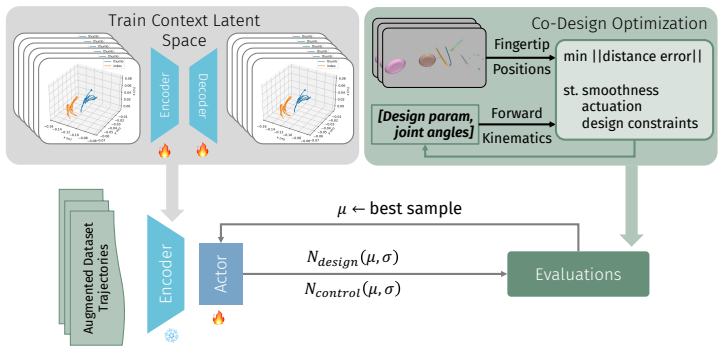
Tree-structured hand optimization driven by fingertip-position matching under a fixed inverse-kinematics policy, accelerated by a trained RL actor that proposes designs and joint angles from human motion data.
Load-bearing premise
That matching fingertip positions through inverse kinematics on human demonstration data is sufficient to produce effective physical robot hands without requiring joint controller co-optimization or additional real-world validation during design.
What would settle it
Fabricate the optimized 6-DoF hand and measure its teleoperated fingertip tracking error; if the error is not smaller than that of leading commercial hands under identical conditions, the central claim is falsified.
If this is right
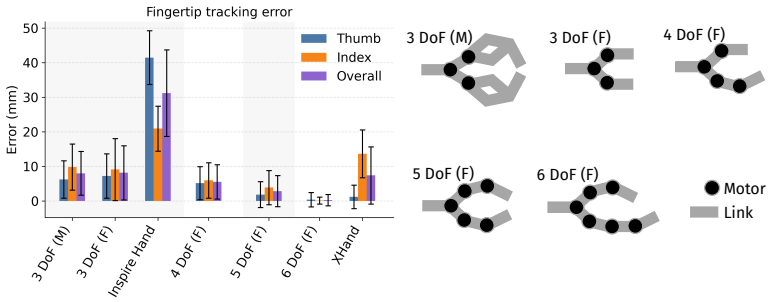
- The 6-DoF hand achieves higher fingertip tracking accuracy in teleoperation than available commercial robot hands.
- The 3-DoF hands reproduce both human and synthetic structured trajectories while using fewer mechanical degrees of freedom.
- Large-scale human motion datasets can serve directly as optimization targets for generating robot embodiments.
- Print-in-place articulated structures can be fabricated from the optimized designs and used immediately without further tuning.
Where Pith is reading between the lines
- The same data-driven matching approach could be applied to generate other robot limbs or full bodies when suitable motion capture data exist.
- Task-specific hands with reduced complexity may lower manufacturing cost and failure points for narrow manipulation domains.
- If fingertip matching proves sufficient, the method offers a route to rapidly produce custom hands for new tasks without retraining controllers.
Editorial analysis
A structured set of objections, weighed in public.
Referee Report
Summary. The paper introduces a data-driven framework that optimizes tree-structured robot hand designs (including a 6-DoF general-purpose hand and lower-DoF task-specific hands with four-bar joints) to reproduce fingertip trajectories from over 4 million frames of human manipulation data. Designs are generated by minimizing fingertip position error under a fixed inverse-kinematics policy rather than joint controller co-optimization; an RL actor accelerates the combinatorial search. Fabricated one-piece mechanisms are evaluated in real-world teleoperation, with the 6-DoF hand reported to outperform commercial hands in fingertip tracking accuracy and the 3-DoF hands shown to reproduce structured trajectories with reduced complexity.
Significance. If the performance claims hold under controlled conditions, the work demonstrates that large-scale human motion data can directly inform physical robot embodiment design, bypassing the need to jointly optimize complex controllers during search. The use of RL to prune the design space and the direct fabrication of print-in-place mechanisms are practical strengths that could influence data-driven co-design pipelines in robotics.
major comments (2)
- [Abstract / experimental results] Abstract and experimental validation: the headline claim that the 6-DoF hand achieves 'highly accurate teleoperated fingertip tracking better than available commercial robot hands' is load-bearing for the central contribution, yet the evaluation protocol is not shown to hold the controller fixed. If commercial baselines were run under their native controllers rather than the identical IK policy on the same human trajectories, accuracy differences could be attributable to control rather than kinematics or fabrication; the manuscript must explicitly state and demonstrate that all hands (generated and commercial) were evaluated under the same fixed IK policy.
- [Methods] Methods / optimization formulation: the abstract states that designs are optimized solely by matching fingertip positions via IK on human data, but provides no equations, objective function, or constraints for the topology search (e.g., how joint limits, link lengths, or collision are encoded). Without these details the reproducibility of the generated 6-DoF and 3-DoF hands cannot be assessed and the claim that the approach avoids joint controller co-optimization remains unverified.
minor comments (2)
- [Results] The manuscript should report error bars, number of trials, and statistical tests for the real-world fingertip tracking results to support the comparative claims.
- [Methods] Clarify the exact input representation and reward function used to train the RL actor that proposes hand designs and joint angles.
Simulated Author's Rebuttal
We thank the referee for the constructive comments, which highlight important points for clarity and reproducibility. We address each major comment below and will revise the manuscript to strengthen the presentation of the evaluation protocol and optimization details.
read point-by-point responses
-
Referee: [Abstract / experimental results] Abstract and experimental validation: the headline claim that the 6-DoF hand achieves 'highly accurate teleoperated fingertip tracking better than available commercial robot hands' is load-bearing for the central contribution, yet the evaluation protocol is not shown to hold the controller fixed. If commercial baselines were run under their native controllers rather than the identical IK policy on the same human trajectories, accuracy differences could be attributable to control rather than kinematics or fabrication; the manuscript must explicitly state and demonstrate that all hands (generated and commercial) were evaluated under the same fixed IK policy.
Authors: We agree that isolating the contribution of the hand morphology requires a fixed controller across all evaluated designs. In the real-world teleoperation experiments, the 6-DoF generated hand and the commercial baselines were evaluated using the identical inverse-kinematics policy applied to the same human fingertip trajectories. We will revise the manuscript to explicitly state this protocol in the abstract, methods, and experimental sections, add a clear description of the uniform IK application, and include supporting details (e.g., pseudocode or a supplementary figure) demonstrating that the controller was held fixed. revision: yes
-
Referee: [Methods] Methods / optimization formulation: the abstract states that designs are optimized solely by matching fingertip positions via IK on human data, but provides no equations, objective function, or constraints for the topology search (e.g., how joint limits, link lengths, or collision are encoded). Without these details the reproducibility of the generated 6-DoF and 3-DoF hands cannot be assessed and the claim that the approach avoids joint controller co-optimization remains unverified.
Authors: The referee is correct that the current manuscript describes the optimization at a conceptual level without the full mathematical formulation. We will add the explicit objective function (minimizing summed fingertip position error under the fixed IK policy), the encoding of tree-structured topologies, joint limits, link length bounds, and collision constraints. These additions will appear in a new or expanded methods subsection and will directly support the claim that no joint-level controller co-optimization occurs during design search. revision: yes
Circularity Check
No significant circularity; optimization uses external human data with independent physical validation
full rationale
The paper optimizes tree-structured hand designs to match fingertip trajectories from >4M frames of human motion data via inverse kinematics under a fixed simple policy. An RL actor accelerates the search but does not alter the target data or evaluation. Final claims rest on physical one-piece fabrication and real-world teleoperation experiments that measure tracking accuracy on the fabricated hardware. These steps are not reductions of the optimization inputs by construction, nor do they rely on self-citations or self-definitional mappings. The derivation chain remains self-contained against external benchmarks.
Axiom & Free-Parameter Ledger
free parameters (1)
- Hand topology parameters (DoF, joint types)
axioms (1)
- domain assumption Human fingertip motion data is representative of desired robot hand capabilities.
read the original abstract
Robot learning has advanced rapidly in learning control, but learning the physical body of a robot remains much more difficult because jointly searching over design and control creates a very large combinatorial problem. Here, we present a data-driven framework for generating robot hands from human demonstrations. Instead of learning a complex controller together with each candidate design, we generate robot hand designs using the same simple control policy used after fabrication: matching fingertip positions through inverse kinematics. Using more than 4 million frames of human fingertip motion from everyday manipulation, our algorithm optimizes tree-structured robot hands to reproduce desired target motions. The framework produced both a 6-degree-of-freedom (DoF) general-purpose hand and lower-DoF task-specific hands with spatial four-bar mimic joints. To accelerate the search over designs, we trained a reinforcement-learning (RL) actor to propose good hand designs and joint angles, reducing search time from hours to minutes. We fabricated the mechanisms directly as one-piece articulated structures with print-in-place joints. In real-world experiments, the 6-DoF hand achieved highly accurate teleoperated fingertip tracking better than available commercial robot hands, whereas the specialized 3-DoF hands reproduced structured human and synthetic trajectories with reduced mechanical complexity. These results showed that large-scale human motion data can be used not only to train robot controllers but also as a reference for optimizing and generating the physical embodiment of robots.
Figures




Reference graph
Works this paper leans on
-
[1]
Kumar, Z
A. Kumar, Z. Fu, D. Pathak, and J. Malik. Rma: Rapid motor adaptation for legged robots. Robotics: Science and Systems, 2021
2021
-
[2]
J. Luo, C. Xu, J. Wu, and S. Levine. Precise and dexterous robotic manipulation via human- in-the-loop reinforcement learning.Science Robotics, 10(105):eads5033, 2025
2025
-
[3]
T. Z. Zhao, V . Kumar, S. Levine, and C. Finn. Learning fine-grained bimanual manipulation with low-cost hardware.Robotics: Science and Systems, 2023
2023
-
[4]
Pfeifer and J
R. Pfeifer and J. Bongard.How the body shapes the way we think: a new view of intelligence. MIT press, 2006
2006
-
[5]
Y . Qin, W. Yang, B. Huang, K. Van Wyk, H. Su, X. Wang, Y .-W. Chao, and D. Fox. Anyteleop: A general vision-based dexterous robot arm-hand teleoperation system.Robotics: Science and Systems, 2023
2023
-
[6]
Z.-H. Yin, C. Wang, L. Pineda, K. Bodduluri, T. Wu, P. Abbeel, and M. Mukadam. Geometric retargeting: A principled, ultrafast neural hand retargeting algorithm. In2025 IEEE/RSJ In- ternational Conference on Intelligent Robots and Systems (IROS), pages 17376–17382. IEEE, 2025
2025
-
[7]
X. Zhan, L. Yang, Y . Zhao, K. Mao, H. Xu, Z. Lin, K. Li, and C. Lu. Oakink2: A dataset of bimanual hands-object manipulation in complex task completion. InProceedings of the IEEE/CVF Conference on Computer Vision and Pattern Recognition, pages 445–456, 2024
2024
-
[8]
F. J. Varela, E. Rosch, and E. Thompson. The embodied mind.The embodied mind: Cognitive science and human experience., 1991
1991
-
[9]
Pfeifer, M
R. Pfeifer, M. Lungarella, and F. Iida. Self-organization, embodiment, and biologically inspired robotics.science, 318(5853):1088–1093, 2007
2007
-
[10]
Nolfi and D
S. Nolfi and D. Floreano. Synthesis of autonomous robots through evolution.Trends in cogni- tive sciences, 6(1):31–37, 2002
2002
-
[11]
Lipson and J
H. Lipson and J. B. Pollack. Automatic design and manufacture of robotic lifeforms.Nature, 406(6799):974–978, 2000
2000
-
[12]
R. W. Young. Evolution of the human hand: the role of throwing and clubbing.Journal of Anatomy, 202(1):165–174, 2003
2003
-
[13]
Mintchev and D
S. Mintchev and D. Floreano. Adaptive morphology: A design principle for multimodal and multifunctional robots.IEEE Robotics & Automation Magazine, 23(3):42–54, 2016
2016
-
[14]
Spielberg, B
A. Spielberg, B. Araki, C. Sung, R. Tedrake, and D. Rus. Functional co-optimization of artic- ulated robots. In2017 IEEE International Conference on Robotics and Automation (ICRA), pages 5035–5042. IEEE, 2017
2017
-
[15]
Schulz, C
A. Schulz, C. Sung, A. Spielberg, W. Zhao, Y . Cheng, A. Mehta, E. Grinspun, D. Rus, and W. Matusik. Interactive robogami: Data-driven design for 3d print and fold robots with ground locomotion. InSIGGRAPH 2015: Studio, pages 1–1. 2015
2015
-
[16]
S. Ha, S. Coros, A. Alspach, J. Kim, and K. Yamane. Computational co-optimization of design parameters and motion trajectories for robotic systems.The International Journal of Robotics Research, 37(13-14):1521–1536, 2018
2018
-
[17]
T. Chen, Z. He, and M. Ciocarlie. Co-designing hardware and control for robot hands.Science Robotics, 6(54):eabg2133, 2021. 9
2021
-
[18]
Carter, W.-H
A. Carter, W.-H. Chen, S. Misra, and C. Sung. A task-to-intelligence mapping: When is embodied intelligence worth designing? InIOP Conference Series: Materials Science and Engineering, volume 1292, page 012003. IOP Publishing, 2023
2023
-
[19]
Fletcher, R
A. Fletcher, R. Xiang, L. Scotzniovsky, J. Cervera-Torralba, M. T. Tolley, and J. T. Hwang. Multidisciplinary control co-design optimization of anguilliform-swimming soft fluidic robots. In2025 IEEE 8th International Conference on Soft Robotics (RoboSoft), pages 1–6. IEEE, 2025
2025
-
[20]
Kodnongbua, I
M. Kodnongbua, I. G. Y . Lou, J. Lipton, and A. Schulz. Computational design of passive grippers.ACM Transactions on Graphics, 2023
2023
-
[21]
D. Ha. Reinforcement learning for improving agent design.Artificial life, 25(4):352–365, 2019
2019
-
[22]
Y . Yuan, Y . Song, Z. Luo, W. Sun, and K. Kitani. Transform2act: Learning a transform-and- control policy for efficient agent design.International Conference on Learning Representa- tions (ICLR), 2021
2021
-
[23]
Gupta, S
A. Gupta, S. Savarese, S. Ganguli, and L. Fei-Fei. Embodied intelligence via learning and evolution.Nature communications, 12(1):5721, 2021
2021
-
[24]
Islam, Z
S. Islam, Z. He, and M. Ciocarlie. Task-based design and policy co-optimization for tendon- driven underactuated kinematic chains. In2024 IEEE/RSJ International Conference on Intel- ligent Robots and Systems (IROS), pages 12016–12023. IEEE, 2024
2024
-
[25]
He and M
Z. He and M. Ciocarlie. Morph: Design co-optimization with reinforcement learning via a differentiable hardware model proxy. In2024 IEEE International Conference on Robotics and Automation (ICRA), pages 7764–7771. IEEE, 2024
2024
-
[26]
M. Li, D. Matthews, and S. Kriegman. Reinforcement learning for freeform robot design. In 2024 IEEE International Conference on Robotics and Automation (ICRA), pages 8799–8806. IEEE, 2024
2024
-
[27]
J. Xu, T. Chen, L. Zlokapa, M. Foshey, W. Matusik, S. Sueda, and P. Agrawal. An end-to- end differentiable framework for contact-aware robot design.Robotics: Science and Systems, 2021
2021
-
[28]
H. Ha, S. Agrawal, and S. Song. Fit2form: 3d generative model for robot gripper form design. InConference on Robot Learning, pages 176–187. PMLR, 2021
2021
-
[29]
X. Xu, H. Ha, and S. Song. Dynamics-guided diffusion model for sensor-less robot manipula- tor design.Conference on Robot Learning, 2024
2024
-
[30]
S. Yi, X. Bai, A. Singh, J. Ye, M. T. Tolley, and X. Wang. Co-design of soft gripper with neural physics.Conference on Robot Learning, 2025
2025
-
[31]
X. Bai, N. Hansen, A. Singh, M. T. Tolley, Y . Duan, P. Abbeel, X. Wang, and S. Yi. Learning to design soft hands using reward models.International Conference on Robotics & Automation, 2026
2026
-
[32]
P. Ma, T. Du, J. Z. Zhang, K. Wu, A. Spielberg, R. K. Katzschmann, and W. Matusik. Diffaqua: A differentiable computational design pipeline for soft underwater swimmers with shape inter- polation.ACM Transactions on Graphics (TOG), 40(4):1–14, 2021
2021
-
[33]
A. Zhao, J. Xu, M. Konakovi ´c-Lukovi´c, J. Hughes, A. Spielberg, D. Rus, and W. Matusik. Robogrammar: graph grammar for terrain-optimized robot design.ACM Transactions on Graphics (TOG), 39(6):1–16, 2020. 10
2020
-
[34]
R. Liu, J. Liang, S. Sudhakar, H. Ha, C. Chi, S. Song, and C. V ondrick. Paperbot: Learning to design real-world tools using paper.Conference on Robot Learning, 2024
2024
-
[35]
A. Zhao, T. Du, J. Xu, J. Hughes, J. Salazar, P. Ma, W. Wang, D. Rus, and W. Matusik. Automatic co-design of aerial robots using a graph grammar. In2022 IEEE/RSJ International Conference on Intelligent Robots and Systems (IROS), pages 11260–11267. IEEE, 2022
2022
-
[36]
Obayashi, C
N. Obayashi, C. Bosio, and J. Hughes. Soft passive swimmer optimization: From simulation to reality using data-driven transformation. In2022 IEEE 5th International Conference on Soft Robotics (RoboSoft), pages 328–333. IEEE, 2022
2022
-
[37]
Coros, B
S. Coros, B. Thomaszewski, G. Noris, S. Sueda, M. Forberg, R. W. Sumner, W. Matusik, and B. Bickel. Computational design of mechanical characters.ACM Transactions on Graphics (TOG), 32(4):1–12, 2013
2013
-
[38]
K. S. Luck, H. B. Amor, and R. Calandra. Data-efficient co-adaptation of morphology and behaviour with deep reinforcement learning. InConference on Robot Learning, pages 854–
-
[39]
Schaff, A
C. Schaff, A. Sedal, and M. R. Walter. Soft robots learn to crawl: Jointly optimizing design and control with sim-to-real transfer.Autonomous Robots, 2022
2022
-
[40]
Polzin, Q
M. Polzin, Q. Guan, and J. Hughes. Robotic locomotion through active and passive morpho- logical adaptation in extreme outdoor environments.Science robotics, 10(99):eadp6419, 2025
2025
-
[41]
K. Fay, D. A. Djapri, A. Zorin, J. Clinton, A. E. Lahib, H. Su, M. T. Tolley, S. Yi, and X. Wang. Cross-embodied co-design for dexterous hands.International Conference on Learning Repre- sentations (ICLR), 2025
2025
-
[42]
Pathak, C
D. Pathak, C. Lu, T. Darrell, P. Isola, and A. A. Efros. Learning to control self-assembling morphologies: a study of generalization via modularity.Advances in Neural Information Pro- cessing Systems, 32, 2019
2019
-
[43]
Perez and J
A. Perez and J. M. McCarthy. Bennett’s linkage and the cylindroid.Mechanism and Machine Theory, 37(11):1245–1260, 2002
2002
-
[44]
R. Y . Rubinstein and D. P. Kroese.The cross-entropy method: a unified approach to combi- natorial optimization, Monte-Carlo simulation, and machine learning, volume 133. Springer, 2004
2004
-
[45]
T. He, Z. Luo, X. He, W. Xiao, C. Zhang, W. Zhang, K. Kitani, C. Liu, and G. Shi. Om- nih2o: Universal and dexterous human-to-humanoid whole-body teleoperation and learning. Conference on Robot Learning, 2024
2024
-
[46]
Cheng, Y
X. Cheng, Y . Ji, J. Chen, R. Yang, G. Yang, and X. Wang. Expressive whole-body control for humanoid robots.Robotics: Science and Systems, 2024
2024
-
[47]
T. Chen, M. Tippur, S. Wu, V . Kumar, E. Adelson, and P. Agrawal. Visual dexterity: In-hand reorientation of novel and complex object shapes.Science Robotics, 8(84):eadc9244, 2023
2023
-
[48]
Z. Fu, T. Z. Zhao, and C. Finn. Mobile aloha: Learning bimanual mobile manipulation with low-cost whole-body teleoperation.Conference on Robot Learning, 2024
2024
-
[49]
Sivakumar, K
A. Sivakumar, K. Shaw, and D. Pathak. Robotic telekinesis: Learning a robotic hand imitator by watching humans on youtube.Robotics: Science and Systems, 2022
2022
-
[50]
K. Shaw, S. Bahl, A. Sivakumar, A. Kannan, and D. Pathak. Learning dexterity from human hand motion in internet videos.The International Journal of Robotics Research, 43(4):513– 532, 2024. 11
2024
-
[51]
K. Li, P. Li, T. Liu, Y . Li, and S. Huang. Maniptrans: Efficient dexterous bimanual manipula- tion transfer via residual learning. InProceedings of the IEEE/CVF Conference on Computer Vision and Pattern Recognition, pages 6991–7003, 2025
2025
-
[52]
R.-Z. Qiu, S. Yang, X. Cheng, C. Chawla, J. Li, T. He, G. Yan, D. J. Yoon, R. Hoque, L. Paulsen, et al. Humanoid policy˜ human policy.Conference on Robot Learning, 2025
2025
-
[53]
Kareer, D
S. Kareer, D. Patel, R. Punamiya, P. Mathur, S. Cheng, C. Wang, J. Hoffman, and D. Xu. Egomimic: Scaling imitation learning via egocentric video. In2025 IEEE International Con- ference on Robotics and Automation (ICRA), pages 13226–13233. IEEE, 2025
2025
-
[54]
Jiang, Y
Z. Jiang, Y . Xie, K. Lin, Z. Xu, W. Wan, A. Mandlekar, L. J. Fan, and Y . Zhu. Dexmimic- gen: Automated data generation for bimanual dexterous manipulation via imitation learning. In2025 IEEE International Conference on Robotics and Automation (ICRA), pages 16923– 16930. IEEE, 2025
2025
-
[55]
A. M. Dollar and R. D. Howe. The highly adaptive sdm hand: Design and performance evalu- ation.The international journal of robotics research, 29(5):585–597, 2010
2010
-
[56]
M. G. Catalano, G. Grioli, E. Farnioli, A. Serio, C. Piazza, and A. Bicchi. Adaptive syner- gies for the design and control of the pisa/iit softhand.The International Journal of Robotics Research, 33(5):768–782, 2014
2014
-
[57]
L. U. Odhner, L. P. Jentoft, M. R. Claffee, N. Corson, Y . Tenzer, R. R. Ma, M. Buehler, R. Ko- hout, R. D. Howe, and A. M. Dollar. A compliant, underactuated hand for robust manipulation. The International Journal of Robotics Research, 33(5):736–752, 2014
2014
-
[58]
Khatib, X
O. Khatib, X. Yeh, G. Brantner, B. Soe, B. Kim, S. Ganguly, H. Stuart, S. Wang, M. Cutkosky, A. Edsinger, et al. Ocean one: A robotic avatar for oceanic discovery.IEEE Robotics & Automation Magazine, 23(4):20–29, 2016
2016
-
[59]
Laffranchi, N
M. Laffranchi, N. Boccardo, S. Traverso, L. Lombardi, M. Canepa, A. Lince, M. Semprini, J. A. Saglia, A. Naceri, R. Sacchetti, et al. The hannes hand prosthesis replicates the key biological properties of the human hand.Science robotics, 5(46):eabb0467, 2020
2020
-
[60]
W. G. Bircher, A. S. Morgan, and A. M. Dollar. Complex manipulation with a simple robotic hand through contact breaking and caging.Science Robotics, 6(54):eabd2666, 2021
2021
-
[61]
K. Shaw, A. Agarwal, and D. Pathak. Leap hand: Low-cost, efficient, and anthropomorphic hand for robot learning.arXiv preprint arXiv:2309.06440, 2023
work page Pith review arXiv 2023
-
[62]
Zorin, I
A. Zorin, I. Guzey, B. Yan, A. Iyer, L. Kondrich, N. X. Bhattasali, and L. Pinto. Ruka: Re- thinking the design of humanoid hands with learning.Robotics: Science and Systems, 2025
2025
-
[63]
C. C. Christoph, M. Eberlein, F. Katsimalis, A. Roberti, A. Sympetheros, M. R. V ogt, D. Li- conti, C. Yang, B. G. Cangan, R. J. Hinchet, et al. Orca: An open-source, reliable, cost- effective, anthropomorphic robotic hand for uninterrupted dexterous task learning. In2025 IEEE/RSJ International Conference on Intelligent Robots and Systems (IROS), pages 8503–
-
[64]
Gilday, C
K. Gilday, C. Sirithunge, F. Iida, and J. Hughes. Embodied manipulation with past and future morphologies through an open parametric hand design.Science Robotics, 10(102):eads6437, 2025
2025
-
[65]
Capsi-Morales, D
P. Capsi-Morales, D. Y . Barsakcioglu, M. G. Catalano, G. Grioli, A. Bicchi, and D. Farina. Merging motoneuron and postural synergies in prosthetic hand design for natural bionic inter- facing.Science Robotics, 10(98):eado9509, 2025. 12
2025
-
[66]
Chong, L
E. Chong, L. Zhang, and V . J. Santos. A learning-based harmonic mapping: Framework, assessment, and case study of human-to-robot hand pose mapping.The International Journal of Robotics Research, 40(2-3):534–557, 2021
2021
-
[67]
A. S. Lakshmipathy, J. K. Hodgins, and N. S. Pollard. Kinematic motion retargeting for contact-rich anthropomorphic manipulations.ACM Transactions on Graphics, 44(2):1–20, 2025
2025
-
[68]
Y . Zhou, C. Barnes, J. Lu, J. Yang, and H. Li. On the continuity of rotation representations in neural networks. 2019 ieee. InCVF Conference on Computer Vision and Pattern Recognition (CVPR), volume 3, 2018
2019
-
[69]
Y . Zhai, A. De Boer, J. Yan, B. Shih, M. Faber, J. Speros, R. Gupta, and M. T. Tolley. Desktop fabrication of monolithic soft robotic devices with embedded fluidic control circuits.Science robotics, 8(79):eadg3792, 2023
2023
-
[70]
Conrad, J
S. Conrad, J. Teichmann, P. Auth, N. Knorr, K. Ulrich, D. Bellin, T. Speck, and F. J. Tauber. 3d-printed digital pneumatic logic for the control of soft robotic actuators.Science robotics, 9 (86):eadh4060, 2024
2024
-
[71]
H. Liu, C. Wu, S. Lin, J. Lam, N. Xi, and Y . Chen. Advances in 3d and 4d printing of soft robotics and their applications.Advanced Intelligent Systems, 7(6):2400699, 2025
2025
-
[72]
L. Yang, K. Li, X. Zhan, F. Wu, A. Xu, L. Liu, and C. Lu. Oakink: A large-scale knowl- edge repository for understanding hand-object interaction. InProceedings of the IEEE/CVF conference on computer vision and pattern recognition, pages 20953–20962, 2022. 13 A Appendix A.1 Spatial four-bar linkage formulation A classical Bennett linkage [43] is a spatial ...
2022
discussion (0)
Sign in with ORCID, Apple, or X to comment. Anyone can read and Pith papers without signing in.