Empowering Embodied AI in 6G Networks: Architecture, Enablers, and Open Challenges
Pith reviewed 2026-06-30 19:40 UTC · model grok-4.3
The pith
Future 6G networks must evolve from connectivity platforms into unified closed-loop systems that enable embodied physical intelligence.
A machine-rendered reading of the paper's core claim, the machinery that carries it, and where it could break.
Core claim
Future 6G systems must evolve from intelligent communication platforms into active enablers of embodied physical intelligence by treating communication, sensing, computation, and control as a unified closed-loop infrastructure that supports perception-communication-action interactions for agents operating in dynamic physical environments.
What carries the argument
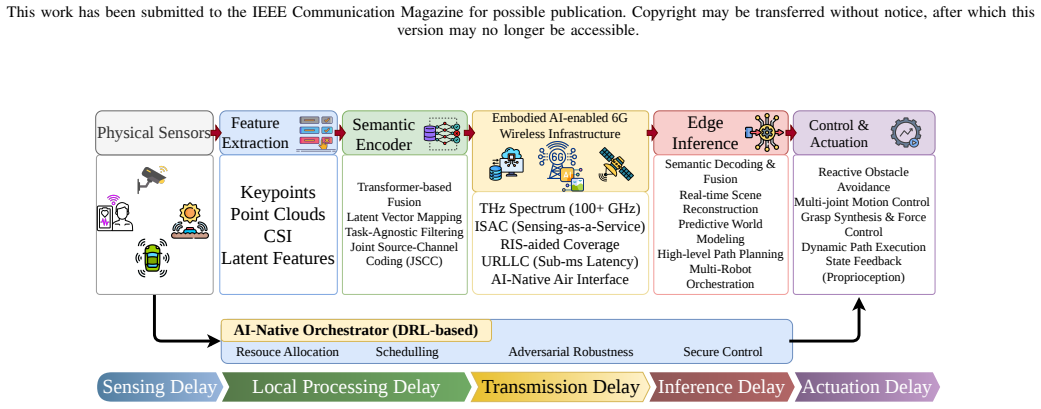
The system-level PCA architecture, which jointly designs communication, sensing, computation, and control into a single closed-loop infrastructure to support task-driven embodied agents.
If this is right
- Communication performance becomes a direct determinant of physical control stability and task success rates for embodied agents.
- Representative applications in robotics, autonomous vehicles, and XR require multimodal intelligence and edge-aware deployment as core enablers.
- Practical implementation must resolve open challenges in evaluation metrics, trustworthiness, and scalable deployment of the unified infrastructure.
Where Pith is reading between the lines
- Standards bodies may need to define new performance metrics that include physical task completion rather than throughput alone.
- Edge computation resources could be allocated dynamically based on real-time control requirements instead of data volume.
- Security models for 6G would have to account for physical-world consequences of communication failures in addition to data privacy.
Load-bearing premise
Existing AI-native wireless architectures remain largely connectivity-centric and therefore cannot support task-driven embodied intelligence at large scale.
What would settle it
A working large-scale deployment of embodied agents such as robot fleets or XR systems that achieves stable task performance using only conventional connectivity-centric 6G designs without joint PCA optimization would falsify the central claim.
Figures

read the original abstract
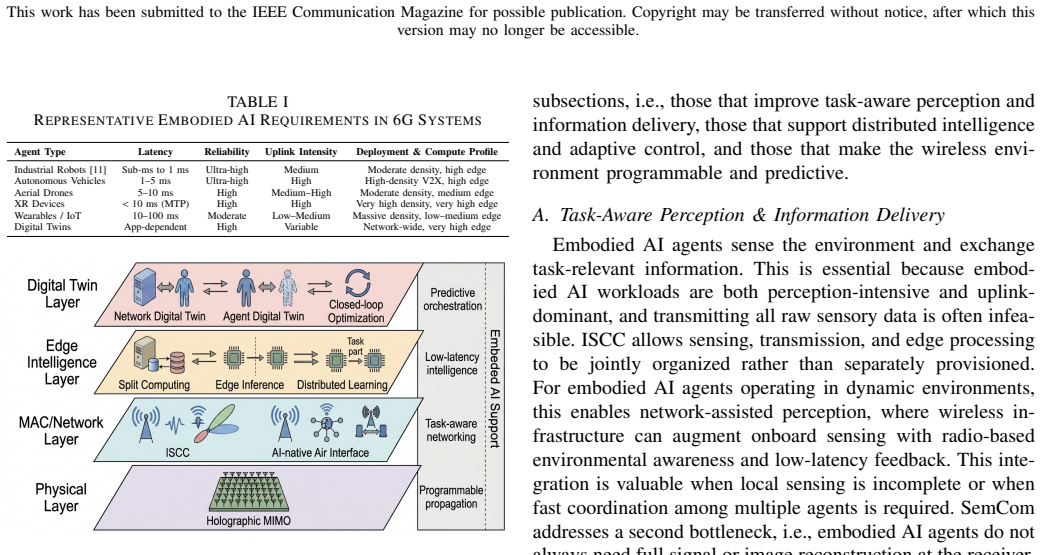
Embodied artificial intelligence (AI) is emerging as a key driver of the sixth-generation (6G) wireless networks by enabling agents that continuously perceive, communicate, and act in dynamic physical environments. Unlike conventional AI systems that process disembodied data, embodied agents such as robots, autonomous vehicles, and extended reality (XR) devices operate through closed-loop perception-communication-action (PCA) interactions, where communication performance directly affects physical behavior, control stability, and task success. However, existing AI-native wireless architectures remain largely connectivity-centric and are not designed to support task-driven embodied intelligence at large scale. Therefore, we present a holistic framework for embodied AI-native 6G systems, in which communication, sensing, computation, and control are jointly designed as a unified closed-loop infrastructure. We introduce a system-level PCA architecture, discuss key enabling technologies and representative applications, and highlight major open challenges in multimodal intelligence, edge-aware deployment, evaluation, trustworthiness, and practical implementation. Our central argument is that future 6G systems must evolve from intelligent communication platforms into active enablers of embodied physical intelligence.
Editorial analysis
A structured set of objections, weighed in public.
Referee Report
Summary. The paper claims that embodied AI requires 6G networks to move beyond connectivity-centric designs to support closed-loop perception-communication-action (PCA) interactions in physical agents such as robots, autonomous vehicles, and XR devices. It argues that existing AI-native wireless architectures are insufficient for task-driven embodied intelligence at scale and proposes a holistic embodied AI-native 6G framework that jointly designs communication, sensing, computation, and control. The manuscript introduces a system-level PCA architecture, discusses enabling technologies and applications, and enumerates open challenges in multimodal intelligence, edge-aware deployment, evaluation, trustworthiness, and implementation. Its central thesis is that future 6G systems must evolve from intelligent communication platforms into active enablers of embodied physical intelligence.
Significance. If the vision holds, the paper could help steer 6G research toward architectures that treat communication as part of a physical control loop rather than an isolated service. The structured discussion of PCA enablers and challenges offers a useful roadmap for integrating wireless systems with embodied agents. As a conceptual position paper without derivations, simulations, or empirical validation, its value lies in framing the problem and identifying directions rather than delivering immediately actionable technical results.
minor comments (2)
- [Abstract] Abstract, paragraph 2: the statement that existing architectures 'remain largely connectivity-centric' is presented as motivation; adding one or two concrete references to prior AI-native 6G designs (e.g., semantic communication or ISAC frameworks) would make the contrast more precise without altering the argument.
- The manuscript would benefit from a short table or diagram summarizing the key differences between the proposed PCA architecture and conventional AI-native stacks; this is a presentation issue that would improve readability for readers unfamiliar with embodied AI.
Simulated Author's Rebuttal
We thank the referee for the constructive summary, positive significance assessment, and recommendation of minor revision. No specific major comments were raised in the report.
Circularity Check
No significant circularity
full rationale
The manuscript is a high-level position and vision paper that introduces a PCA architecture and enumerates open challenges. It contains no equations, derivations, fitted parameters, or quantitative predictions. The central claim—that 6G must evolve to support embodied physical intelligence—is presented as an architectural argument motivated by the stated distinction between connectivity-centric and task-driven systems. This distinction is offered directly in the abstract and introduction without reduction to self-referential definitions, self-citations, or fitted inputs. No load-bearing steps reduce to the paper's own inputs by construction.
Axiom & Free-Parameter Ledger
axioms (1)
- domain assumption Embodied agents operate through closed-loop perception-communication-action interactions where communication performance directly affects physical behavior and task success.
Reference graph
Works this paper leans on
-
[1]
Bridging physical and digital worlds: Embodied large AI for future wireless systems,
X. Wang, F. Zhu, Z. Yang, C. Huang, X. Chen, Z. Zhang, S. Muhaidat, and M. Debbah, “Bridging physical and digital worlds: Embodied large AI for future wireless systems,”arXiv preprint arXiv:2506.24009, June 2025
-
[2]
A survey on goal-oriented semantic communication: Techniques, challenges, and future directions,
T. M. Getu, G. Kaddoum, and M. Bennis, “A survey on goal-oriented semantic communication: Techniques, challenges, and future directions,” IEEE Access, vol. 12, pp. 51 223–51 274, March 2024
2024
-
[3]
Toward goal- oriented semantic communications: New metrics, framework, and open challenges,
A. Li, S. Wu, S. Meng, R. Lu, S. Sun, and Q. Zhang, “Toward goal- oriented semantic communications: New metrics, framework, and open challenges,”IEEE Wireless Communications, vol. 31, no. 5, pp. 238– 245, July 2024
2024
-
[4]
Integrating network digital twinning into future AI-based 6G systems: The 6G-twin vision,
S. Faye, M. Camelo, J.-S. Sottet, C. Sommer, M. Franke, J. Baudouin, G. Castellanos, R. Decorme, M. P. Fanti, R. Fuladiet al., “Integrating network digital twinning into future AI-based 6G systems: The 6G-twin vision,” in2024 Joint European conference on networks and communi- cations & 6G summit (EuCNC/6G Summit). Antwerp, Belgium: IEEE, July 2024, pp. 883–888
2024
-
[5]
IEEE P1948.1: Standard Framework for the Integration of Artificial Intelligence Applications in 5G and 6G Mobile Networks,
IEEE Standards Association, “IEEE P1948.1: Standard Framework for the Integration of Artificial Intelligence Applications in 5G and 6G Mobile Networks,” https://standards.ieee.org/ieee/1948.1/11667/, June 2024
1948
-
[6]
Synergetic Empowerment: Wireless Communications Meets Embodied Intelligence
H. Liang, Y . Diao, Y . Wu, F. Zhou, and Q. Wu, “Synergetic empow- erment: Wireless communications meets embodied intelligence,”arXiv preprint arXiv:2509.10481, 2025
work page internal anchor Pith review Pith/arXiv arXiv 2025
-
[7]
Toward native artificial intelligence in 6g,
Y . Liu, Y . He, Y . Lin, and L. Tang, “Toward native artificial intelligence in 6g,” in2022 IEEE International Symposium on Broadband Multi- media Systems and Broadcasting (BMSB). Bilbao, Spain: IEEE, July 2022, pp. 1–6
2022
-
[8]
A survey of embodied ai: From simulators to research tasks,
J. Duan, S. Yu, H. L. Tan, H. Zhu, and C. Tan, “A survey of embodied ai: From simulators to research tasks,”IEEE Transactions on Emerging Topics in Computational Intelligence, vol. 6, no. 2, pp. 230–244, January 2022
2022
-
[9]
Pfeifer and J
R. Pfeifer and J. Bongard,How the body shapes the way we think: A new view of intelligence. MIT press, 2006
2006
-
[10]
A survey: Learning embodied intel- ligence from physical simulators and world models,
X. Long, Q. Zhao, K. Zhang, Z. Zhang, D. Wang, Y . Liu, Z. Shu, Y . Lu, S. Wang, X. Weiet al., “A survey: Learning embodied intel- ligence from physical simulators and world models,”arXiv preprint arXiv:2507.00917, 2025
-
[11]
The tactile internet for industries: A review,
A. Aijaz and M. Sooriyabandara, “The tactile internet for industries: A review,”Proceedings of the IEEE, vol. 107, no. 2, pp. 414–435, November 2018
2018
-
[12]
Cooperative perception for automated driving: A survey of algorithms, applications, and future directions,
C. Wei, G. Wu, and M. J. Barth, “Cooperative perception for automated driving: A survey of algorithms, applications, and future directions,” Proceedings of the IEEE, pp. 1–27, October 2025
2025
-
[13]
The emergence of edge computing,
M. Satyanarayanan, “The emergence of edge computing,”Computer, vol. 50, no. 1, pp. 30–39, Junary 2017
2017
-
[14]
Z. Li, Z. Gao, X. Liu, Z. Wang, X. Zhou, L. Liu, Y . Wu, W. Feng, and Y . Huang, “Large model enabled embodied intelligence for 6G integrated perception, communication, and computation network,”arXiv preprint arXiv:2512.15109, Dec. 2025
-
[15]
A survey on enabling XR services in beyond 5G mobile networks,
E. Stafidas and F. Foukalas, “A survey on enabling XR services in beyond 5G mobile networks,”IEEE Access, vol. 12, pp. 59 170–59 197, April 2024. 8
2024
discussion (0)
Sign in with ORCID, Apple, or X to comment. Anyone can read and Pith papers without signing in.