A Quantum-Assisted Agentic Distributed Artificial Intelligence Framework for Deadline-Bounded Orchestration of Hybrid Renewable Microgrids
Pith reviewed 2026-06-27 05:20 UTC · model grok-4.3
The pith
A quantum-assisted agentic framework solves every microgrid dispatch slot to exact optimality while meeting all deliberation deadlines.
A machine-rendered reading of the paper's core claim, the machinery that carries it, and where it could break.
Core claim
The central claim is that the described quantum-assisted DAI framework, by elevating solver selection to an agentic action informed by learned latency beliefs and by pricing storage at a discounted future-peak value, solves the combinatorial dispatch problem to global optimality in every control slot without violating the hard deliberation deadline, yielding a realized daily cost identical to the theoretical minimum.
What carries the argument
The coordinator agent's learned-belief-based selection of the solver expected to finish before the deadline, applied to QUBO problems formulated by BDIx agents together with the storage agent's belief-shaped future-peak valuation.
If this is right
- The committed dispatch attains the exact optimum on every slot.
- The realized daily cost equals the exact lower bound of 146.24 EUR.
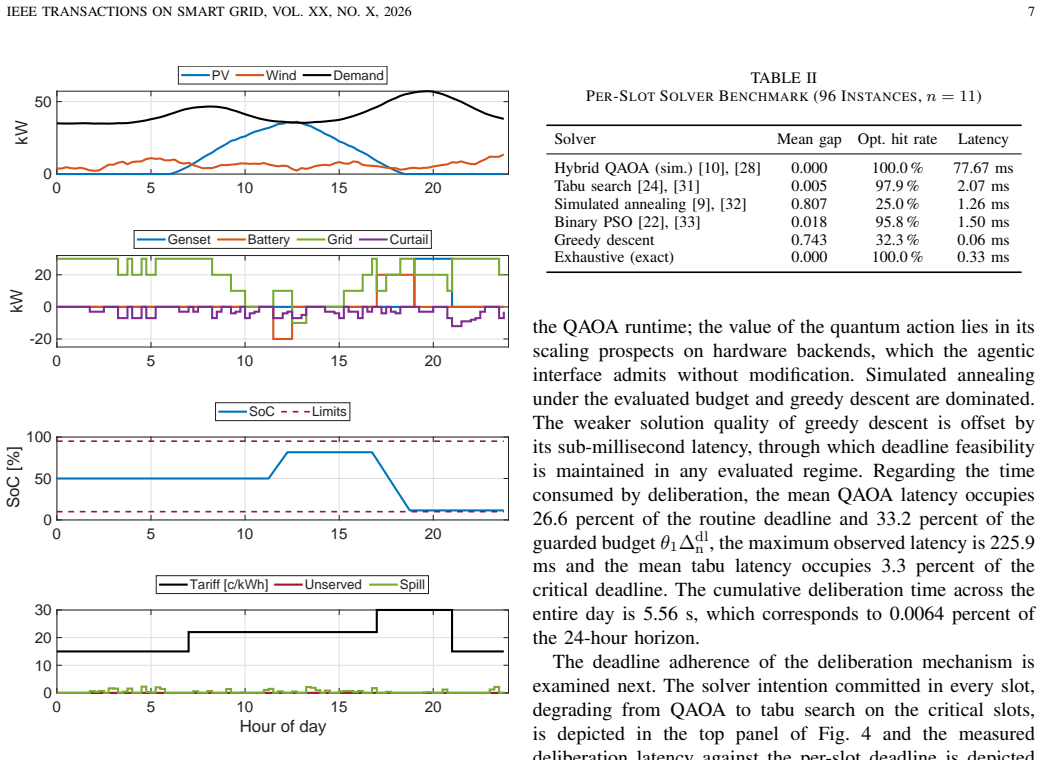
- Renewable utilization reaches 97.83 percent with zero unserved energy.
- Deactivating the storage valuation mechanism raises the daily cost by 4.5 percent to 152.75 EUR.
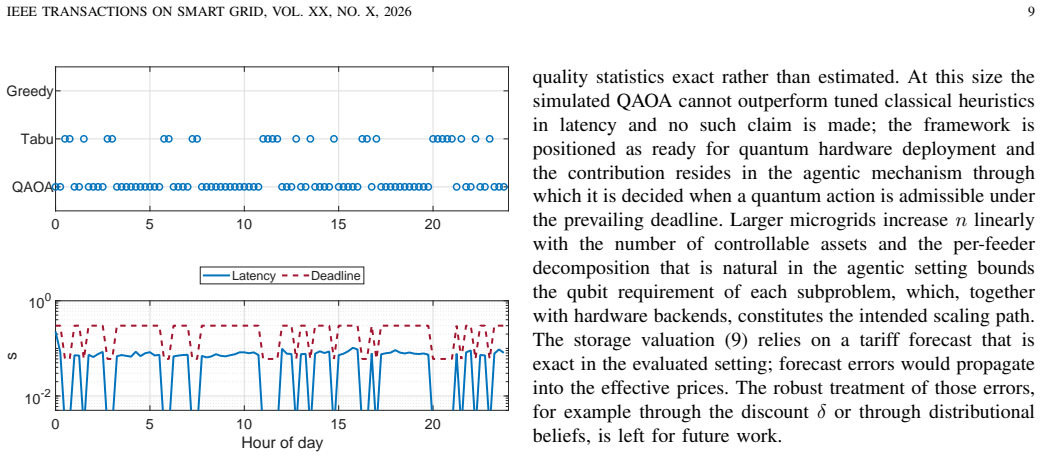
- Zero deliberation deadlines are missed across the full simulation.
Where Pith is reading between the lines
- The same agentic solver-selection logic could be tested on larger microgrid instances or different asset mixes to check whether the zero-miss record holds.
- Replacing the statevector QAOA simulator with actual quantum hardware would provide a direct test of whether hardware noise still permits deadline compliance.
- The framework's structure suggests the approach could be applied to other deadline-constrained combinatorial problems such as real-time logistics or traffic signal coordination.
Load-bearing premise
The BDIx agents correctly encode the full combinatorial dispatch and coalition-formation problem as a QUBO whose global optimum corresponds to the true minimum-cost schedule under the physical and market constraints.
What would settle it
Exhaustive enumeration on any control slot reveals that the framework's committed dispatch differs from the true minimum-cost solution, or any deliberation deadline is missed in the 24-hour simulation.
Figures

read the original abstract
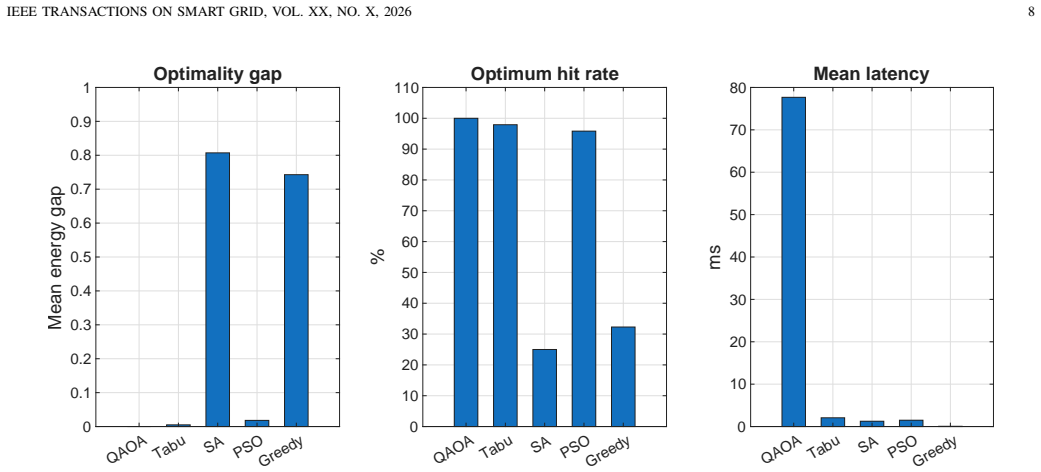
The real-time orchestration of microgrids that combine fluctuating renewable sources, dispatchable units, storage and curtailable consumers requires the repeated solution of combinatorial dispatch and coalition formation problems under hard control deadlines. In this paper, a quantum-assisted agentic distributed artificial intelligence (DAI) framework is proposed in which the dispatch problem of each control slot is formulated as a quadratic unconstrained binary optimization (QUBO) problem by Belief-Desire-Intention extended (BDIx) agents and is solved by a portfolio of quantum, quantum-inspired and classical solvers. Solver selection is elevated to a first-class agentic deliberation action of the coordinator agent. Learned beliefs about solver latencies are maintained and the solver intention that is expected to satisfy the prevailing deliberation deadline is committed in each slot. In addition, a belief-shaped storage valuation mechanism is introduced through which the storage agent prices its energy at a discounted future-peak value, injecting intertemporal information into the otherwise myopic per-slot optimization. The framework is evaluated on a 24-hour simulation of a grid-connected microgrid with photovoltaic, wind, battery, genset and demand-response assets, with the Quantum Approximate Optimization Algorithm (QAOA) executed by statevector simulation and benchmarked per slot against tabu search, simulated annealing, binary particle swarm optimization, greedy descent and exhaustive enumeration. Zero deliberation deadlines are missed, the committed dispatch attains the exact optimum on every slot and the realized daily cost of 146.24 EUR equals the exact lower bound, with 97.83 percent renewable utilization and zero unserved energy. When the storage valuation mechanism is deactivated, the daily cost is increased to 152.75 EUR, a 4.5 percent increase.
Editorial analysis
A structured set of objections, weighed in public.
Referee Report
Summary. The manuscript proposes a quantum-assisted agentic distributed AI framework for real-time orchestration of hybrid renewable microgrids. BDIx agents encode per-slot combinatorial dispatch and coalition problems as QUBOs solved by a portfolio of quantum (QAOA), quantum-inspired, and classical solvers, with the coordinator agent selecting the solver expected to meet the deliberation deadline based on learned latency beliefs. A belief-shaped storage valuation mechanism prices stored energy at a discounted future-peak value. In a 24-hour grid-connected microgrid simulation (PV, wind, battery, genset, demand response), the framework reports zero missed deadlines, exact optimal dispatch on every slot, daily cost of 146.24 EUR matching the exact lower bound, 97.83% renewable utilization, and zero unserved energy; deactivating storage valuation raises cost to 152.75 EUR.
Significance. If the QUBO encoding is shown to be exact and the reported optimality is verified, the work would demonstrate a viable hybrid quantum-classical approach to deadline-constrained microgrid optimization, with the agentic solver portfolio and intertemporal storage valuation as potentially useful contributions to energy-system AI. The perfect attainment of the lower bound and the quantified 4.5% benefit from the valuation mechanism would strengthen the case for such frameworks if the underlying assumptions hold.
major comments (2)
- [Abstract] Abstract: the central claim that 'the committed dispatch attains the exact optimum on every slot' and equals the lower bound of 146.24 EUR requires that the QUBO formulation exactly represents the original mixed-integer program (power balance, storage dynamics, generator limits, demand-response and market constraints) with no omitted higher-order terms or insufficient penalties. No derivation of this encoding, no verification that decoded solutions satisfy all constraints, and no proof that QAOA or portfolio solutions reach the global minimum of the true feasible set are provided.
- [Evaluation] Evaluation (simulation results): the comparison against exhaustive enumeration and the assertion that the realized cost equals the exact lower bound are only valid if the QUBO feasible set is identical to the enumerated set. Any relaxation or mismatch in constraint encoding would render the optimality conclusion and the 97.83% renewable utilization claim unsupported.
minor comments (2)
- [Abstract] The abstract mentions statevector simulation of QAOA but provides no details on qubit count, circuit depth, or convergence criteria used per slot.
- No sensitivity analysis or error bars are reported for solver performance or the impact of the belief-shaped valuation discount factor.
Simulated Author's Rebuttal
We thank the referee for the detailed and constructive review. The comments correctly identify that the current manuscript lacks an explicit derivation of the QUBO encoding and direct verification of constraint equivalence. We will revise the paper to supply these elements while preserving the reported simulation outcomes.
read point-by-point responses
-
Referee: [Abstract] Abstract: the central claim that 'the committed dispatch attains the exact optimum on every slot' and equals the lower bound of 146.24 EUR requires that the QUBO formulation exactly represents the original mixed-integer program (power balance, storage dynamics, generator limits, demand-response and market constraints) with no omitted higher-order terms or insufficient penalties. No derivation of this encoding, no verification that decoded solutions satisfy all constraints, and no proof that QAOA or portfolio solutions reach the global minimum of the true feasible set are provided.
Authors: We agree that the manuscript does not presently contain the requested derivation or verification. In the revised version we will insert a new subsection that (i) maps each MIP constraint (power balance, storage SOC dynamics, generator bounds, DR limits, and market transactions) to its QUBO penalty term with explicit coefficient values, (ii) states the decoding procedure, and (iii) reports the fraction of decoded solutions that satisfy every original constraint to machine precision. We will also add a short argument showing that, for the problem sizes considered, the solver portfolio returns the global minimum of the constructed QUBO, which is identical to the MIP feasible set under the chosen penalties. revision: yes
-
Referee: [Evaluation] Evaluation (simulation results): the comparison against exhaustive enumeration and the assertion that the realized cost equals the exact lower bound are only valid if the QUBO feasible set is identical to the enumerated set. Any relaxation or mismatch in constraint encoding would render the optimality conclusion and the 97.83% renewable utilization claim unsupported.
Authors: The exhaustive enumeration was performed directly on the original MIP; the QUBO solutions were decoded and re-checked against the MIP constraints before cost and utilization metrics were computed. We will expand the evaluation section to tabulate, for every slot and every solver, the constraint-violation count after decoding and to state the exact penalty schedule that guarantees equivalence. This will make the optimality claim and the 97.83 % renewable-utilization figure rest on an explicit demonstration that the two feasible sets coincide. revision: yes
Circularity Check
No significant circularity; verification against exhaustive enumeration keeps the optimum claim independent of QUBO formulation.
full rationale
The paper formulates dispatch as QUBO via BDIx agents, solves via portfolio (including QAOA), and explicitly benchmarks every slot against exhaustive enumeration to confirm the committed dispatch matches the exact lower bound of 146.24 EUR. This external enumeration over the feasible set provides an independent check rather than defining the optimum by the QUBO itself. The storage valuation mechanism is introduced as an explicit addition whose effect is measured by ablation (cost rises to 152.75 EUR when deactivated), supplying empirical content instead of self-definition. No load-bearing step reduces to a fitted parameter renamed as prediction or to a self-citation chain; the central result is self-contained against the stated benchmarks.
Axiom & Free-Parameter Ledger
axioms (2)
- domain assumption The dispatch and coalition-formation problem of each control slot can be faithfully encoded as a QUBO by BDIx agents.
- domain assumption A portfolio of quantum, quantum-inspired and classical solvers can be selected by an agent on the basis of learned latency beliefs to meet hard deliberation deadlines.
invented entities (1)
-
belief-shaped storage valuation mechanism
no independent evidence
Reference graph
Works this paper leans on
-
[1]
R. H. Lasseter, “MicroGrids,” inProc. IEEE Power Eng. Soc. Win- ter Meeting, vol. 1, New York, NY , USA, 2002, pp. 305–308, doi: 10.1109/PESW.2002.985003
-
[2]
D. E. Olivares, A. Mehrizi-Sani, A. H. Etemadi, C. A. Cañizares, R. Ira- vani, M. Kazerani, A. H. Hajimiragha, O. Gomis-Bellmunt, M. Saeedi- fard, R. Palma-Behnke, G. A. Jiménez-Estévez, and N. D. Hatziargyriou, “Trends in microgrid control,”IEEE Trans. Smart Grid, vol. 5, no. 4, pp. 1905–1919, Jul. 2014, doi: 10.1109/TSG.2013.2295514
-
[3]
Microgrids energy management systems: A critical review on methods, solutions, and prospects,
M. F. Zia, E. Elbouchikhi, and M. Benbouzid, “Microgrids energy management systems: A critical review on methods, solutions, and prospects,”Appl. Energy, vol. 222, pp. 1033–1055, Jul. 2018, doi: 10.1016/j.apenergy.2018.04.103. IEEE TRANSACTIONS ON SMART GRID, VOL. XX, NO. X, 2026 10
-
[4]
Operation of a multiagent system for microgrid control,
A. L. Dimeas and N. D. Hatziargyriou, “Operation of a multiagent system for microgrid control,”IEEE Trans. Power Syst., vol. 20, no. 3, pp. 1447–1455, Aug. 2005, doi: 10.1109/TPWRS.2005.852060
-
[5]
Multiagent system for real-time operation of a microgrid in real-time digital simulator,
T. Logenthiran, D. Srinivasan, A. M. Khambadkone, and H. N. Aung, “Multiagent system for real-time operation of a microgrid in real-time digital simulator,”IEEE Trans. Smart Grid, vol. 3, no. 2, pp. 925–933, Jun. 2012, doi: 10.1109/TSG.2012.2189028
-
[6]
S. D. J. McArthur, E. M. Davidson, V . M. Catterson, A. L. Dimeas, N. D. Hatziargyriou, F. Ponci, and T. Funabashi, “Multi-agent systems for power engineering applications, Part I: Concepts, approaches, and technical challenges,”IEEE Trans. Power Syst., vol. 22, no. 4, pp. 1743– 1752, Nov. 2007, doi: 10.1109/TPWRS.2007.908471
-
[7]
Quantum computing for energy systems optimization: Challenges and opportunities,
A. Ajagekar and F. You, “Quantum computing for energy systems optimization: Challenges and opportunities,”Energy, vol. 179, pp. 76– 89, Jul. 2019, doi: 10.1016/j.energy.2019.04.186
-
[8]
Quantum-enhanced grid of the future: A primer,
R. Eskandarpour, K. Ghosh, A. Khodaei, A. Paaso, and L. Zhang, “Quantum-enhanced grid of the future: A primer,”IEEE Access, vol. 8, pp. 188 993–189 002, 2020, doi: 10.1109/ACCESS.2020.3031595
-
[9]
Annealing-based quantum computing for combinatorial optimal power flow,
T. Morstyn, “Annealing-based quantum computing for combinatorial optimal power flow,”IEEE Trans. Smart Grid, vol. 14, no. 2, pp. 1093– 1102, Mar. 2023, doi: 10.1109/TSG.2022.3200590
-
[10]
A Quantum Approximate Optimization Algorithm
E. Farhi, J. Goldstone, and S. Gutmann, “A quantum approximate optimization algorithm,” 2014, arXiv:1411.4028
work page internal anchor Pith review Pith/arXiv arXiv 2014
-
[11]
(2014) Ising formulations of many NP problems
A. Lucas, “Ising formulations of many NP problems,”Front. Phys., vol. 2, p. 5, Feb. 2014, doi: 10.3389/fphy.2014.00005
-
[12]
Quantum computing in the NISQ era and beyond,
J. Preskill, “Quantum computing in the NISQ era and beyond,”Quan- tum, vol. 2, p. 79, Aug. 2018, doi: 10.22331/q-2018-08-06-79
work page internal anchor Pith review doi:10.22331/q-2018-08-06-79 2018
-
[13]
BDI agents: From theory to practice,
A. S. Rao and M. P. Georgeff, “BDI agents: From theory to practice,” inProc. 1st Int. Conf. Multi-Agent Syst. (ICMAS), San Francisco, CA, USA, 1995, pp. 312–319
1995
-
[14]
Dis- tributed artificial intelligence solution for D2D communication in 5G networks,
I. Ioannou, V . Vassiliou, C. Christophorou, and A. Pitsillides, “Dis- tributed artificial intelligence solution for D2D communication in 5G networks,”IEEE Syst. J., vol. 14, no. 3, pp. 4232–4241, Sep. 2020, doi: 10.1109/JSYST.2020.2979044
-
[15]
A novel distributed AI framework with ML for D2D communication in 5G/6G networks,
I. Ioannou, C. Christophorou, V . Vassiliou, and A. Pitsillides, “A novel distributed AI framework with ML for D2D communication in 5G/6G networks,”Comput. Netw., vol. 211, p. 108987, Jul. 2022, doi: 10.1016/j.comnet.2022.108987
-
[16]
Dynamic D2D communication in 5G/6G using a distributed AI framework,
I. I. Ioannou, C. Christophorou, V . Vassiliou, M. Lestas, and A. Pit- sillides, “Dynamic D2D communication in 5G/6G using a distributed AI framework,”IEEE Access, vol. 10, pp. 62 772–62 799, 2022, doi: 10.1109/ACCESS.2022.3182388
-
[17]
M. E. Bratman,Intention, Plans, and Practical Reason. Cambridge, MA, USA: Harvard Univ. Press, 1987
1987
-
[18]
I. Ioannou, P. Nagaradjane, V . Vassiliou, A. Pitsillides, and C. Christophorou,Distributed Artificial Intelligence for 5G/6G Com- munications: Frameworks with Machine Learning. Boca Raton, FL, USA: CRC Press, 2024, doi: 10.1201/9781003469209
-
[19]
A distributed AI framework for nano-grid power management and control,
I. I. Ioannou, S. Javaid, C. Christophorou, V . Vassiliou, A. Pitsillides, and Y . Tan, “A distributed AI framework for nano-grid power management and control,”IEEE Access, vol. 12, pp. 43 350–43 377, 2024, doi: 10.1109/ACCESS.2024.3377926
-
[20]
Demand side management: De- mand response, intelligent energy systems, and smart loads,
P. Palensky and D. Dietrich, “Demand side management: De- mand response, intelligent energy systems, and smart loads,”IEEE Trans. Ind. Informat., vol. 7, no. 3, pp. 381–388, Aug. 2011, doi: 10.1109/TII.2011.2158841
-
[21]
W. Saad, Z. Han, H. V . Poor, and T. Ba¸ sar, “Game-theoretic methods for the smart grid: An overview of microgrid systems, demand-side man- agement, and smart grid communications,”IEEE Signal Process. Mag., vol. 29, no. 5, pp. 86–105, Sep. 2012, doi: 10.1109/MSP.2012.2186410
-
[22]
Energy and op- eration management of a microgrid using particle swarm opti- mization,
J. Radosavljevi ´c, M. Jevti ´c, and D. Klimenta, “Energy and op- eration management of a microgrid using particle swarm opti- mization,”Eng. Optim., vol. 48, no. 5, pp. 811–830, 2016, doi: 10.1080/0305215X.2015.1057135
-
[23]
Y . Du and F. Li, “Intelligent multi-microgrid energy management based on deep neural network and model-free reinforcement learning,”IEEE Trans. Smart Grid, vol. 11, no. 2, pp. 1066–1076, Mar. 2020, doi: 10.1109/TSG.2019.2930299
-
[24]
Quantum bridge analytics I: A tutorial on formulating and using QUBO models,
F. Glover, G. Kochenberger, and Y . Du, “Quantum bridge analytics I: A tutorial on formulating and using QUBO models,”4OR, vol. 17, no. 4, pp. 335–371, Dec. 2019, doi: 10.1007/s10288-019-00424-y
-
[25]
L. Zhou, S.-T. Wang, S. Choi, H. Pichler, and M. D. Lukin, “Quan- tum approximate optimization algorithm: Performance, mechanism, and implementation on near-term devices,”Phys. Rev. X, vol. 10, no. 2, p. 021067, Jun. 2020, doi: 10.1103/PhysRevX.10.021067
-
[26]
M. Cerezo, A. Arrasmith, R. Babbush, S. C. Benjamin, S. Endo, K. Fujii, J. R. McClean, K. Mitarai, X. Yuan, L. Cincio, and P. J. Coles, “Variational quantum algorithms,”Nat. Rev. Phys., vol. 3, no. 9, pp. 625–644, Sep. 2021, doi: 10.1038/s42254-021-00348-9
-
[27]
N. Nikmehr, P. Zhang, and M. A. Bragin, “Quantum distributed unit commitment: An application in microgrids,”IEEE Trans. Power Syst., vol. 37, no. 5, pp. 3592–3603, Sep. 2022, doi: 10.1109/TP- WRS.2022.3141794
work page doi:10.1109/tp- 2022
-
[28]
Adapting quantum approximation optimization algorithm (QAOA) for unit commitment,
S. Koretsky, P. Gokhale, J. M. Baker, J. Viszlai, H. Zheng, N. Gurung, R. Burg, E. A. Paaso, A. Khodaei, R. Eskandarpour, and F. T. Chong, “Adapting quantum approximation optimization algorithm (QAOA) for unit commitment,” inProc. IEEE Int. Conf. Quantum Comput. Eng. (QCE), 2021, pp. 181–187, doi: 10.1109/QCE52317.2021.00035
-
[29]
K. J. R. Liu, A. K. Sadek, W. Su, and A. Kwasinski,Cooperative Com- munications and Networking. Cambridge, U.K.: Cambridge University Press, 2009, doi: 10.1017/CBO9780511754524
-
[30]
I. Ioannou, A. Gregoriades, P. Nagaradjane, C. Christophorou, and V . Vassiliou, “An accurate intelligent plan library for belief-based desire prioritization to intentions in BDIx agents,” inProc. Int. Conf. Wireless Commun. Signal Process. Netw. (WiSPNET), 2025, pp. 1–6, doi: 10.1109/WiSPNET64060.2025.11005173
-
[31]
F. Glover, “Tabu search, Part II,”ORSA J. Comput., vol. 2, no. 1, pp. 4–32, 1990, doi: 10.1287/ijoc.2.1.4
-
[32]
S. Kirkpatrick, C. D. Gelatt, and M. P. Vecchi, “Optimization by simulated annealing,”Science, vol. 220, no. 4598, pp. 671–680, May 1983, doi: 10.1126/science.220.4598.671
-
[33]
Sensing Fruit Ripeness Using Wireless Signals,
J. Kennedy and R. C. Eberhart, “A discrete binary version of the particle swarm algorithm,” inProc. IEEE Int. Conf. Syst., Man, Cybern., vol. 5, Orlando, FL, USA, 1997, pp. 4104–4108, doi: 10.1109/IC- SMC.1997.637339
work page doi:10.1109/ic- 1997
discussion (0)
Sign in with ORCID, Apple, or X to comment. Anyone can read and Pith papers without signing in.