When CPT Violation Hides in Plain Sight: How CP Measurements Are Compromised and How to Fix Them
Pith reviewed 2026-06-26 16:15 UTC · model grok-4.3
The pith
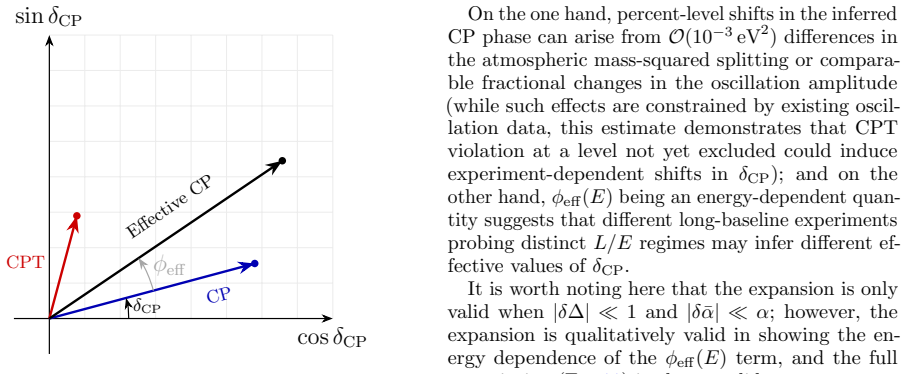
A constant difference in neutrino and antineutrino atmospheric mass splittings produces an energy-dependent phase shift that is degenerate with δ_CP in long-baseline appearance data.
A machine-rendered reading of the paper's core claim, the machinery that carries it, and where it could break.
Core claim
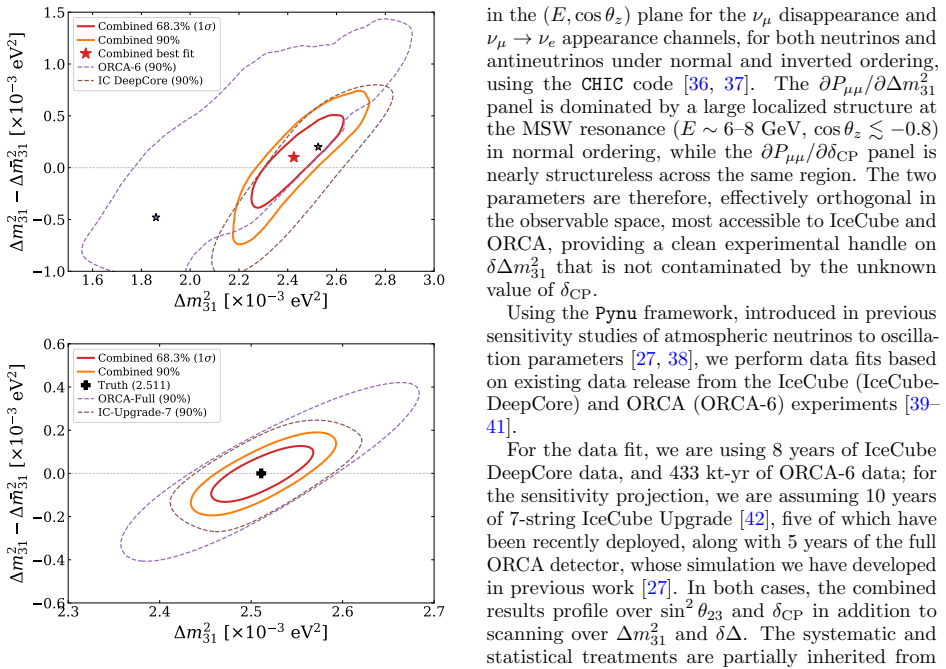
CPT violation parametrized as a constant difference δΔm²₃₁ ≡ Δm̄²₃₁ − Δm²₃₁ between neutrino and antineutrino atmospheric mass splittings induces an effective energy-dependent phase shift φ_eff(E) that is functionally identical to δ_CP inside the long-baseline appearance asymmetry ⟨ΔP⟩; a CPT-conserving analysis therefore misattributes the effect to δ_CP, with the bias becoming severe for |δΔm²₃₁| ≳ 0.3×10^{-3} eV² at DUNE, while atmospheric data from IceCube-DeepCore (7.74 yr) and KM3NeT/ORCA-6 (433 kt-yr) constrain |δΔm²₃₁| ≤ 0.57×10^{-3} eV² at 90% CL.
What carries the argument
The effective phase shift φ_eff(E) generated by the constant CPT-violating mass-splitting difference δΔm²₃₁, which enters the oscillation probability asymmetry in the same functional form as the CP phase δ_CP.
If this is right
- A CPT-conserving analysis of DUNE data returns a biased δ_CP once |δΔm²₃₁| exceeds roughly 0.3×10^{-3} eV².
- The existing tension between T2K and NOνA best-fit δ_CP values can be reduced if a small CPT violation is allowed.
- Atmospheric neutrino data supply an independent limit on δΔm²₃₁ that removes the degeneracy for long-baseline CP extractions.
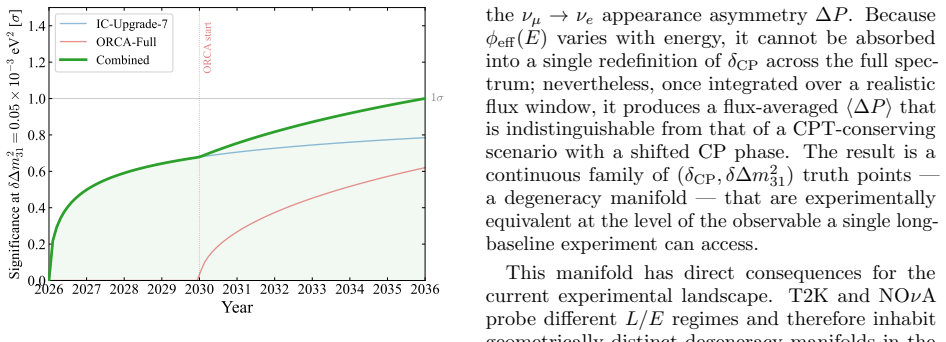
- IceCube Upgrade and full ORCA data will reach a 1σ sensitivity of 10^{-4} eV² on |δΔm²₃₁| within a decade.
Where Pith is reading between the lines
- Global neutrino oscillation fits should include δΔm²₃₁ as a free parameter when extracting δ_CP rather than fixing it to zero by assumption.
- The same effective-phase mechanism may affect other appearance-channel analyses that have not yet been checked for this degeneracy.
- A nonzero δΔm²₃₁ signal would motivate re-analysis of reactor disappearance data to test consistency with the assumed form of CPT violation.
Load-bearing premise
CPT violation is assumed to appear exclusively as a constant shift in the atmospheric mass splitting with no additional violations in mixing angles or other parameters.
What would settle it
A joint fit in which atmospheric data bound |δΔm²₃₁| above 0.3×10^{-3} eV² while long-baseline appearance data are still described by a single δ_CP value would confirm the degeneracy; a tight atmospheric bound together with a DUNE result that deviates from the CPT-conserving prediction would challenge it.
Figures

read the original abstract
The extraction of the leptonic charge-parity (CP)-violating phase $\delta_{\rm CP}$ from long-baseline neutrino oscillation experiments rests on the assumption of charge-parity-time (CPT) conservation. We show that CPT violation, parametrized as an asymmetry $\delta\Delta m^2_{31} \equiv \Delta\bar{m}^2_{31} - \Delta m^2_{31}$ between neutrino and antineutrino mass splittings, induces an effective, energy-dependent phase shift $\phi_{\rm eff}(E)$ that is functionally degenerate with $\delta_{\rm CP}$ in the appearance asymmetry $\langle\Delta P\rangle$. This has a profound implication for long-baseline experiments, where the tension between T2K and NO$\nu$A CPT-conserving best-fit $\delta_{\rm CP}$ values can be significantly alleviated by a CPT-violating truth; and a CPT-conserving fit can miss the true CP phase entirely for $|\delta\Delta m^2_{31}|\gtrsim 0.3\times10^{-3}~\text{eV}^2$ for DUNE. We then demonstrate that atmospheric neutrino telescopes provide the natural tool to resolve this degeneracy: using existing data from IceCube-DeepCore (7.74 yr) and KM3NeT/ORCA-6 (433 kt-yr), we derive a world-leading constraint on CPT-violation at $| \delta\Delta m^2_{31}|\leq 0.57\times10^{-3}~\text{eV}^2$ at 90% CL. With the IceCube Upgrade and full ORCA detector, we can reach a $1\sigma$ constraint at $10^{-4}~\text{eV}^2$ within a decade, providing the independent CPT constraint needed to ensure that DUNE's $\delta_{\rm CP}$ measurement is unambiguous.
Editorial analysis
A structured set of objections, weighed in public.
Referee Report
Summary. The paper claims that CPT violation parametrized solely as a constant difference δΔm²₃₁ between neutrino and antineutrino mass splittings induces an energy-dependent effective phase shift φ_eff(E) that is functionally degenerate with δ_CP in the long-baseline appearance asymmetry ⟨ΔP⟩. This degeneracy can alleviate the T2K–NOνA tension in δ_CP and cause a CPT-conserving fit to miss the true CP phase in DUNE for |δΔm²₃₁| ≳ 0.3×10^{-3} eV². Atmospheric neutrino data from IceCube-DeepCore (7.74 yr) and KM3NeT/ORCA-6 (433 kt-yr) are used to set a 90% CL limit |δΔm²₃₁| ≤ 0.57×10^{-3} eV², with future upgrades projected to reach 10^{-4} eV².
Significance. If the claimed functional degeneracy survives binned likelihoods and the atmospheric constraint is robust, the work would be significant for neutrino oscillation phenomenology: it identifies a previously under-appreciated systematic that can bias δ_CP extraction in long-baseline experiments and demonstrates that existing atmospheric data already provide a useful independent CPT test. The forward-calculation approach and use of public data sets are positive features.
major comments (1)
- [Abstract] Abstract (paragraph on effective phase shift): the assertion that φ_eff(E) ∝ δΔm²₃₁ L/(4E) is functionally degenerate with a constant δ_CP must be demonstrated explicitly in a binned DUNE likelihood; the explicit 1/E energy dependence cannot be absorbed by a single constant phase across the 0.5–8 GeV range, so the integrated-asymmetry degeneracy does not automatically imply that a CPT-conserving fit misses the true CP phase in realistic analyses.
minor comments (1)
- [Abstract] The numerical constraint |δΔm²₃₁| ≤ 0.57×10^{-3} eV² at 90% CL is quoted without an accompanying error budget, baseline comparison, or description of the fit procedure used on the IceCube-DeepCore and ORCA data sets.
Simulated Author's Rebuttal
We thank the referee for the careful and constructive review. The point raised about demonstrating the degeneracy explicitly in a binned DUNE likelihood is well taken, and we address it directly below. We are prepared to strengthen the manuscript with additional analysis to substantiate the claims.
read point-by-point responses
-
Referee: [Abstract] Abstract (paragraph on effective phase shift): the assertion that φ_eff(E) ∝ δΔm²₃₁ L/(4E) is functionally degenerate with a constant δ_CP must be demonstrated explicitly in a binned DUNE likelihood; the explicit 1/E energy dependence cannot be absorbed by a single constant phase across the 0.5–8 GeV range, so the integrated-asymmetry degeneracy does not automatically imply that a CPT-conserving fit misses the true CP phase in realistic analyses.
Authors: We agree that the explicit 1/E dependence of φ_eff(E) is not identical to a constant δ_CP and that this distinction matters for binned analyses. Our abstract statement is grounded in the degeneracy observed in the integrated appearance asymmetry ⟨ΔP⟩, which is the dominant driver of δ_CP sensitivity. Nevertheless, the referee correctly notes that this does not automatically guarantee a bias in realistic binned likelihood fits. To resolve the concern, we will add an explicit binned DUNE likelihood study in the revised manuscript, comparing CPT-conserving fits to data generated with nonzero δΔm²₃₁. This will quantify any residual bias in the extracted δ_CP across the 0.5–8 GeV range and clarify the conditions under which the effect persists. revision: yes
Circularity Check
No significant circularity; central constraint from independent external datasets
full rationale
The paper's derivation proceeds by parametrizing CPT violation as a constant δΔm²₃₁, computing its effect on the appearance asymmetry via the oscillation phase (a forward calculation), and then fitting that parameter to separate atmospheric neutrino datasets (IceCube-DeepCore 7.74 yr and KM3NeT/ORCA-6 433 kt-yr). These datasets are external and not derived from the long-baseline experiments under discussion. No self-citations appear load-bearing, no fitted inputs are relabeled as predictions, and no ansatz or uniqueness claim reduces the result to its own inputs by construction. The degeneracy statement is presented as a calculational observation rather than a statistical fit to the same data.
Axiom & Free-Parameter Ledger
axioms (2)
- standard math Neutrino oscillations are described by the standard three-flavor PMNS framework with the usual mixing angles and mass splittings.
- domain assumption CPT violation is fully captured by a constant difference δΔm²₃₁ between neutrino and antineutrino mass splittings, with no CPT violation in mixing angles or other parameters.
Reference graph
Works this paper leans on
-
[1]
With this parameterization, we obtain back the decomposition from Ref. [26] ∆P= ∆P CP,matter + ∆PCPT.(5) 3 For simplicity, we can define ∆ PCP = ∆P vacuum CP to be the vacuum genuine CP violation, and let ∆Pmatter = ∆ P− ∆PCP absorb the leftover prob- ability difference in CPT-conserving scenario. An- other choice, as done in Ref. [ 26], would be to dis- ...
-
[2]
CPT-violating terms interfere with CP- sensitive contributions, producing an energy- dependent effect functionally similar to genuine CP violation in vacuum
-
[3]
This interplay allows for situations in which a true CP phase with small CPT violation produces the same ∆P as a CPT-conserving scenario with a shifted CP phase
Matter effects further modify the interference, enhancing the degeneracy between CP and CPT effects. This interplay allows for situations in which a true CP phase with small CPT violation produces the same ∆P as a CPT-conserving scenario with a shifted CP phase. Additional considerations to break or mitigate this degeneracy include: • Energy dependence:Th...
-
[4]
impostor
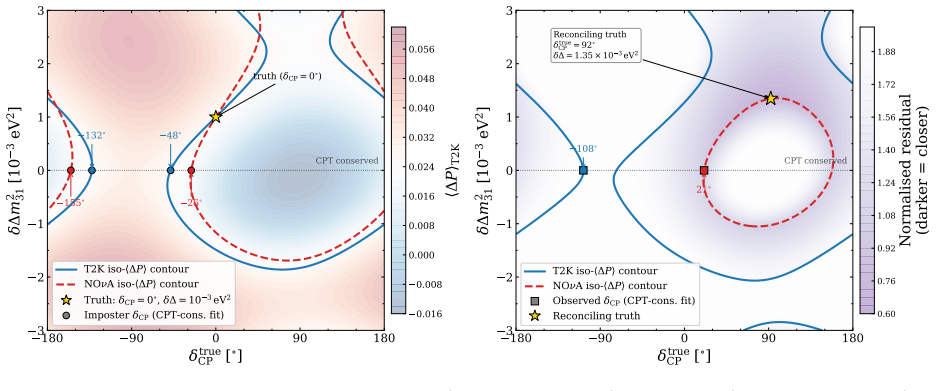
truth plane. The observable is the flux-weighted CP asymmetry ⟨∆P⟩ , computed via the Cervera analytic formula with matter effects. Fluxes are assumed to be Gaussian distributed around respective characteristic fluxes.Left panel (image):iso- ⟨∆P⟩ contours passing through a CPT-violating truth at δCP = 0◦, δ∆m2 31 = 10−3 eV2 (gold star). Where each contour...
-
[5]
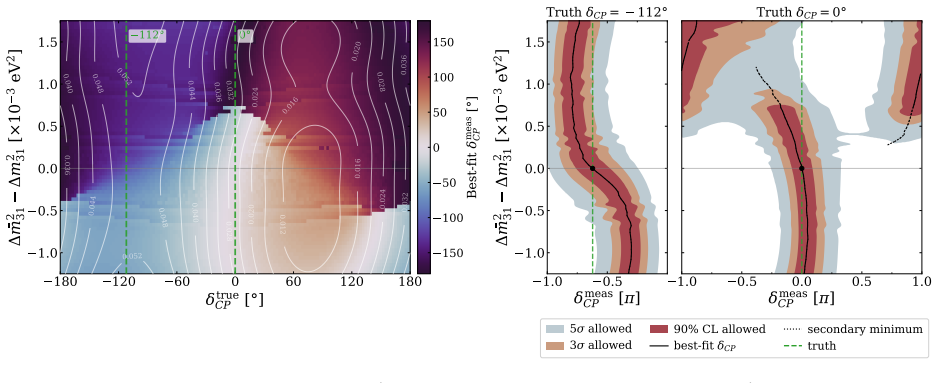
differs qualitatively from that obtained in the beam analysis, reflecting the distinct energy de- pendence of CPT-violating effects and the dominance of lower-energy events in the atmospheric sample (see Section II). C. Uncovering the impostor CP with IceCube and ORCA To extract meaningful δCP measurements from long-baseline accelerator neutrino experimen...
-
[6]
Atmospheric neutrinos offer a qualitative advantage that long-baseline beams cannot replicate: a natural decoupling between the CP-sensitive and CPT-sensitive observables. The CP-violating phase δCP enters the oscillation probability through the in- terference between the solar and atmospheric ampli- tudes, a term suppressed by α21 = ∆m2 21/∆m2 31 that is...
2026
-
[7]
This manifold has direct consequences for the current experimental landscape
truth points — a degeneracy manifold — that are experimentally equivalent at the level of the observable a single long- baseline experiment can access. This manifold has direct consequences for the current experimental landscape. T2K and NO νA probe different L/E regimes and therefore inhabit geometrically distinct degeneracy manifolds in the (δCP, δ∆m2
-
[8]
plane. Their CPT-conserving best-fit δCP values correspond to different intersection points of their respective manifolds with the δ∆ = 0 axis. The tension between those intersections is there- fore not a fundamental disagreement between the experiments — it is the geometric consequence of fitting a single parameter to data that is sensitive to two. We sh...
-
[9]
Fukudaet al.(Super-Kamiokande), Evidence for an anomalous component of cosmic-ray muons, Phys
Y. Fukudaet al.(Super-Kamiokande), Evidence for an anomalous component of cosmic-ray muons, Phys. Rev. Lett.81, 1562 (1998), arXiv:hep-ex/9807003
Pith/arXiv arXiv 1998
-
[10]
Q. R. Ahmadet al.(SNO), Direct evidence for neu- trino flavor transformation from neutral-current in- teractions in the sudbury neutrino observatory, Phys. Rev. Lett.89, 011301 (2002), arXiv:nucl-ex/0204008
Pith/arXiv arXiv 2002
-
[11]
Abiet al.(DUNE), Long-baseline neutrino oscil- lation physics potential of the DUNE experiment, Eur
B. Abiet al.(DUNE), Long-baseline neutrino oscil- lation physics potential of the DUNE experiment, Eur. Phys. J. C80, 978 (2020), arXiv:2006.16043 [hep-ex]
arXiv 2020
-
[12]
K. Abeet al.(Hyper-Kamiokande Proto- Collaboration), Hyper-Kamiokande Design Report (2018), arXiv:1805.04163 [physics.ins-det]
Pith/arXiv arXiv 2018
-
[13]
G. Barenboim, C. A. Ternes, and M. T´ ortola, CPT and CP, an entangled couple, JHEP07, 155, arXiv:2005.05975 [hep-ph]
arXiv 2005
-
[14]
L¨ uders, On the equivalence of invariance under time reversal and under particle-antiparticle conju- gation for relativistic field theories, Kong
G. L¨ uders, On the equivalence of invariance under time reversal and under particle-antiparticle conju- gation for relativistic field theories, Kong. Dan. Vid. Sel. Mat. Fys. Med.28N5, 1 (1954)
1954
-
[15]
Pauli, Exclusion principle, Lorentz group and reflection of space-time and charge, inNiels Bohr and the Development of Physics, edited by W
W. Pauli, Exclusion principle, Lorentz group and reflection of space-time and charge, inNiels Bohr and the Development of Physics, edited by W. Pauli (McGraw-Hill, New York, 1955) pp. 30–51
1955
-
[16]
J. S. Bell, Time reversal in field theory, Proc. Roy. Soc. Lond. A231, 479 (1955)
1955
-
[17]
Jost, Eine bemerkung zum CTP theorem, Helv
R. Jost, Eine bemerkung zum CTP theorem, Helv. Phys. Acta30, 409 (1957)
1957
-
[18]
V. A. Kosteleck´ y and S. Samuel, Spontaneous break- ing of Lorentz symmetry in string theory, Phys. Rev. D39, 683 (1989)
1989
-
[19]
V. A. Kosteleck´ y and S. Samuel, Gravitational phenomenology in higher-dimensional theories and strings, Phys. Rev. D40, 1886 (1989)
1989
-
[20]
D. Colladay and V. A. Kosteleck´ y, CPT violation and the standard model, Phys. Rev. D55, 6760 (1997), arXiv:hep-ph/9703464
Pith/arXiv arXiv 1997
-
[21]
D. Colladay and V. A. Kosteleck´ y, Lorentz-violating extension of the standard model, Phys. Rev. D58, 116002 (1998), arXiv:hep-ph/9809521
Pith/arXiv arXiv 1998
-
[22]
V. A. Kosteleck´ y, Gravity, Lorentz violation, and the standard model, Phys. Rev. D69, 105009 (2004), arXiv:hep-th/0312310
Pith/arXiv arXiv 2004
-
[23]
G. Barenboim, L. Borissov, J. Lykken, and A. Y. Smirnov, Neutrinos as the messengers of CPT viola- tion, JHEP10, 001, arXiv:hep-ph/0108199
-
[24]
G. Amelino-Camelia, J. R. Ellis, N. E. Mavromatos, D. V. Nanopoulos, and S. Sarkar, Tests of quan- tum gravity from observations of gamma-ray bursts, Nature393, 763 (1998), arXiv:astro-ph/9712103
Pith/arXiv arXiv 1998
-
[25]
N. E. Mavromatos, CPT violation and decoherence in quantum gravity, Lect. Notes Phys.669, 245 (2005), arXiv:gr-qc/0407005
Pith/arXiv arXiv 2005
-
[26]
V. A. Kosteleck´ y and M. Mewes, Lorentz and CPT vi- olation in neutrinos, Phys. Rev. D69, 016005 (2004), arXiv:hep-ph/0309025
Pith/arXiv arXiv 2004
-
[27]
R. Abbasiet al.(IceCube), Search for a Lorentz- violating sidereal signal with atmospheric neutri- nos in IceCube, Phys. Rev. D82, 112003 (2010), arXiv:1010.4096 [astro-ph.HE]
Pith/arXiv arXiv 2010
-
[28]
C. A. Arg¨ uelles, P. Fern´ andez, I. Mart\’\inez-Soler, and M. Jin, Measuring Oscillations with a Million Atmospheric Neutrinos, Phys. Rev. X13, 41055 (2023)
2023
-
[29]
S. Razzaque and A. Y. Smirnov, Super-PINGU for measurement of the leptonic CP-phase with atmo- spheric neutrinos, JHEP05, 139, arXiv:1406.1407 [hep-ph]
-
[30]
K. J. Kelly, P. A. Machado, I. Martinez Soler, S. J. Parke, and Y. F. Perez Gonzalez, Sub-GeV Atmo- spheric Neutrinos and CP-Violation in DUNE, Phys. Rev. Lett.123, 081801 (2019), arXiv:1904.02751 [hep-ph]
arXiv 2019
-
[31]
P. B. Denton, Probing CP Violation with Neutrino Disappearance Alone, Phys. Rev. Lett.133, 031801 (2024), arXiv:2309.03262 [hep-ph]
arXiv 2024
-
[32]
J. F. Beacom, N. F. Bell, M. J. Dolan, S. A. Meighen- Berger, and H. M. Yim, Towards Measuring the CP- Violating Phase with Atmospheric Neutrinos (2026), arXiv:2605.16721 [hep-ph]
Pith/arXiv arXiv 2026
-
[33]
A. Cervera, A. Donini, M. B. Gavela, J. J. Gomez Ca- denas, P. Hernandez, O. Mena, and S. Rigolin, Golden measurements at a neutrino factory, Nucl. Phys. B579, 17 (2000), [Erratum: Nucl.Phys.B 593, 731–732 (2001)], arXiv:hep-ph/0002108
Pith/arXiv arXiv 2000
-
[34]
H. Nunokawa, S. J. Parke, and J. W. F. Valle, CP Violation and Neutrino Oscillations, Prog. Part. Nucl. Phys.60, 338 (2008), arXiv:0710.0554 [hep-ph]
Pith/arXiv arXiv 2008
-
[35]
C. A. Arg¨ uelles, P. Fern´ andez, I. Mart´ ınez-Soler, and M. Jin, Measuring Oscillations with a Million Atmospheric Neutrinos, Phys. Rev. X13, 041055 (2023), arXiv:2211.02666 [hep-ph]
arXiv 2023
-
[36]
S. Abubakaret al.(T2K, NOvA), Joint neutrino oscillation analysis from the T2K and NOvA exper- iments, Nature646, 818 (2025), arXiv:2510.19888 [hep-ex]
arXiv 2025
-
[37]
Huber, M
P. Huber, M. Lindner, and W. Winter, Simula- tion of long-baseline neutrino oscillation experiments with globes, Computer Physics Communications167, 195–202 (2005)
2005
-
[38]
Huber, J
P. Huber, J. Kopp, M. Lindner, M. Rolinec, and W. Winter, New features in the simulation of neu- trino oscillation experiments with globes 3.0, Com- puter Physics Communications177, 432–438 (2007)
2007
-
[39]
D. Collaboration, Long-baseline neutrino facil- ity (lbnf) and deep underground neutrino exper- iment (dune) conceptual design report volume 2: The physics program for dune at lbnf (2016), arXiv:1512.06148 [physics.ins-det]
arXiv 2016
-
[40]
Barenboim, C
G. Barenboim, C. Ternes, and M. T´ ortola, Neutrinos, dune and the world best bound on cpt invariance, 13 Physics Letters B780, 631–637 (2018)
2018
-
[41]
C. A. Ternes, S. Gariazzo, R. Hajjar, O. Mena, M. Sorel, and M. T´ ortola, Neutrino mass ordering at DUNE: An extra ν bonus, Phys. Rev. D100, 093004 (2019), arXiv:1905.03589 [hep-ph]
arXiv 2019
-
[42]
B. Abiet al.(DUNE), Deep Underground Neu- trino Experiment (DUNE), Far Detector Technical Design Report, Volume II: DUNE Physics (2020), arXiv:2002.03005 [hep-ex]
arXiv 2020
-
[43]
I. Martinez-Soler and H. Minakata, Perturbing Neu- trino Oscillations Around the Solar Resonance, PTEP2019, 073B07 (2019), arXiv:1904.07853 [hep- ph]
arXiv 2019
-
[44]
P. Fernandez-Menendez, Chic: Caley-hamilton, in- variants and constants for neutrino oscillation proba- bilities and gradients, Journal of Physics G: Nuclear and Particle Physics (2026)
2026
-
[45]
Fern´ andez-Men´ endez, CHIC Neutrino Oscillations and Derivatives (2026)
P. Fern´ andez-Men´ endez, CHIC Neutrino Oscillations and Derivatives (2026)
2026
-
[46]
S. G. Olavarrieta, M. Jin, C. A. Arg¨ uelles, P. Fern´ andez, and I. Mart´ ınez-Soler, Boosting neu- trino mass ordering sensitivity with inelasticity for atmospheric neutrino oscillation measurement, Phys. Rev. D110, L051101 (2024), arXiv:2402.13308 [hep- ph]
arXiv 2024
-
[47]
S. Aielloet al.(KM3NeT), Measurement of neutrino oscillation parameters with the first six detection units of KM3NeT/ORCA, JHEP10, 206, [Adden- dum: JHEP 10, 041 (2025)], arXiv:2408.07015 [hep- ex]
arXiv 2025
-
[48]
Dendzik, Physical Review Letters125, 10.1103/Phys- RevLett.125.096401 (2020)
R. Abbasi, M. Ackermann, J. Adams, S. Agarwalla, et al., Measurement of atmospheric neutrino mixing with improved icecube deepcore calibration and data processing, Physical Review D108, 10.1103/phys- revd.108.012014 (2023)
-
[49]
KM3NeT Collaboration, ORCA6 Data Release (2025)
2025
-
[50]
IceCube Collaboration, IceCube Upgrade Monte Carlo (2024)
2024
-
[51]
R. J. Barlow and C. Beeston, Fitting using finite Monte Carlo samples, Comput. Phys. Commun.77, 219 (1993)
1993
-
[52]
J. S. Conway, Incorporating nuisance parame- ters in likelihoods for multisource spectra (2011), arXiv:1103.0354 [physics.data-an]
Pith/arXiv arXiv 2011
-
[53]
KM3NeT Collaboration,Report on the Status of KM3NeT for the IN2P3 Scientific Council, Sta- tus Report (APC, CPPM, IPHC, LPC, Subatech, LUPM, 2026) full KM3NeT/ORCA detector com- pletion expected by 2030
2026
-
[54]
I. Ambatset al.(NOvA), NOvA proposal to build a 30-kiloton off-axis detector to study neutrino os- cillations in the Fermilab NuMI beamline (2004), arXiv:hep-ex/0503053
Pith/arXiv arXiv 2004
-
[55]
Yang and S
T. Yang and S. Wojcicki (NOvA),Study of physics sensitivity of νµ disappearance in a totally active version of NOvA detector, Tech. Rep. Off-Axis-Note- SIM-30 (NOvA Collaboration, 2004). 14 Appendix A: Details on Accelerator Experiments’ Distributions and Measurements This appendix shows additional figures for the accelerator experiments analysis performe...
2004
-
[56]
Shared” parameters enter the combined χ2 once and multiply event weights in both experiments. “ORCA only
The right-most panels show the aggregated flux of both currents. This is only for the purpose of demonstrating that the two basins fit better in aggregate than the null hypothesis with CP conservation; in the actual fit the two horn currents are binned separately. Supplemental Methods and Tables – S1 SUPPL. FIG. 2. CP–CPT degeneracy analysis at the DUNE b...
-
[57]
The subtraction ηj −η nom j ensures that the slope terms vanish at the nominal hypersurface point, leaving only the intercept correction
is the linear response slope to the IceCube detector nuisance parameter ηj. The subtraction ηj −η nom j ensures that the slope terms vanish at the nominal hypersurface point, leaving only the intercept correction. The final expectationE IC i is obtained by applying these category-wise correction factors to the flux-reweighted histograms and summing over t...
discussion (0)
Sign in with ORCID, Apple, or X to comment. Anyone can read and Pith papers without signing in.