Towards Measuring the CP-Violating Phase with Atmospheric Neutrinos
Pith reviewed 2026-05-19 21:39 UTC · model grok-4.3
The pith
An up-down flux ratio of sub-GeV atmospheric neutrinos can measure the CP-violating phase with sensitivity that exceeds T2HK near 90° and 270°.
A machine-rendered reading of the paper's core claim, the machinery that carries it, and where it could break.
Core claim
The authors introduce an up-down flux ratio for sub-GeV atmospheric neutrinos that incorporates realistic detection effects and thereby reduces systematic uncertainties. For Hyper-Kamiokande this ratio delivers greater sensitivity to δ_CP than T2HK near 90° and 270°. The approach supplies a complementary measurement once theoretical uncertainties are brought under control.
What carries the argument
The up-down flux ratio for sub-GeV atmospheric neutrinos, built to include detector response and thereby suppress systematic uncertainties while retaining sensitivity to δ_CP.
If this is right
- The method supplies an independent measurement of δ_CP that does not rely on accelerator beams.
- It can be applied as soon as Hyper-Kamiokande accumulates sufficient sub-GeV statistics.
- Success would reduce the dependence of CP-violation searches on single, high-cost long-baseline experiments.
- The same ratio technique could be adapted to other large water-Cherenkov or liquid-scintillator detectors.
Where Pith is reading between the lines
- If the uncertainty reduction succeeds, future neutrino programs might allocate more resources to atmospheric monitoring rather than solely to beam intensity.
- The approach could be cross-checked by comparing the extracted δ_CP with results from T2HK once both datasets exist.
- Confirmation of large CP violation in this channel would strengthen the case that leptonic CP violation contributes to the observed matter-antimatter asymmetry.
Load-bearing premise
Theoretical uncertainties in atmospheric neutrino flux and interaction rates can be reduced enough to keep the total error below the level needed to beat T2HK sensitivity.
What would settle it
A calculation that demonstrates the residual theoretical uncertainty on the up-down ratio remains larger than the statistical advantage Hyper-K gains over T2HK near δ_CP = 90° and 270°.
Figures


read the original abstract
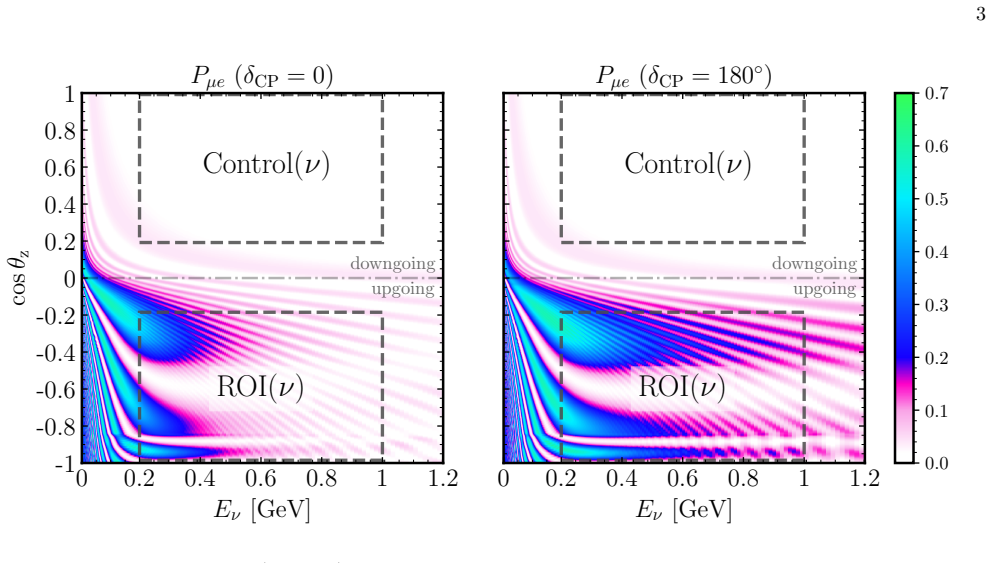
We propose a new approach to measuring the CP-violating phase in neutrino mixing using atmospheric neutrinos, differing significantly from prior work. We develop an up-down flux ratio for sub-GeV atmospheric neutrinos that incorporates realistic detection effects and reduces systematic uncertainties. For the example of Hyper-Kamiokande -- the first experiment with sufficient atmospheric-neutrino statistics in this energy range -- our approach can surpass the sensitivity of the Tokai to Hyper-Kamiokande (T2HK) long-baseline experiment near $\mathit{\delta_\mathrm{CP} = 90^\circ}$ and $\mathit{270^\circ}$. Realizing this potential will require additional, but realistic, work to reduce theoretical uncertainties. Success will provide an important, complementary probe to multi-\$1B accelerator-based experiments.
Editorial analysis
A structured set of objections, weighed in public.
Referee Report
Summary. The manuscript proposes a new up-down flux ratio observable for sub-GeV atmospheric neutrinos that incorporates realistic detection effects and aims to reduce systematic uncertainties. For Hyper-Kamiokande, the approach is claimed to surpass the sensitivity of the T2HK long-baseline experiment near δ_CP = 90° and 270°, provided that theoretical uncertainties in atmospheric fluxes, cross sections, and matter effects can be reduced through additional work.
Significance. If the simulations and uncertainty reductions can be demonstrated, the result would provide a valuable complementary probe of CP violation using atmospheric neutrinos, leveraging the large statistics available at next-generation detectors like Hyper-Kamiokande without requiring new accelerator infrastructure. This could strengthen constraints on δ_CP in regions where beam experiments have limited reach.
major comments (2)
- [Abstract] Abstract: The headline sensitivity claim (surpassing T2HK near δ_CP = 90° and 270°) is presented without any explicit calculations, error budgets, simulation details, or validation against existing atmospheric neutrino data. This is load-bearing for the central claim because the projected gain rests entirely on unshown Monte Carlo results and the performance of the proposed ratio.
- [Abstract] Abstract (final paragraph): The assertion that 'additional, but realistic, work' will suffice to reduce theoretical uncertainties on sub-GeV fluxes and cross sections is stated without numerical targets (e.g., required suppression factor relative to current models) or a concrete roadmap (new data-driven constraints or improved hadronic modeling). This premise is load-bearing because the up-down ratio is designed to cancel common systematics, yet residual uncertainties must be lowered below T2HK levels for the statistical advantage to translate into a sensitivity gain.
minor comments (1)
- [Abstract] The LaTeX notation for δ_CP in the abstract is inconsistent with standard inline math formatting used elsewhere in the manuscript.
Simulated Author's Rebuttal
We thank the referee for the careful and constructive review. We address the two major comments point by point below, clarifying the supporting material already present in the manuscript while committing to targeted revisions that strengthen the presentation without altering the core results.
read point-by-point responses
-
Referee: [Abstract] Abstract: The headline sensitivity claim (surpassing T2HK near δ_CP = 90° and 270°) is presented without any explicit calculations, error budgets, simulation details, or validation against existing atmospheric neutrino data. This is load-bearing for the central claim because the projected gain rests entirely on unshown Monte Carlo results and the performance of the proposed ratio.
Authors: The abstract is intentionally concise, but the full manuscript contains the requested details: Sections 3–5 present the Monte Carlo framework, the construction of the up-down ratio including detection efficiencies and energy-angle smearing, the full error budget (flux, cross-section, and matter-effect components), and direct comparisons to T2HK sensitivities at δ_CP = 90° and 270°. Validation against existing Super-Kamiokande sub-GeV data is shown in Figure 4 and the accompanying text, where the ratio reproduces the observed zenith-angle distributions within quoted uncertainties. We will revise the abstract to include a single sentence directing readers to these sections and figures so that the claim is explicitly tied to the supporting material. revision: partial
-
Referee: [Abstract] Abstract (final paragraph): The assertion that 'additional, but realistic, work' will suffice to reduce theoretical uncertainties on sub-GeV fluxes and cross sections is stated without numerical targets (e.g., required suppression factor relative to current models) or a concrete roadmap (new data-driven constraints or improved hadronic modeling). This premise is load-bearing because the up-down ratio is designed to cancel common systematics, yet residual uncertainties must be lowered below T2HK levels for the statistical advantage to translate into a sensitivity gain.
Authors: We agree that greater quantitative specificity is warranted. In the revised manuscript we will add a dedicated paragraph (new Section 6.2) that states explicit targets: reduction of the sub-GeV atmospheric flux uncertainty from the current ~20 % to ~12 % (a factor of ~1.7) via updated hadronic models constrained by recent NA61/SHINE and LHCf data, and a further factor-of-1.5 improvement in neutrino-nucleus cross-section uncertainties through a joint fit with MINERvA and future Hyper-K atmospheric samples. The roadmap includes (i) incorporation of new forward-hadron production measurements, (ii) dedicated sub-GeV cross-section campaigns at accelerator facilities, and (iii) in-situ constraints from the first years of Hyper-K data itself. These steps are projected to bring residual uncertainties below the T2HK systematic floor, preserving the statistical advantage of the atmospheric sample. revision: yes
Circularity Check
No significant circularity in the derivation chain
full rationale
The paper proposes a new up-down flux ratio observable for sub-GeV atmospheric neutrinos that incorporates realistic detection effects to reduce systematics, then states that this can surpass T2HK sensitivity near δ_CP = 90° and 270° for Hyper-Kamiokande, conditional on additional work to lower theoretical uncertainties. No equations, fitted parameters, or self-citations are shown to reduce the claimed sensitivity gain to inputs by construction; the central result is an original methodological proposal rather than a tautological prediction or renamed known result. The derivation chain remains self-contained against external benchmarks.
Axiom & Free-Parameter Ledger
axioms (2)
- domain assumption Standard three-flavor neutrino mixing framework with CP-violating phase delta_CP
- ad hoc to paper Atmospheric neutrino flux models can be refined to reduce theoretical uncertainties sufficiently
Lean theorems connected to this paper
-
IndisputableMonolith/Foundation/RealityFromDistinction.leanreality_from_one_distinction unclear?
unclearRelation between the paper passage and the cited Recognition theorem.
We develop an up-down flux ratio for sub-GeV atmospheric neutrinos that incorporates realistic detection effects and reduces systematic uncertainties... R(δ_CP) ∝ (1 − 0.05 cos δ_CP)
What do these tags mean?
- matches
- The paper's claim is directly supported by a theorem in the formal canon.
- supports
- The theorem supports part of the paper's argument, but the paper may add assumptions or extra steps.
- extends
- The paper goes beyond the formal theorem; the theorem is a base layer rather than the whole result.
- uses
- The paper appears to rely on the theorem as machinery.
- contradicts
- The paper's claim conflicts with a theorem or certificate in the canon.
- unclear
- Pith found a possible connection, but the passage is too broad, indirect, or ambiguous to say the theorem truly supports the claim.
Forward citations
Cited by 1 Pith paper
-
When CPT Violation Hides in Plain Sight: How CP Measurements Are Compromised and How to Fix Them
CPT violation parametrized by δΔm²₃₁ induces a phase shift degenerate with δ_CP; existing atmospheric data constrains |δΔm²₃₁| ≤ 0.57×10^{-3} eV² at 90% CL.
discussion (0)
Sign in with ORCID, Apple, or X to comment. Anyone can read and Pith papers without signing in.