Old and Bright: The Remarkable Radio Brightening of the Engine-driven SN 2012au Several Years After Explosion Signals the Birth of a PWN
Pith reviewed 2026-06-26 15:56 UTC · model grok-4.3
The pith
SN 2012au's late radio re-brightening is produced by a newborn pulsar wind nebula rather than shock interaction with circumstellar material.
A machine-rendered reading of the paper's core claim, the machinery that carries it, and where it could break.
Core claim
The emergence of radiation from a newborn Pulsar Wind Nebula naturally explains the radio spectral evolution and high-energy limits, where the emission is governed by the adiabatic expansion of a relic pair plasma. We conclude that SN 2012au represents the most compelling candidate for a young, newborn PWN discovered to date, a scenario that can be directly tested with pending Very Long Baseline Interferometry observations.
What carries the argument
Emission from adiabatic expansion of relic pair plasma inside a newborn Pulsar Wind Nebula.
If this is right
- The late emission is produced by adiabatic expansion of relic pair plasma rather than ongoing particle acceleration at a shock.
- No detectable X-ray emission is expected because high-energy radiation is either absorbed or intrinsically weak.
- The radio source remains compact and slow-moving while embedded in gas denser than 10^4 cm^{-3}.
- The electron spectrum is hard, with power-law index near 1.6.
- Pending VLBI observations can directly test the PWN interpretation by resolving the source size and velocity.
Where Pith is reading between the lines
- If confirmed, late-time radio monitoring of other engine-driven supernovae could uncover additional young PWNe that are currently hidden.
- Detection of more such objects would tighten constraints on the fraction of core-collapse events that leave behind rapidly rotating, strongly magnetized neutron stars.
- The same adiabatic-pair-plasma mechanism may operate in other compact radio sources whose spectra harden at late times.
Load-bearing premise
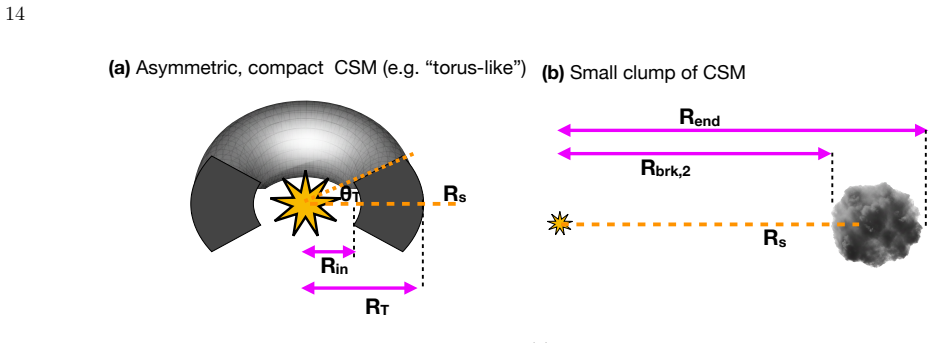
The radio properties cannot be produced by aspherical shock-CSM interaction without extreme and unmotivated circumstellar geometry, density, or mass.
What would settle it
Very Long Baseline Interferometry measurements that either confirm or rule out a source size of order 10^16 cm expanding at less than or equal to 500 km/s at late times.
Figures







read the original abstract
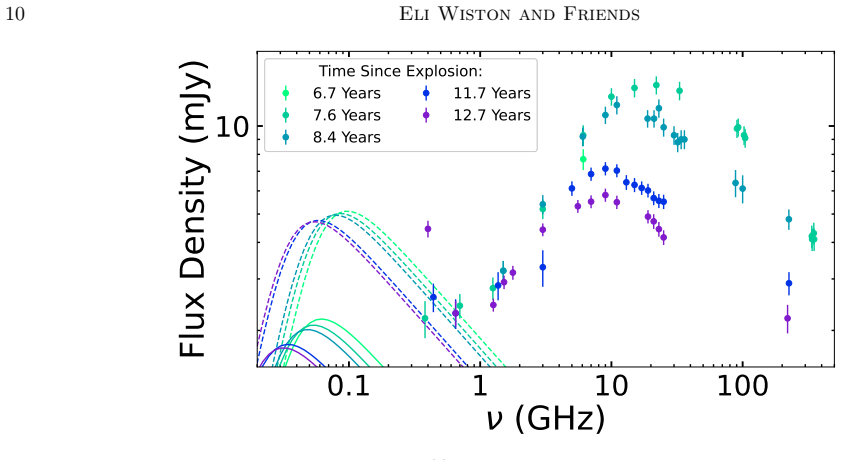
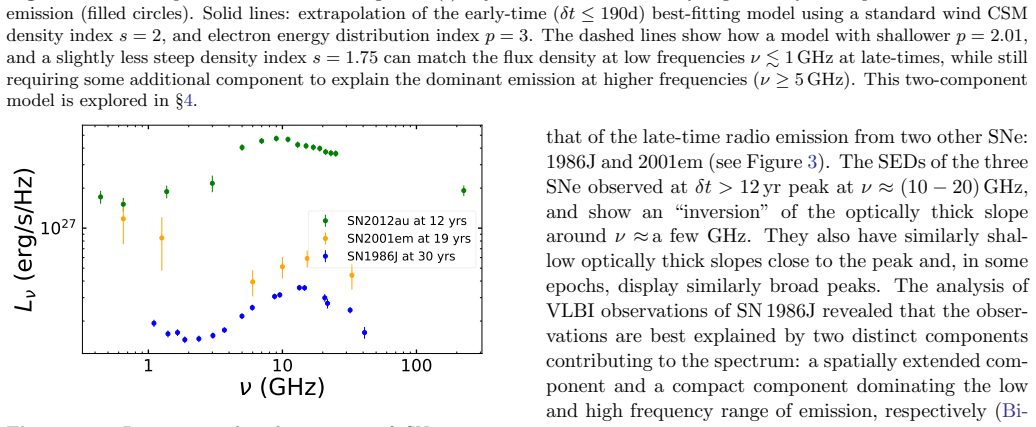
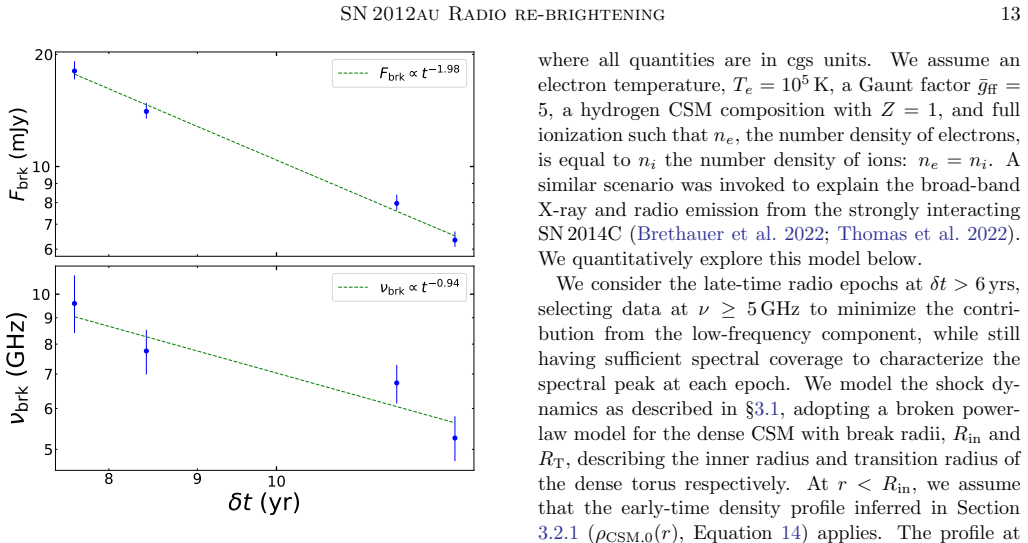
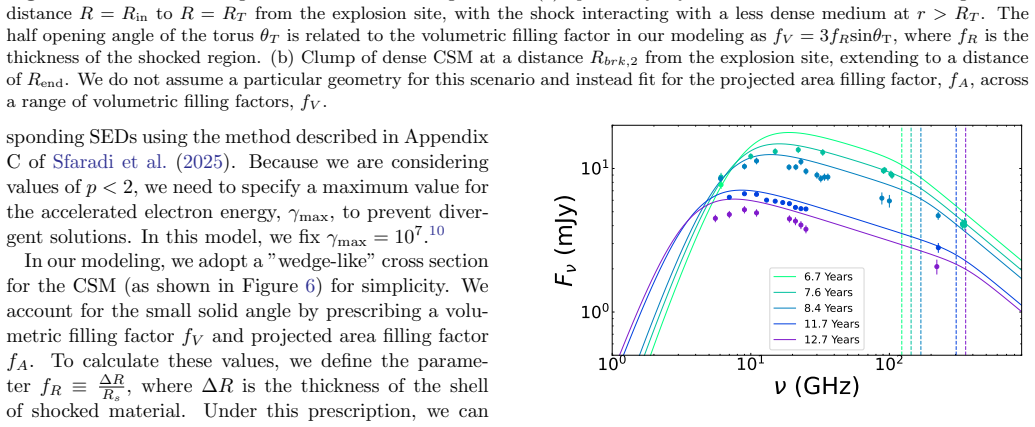
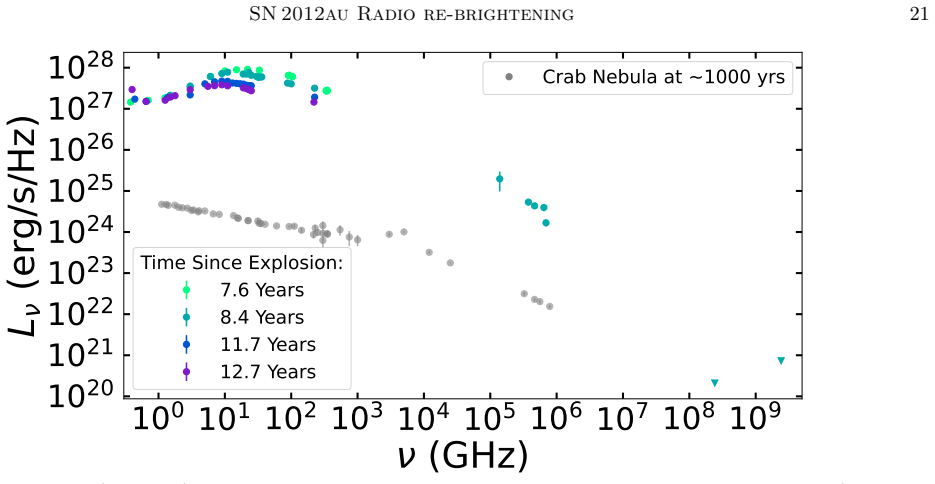
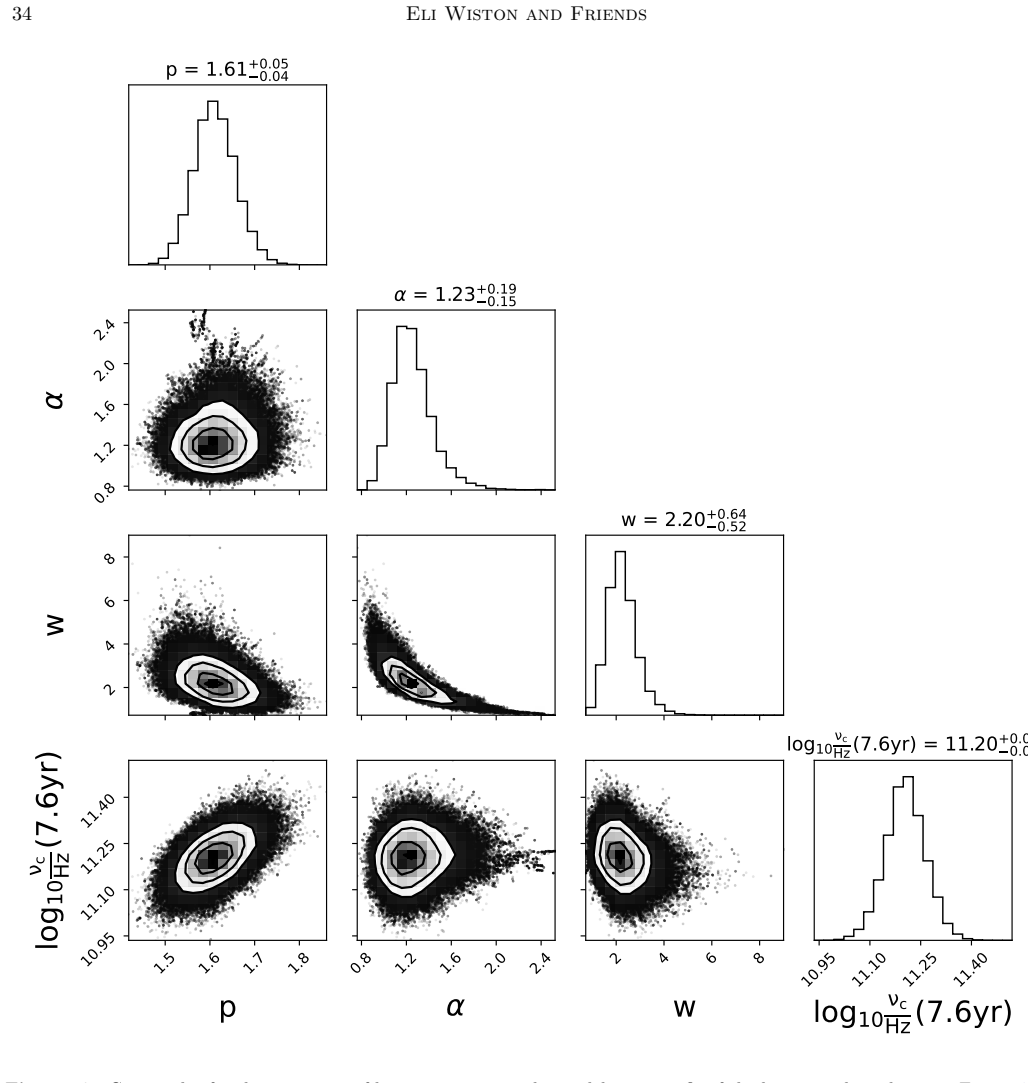
We present the results from an extensive broad-band (radio to X-rays) observing campaign of the engine-driven Type Ib SN 2012au in the first 13 years of evolution. The early-time (${\delta}t\leq{190}$ d) radio and X-ray evolution is well-described by conventional models of a forward shock interacting with a wind-like circumstellar medium ($\rho_{\rm{CSM}}\propto{r}^{-2}$). However, starting at $\delta{t}\approx{6.7}$ yr, we detect a significant radio re-brightening. This late-time emission is dominated by a luminous component characterized by a broad and rapidly evolving spectral peak and a shallow optically thin spectral slope, $F_{\nu}\propto{\nu}^{-0.31\pm0.02}$. These properties imply a compact emitting region ($R\lesssim{10}^{16}$ cm) expanding at a remarkably slow velocity ($\lesssim{500}$ km/s) into a high-density environment ($\geq{10}^4 \rm{cm}^{-3}$), accompanied by a hard electron power-law index $p\approx{1.6}$. No soft or hard X-ray emission is detected at any epoch, indicating that high-energy radiation is either strongly absorbed or intrinsically absent. In the context of aspherical shock-CSM interaction models, these observations imply extreme properties of the CSM (geometry, density, total mass) that lack clear astrophysical motivation. Instead, we show that the emergence of radiation from a newborn Pulsar Wind Nebula (PWN) naturally explains the radio spectral evolution and high-energy limits, where the emission is governed by the adiabatic expansion of a relic pair plasma. We conclude that SN 2012au represents the most compelling candidate for a young, newborn PWN discovered to date, a scenario that can be directly tested with pending Very Long Baseline Interferometry (VLBI) observations.
Editorial analysis
A structured set of objections, weighed in public.
Referee Report
Summary. The paper presents multi-wavelength (radio to X-ray) observations of the engine-driven Type Ib SN 2012au over 13 years. Early emission (δt ≤ 190 d) is consistent with a forward shock in a wind-like CSM (ρ_CSM ∝ r^{-2}). At δt ≈ 6.7 yr a radio re-brightening is detected with a broad, rapidly evolving spectral peak, optically thin index F_ u ∝ u^{-0.31 ± 0.02}, implying a compact region (R ≲ 10^{16} cm), slow velocity (≲ 500 km s^{-1}), high density (≥ 10^4 cm^{-3}), and hard electron index p ≈ 1.6. No X-ray emission is seen at any epoch. The authors argue these properties cannot arise from aspherical shock-CSM interaction without extreme, unmotivated CSM parameters and instead attribute the emission to adiabatic expansion of relic pair plasma in a newborn PWN, testable with VLBI.
Significance. If the PWN interpretation is confirmed, the result would be significant as the first compelling identification of a young, newborn PWN in a supernova, with implications for central-engine activity and non-thermal particle populations in engine-driven events. The combination of radio spectral evolution, compactness, and X-ray non-detection provides a potential observational template.
major comments (2)
- [Abstract] Abstract: The central claim that 'in the context of aspherical shock-CSM interaction models, these observations imply extreme properties of the CSM (geometry, density, total mass) that lack clear astrophysical motivation' is presented without any quantitative derivation (e.g., minimum CSM mass, required density contrast, or solid angle) using the standard synchrotron formulas to match the observed radio luminosity, spectral peak evolution, and derived parameters (R, v, n, p). This exclusion of the CSM channel is therefore an assertion rather than a demonstrated inconsistency and is load-bearing for preferring the PWN scenario.
- [Abstract] Abstract and modeling sections: The reported parameters (p ≈ 1.6, R ≲ 10^{16} cm, v ≲ 500 km s^{-1}, n ≥ 10^4 cm^{-3}) are derived from the same late-time radio data used to motivate the PWN model; no independent, falsifiable prediction of the PWN scenario (e.g., expected light-curve shape or VLBI size evolution) is shown prior to comparison with the data, raising a circularity concern for the interpretation.
Simulated Author's Rebuttal
We thank the referee for their careful reading and valuable comments on our manuscript. We respond to each major comment below and indicate the revisions we will make.
read point-by-point responses
-
Referee: [Abstract] Abstract: The central claim that 'in the context of aspherical shock-CSM interaction models, these observations imply extreme properties of the CSM (geometry, density, total mass) that lack clear astrophysical motivation' is presented without any quantitative derivation (e.g., minimum CSM mass, required density contrast, or solid angle) using the standard synchrotron formulas to match the observed radio luminosity, spectral peak evolution, and derived parameters (R, v, n, p). This exclusion of the CSM channel is therefore an assertion rather than a demonstrated inconsistency and is load-bearing for preferring the PWN scenario.
Authors: We agree that the abstract would be strengthened by explicitly referencing the quantitative analysis. In the main text (particularly in the discussion of the late-time emission), we apply the standard synchrotron formulas to show that reproducing the observed radio luminosity and the derived compact size, low velocity, and high density in an aspherical CSM interaction would require either a total CSM mass of several solar masses confined to a small solid angle or extreme density contrasts (factors of 10^3 or more) with no clear link to known progenitor mass-loss histories. To make this transparent in the abstract, we will revise it to include a concise mention of these calculations. revision: yes
-
Referee: [Abstract] Abstract and modeling sections: The reported parameters (p ≈ 1.6, R ≲ 10^{16} cm, v ≲ 500 km s^{-1}, n ≥ 10^4 cm^{-3}) are derived from the same late-time radio data used to motivate the PWN model; no independent, falsifiable prediction of the PWN scenario (e.g., expected light-curve shape or VLBI size evolution) is shown prior to comparison with the data, raising a circularity concern for the interpretation.
Authors: The emitting region parameters are obtained directly from the radio observations via synchrotron self-absorption modeling and are thus independent of the subsequent physical interpretation. These parameters then allow us to evaluate the plausibility of CSM versus PWN origins. While the PWN scenario is indeed applied after deriving the parameters, it provides a self-consistent explanation without requiring ad hoc adjustments. We recognize the referee's point regarding forward modeling and will add a new subsection in the revised manuscript that outlines specific, testable predictions of the PWN model, such as the expected temporal evolution of the source size measurable with VLBI and the anticipated radio light curve behavior at later times. revision: partial
Circularity Check
No significant circularity; derivation remains self-contained
full rationale
The provided abstract and context show the paper fits standard synchrotron models to early radio/X-ray data to derive CSM parameters, then qualitatively contrasts late-time fitted values (R ≲ 10^16 cm, v ≲ 500 km/s, n ≥ 10^4 cm^{-3}, p ≈ 1.6) against aspherical CSM scenarios by asserting they require 'extreme properties lacking astrophysical motivation.' It proposes PWN as an alternative that 'naturally explains' the evolution without presenting equations that reduce the PWN conclusion to the fitted inputs by construction, nor any self-citation chains, uniqueness theorems imported from prior work, or ansatzes smuggled via citation. No load-bearing step equates a 'prediction' to a fit or renames a known result. The central claim is therefore an interpretive preference rather than a circular reduction, consistent with a score of 0.
Axiom & Free-Parameter Ledger
free parameters (3)
- electron power-law index p =
1.6
- emitting region size R =
≲10^16 cm
- expansion velocity =
≲500 km/s
axioms (2)
- domain assumption The late-time radio emission is dominated by a single luminous component with the stated spectral properties
- ad hoc to paper Aspherical shock-CSM interaction cannot produce the observed combination of compactness, slow velocity, and high density without astrophysically unmotivated CSM properties
invented entities (1)
-
newborn Pulsar Wind Nebula
no independent evidence
Reference graph
Works this paper leans on
-
[1]
Additional Evidence for a Pulsar Wind Nebula in the Heart of SN 1987A from Multiepoch X-Ray Data and MHD Modeling. , keywords =. doi:10.3847/1538-4357/ac679d , archivePrefix =. 2204.06804 , primaryClass =
-
[2]
High Angular Resolution ALMA Images of Dust and Molecules in the SN 1987A Ejecta. , keywords =. doi:10.3847/1538-4357/ab4b46 , archivePrefix =. 1910.02960 , primaryClass =
-
[3]
Indication of a Pulsar Wind Nebula in the Hard X-Ray Emission from SN 1987A. , keywords =. doi:10.3847/2041-8213/abdf5a , archivePrefix =. 2101.09029 , primaryClass =
-
[4]
Optical and X-ray emission from stable millisecond magnetars formed from the merger of binary neutron stars. , keywords =. doi:10.1093/mnras/stu247 , archivePrefix =. 1311.1519 , primaryClass =
work page internal anchor Pith review Pith/arXiv arXiv doi:10.1093/mnras/stu247
-
[5]
A Dynamical Model for the Evolution of a Pulsar Wind Nebula inside a Non-Radiative Supernova Remnant
A Dynamical Model for the Evolution of a Pulsar Wind Nebula Inside a Nonradiative Supernova Remnant. , keywords =. doi:10.1088/0004-637X/703/2/2051 , archivePrefix =. 0904.4053 , primaryClass =
work page internal anchor Pith review Pith/arXiv arXiv doi:10.1088/0004-637x/703/2/2051 2051
-
[6]
Evolution of Nonradiative Supernova Remnants. , keywords =. doi:10.1086/313176 , adsurl =
-
[7]
X-rays from the location of the Bactrian Transient ASASSN-15lh
X-Rays from the Location of the Double-humped Transient ASASSN-15lh. , keywords =. doi:10.3847/1538-4357/836/1/25 , archivePrefix =. 1610.01632 , primaryClass =
work page internal anchor Pith review Pith/arXiv arXiv doi:10.3847/1538-4357/836/1/25
-
[8]
Gammy-Ray and Hard X-Ray Emission from Pulsar-aided Supernovae as a Probe of Particle Acceleration in Embryonic Pulsar Wind Nebulae. , keywords =. doi:10.1088/0004-637X/805/1/82 , archivePrefix =. 1411.0619 , primaryClass =
work page internal anchor Pith review Pith/arXiv arXiv doi:10.1088/0004-637x/805/1/82
-
[9]
A burst in a wind bubble and the impact on baryonic ejecta: high-energy gamma-ray flashes and afterglows from fast radio bursts and pulsar-driven supernova remnants. , keywords =. doi:10.1093/mnras/stw1328 , archivePrefix =. 1603.08875 , primaryClass =
work page internal anchor Pith review Pith/arXiv arXiv doi:10.1093/mnras/stw1328
-
[10]
ALMA and NOEMA constraints on synchrotron nebular emission from embryonic superluminous supernova remnants and radio-gamma-ray connection. , keywords =. doi:10.1093/mnras/stab2506 , archivePrefix =. 2105.05239 , primaryClass =
-
[11]
Multi-Messenger Tests for Fast-Spinning Newborn Pulsars Embedded in Stripped-Envelope Supernovae
Multi-messenger Tests for Fast-spinning Newborn Pulsars Embedded in Stripped-envelope Supernovae. , keywords =. doi:10.3847/0004-637X/818/1/94 , archivePrefix =. 1508.04393 , primaryClass =
work page internal anchor Pith review Pith/arXiv arXiv doi:10.3847/0004-637x/818/1/94
-
[12]
Radio Emission from Embryonic Super-Luminous Supernova Remnants
Radio emission from embryonic superluminous supernova remnants. , keywords =. doi:10.1093/mnras/stx2743 , archivePrefix =. 1704.00456 , primaryClass =
work page internal anchor Pith review Pith/arXiv arXiv doi:10.1093/mnras/stx2743
-
[13]
Signatures of pulsars in the light curves of newly formed supernova remnants
Signatures of pulsars in the light curves of newly formed supernova remnants. , keywords =. doi:10.1093/mnras/stt680 , archivePrefix =. 1304.5326 , primaryClass =
work page internal anchor Pith review Pith/arXiv arXiv doi:10.1093/mnras/stt680
-
[14]
Results from a systematic survey of X-ray emission from Hydrogen-poor Superluminous Supernovae
Results from a Systematic Survey of X-Ray Emission from Hydrogen-poor Superluminous SNe. , keywords =. doi:10.3847/1538-4357/aad2df , archivePrefix =. 1704.05865 , primaryClass =
work page internal anchor Pith review Pith/arXiv arXiv doi:10.3847/1538-4357/aad2df
-
[16]
Ionization break-out from millisecond pulsar wind nebulae: an X-ray probe of the origin of superluminous supernovae. , keywords =. doi:10.1093/mnras/stt1922 , archivePrefix =. 1307.8115 , primaryClass =
work page internal anchor Pith review Pith/arXiv arXiv doi:10.1093/mnras/stt1922
-
[17]
Vurm, Indrek and Metzger, Brian D. , title =. The Astrophysical Journal , abstract =. 2021 , month =. doi:10.3847/1538-4357/ac0826 , url =
-
[18]
Margalit, Ben and Berger, Edo and Metzger, Brian D. , title =. The Astrophysical Journal , abstract =. 2019 , month =. doi:10.3847/1538-4357/ab4c31 , url =
-
[19]
Particle Acceleration at Shocks: An Introduction. arXiv e-prints , keywords =. doi:10.48550/arXiv.2307.00284 , archivePrefix =. 2307.00284 , primaryClass =
-
[20]
Late Emission from the Type Ib/c SN 2001em: Overtaking the Hydrogen Envelope
Late Emission from the Type Ib/c SN 2001em: Overtaking the Hydrogen Envelope. , keywords =. doi:10.1086/500539 , archivePrefix =. astro-ph/0510362 , primaryClass =
work page internal anchor Pith review Pith/arXiv arXiv doi:10.1086/500539
-
[21]
HI4PI: A full-sky HI survey based on EBHIS and GASS
HI4PI: A full-sky H I survey based on EBHIS and GASS. , keywords =. doi:10.1051/0004-6361/201629178 , archivePrefix =. 1610.06175 , primaryClass =
work page internal anchor Pith review Pith/arXiv arXiv doi:10.1051/0004-6361/201629178
-
[22]
Seven Years of SN 2014C: A Multiwavelength Synthesis of an Extraordinary Supernova. , keywords =. doi:10.3847/1538-4357/ac5fa6 , archivePrefix =. 2203.12747 , primaryClass =
-
[23]
The radio re-brightening of the Type IIb SN 2001ig. , keywords =. doi:10.1017/pasa.2025.38 , archivePrefix =. 2502.01740 , primaryClass =
-
[24]
PS1-11aop: Probing the Mass-loss History of a Luminous Interacting Supernova Prior to Its Final Eruption with Multiwavelength Observations. , keywords =. doi:10.3847/1538-4357/ad9336 , archivePrefix =. 2410.15140 , primaryClass =
-
[25]
Bietenholz and Norbert Bartel , title =
Michael F. Bietenholz and Norbert Bartel , title =. The Astrophysical Journal , abstract =. 2017 , month =. doi:10.3847/1538-4357/aa960b , url =
-
[26]
doi:https://doi.org/10.1002/9783527618170.ch5 , url =
BREMSSTRAHLUNG , booktitle =. doi:https://doi.org/10.1002/9783527618170.ch5 , url =. https://onlinelibrary.wiley.com/doi/pdf/10.1002/9783527618170.ch5 , year =
-
[27]
Quimby, Robert M. and Cia, Annalisa De and Gal-Yam, Avishay and Leloudas, Giorgos and Lunnan, Ragnhild and Perley, Daniel A. and Vreeswijk, Paul M. and Yan, Lin and Bloom, Joshua S. and Cenko, S. Bradley and Cooke, Jeff and Ellis, Richard and Filippenko, Alexei V. and Kasliwal, Mansi M. and Kleiser, Io K. W. and Kulkarni, Shrinivas R. and Matheson, Thomas...
-
[28]
Central Bureau Electronic Telegrams , year = 2012, month = mar, volume =
Supernova 2012au in NGC 4790 = Psn J12545218-1014502. Central Bureau Electronic Telegrams , year = 2012, month = mar, volume =
2012
-
[29]
Radio Observations Reveal a Smooth Circumstellar Environment Around the Extraordinary Type Ib Supernova 2012au. , keywords =. doi:10.1088/0004-637X/797/1/2 , adsurl =
-
[30]
Chevalier, Roger A. and Fransson, Claes. Thermal and Non-thermal Emission from Circumstellar Interaction. Handbook of Supernovae. 2017. doi:10.1007/978-3-319-21846-5_34
-
[31]
Synchrotron Self-Absorption in Radio Supernovae. , keywords =. doi:10.1086/305676 , adsurl =
-
[32]
and Terreran, Giacomo and Coppejans, Deanne L
Stroh, Michael C. and Terreran, Giacomo and Coppejans, Deanne L. and Bright, Joe S. and Margutti, Raffaella and Bietenholz, Michael F. and De Colle, Fabio and DeMarchi, Lindsay and Duran, Rodolfo Barniol and Milisavljevic, Danny and Murase, Kohta and Paterson, Kerry and Williams, Wendy L. , title =. 2021 , month =. doi:10.3847/2041-8213/ac375e , url =
-
[33]
Evidence for a pulsar wind nebula in the Type Ib-peculiar supernova SN 2012au
Evidence for a Pulsar Wind Nebula in the Type Ib Peculiar Supernova SN 2012au. , keywords =. doi:10.3847/2041-8213/aadd4e , archivePrefix =. 1809.01141 , primaryClass =
work page internal anchor Pith review Pith/arXiv arXiv doi:10.3847/2041-8213/aadd4e 2041
-
[34]
SN 2012au: A Golden Link Between Superluminous Supernovae and Their Lower-Luminosity Counterparts
SN 2012au: A Golden Link between Superluminous Supernovae and Their Lower-luminosity Counterparts. , keywords =. doi:10.1088/2041-8205/770/2/L38 , archivePrefix =. 1304.0095 , primaryClass =
work page internal anchor Pith review Pith/arXiv arXiv doi:10.1088/2041-8205/770/2/l38 2041
-
[35]
A Luminous and Fast-Expanding Type Ib Supernova SN 2012au
A Luminous and Fast-expanding Type Ib Supernova SN 2012au. , keywords =. doi:10.1088/2041-8205/772/2/L17 , archivePrefix =. 1306.5490 , primaryClass =
work page internal anchor Pith review Pith/arXiv arXiv doi:10.1088/2041-8205/772/2/l17 2041
-
[36]
Alburger, D. E. and Warburton, E. K. and Tao, Z. , journal =. Half-life of ^. 1989 , month =. doi:10.1103/PhysRevC.40.2789 , url =
-
[37]
da Cruz, M. T. F. and Chan, Y. and Larimer, R.-M. and Lesko, K. T. and Norman, E. B. and Stokstad, R. G. and Wietfeldt, F. E. and. Half-life of ^. Phys. Rev. C , volume =. 1992 , month =. doi:10.1103/PhysRevC.46.1132 , url =
-
[38]
Photometric, polarimetric, and spectroscopic studies of the luminous, slow-decaying Type Ib SN 2012au. , keywords =. doi:10.1093/mnras/stab1889 , archivePrefix =. 2106.15856 , primaryClass =
-
[39]
American Astronomical Society Meeting Abstracts , year = 2023, series =
Asymmetry and Clumps and Jets! Oh My!: Revealing the Changing Structure of Type-Ib SN 2012au. American Astronomical Society Meeting Abstracts , year = 2023, series =
2023
-
[40]
Astronomical Data Analysis Software and Systems XVI , year = 2007, series =
CASA Architecture and Applications. Astronomical Data Analysis Software and Systems XVI , year = 2007, series =
2007
-
[41]
ascl:1502.007 , adsurl =
PyBDSF: Python Blob Detection and Source Finder. ascl:1502.007 , adsurl =
-
[42]
Ionospheric calibration of low frequency radio interferometric observations using the peeling scheme. I. Method description and first results. , keywords =. doi:10.1051/0004-6361/200811094 , archivePrefix =. 0904.3975 , primaryClass =
work page internal anchor Pith review Pith/arXiv arXiv doi:10.1051/0004-6361/200811094
-
[43]
The GMRT 150 MHz All-sky Radio Survey: First Alternative Data Release TGSS ADR1
The GMRT 150 MHz all-sky radio survey. First alternative data release TGSS ADR1. , keywords =. doi:10.1051/0004-6361/201628536 , archivePrefix =. 1603.04368 , primaryClass =
work page internal anchor Pith review Pith/arXiv arXiv doi:10.1051/0004-6361/201628536
-
[44]
Offringa, A. R. and McKinley, B. and Hurley-Walker and others , title =. 2014 , doi =
2014
-
[45]
AIPS: Astronomical Image Processing System
-
[46]
The radio and X-ray emission from type II supernovae. , keywords =. doi:10.1086/160167 , adsurl =
-
[47]
Asymmetric Envelope Expansion of Supernova 1987A. , keywords =. doi:10.1086/167545 , adsurl =
-
[48]
The Astrophysical Journal , abstract =
Granot, Jonathan and Sari, Re’em , title =. The Astrophysical Journal , abstract =. 2002 , month =. doi:10.1086/338966 , url =
-
[49]
Chevalier, Roger A. and Fransson, Claes , title =. The Astrophysical Journal , abstract =. 2006 , month =. doi:10.1086/507606 , url =
-
[50]
2025 , eprint=
Systematic Investigation into Radio Supernovae with Markov Chain Monte Carlo Analysis: Implications for Massive Stars' Mass Loss and Shock Acceleration Physics , author=. 2025 , eprint=
2025
-
[51]
The Astrophysical Journal Letters , abstract =
Yang, Yuan-Pei and Zhang, Bing , title =. The Astrophysical Journal Letters , abstract =. 2018 , month =. doi:10.3847/2041-8213/aada4f , url =
-
[52]
Matzner, Christopher D. and McKee, Christopher F. , title =. The Astrophysical Journal , abstract =. 1999 , month =. doi:10.1086/306571 , url =
-
[53]
The interaction of core-collapse supernova ejecta with a companion star
The interaction of core-collapse supernova ejecta with a companion star. , keywords =. doi:10.1051/0004-6361/201526757 , archivePrefix =. 1509.03633 , primaryClass =
work page internal anchor Pith review Pith/arXiv arXiv doi:10.1051/0004-6361/201526757
-
[54]
Physics of Fluids A: Fluid Dynamics , volume =
Waxman, Eli and Shvarts, Dov , title =. Physics of Fluids A: Fluid Dynamics , volume =. 1993 , month =. doi:10.1063/1.858668 , url =
-
[55]
Nonthermal processes in galactic and extragalactic sources
Radio astrophysics. Nonthermal processes in galactic and extragalactic sources
-
[56]
Seven Years of Coordinated Chandra-NuSTAR Observations of SN 2014C Unfold the Extreme Mass-loss History of Its Stellar Progenitor. , keywords =. doi:10.3847/1538-4357/ac8b14 , archivePrefix =. 2206.00842 , primaryClass =
-
[57]
2025 , eprint=
The First Radio-Bright Off-Nuclear TDE 2024tvd Reveals the Fastest-Evolving Double-Peaked Radio Emission , author=. 2025 , eprint=
2025
-
[58]
and Chugai, Nikolai and Milisavljevic, Dan and Fransson, Claes , title =
Chandra, Poonam and Chevalier, Roger A. and Chugai, Nikolai and Milisavljevic, Dan and Fransson, Claes , title =. The Astrophysical Journal , abstract =. 2020 , month =. doi:10.3847/1538-4357/abb460 , url =
-
[59]
VizieR Online Data Catalog: 1.4GHz NRAO VLA Sky Survey (NVSS) (Condon+ 1998)
1998
-
[60]
2026 , eprint=
VLBI Observations of SN 2012au Reveal a Compact Radio Source a Decade Post Explosion , author=. 2026 , eprint=
2026
-
[61]
Margalit, Ben and Metzger, Brian D. , title =. The Astrophysical Journal Letters , abstract =. 2018 , month =. doi:10.3847/2041-8213/aaedad , url =
-
[62]
Drout, Maria R. and Soderberg, Alicia M. and Gal-Yam, Avishay and Cenko, S. Bradley and Fox, Derek B. and Leonard, Douglas C. and Sand, David J. and Moon, Dae-Sik and Arcavi, Iair and Green, Yoav , title =. The Astrophysical Journal , abstract =. 2011 , month =. doi:10.1088/0004-637X/741/2/97 , url =
-
[63]
Particle acceleration in interstellar shocks , journal=
Uro. Particle acceleration in interstellar shocks , journal=. 2019 , month=. doi:10.1007/s10509-019-3669-y , url=
-
[64]
Gelfand, Joseph D. and Slane, Patrick O. and Temim, Tea , title =. The Astrophysical Journal , abstract =. 2015 , month =. doi:10.1088/0004-637X/807/1/30 , url =
-
[65]
Slane, Patrick. Pulsar Wind Nebulae. Handbook of Supernovae. 2017. doi:10.1007/978-3-319-21846-5_95
-
[66]
The Keck Low-Resolution Imaging Spectrometer. , keywords =. doi:10.1086/133562 , adsurl =
-
[67]
DAOPHOT - A computer program for crowded-field stellar photometry. , keywords =. doi:10.1086/131977 , adsurl =
-
[68]
G., Adelman, J., Anderson, Jr., J
The Sloan Digital Sky Survey: Technical Summary. , eprint =. doi:10.1086/301513 , adsurl =
-
[69]
, archivePrefix = "arXiv", eprint =
Setting UBVRI Photometric Zero-Points Using Sloan Digital Sky Survey ugriz Magnitudes. , archivePrefix = "arXiv", eprint =. doi:10.1088/0004-6256/135/1/264 , adsurl =
-
[70]
Measuring Average Treatment Effect from Heavy-tailed Data
The Evolution and Structure of Pulsar Wind Nebulae. , keywords =. doi:10.1146/annurev.astro.44.051905.092528 , archivePrefix =. astro-ph/0601081 , primaryClass =
work page internal anchor Pith review Pith/arXiv arXiv doi:10.1146/annurev.astro.44.051905.092528
-
[71]
Macías-Pérez, J. F. and Mayet, F. and Aumont, J. and Désert, F.-X. , title =. The Astrophysical Journal , abstract =. 2010 , month =. doi:10.1088/0004-637X/711/1/417 , url =
-
[72]
and Charles, Philip A
Seward, Frederick D. and Charles, Philip A. , year=. Neutron stars, pulsars, pulsar wind nebulae, and more supernova remnants , booktitle=
-
[73]
Dong, Dillon Z. and Hallinan, Gregg , title =. The Astrophysical Journal , abstract =. 2023 , month =. doi:10.3847/1538-4357/acc06c , url =
-
[74]
Evolution of pulsar-driven supernova remnants. , keywords =. doi:10.1086/161831 , adsurl =
-
[75]
and Berger, Edo and Margalit, Ben , title =
Metzger, Brian D. and Berger, Edo and Margalit, Ben , title =. The Astrophysical Journal , abstract =. 2017 , month =. doi:10.3847/1538-4357/aa633d , url =
-
[76]
Monthly Notices of the Royal Astronomical Society , volume =
Smeaton, Zachary J and Filipović, Miroslav D and Lazarević, Sanja and Alsaberi, Rami Z E and Ahmad, Adeel and Araya, Miguel and Ball, Brianna D and Bordiu, Cristobal and Buemi, Carla S and Bufano, Filomena and Dai, Shi and Haberl, Frank and Hopkins, Andrew M and Ingallinera, Adriano and Jarrett, Thomas and Koribalski, Bärbel S and Kothes, Roland and Kraan...
-
[77]
Testing a stochastic acceleration model of pulsar wind nebulae: early evolution of a wind nebula associated with SN 1986J. , keywords =. doi:10.1093/mnras/stad2504 , archivePrefix =. 2308.08809 , primaryClass =
-
[78]
Supernova 1987A: Six Weeks Later. , keywords =. doi:10.1086/165908 , adsurl =
-
[79]
K. Hurley , abstract =. Magnetars , journal =. 2011 , note =. doi:https://doi.org/10.1016/j.physe.2010.07.028 , url =
-
[80]
Frail, D. A. and Scharringhausen, B. R. , title =. The Astrophysical Journal , abstract =. 1997 , month =. doi:10.1086/303943 , url =
-
[81]
Toward nebular spectral modeling of magnetar-powered supernovae. , keywords =. doi:10.1051/0004-6361/202245406 , archivePrefix =. 2211.04502 , primaryClass =
discussion (0)
Sign in with ORCID, Apple, or X to comment. Anyone can read and Pith papers without signing in.