Stakeholder Criteria in Technical Debt Decision-Making: A Practitioner-Informed Taxonomy
Pith reviewed 2026-06-26 16:03 UTC · model grok-4.3
The pith
A taxonomy from practitioner interviews shows stakeholder criteria for technical debt fall into six families that function as permissions when acquiring debt and authorizations when repaying it.
A machine-rendered reading of the paper's core claim, the machinery that carries it, and where it could break.
Core claim
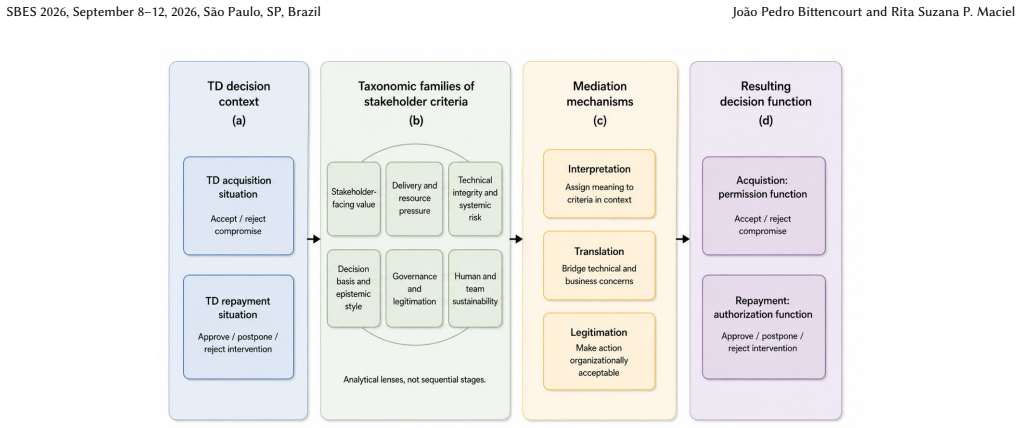
The resulting taxonomy comprises six families: stakeholder-facing value; delivery and resource pressure; technical integrity and systemic risk; decision basis and epistemic style; governance and legitimation; and human and team sustainability. Acquisition and repayment share taxonomic families but differ in decision function. In acquisition, criteria often operate as permission mechanisms that make shortcuts acceptable under current constraints. In repayment, criteria operate as authorization mechanisms that justify allocating time and resources to address existing debt. The conceptual model further shows how criteria become actionable through stakeholder interpretation, translation across t
What carries the argument
The six-family taxonomy of stakeholder criteria for technical debt decisions, which organizes heterogeneous factors and distinguishes their roles as permission mechanisms versus authorization mechanisms.
If this is right
- The same six families apply whether practitioners are deciding to acquire or repay technical debt.
- Criteria act as permission mechanisms that accept shortcuts under delivery or resource constraints during acquisition.
- Criteria act as authorization mechanisms that justify committing resources to fix debt during repayment.
- The taxonomy supplies a structure for classifying decision contexts and comparing them across projects.
- Criteria reach decisions through processes of stakeholder interpretation, translation between perspectives, and legitimation.
Where Pith is reading between the lines
- Teams could adopt the six families as a checklist to ensure debt discussions address value, risk, governance, and sustainability factors together.
- The permission-versus-authorization distinction suggests management tools should treat acquisition and repayment workflows as distinct rather than symmetric.
- Testing the taxonomy in additional countries or project types could show whether new families emerge or the existing ones need refinement.
- The model of interpretation and legitimation may apply to other engineering decisions where short-term pressures conflict with long-term system integrity.
Load-bearing premise
The criteria extracted and consolidated from 11 interviews in one country form a stable, generalizable taxonomy usable to classify and compare technical debt decision contexts across other settings without substantial revision.
What would settle it
A replication study in a different country or industry that identifies major decision criteria outside the six families or shows the permission-authorization distinction does not hold would require revising or discarding the taxonomy.
Figures

read the original abstract
Technical Debt (TD) decisions are rarely just technical. Stakeholders consider heterogeneous criteria, such as deadlines, client expectations, architectural consequences, available resources, organizational authority, and team sustainability, when deciding whether to acquire, postpone, prioritize, or repay TD. However, these criteria are often reported under different labels and at different levels of abstraction, making it difficult to compare findings across TD decision contexts. This paper proposes a practitioner-informed taxonomy represented as a conceptual model of stakeholder criteria for TD decision-making. Based on a qualitative study with 11 software practitioners in Brazil, we extracted, consolidated, and organized criteria related to TD acquisition and repayment. The resulting taxonomy comprises six families: stakeholder-facing value; delivery and resource pressure; technical integrity and systemic risk; decision basis and epistemic style; governance and legitimation; and human and team sustainability. Our findings show that acquisition and repayment share taxonomic families but differ in decision function. In acquisition, criteria often operate as permission mechanisms that make shortcuts acceptable under current constraints. In repayment, criteria operate as authorization mechanisms that justify allocating time and resources to address existing debt. The conceptual model further shows how criteria become actionable through stakeholder interpretation, translation across technical and business perspectives, and organizational legitimation. The taxonomy and model provide an empirically grounded artifact for classifying TD decision criteria, comparing decision contexts, and structuring discussions about TD acquisition and repayment.
Editorial analysis
A structured set of objections, weighed in public.
Referee Report
Summary. The paper claims to propose a practitioner-informed taxonomy of stakeholder criteria for technical debt (TD) decision-making, derived from thematic analysis of interviews with 11 software practitioners in Brazil. The taxonomy organizes criteria into six families (stakeholder-facing value; delivery and resource pressure; technical integrity and systemic risk; decision basis and epistemic style; governance and legitimation; human and team sustainability) and distinguishes acquisition (criteria as permission mechanisms) from repayment (criteria as authorization mechanisms). A conceptual model illustrates how criteria become actionable via interpretation, translation, and legitimation, positioning the taxonomy as an artifact for classifying TD decision contexts across settings.
Significance. If the taxonomy holds, it supplies a useful empirically grounded vocabulary for comparing heterogeneous stakeholder considerations in TD decisions, which could help structure research and practice discussions in software engineering. The acquisition/repayment functional distinction and the emphasis on organizational legitimation add nuance beyond purely technical TD models.
major comments (2)
- [Qualitative study description] The qualitative study description (abstract and methods narrative): the consolidation step from raw criteria extracted from the 11 interviews to the six families is presented without an audit trail, inter-rater reliability statistics, or member-checking results. This directly affects the trustworthiness of the central taxonomy artifact.
- [Abstract and applicability claims] Abstract and discussion of applicability: the claim that the taxonomy 'supplies a stable artifact usable for classifying TD decision contexts across other settings' rests on transferability from a single-country sample of 11 practitioners, yet no evidence, sensitivity analysis, or discussion of potential missing families under different regulatory/market structures is provided. This assumption is load-bearing for the cross-context classification use case.
minor comments (1)
- [Abstract] The abstract could explicitly note the single-country limitation to set reader expectations for the taxonomy's scope.
Simulated Author's Rebuttal
We thank the referee for the constructive feedback. We respond to each major comment below and note planned revisions.
read point-by-point responses
-
Referee: The qualitative study description (abstract and methods narrative): the consolidation step from raw criteria extracted from the 11 interviews to the six families is presented without an audit trail, inter-rater reliability statistics, or member-checking results. This directly affects the trustworthiness of the central taxonomy artifact.
Authors: We agree the methods narrative would benefit from greater transparency. In revision we will expand the methods section with a detailed audit trail, including examples of raw criteria extracted from interviews, initial codes, and the consolidation steps into the six families. The analysis was interpretive and led by one researcher with team discussion; formal inter-rater reliability statistics were not computed, which is standard for this style of thematic analysis. We will state this rationale explicitly. Member checking was not performed and will be noted as a limitation. revision: partial
-
Referee: Abstract and discussion of applicability: the claim that the taxonomy 'supplies a stable artifact usable for classifying TD decision contexts across other settings' rests on transferability from a single-country sample of 11 practitioners, yet no evidence, sensitivity analysis, or discussion of potential missing families under different regulatory/market structures is provided. This assumption is load-bearing for the cross-context classification use case.
Authors: We accept that the current wording overstates transferability. We will revise the abstract and discussion to present the taxonomy as a practitioner-informed artifact from the Brazilian sample rather than a stable cross-context classifier. A new limitations subsection will discuss the single-country, small-sample scope and logically consider how differing regulatory or market conditions could surface additional families, drawing on related TD literature. We will call for future validation studies. No sensitivity analysis is possible with the existing data. revision: yes
Circularity Check
No circularity: taxonomy derived from primary interview data
full rationale
The paper conducts thematic analysis on 11 new interviews to extract and consolidate criteria into six families. No equations, fitted parameters, predictions, or self-citations are used to derive the taxonomy; the central artifact is built directly from the collected practitioner accounts. The derivation chain is empirical and independent of prior author results.
Axiom & Free-Parameter Ledger
axioms (1)
- domain assumption Qualitative interview data from a small purposive sample can be consolidated into a generalizable taxonomy of decision criteria.
Reference graph
Works this paper leans on
-
[1]
Nicolli S. R. Alves, Leilane F. Ribeiro, Vivyane Caires, Thiago S. Mendes, and Rodrigo O. Spínola. 2014. Towards an Ontology of Terms on Technical Debt. In Proceedings of the 2014 Sixth International Workshop on Managing Technical Debt (MTD ’14). IEEE Computer Society, USA, 1–7. doi:10.1109/MTD.2014.9
-
[2]
Anonymous. 2026. Anonymized for double-blind review. Anonymized journal (2026). Details omitted for double-blind review
2026
-
[3]
Kenneth D. Bailey. 1994. Typologies and Taxonomies: An Introduction to Classi/f_ica- tion Techniques. Number 102 in Quantitative Applications in the Social Sciences. SAGE Publications, Thousand Oaks, CA. doi:10.4135/9781412986397 Stakeholder Criteria in Technical Debt Decision-Making SBES 2026, September 8–12, 2026, São Paulo, SP, Brazil
-
[4]
Christoph Becker, Fabian Fagerholm, Rahul Mohanani, and Alexander Chatzige- orgiou. 2019. Temporal discounting in technical debt: how do software practi- tioners discount the future?. In Proceedings of the Second International Conference on Technical Debt (Montreal, Quebec, Canada) (TechDebt ’19). IEEE Press, 23–32. doi:10.1109/TechDebt.2019.00011
-
[5]
João Paulo Biazotto, Daniel Feitosa, Paris Avgeriou, and Elisa Yumi Nakagawa
-
[6]
Empirical Software Engineering 30, 5 (2025), 134
Understanding practitioners’ reasoning and requirements for efficient tool support in technical debt management. Empirical Software Engineering 30, 5 (2025), 134. doi:10.1007/s10664-025-10691-5
-
[7]
Ward Cunningham. 1992. The WyCash portfolio management system. In Adden- dum to the Proceedings on Object-Oriented Programming Systems, Languages, and Applications (Addendum) (Vancouver, British Columbia, Canada) (OOP- SLA ’92) . Association for Computing Machinery, New York, NY, USA, 29–30. doi:10.1145/157709.157715
-
[8]
Carlos Fernández-Sánchez, Juan Garbajosa, and Agustín Yagüe. 2015. A frame- work to aid in decision making for technical debt management. In 2015 IEEE 7th International Workshop on Managing Technical Debt (MTD) . 69–76. doi:10.1109/ MTD.2015.7332628
arXiv 2015
-
[9]
Carlos Fernández-Sánchez, Juan Garbajosa, Agustín Yagüe, and Jennifer Perez
-
[10]
Journal of Systems and Software 124 (2017), 22–38
Identi/f_ication and analysis of the elements required to manage technical debt by means of a systematic mapping study. Journal of Systems and Software 124 (2017), 22–38. doi:10.1016/j.jss.2016.10.018
-
[11]
Sávio Freire, Nicolli Rios, Boris Gutierrez, Darío Torres, Manoel Mendonça, Clemente Izurieta, Carolyn Seaman, and Rodrigo O. Spínola. 2020. Surveying Software Practitioners on Technical Debt Payment Practices and Reasons for not Paying off Debt Items. In Proceedings of the 24th International Conference on Evaluation and Assessment in Software Engineering ...
-
[12]
Sávio Freire, Nicolli Rios, Boris Pérez, Camilo Castellanos, Darío Correal, Robert Ramač, Vladimir Mandić, Nebojša Taušan, Alexia Pacheco, Gustavo López, Ma- noel Mendonça, Clemente Izurieta, Davide Falessi, Carolyn Seaman, and Rodrigo Spínola. 2021. Pitfalls and Solutions for Technical Debt Management in Agile Soft- ware Projects. IEEE Softw. 38, 6 (Nov....
-
[13]
Gomes, Diogo Alves de Moura Loiola, and Alcemir Ro- drigues Santos
Tchalisson Brenne S. Gomes, Diogo Alves de Moura Loiola, and Alcemir Ro- drigues Santos. 2024. Technical Debt Tools: a Survey and an Empirical Evaluation. 12 (Aug. 2024), 8:1 – 8:16. doi:10.5753/jserd.2024.3591
-
[14]
Yuepu Guo, Rodrigo Oliveira Spínola, and Carolyn Seaman. 2016. Exploring the costs of technical debt management — a case study. Empirical Softw. Engg. 21, 1 (Feb. 2016), 159–182. doi:10.1007/s10664-014-9351-7
-
[15]
Philippe Kruchten, Robert L. Nord, and Ipek Ozkaya. 2012. Technical Debt: From Metaphor to Theory and Practice. IEEE Softw. 29, 6 (Nov. 2012), 18–21. doi:10.1109/MS.2012.167
-
[16]
Valentina Lenarduzzi, Terese Besker, Davide Taibi, Antonio Martini, and Francesca Arcelli Fontana. 2021. A systematic literature review on Technical Debt prioritization: Strategies, processes, factors, and tools. Journal of Systems and Software 171 (2021), 110827. doi:10.1016/j.jss.2020.110827
-
[17]
Zengyang Li, Paris Avgeriou, and Peng Liang. 2015. A systematic mapping study on technical debt and its management. J. Syst. Softw. 101, C (March 2015), 193–220. doi:10.1016/j.jss.2014.12.027
-
[18]
Erin Lim, Nitin Taksande, and Carolyn Seaman. 2012. A Balancing Act: What Software Practitioners Have to Say about Technical Debt. IEEE Softw. 29, 6 (Nov. 2012), 22–27. doi:10.1109/MS.2012.130
-
[19]
Vladimir Mandić, Nebojša Taušan, Robert Ramač, Sávio Freire, Nicolli Rios, Boris Pérez, Camilo Castellanos, Darío Correal, Alexia Pacheco, Gustavo Lopez, Clemente Izurieta, Davide Falessi, Carolyn Seaman, and Rodrigo Spínola. 2021. Technical and Nontechnical Prioritization Schema for Technical Debt: Voice of TD-Experienced Practitioners. IEEE Softw. 38, 6...
arXiv 2021
-
[20]
Antonio Martini, Jan Bosch, and Michel Chaudron. 2014. Architecture Technical Debt: Understanding Causes and a Qualitative Model. In Proceedings of the 2014 40th EUROMICRO Conference on Software Engineering and Advanced Applications (SEAA ’14). IEEE Computer Society, USA, 85–92. doi:10.1109/SEAA.2014.65
-
[21]
Antonio Martini, Jan Bosch, and Michel Chaudron. 2015. Investigating Architec- tural Technical Debt accumulation and refactoring over time. Inf. Softw. Technol. 67, C (Nov. 2015), 237–253. doi:10.1016/j.infsof.2015.07.005
-
[22]
Nickerson, Upkar Varshney, and Jan Muntermann
Robert C. Nickerson, Upkar Varshney, and Jan Muntermann. 2013. A Method for Taxonomy Development and Its Application in Information Systems. European Journal of Information Systems 22, 3 (2013), 336–359. doi:10.1057/ejis.2012.26
-
[23]
Farias, Manoel Mendonça, and Ro- drigo Oliveira Spínola
Leilane Ferreira Ribeiro, Mário André de F. Farias, Manoel Mendonça, and Ro- drigo Oliveira Spínola. 2016. Decision Criteria for the Payment of Technical Debt in Software Projects: A Systematic Mapping Study. In Proceedings of the 18th International Conference on Enterprise Information Systems (Rome, Italy) (ICEIS 2016). SCITEPRESS - Science and Technolog...
-
[24]
Nicolli Rios, Manoel Gomes de Mendonça Neto, and Rodrigo Oliveira Spínola
-
[25]
Information and Software Technology 102 (2018), 117–145
A tertiary study on technical debt: Types, management strategies, re- search trends, and base information for practitioners. Information and Software Technology 102 (2018), 117–145. doi:10.1016/j.infsof.2018.05.010
-
[26]
Nicolli Rios, Rodrigo Oliveira Spínola, Manoel Mendonça, and Carolyn Seaman
-
[27]
The most common causes and effects of technical debt: /f_irst results from a global family of industrial surveys. In Proceedings of the 12th ACM/IEEE Inter- national Symposium on Empirical Software Engineering and Measurement (Oulu, Finland) (ESEM ’18). Association for Computing Machinery, New York, NY, USA, Article 39, 10 pages. doi:10.1145/3239235.3268917
-
[28]
Stochel, Tomasz Borek, Mariusz R
Marek G. Stochel, Tomasz Borek, Mariusz R. Wawrowski, and Piotr Chołda. 2023. Business-driven technical debt management using Continuous Debt Valuation Approach (CoDV A).Inf. Softw. Technol. 164, C (Dec. 2023), 21 pages. doi:10.1016/ j.infsof.2023.107333
arXiv 2023
-
[29]
Edith Tom, AybüKe Aurum, and Richard Vidgen. 2013. An exploration of technical debt. J. Syst. Softw. 86, 6 (June 2013), 1498–1516. doi:10.1016/j.jss.2012.12.052
-
[30]
Jesse Yli-Huumo, Andrey Maglyas, and Kari Smolander. 2016. How do software development teams manage technical debt? - An empirical study. J. Syst. Softw. 120, C (Oct. 2016), 195–218. doi:10.1016/j.jss.2016.05.018
discussion (0)
Sign in with ORCID, Apple, or X to comment. Anyone can read and Pith papers without signing in.