Slot decomposition of continuous Box-Ball Systems
Pith reviewed 2026-06-26 15:41 UTC · model grok-4.3
The pith
When the weight function is integrable, the slot decomposition of the continuous box-ball walk is a Poisson process.
A machine-rendered reading of the paper's core claim, the machinery that carries it, and where it could break.
Core claim
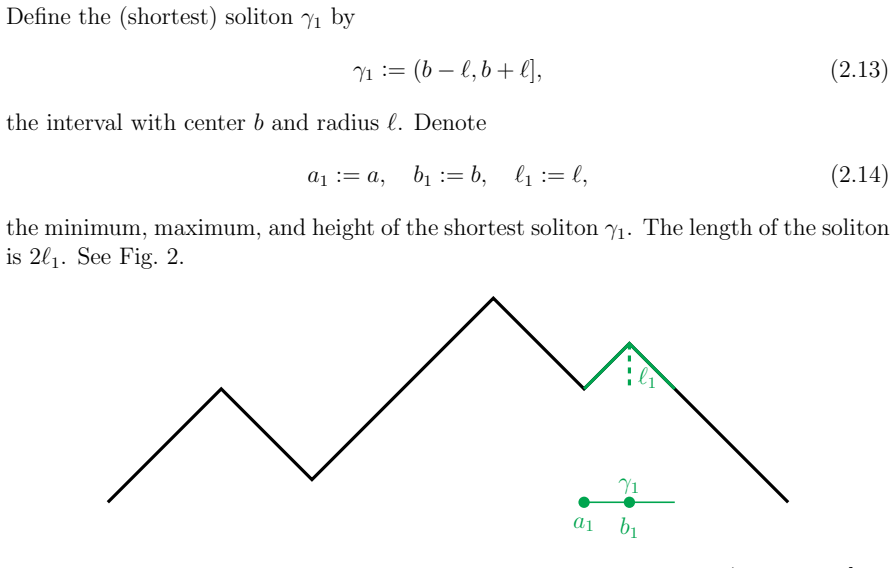
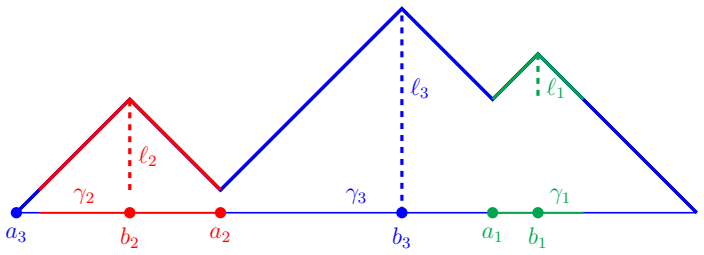
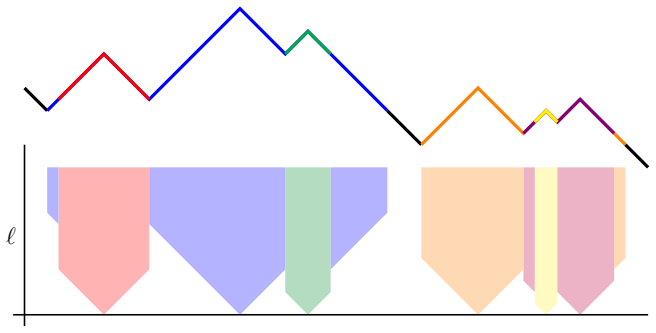
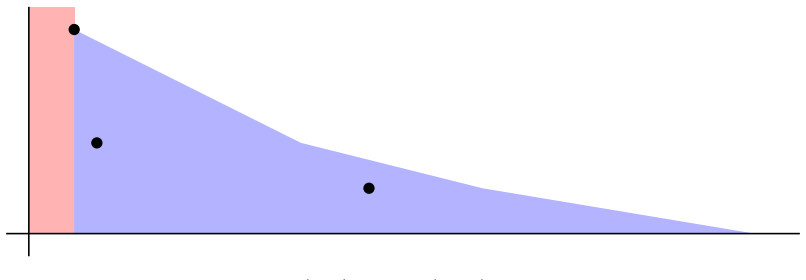
The slot decomposition, which represents each soliton of the walk by a point whose coordinates are its position and its height, is a Poisson process whenever the underlying measure on excursions is the product measure induced by an L1 weight function.
What carries the argument
The slot decomposition, which maps each soliton to a point in the plane with one coordinate for position and one for soliton height.
If this is right
- The configuration of all solitons is fully described by a Poisson point process on the half-plane.
- The intensity measure of the Poisson process can be written down explicitly once the weight function is given.
- The asymmetric telegraph process yields an explicit intensity that can be read off from the Kac construction.
- Stationary distributions for the continuous system are obtained directly from the Poisson property.
Where Pith is reading between the lines
- The same Poisson description may survive under weak limits that recover the discrete box-ball system.
- Because the decomposition separates position from height, it supplies a natural coordinate system in which to study the dynamics announced for a later paper.
- The construction gives a candidate for the invariant measure of any continuous soliton system whose height statistics factor in the same way.
Load-bearing premise
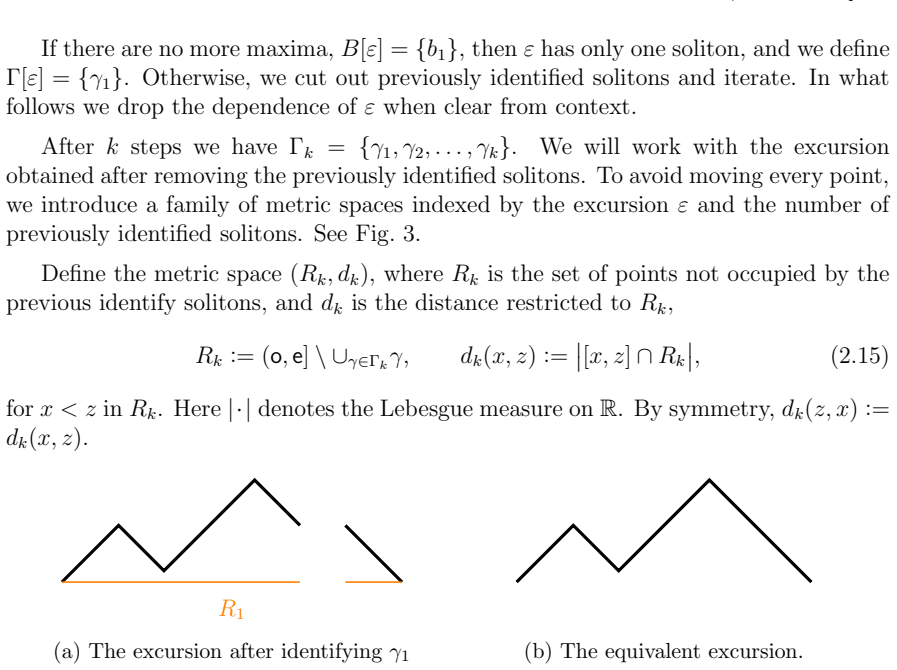
The law on walks is a product measure on the excursions over past minima, with each excursion weighted by a product of factors that depend only on the heights of its solitons.
What would settle it
An explicit computation, for some integrable weight function, showing that the number of points falling in two disjoint regions of the plane are not independent.
Figures




read the original abstract
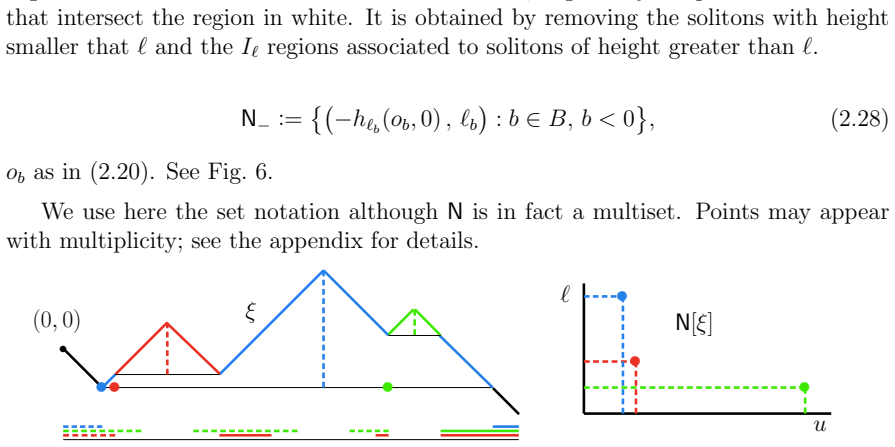
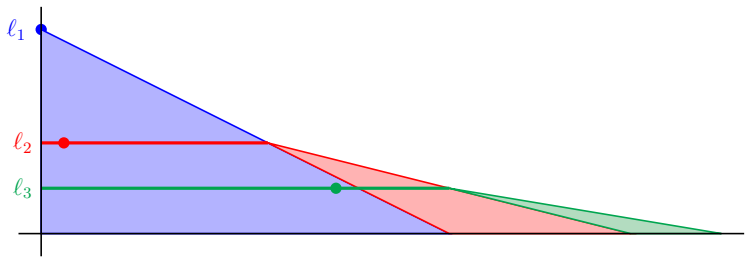
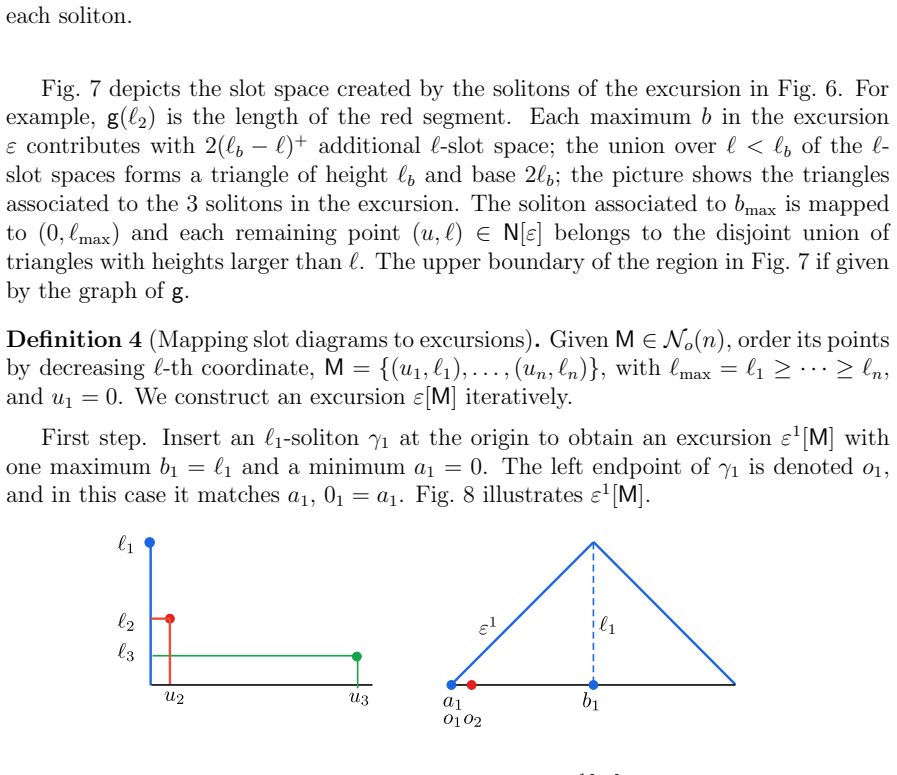
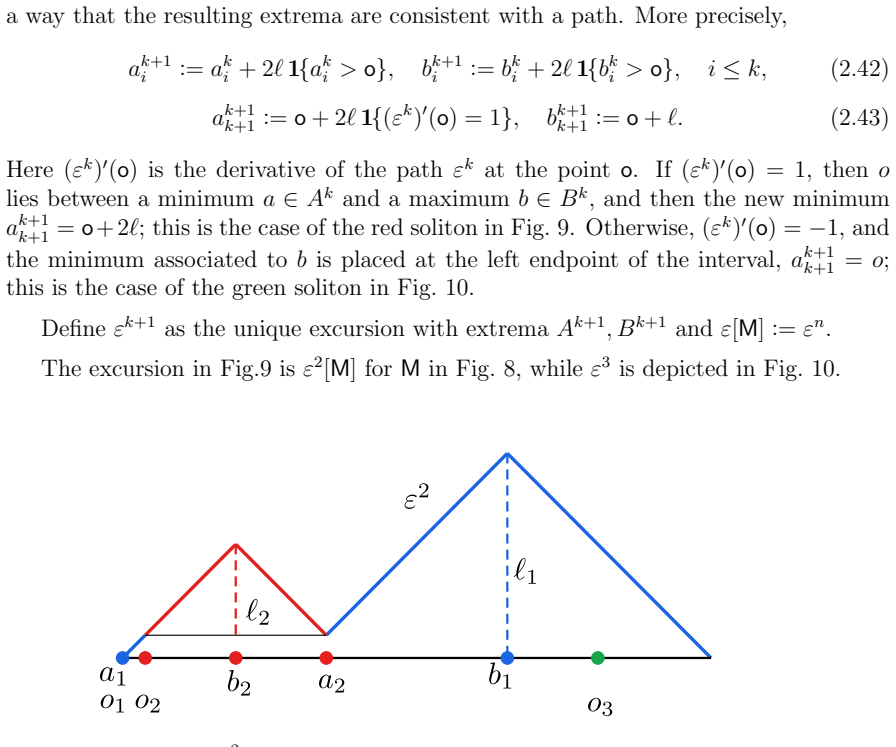
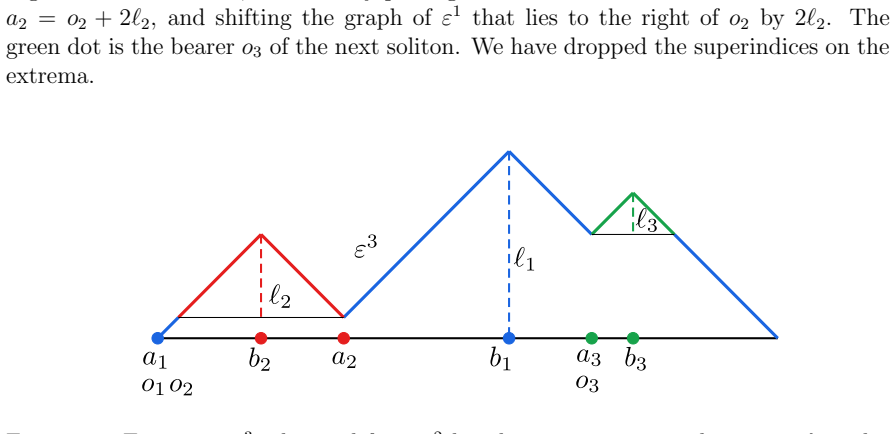
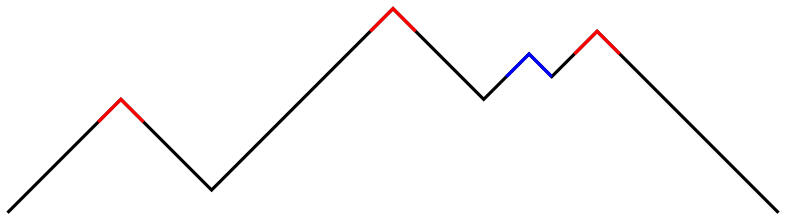
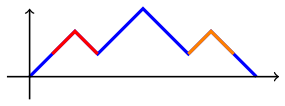
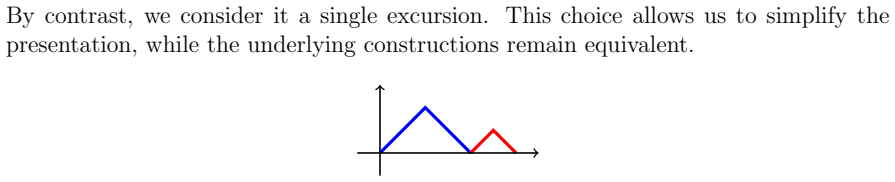
We study a piecewise constant function $\eta:\mathbb R\to\{-1,1\}$ with a finite number of discontinuities in any interval. We assume that the associated walk $\xi:\mathbb R\to\mathbb R$ satisfying $\xi'(x)=\eta(x)$, pinned by $\xi(0)=0$, has finite length excursions over past minima. This is the continuous generalization of an initial ball configuration in the discrete Box Ball System introduced by Takahashi and Satsuma, where solitons of integer sizes $k\ge1$ are identified. We extend the slot decomposition developed by Ferrari, Nguyen, Rolla and Wang in the discrete setting to the continuous case. Each soliton of $\xi$ is represented by a point in two dimensional space, one coordinate for position and the other for the soliton height, mapping $\xi$ to a point configuration. We consider a distribution on walks given by a product measure on the decomposition of the path into excursions over past minima. Excursions are distributed as products of their solitons weights, which are determined by the soliton heights. We show that when the weight function is in $L^1$ the slot decomposition of $\xi$ is a Poisson process. This extends to the continuous case an approach of Ferrari and Gabrielli. As an example, we compute the intensity measure of the Poisson process associated to the asymmetric telegraph process introduced by Kac. In a forthcoming paper we discuss the dynamic properties.
Editorial analysis
A structured set of objections, weighed in public.
Referee Report
Summary. The manuscript extends the slot decomposition of discrete Box-Ball Systems to a continuous setting for piecewise constant functions η:ℝ→{-1,1} whose associated walk ξ (with ξ'=η and ξ(0)=0) has finite-length excursions over past minima. Solitons are mapped to points in the position-height plane. A product measure is placed on the decomposition of the path into such excursions, with each excursion factored into independent solitons whose weights depend on height. The central claim is that when this weight function lies in L¹ the resulting slot point process is Poisson; the intensity is computed explicitly for the asymmetric telegraph process of Kac. Dynamics are deferred to a forthcoming paper.
Significance. If the central theorem holds, the work supplies a continuous analogue of the discrete Ferrari–Gabrielli construction in which the Poisson property follows directly from the product structure on excursions once the weight is integrable. This is a parameter-free derivation in the sense that no additional fitting is required beyond the L¹ hypothesis. The explicit intensity calculation for the telegraph process provides a concrete, falsifiable prediction that strengthens the contribution.
major comments (1)
- [Abstract] Abstract and main theorem statement: the claim that the slot decomposition is Poisson when the weight function is in L¹ is asserted without any proof steps, error controls, or verification of the continuous generalization. Because the result cannot be checked from the supplied text, the load-bearing assertion remains unverified.
minor comments (2)
- [Setup of the measure] The assumption that excursions have finite length is used to define the measure, but the manuscript does not indicate how this interacts with the continuous soliton identification or whether it is automatically satisfied under the product measure.
- [Introduction] Notation for the weight function on soliton heights and the precise definition of the product measure on excursions should be introduced with an equation number before the statement of the main result.
Simulated Author's Rebuttal
We thank the referee for the positive assessment of the contribution and the careful reading. We address the single major comment below.
read point-by-point responses
-
Referee: [Abstract] Abstract and main theorem statement: the claim that the slot decomposition is Poisson when the weight function is in L¹ is asserted without any proof steps, error controls, or verification of the continuous generalization. Because the result cannot be checked from the supplied text, the load-bearing assertion remains unverified.
Authors: The main theorem (Theorem 2.1) is stated after the setup in Section 2 and proved in full in Section 4. The argument proceeds by first constructing the product measure on finite excursions over past minima, factoring each excursion into independent solitons with weights given by the height function, then applying the slot mapping to obtain a point process on the position-height plane. Under the L¹ integrability assumption we show that the resulting intensity measure is finite and that the process is Poisson by verifying the complete independence property on disjoint sets via the product structure; the continuous case is handled by approximating the piecewise-constant path by its discrete skeleton and controlling the error in the slot positions via a uniform bound on excursion lengths. Explicit error controls appear in Lemmas 4.3–4.5 and the intensity calculation for the asymmetric telegraph process is carried out in Section 5. We will expand the exposition of these steps and add a short appendix summarizing the discrete-to-continuous passage to make the verification immediate. revision: partial
Circularity Check
No significant circularity; derivation self-contained from explicit product measure to Poisson conclusion
full rationale
The paper defines the model by positing a product measure on excursions over past minima, with each excursion distributed as a product of soliton weights determined by heights. It then proves that, when the weight function lies in L^1, the induced slot decomposition is a Poisson point process. This is a direct construction and verification from the stated hypotheses, not a reduction of the claimed result to its own inputs by definition, fitting, or self-citation. References to prior discrete work supply context for the extension but do not carry the load of the continuous proof, which relies on the product structure and integrability condition rather than any imported uniqueness theorem or ansatz. No self-definitional, fitted-prediction, or renaming patterns appear in the load-bearing steps.
Axiom & Free-Parameter Ledger
free parameters (1)
- weight function on soliton heights
axioms (2)
- domain assumption The associated walk ξ has finite length excursions over past minima.
- domain assumption Excursions are distributed as products of their solitons weights determined by heights.
Reference graph
Works this paper leans on
-
[1]
Scaling limits of solitons in the box-ball system , author=. 2025 , journal=. 2411.14818 , archivePrefix=
arXiv 2025
-
[2]
Pitman , journal =
James W. Pitman , journal =. One-Dimensional
-
[3]
Bierkens, Joris and Roberts, Gareth , Title =. Ann. Appl. Probab. , ISSN =. 2017 , Language =. doi:10.1214/16-AAP1217 , Keywords =
-
[4]
, TITLE =
Stanley, Richard P. , TITLE =
-
[5]
Random trees and applications , JOURNAL =
Le Gall, Jean-Fran. Random trees and applications , JOURNAL =. 2005 , PAGES =
2005
-
[6]
Yoshihara, Daisuke and Yura, Fumitaka and Tokihiro, Tetsuji , TITLE =. J. Phys. A , FJOURNAL =. 2003 , NUMBER =
2003
-
[7]
Journal of The Physical Society of Japan , volume =
Takahashi, Daisuke and Satsuma, Junkichi , title =. Journal of The Physical Society of Japan , volume =. 1990 , number =
1990
-
[8]
Physical Review Letters , volume=
From soliton equations to integrable cellular automata through a limiting procedure , author=. Physical Review Letters , volume=. 1996 , publisher=
1996
-
[9]
Journal of Physics A: Mathematical and General , volume=30, number=21, pages=
Box and ball system with a carrier and ultradiscrete modified KdV equation , author=. Journal of Physics A: Mathematical and General , volume=30, number=21, pages=
-
[10]
Harris, T. E. , TITLE =. Z. Wahrscheinlichkeitstheorie und Verw. Gebiete , VOLUME =. 1971 , PAGES =
1971
-
[11]
and Stone, Charles J
Port, Sidney C. and Stone, Charles J. , TITLE =. Trans. Amer. Math. Soc. , FJOURNAL =. 1973 , PAGES =
1973
-
[12]
doi:10.1007/978-1-4612-1236-2 , URL =
Thorisson, Hermann , TITLE =. doi:10.1007/978-1-4612-1236-2 , URL =
-
[13]
Spectral Analysis of Transition Operators, Automata Groups and Translation in
Kato, Tsuyoshi and Tsujimoto, Satoshi and Zuk, Andrzej , journal=. Spectral Analysis of Transition Operators, Automata Groups and Translation in. 2016 , publisher=
2016
-
[14]
Double jump phase transition in a random soliton cellular automaton , author=
-
[15]
Evans, Steven N. , TITLE =. 2008 , PAGES =. doi:10.1007/978-3-540-74798-7 , URL =
-
[16]
Integrable structure of box--ball systems: crystal,
Inoue, Rei and Kuniba, Atsuo and Takagi, Taichiro , journal=. Integrable structure of box--ball systems: crystal,. 2012 , publisher=
2012
-
[17]
Spectral analysis of transition operators, automata groups and translation in
Kato, Tsuyoshi and Tsujimoto, Satoshi and Zuk, Andrzej , journal=. Spectral analysis of transition operators, automata groups and translation in. 2017 , publisher=
2017
-
[18]
The exact correspondence between conserved quantities of a periodic box-ball system and string solutions of the
Mada, Jun and Idzumi, Makoto and Tokihiro, Tetsuji , journal=. The exact correspondence between conserved quantities of a periodic box-ball system and string solutions of the
-
[19]
Journal of Physics A: Mathematical and General , volume=35, number=16, pages=3787, year=2002, publisher=
On a periodic soliton cellular automaton , author=. Journal of Physics A: Mathematical and General , volume=35, number=16, pages=3787, year=2002, publisher=
2002
-
[20]
Croydon, David A. and Sasada, Makiko , Title =. J. Math. Phys. , ISSN =. 2019 , Language =. doi:10.1063/1.5095622 , Keywords =
-
[21]
Aldous, David J. , TITLE =. SIAM J. Discrete Math. , FJOURNAL =. 1990 , NUMBER =. doi:10.1137/0403039 , URL =
-
[22]
Kawazu, Kiyoshi and Watanabe, Shinzo , TITLE =. Teor. Verojatnost. i Primenen. , FJOURNAL =. 1971 , PAGES =
1971
-
[23]
Dwass, Meyer , TITLE =. Proc. Amer. Math. Soc. , FJOURNAL =. 1975 , PAGES =. doi:10.2307/2040307 , URL =
-
[25]
One-sided scaling limit of multicolor box-ball system. arXiv:1808.08074 , keywords =. 2018
arXiv 2018
-
[26]
Yoshihara, Daisuke and Yura, Fumitaka and Tokihiro, Tetsuji , TITLE =. J. Phys. A , FJOURNAL =
-
[27]
Journal of Physics A: Mathematical and General , volume=
Box and ball system with a carrier and ultradiscrete modified KdV equation , author=. Journal of Physics A: Mathematical and General , volume=. 1997 , publisher=
1997
-
[28]
Collision rate ansatz for the classical
Spohn, Herbert , journal=. Collision rate ansatz for the classical. 2020 , publisher=
2020
-
[29]
Cao, Xiangyu and Bulchandani, Vir B and Spohn, Herbert , journal=. The. 2019 , publisher=
2019
-
[30]
Journal of Physics A: Mathematical and Theoretical , volume=
Generalized hydrodynamics in box-ball system , author=. Journal of Physics A: Mathematical and Theoretical , volume=. 2020 , publisher=
2020
-
[31]
SciPost Physics , volume=
Generalized hydrodynamics in complete box-ball system for U_q (\ sl\ _n) , author=. SciPost Physics , volume=
-
[32]
Journal of Physics A: Mathematical and Theoretical , volume=
Current correlations, Drude weights and large deviations in a box--ball system , author=. Journal of Physics A: Mathematical and Theoretical , volume=. 2022 , publisher=
2022
-
[33]
Nuclear Physics B , volume=
Randomized box--ball systems, limit shape of rigged configurations and thermodynamic Bethe ansatz , author=. Nuclear Physics B , volume=. 2018 , publisher=
2018
-
[34]
arXiv preprint arXiv:1911.04458 , year=
Scaling limit of soliton lengths in a multicolor box-ball system , author=. arXiv preprint arXiv:1911.04458 , year=
arXiv 1911
-
[35]
Dynamics of the box-ball system with random initial conditions via
Croydon, David A and Kato, Tsuyoshi and Sasada, Makiko and Tsujimoto, Satoshi , journal=. Dynamics of the box-ball system with random initial conditions via
-
[36]
Statistical inference and simulation for spatial point processes , SERIES =
M. Statistical inference and simulation for spatial point processes , SERIES =
-
[37]
Le Gall, J.-F. , TITLE =. S\'. doi:10.1007/BFb0075735 , URL =
-
[38]
and Fomin, Sergey , year = 1999, month = jan, edition =
Stanley, Richard P. , TITLE =. doi:10.1017/CBO9780511609589 , URL =
-
[39]
Journal of the Physical Society of Japan , volume = 59, number = 10, pages =
Takahashi ,Daisuke and Satsuma ,Junkichi , title =. Journal of the Physical Society of Japan , volume = 59, number = 10, pages =. doi:10.1143/JPSJ.59.3514 , URL =
-
[40]
Kinetic theory of quantum and classical
Bulchandani, Vir B and Cao, Xiangyu and Moore, Joel E , year=. Kinetic theory of quantum and classical. Journal of Physics A: Mathematical and Theoretical , publisher=. doi:10.1088/1751-8121/ab2cf0 , number=
-
[41]
Journal of Physics A: Mathematical and Theoretical , abstract =
Xiangyu Cao and Vir B Bulchandani and Herbert Spohn , title =. Journal of Physics A: Mathematical and Theoretical , abstract =. doi:10.1088/1751-8121/ab5019 , year = 2019, month =
-
[42]
and Nguyen, Chi and Rolla, Leonardo T
Ferrari, Pablo A. and Nguyen, Chi and Rolla, Leonardo T. and Wang, Minmin , Title =. Forum Math. Sigma , ISSN =. 2021 , Language =. doi:10.1017/fms.2021.49 , Keywords =
-
[43]
Kuniba, Atsuo and Okado, Masato and Sakamoto, Reiho and Takagi, Taichiro and Yamada, Yasuhiko , Title =. Nucl. Phys., B , ISSN =. 2006 , Language =. doi:10.1016/j.nuclphysb.2006.02.005 , Keywords =
-
[44]
Bierkens, Joris and Fearnhead, Paul and Roberts, Gareth , Title =. Ann. Stat. , ISSN =. 2019 , Language =. doi:10.1214/18-AOS1715 , Keywords =
-
[45]
and Burago, Yu
Burago, D. and Burago, Yu. and Ivanov, S. , fseries =. A course in metric geometry , volume = 33, year = 2001, zbl =
2001
-
[46]
Mada, Jun and Idzumi, Makoto and Tokihiro, Tetsuji , title =. J. Phys. A, Math. Gen. , issn =. 2006 , language =. doi:10.1088/0305-4470/39/43/L01 , keywords =
-
[47]
Generalized hydrodynamics of the classical
Doyon, Benjamin , year=. Generalized hydrodynamics of the classical. Journal of Mathematical Physics , publisher=. doi:10.1063/1.5096892 , number=
-
[48]
Spohn, Herbert , year=. Generalized. doi:10.1007/s10955-019-02320-5 , journal=
-
[49]
Croydon and Makiko Sasada and Satoshi Tsujimoto , year=
David A. Croydon and Makiko Sasada and Satoshi Tsujimoto , year=. Dynamics of the ultra-discrete
-
[50]
and Gabrielli, Davide , Title =
Ferrari, Pablo A. and Gabrielli, Davide , Title =. 2020 , Publisher =. doi:10.1007/978-3-030-57513-7_5 , Keywords =
-
[51]
and Gabrielli, Davide , Title =
Ferrari, Pablo A. and Gabrielli, Davide , Title =. Electron. J. Probab. , ISSN =. 2020 , Language =. doi:10.1214/20-EJP475 , Keywords =
-
[52]
and O'Connell, N
Hambly, Ben and Martin, James B. and O'Connell, N. , title =. Electron. Commun. Probab. , year =
-
[53]
Croydon, David A. and Sasada, Makiko , TITLE =. Comm. Math. Phys. , FJOURNAL =. 2021 , NUMBER =. doi:10.1007/s00220-020-03914-x , URL =
-
[54]
Croydon, David A. and Sasada, Makiko , Title =. Stochastic analysis, random fields and integrable probability -- Fukuoka 2019. Proceedings of the 12th Mathematical Society of Japan, Seasonal Institute (MSJ-SI), Kyushu University, Japan, 31 July -- 9 August 2019 , ISBN =. 2021 , Publisher =. doi:10.2969/aspm/08710381 , Keywords =
-
[55]
and Sasada, Makiko and Tsujimoto, Satoshi , Title =
Croydon, David A. and Sasada, Makiko and Tsujimoto, Satoshi , Title =. RIMS K. 2020 , Language =
2020
-
[56]
and Sasada, Makiko and Tsujimoto, Satoshi , title =
Croydon, David A. and Sasada, Makiko and Tsujimoto, Satoshi , title =. Math. Phys. Anal. Geom. , issn =. 2022 , language =. doi:10.1007/s11040-022-09435-4 , keywords =
-
[58]
Hard Rod Hydrodynamics and the
Ferrari, Pablo A and Franceschini, Chiara and Grevino, Dante GE and Spohn, Herbert , journal=. Hard Rod Hydrodynamics and the
-
[59]
arXiv preprint arXiv:2301.08504 , year=
Hydrodynamic scales of integrable many-particle systems , author=. arXiv preprint arXiv:2301.08504 , year=
-
[60]
arXiv preprint arXiv:2210.02079 , year=
Diffusive Fluctuations in Hard Rods System , author=. arXiv preprint arXiv:2210.02079 , year=
-
[61]
and Kato, Tsuyoshi and Sasada, Makiko and Tsujimoto, Satoshi , Title =
Croydon, David A. and Kato, Tsuyoshi and Sasada, Makiko and Tsujimoto, Satoshi , Title =. 2023 , Publisher =. doi:10.1090/memo/1398 , Keywords =
-
[62]
Boldrighini, C. and Suhov, Y. M. , Title =. Commun. Math. Phys. , ISSN =. 1997 , Language =. doi:10.1007/s002200050218 , Keywords =
-
[63]
and Dobrushin, R
Boldrighini, C. and Dobrushin, R. L. and Sukhov, Yu. M. , title=. J. Stat. Phys. , pages=
-
[64]
Mucciconi, Matteo and Sasada, Makiko and Sasamoto, Tomohiro and Suda, Hayate , title =. Forum Math. Sigma , issn =. doi:10.1017/fms.2024.39 , keywords =
-
[65]
Kirillov, Anatol N. and Sakamoto, Reiho , Title =. Lett. Math. Phys. , ISSN =. doi:10.1007/s11005-009-0318-3 , Keywords =
-
[66]
Liu, Xuan and Scrimshaw, Travis , Title =. Ann. Henri Poincar. 2019 , Language =. doi:10.1007/s00023-019-00773-8 , Keywords =
-
[67]
arXiv preprint arXiv:2312.15358 , year=
Seat number configuration of the box-ball system, and its relation to the 10-elimination and invariant measures , author=. arXiv preprint arXiv:2312.15358 , year=
-
[68]
SIGMA, Symmetry Integrability Geom
Kuniba, Atsuo and Takagi, Taichiro , Title =. SIGMA, Symmetry Integrability Geom. Methods Appl. , ISSN =. 2010 , Language =. doi:10.3842/SIGMA.2010.013 , Keywords =
-
[69]
Kuniba, Atsuo and Lyu, Hanbaek and Okado, Masato , Title =. Nucl. Phys., B , ISSN =. 2018 , Language =. doi:10.1016/j.nuclphysb.2018.10.008 , Keywords =
-
[70]
Kac, Mark , title =. Rocky Mt. J. Math. , issn =. 1974 , language =. doi:10.1216/RMJ-1974-4-3-497 , keywords =
-
[71]
Ratanov, Nikita and Kolesnik, Alexander D. , title =. 2022 , publisher =. doi:10.1007/978-3-662-65827-7 , keywords =
-
[72]
2026 , howpublished =
Amol Aggarwal and Matthew Nicoletti , title =. 2026 , howpublished =
2026
-
[73]
2026 , howpublished =
Amol Aggarwal , title =. 2026 , howpublished =
2026
-
[74]
Spohn, Herbert , title =. 2024 , publisher =. doi:10.1142/13600 , keywords =
discussion (0)
Sign in with ORCID, Apple, or X to comment. Anyone can read and Pith papers without signing in.