The AI Evaluability Gap: The Missing Layer for Managing Risk and Sustaining Value
Pith reviewed 2026-06-26 14:35 UTC · model grok-4.3
The pith
The AI Evaluability Gap arises because governance focuses on system properties instead of the evidence needed to justify decisions about those properties.
A machine-rendered reading of the paper's core claim, the machinery that carries it, and where it could break.
Core claim
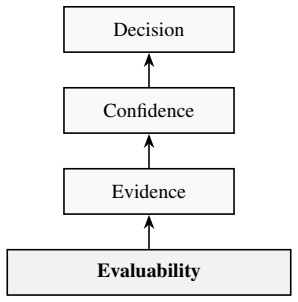
The paper establishes that the AI Evaluability Gap represents a category error in AI governance, where attention to system properties such as safety, fairness, reliability, compliance, and value overshadows the need for adequate evidentiary foundations. It defines Evaluability as the capability of a system to generate, maintain, and renew evidence sufficient to support high-confidence governance decisions over time. Governance decisions are formalized as functions of calibrated confidence Conf(D|E), and evidence must satisfy six properties: observability, attributability, intervenability, verifiability, calibration, and temporal validity. The framework separates Operational Certification rel
What carries the argument
Evaluability, defined as the capability of a system to generate, maintain, and renew evidence sufficient to support high-confidence governance decisions over time.
If this is right
- Governance decisions depend on evidence meeting the six properties to achieve calibrated confidence.
- Operational decisions about system deployment rely on structural evidence while investment decisions about resource allocation rely on causal evidence.
- Addressing evidence sufficiency closes the gap and enables both risk management and value sustainment in AI organizations.
- The six properties—observability, attributability, intervenability, verifiability, calibration, and temporal validity—form the basis for sufficient evidence.
Where Pith is reading between the lines
- Adopting this approach might require organizations to implement new monitoring systems focused on tracking these evidence properties throughout an AI system's lifecycle.
- The distinction between operational and investment certification suggests that different types of evidence audits could be needed depending on whether the decision is about launching or continuing funding.
- This framework could extend to non-AI systems facing similar evidence challenges in governance contexts.
Load-bearing premise
The six properties of evidence are both necessary and jointly sufficient to close the AI Evaluability Gap and support high-confidence governance decisions.
What would settle it
An empirical study showing that organizations using evidence satisfying all six properties still fail to achieve high-confidence decisions, or that high-confidence decisions are possible without one or more of the properties.
Figures



read the original abstract
Organizations deploying AI face two fundamental governance challenges: managing AI risk and sustaining AI value. Both depend on evidence whose sufficiency cannot be taken for granted. We call the shared underlying challenge the AI Evaluability Gap: the condition in which organizations lack sufficient evidence to support high-confidence governance decisions regarding either risk or value. We argue that this gap reflects a category error in current practice. Existing governance approaches focus primarily on properties of systems, such as safety, fairness, reliability, compliance, and value, while paying comparatively little attention to the evidentiary foundations required to justify decisions about those properties. We further argue that AI governance encompasses both operational decisions regarding whether a system may operate and investment decisions regarding whether it merits continued organizational resources. To address this problem, we introduce Evaluability, defined as the capability of a system to generate, maintain, and renew evidence sufficient to support high-confidence governance decisions over time. We formalize governance decisions as functions of calibrated confidence Conf(D|E) and identify six properties of evaluable evidence: observability, attributability, intervenability, verifiability, calibration, and temporal validity. The framework distinguishes Operational Certification, which relies primarily on structural evidence to justify deployment decisions, from Investment Certification, which relies primarily on causal evidence to justify continued resource allocation. We argue that evidence sufficiency is a missing layer of AI governance and that closing the AI Evaluability Gap is a prerequisite for both managing risk and sustaining value in AI-enabled organizations.
Editorial analysis
A structured set of objections, weighed in public.
Referee Report
Summary. The paper claims that organizations deploying AI face an 'AI Evaluability Gap'—a lack of sufficient evidence to support high-confidence governance decisions on risk management and value sustainment. It argues this reflects a category error, with existing approaches over-focusing on system properties (safety, fairness, etc.) rather than evidentiary foundations. The authors introduce 'Evaluability' as the capability to generate, maintain, and renew evidence, formalized via calibrated confidence Conf(D|E), and enumerate six properties of evaluable evidence: observability, attributability, intervenability, verifiability, calibration, and temporal validity. The framework distinguishes Operational Certification (structural evidence for deployment) from Investment Certification (causal evidence for resource allocation), positioning evidence sufficiency as a missing governance layer.
Significance. If the framework holds, it supplies a conceptual distinction between structural and causal evidence that could clarify governance trade-offs in AI deployment versus continued investment. The paper's explicit separation of operational and investment certification decisions is a clear organizational contribution. However, as a definitional and argumentative piece without empirical measurements, case studies, or formal derivation of the six properties, its significance rests on whether the framework is adopted and tested by practitioners rather than on demonstrated predictive or prescriptive power.
major comments (2)
- [Abstract and framework section] Abstract and framework section: The six properties of evaluable evidence are introduced by enumeration without derivation from the Conf(D|E) function or demonstration that they are individually necessary and jointly sufficient to support high-confidence governance decisions. This is load-bearing for the central claim that closing the evaluability gap addresses a category error in current practice.
- [Abstract] Abstract: The assertion that current governance approaches 'pay comparatively little attention to the evidentiary foundations' is presented without supporting measurements, citations to specific frameworks, or case studies showing systematic neglect; this underpins the category-error diagnosis but remains untested within the manuscript.
minor comments (1)
- The distinction between 'structural evidence' for operational certification and 'causal evidence' for investment certification is stated but not illustrated with concrete examples or decision criteria that would allow readers to apply the distinction.
Simulated Author's Rebuttal
We thank the referee for their constructive comments, which highlight opportunities to strengthen the foundational elements of the Evaluability framework. We address each major comment below, agreeing where revisions are warranted to better support the central claims.
read point-by-point responses
-
Referee: [Abstract and framework section] Abstract and framework section: The six properties of evaluable evidence are introduced by enumeration without derivation from the Conf(D|E) function or demonstration that they are individually necessary and jointly sufficient to support high-confidence governance decisions. This is load-bearing for the central claim that closing the evaluability gap addresses a category error in current practice.
Authors: We agree that an explicit derivation would strengthen the argument. In the revised manuscript, we will expand the framework section to derive each of the six properties directly from the requirements of supporting calibrated confidence Conf(D|E) in governance decisions. This will include showing how observability, attributability, intervenability, verifiability, calibration, and temporal validity are individually necessary for evidence to enable high-confidence risk and value decisions, and jointly sufficient to address the category error by shifting focus from system properties to evidentiary capabilities. revision: yes
-
Referee: [Abstract] Abstract: The assertion that current governance approaches 'pay comparatively little attention to the evidentiary foundations' is presented without supporting measurements, citations to specific frameworks, or case studies showing systematic neglect; this underpins the category-error diagnosis but remains untested within the manuscript.
Authors: This assertion is grounded in our review of prominent AI governance approaches, which prioritize system properties over evidence-generation mechanisms. To address the concern, the revised version will incorporate specific citations to frameworks such as the NIST AI Risk Management Framework and the EU AI Act, noting their emphasis on properties like safety and fairness with limited explicit treatment of evaluability. As the paper is conceptual rather than empirical, we will not add measurements or case studies but will qualify the statement to reflect this literature analysis, thereby better supporting the category-error diagnosis. revision: partial
Circularity Check
Evaluability and its six properties defined by construction to support the governance decisions the framework claims to enable
specific steps
-
self definitional
[Abstract]
"We introduce Evaluability, defined as the capability of a system to generate, maintain, and renew evidence sufficient to support high-confidence governance decisions over time. We formalize governance decisions as functions of calibrated confidence Conf(D|E) and identify six properties of evaluable evidence: observability, attributability, intervenability, verifiability, calibration, and temporal validity."
Evaluability is defined in terms of producing evidence 'sufficient to support high-confidence governance decisions,' while the six properties are identified as the properties of such 'evaluable evidence.' The sufficiency claim and the gap-closing role are therefore built into the definition rather than derived from the Conf(D|E) formalization or validated independently, rendering the framework equivalent to its own inputs by construction.
full rationale
The paper's central contribution defines the AI Evaluability Gap as insufficient evidence for high-confidence Conf(D|E) decisions, then introduces Evaluability as the capability to generate evidence sufficient for exactly those decisions, and enumerates the six properties as those of 'evaluable evidence' without deriving them from Conf(D|E) or demonstrating necessity/sufficiency via external validation or case evidence. This makes the claimed missing governance layer self-definitional rather than independently derived. No self-citations or fitted predictions are present; the circularity is purely in the definitional structure of the framework itself.
Axiom & Free-Parameter Ledger
axioms (1)
- domain assumption AI governance decisions require high-confidence evidence whose sufficiency cannot be taken for granted.
invented entities (1)
-
Evaluability
no independent evidence
Reference graph
Works this paper leans on
-
[1]
Bloomfield, R., and Bishop, P. (2010). Safety and Assurance Cases: Past, Present and Possible Future, an Adelard Perspective. In Making Systems Safer: Proceedings of the Eighteenth Safety-Critical Systems Symposium, 51--67
2010
- [2]
-
[3]
Cooke, R. M. (1991). Experts in Uncertainty: Opinion and Subjective Probability in Science. Oxford University Press
1991
-
[4]
Gilboa, I., and Schmeidler, D. (1989). Maxmin Expected Utility with Non-Unique Prior. Journal of Mathematical Economics, 18(2), 141--153
1989
-
[5]
ISO/IEC 42001:2023 -- Information technology -- Artificial intelligence -- Management system
International Organization for Standardization (2023). ISO/IEC 42001:2023 -- Information technology -- Artificial intelligence -- Management system. International Organization for Standardization, Geneva
2023
-
[6]
Kelly, T., and Weaver, R. (2004). The Goal Structuring Notation -- A Safety Argument Notation. In Proceedings of the Dependable Systems and Networks 2004 Workshop on Assurance Cases
2004
-
[7]
Artificial Intelligence Risk Management Framework (AI RMF 1.0)
National Institute of Standards and Technology (2023). Artificial Intelligence Risk Management Framework (AI RMF 1.0). NIST AI 100-1, U.S. Department of Commerce
2023
-
[8]
Pearl, J. (2009). Causality: Models, Reasoning, and Inference. 2nd ed. Cambridge University Press
2009
-
[9]
Rubin, D. B. (1974). Estimating Causal Effects of Treatments in Randomized and Nonrandomized Studies. Journal of Educational Psychology, 66(5), 688--701
1974
- [10]
-
[11]
Savage, L. J. (1954). The Foundations of Statistics. John Wiley & Sons
1954
- [12]
- [13]
-
[14]
Vovk, V., Gammerman, A., and Shafer, G. (2005). Algorithmic Learning in a Random World. Springer
2005
discussion (0)
Sign in with ORCID, Apple, or X to comment. Anyone can read and Pith papers without signing in.