Classification of Eclipsing Binary Light Curves in Gaia DR3: A Machine Learning Approach
Pith reviewed 2026-06-26 13:46 UTC · model grok-4.3
The pith
A multimodal neural network classifies nearly 2 million Gaia DR3 eclipsing binaries into EA, EB, and EW types with over 95% accuracy.
A machine-rendered reading of the paper's core claim, the machinery that carries it, and where it could break.
Core claim
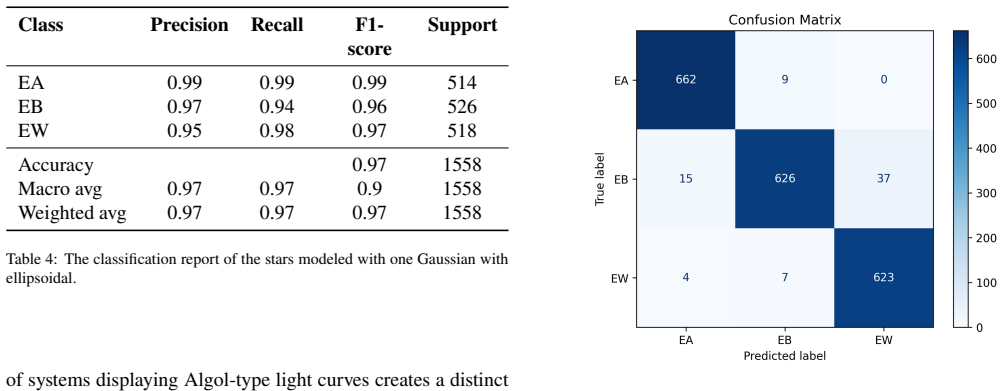
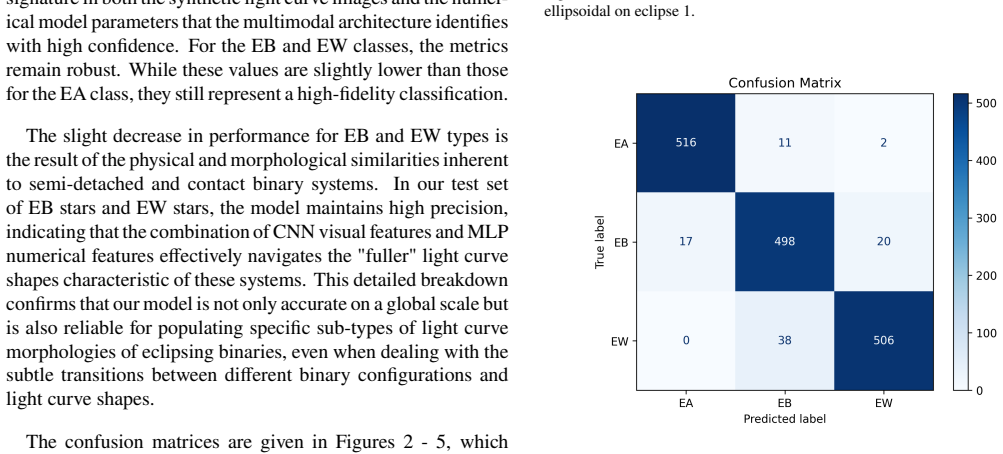
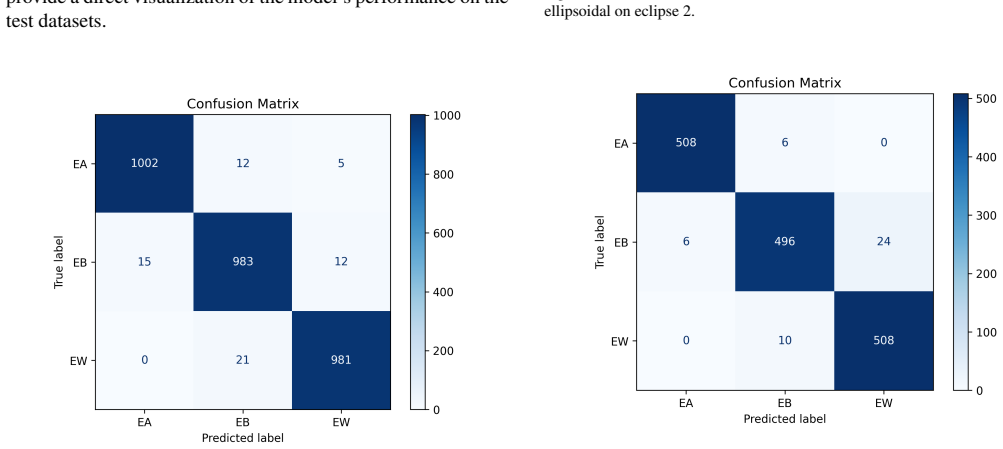
The multimodal deep learning architecture simultaneously utilizes a CNN that extracts visual features from light curve images and an MLP that processes geometric model parameters. Trained on noise-free synthetic light curves, the model achieves an accuracy rate of over 95% for all classes and classifies the Gaia DR3 eclipsing binaries as 40% EA, 30% EB, and 30% EW.
What carries the argument
Multimodal deep learning model that combines a Convolutional Neural Network for light curve image features with a Multilayer Perceptron for geometric parameters.
If this is right
- The automated classification produces a 40-30-30 breakdown of EA, EB, and EW types across the Gaia DR3 catalog.
- High accuracy supports statistical studies of binary star populations on a scale impossible with manual methods.
- The multimodal framework provides a transferable method for future large-scale surveys.
- Particularly strong performance on EA systems enables focused analysis of detached binaries.
Where Pith is reading between the lines
- The reported fractions may reflect a combination of true occurrence rates and Gaia selection effects in the observed sample.
- Adding realistic noise to the synthetic training set could reduce any domain shift when classifying actual observations.
- The same architecture could be retrained to classify other classes of variable stars in Gaia or future surveys.
- Cross-checking the assigned labels against smaller catalogs with known types would test consistency of the 40-30-30 split.
Load-bearing premise
Noise-free synthetic light curves capture the geometric morphologies of real, noisy Gaia DR3 observations closely enough that the model generalizes without major domain shift or misclassification.
What would settle it
Testing the trained model on a sample of real Gaia DR3 light curves that have independent expert classifications and obtaining accuracy well below 95% would show that the synthetic training data do not generalize.
Figures

read the original abstract
Gaia Data Release 3 (DR3) presents a unique dataset with approximately 2.1 million eclipsing binary star candidates. The unsustainability of manually classifying such a large volume of data has necessitated the development of reliable and scalable automated techniques. In this study, a novel multimodal deep learning model has been developed for the automated classification of approximately 2 million eclipsing binary stars in the Gaia DR3 archive based on their light curve morphologies (EA, EB, EW). The developed architecture simultaneously utilizes a Convolutional Neural Network (CNN) that extracts visual features from light curve images and a Multilayer Perceptron (MLP) that processes geometric model parameters. Noise-free synthetic light curves were used during the training process to ensure the model focuses on geometric shapes. Tests showed that the model achieved an accuracy rate of over 95% for all classes, exhibiting excellent separation performance, particularly in EA-type systems. As a result of the automated classification performed with the trained model, 40% of the Gaia DR3 eclipsing binaries were classified as EA, 30% as EB, and 30% as EW. This study provides a highly accurate and transferable classification framework for future large-scale sky surveys.
Editorial analysis
A structured set of objections, weighed in public.
Referee Report
Summary. The paper presents a multimodal deep learning architecture (CNN processing light-curve images plus MLP ingesting geometric model parameters) trained exclusively on noise-free synthetic eclipsing-binary light curves. The model is applied to the ~2 million Gaia DR3 eclipsing-binary candidates, yielding reported test accuracy >95% and downstream class fractions of 40% EA, 30% EB, and 30% EW.
Significance. A validated version of this pipeline would supply a scalable, geometry-focused classifier useful for future all-sky surveys. The deliberate choice to train on noise-free synthetics isolates morphological features and is a defensible methodological decision; however, the manuscript supplies no evidence that this choice transfers to real Gaia sampling and noise.
major comments (2)
- [Abstract] Abstract: the central claim that the trained model can be applied directly to Gaia DR3 to produce reliable 40/30/30% fractions is load-bearing on generalization from noise-free synthetics; the manuscript reports no accuracy, confusion matrix, or cross-validation metrics on any real Gaia light curves (or on Kepler overlaps), leaving domain-shift effects unquantified.
- [Results] Results section: no ablation or robustness tests are described that add realistic Gaia noise levels, cadence gaps, or photometric uncertainties to the synthetic training/test sets, which directly affects whether the >95% figure supports the downstream catalog statistics.
minor comments (1)
- The manuscript would benefit from explicit uncertainty estimates (e.g., bootstrap or cross-validation standard errors) on the reported 40/30/30% fractions.
Simulated Author's Rebuttal
We thank the referee for the detailed and constructive report. The comments correctly identify that our reliance on noise-free synthetic training data leaves the generalization to real Gaia observations unquantified. Below we respond point-by-point and indicate the revisions we will make to strengthen the manuscript.
read point-by-point responses
-
Referee: [Abstract] Abstract: the central claim that the trained model can be applied directly to Gaia DR3 to produce reliable 40/30/30% fractions is load-bearing on generalization from noise-free synthetics; the manuscript reports no accuracy, confusion matrix, or cross-validation metrics on any real Gaia light curves (or on Kepler overlaps), leaving domain-shift effects unquantified.
Authors: We agree that the absence of real-data validation metrics is a limitation. The manuscript does not contain accuracy figures, confusion matrices, or cross-validation results on actual Gaia light curves or on Kepler overlaps. To address this, the revised manuscript will add a dedicated validation subsection that applies the trained model to a set of Kepler eclipsing binaries with published classifications (as a proxy for real, noisy photometry) and reports the resulting accuracy and confusion matrix. This will allow readers to assess the magnitude of domain shift before accepting the Gaia DR3 class fractions. revision: yes
-
Referee: [Results] Results section: no ablation or robustness tests are described that add realistic Gaia noise levels, cadence gaps, or photometric uncertainties to the synthetic training/test sets, which directly affects whether the >95% figure supports the downstream catalog statistics.
Authors: The referee is correct that no such ablation studies appear in the current Results section. The decision to train exclusively on noise-free synthetics was intentional to isolate morphological features, but it leaves open the question of robustness. In revision we will insert new experiments that (i) inject Gaia-like photometric uncertainties, (ii) impose the actual Gaia sampling cadence and gaps, and (iii) retrain/test under these conditions. The resulting accuracy and class-fraction stability will be reported, directly linking the >95% synthetic figure to the reliability of the Gaia DR3 statistics. revision: yes
Circularity Check
No circularity: empirical ML pipeline on external data with no self-referential reductions.
full rationale
The paper trains a CNN+MLP classifier exclusively on noise-free synthetic light curves chosen to isolate geometric morphology, reports test accuracy >95% (presumably on held-out synthetics), and applies the fixed model to the independent Gaia DR3 catalog of ~2M candidates to obtain the 40/30/30 class fractions. No equations, fitted parameters, or uniqueness theorems are invoked; the output statistics are produced by forward application of a trained model to external observations rather than by construction from the inputs. No self-citation load-bearing steps, ansatz smuggling, or renaming of known results appear in the provided text. The domain-shift concern raised by the skeptic is a question of generalization and correctness, not circularity.
Axiom & Free-Parameter Ledger
Reference graph
Works this paper leans on
-
[1]
Evolution in Binary and Triple Stars, with an application to SS Lac
Orbital Evolution in Binary and Triple Stars, with an Application to SS Lacertae. , keywords =. doi:10.1086/323843 , archivePrefix =. astro-ph/0104126 , primaryClass =
work page internal anchor Pith review Pith/arXiv arXiv doi:10.1086/323843
-
[2]
The Gaia mission. , keywords =. 2016 , month = nov, volume =. doi:10.1051/0004-6361/201629272 , archivePrefix =. 1609.04153 , primaryClass =
work page internal anchor Pith review Pith/arXiv arXiv doi:10.1051/0004-6361/201629272 2016
-
[3]
Summary of the content and survey properties
Gaia Data Release 3. Summary of the content and survey properties. , keywords =. 2023 , month = jun, volume =. doi:10.1051/0004-6361/202243940 , archivePrefix =. 2208.00211 , primaryClass =
-
[4]
The Astrophysical Journal Supplement Series , author=
Classification of. The Astrophysical Journal Supplement Series , author=. 2021 , pages=
2021
-
[5]
Astronomy and Computing , author=
Automatic classification of eclipsing binary stars using deep learning methods , volume=. Astronomy and Computing , author=. 2021 , pages=
2021
-
[6]
Monthly Notices of the Royal Astronomical Society , author=
Automated classification of eclipsing binary systems in the. Monthly Notices of the Royal Astronomical Society , author=. 2023 , pages=
2023
-
[7]
2023 , pages=
Astronomy & Astrophysics , author=. 2023 , pages=
2023
-
[8]
2012 , pages=
The Astronomical Journal , author=. 2012 , pages=
2012
-
[9]
2017 , pages=
Astronomy & Astrophysics , author=. 2017 , pages=
2017
-
[10]
2025 , eprint=
Detection of Oscillation-like Patterns in Eclipsing Binary Light Curves using Neural Network-based Object Detection Algorithms , author=. 2025 , eprint=
2025
-
[11]
Kepler Planet-Detection Mission: Introduction and First Results. Science , keywords =. doi:10.1126/science.1185402 , adsurl =
-
[12]
Journal of Astronomical Telescopes, Instruments, and Systems , year = 2015, month = jan, volume =
Transiting Exoplanet Survey Satellite (TESS). Journal of Astronomical Telescopes, Instruments, and Systems , year = 2015, month = jan, volume =. doi:10.1117/1.JATIS.1.1.014003 , adsurl =
work page internal anchor Pith review doi:10.1117/1.jatis.1.1.014003 2015
-
[13]
The PLATO 2.0 mission. Experimental Astronomy , keywords =. doi:10.1007/s10686-014-9383-4 , archivePrefix =. 1310.0696 , primaryClass =
work page internal anchor Pith review Pith/arXiv arXiv doi:10.1007/s10686-014-9383-4
-
[14]
LSST: from Science Drivers to Reference Design and Anticipated Data Products
LSST: From Science Drivers to Reference Design and Anticipated Data Products. , keywords =. doi:10.3847/1538-4357/ab042c , archivePrefix =. 0805.2366 , primaryClass =
work page internal anchor Pith review Pith/arXiv arXiv doi:10.3847/1538-4357/ab042c
-
[15]
Deep learning-based astronomical multimodal data fusion: A comprehensive review , journal =
Wujun Shao and Dongwei Fan and Chenzhou Cui and Yunfei Xu and Shirui Wei and Xin Lyu , keywords =. Deep learning-based astronomical multimodal data fusion: A comprehensive review , journal =. 2026 , issn =. doi:https://doi.org/10.1016/j.inffus.2025.104103 , url =
-
[16]
The Astrophysical Journal Supplement Series , abstract =
Shi, Jing-Hang and Zhang, Yanxia and Li, Changhua and Zhang, Jingyi and Kang, Zihan and Wei, Shirui and Fu, Yuming and Wu, Xue-Bing and Kong, Xiao and Luo, Ali and Zhao, Yongheng and Fan, Dongwei and Yue, Caizhan , title =. The Astrophysical Journal Supplement Series , abstract =. 2026 , month =. doi:10.3847/1538-4365/ae4003 , url =
-
[17]
Frontiers in Astronomy and Space Sciences , keywords =
Listening to stars: audio-inspired multimodal learning for star classification. Frontiers in Astronomy and Space Sciences , keywords =. doi:10.3389/fspas.2025.1659534 , adsurl =
discussion (0)
Sign in with ORCID, Apple, or X to comment. Anyone can read and Pith papers without signing in.