Population-level correlations in Bayesian statistics: an illustrative model for gravitational-wave astronomy
Pith reviewed 2026-06-26 13:57 UTC · model grok-4.3
The pith
Correlations at the single-event level increase uncertainty on population-level correlations in gravitational-wave catalogs and allow systematic biases to be misinterpreted as such.
A machine-rendered reading of the paper's core claim, the machinery that carries it, and where it could break.
Core claim
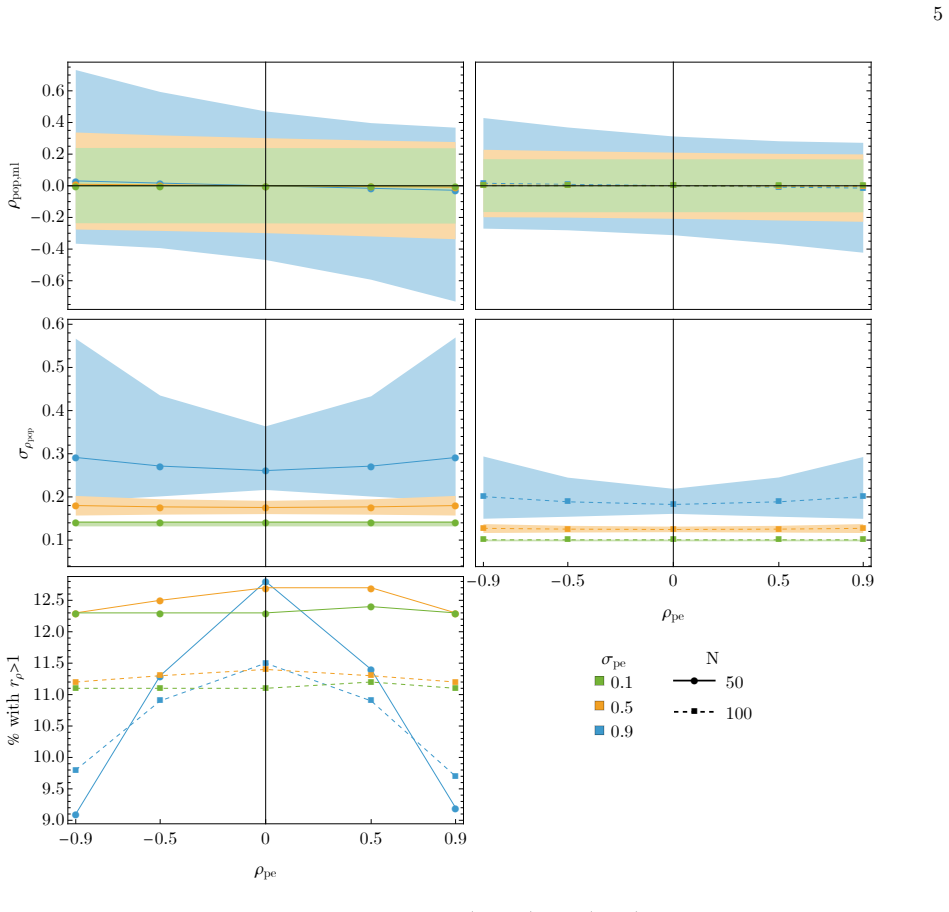
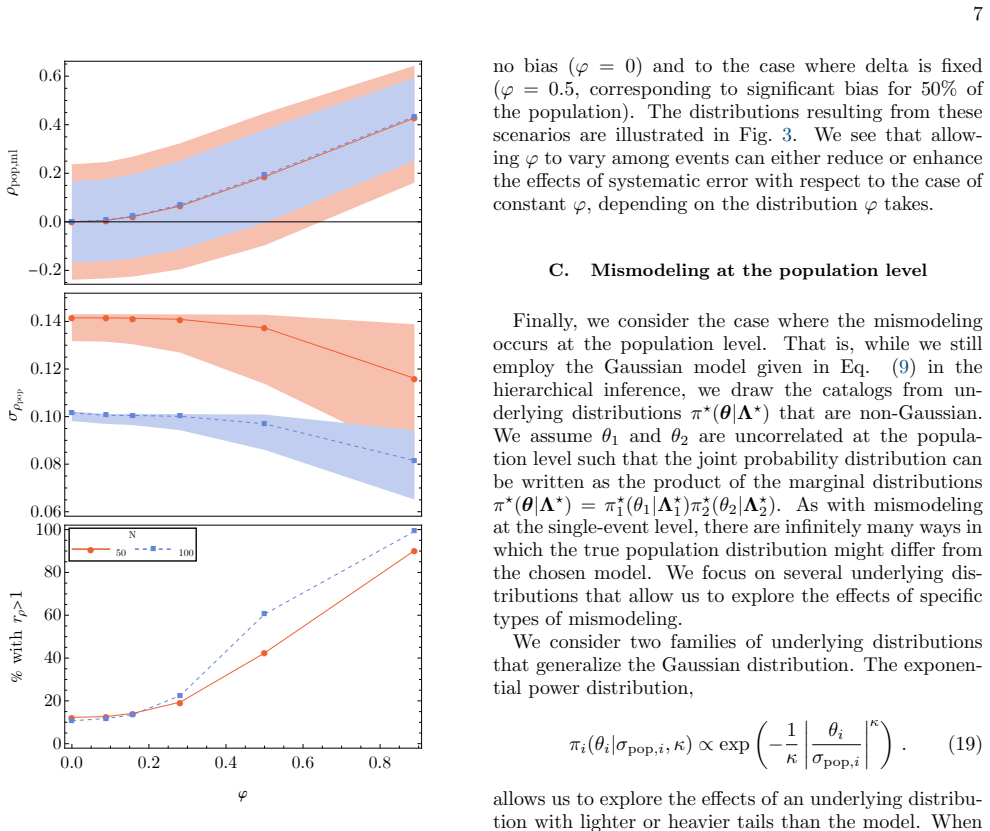
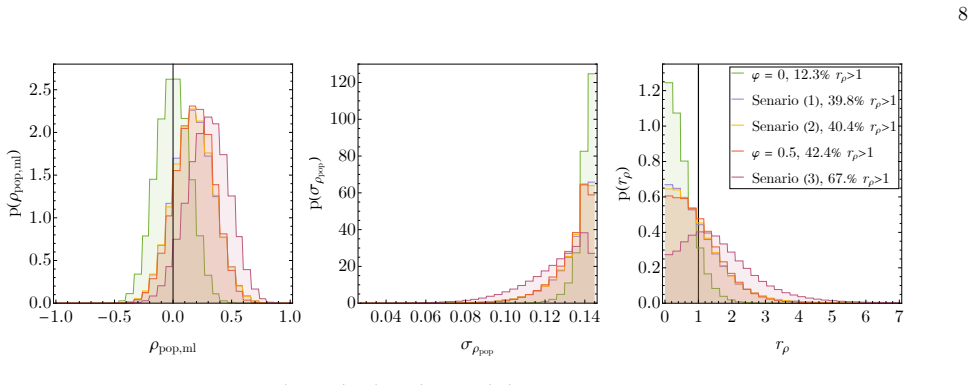
With this idealized model we show that the presence of correlations at the single-event level between a pair of parameters increases the uncertainty of population-level correlations for those parameters, potentially obscuring the true underlying population correlation if present. We also find that if waveform systematics lead to biases that are correlated across the catalog, this can be effectively absorbed by a population analysis that targets correlations and can be misinterpreted as such.
What carries the argument
The idealized analytical Gaussian-based model that links single-event posteriors to population inference while incorporating possible systematic biases.
If this is right
- Population-level correlation measurements from gravitational-wave catalogs may have larger uncertainties than expected due to single-event correlations.
- Correlated systematics across events can produce spurious population correlation signals.
- The model provides a simple way to estimate these effects before applying full hierarchical analyses.
- Future population studies should consider accounting for single-event correlation parameters to avoid misinterpretation.
Where Pith is reading between the lines
- This implies that hierarchical models for gravitational-wave populations may need to marginalize over or model single-event correlations explicitly.
- Similar effects could appear in other hierarchical inference problems where individual measurements have correlated uncertainties.
- Testing with non-Gaussian posteriors from actual waveform analyses would be a direct next step to validate the Gaussian approximation.
Load-bearing premise
The idealized Gaussian-based model accurately captures the essential features of real gravitational-wave data analysis including how single-event posteriors and systematic biases interact with population inference.
What would settle it
A calculation or simulation using actual non-Gaussian posterior distributions from gravitational-wave events that shows no increase in population correlation uncertainty from single-event correlations.
Figures
read the original abstract
With increasingly large numbers of gravitational-wave events, population inference is now beginning to move beyond predictions of marginal distributions and to probe correlations between compact-binary parameters such as masses, spins, and redshifts. These correlations have strong constraining power for both astrophysics and tests of general relativity. In this paper, we present an idealized analytical model to study the interplay between single-event correlations, systematic biases, and population-level correlations. With this, we investigate the potential emergence of false-positive measurements of population-level correlations. We quantify how the presence of correlations at the single-event level between a pair of parameters increases the uncertainty of population-level correlations for those parameters, potentially obscuring the true underlying population correlation if present. We also find that if waveform systematics lead to biases that are correlated across the catalog (which is likely, because certain regions of the parameter space are more difficult to model), this can be effectively absorbed by a population analysis that targets correlations and can be misinterpreted as such. This simple Gaussian-based model may serve as a broad compass for future, more detailed explorations.
Editorial analysis
A structured set of objections, weighed in public.
Referee Report
Summary. The paper introduces an idealized analytical Gaussian model to explore how single-event parameter correlations and catalog-wide systematic biases interact with inferences of population-level correlations among compact-binary parameters (masses, spins, redshifts) in gravitational-wave astronomy. Using this forward model, it shows that single-event correlations inflate the uncertainty on recovered population correlations (potentially masking true signals) and that correlated waveform systematics across events can be absorbed into apparent population correlations.
Significance. If the analytic results hold, the work supplies a transparent, reproducible benchmark that flags concrete interpretational risks for the next generation of GW population analyses. Its explicit framing as an illustrative 'broad compass' rather than a realistic simulation is a strength; the Gaussian construction allows closed-form derivations that isolate the mechanisms without confounding numerical artifacts.
minor comments (2)
- The abstract and introduction would benefit from a single sentence stating the precise functional form of the population-level correlation parameter (e.g., the off-diagonal element of the covariance matrix) that is being recovered, to make the central claim immediately quantifiable for readers.
- Figure captions should explicitly note whether the plotted uncertainties are analytic or obtained from Monte Carlo realizations of the Gaussian model; this is implied but not stated.
Simulated Author's Rebuttal
We thank the referee for their positive assessment of the manuscript, for highlighting its value as a transparent benchmark, and for recommending acceptance. We are pleased that the idealized Gaussian construction and its framing as an illustrative model were viewed as strengths.
Circularity Check
No significant circularity
full rationale
The paper constructs an idealized Gaussian analytical model to explore the interplay of single-event correlations and population-level inferences within that model. All central results (increased uncertainty from single-event correlations; absorption of catalog-wide biases) are derived directly from the model's assumptions and equations as forward simulations or analytic calculations, without fitting parameters to external data and then relabeling those fits as predictions, without self-citation load-bearing on uniqueness theorems, and without renaming known results. The model is explicitly presented as illustrative rather than a claim about real data, rendering the derivation chain self-contained against its own stated inputs.
Axiom & Free-Parameter Ledger
axioms (1)
- domain assumption Gaussian distributions adequately model the parameter posteriors and population distributions.
Reference graph
Works this paper leans on
-
[1]
DrawNsamplesθ ⋆ from the chosen population distributionπ ⋆(θ|Λ⋆)
-
[2]
Pro- getto Dipartimenti di Eccellenza 2023-2027
For eachθ ⋆, we draw ∆θ stat from the Gaussian distributionN(0,Σ pe). If systematic effects are in- cluded, we additionally compute ∆θ sys according to the chosen prescription. Finally,θ ml =θ ⋆ + ∆θ. B. Hierarchical Inference Once the mock catalog of observations is generated, the next step is hierarchical inference to recover the pop- ulation parameters...
2021
-
[3]
I. Mandel, W. M. Farr, and J. R. Gair, Mon. Not. R. Astron. Soc.486, 1086 (2019), arXiv:1809.02063 [physics.data-an]
Pith/arXiv arXiv 2019
-
[4]
Vitale, D
S. Vitale, D. Gerosa, W. M. Farr, and S. R. Taylor, in Handbook of Gravitational Wave Astronomy(Springer,
-
[5]
arXiv:2007.05579 [astro-ph.IM]
Pith/arXiv arXiv 2007
-
[6]
A. G. Abacet al.(LIGO, Virgo, KAGRA), (2026), arXiv:2605.27226 [astro-ph.HE]
Pith/arXiv arXiv 2026
-
[7]
A. G. Abacet al.(LIGO, Virgo, KAGRA), (2026), arXiv:2605.27227 [astro-ph.CO]
Pith/arXiv arXiv 2026
-
[8]
A. G. Abacet al.(LIGO, Virgo, KAGRA), (2026), arXiv:2603.19019 [gr-qc]
Pith/arXiv arXiv 2026
-
[9]
T. A. Callister, inEncyclopedia of Astrophysics, 1st ed. (Elsevier, 2026) arXiv:2410.19145 [astro-ph.HE]
arXiv 2026
-
[10]
J. Heinzel, M. Mould, S. ´Alvarez-L´ opez, and S. Vi- tale, Phys. Rev. D111, 063043 (2025), arXiv:2406.16813 [astro-ph.HE]
arXiv 2025
-
[11]
F. Antonini, I. Romero-Shaw, T. Callister, F. Dosopoulou, D. Chattopadhyay, Y. B. Ginat, M. Gieles, and M. Mapelli, (2025), arXiv:2509.04637 [astro-ph.HE]
Pith/arXiv arXiv 2025
-
[12]
R. Tenorio, A. Toubiana, T. Bruel, D. Gerosa, and J. R. Gair, Astrophys. J. Lett.994, L52 (2025), arXiv:2509.19466 [astro-ph.HE]
arXiv 2025
-
[13]
S. Banagiri, E. Thrane, and P. D. Lasky, (2025), arXiv:2509.15646 [astro-ph.HE]
Pith/arXiv arXiv 2025
-
[14]
N. Guttman, E. Payne, P. D. Lasky, and E. Thrane, Astrophys. J.996, 144 (2026), arXiv:2509.09876 [astro- ph.HE]
arXiv 2026
- [15]
-
[16]
Tiwari, (2025), arXiv:2510.25579 [astro-ph.HE]
V. Tiwari, (2025), arXiv:2510.25579 [astro-ph.HE]
arXiv 2025
-
[17]
H. Tong, T. A. Callister, M. Fishbach, E. Thrane, F. Antonini, S. Stevenson, I. M. Romero-Shaw, and F. Dosopoulou, (2025), arXiv:2511.05316 [astro-ph.HE]
arXiv 2025
-
[18]
V. Gennari, S. Mastrogiovanni, N. Tamanini, S. Marsat, and G. Pierra, Phys. Rev. D111, 123046 (2025), arXiv:2502.20445 [gr-qc]
arXiv 2025
-
[19]
A. Q. Cheng, A. Toubiana, S. Biscoveanu, and J. Gair, (2026), arXiv:2605.25980 [astro-ph.HE]
Pith/arXiv arXiv 2026
-
[20]
I. Mandel and A. Farmer, Phys. Rep.955, 1 (2022), arXiv:1806.05820 [astro-ph.HE]
arXiv 2022
-
[21]
Mapelli, inHandbook of Gravitational Wave Astron- omy(Springer, 2021) arXiv:2106.00699 [astro-ph.HE]
M. Mapelli, inHandbook of Gravitational Wave Astron- omy(Springer, 2021) arXiv:2106.00699 [astro-ph.HE]
arXiv 2021
- [22]
- [23]
-
[24]
T. A. Callister, C.-J. Haster, K. K. Y. Ng, S. Vitale, and W. M. Farr, Astrophys. J. Lett.922, L5 (2021), arXiv:2106.00521 [astro-ph.HE]
arXiv 2021
-
[25]
Abbottet al.(LIGO, Virgo, KAGRA), Phys
R. Abbottet al.(LIGO, Virgo, KAGRA), Phys. Rev. X 13, 011048 (2023), arXiv:2111.03634 [astro-ph.HE]
Pith/arXiv arXiv 2023
-
[26]
A. G. Abacet al.(LIGO, Virgo, KAGRA), (2025), arXiv:2508.18083 [astro-ph.HE]
Pith/arXiv arXiv 2025
-
[27]
K. K. Y. Ng, S. Vitale, A. Zimmerman, K. Chatziioan- nou, D. Gerosa, and C.-J. Haster, Phys. Rev. D98, 083007 (2018), arXiv:1805.03046 [gr-qc]
Pith/arXiv arXiv 2018
-
[28]
C. B. Owen, C.-J. Haster, S. Perkins, N. J. Cor- nish, and N. Yunes, Phys. Rev. D108, 044018 (2023), arXiv:2301.11941 [gr-qc]
arXiv 2023
- [29]
- [30]
-
[31]
R. S. Chandramouli, K. Prokup, E. Berti, and N. Yunes, Phys. Rev. D111, 044026 (2025), arXiv:2410.06254 [gr- qc]
arXiv 2025
-
[32]
A. G. Abacet al.(LIGO, Virgo, KAGRA), Astrophys. J. Lett.993, L25 (2025), arXiv:2507.08219 [astro-ph.HE]
Pith/arXiv arXiv 2025
-
[33]
A. G. Abacet al.(LIGO, Virgo, KAGRA), (2025), arXiv:2509.07348 [gr-qc]. 11
arXiv 2025
-
[34]
I. M. Romero-Shaw, E. Thrane, and P. D. Lasky, Publ. Astron. Soc. Aust.39, e025 (2022), arXiv:2202.05479 [astro-ph.IM]
arXiv 2022
-
[35]
A. Q. Cheng, M. Zevin, and S. Vitale, Astrophys. J.955, 127 (2023), arXiv:2307.03129 [astro-ph.HE]
arXiv 2023
-
[36]
S. J. Miller, S. Winney, K. Chatziioannou, and P. M. Meyers, (2026), arXiv:2604.06090 [gr-qc]
Pith/arXiv arXiv 2026
-
[37]
M. Mould, J. Heinzel, S. Alvarez-Lopez, C. Plunkett, N. E. Wolfe, and S. Vitale, Phys. Rev. D113, 103021 (2026), arXiv:2602.11282 [astro-ph.HE]
Pith/arXiv arXiv 2026
- [38]
-
[39]
C. Cutler and M. Vallisneri, Phys. Rev. D76, 104018 (2007), arXiv:0707.2982 [gr-qc]
Pith/arXiv arXiv 2007
-
[40]
A. G. Abacet al.(LIGO, Virgo, KAGRA), (2026), arXiv:2603.19020 [gr-qc]
Pith/arXiv arXiv 2026
-
[41]
A. G. Abacet al.(LIGO, Virgo, KAGRA), (2026), arXiv:2603.19021 [gr-qc]
Pith/arXiv arXiv 2026
-
[42]
J. R. Gair, A. Antonelli, and R. Barbieri, Mon. Not. R. Astron. Soc.519, 2736 (2022), arXiv:2205.07893 [gr-qc]
arXiv 2022
-
[43]
V. De Renzis, F. Iacovelli, D. Gerosa, M. Mancar- ella, and C. Pacilio, Phys. Rev. D111, 044048 (2025), arXiv:2410.17325 [astro-ph.HE]
arXiv 2025
-
[44]
Abbottet al.(LIGO, Virgo), Phys
R. Abbottet al.(LIGO, Virgo), Phys. Rev. D109, 022001 (2024), arXiv:2108.01045 [gr-qc]
Pith/arXiv arXiv 2024
-
[45]
Abbottet al.(LIGO, Virgo, KAGRA), Phys
R. Abbottet al.(LIGO, Virgo, KAGRA), Phys. Rev. X 13, 041039 (2023), arXiv:2111.03606 [gr-qc]
Pith/arXiv arXiv 2023
-
[46]
A. G. Abacet al.(LIGO, Virgo, KAGRA), (2025), arXiv:2508.18082 [gr-qc]
Pith/arXiv arXiv 2025
-
[47]
A. G. Abacet al.(LIGO, Virgo, KAGRA), (2026), arXiv:2605.27225 [gr-qc]
Pith/arXiv arXiv 2026
-
[48]
G. Prattenet al., Phys. Rev. D103, 104056 (2021), arXiv:2004.06503 [gr-qc]
Pith/arXiv arXiv 2021
-
[49]
M. Colleoni, F. A. R. Vidal, C. Garc´ ıa-Quir´ os, S. Ak¸ cay, and S. Bera, Phys. Rev. D111, 104019 (2025), arXiv:2412.16721 [gr-qc]
arXiv 2025
-
[50]
A. Ramos-Buades, A. Buonanno, H. Estell´ es, M. Khalil, D. P. Mihaylov, S. Ossokine, L. Pompili, and M. Shiferaw, Phys. Rev. D108, 124037 (2023), arXiv:2303.18046 [gr-qc]
arXiv 2023
-
[51]
L. Pompiliet al., Phys. Rev. D108, 124035 (2023), arXiv:2303.18039 [gr-qc]
arXiv 2023
-
[52]
V. Varma, S. E. Field, M. A. Scheel, J. Blackman, D. Gerosa, L. C. Stein, L. E. Kidder, and H. P. Pfeiffer, Phys. Rev. Research.1, 033015 (2019), arXiv:1905.09300 [gr-qc]
Pith/arXiv arXiv 2019
discussion (0)
Sign in with ORCID, Apple, or X to comment. Anyone can read and Pith papers without signing in.