Dementia-Agents: A Multi-Modal Multi-Agent System for Dementia Staging and Phenotyping
Pith reviewed 2026-06-26 14:44 UTC · model grok-4.3
The pith
A multi-agent system with five domain experts and a coordinator improves real-world dementia staging and phenotyping over monolithic models.
A machine-rendered reading of the paper's core claim, the machinery that carries it, and where it could break.
Core claim
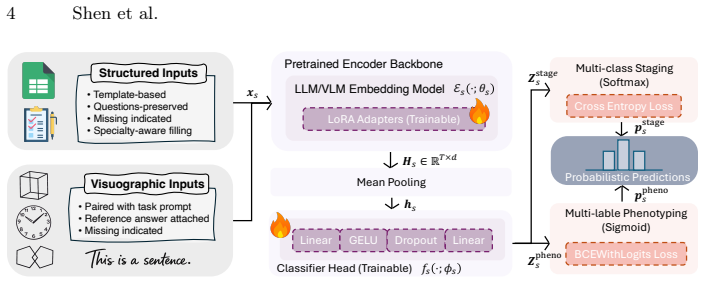
Dementia-Agents follows a three-step workflow in which a data agent renders clinical records as semantically faithful text that preserves missing-data signals, five fine-tuned expert agents produce domain-level predictions, and a coordinator agent performs probabilistic aggregation to yield final staging and phenotyping decisions; on 1,066 real-world patients this yields consistent gains over monolithic MLLMs and earlier medical multi-agent systems while retaining domain-level interpretability.
What carries the argument
The three-step workflow of a data agent that translates records, five domain-aligned expert agents that generate predictions, and a coordinator agent that performs probabilistic aggregation.
If this is right
- Higher accuracy on heterogeneous, incomplete clinical data for syndrome-level rather than pathology-only dementia decisions.
- Retained visibility into each domain expert's contribution to the final output.
- Applicability to multiple stages and phenotypes instead of binary AD detection.
- Direct use on real-world records from multiple informants and services.
Where Pith is reading between the lines
- The same agent-division pattern could be tested on other multi-modal diagnostic tasks that currently suffer from monolithic-model opacity.
- Probabilistic aggregation rules might be varied to trade off accuracy against different forms of clinical caution.
- Deployment in electronic records could reduce inter-clinician variability by surfacing the same domain signals each time.
Load-bearing premise
Routing data through five domain-aligned expert agents and aggregating their outputs probabilistically will reliably outperform monolithic models without introducing new biases from the fine-tuning or the aggregation rules.
What would settle it
An independent replication on a comparable clinical cohort that finds no accuracy gain or that loses measurable domain interpretability would falsify the performance claim.
Figures

read the original abstract
Dementia diagnosis requires integrating multi-modal clinical assessments from diverse informants and clinicians under incomplete and heterogeneous data conditions. Yet most AI-driven approaches remain Alzheimer's disease (AD)-centric, framing the problem as binary AD detection or three-stage AD progression modeling within well-curated research settings. This pathology-driven paradigm overlooks the broader, syndrome-level nature of dementia, which spans multiple stages, phenotypes, and etiologies. In this paper, we propose Dementia-Agents, a clinically aligned multi-agent framework for real-world dementia staging and phenotyping. The framework follows a three-step workflow: (1) a data agent translates structured clinical records into semantically faithful textual representations that preserve missing-data signals and routes them to domain-aligned experts; (2) five fine-tuned expert agents generate domain-level predictions; and (3) a coordinator agent performs probabilistic aggregation to produce final staging and phenotyping decisions. We develop and evaluate Dementia-Agents on a real-world clinical cohort of 1,066 patients from two cognitive neurology services. Compared with monolithic multi-modal large language models (MLLMs) and prior medical multi-agent systems, our approach achieves consistent improvements in diagnostic performance for real-world syndrome-level dementia staging and phenotyping, while preserving domain-level interpretability.
Editorial analysis
A structured set of objections, weighed in public.
Referee Report
Summary. The paper proposes Dementia-Agents, a three-step multi-agent framework for real-world dementia staging and phenotyping: a data agent converts structured records to text while preserving missing-data signals, five fine-tuned domain-aligned expert agents produce predictions, and a coordinator performs probabilistic aggregation. The system is evaluated on a cohort of 1,066 patients from two cognitive neurology services and is claimed to outperform monolithic MLLMs and prior medical multi-agent systems in diagnostic performance while retaining domain-level interpretability.
Significance. If the performance gains are rigorously demonstrated with ablations and statistical tests, the work would advance application of multi-agent systems to heterogeneous, incomplete clinical data for syndrome-level dementia diagnosis beyond AD-centric paradigms, with the real-world cohort and emphasis on interpretability as notable strengths.
major comments (3)
- [Abstract] Abstract: the assertion of 'consistent improvements in diagnostic performance' is unsupported by any reported metrics (accuracy, F1, AUC, etc.), baselines, statistical tests, or confidence intervals, preventing verification of the central claim from the provided text.
- [Evaluation] Evaluation section (implied by cohort description): no ablation studies isolate the contribution of the five-expert routing plus coordinator probabilistic aggregation versus simply fine-tuning a single model on the same 1,066-patient data, leaving the weakest assumption untested and the source of any gains unclear.
- [Methods] Methods (data agent and coordinator): no explicit description of how missing values or multi-informant inputs are encoded in the textual representations or propagated through the probabilistic aggregation, which is load-bearing for the heterogeneous-data claim.
minor comments (1)
- [Abstract] The abstract and introduction would benefit from a brief statement of the exact performance metrics used and the train/test split protocol on the 1,066-patient cohort.
Simulated Author's Rebuttal
We thank the referee for the constructive comments, which highlight areas where additional clarity and evidence will strengthen the manuscript. We address each major comment below and commit to revisions that directly respond to the concerns raised.
read point-by-point responses
-
Referee: [Abstract] Abstract: the assertion of 'consistent improvements in diagnostic performance' is unsupported by any reported metrics (accuracy, F1, AUC, etc.), baselines, statistical tests, or confidence intervals, preventing verification of the central claim from the provided text.
Authors: We agree that the abstract as currently written does not include the specific quantitative metrics needed to substantiate the claim. In the revised version we will insert the key performance figures (accuracy, macro-F1, AUC) together with the corresponding baseline comparisons and statistical test results so that the central claim can be verified directly from the abstract. revision: yes
-
Referee: [Evaluation] Evaluation section (implied by cohort description): no ablation studies isolate the contribution of the five-expert routing plus coordinator probabilistic aggregation versus simply fine-tuning a single model on the same 1,066-patient data, leaving the weakest assumption untested and the source of any gains unclear.
Authors: The referee is correct that the current manuscript lacks explicit ablation experiments that isolate the incremental value of the multi-expert routing and probabilistic coordinator. We will add a dedicated ablation subsection that compares the full Dementia-Agents system against (i) a single fine-tuned MLLM trained on the identical 1,066-patient cohort and (ii) variants that remove either the expert routing or the coordinator, accompanied by appropriate statistical significance tests. revision: yes
-
Referee: [Methods] Methods (data agent and coordinator): no explicit description of how missing values or multi-informant inputs are encoded in the textual representations or propagated through the probabilistic aggregation, which is load-bearing for the heterogeneous-data claim.
Authors: We acknowledge that the methods section currently provides insufficient detail on these mechanisms. In the revision we will expand the data-agent subsection to specify the exact textual encoding used for missing-value indicators and multi-informant provenance tags, and we will add a paragraph in the coordinator section that describes how these signals are represented in the probability distributions and how they influence the final aggregation. revision: yes
Circularity Check
No circularity: empirical system description with external cohort evaluation
full rationale
The paper describes a multi-agent workflow (data agent, five expert agents, coordinator) and reports empirical performance gains on a held-out 1,066-patient clinical cohort. No equations, derivations, fitted parameters presented as predictions, or self-citation chains appear in the text. The central claims rest on direct comparison against monolithic MLLMs and prior systems using external data, with no load-bearing step that reduces by construction to its own inputs. This is the normal case of a self-contained empirical contribution.
Axiom & Free-Parameter Ledger
Reference graph
Works this paper leans on
-
[1]
Jama322(16), 1589–1599 (2019)
Arvanitakis, Z., Shah, R.C., Bennett, D.A.: Diagnosis and management of demen- tia. Jama322(16), 1589–1599 (2019)
2019
-
[2]
arXiv preprint arXiv:2509.07613 (2025)
Cheng, F., Ray, S., Yang, X.: Data-efficient fine-tuning of vision-language models for diagnosis of alzheimer’s disease. arXiv preprint arXiv:2509.07613 (2025)
-
[3]
Nature Reviews Neurology13(8), 457–476 (2017)
Elahi, F.M., Miller, B.L.: A clinicopathological approach to the diagnosis of de- mentia. Nature Reviews Neurology13(8), 457–476 (2017)
2017
-
[4]
Journal of psy- chiatric research12(3), 189–198 (1975)
Folstein, M.F., Folstein, S.E., McHugh, P.R.: Mini-mental state. Journal of psy- chiatric research12(3), 189–198 (1975)
1975
-
[5]
In: International Workshop on Agentic AI for Medicine
Hou, W., Yang, G., Du, Y., Lau, Y., Liu, L., He, J., Long, L., Wang, S.: Ada- gent: Llm agent for alzheimer’s disease analysis with collaborative coordinator. In: International Workshop on Agentic AI for Medicine. pp. 23–32. Springer (2025)
2025
-
[6]
In: International Con- ference on Learning Representations (2022), https://openreview.net/forum?id= nZeVKeeFYf9
Hu, E.J., Shen, Y., Wallis, P., Allen-Zhu, Z., Li, Y., Wang, S., Wang, L., Chen, W.: LoRA: Low-rank adaptation of large language models. In: International Con- ference on Learning Representations (2022), https://openreview.net/forum?id= nZeVKeeFYf9
2022
-
[7]
In: proceedings of Medical Image Com- puting and Computer Assisted Intervention – MICCAI 2025
Hu, W., Guan, Z., Yang, P., Li, J., Liu, Y., Gan, S., Cai, T., Zhang, A., Zhang, T., Qu, J., Wang, S., Cai, G., Dong, X., Wang, T., Lei, B.: Anatomy-Guided Mul- timodal Graph Networks for Alzheimer’s Disease: Integrative Analysis of Cross- Modal Brain Connectivity Signatures . In: proceedings of Medical Image Com- puting and Computer Assisted Intervention...
2025
-
[8]
Jiang, S., Wang, Y., Song, S., Hu, T., Zhou, C., Pu, B., Zhang, Y., Yang, Z., Feng, Y., Zhou, J.T., Hao, J., Chen, Z., Wu, R., Tang, T., Lv, J., Xu, H., Wang, H., Xiao, J., Feng, B., Zhu, F., Li, K., Xie, W., Sun, J., Wu, J., Liu, Z.: Hulu-med: A transparent generalist model towards holistic medical vision-language understand- ing (2025), https://arxiv.or...
- [9]
-
[10]
LLaVA-Med: Training a Large Language-and-Vision Assistant for Biomedicine in One Day
Li, C., Wong, C., Zhang, S., Usuyama, N., Liu, H., Yang, J., Naumann, T., Poon, H., Gao, J.: Llava-med: Training a large language-and-vision assistant for biomedicine in one day. arXiv preprint arXiv:2306.00890 (2023)
work page internal anchor Pith review Pith/arXiv arXiv 2023
-
[11]
Li, M., Zhang, Y., Long, D., Keqin, C., Song, S., Bai, S., Yang, Z., Xie, P., Yang, A., Liu, D., Zhou, J., Lin, J.: Qwen3-vl-embedding and qwen3-vl-reranker: A unified framework for state-of-the-art multimodal retrieval and ranking. arXiv preprint arXiv:2601.04720 (2026)
work page internal anchor Pith review Pith/arXiv arXiv 2026
-
[12]
npj Digital Medicine8(1), 541 (2025)
Li, R., Wang, X., Berlowitz, D., Mez, J., Lin, H., Yu, H.: Care-ad: a multi-agent large language model framework for alzheimer’s disease prediction using longitu- dinal clinical notes. npj Digital Medicine8(1), 541 (2025)
2025
-
[13]
In: 2025 IEEE/CVF Winter Conference on Applications of Computer Vision (WACV), pp
Li, Y., Ghahremani, M., Wally, Y., Wachinger, C.: Diamond: Dementia diagnosis with multi-modal vision transformers using mri and pet. In: 2025 IEEE/CVF Win- ter Conference on Applications of Computer Vision (WACV). pp. 107–116 (2025). https://doi.org/10.1109/WACV61041.2025.00021
-
[14]
Nelder,J.A.,Mead,R.:Asimplexmethodforfunctionminimization.Thecomputer journal7(4), 308–313 (1965)
1965
-
[15]
International psychogeriatrics8(S3), 301–308 (1997) 10 Shen et al
Reisberg, B., Auer, S.R., Monteiro, I.M.: Behavioral pathology in alzheimer’s dis- ease (behave-ad) rating scale. International psychogeriatrics8(S3), 301–308 (1997) 10 Shen et al
1997
-
[16]
Advances in neural information processing systems25(2012)
Snoek, J., Larochelle, H., Adams, R.P.: Practical bayesian optimization of machine learning algorithms. Advances in neural information processing systems25(2012)
2012
-
[17]
Journal of global optimization11(4), 341–359 (1997)
Storn, R., Price, K.: Differential evolution–a simple and efficient heuristic for global optimization over continuous spaces. Journal of global optimization11(4), 341–359 (1997)
1997
-
[18]
Tang, X., Zou, A., Zhang, Z., Li, Z., Zhao, Y., Zhang, X., Cohan, A., Gerstein, M.: MedAgents: Large language models as collaborators for zero-shot medical rea- soning. In: Ku, L.W., Martins, A., Srikumar, V. (eds.) Findings of the Association for Computational Linguistics: ACL 2024. pp. 599–621. Association for Computa- tional Linguistics, Bangkok, Thail...
-
[19]
Team, Q.: Qwen3 technical report (2025), https://arxiv.org/abs/2505.09388
work page internal anchor Pith review Pith/arXiv arXiv 2025
-
[20]
InternVL3.5: Advancing Open-Source Multimodal Models in Versatility, Reasoning, and Efficiency
Wang, W., Gao, Z., Gu, L., Pu, H., Cui, L., Wei, X., Liu, Z., Jing, L., Ye, S., Shao, J., et al.: Internvl3.5: Advancing open-source multimodal models in versatility, reasoning, and efficiency. arXiv preprint arXiv:2508.18265 (2025)
work page internal anchor Pith review Pith/arXiv arXiv 2025
-
[21]
In: The Fourteenth International Conference on Learning Representations (2026), https://openreview.net/forum?id=ZOuU0udyA4
Wang, Z., Wu, J., Cai, L., Low, C.H., Yang, X., Li, Q., Jin, Y.: Medagent-pro: To- wards evidence-based multi-modal medical diagnosis via reasoning agentic work- flow. In: The Fourteenth International Conference on Learning Representations (2026), https://openreview.net/forum?id=ZOuU0udyA4
2026
-
[22]
De- mentia & neuropsychologia2, 102–107 (2008)
Wear, H.J., Wedderburn, C.J., Mioshi, E., Williams-Gray, C.H., Mason, S.L., Barker, R.A., Hodges, J.R.: The cambridge behavioural inventory revised. De- mentia & neuropsychologia2, 102–107 (2008)
2008
-
[23]
Alzheimer’s & Dementia9(5), e111–e194 (2013)
Weiner, M.W., Veitch, D.P., Aisen, P.S., Beckett, L.A., Cairns, N.J., Green, R.C., Harvey, D., Jack, C.R., Jagust, W., Liu, E., et al.: The alzheimer’s disease neu- roimaging initiative: a review of papers published since its inception. Alzheimer’s & Dementia9(5), e111–e194 (2013)
2013
-
[24]
Nature Medicine30(10), 2977– 2989 (2024)
Xue, C., Kowshik, S.S., Lteif, D., Puducheri, S., Jasodanand, V.H., Zhou, O.T., Walia, A.S., Guney, O.B., Zhang, J.D., Poésy, S., et al.: Ai-based differential diag- nosis of dementia etiologies on multimodal data. Nature Medicine30(10), 2977– 2989 (2024)
2024
-
[25]
Qwen3 Embedding: Advancing Text Embedding and Reranking Through Foundation Models
Zhang, Y., Li, M., Long, D., Zhang, X., Lin, H., Yang, B., Xie, P., Yang, A., Liu, D., Lin, J., Huang, F., Zhou, J.: Qwen3 embedding: Advancing text embedding and reranking through foundation models. arXiv preprint arXiv:2506.05176 (2025)
work page internal anchor Pith review Pith/arXiv arXiv 2025
discussion (0)
Sign in with ORCID, Apple, or X to comment. Anyone can read and Pith papers without signing in.