Differential Zonotopes for Verifying Global Robustness of DNNs
Pith reviewed 2026-06-26 14:11 UTC · model grok-4.3
The pith
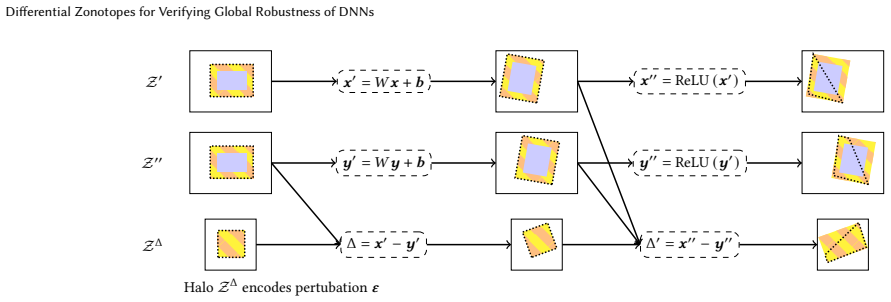
Differential halo zonotopes verify global robustness of DNNs by jointly propagating input pairs and bounding their divergence.
A machine-rendered reading of the paper's core claim, the machinery that carries it, and where it could break.
Core claim
Differential halo zonotopes form an abstract domain that extends ordinary zonotopes to propagate pairs of perturbed inputs in lock-step while tightly bounding their divergence; combined with a symmetric variant of confidence-based global robustness that disregards low-confidence differing predictions, this domain supports a sound static analysis that verifies global robustness for networks an order of magnitude larger than those handled by prior techniques.
What carries the argument
differential halo zonotopes, which jointly track pairs of inputs and bound their output divergence
If this is right
- Verification becomes feasible for networks an order of magnitude larger than those handled by earlier global-robustness tools.
- The same abstract domain yields both higher precision and better scalability than prior techniques on standard benchmarks.
- The symmetric confidence relaxation broadens the class of networks for which global robustness can be checked.
- The approach is implemented in a tool that runs on widely deployed models and standard verification suites.
Where Pith is reading between the lines
- The pair-propagation idea could be lifted to other 2-safety properties beyond robustness, such as non-interference or fairness constraints.
- If the divergence bound can be made even tighter, the method might support verification of networks with recurrent or transformer layers.
- Combining the domain with existing local-robustness tools could produce a two-stage pipeline that first filters easy cases locally and then checks remaining pairs globally.
Load-bearing premise
The symmetric variant of confidence-based global robustness is a practically meaningful property that applies to more networks without changing the verification goal.
What would settle it
A concrete network and perturbation bound where two high-confidence inputs differ in label yet the analysis reports the network as robust.
Figures


read the original abstract
The robustness of deep neural networks (DNNs) is critical in security-sensitive applications, where small input perturbations should not alter model predictions. This property is commonly formalized as local or global robustness: the former considers perturbations around a single input, while the latter -- strictly stronger -- quantifies over all input pairs. While local robustness can be expressed as a safety property, global robustness is a 2-safety property, making it substantially more challenging to verify. We present a novel static analysis technique for verifying the global robustness of DNNs. Our approach is based on differential halo zonotopes, a new abstract domain that extends zonotopes to jointly propagate pairs of perturbed inputs in lock-step while tightly bounding their divergence. In addition, we introduce a symmetric variant of confidence-based global robustness that disregards perturbations leading to differing but low-confidence predictions. This relaxation yields a practically meaningful notion of robustness that applies to a broader class of networks. We implement our approach in a new tool, called TwoSafe, and evaluate it on standard DNN verification benchmarks, including widely deployed models. Our results show that TwoSafe significantly outperforms the state of the art in both precision and scalability, enabling the verification of networks an order of magnitude larger than those handled by prior techniques.
Editorial analysis
A structured set of objections, weighed in public.
Referee Report
Summary. The manuscript introduces differential halo zonotopes, a new abstract domain extending zonotopes to jointly propagate pairs of perturbed inputs in lock-step while bounding their divergence, for verifying global robustness of DNNs (a 2-safety property). It also defines a symmetric confidence-based relaxation of global robustness that ignores low-confidence differing predictions, implements the approach in the TwoSafe tool, and reports superior precision and scalability over prior techniques on standard benchmarks including deployed models.
Significance. If the central claims hold, the work would advance DNN verification by addressing the harder global robustness property with a specialized abstract domain that enables tighter joint analysis. The explicit framing of the confidence relaxation as a deliberate practical weakening, combined with empirical results on larger networks, strengthens applicability. Strengths include the new domain construction and the tool's reported outperformance.
major comments (1)
- [Abstract, §4] Abstract and §4 (definition of the symmetric variant): the claim that the relaxation 'yields a practically meaningful notion of robustness that applies to a broader class of networks' without invalidating the verification goal is load-bearing for the practical contribution; the manuscript should provide a formal statement of the relaxed property and a soundness argument showing when it preserves the intended 2-safety guarantee.
minor comments (2)
- [§5] §5 (experimental setup): clarify the exact definition of 'order of magnitude larger' networks (e.g., layer count or parameter count) and report raw numbers alongside the relative improvement to allow direct comparison with prior work.
- [§3] Notation in §3: ensure the halo component of the differential zonotope is defined with explicit generators and center before the propagation rules are stated, to avoid forward references.
Simulated Author's Rebuttal
We thank the referee for the constructive feedback and positive assessment of the work. We address the single major comment below.
read point-by-point responses
-
Referee: [Abstract, §4] Abstract and §4 (definition of the symmetric variant): the claim that the relaxation 'yields a practically meaningful notion of robustness that applies to a broader class of networks' without invalidating the verification goal is load-bearing for the practical contribution; the manuscript should provide a formal statement of the relaxed property and a soundness argument showing when it preserves the intended 2-safety guarantee.
Authors: We agree that an explicit formal statement and soundness argument would strengthen the presentation of the symmetric confidence-based relaxation. In the revised version we will augment §4 with (i) a precise mathematical definition of the relaxed 2-safety property (symmetric confidence-based global robustness) and (ii) a soundness theorem together with a proof sketch establishing the conditions under which the relaxation preserves the original 2-safety guarantee for high-confidence predictions while correctly identifying networks that satisfy the relaxed property. This addition will directly support the claim in the abstract without altering any technical results. revision: yes
Circularity Check
No significant circularity identified
full rationale
The paper introduces differential halo zonotopes as a novel abstract domain extending zonotopes for joint propagation of input pairs to verify global robustness as a 2-safety property, along with a symmetric confidence-based relaxation framed as a deliberate practical weakening. No equations, derivations, or load-bearing steps are present that reduce any claimed result to fitted parameters, self-definitions, or self-citation chains by construction. The central technique is presented as an independent extension with external evaluation on benchmarks, making the derivation self-contained against external verification goals.
Axiom & Free-Parameter Ledger
Reference graph
Works this paper leans on
-
[1]
Davide Anguita, Alessandro Ghio, Luca Oneto, Xavier Parra, and Jorge Luis Reyes-Ortiz. 2013. A Public Domain Dataset for Human Activity Recognition using Smartphones. In21st European Symposium on Artificial Neural Networks. https://www.esann.org/sites/default/files/proceedings/legacy/es2013-84.pdf
2013
-
[2]
Shuang Ao, Stefan Rueger, and Advaith Siddharthan. 2023. Two Sides of Mis- calibration: Identifying Over and Under-Confidence Prediction for Network Calibration. InUncertainty in Artificial Intelligence (Proceedings of Machine Learn- ing Research, Vol. 216), Robin J. Evans and Ilya Shpitser (Eds.). PMLR, 77–87. https://proceedings.mlr.press/v216/ao23a.html
2023
-
[3]
Anagha Athavale, Ezio Bartocci, Maria Christakis, Matteo Maffei, Dejan Nickovic, and Georg Weissenbacher. 2024. Verifying Global Two-Safety Properties in Neural Networks with Confidence. In36th International Conference on Computer Aided Verification (LNCS, Vol. 14682), Arie Gurfinkel and Vijay Ganesh (Eds.). Springer, 329–351. doi:10.1007/978-3-031-65630-9_17
-
[4]
Stanley Bak. 2021. nnenum: Verification of ReLU Neural Networks with Opti- mized Abstraction Refinement. In13th NASA Formal Methods Symposium (LNCS, Vol. 12673), Aaron Dutle, Mariano M. Moscato, Laura Titolo, César A. Muñoz, and Ivan Perez (Eds.). Springer, 19–36. doi:10.1007/978-3-030-76384-8_2
-
[6]
Debangshu Banerjee and Gagandeep Singh. 2024. Relational DNN Verifica- tion With Cross Executional Bound Refinement. In41st International Confer- ence on Machine Learning. OpenReview.net. https://openreview.net/forum?id= HOG80Yk4Gw
2024
-
[7]
Debangshu Banerjee, Changming Xu, and Gagandeep Singh. 2024. Input- Relational Verification of Deep Neural Networks.Proc. ACM Program. Lang.8, PLDI (2024), 1–27. doi:10.1145/3656377
-
[8]
Anahita Baninajjar, Kamran Hosseini, Ahmed Rezine, and Amir Aminifar. 2023. SafeDeep: A Scalable Robustness Verification Framework for Deep Neural Net- works. InIEEE International Conference on Acoustics, Speech and Signal Processing. IEEE, 1–5. doi:10.1109/ICASSP49357.2023.10097028
-
[9]
Jeff Bezanson, Alan Edelman, Stefan Karpinski, and Viral B. Shah. 2017. Julia: A Fresh Approach to Numerical Computing.SIAM Rev.59, 1 (2017), 65–98. doi:10.1137/141000671
-
[10]
Luigi Bibbo and Marley MBR Vellasco. 2023. Human activity recognition (HAR) in healthcare. 13009 pages
2023
-
[11]
Sumon Biswas and Hridesh Rajan. 2023. Fairify: Fairness Verification of Neural Networks. In45th IEEE/ACM International Conference on Software Engineering, ICSE. IEEE, 1546–1558. doi:10.1109/ICSE48619.2023.00134
-
[12]
Bosman, Aaron Berger, Holger H
Annelot W. Bosman, Aaron Berger, Holger H. Hoos, and Jan N. van Rijn. 2025. Robustness Distributions in Neural Network Verification.J. Artif. Intell. Res.83 (2025). doi:10.1613/JAIR.1.18403
-
[14]
Michael R Clarkson and Fred B Schneider. 2010. Hyperproperties.Journal of Computer Security18, 6 (2010), 1157–1210
2010
-
[15]
Miguel Angel Alvarez de la Concepcion, Luis Miguel Soria Morillo, Juan Anto- nio Álvarez García, and Luis Gonzalez-Abril. 2017. Mobile activity recognition and fall detection system for elderly people using Ameva algorithm.Pervasive and Mobile Computing34 (2017), 3–13
2017
-
[16]
Javier Duarte, Song Han, Philip Harris, Sergo Jindariani, Edward Kreinar, Ben- jamin Kreis, Jennifer Ngadiuba, Maurizio Pierini, Ryan Rivera, Nhan Tran, et al . 2018. Fast inference of deep neural networks in FPGAs for particle physics.Journal of instrumentation13, 07 (2018), P07027. arXiv:1804.06913 doi:10.1088/1748-0221/13/07/P07027
-
[17]
Souradeep Dutta, Susmit Jha, Sriram Sankaranarayanan, and Ashish Tiwari. 2018. Output Range Analysis for Deep Feedforward Neural Networks. In10th NASA Formal Methods Symposium (LNCS, Vol. 10811), Aaron Dutle, César A. Muñoz, and Anthony Narkawicz (Eds.). Springer, 121–138. doi:10.1007/978-3-319-77935-5_9
-
[18]
Timon Gehr, Matthew Mirman, Dana Drachsler-Cohen, Petar Tsankov, Swarat Chaudhuri, and Martin T. Vechev. 2018. AI2: Safety and Robustness Certification of Neural Networks with Abstract Interpretation. InIEEE Symposium on Security and Privacy. IEEE Computer Society, 3–18. doi:10.1109/SP.2018.00058
-
[19]
Yonatan Geifman and Ran El-Yaniv. 2017. Selective Classification for Deep Neural Networks. InAdvances in Neural Information Processing Systems, Isabelle Guyon, Ulrike von Luxburg, Samy Bengio, Hanna M. Wallach, Rob Fergus, S. V. N. Vishwanathan, and Roman Garnett (Eds.). 4878–4887
2017
-
[20]
Chuqin Geng, Nham Le, Xiaojie Xu, Zhaoyue Wang, Arie Gurfinkel, and Xujie Si. 2023. Towards Reliable Neural Specifications. InInternational Conference on Machine Learning (Proceedings of Machine Learning Research, Vol. 202), Andreas Krause, Emma Brunskill, Kyunghyun Cho, Barbara Engelhardt, Sivan Sabato, and Jonathan Scarlett (Eds.). PMLR, 11196–11212. ht...
2023
-
[21]
Khalil Ghorbal, Eric Goubault, and Sylvie Putot. 2009. The Zonotope Abstract Domain Taylor1+. In21st International Conference on Computer Aided Verification (LNCS, Vol. 5643), Ahmed Bouajjani and Oded Maler (Eds.). Springer, 627–633. doi:10.1007/978-3-642-02658-4_47
-
[22]
Goodfellow, Yoshua Bengio, and Aaron C
Ian J. Goodfellow, Yoshua Bengio, and Aaron C. Courville. 2016.Deep Learning. MIT Press. http://www.deeplearningbook.org/
2016
-
[23]
Divya Gopinath, Guy Katz, Corina S. Pasareanu, and Clark W. Barrett. 2018. Deep- Safe: A Data-Driven Approach for Assessing Robustness of Neural Networks. In16th International Symposium on Automated Technology for Verification and Analysis (LNCS, Vol. 11138), Shuvendu K. Lahiri and Chao Wang (Eds.). Springer, 3–19. doi:10.1007/978-3-030-01090-4_1
-
[24]
Weinberger
Chuan Guo, Geoff Pleiss, Yu Sun, and Kilian Q. Weinberger. 2017. On Calibration of Modern Neural Networks. In34th International Conference on Machine Learning (Proceedings of Machine Learning Research, Vol. 70), Doina Precup and Yee Whye Teh (Eds.). PMLR, 1321–1330. http://proceedings.mlr.press/v70/guo17a.html
2017
-
[25]
Gurobi Optimization, LLC. 2023. Gurobi Optimizer Reference Manual. https: //www.gurobi.com
2023
-
[26]
Xiaowei Huang, Marta Kwiatkowska, Sen Wang, and Min Wu. 2017. Safety Veri- fication of Deep Neural Networks. In29th International Conference on Computer Aided Verification (LNCS, Vol. 10426), Rupak Majumdar and Viktor Kuncak (Eds.). Springer, 3–29. doi:10.1007/978-3-319-63387-9_1
-
[27]
Julian, Jessica Lopez, Jeffrey S
Kyle D. Julian, Jessica Lopez, Jeffrey S. Brush, Michael P. Owen, and Mykel J. Kochenderfer. 2016. Policy compression for aircraft collision avoidance systems. In35th IEEE/AIAA Digital A vionics Systems Conference. 1–10. doi:10.1109/DASC. 2016.7778091
-
[28]
Barrett, David L
Guy Katz, Clark W. Barrett, David L. Dill, Kyle Julian, and Mykel J. Kochenderfer
-
[29]
Safety and risk—why their definitions matter,
Reluplex: An Efficient SMT Solver for Verifying Deep Neural Networks. In 29th International Conference on Computer Aided Verification (LNCS, Vol. 10426), Rupak Majumdar and Viktor Kuncak (Eds.). Springer, 97–117. doi:10.1007/978-3- 319-63387-9_5
-
[30]
Guy Katz, Derek A. Huang, Duligur Ibeling, Kyle Julian, Christopher Lazarus, Rachel Lim, Parth Shah, Shantanu Thakoor, Haoze Wu, Aleksandar Zeljic, David L. Dill, Mykel J. Kochenderfer, and Clark W. Barrett. 2019. The Marabou Framework for Verification and Analysis of Deep Neural Networks. In31st Inter- national Conference on Computer Aided Verification (...
-
[31]
Konstantin Kaulen, Tobias Ladner, Stanley Bak, Christopher Brix, Hai Duong, Thomas Flinkow, Taylor T Johnson, Lukas Koller, Edoardo Manino, ThanhVu H Nguyen, et al . 2025. The 6th International Verification of Neural Networks Competition (VNN-COMP 2025): Summary and Results. arXiv:2512.19007 [cs.LG] https://arxiv.org/abs/2512.19007
arXiv 2025
-
[32]
Philipp Kern, Edoardo Manino, and Carsten Sinz. 2025. Certified Error Analysis of Homomorphically Encrypted Neural Networks. In2nd International Symposium on AI Verification (LNCS, Vol. 15947), Mirco Giacobbe and Anna Lukina (Eds.). Springer, 156–179. doi:10.1007/978-3-031-99991-8_8
-
[33]
Haitham Khedr and Yasser Shoukry. 2023. CertiFair: A Framework for Certified Global Fairness of Neural Networks. In37th AAAI Conference on Artificial In- telligence, Brian Williams, Yiling Chen, and Jennifer Neville (Eds.). AAAI Press, 8237–8245. doi:10.1609/AAAI.V37I7.25994
-
[34]
Brian Hyeongseok Kim, Jingbo Wang, and Chao Wang. 2025. FairQuant: Certi- fying and Quantifying Fairness of Deep Neural Networks. InProceedings of the IEEE/ACM 47th International Conference on Software Engineering(Ottawa, On- tario, Canada)(ICSE ’25). IEEE Press, 527–539. doi:10.1109/ICSE55347.2025.00016
-
[35]
Niklas Kochdumper, Christian Schilling, Matthias Althoff, and Stanley Bak. 2023. Open- and Closed-Loop Neural Network Verification Using Polynomial Zono- topes. In15th NASA Formal Methods Symposium (Lecture Notes in Computer Science, Vol. 13903), Kristin Yvonne Rozier and Swarat Chaudhuri (Eds.). Springer, 16–36. doi:10.1007/978-3-031-33170-1_2
-
[36]
Meelis Kull, Miquel Perelló-Nieto, Markus Kängsepp, Telmo de Menezes e Silva Filho, Hao Song, and Peter A. Flach. 2019. Beyond temperature scaling: Obtaining well-calibrated multi-class probabilities with Dirichlet calibration. In Annual Conference on Neural Information Processing Systems, Hanna M. Wallach, Hugo Larochelle, Alina Beygelzimer, Florence d’A...
2019
-
[37]
Tobias Ladner and Matthias Althoff. 2024. Exponent Relaxation of Polynomial Zonotopes and Its Applications in Formal Neural Network Verification. In38th AAAI Conference on Artificial Intelligence, Michael J. Wooldridge, Jennifer G. Dy, and Sriraam Natarajan (Eds.). AAAI Press, 21304–21311. doi:10.1609/AAAI. V38I19.30125 13 Anagha Athavale, Samuel Teuber, ...
-
[38]
Jianlin Li, Jiangchao Liu, Pengfei Yang, Liqian Chen, Xiaowei Huang, and Lijun Zhang. 2019. Analyzing Deep Neural Networks with Symbolic Propagation: Towards Higher Precision and Faster Verification. In26th International Sympo- sium on Static Analysis (LNCS, Vol. 11822), Bor-Yuh Evan Chang (Ed.). Springer, 296–319. doi:10.1007/978-3-030-32304-2_15
-
[39]
Rex Liu, Albara Ah Ramli, Huanle Zhang, Erik Henricson, and Xin Liu. 2021. An overview of human activity recognition using wearable sensors: Healthcare and artificial intelligence. InInternational Conference on Internet of Things. Springer, 1–14
2021
-
[40]
Diego Manzanas Lopez, Sung Woo Choi, Hoang-Dung Tran, and Taylor T. John- son. 2023. NNV 2.0: The Neural Network Verification Tool. In35th International Conference on Computer Aided Verification (LNCS, Vol. 13965), Constantin Enea and Akash Lal (Eds.). Springer, 397–412. doi:10.1007/978-3-031-37703-7_19
-
[41]
Seyed-Mohsen Moosavi-Dezfooli, Alhussein Fawzi, Omar Fawzi, and Pascal Frossard. 2017. Universal Adversarial Perturbations. InIEEE Conference on Computer Vision and Pattern Recognition. IEEE Computer Society, 86–94. doi:10. 1109/CVPR.2017.17
2017
-
[42]
Brandon Paulsen, Jingbo Wang, and Chao Wang. 2020. ReluDiff: differential verification of deep neural networks. In42nd International Conference on Software Engineering, Gregg Rothermel and Doo-Hwan Bae (Eds.). ACM, 714–726. doi:10. 1145/3377811.3380337
arXiv 2020
-
[43]
Brandon Paulsen, Jingbo Wang, Jiawei Wang, and Chao Wang. 2020. NeuroDiff: Scalable Differential Verification of Neural Networks using Fine-Grained Ap- proximation. In35th IEEE/ACM International Conference on Automated Software Engineering. IEEE, 784–796. doi:10.1145/3324884.3416560
-
[44]
Lawrence C. Paulson. 1994.Isabelle - A Generic Theorem Prover (with a contribu- tion by T. Nipkow). LNCS, Vol. 828. Springer. doi:10.1007/BFB0030541
-
[45]
Luca Pulina and Armando Tacchella. 2010. An Abstraction-Refinement Approach to Verification of Artificial Neural Networks. In22nd International Conference on Computer Aided Verification (LNCS, Vol. 6174), Tayssir Touili, Byron Cook, and Paul B. Jackson (Eds.). Springer, 243–257. doi:10.1007/978-3-642-14295-6_24
-
[46]
Luca Pulina and Armando Tacchella. 2012. Challenging SMT solvers to verify neural networks.AI Commun.25, 2 (2012), 117–135. doi:10.3233/AIC-2012-0525
-
[47]
Ashwin Sankaran. 2025. The future of smart healthcare: how ai and har are reshaping hospital workflows.Well Testing J34, 1 (2025), 68–92
2025
-
[48]
Fatemeh Serpush, Mohammad Bagher Menhaj, Behrooz Masoumi, and Babak Karasfi. 2022. Wearable sensor-based human activity recognition in the smart healthcare system.Computational intelligence and neuroscience2022, 1 (2022), 1391906
2022
-
[49]
Seshia, Ankush Desai, Tommaso Dreossi, Daniel J
Sanjit A. Seshia, Ankush Desai, Tommaso Dreossi, Daniel J. Fremont, Shromona Ghosh, Edward Kim, Sumukh Shivakumar, Marcell Vazquez-Chanlatte, and Xi- angyu Yue. 2018. Formal Specification for Deep Neural Networks. In16th In- ternational Symposium on Automated Technology for Verification and Analysis (LNCS, Vol. 11138), Shuvendu K. Lahiri and Chao Wang (Ed...
-
[50]
Gagandeep Singh, Timon Gehr, Matthew Mirman, Markus Püschel, and Martin T. Vechev. 2018. Fast and Effective Robustness Certification. InAnnual Conference on Neural Information Processing Systems, Samy Bengio, Hanna M. Wallach, Hugo Larochelle, Kristen Grauman, Nicolò Cesa-Bianchi, and Roman Garnett (Eds.). 10825–10836
2018
-
[51]
Gagandeep Singh, Timon Gehr, Markus Püschel, and Martin T. Vechev. 2019. An abstract domain for certifying neural networks.Proc. ACM Program. Lang.3, POPL (2019), 41:1–41:30. doi:10.1145/3290354
-
[52]
Tarun Suresh, Debangshu Banerjee, and Gagandeep Singh. 2024. Relational Veri- fication Leaps Forward with RABBit. InAnnual Conference on Neural Information Processing Systems, Amir Globersons, Lester Mackey, Danielle Belgrave, Angela Fan, Ulrich Paquet, Jakub M. Tomczak, and Cheng Zhang (Eds.)
2024
-
[53]
Samuel Teuber, Marko Kleine Büning, Philipp Kern, and Carsten Sinz. 2021. Geometric Path Enumeration for Equivalence Verification of Neural Networks. In33rd IEEE International Conference on Tools with Artificial Intelligence. IEEE, 200–208. doi:10.1109/ICTAI52525.2021.00035
-
[54]
Samuel Teuber, Philipp Kern, Marvin Janzen, and Bernhard Beckert. 2025. Re- visiting Differential Verification: Equivalence Verification with Confidence. In 31st International Conference on Tools and Algorithms for the Construction and Analysis of Systems (LNCS, Vol. 15697), Arie Gurfinkel and Marijn Heule (Eds.). Springer, 257–278. doi:10.1007/978-3-031-...
-
[55]
Vincent Tjeng, Kai Yuanqing Xiao, and Russ Tedrake. 2019. Evaluating Ro- bustness of Neural Networks with Mixed Integer Programming. In7th In- ternational Conference on Learning Representations. OpenReview.net. https: //openreview.net/forum?id=HyGIdiRqtm
2019
-
[56]
Hoang-Dung Tran, Xiaodong Yang, Diego Manzanas Lopez, Patrick Musau, Luan Viet Nguyen, Weiming Xiang, Stanley Bak, and Taylor T. Johnson. 2020. NNV: The Neural Network Verification Tool for Deep Neural Networks and Learning-Enabled Cyber-Physical Systems. In32nd International Conference on Computer Aided Verification (LNCS, Vol. 12224), Shuvendu K. Lahiri...
-
[57]
Zico Kolter
Shiqi Wang, Huan Zhang, Kaidi Xu, Xue Lin, Suman Jana, Cho-Jui Hsieh, and J. Zico Kolter. 2021. Beta-CROWN: Efficient Bound Propagation with Per-neuron Split Constraints for Neural Network Robustness Verification. InAnnual Con- ference on Neural Information Processing Systems, Marc’Aurelio Ranzato, Alina Beygelzimer, Yann N. Dauphin, Percy Liang, and Jenn...
2021
-
[58]
Linda F Wightman. 1998. LSAC National Longitudinal Bar Passage Study. LSAC Research Report Series
1998
-
[59]
Yuhao Zhang and Xiangru Xu. 2023. Reachability Analysis and Safety Verifi- cation of Neural Feedback Systems via Hybrid Zonotopes. InAmerican Control Conference. IEEE, 1915–1921. doi:10.23919/ACC55779.2023.10156417 A Proofs Lemma 4.8(Soundness of Symmetric Confidence LP).Assume 𝜏1, 𝜏2 ∈ [0.5,1 ) and let 𝒵out be a differential zonotope returned for ReachΔ ...
discussion (0)
Sign in with ORCID, Apple, or X to comment. Anyone can read and Pith papers without signing in.