Extended [CII] gas emission in and around a massive quiescent galaxy at z=7.3
Pith reviewed 2026-06-26 13:49 UTC · model grok-4.3
The pith
Extended [CII] emission shows a massive quiescent galaxy at z=7.3 retains a large cold gas reservoir extending far beyond its stars.
A machine-rendered reading of the paper's core claim, the machinery that carries it, and where it could break.
Core claim
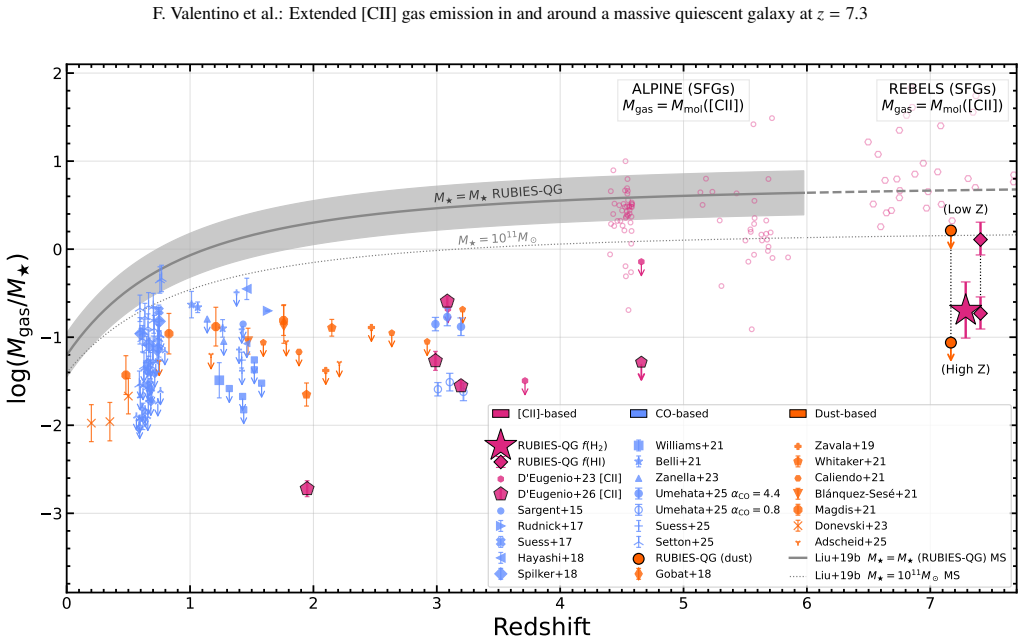
The central claim is that the galaxy-scale [CII] emission converts to log(M_mol/Msun) = 9.53 and log(M_HI/Msun) between 9.46 and 10.34, with the extended halo carrying roughly twice that gas mass, while the blueshifted halo velocity is consistent with AGN-driven expulsion that may link to the suppression of star formation.
What carries the argument
The spatially extended [CII] 158 micron line emission, which traces cold molecular and atomic gas mass and reveals both the halo reservoir and the velocity offset of the circumgalactic component.
If this is right
- The galaxy retains gas fractions above 20 percent and long depletion times across most calibration choices despite being roughly 10 times more gas-poor than typical star-forming systems at the same redshift and mass.
- The circumgalactic halo contains about twice the gas mass of the galaxy itself.
- The blueshifted velocity offset in the [CII] halo aligns with a past AGN-driven outflow that could be tied to quenching.
- Whatever quenches star formation must operate effectively on 100 Myr timescales even when cold gas is abundant at early cosmic epochs.
Where Pith is reading between the lines
- Repeated [CII] mapping of other high-redshift quiescent galaxies could reveal whether extended halos are a common feature of early quenching.
- Models of galaxy formation may need to incorporate mechanisms that keep star formation efficiency low without rapidly removing all available gas.
- Higher-resolution ALMA data on the same target could test whether the halo gas shows clear outflow kinematics or signs of ongoing accretion.
Load-bearing premise
Standard [CII]-to-gas-mass calibrations remain valid for this high-redshift quiescent system.
What would settle it
An independent CO line detection or dust-based gas mass measurement that yields a depletion timescale much shorter than the ~100 Myr values inferred here.
Figures



read the original abstract
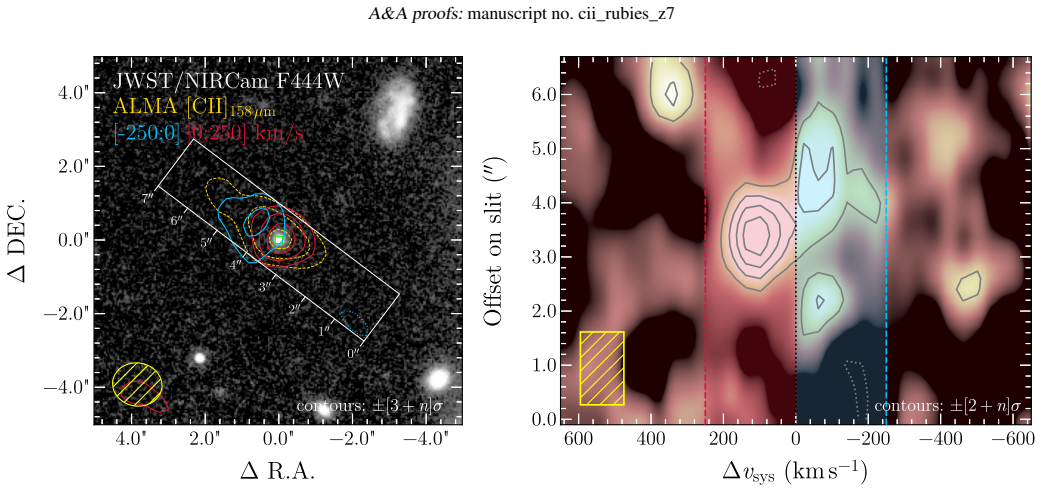
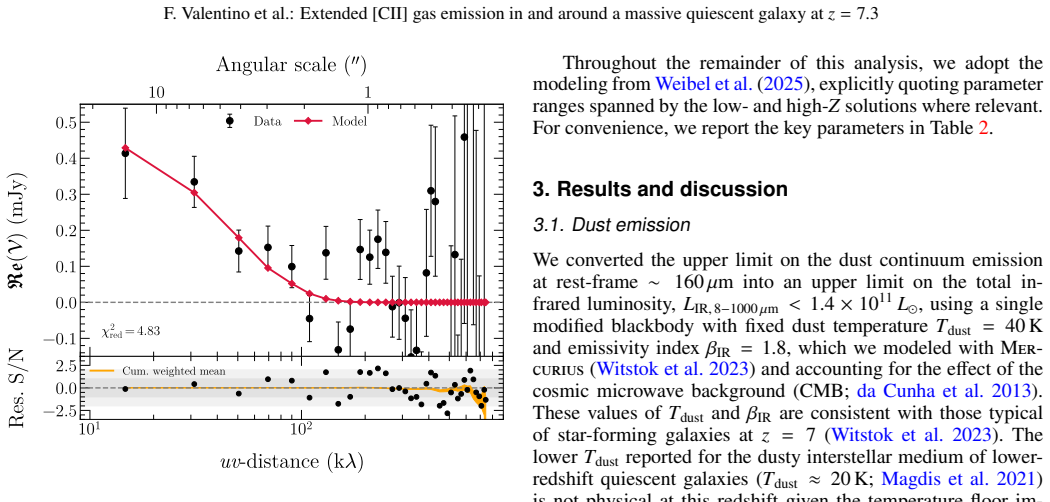
We report the discovery of [CII] 158 micron emission in and around the most distant known massive quiescent galaxy RUBIES-UDS-QG-z7 at z = 7.27. Observed with ALMA in band 6, the [CII] line independently confirms the spectroscopic redshift from JWST/NIRSpec spectra at low and medium resolution. The emission extends over an effective radius R_eff,[CII] = 8 +/- 3 kpc, well beyond the compact stellar body traced by JWST/NIRCam (R_eff = 209 (+33/-24) pc), with a significant fraction of approximately 70% of the flux arising from a circumgalactic halo. No dust continuum is detected at rest-frame ~160 micron, setting an upper limit on the infrared luminosity of L_IR < 1.4 x 10^11 Lsun, overall consistent with expectations from rest-frame UV to near-infrared SED modeling under energy balance. Converting the galaxy-scale [CII] emission into cold gas mass, we find log(M_mol/Msun) = 9.53 (+0.32/-0.31) and log(M_HI/Msun) = 9.46-10.34, depending on the assumed calibration and metallicity. Despite being approximately 10x more gas-poor than typical star-forming galaxies at fixed redshift, stellar mass, and [CII] to gas mass conversion, RUBIES-UDS-QG-z7 retains a substantial cold gas reservoir with fractions f_gas >~ 20% and long depletion timescales across most assumptions. The extended [CII] halo carries approximately twice as much gas as the galaxy alone and shows a blueshifted velocity offset consistent with the tentative gas outflow detected in MgII absorption in previous work, suggesting a past episode of AGN-driven gas expulsion possibly linked to the suppression of star formation. The presence of a large gas reservoir in and around a massive quiescent galaxy just 700 Myr after the Big Bang implies that whatever mechanism is suppressing star formation must be remarkably effective at maintaining a low star formation efficiency on ~100 Myr timescales, even in the presence of abundant fuel.
Editorial analysis
A structured set of objections, weighed in public.
Referee Report
Summary. The manuscript reports an ALMA Band 6 detection of [CII] 158μm emission associated with the z=7.27 massive quiescent galaxy RUBIES-UDS-QG-z7. The line emission is spatially extended (R_eff,[CII]=8±3 kpc) with ~70% of the flux arising from a circumgalactic halo; no dust continuum is detected (L_IR <1.4×10^11 L_⊙). Galaxy-scale [CII] flux is converted to molecular and atomic gas masses (log M_mol/M_⊙=9.53^{+0.32}_{-0.31}; log M_HI/M_⊙=9.46–10.34) that imply f_gas≳20% and long depletion times under standard calibrations. The halo shows a blueshifted velocity offset interpreted as possible AGN-driven outflow. The central implication is that star-formation suppression at z~7 must maintain low efficiency despite abundant cold gas.
Significance. If the [CII]-to-gas conversion remains valid, the result would be significant for high-redshift galaxy evolution: it supplies direct evidence that massive quiescent systems at <700 Myr after the Big Bang can retain substantial cold-gas reservoirs (f_gas>20%) while maintaining low star-formation efficiency, thereby constraining the timescales and physical mechanisms of quenching.
major comments (2)
- [abstract] Abstract (gas-mass conversion paragraph): The headline claim that the system retains a 'substantial cold gas reservoir with fractions f_gas ≳20%' and that suppression must therefore be 'remarkably effective' rests on the adopted [CII]-to-M_mol and [CII]-to-M_HI conversions. No quantitative exploration is provided of how plausible variations in these factors (e.g., lower emissivity in low-SFR or AGN-influenced ISM) would shift f_gas below 10% and remove the reported tension with suppression models.
- [abstract] Abstract (velocity-offset paragraph): The interpretation that the blueshifted halo velocity offset traces an AGN-driven outflow 'possibly linked to the suppression of star formation' is presented without supporting kinematic modeling, comparison to the MgII absorption profile, or tests against alternative origins (e.g., inflow or merger). This link is load-bearing for the proposed quenching scenario.
minor comments (2)
- The manuscript should supply the ALMA data-reduction steps, beam parameters, and error-propagation details for the line flux and size measurements so that the reported R_eff,[CII] and flux fractions can be reproduced.
- Clarify whether the non-detection of continuum is used to place an independent upper limit on obscured SFR or is only compared to the UV-to-NIR SED; the two uses have different implications for energy balance.
Simulated Author's Rebuttal
We thank the referee for their thoughtful review and for highlighting areas where the abstract claims require additional context or qualification. We address each major comment below and indicate where revisions will be made to the manuscript.
read point-by-point responses
-
Referee: [abstract] Abstract (gas-mass conversion paragraph): The headline claim that the system retains a 'substantial cold gas reservoir with fractions f_gas ≳20%' and that suppression must therefore be 'remarkably effective' rests on the adopted [CII]-to-M_mol and [CII]-to-M_HI conversions. No quantitative exploration is provided of how plausible variations in these factors (e.g., lower emissivity in low-SFR or AGN-influenced ISM) would shift f_gas below 10% and remove the reported tension with suppression models.
Authors: We agree that the f_gas estimate is sensitive to the choice of conversion factors and that the abstract does not explicitly test variations such as reduced [CII] emissivity in low-SFR or AGN-influenced gas. The manuscript already reports a range for M_HI (log M_HI/M_⊙ = 9.46–10.34) arising from different calibrations and metallicities, and states that f_gas ≳20% holds across most assumptions. To directly address the concern, we will add a quantitative sensitivity analysis (new subsection or appendix) that explores plausible downward revisions to the [CII]-to-gas conversion (e.g., factors of 2–5 lower emissivity) and shows the resulting f_gas distribution, including cases below 10%. This will clarify the robustness of the tension with quenching models. revision: yes
-
Referee: [abstract] Abstract (velocity-offset paragraph): The interpretation that the blueshifted halo velocity offset traces an AGN-driven outflow 'possibly linked to the suppression of star formation' is presented without supporting kinematic modeling, comparison to the MgII absorption profile, or tests against alternative origins (e.g., inflow or merger). This link is load-bearing for the proposed quenching scenario.
Authors: The abstract phrasing is indeed suggestive rather than definitive. The velocity offset is noted as consistent with the tentative MgII absorption outflow reported in prior work on the same object, but no new kinematic modeling or explicit comparison to inflow/merger scenarios is performed in the current data. We will revise the abstract to state that the offset is 'consistent with' the MgII feature and 'suggestive of' a past outflow, while adding a short discussion in the main text that lists alternative origins (inflow, merger) and notes the limited S/N precludes detailed modeling. The quenching link will be presented as one possible implication rather than a direct conclusion. revision: partial
Circularity Check
Direct observational report using external [CII] calibrations; no circularity
full rationale
The paper measures [CII] flux and spatial extent directly from ALMA data, then converts luminosity to gas mass via standard external calibrations (with explicit dependence on assumed metallicity and calibration choice). No derivation reduces to a self-defined quantity, fitted parameter renamed as prediction, or load-bearing self-citation chain. The central implication follows from the observed flux and external conversion factors rather than internal redefinition. This matches the expected non-circular outcome for an observational detection paper.
Axiom & Free-Parameter Ledger
free parameters (2)
- [CII]-to-molecular gas conversion factor
- Metallicity for HI mass estimate
axioms (2)
- domain assumption The [CII] 158 micron line primarily traces cold molecular and atomic gas in high-redshift galaxies under the adopted calibrations
- domain assumption The non-detection of dust continuum at rest-frame 160 micron is consistent with energy-balance SED modeling for a quiescent system
Reference graph
Works this paper leans on
-
[1]
E., Leja , J., et al
Akhshik , M., Whitaker , K. E., Leja , J., et al. 2023, , 943, 179
2023
-
[2]
C., Helton , J
Alberts , S., Williams , C. C., Helton , J. M., et al. 2024, , 975, 85
2024
-
[3]
M., Lim , S., D'Eugenio , F., et al
Baker , W. M., Lim , S., D'Eugenio , F., et al. 2025 a , , 539, 557
2025
-
[4]
M., Valentino , F., Lagos , C
Baker , W. M., Valentino , F., Lagos , C. d. P., et al. 2025 b , , 702, A270
2025
-
[5]
D., et al
Baron , D., Netzer , H., French , K. D., et al. 2023, , 524, 2741
2023
-
[6]
2021, , 909, L11
Belli , S., Contursi , A., Genzel , R., et al. 2021, , 909, L11
2021
-
[7]
L., et al
Belli , S., Park , M., Davies , R. L., et al. 2024, , 630, 54
2024
-
[8]
2020, , 643, A2
B \'e thermin , M., Fudamoto , Y., Ginolfi , M., et al. 2020, , 643, A2
2020
- [9]
-
[10]
E., et al
Bl \'a nquez-Ses \'e , D., G \'o mez-Guijarro , C., Magdis , G. E., et al. 2023, , 674, A166
2023
-
[11]
J., Smit , R., Schouws , S., et al
Bouwens , R. J., Smit , R., Schouws , S., et al. 2021, arXiv e-prints, arXiv:2106.13719
arXiv 2021
-
[12]
Carnall , A. C., McLeod , D. J., McLure , R. J., et al. 2022, arXiv e-prints, arXiv:2208.00986
arXiv 2022
-
[13]
C., McLure , R
Carnall , A. C., McLure , R. J., Dunlop , J. S., et al. 2023, , 619, 716
2023
-
[14]
2003, , 115, 763
Chabrier , G. 2003, , 115, 763
2003
-
[15]
2026, arXiv e-prints, arXiv:2601.15207
Chaikin , E., Schaye , J., Hu s ko , F., et al. 2026, arXiv e-prints, arXiv:2601.15207
arXiv 2026
-
[16]
Chandro-G \'o mez , \'A ., Lagos , C. d. P., Power , C., et al. 2025, arXiv e-prints, arXiv:2512.16208
Pith/arXiv arXiv 2025
-
[17]
2016, , 823, 102
Choi , J., Dotter , A., Conroy , C., et al. 2016, , 823, 102
2016
-
[18]
& Gunn , J
Conroy , C. & Gunn , J. E. 2010, , 712, 833
2010
-
[19]
Cornwell , T. J. 2008, IEEE Journal of Selected Topics in Signal Processing, 2, 793
2008
-
[20]
2013, , 766, 13
da Cunha , E., Groves , B., Walter , F., et al. 2013, , 766, 13
2013
-
[21]
L., Belli , S., Park , M., et al
Davies , R. L., Belli , S., Park , M., et al. 2024, , 528, 4976
2024
-
[22]
A., Alatalo , K., Sarzi , M., et al
Davis , T. A., Alatalo , K., Sarzi , M., et al. 2011, , 417, 882
2011
-
[23]
2025 a , , 697, A189
de Graaff , A., Brammer , G., Weibel , A., et al. 2025 a , , 697, A189
2025
-
[24]
J., Brammer , G., et al
de Graaff , A., Setton , D. J., Brammer , G., et al. 2025 b , Nature Astronomy, 9, 280
2025
-
[25]
2014, , 568, A62
De Looze , I., Cormier , D., Lebouteiller , V., et al. 2014, , 568, A62
2014
-
[26]
2025, arXiv e-prints, arXiv:2502.01724
De Lucia , G., Fontanot , F., Hirschmann , M., & Xie , L. 2025, arXiv e-prints, arXiv:2502.01724
arXiv 2025
-
[27]
2024, , 687, A68
De Lucia , G., Fontanot , F., Xie , L., & Hirschmann , M. 2024, , 687, A68
2024
-
[28]
2019, , 623, A5
De Vis , P., Jones , A., Viaene , S., et al. 2019, , 623, A5
2019
-
[29]
2026, arXiv e-prints, arXiv:2604.09347
D'Eugenio , C., Daddi , E., Gobat , R., et al. 2026, arXiv e-prints, arXiv:2604.09347
Pith/arXiv arXiv 2026
-
[30]
2023, , 678, L9
D'Eugenio , C., Daddi , E., Liu , D., & Gobat , R. 2023, , 678, L9
2023
-
[31]
2023, , 678, A35
Donevski , D., Damjanov , I., Nanni , A., et al. 2023, , 678, A35
2023
-
[32]
T., McLure , R
Donnan , C. T., McLure , R. J., Dunlop , J. S., et al. 2024, , 533, 3222
2024
-
[33]
R., Spilker , J
D'Onofrio , V. R., Spilker , J. S., Bezanson , R., et al. 2026, , 1003, 52
2026
-
[34]
2025, The Open Journal of Astrophysics, 8, 87
Ellison , S., Huang , Q., Yang , D., et al. 2025, The Open Journal of Astrophysics, 8, 87
2025
-
[35]
L., Fudamoto , Y., Oesch , P
Faisst , A. L., Fudamoto , Y., Oesch , P. A., et al. 2020, , 498, 4192
2020
- [36]
-
[37]
2025, arXiv e-prints, arXiv:2511.15789
Fontanot , F., Decarli , R., De Lucia , G., et al. 2025, arXiv e-prints, arXiv:2511.15789
arXiv 2025
-
[38]
W., Lang , D., & Goodman , J
Foreman-Mackey , D., Hogg , D. W., Lang , D., & Goodman , J. 2013, Publications of the Astronomical Society of the Pacific, 125, 306
2013
-
[39]
D., Smercina , A., Rowlands , K., et al
French , K. D., Smercina , A., Rowlands , K., et al. 2023, , 942, 25
2023
-
[40]
D., Yang , Y., Zabludoff , A., et al
French , K. D., Yang , Y., Zabludoff , A., et al. 2015, , 801, 1
2015
-
[41]
D., Zabludoff , A
French , K. D., Zabludoff , A. I., Yoon , I., et al. 2018, , 861, 123
2018
-
[42]
Fudamoto , Y., Inoue , A. K., Bouwens , R., et al. 2025, arXiv e-prints, arXiv:2504.03831
arXiv 2025
-
[43]
D., Bethermin , M., et al
Fujimoto , S., Silverman , J. D., Bethermin , M., et al. 2020, , 900, 1
2020
-
[44]
2018, Nature Astronomy, 2, 239
Gobat , R., Daddi , E., Magdis , G., et al. 2018, Nature Astronomy, 2, 239
2018
-
[45]
E., Brammer , G
Heintz , K. E., Brammer , G. B., Watson , D., et al. 2025 a , , 693, A60
2025
-
[46]
E., De Cia , A., Th \"o ne , C
Heintz , K. E., De Cia , A., Th \"o ne , C. C., et al. 2023, , 679, A91
2023
-
[47]
E., Watson , D., Oesch , P
Heintz , K. E., Watson , D., Oesch , P. A., Narayanan , D., & Madden , S. C. 2021, , 922, 147
2021
-
[48]
E., Watson , D., Valentino , F., et al
Heintz , K. E., Watson , D., Valentino , F., et al. 2025 b , arXiv e-prints, arXiv:2510.07936
arXiv 2025
-
[49]
2025, , 699, A80
Herrera-Camus , R., Gonz \'a lez-L \'o pez , J., F \"o rster Schreiber , N., et al. 2025, , 699, A80
2025
-
[50]
2014, , 443, 1704
Hirashita , H., Ferrara , A., Dayal , P., & Ouchi , M. 2014, , 443, 1704
2014
-
[51]
R., Indebetouw , R., Brogan , C
Hunter , T. R., Indebetouw , R., Brogan , C. L., et al. 2023, , 135, 074501
2023
-
[52]
2025, arXiv e-prints, arXiv:2506.22642
Ito , K., Valentino , F., Brammer , G., et al. 2025, arXiv e-prints, arXiv:2506.22642
arXiv 2025
-
[53]
2019, , 71, 111
Izumi , T., Onoue , M., Matsuoka , Y., et al. 2019, , 71, 111
2019
-
[54]
2018, , 70, 36
Izumi , T., Onoue , M., Shirakata , H., et al. 2018, , 70, 36
2018
-
[55]
Ji , Z., Williams , C. C., Behroozi , P., et al. 2026, arXiv e-prints, arXiv:2604.05022
Pith/arXiv arXiv 2026
- [56]
-
[57]
D., Leja , J., Conroy , C., & Speagle , J
Johnson , B. D., Leja , J., Conroy , C., & Speagle , J. S. 2021, , 254, 22
2021
-
[58]
Kennicutt , R. C. & Evans , N. J. 2012, , 50, 531
2012
-
[59]
C., Remus , R.-S., Seidel , B., et al
Kimmig , L. C., Remus , R.-S., Seidel , B., et al. 2025, , 979, 15
2025
-
[60]
& Conroy , C
Kriek , M. & Conroy , C. 2013, , 775, L16
2013
-
[61]
2021, , 919, 6
Kubo , M., Umehata , H., Matsuda , Y., et al. 2021, , 919, 6
2021
-
[62]
2022, , 935, 89
Kubo , M., Umehata , H., Matsuda , Y., et al. 2022, , 935, 89
2022
-
[63]
2016, , 455, 3333
Kubo , M., Yamada , T., Ichikawa , T., et al. 2016, , 455, 3333
2016
-
[64]
2024, , 534, 3974
Kurinchi-Vendhan , S., Farcy , M., Hirschmann , M., & Valentino , F. 2024, , 534, 3974
2024
-
[65]
Lagos , C. d. P., Bravo , M., Tobar , R., et al. 2024, , 531, 3551
2024
-
[66]
Lagos , C. d. P., Valentino , F., Wright , R. J., et al. 2025, , 536, 2324
2025
-
[67]
2020, , 643, A1
Le F \`e vre , O., B \'e thermin , M., Faisst , A., et al. 2020, , 643, A1
2020
-
[68]
M., Steidel , C
Lee , M. M., Steidel , C. C., Brammer , G., et al. 2024, , 527, 9529
2024
-
[69]
C., Johnson , B
Leja , J., Carnall , A. C., Johnson , B. D., Conroy , C., & Speagle , J. S. 2019 a , , 876, 3
2019
-
[70]
D., Conroy , C., et al
Leja , J., Johnson , B. D., Conroy , C., et al. 2019 b , , 877, 140
2019
-
[71]
2019, , 887, 235
Liu , D., Schinnerer , E., Groves , B., et al. 2019, , 887, 235
2019
-
[72]
Lorenzon , G., Donevski , D., Man , A. W. S., et al. 2025, , 995, L63
2025
-
[73]
C., Cormier , D., Hony , S., et al
Madden , S. C., Cormier , D., Hony , S., et al. 2020, , 643, A141
2020
-
[74]
E., Gobat , R., Valentino , F., et al
Magdis , G. E., Gobat , R., Valentino , F., et al. 2021, , 647, A33
2021
-
[75]
& Belli , S
Man , A. & Belli , S. 2018, Nature Astronomy, 2, 695
2018
-
[76]
Mart \' -Vidal , I., Vlemmings , W. H. T., Muller , S., & Casey , S. 2014, , 563, A136
2014
-
[77]
P., Waters , B., Schiebel , D., Young , W., & Golap , K
McMullin , J. P., Waters , B., Schiebel , D., Young , W., & Golap , K. 2007, in Astronomical Data Analysis Software and Systems XVI, Vol. 376, 127
2007
-
[78]
2025, The Open Journal of Astrophysics, 8, E170
Merlin , E., Fortuni , F., Calabr \'o , A., et al. 2025, The Open Journal of Astrophysics, 8, E170
2025
-
[79]
J., Gall , C., Hjorth , J., et al
Micha owski , M. J., Gall , C., Hjorth , J., et al. 2024, , 964, 129
2024
-
[80]
J., Hjorth , J., Gall , C., et al
Micha owski , M. J., Hjorth , J., Gall , C., et al. 2019, , 632, A43
2019
discussion (0)
Sign in with ORCID, Apple, or X to comment. Anyone can read and Pith papers without signing in.