Fusing Backdoors, Machine Learning, and Optimization for Large-Scale Parametric Mixed-Integer Programs
Pith reviewed 2026-06-26 14:39 UTC · model grok-4.3
The pith
Identifying backdoor variables and using machine learning to predict their values reduces solution times for large parametric mixed-integer programs.
A machine-rendered reading of the paper's core claim, the machinery that carries it, and where it could break.
Core claim
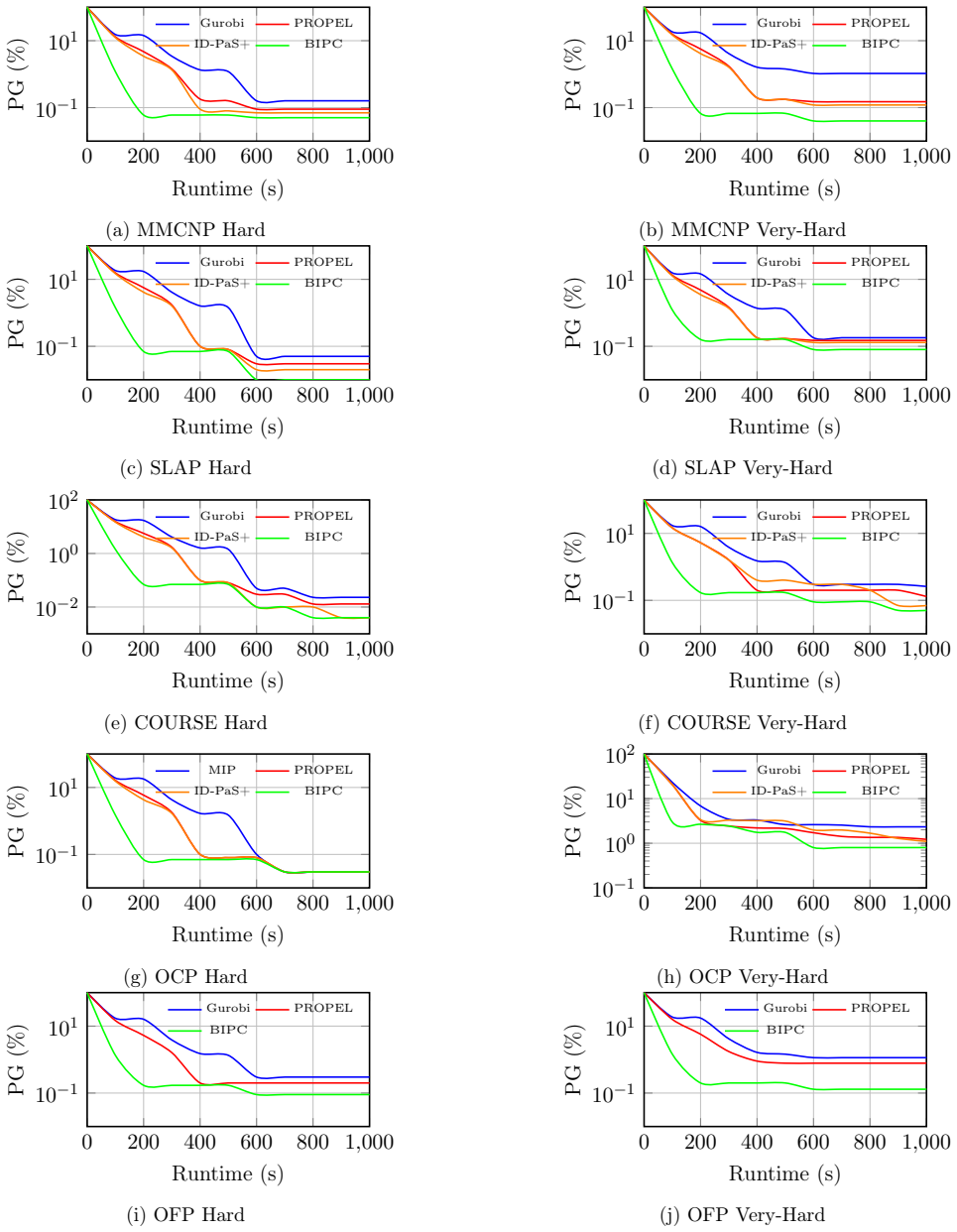
The BIPC framework consists of three phases: an identification procedure to discover backdoors for a distribution of instances, supervised learning to predict backdoor variable values or intervals, and optimization of the reduced problem with optional correction to restore feasibility or optimality. Experiments on real-world large-scale problems demonstrate substantial reductions in solution time with only limited loss in solution quality.
What carries the argument
The backdoor, a subset of variables that drive most of the computational complexity in the mixed-integer program.
If this is right
- The framework allows quick provision of high-quality solutions under parameter perturbations without changing problem structure.
- Machine learning can be integrated into existing optimization pipelines for parametric problems.
- Organizations facing frequent changes in demand or operations can solve problems more efficiently.
- The method applies to general mixed-integer programs, not just specific types.
Where Pith is reading between the lines
- This could extend to other optimization problem classes where backdoors exist.
- Testing the framework on synthetic distributions might reveal limits of the backdoor identification.
- Combining with other acceleration techniques like warm starts could further improve performance.
- The correction step might be analyzed for its frequency and impact on overall time savings.
Load-bearing premise
A backdoor subset of variables can be reliably identified from a distribution of instances and machine learning models can make predictions accurate enough to produce feasible or near-optimal solutions after solving the reduced problem and correction.
What would settle it
Running the BIPC framework on a new collection of real-world parametric mixed-integer instances and finding that solution times are not substantially reduced or that solution quality loss exceeds acceptable limits would falsify the claim.
Figures


read the original abstract
Large-scale optimization problems are often solved repeatedly under similar structural conditions, leading to substantial computational overhead. This occurs in applications such as power systems, transportation, and supply chain networks, where the underlying structure is fixed while parameters frequently vary under perturbations. This paper proposes a Learning to Optimize (LTO) framework that accelerates the solution of large-scale general mixed-integer problems by leveraging the concept of a backdoor, i.e., a subset of variables that drive most of the computational complexity. The proposed BIPC framework consists of three phases. Phase I is an identification procedure that discovers a backdoor for a set of instances in the distribution. Phase II uses supervised learning to develop machine learning models that, given an instance, predict values for bounded-domain backdoor variables and intervals for wide-domain backdoor variables. These predictions define a reduced optimization problem where the predictions constrain the backdoor variables, while the other variables remain free. Phase III optimizes this reduced problem and, if necessary, applies a correction step to restore feasibility or the optimality guarantees. Experiments on real-world, large-scale problems show substantial reductions in solution time with only a limited loss in solution quality. The framework enables organizations to solve large-scale optimization problems efficiently in the presence of frequent perturbations, such as unexpected events, demand fluctuations, or operational changes. Because these changes affect parameters rather than the problem structure, BIPC can quickly provide high-quality, feasible solutions, offering a practical approach to integrating machine learning into existing optimization pipelines.
Editorial analysis
A structured set of objections, weighed in public.
Referee Report
Summary. The paper proposes the BIPC framework for accelerating repeated solves of large-scale parametric mixed-integer programs. It identifies a backdoor subset of variables driving complexity (Phase I), trains supervised ML models to predict values or intervals for those variables (Phase II), solves the resulting reduced MIP, and applies a correction step if needed to restore feasibility or optimality (Phase III). Experiments on real-world instances are claimed to show substantial time reductions with limited quality loss.
Significance. If the backdoor identification is stable across the instance distribution and the ML predictions sufficiently accurate, the framework could enable practical speedups for parametric MIPs in domains such as power systems and supply chains by reducing the effective search space while preserving solution quality.
major comments (2)
- [Experiments] Experiments section: the central claim of 'substantial reductions in solution time with only a limited loss in solution quality' on real-world instances lacks any reported quantitative metrics (e.g., wall-clock times, optimality gaps, number of instances, or statistical tests), baselines (e.g., default MIP solver performance), or ablation results, so the empirical support for the framework cannot be assessed.
- [Phase II] Phase II description: no details are given on the supervised learning models (architecture, loss, training set size, or validation of prediction accuracy), making it impossible to evaluate whether the predictions are reliable enough to produce feasible or near-optimal solutions after reduction.
minor comments (1)
- The acronym BIPC is used without an explicit expansion on first use.
Simulated Author's Rebuttal
We thank the referee for the constructive feedback. The comments highlight important gaps in the presentation of empirical results and methodological details. We will revise the manuscript to address both major concerns by adding the requested quantitative information and model specifications.
read point-by-point responses
-
Referee: [Experiments] Experiments section: the central claim of 'substantial reductions in solution time with only a limited loss in solution quality' on real-world instances lacks any reported quantitative metrics (e.g., wall-clock times, optimality gaps, number of instances, or statistical tests), baselines (e.g., default MIP solver performance), or ablation results, so the empirical support for the framework cannot be assessed.
Authors: We agree that the current manuscript does not provide sufficient quantitative metrics, baselines, or ablation studies to fully support the central claim. This omission limits the ability to assess the empirical results. In the revised version, we will expand the Experiments section with tables reporting wall-clock times, optimality gaps, number of instances, statistical tests, direct comparisons to the default MIP solver, and ablation results on backdoor size and prediction accuracy. revision: yes
-
Referee: [Phase II] Phase II description: no details are given on the supervised learning models (architecture, loss, training set size, or validation of prediction accuracy), making it impossible to evaluate whether the predictions are reliable enough to produce feasible or near-optimal solutions after reduction.
Authors: We acknowledge that the Phase II section lacks necessary details on the supervised learning models. The revised manuscript will include explicit descriptions of the model architectures, loss functions, training and validation set sizes, and quantitative validation of prediction accuracy (e.g., error rates and their impact on solution feasibility). revision: yes
Circularity Check
No significant circularity identified in the derivation chain
full rationale
The BIPC framework is presented as three sequential and independent phases: (1) backdoor identification from a distribution of instances, (2) supervised learning to predict values or intervals for backdoor variables, and (3) solving the resulting reduced MIP with optional correction. No equation, definition, or claim reduces a prediction or result to a fitted input by construction, and the abstract and description contain no load-bearing self-citations or uniqueness theorems imported from prior author work. The central claims rest on empirical performance on real-world parametric instances rather than internal self-reference, satisfying the criteria for a self-contained derivation.
Axiom & Free-Parameter Ledger
Reference graph
Works this paper leans on
-
[1]
European Journal of Operational Research , volume=
Machine learning for combinatorial optimization: a methodological tour d’horizon , author=. European Journal of Operational Research , volume=. 2021 , publisher=
2021
-
[2]
arXiv preprint arXiv:2103.16378 , year=
End-to-end constrained optimization learning: A survey , author=. arXiv preprint arXiv:2103.16378 , year=
-
[3]
IEEE Access , volume=
Learning combinatorial optimization on graphs: A survey with applications to networking , author=. IEEE Access , volume=. 2020 , publisher=
2020
-
[4]
Advances in neural information processing systems , volume=
Combinatorial optimization with graph convolutional networks and guided tree search , author=. Advances in neural information processing systems , volume=
-
[5]
Proceedings of the AAAI Conference on Artificial Intelligence , volume=
Mip-gnn: A data-driven framework for guiding combinatorial solvers , author=. Proceedings of the AAAI Conference on Artificial Intelligence , volume=
-
[6]
Proceedings of the AAAI conference on artificial intelligence , volume=
Combining reinforcement learning and constraint programming for combinatorial optimization , author=. Proceedings of the AAAI conference on artificial intelligence , volume=
-
[7]
predict, then optimize
Smart “predict, then optimize” , author=. Management Science , volume=. 2022 , publisher=
2022
-
[8]
Advances in neural information processing systems , volume=
Generalization bounds in the predict-then-optimize framework , author=. Advances in neural information processing systems , volume=
-
[9]
Computers & Chemical Engineering , volume=
Optimization under uncertainty in the era of big data and deep learning: When machine learning meets mathematical programming , author=. Computers & Chemical Engineering , volume=. 2019 , publisher=
2019
-
[10]
Computers & chemical engineering , volume=
Optimization under uncertainty: state-of-the-art and opportunities , author=. Computers & chemical engineering , volume=. 2004 , publisher=
2004
-
[11]
Advances in neural information processing systems , volume=
Task-based end-to-end model learning in stochastic optimization , author=. Advances in neural information processing systems , volume=
-
[12]
IEEE Transactions on Power Systems , volume=
End-to-end feasible optimization proxies for large-scale economic dispatch , author=. IEEE Transactions on Power Systems , volume=. 2023 , publisher=
2023
-
[13]
Proceedings of the AAAI Conference on Artificial Intelligence , volume=
Fast approximations for job shop scheduling: A lagrangian dual deep learning method , author=. Proceedings of the AAAI Conference on Artificial Intelligence , volume=
-
[14]
arXiv preprint arXiv:2104.12225 , year=
DC3: A learning method for optimization with hard constraints , author=. arXiv preprint arXiv:2104.12225 , year=
-
[15]
ICML 2021 Workshop Tackling Climate Change with Machine Learning , year=
DeepOPF-NGT: Fast no ground truth deep learning-based approach for AC-OPF problems , author=. ICML 2021 Workshop Tackling Climate Change with Machine Learning , year=
2021
-
[16]
Proceedings of the AAAI Conference on Artificial Intelligence , volume=
Self-supervised primal-dual learning for constrained optimization , author=. Proceedings of the AAAI Conference on Artificial Intelligence , volume=
-
[17]
arXiv preprint arXiv:2302.05636 , year=
A gnn-guided predict-and-search framework for mixed-integer linear programming , author=. arXiv preprint arXiv:2302.05636 , year=
-
[18]
Forty-first International Conference on Machine Learning , year=
Contrastive predict-and-search for mixed integer linear programs , author=. Forty-first International Conference on Machine Learning , year=
-
[19]
Cai, Junyang and Er Raqabi, El Mehdi and Van Hentenryck, Pascal and Dilkina, Bistra , journal=
-
[20]
Proceedings of the AAAI conference on artificial intelligence , volume=
Differentially private and fair deep learning: A lagrangian dual approach , author=. Proceedings of the AAAI conference on artificial intelligence , volume=
-
[21]
Proceedings of the AAAI conference on artificial intelligence , volume=
Predicting ac optimal power flows: Combining deep learning and lagrangian dual methods , author=. Proceedings of the AAAI conference on artificial intelligence , volume=
-
[22]
Proceedings of the AAAI Conference on Artificial Intelligence , volume=
Teaching the old dog new tricks: Supervised learning with constraints , author=. Proceedings of the AAAI Conference on Artificial Intelligence , volume=
-
[23]
Proceedings of the AAAI conference on artificial intelligence , volume=
Mipaal: Mixed integer program as a layer , author=. Proceedings of the AAAI conference on artificial intelligence , volume=
-
[24]
Proceedings of the AAAI conference on artificial intelligence , volume=
Melding the data-decisions pipeline: Decision-focused learning for combinatorial optimization , author=. Proceedings of the AAAI conference on artificial intelligence , volume=
-
[25]
IEEE Transactions on Power Systems , volume=
Confidence-aware graph neural networks for learning reliability assessment commitments , author=. IEEE Transactions on Power Systems , volume=. 2023 , publisher=
2023
-
[26]
Top , volume=
On learning and branching: a survey , author=. Top , volume=. 2017 , publisher=
2017
-
[27]
Proceedings of the aaai conference on artificial intelligence , volume=
Parameterizing branch-and-bound search trees to learn branching policies , author=. Proceedings of the aaai conference on artificial intelligence , volume=
-
[28]
Advances in neural information processing systems , volume=
Exact combinatorial optimization with graph convolutional neural networks , author=. Advances in neural information processing systems , volume=
-
[29]
Advances in neural information processing systems , volume=
Hybrid models for learning to branch , author=. Advances in neural information processing systems , volume=
-
[30]
International conference on machine learning , pages=
Reinforcement learning for integer programming: Learning to cut , author=. International conference on machine learning , pages=. 2020 , organization=
2020
-
[31]
, author=
Learning to Run Heuristics in Tree Search. , author=. Ijcai , volume=
-
[32]
Advances in Neural Information Processing Systems , volume=
Learning to schedule heuristics in branch and bound , author=. Advances in Neural Information Processing Systems , volume=
-
[33]
International conference on integration of constraint programming, artificial intelligence, and operations research , pages=
A learning-based algorithm to quickly compute good primal solutions for stochastic integer programs , author=. International conference on integration of constraint programming, artificial intelligence, and operations research , pages=. 2020 , organization=
2020
-
[34]
Advances in Neural Information Processing Systems , volume=
A general large neighborhood search framework for solving integer linear programs , author=. Advances in Neural Information Processing Systems , volume=
-
[35]
Proceedings of the AAAI conference on artificial intelligence , volume=
Learning to branch in mixed integer programming , author=. Proceedings of the AAAI conference on artificial intelligence , volume=
-
[36]
INFORMS Journal on Computing , volume=
A machine learning-based approximation of strong branching , author=. INFORMS Journal on Computing , volume=. 2017 , publisher=
2017
-
[37]
Proceedings of the 35th International Conference on Machine Learning , pages =
Learning to Branch , author =. Proceedings of the 35th International Conference on Machine Learning , pages =. 2018 , editor =
2018
-
[38]
arXiv preprint arXiv:2504.07383 , year=
Propel: Supervised and reinforcement learning for large-scale supply chain planning , author=. arXiv preprint arXiv:2504.07383 , year=
-
[39]
Advances in Neural Information Processing Systems , volume=
Dual lagrangian learning for conic optimization , author=. Advances in Neural Information Processing Systems , volume=
-
[40]
A Decomposition Matheuristic for the Transient Stability Constrained Unit Commitment At
Er Raqabi, El Mehdi and Bani, Abderrahman and Morabit, Mouad and Mass. A Decomposition Matheuristic for the Transient Stability Constrained Unit Commitment At. IEEE Transactions on Power Systems , doi=. 2025 , publisher=
2025
-
[41]
doi:https://doi.org/10.1287/inte.2023.0073 , year=
Er Raqabi, El Mehdi and Beljadid, Ahmed and Bennouna, Mohammed Ali and Bennouna, Rania and Boussaadi, Latifa and El Hachemi, Nizar and El Hallaoui, Issmail and Fender, Michel and Jamali, Mohamed Anouar and Si Hammou, Nabil and Soumis, François , journal=. doi:https://doi.org/10.1287/inte.2023.0073 , year=
-
[42]
Primal Methods for Very Large-Scale Optimization , school =
Er Raqabi, El Mehdi , year =. Primal Methods for Very Large-Scale Optimization , school =
-
[43]
Towards resilience:
Er Raqabi, El Mehdi and Wu, Yong and El Hallaoui, Issmail and Soumis, Fran. Towards resilience:. Transportation Research Part E: Logistics and Transportation Review , volume=. 2024 , doi =
2024
-
[44]
Transportation Science , volume=
Machine-learning--based column selection for column generation , author=. Transportation Science , volume=. 2021 , publisher=
2021
-
[45]
2024 , publisher=
Van Hentenryck, Pascal and Dalmeijer, Kevin , journal=. 2024 , publisher=
2024
-
[46]
National Science Review , volume=
Learn to optimize—a brief overview , author=. National Science Review , volume=. 2024 , publisher=
2024
-
[47]
Operations Research , volume=
Mixed-integer optimization with constraint learning , author=. Operations Research , volume=. 2025 , publisher=
2025
-
[48]
2025 , publisher=
Ye, Tinghan and Jovine, Adam S and Van Osselaer, Willem and Zhu, Qihan and Shmoys, David B , journal=. 2025 , publisher=
2025
-
[49]
Transportation Research Part B: Methodological , volume=
Lead-time-constrained middle-mile consolidation network design with fixed origins and destinations , author=. Transportation Research Part B: Methodological , volume=. 2023 , publisher=
2023
-
[50]
Distributional
Huang, Weimin and Huang, Taoan and Ferber, Aaron M and Dilkina, Bistra , journal=. Distributional
-
[51]
arXiv preprint arXiv:2507.22235 , year=
Practice-Based Optimization for the Strategic Locomotive Assignment Problem , author=. arXiv preprint arXiv:2507.22235 , year=
-
[52]
NeurIPS 2025 Workshop MLxOR: Mathematical Foundations and Operational Integration of Machine Learning for Uncertainty-Aware Decision-Making , year=
Deep Learning-Driven Contextual Stochastic Optimization for Real-Time Order Fulfillment , author=. NeurIPS 2025 Workshop MLxOR: Mathematical Foundations and Operational Integration of Machine Learning for Uncertainty-Aware Decision-Making , year=
2025
-
[53]
International conference on machine learning , pages=
Decision trees for decision-making under the predict-then-optimize framework , author=. International conference on machine learning , pages=. 2020 , organization=
2020
-
[54]
IJCAI , volume=
Backdoors to typical case complexity , author=. IJCAI , volume=
-
[55]
Journal of automated reasoning , volume=
Heavy-tailed phenomena in satisfiability and constraint satisfaction problems , author=. Journal of automated reasoning , volume=. 2000 , publisher=
2000
-
[56]
International Conference on Integration of Constraint Programming, Artificial Intelligence, and Operations Research , pages=
Backdoors to combinatorial optimization: Feasibility and optimality , author=. International Conference on Integration of Constraint Programming, Artificial Intelligence, and Operations Research , pages=. 2009 , organization=
2009
-
[57]
International Conference on Principles and Practice of Constraint Programming , pages=
Tradeoffs in the complexity of backdoor detection , author=. International Conference on Principles and Practice of Constraint Programming , pages=. 2007 , organization=
2007
-
[58]
Proceedings of the AAAI Conference on Artificial Intelligence , volume=
Finding backdoors to integer programs: a Monte Carlo tree search framework , author=. Proceedings of the AAAI Conference on Artificial Intelligence , volume=
-
[59]
arXiv preprint arXiv:2401.10467 , year=
Learning backdoors for mixed integer linear programs with contrastive learning , author=. arXiv preprint arXiv:2401.10467 , year=
-
[60]
Wiley encyclopedia of clinical trials , pages=
Wilcoxon signed-rank test , author=. Wiley encyclopedia of clinical trials , pages=. 2007 , publisher=
2007
-
[61]
arXiv preprint arXiv:2511.18269 , year=
A Fair OR-ML Framework for Resource Substitution in Large-Scale Networks , author=. arXiv preprint arXiv:2511.18269 , year=
-
[62]
arXiv preprint arXiv:2606.07403 , year=
The Proxy Benders Decomposition , author=. arXiv preprint arXiv:2606.07403 , year=
-
[63]
arXiv preprint arXiv:2605.18692 , year=
Democratizing Large-Scale Re-Optimization with LLM-Guided Model Patches , author=. arXiv preprint arXiv:2605.18692 , year=
-
[64]
arXiv preprint arXiv:2604.24483 , year=
Scheduling and Routing in the Flexible Job Shop with Heterogeneous Transbots and Zoning: A Constraint Programming Approach , author=. arXiv preprint arXiv:2604.24483 , year=
discussion (0)
Sign in with ORCID, Apple, or X to comment. Anyone can read and Pith papers without signing in.