REVIEW 3 major objections 2 minor 45 references
On Fixed-Time Stability of Continuous Dynamics for Non-Monotone Variational Inequalities
T0 review · 3 major / 2 minor · reviewed 2026-06-26 · grok-4.3
Pith's one-line read Novel dynamical systems ensure exponential and fixed-time stability for non-monotone variational inequalities
desk verdict New continuous dynamics and a scaling trick get fixed-time stability for NMVIs, but the mild gradient assumptions need to be checked closely to confirm they actually deliver the Lyapunov bounds without sneaking in monotonicity. read the letter →
The pith
A machine-rendered reading of the paper's core claim, the machinery that carries it, and where it could break.
The reading
What carries the argument
The scaled continuous-time Korpelevich variant, which introduces a scaling factor to achieve fixed-time stability of the equilibrium point.
What would settle it
Finding an NMVI where the gradient assumptions are satisfied but the proposed dynamics fail to converge to the solution set within a fixed time independent of initial conditions would disprove the claim.
Extended reading notes
Core claim
Under mild assumptions on the gradient of the non-monotone map, novel dynamical systems guarantee exponential stability for unconstrained NMVIs and fixed-time stability for both unconstrained and constrained cases via a scaled continuous-time Korpelevich variant.
Load-bearing premise
Mild assumptions on the gradient of the non-monotone map suffice for the Lyapunov-based proofs of stability.
Editorial extensions
If this is right
- Trajectories of the dynamics reach the solution set in a time bounded by a constant independent of initial conditions.
- The approach applies to both unconstrained and constrained NMVIs.
- Exponential stability is achieved for unconstrained cases with a uniquely constructed system.
- Discretized variants of the dynamics exhibit certain convergence behavior.
Reading between the lines
- If the fixed-time stability holds, it could enable more reliable real-time decision making in economic models and games.
- Extensions might include analyzing the effect of discretization on the fixed-time property.
- Similar scaling could be applied to other continuous-time methods for variational inequalities.
Signed reviews
Editorial analysis
A structured set of objections, weighed in public.
Referee Report
Summary. The paper claims to introduce novel conditions and continuous-time dynamical systems for non-monotone variational inequalities (NMVIs). Under mild assumptions on the gradient of the non-monotone map, a constructed system is shown to yield exponential stability for unconstrained NMVIs and fixed-time stability for both unconstrained and constrained cases; the constrained case employs a continuous-time Korpelevich variant with a novel scaling factor to achieve fixed-time convergence independent of initial conditions. Lyapunov analysis is used throughout, with numerical simulations provided for illustration.
Significance. If the mild assumptions suffice for the Lyapunov bounds, the constructions would strengthen convergence results for NMVIs beyond asymptotic rates, which is relevant for applications in optimization and game theory. The explicit dynamical-system constructions and the scaling approach for fixed-time stability are concrete contributions.
major comments (3)
- [Abstract] Abstract: the central claims rest on unspecified 'mild assumptions on the gradient of the non-monotone map' being sufficient to produce a Lyapunov function V whose derivative satisfies either ḋV ≤ −cV (exponential) or the fixed-time form ḋV ≤ −cV^α (α<1) despite non-monotonicity of F; if these assumptions amount only to local Lipschitzness or boundedness of ∇F, the required global sign condition on the derivative does not follow from the non-monotone inner-product term, rendering the stability proofs incomplete without an additional surrogate inequality.
- [Unconstrained case] Unconstrained case (paragraph on novel dynamical system): the construction must be shown to dominate cross terms arising from non-monotonicity in the Lyapunov derivative; the manuscript does not state whether the assumptions explicitly guarantee this domination or whether they implicitly recover strong monotonicity or cocoercivity.
- [Constrained case] Constrained case (Korpelevich variant and scaling factor): the novel scaling that is asserted to deliver fixed-time stability independent of initial conditions must be verified to preserve the equilibrium set while enforcing the required α-power decay; without an explicit statement of how the scaling interacts with the projection or the non-monotone map, the fixed-time claim remains unverified.
minor comments (2)
- [Numerical simulations] Numerical simulations section: the specific non-monotone maps F, initial conditions, and parameter values used in the examples should be stated explicitly to permit reproduction.
- [Conclusion] The final note on the discretized variant would benefit from a brief statement of the discretization scheme employed.
Simulated Author's Rebuttal
We thank the referee for the careful reading and constructive comments on our manuscript. We address each major comment point by point below, providing clarifications on the assumptions and proof structure while indicating revisions where the presentation can be strengthened.
read point-by-point responses
-
Referee: [Abstract] Abstract: the central claims rest on unspecified 'mild assumptions on the gradient of the non-monotone map' being sufficient to produce a Lyapunov function V whose derivative satisfies either ḋV ≤ −cV (exponential) or the fixed-time form ḋV ≤ −cV^α (α<1) despite non-monotonicity of F; if these assumptions amount only to local Lipschitzness or boundedness of ∇F, the required global sign condition on the derivative does not follow from the non-monotone inner-product term, rendering the stability proofs incomplete without an additional surrogate inequality.
Authors: We agree that the abstract refers to the assumptions too vaguely. The manuscript defines them explicitly in Assumption 3.1 as a condition on ∇F that supplies a surrogate inequality bounding the non-monotone inner-product term by a multiple of the monotone part, thereby guaranteeing the required sign in ḊV. This is stronger than mere local Lipschitzness. In the revision we will restate the assumption verbatim in the abstract and add a short remark after the statement of Assumption 3.1 explaining how it produces the global sign condition used in all Lyapunov arguments. revision: yes
-
Referee: [Unconstrained case] Unconstrained case (paragraph on novel dynamical system): the construction must be shown to dominate cross terms arising from non-monotonicity in the Lyapunov derivative; the manuscript does not state whether the assumptions explicitly guarantee this domination or whether they implicitly recover strong monotonicity or cocoercivity.
Authors: The novel vector field is deliberately chosen so that the inner-product term generated by the non-monotone map is exactly the quantity controlled by Assumption 3.1. The proof of Theorem 3.2 therefore contains an explicit estimate (lines 142–148) showing that the cross term is absorbed into −c‖x−x*‖² without recovering strong monotonicity. To make this step transparent we will insert an intermediate inequality that isolates the contribution of ∇F and directly invokes the assumption, thereby demonstrating domination without additional cocoercivity. revision: partial
-
Referee: [Constrained case] Constrained case (Korpelevich variant and scaling factor): the novel scaling that is asserted to deliver fixed-time stability independent of initial conditions must be verified to preserve the equilibrium set while enforcing the required α-power decay; without an explicit statement of how the scaling interacts with the projection or the non-monotone map, the fixed-time claim remains unverified.
Authors: The scaling factor multiplies the entire right-hand side by a positive continuous function that equals 1 at every equilibrium; consequently the zero set of the vector field is unchanged. In the Lyapunov analysis for the fixed-time theorem we substitute the scaled field into ḊV and obtain an extra positive factor that converts the exponential decay into the α-power form. We will add a short lemma immediately before the fixed-time theorem that records (i) invariance of the equilibrium set under positive scaling and (ii) the precise algebraic effect of the scaling on the derivative bound, together with the explicit interaction with the projection operator. revision: yes
Circularity Check
No circularity; stability claims rest on standard Lyapunov analysis of explicitly constructed dynamics under stated gradient assumptions
full rationale
The paper introduces novel dynamical systems (continuous-time Korpelevich variant and scaled version) and states explicit novel conditions on ∇F for the non-monotone map. It then applies standard Lyapunov-function arguments to show that the constructed vector fields yield Ẇ ≤ −cW or the fixed-time form under those conditions. No equation reduces to a self-definition, no fitted parameter is relabeled as a prediction, and no load-bearing premise is justified solely by self-citation. The derivation chain is therefore self-contained: the assumptions are external to the target stability conclusion, the vector fields are newly defined, and the Lyapunov inequalities are derived directly from the dynamics rather than presupposed.
Assumptions & free parameters
assumptions (2)
- standard math Lyapunov stability theorems for continuous dynamical systems
- domain assumption Existence of solutions to the NMVI under the stated gradient assumptions
Cite this review
Pith. "Pith review of On Fixed-Time Stability of Continuous Dynamics for Non-Monotone Variational Inequalities." pith.science (2026). https://pith.science/paper/VB2UOUBW
@misc{pith2026260621573,
  author       = {Pith},
  title        = {Pith review of: On Fixed-Time Stability of Continuous Dynamics for Non-Monotone Variational Inequalities},
  year         = {2026},
  howpublished = {\url{https://pith.science/paper/VB2UOUBW}},
  note         = {Machine review of arXiv:2606.21573}
}
read the original abstract
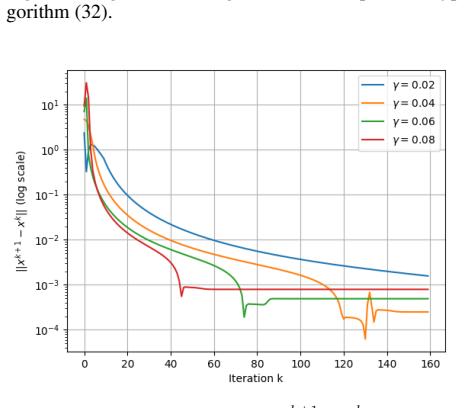
Non-monotone variational inequalities (NMVI) are an important class of problems that generalize non-convex optimization and have various applications in optimization theory, machine learning, game theory, and economics, among others. Most existing work on NMVIs focuses on the asymptotic convergence of algorithms proposed to solve these problems. In this paper, we tackle the problems of exponential and fixed-time stability of the solution set of a class of NMVIs for both unconstrained and constrained problems. We first present novel conditions guaranteeing exponential stability of solutions to unconstrained NMVIs for a uniquely constructed dynamical system under mild assumptions on the gradient of the non-monotone map. Then, under similar assumptions, we construct another novel dynamical system whose equilibrium point is fixed-time stable, i.e., the trajectories reach the equilibrium within a fixed time, independent of the initial conditions. For the case of constrained NMVIs, we employ a continuous-time variant of the Korpelevich method for exponential stability of the solution set, and provide a novel scaling factor in the dynamics to achieve fixed-time stability. We illustrate the efficacy of the proposed modified dynamical systems through numerical simulations and conclude the paper with a brief note on the behavior of the discretized variant of the proposed dynamics and on further work that remains to be done.
Figures

Reference graph
Works this paper leans on
-
[1]
World Scientific, 1993
Ratan Prakash Agarwal, Ravi P Agarwal, and V Lakshmikantham.Uniqueness and Nonuniqueness Criteria for Ordinary Differential Equations, volume 6. World Scientific, 1993
1993
-
[2]
Non-monotone variational inequalities
Sina Arefizadeh and Angelia Nedi ´c. Non-monotone variational inequalities. In2024 60th Annual Allerton Conference on Communication, Control, and Computing, pages 01–07. IEEE, 2024
2024
-
[3]
Existence of solutions for non-monotone vis and implications for games
Sina Arefizadeh and Angelia Nedi´c. Existence of solutions for non-monotone vis and implications for games. arXiv preprint arXiv:2512.16141, 2025
work page Pith review arXiv 2025
-
[4]
Springer-Verlag, Berlin, Heidelberg, 1984
Jean-Pierre Aubin and Arrigo Cellina.Differential Inclusions: Set-Valued Maps and Viability Theory, volume 264 ofGrundlehren der mathematischen Wissenschaften. Springer-Verlag, Berlin, Heidelberg, 1984
1984
-
[5]
Stability and stabilization of discontinuous systems and nonsmooth Lyapunov functions.ESAIM: Control, Optimisation and Calculus of Variations, 4:361–376, 1999
Andrea Bacciotti and Francesca Ceragioli. Stability and stabilization of discontinuous systems and nonsmooth Lyapunov functions.ESAIM: Control, Optimisation and Calculus of Variations, 4:361–376, 1999. 20 APREPRINT- JUNE23, 2026
1999
-
[6]
Athena Scientific, 2003
Dimitri Bertsekas, Angelia Nedi´c, and Asuman E Ozdaglar.Convex Analysis and Optimization. Athena Scientific, 2003
2003
-
[7]
Finite-time stability of continuous autonomous systems.SIAM Journal on Control and optimization, 38(3):751–766, 2000
Sanjay P Bhat and Dennis S Bernstein. Finite-time stability of continuous autonomous systems.SIAM Journal on Control and optimization, 38(3):751–766, 2000
2000
-
[8]
Blanchini
F. Blanchini. Set invariance in control.Automatica, 35(11):1747–1767, 1999
1999
Show all 45 references
-
[9]
Andrew A Brown and Michael C Bartholomew-Biggs. Some effective methods for unconstrained optimiza- tion based on the solution of systems of ordinary differential equations.Journal of Optimization Theory and Applications, 62(2):211–224, 1989
1989
-
[10]
Saddle-point dynamics: conditions for asymptotic stability of saddle points.SIAM Journal on Control and Optimization, 55(1):486–511, 2017
Ashish Cherukuri, Bahman Gharesifard, and Jorge Cortes. Saddle-point dynamics: conditions for asymptotic stability of saddle points.SIAM Journal on Control and Optimization, 55(1):486–511, 2017
2017
-
[11]
Relations between optimization and gradient flow methods with applications to image registration
Ulrich Clarenz, Stefan Henn, Martin Rumpf, and Kristian Witsch. Relations between optimization and gradient flow methods with applications to image registration. InProceedings of the 18th GAMM Seminar Leipzig on Multigrid and Related Methods for Optimisation Problems, pages 11...
2002
-
[12]
SIAM, 1990
Frank H Clarke.Optimization and Nonsmooth Analysis. SIAM, 1990
1990
-
[13]
Springer, 1998
Frank H Clarke, Yu S Ledyaev, Ronald J Stern, and RR Wolenski.Nonsmooth Analysis and Control Theory. Springer, 1998
1998
-
[14]
Finite-time convergent gradient flows with applications to network consensus.Automatica, 42(11):1993–2000, 2006
Jorge Cortés. Finite-time convergent gradient flows with applications to network consensus.Automatica, 42(11):1993–2000, 2006
1993
-
[15]
Recent theoretical advances in non-convex optimization
Marina Danilova, Pavel Dvurechensky, Alexander Gasnikov, Eduard Gorbunov, Sergey Guminov, Dmitry Kam- zolov, and Innokentiy Shibaev. Recent theoretical advances in non-convex optimization. InHigh-Dimensional Optimization and Probability: With a View Towards Data Science, pages...
2022
-
[16]
Numerical solustions and conditioning of Lyapunov and Sylvester equation
Biswa Nath Datta. Numerical solustions and conditioning of Lyapunov and Sylvester equation. In Biswa Nath Datta, editor,Numerical Methods for Linear Control Systems, pages 245–303. Academic Press, San Diego, 2004
2004
-
[17]
The proximal augmented lagrangian method for nonsmooth composite optimization.IEEE Transactions on Automatic Control, 64(7):2861–2868, 2018
Neil K Dhingra, Sei Zhen Khong, and Mihailo R Jovanovi ´c. The proximal augmented lagrangian method for nonsmooth composite optimization.IEEE Transactions on Automatic Control, 64(7):2861–2868, 2018
2018
-
[18]
On a class of smooth optimization algorithms with applications in control.IFAC Proceedings Volumes, 45(17):291–298, 2012
Hans-Bernd Dürr and Christian Ebenbauer. On a class of smooth optimization algorithms with applications in control.IFAC Proceedings Volumes, 45(17):291–298, 2012
2012
-
[19]
Chapman and Hall/CRC, 2025
Lawrence C Evans.Measure Theory and Fine Properties of Functions. Chapman and Hall/CRC, 2025
2025
-
[20]
Springer, 2003
Francisco Facchinei and Jong-Shi Pang.Finite-dimensional Variational Inequalities and Complementarity Problems. Springer, 2003
2003
-
[21]
Fixed-time stable proximal dynamical system for solving MVIPs.IEEE Transactions on Automatic Control, 68(8):5029–5036, 2022
Kunal Garg, Mayank Baranwal, Rohit Gupta, and Mouhacine Benosman. Fixed-time stable proximal dynamical system for solving MVIPs.IEEE Transactions on Automatic Control, 68(8):5029–5036, 2022
2022
-
[22]
Fixed-time stable gradient flows: Applications to continuous-time optimization
Kunal Garg and Dimitra Panagou. Fixed-time stable gradient flows: Applications to continuous-time optimization. IEEE Transactions on Automatic Control, 66(5):2002–2015, 2020
2002
-
[23]
Springer Science & Business Media, 2012
Uwe Helmke and John B Moore.Optimization and Dynamical Systems. Springer Science & Business Media, 2012
2012
-
[24]
Prentice Hall Upper Saddle River, NJ, 3rd edition, 2002
Hassan K Khalil.Nonlinear Systems. Prentice Hall Upper Saddle River, NJ, 3rd edition, 2002
2002
-
[25]
SIAM, 2000
David Kinderlehrer and Guido Stampacchia.An Introduction to Variational Inequalities and their Applications. SIAM, 2000
2000
-
[26]
Mathematics in Science and Engineering, C
Igor Konnov.Equilibrium Models and Variational Inequalities, volume 210 ofser. Mathematics in Science and Engineering, C. K. Chui ed.Amsterdam, The Netherlands: Elsevier, 2007
2007
-
[27]
The extragradient method for finding saddle points and other problems.Matecon, 12:747–756, 1976
Galina M Korpelevich. The extragradient method for finding saddle points and other problems.Matecon, 12:747–756, 1976
1976
-
[28]
Accelerated mirror descent in continuous and discrete time.Advances in neural information processing systems, 28, 2015
Walid Krichene, Alexandre Bayen, and Peter L Bartlett. Accelerated mirror descent in continuous and discrete time.Advances in neural information processing systems, 28, 2015
2015
-
[29]
Convex and non-convex optimization under generalized smoothness.Advances in Neural Information Processing Systems, 36:40238–40271, 2023
Haochuan Li, Jian Qian, Yi Tian, Alexander Rakhlin, and Ali Jadbabaie. Convex and non-convex optimization under generalized smoothness.Advances in Neural Information Processing Systems, 36:40238–40271, 2023
2023
-
[30]
Multiobjective distributed optimization via a predefined-time multiagent approach.IEEE Transactions on Automatic Control, 68(11):6998–7005, 2023
Yang Liu, Zicong Xia, and Weihua Gui. Multiobjective distributed optimization via a predefined-time multiagent approach.IEEE Transactions on Automatic Control, 68(11):6998–7005, 2023
2023
-
[31]
Chapman and Hall/CRC, 2010
Lawrence Narici and Edward Beckenstein.Topological Vector Spaces. Chapman and Hall/CRC, 2010. 21 APREPRINT- JUNE23, 2026
2010
-
[32]
Nonsmooth Lyapunov stability of differential equations.Applied Mathemat- ical Sciences, 11(18):887–897, 2017
Mohammad Fuad Mohammad Naser. Nonsmooth Lyapunov stability of differential equations.Applied Mathemat- ical Sciences, 11(18):887–897, 2017
2017
-
[33]
Sparse recovery via differential inclusions
Stanley Osher, Feng Ruan, Jiechao Xiong, Yuan Yao, and Wotao Yin. Sparse recovery via differential inclusions. Applied and Computational Harmonic Analysis, 41(2):436–469, 2016
2016
-
[34]
Nonlinear feedback design for fixed-time stabilization of linear control systems.IEEE transactions on Automatic Control, 57(8):2106–2110, 2011
Andrey Polyakov. Nonlinear feedback design for fixed-time stabilization of linear control systems.IEEE transactions on Automatic Control, 57(8):2106–2110, 2011
2011
-
[35]
Nonsmooth extremum seeking control with user-prescribed fixed-time convergence.IEEE Transactions on Automatic Control, 66(12):6156–6163, 2021
Jorge I Poveda and Miroslav Krsti ´c. Nonsmooth extremum seeking control with user-prescribed fixed-time convergence.IEEE Transactions on Automatic Control, 66(12):6156–6163, 2021
2021
-
[36]
Fixed-time nash equilibrium seeking in time-varying networks
Jorge I Poveda, Miroslav Krsti´c, and Tamer Ba¸ sar. Fixed-time nash equilibrium seeking in time-varying networks. IEEE Transactions on Automatic Control, 68(4):1954–1969, 2022
1954
-
[37]
Springer, 1998
R Tyrrell Rockafellar and Roger JB Wets.Variational Analysis. Springer, 1998
1998
-
[38]
Encyclopedia of Mathematics and its Applications
Rolf Schneider.Convex Bodies: The Brunn–Minkowski Theory. Encyclopedia of Mathematics and its Applications. Cambridge University Press, 2 edition, 2013
2013
-
[39]
A differential equation for modeling Nesterov’s accelerated gradient method: Theory and insights.Journal of Machine Learning Research, 17(153):1–43, 2016
Weijie Su, Stephen Boyd, and Emmanuel J Candes. A differential equation for modeling Nesterov’s accelerated gradient method: Theory and insights.Journal of Machine Learning Research, 17(153):1–43, 2016
2016
-
[40]
Relaxed two-step inertial tseng’s extragradient method for nonmonotone variational inequalities.Journal of Optimization Theory and Applications, 205(1):7–27, 2025
Duong Viet Thong, Pham Ky Anh, and Vu Tien Dung. Relaxed two-step inertial tseng’s extragradient method for nonmonotone variational inequalities.Journal of Optimization Theory and Applications, 205(1):7–27, 2025
2025
-
[41]
Generalization of gronwall’s inequality and its applications in functional differential equations
TINGXIU Wang. Generalization of gronwall’s inequality and its applications in functional differential equations. Commun. Appl. Anal, 19:679–688, 2015
2015
-
[42]
A variational perspective on accelerated methods in optimization.Proceedings of the National Academy of Sciences, 113(47):E7351–E7358, 2016
Andre Wibisono, Ashia C Wilson, and Michael I Jordan. A variational perspective on accelerated methods in optimization.Proceedings of the National Academy of Sciences, 113(47):E7351–E7358, 2016
2016
-
[43]
Youshen Xia, Henry Leung, and Jun Wang. A projection neural network and its application to constrained optimization problems.IEEE Transactions on Circuits and Systems I: Fundamental Theory and Applications, 49(4):447–458, 2002
2002
-
[44]
A general methodology for designing globally convergent optimization neural networks.IEEE Transactions on Neural Networks, 9(6):1331–1343, 1998
Youshen Xia and Jun Wang. A general methodology for designing globally convergent optimization neural networks.IEEE Transactions on Neural Networks, 9(6):1331–1343, 1998
1998
-
[45]
Communication-efficient gradient descent-accent methods for distributed variational inequalities: Unified analysis and local updates.arXiv preprint arXiv:2306.05100, 2023
Siqi Zhang, Sayantan Choudhury, Sebastian U Stich, and Nicolas Loizou. Communication-efficient gradient descent-accent methods for distributed variational inequalities: Unified analysis and local updates.arXiv preprint arXiv:2306.05100, 2023. A Proofs of Auxiliary Results A.1 ...
2023
Reviewed June 26, 2026 · model on record in the stance chip above.
Discussion (0). Continue with ORCID to comment.