Local-to-Global Exactness of SDP Relaxations for Sparse QCQPs
Pith reviewed 2026-06-26 12:13 UTC · model grok-4.3
The pith
If local sub-SDPs are exact then the global SDP relaxation is exact for sparse QCQPs.
A machine-rendered reading of the paper's core claim, the machinery that carries it, and where it could break.
Core claim
The main theorem shows that if the local sub-SDPs are exact, then the original SDP relaxation is exact. The SDP is first rewritten in clique-wise variables; each local sub-SDP receives a right-hand-side vector and a consistency matrix taken from an optimal solution of this global formulation; exactness of the locals forces the existence of a rank-at-most-one global solution that solves the QCQP.
What carries the argument
Local sub-SDP parameterized by a local right-hand-side vector and a consistency matrix that fixes shared entries across overlapping cliques.
If this is right
- Convex local QCQPs on each clique yield an exact global SDP relaxation.
- Local QCQPs satisfying sign-pattern conditions can be combined to certify global exactness.
- Separable local QCQPs with a limited number of constraints likewise produce an exact global relaxation.
- The three local classes can be mixed within one sparse QCQP provided the intersection condition holds.
Where Pith is reading between the lines
- Verification can be reduced to independent checks on the individual cliques once a candidate global solution is known.
- The single-node intersection restriction may be removable for some of the local classes without losing the local-to-global implication.
- The same decomposition could be applied to certify exactness of other convex relaxations that admit clique-wise formulations.
Load-bearing premise
Any two distinct cliques intersect in at most one node.
What would settle it
A sparse QCQP obeying the single-node intersection condition whose local sub-SDPs are all exact yet whose global SDP relaxation has no rank-one optimal solution.
Figures
read the original abstract
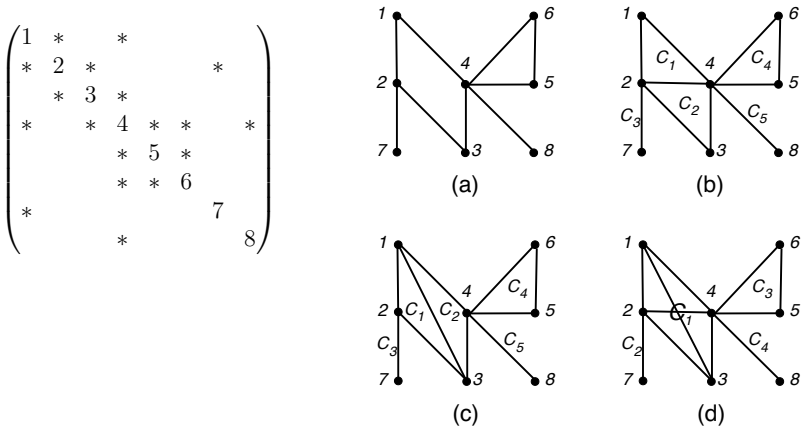
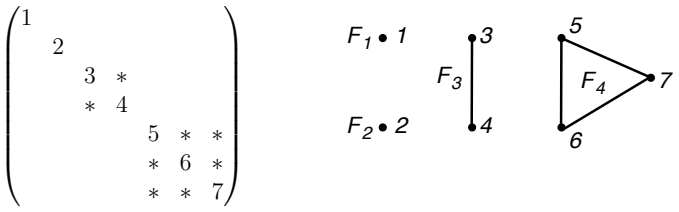
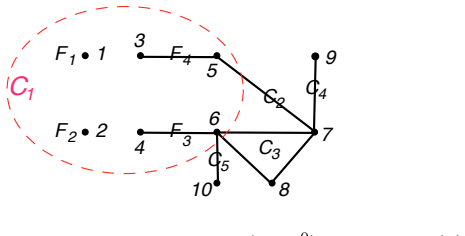
We study exact semidefinite programming (SDP) relaxation for a given sparse quadratically constrained quadratic program (QCQP). The SDP relaxation is exact if, whenever it has an optimal solution, it admits a rank-at-most-one optimal solution that corresponds to an optimal solution of the QCQP. Using the maximal cliques of a chordal extension of the aggregate sparsity pattern graph of the data matrices, we formulate the SDP relaxation in terms of clique-wise matrix variables and develop a local-to-global framework for certifying exactness. For each clique-wise matrix variable, we introduce a local sub-SDP with two parameters: a local right-hand-side vector and a consistency matrix specifying the values of entries shared by overlapping clique-wise matrix variables. In the main theorem, these parameters are determined by an optimal solution of the global clique-wise SDP. The theorem shows that if the resulting local sub-SDPs are exact, then the original SDP relaxation is exact. Under the additional assumption that any two distinct cliques intersect in at most one node, we present three classes of local QCQPs that can be incorporated into this framework: convex local QCQPs, local QCQPs characterized by sign-pattern conditions, and separable local QCQPs with a limited number of constraints. Examples illustrate how these different local QCQP classes can be combined in sparse QCQPs.
Editorial analysis
A structured set of objections, weighed in public.
Referee Report
Summary. The paper develops a local-to-global framework for exactness of SDP relaxations of sparse QCQPs. It reformulates the global SDP using clique-wise matrix variables from the maximal cliques of a chordal extension of the aggregate sparsity pattern. Local sub-SDPs are introduced for each clique, parameterized by a local right-hand-side vector and a consistency matrix whose values are taken from an optimal solution of the global clique-wise SDP. The central theorem asserts that exactness of these parameterized local sub-SDPs implies exactness of the original global SDP relaxation. Under the additional assumption that any two distinct cliques intersect in at most one node, three classes of local QCQPs (convex, sign-pattern, and separable with limited constraints) are identified whose known exactness can be plugged into the framework, with examples showing combinations.
Significance. If the main theorem is correct, the framework supplies a modular certification route: global exactness follows from local exactness once parameters are fixed by a global solution. This is potentially useful for large-scale sparse QCQPs, where the global SDP may be intractable but local subproblems on small cliques are tractable or already known to be exact. The approach leverages standard chordal-graph properties without introducing new free parameters or circular reductions, and the concrete local classes (convex, sign-pattern, separable) provide immediate applicability. The separation of the core implication from the intersection assumption is a strength.
minor comments (3)
- [Abstract] The abstract states the main theorem but does not indicate its section or theorem number; a forward reference (e.g., "Theorem 3.2") would help readers locate the precise statement.
- The consistency matrix is introduced as specifying shared entries, but its construction from the global solution (including how overlapping entries are aggregated when more than two cliques meet) would benefit from an explicit formula or pseudocode in the framework section.
- The three concrete local QCQP classes are presented under the intersection-at-most-one assumption; a brief remark on whether the main theorem itself requires this assumption or only the examples would clarify the logical structure.
Simulated Author's Rebuttal
We thank the referee for the positive assessment of the paper, the accurate summary of our local-to-global framework, and the recommendation for minor revision. No specific major comments were raised in the report.
Circularity Check
No significant circularity detected
full rationale
The central result is a mathematical implication (local sub-SDP exactness implies global SDP exactness) whose parameters are explicitly taken from a global optimal solution; this is a standard theoretical reduction and does not reduce the claimed exactness to a fitted quantity or self-citation by construction. The intersection-at-most-one-node condition is stated as an additional assumption needed only to exhibit concrete local QCQP classes, not to support the main theorem. No load-bearing step relies on a self-citation chain or renames a known result; the derivation remains self-contained against external benchmarks.
Axiom & Free-Parameter Ledger
axioms (1)
- standard math Maximal cliques of a chordal extension of the aggregate sparsity pattern graph can be used to decompose the SDP relaxation
Reference graph
Works this paper leans on
-
[1]
C. J. Argue, F. Kilin¸ c-Karzan, and A.L. Wang. Necessary and sufficient conditions for rank-one-generated cones.Math. Oper. Res., 48(1):100–126, 2023
2023
-
[2]
N. Arima, S. Kim, and M. Kojima. Exact SDP relaxations for a class of quadratic pro- grams with finite and infinite quadratic constraints. Technical Report arXiv:2409.07213, To appear inSIAM J. Optim., September 2024
work page internal anchor Pith review Pith/arXiv arXiv 2024
-
[3]
Arima, S
N. Arima, S. Kim, and M. Kojima. Further development in convex conic reformulation of geometric nonconvex conic optimization problems.SIAM J. Optim., 34(4):3194– 3211, 2024
2024
-
[4]
N. V. Bao, X. Sahinidis and M. Tawarmalani. Semidefinite relaxations for quadrat- ically constrained quadratic programming: A review and comparisons.Mathematical Programming, 129:129–157, 2011. 24
2011
-
[5]
Ben-Tal and A
A. Ben-Tal and A. Nemirovski.Lectures on Modern Convex Optimization: Analysis, Algorithms, and Engineering Applications. SIAM, 2001
2001
-
[6]
J. R. S. Blair and B. Peyton. An introduction to chordal graphs and clique trees. In Liu J.W.H. George A., Gilbert J. R., editor,Graph Theory and Sparse Matrix Computation. Springer-Verlag, New York, 1993
1993
-
[7]
J. Dancis. Positive semidefinite completions of partial Hermitian matrices.Linear Algebra Appl., 175:91–114, 1992
1992
-
[8]
Fujie and M
T. Fujie and M. Kojima. Semidefinite programming relaxation for nonconvex quadratic programs.J. of Global Optim., 10:367–368, 1997
1997
-
[9]
Fukuda, M
M. Fukuda, M. Kojima, K. Murota, and K. Nakata. Exploiting sparsity in semidefinite programming via matrix completion. I: General framework.SIAM J. Optim., 11:647– 674, 2000
2000
-
[10]
Grone, C
R. Grone, C. R. Johnson, E. M. S´ a, and H. Wolkowicz. Positive definite completions of partial hermitian matrices.Linear Algebra Appl., 58:109–124, 1984
1984
-
[11]
Huang and D
Y. Huang and D. P. Palomar. Rank-constrained separable semidefinite programming with applications to optimal beamforming.IEEE TRANSACTIONS ON SIGNAL PROCESSING, 58(2):664–678, 2010
2010
-
[12]
Jiang, Y
X. Jiang, Y. Sun, M. S. Andersen, and L. Vandenberghe. Minimum-rank positive semidefinite matrix completion with chordal patterns and applications to semidefinite relaxations.Appl. Set-Valued Anal. Optim., 5(2):265–283, 2023
2023
-
[13]
Johnson and R.I
C.R. Johnson and R.I. Smith. The completion problem for m-matrices and inverse m-matrices.Linear Algebr. Appl., 241–243:655–667, 1996
1996
-
[14]
Joyce and B
A. Joyce and B. Yang. Convex hull results on quadratic programs with non-intersecting constraints.Math. Program., 205:539–558, 2024
2024
-
[15]
Kim and M
S. Kim and M. Kojima. Exact solutions of some nonconvex quadratic optimization problems via SDP and SOCP relaxations.Comput. Optim. Appl., 26(2):143–154, 2003
2003
-
[16]
S. Kim, M. Kojima, and K. C. Toh. Doubly nonnegative relaxations are equivalent to completely positive reformulations of quadratic optimization problems with block- clique graph structures.Journal of Global Optimization, 77(3):513–541, 2020
2020
-
[17]
S. Kim, M. Kojima, and K. C. Toh. A geometrical analysis of a class of nonconvex conic programs for convex conic reformulations of quadratic and polynomial optimization problems.SIAM J. Optim., 30:1251–1273, 2020
2020
- [18]
-
[19]
Separable QCQPs and Their Exact SDP Relaxations
M. Kojima, S. Kim, and N. Arima. Separable QCQPs and their exact SDP relaxations. Technical Report arXiv:2604.02968, April 2026. 25
work page internal anchor Pith review Pith/arXiv arXiv 2026
-
[20]
Luo, W.-K
Z.-Q. Luo, W.-K. Ma, A. M.-C. So, Y. Ye, and S. Zhang. Semidefinite relaxation of quadratic optimization problems.IEEE Signal Processing Magazine, 27(3):20–34, 2010
2010
-
[21]
Nakata, K
K. Nakata, K. Fujisawa, M. Fukuda, M. Kojima, and K. Murota. Exploiting sparsity in semidefinite programming via matrix completion. II: Implementation and numerical results.Math. Program., 95:303–327, 2003
2003
-
[22]
G. Pataki. On the rank of extreme matrices in semidefinite programs and the multi- plicity of optimal eigenvalues.Math. Oper. Res., 23(2):339–358, 1998
1998
-
[23]
B. T. Polyak. Convexity of quadratic transformations and its use in control and opti- mization.J. Optim. Theory Appl., 99(3):553–583, 1998
1998
-
[24]
N. Z. Shor. Quadratic optimization problems.Soviet Journal of Computer and Systems Sciences, 25:1–11, 1987
1987
-
[25]
Sojoudi and J
S. Sojoudi and J. Lavaei. Exactness of semidefinite relaxations for nonlinear optimiza- tion problems with underlying graph structure.SIAM J. Optim., 24(4):1746–1778, 2014
2014
-
[26]
B. Yang, K. Anstreiher, and S. Burer. Quadratic programs with hollows.Math. Pro- gram., 170:541–553, 2018
2018
-
[27]
Ye and S
Y. Ye and S. Zhang. New results on quadratic minimization.SIAM J. Optim., 14:245– 267, 2003. 26
2003
discussion (0)
Sign in with ORCID, Apple, or X to comment. Anyone can read and Pith papers without signing in.