Spectrally Safe Neural Operator Warm-Starts for Large-Scale Newton Solvers
Pith reviewed 2026-06-26 12:08 UTC · model grok-4.3
The pith
Neural operators with O(10^{-3}) L2 error can still produce indefinite Jacobians for Newton solvers, but energy penalization fixes the spectrum without new data.
A machine-rendered reading of the paper's core claim, the machinery that carries it, and where it could break.
Core claim
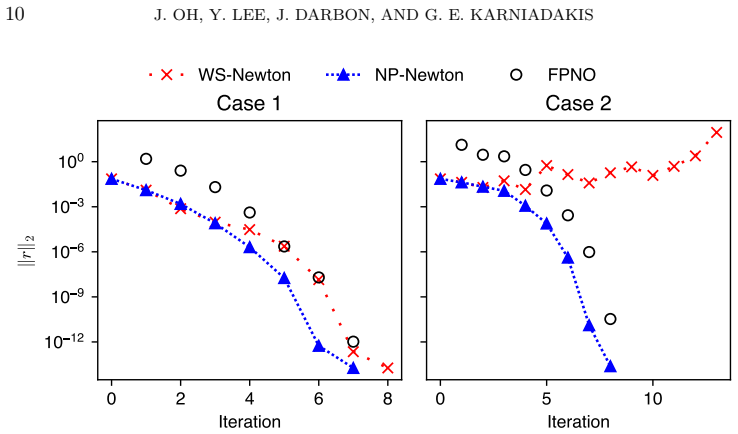
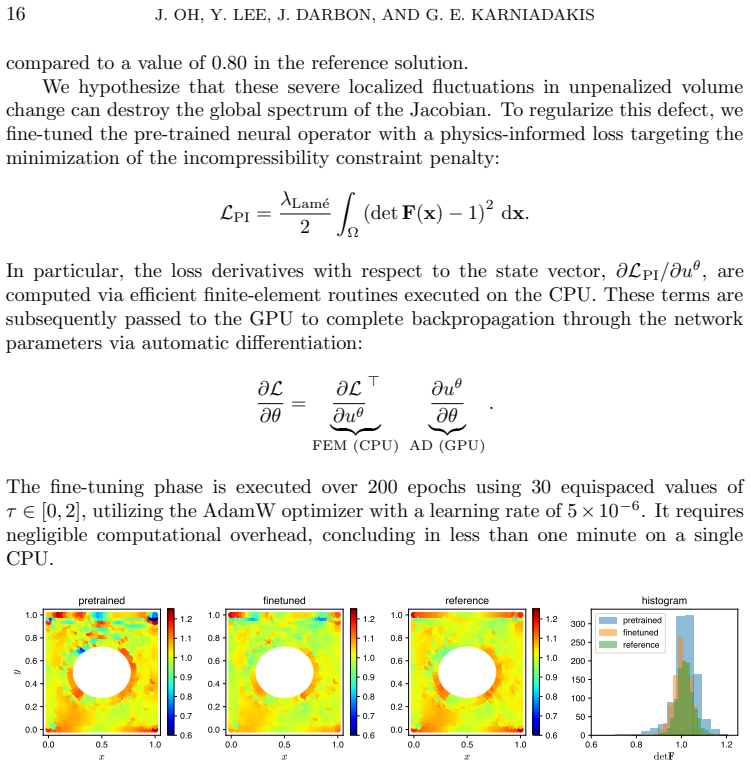
An operator trained to relative L2 error O(10^{-3}) can produce initial states in which det F is dispersed away from one, so that the discrete Jacobian acquires negative eigenvalues even when the predicted field is visually close to the reference. Penalizing the operator against the discrete energy in a short label-free fine-tuning phase restores positive definiteness, allowing inexact Newton iterations to succeed across the full loading range where the unregularized operator fails and yielding up to 5.4 times wall-clock speedup on a 3D problem with 6.4 million degrees of freedom.
What carries the argument
The label-free fine-tuning phase that penalizes the neural operator output against the discrete energy functional to enforce positive definiteness of the Jacobian.
If this is right
- The combined warm-started Newton method converges across the full loading range where the unregularized operator fails.
- It reaches up to 5.4 times wall-clock speedup over incremental continuation on a 3D hyperelasticity problem with 6.4 million degrees of freedom.
- No additional labeled solution data are needed for the fine-tuning step.
- The approach remains compatible with inexact outer loops and memory-feasible Krylov solvers at multi-million-dof scale.
Where Pith is reading between the lines
- The same energy penalty may stabilize neural warm-starts for other nonlinear PDEs whose Jacobians become indefinite when physical invariants are locally violated.
- Reducing dependence on incremental continuation could simplify simulation workflows for large-scale nonlinear mechanics.
- Testing the fine-tuned operator on refined meshes or altered material parameters would check whether spectral safety holds under changes in discretization.
Load-bearing premise
Penalizing the operator against the discrete energy during a short label-free fine-tuning phase will reliably shift the Jacobian spectrum to positive definite across the full loading range without requiring additional solution data or introducing new instabilities.
What would settle it
Apply the fine-tuned operator to the full loading path on the 6.4-million-dof mesh and check whether every resulting discrete Jacobian has strictly positive eigenvalues and whether Newton iterations converge at every load step.
Figures



read the original abstract
Neural operators are increasingly used to warm-start Newton solvers for nonlinear PDEs, on the premise that a low test error places the initial guess inside the basin of attraction. We show that this premise is unreliable. An operator trained to the relative \(L^2\) error \(O(10^{-3})\) can still produce an initial state in which the discrete Jacobian is indefinite, because the mean-squared training controls error on average while leaving localized pointwise violations of the underlying physics. For a nearly incompressible hyperelasticity problem, we trace this to the predicted volume change: the operator disperses \(\mathrm{det} F\) well away from one, and the resulting Jacobian acquires negative eigenvalues even when the predicted field is visually indistinguishable from the reference. At a small scale, this is a nuisance; at a multi-million degree-of-freedom scale, it is disqualifying, since the conjugate gradient and other Krylov solvers needed for memory-feasible Newton steps assume a definite spectrum. We then show that a short, label-free fine-tuning phase -- penalizing the operator against the discrete energy, with no additional solution data -- shifts the Jacobian spectrum back to positive definite. Combined with an inexact outer loop, this gives a warm-started Newton method that converges across the full loading range where the unregularized operator fails, reaching up to 5.4\(\times\) wall-clock speedup over incremental continuation on a 3D problem with 6.4 million degrees of freedom.
Editorial analysis
A structured set of objections, weighed in public.
Referee Report
Summary. The manuscript argues that neural operators trained only to relative L2 error O(10^{-3}) are unreliable warm-starts for Newton solvers on nonlinear PDEs because mean-squared loss permits localized pointwise violations of the physics (e.g., det F far from 1 in hyperelasticity), producing indefinite discrete Jacobians even when the predicted field looks plausible. It then introduces a short label-free fine-tuning stage that penalizes the operator output against the discrete energy, shifting the Jacobian spectrum to positive definite and enabling convergence over the full loading range; combined with an inexact outer loop this yields up to 5.4× wall-clock speedup versus incremental continuation on a 6.4-million-DOF 3D hyperelasticity problem.
Significance. If the energy-penalized fine-tuning reliably restores positive-definiteness across the loading path without degrading accuracy or creating new instabilities, the work removes a practical obstacle to deploying neural operators inside memory-constrained large-scale nonlinear solvers that must rely on Krylov methods. The concrete demonstration on a multi-million-DOF example supplies a falsifiable performance claim that can be checked by other groups.
major comments (2)
- [Methods / fine-tuning description] The central claim that the label-free energy penalty corrects localized det F violations and produces positive-definite Jacobians for every load step rests on an unstated penalty formulation and weight; without the explicit expression (presumably in the methods section) or an ablation on the weight, it is impossible to verify that the correction targets the physics violation rather than driving the operator to a different local minimum.
- [Results / large-scale experiment] The reported 5.4× speedup and full-range convergence are load-bearing for the practical contribution, yet the abstract supplies neither error bars on the timing, nor success/failure rates across the loading path, nor a comparison against the unregularized operator on the same 6.4 M DOF mesh; these omissions leave the weakest assumption (that the fine-tuning never introduces new instabilities) untested.
minor comments (2)
- The abstract states that the operator is trained to relative L2 error O(10^{-3}) but does not report the precise test-set error or the training/validation split used for the hyperelasticity example.
- A plot of the smallest Jacobian eigenvalue versus load step, before and after fine-tuning, would make the spectral correction claim immediately verifiable.
Simulated Author's Rebuttal
We thank the referee for the careful reading and for recognizing the potential impact on memory-constrained large-scale nonlinear solvers. We respond to each major comment below and indicate the changes that will be incorporated in the revised manuscript.
read point-by-point responses
-
Referee: [Methods / fine-tuning description] The central claim that the label-free energy penalty corrects localized det F violations and produces positive-definite Jacobians for every load step rests on an unstated penalty formulation and weight; without the explicit expression (presumably in the methods section) or an ablation on the weight, it is impossible to verify that the correction targets the physics violation rather than driving the operator to a different local minimum.
Authors: We agree that the explicit mathematical expression for the energy penalty and the numerical value of the weight were not stated with sufficient precision in the methods section. This was an oversight that hinders reproducibility. In the revised manuscript we will insert the precise formulation of the label-free penalty (the discrete hyperelastic energy evaluated directly on the operator output) together with the specific weight chosen on a small validation set. We will also add a short ablation table showing the effect of varying the weight on both L2 accuracy and the fraction of load steps for which the Jacobian remains positive definite. revision: yes
-
Referee: [Results / large-scale experiment] The reported 5.4× speedup and full-range convergence are load-bearing for the practical contribution, yet the abstract supplies neither error bars on the timing, nor success/failure rates across the loading path, nor a comparison against the unregularized operator on the same 6.4 M DOF mesh; these omissions leave the weakest assumption (that the fine-tuning never introduces new instabilities) untested.
Authors: The abstract is length-constrained and therefore omits these statistics, but the main text already documents that the unregularized operator fails to converge on the full loading path while the fine-tuned operator succeeds, together with the observed wall-clock speedup versus incremental continuation. Nevertheless, we accept that explicit variability measures, per-step success rates, and a direct side-by-side comparison on the identical 6.4 M DOF mesh would make the claim more robust. In the revision we will add timing statistics with standard deviations, a table of convergence success/failure for each load increment, and a column-wise comparison against the unregularized operator on the same mesh. revision: yes
Circularity Check
No load-bearing circularity; fine-tuning presented as independent adjustment
full rationale
The paper identifies that L2 training to O(10^{-3}) error can leave localized det F violations producing indefinite Jacobians, then introduces a separate label-free energy-penalization fine-tuning phase as a post-training correction. No equation reduces the spectral correction, convergence across loading range, or reported 5.4x speedup to a quantity defined by the original training loss or fitted parameters. The demonstration on the 6.4M-DOF problem is empirical rather than a self-referential derivation, and no self-citation chain is invoked to justify uniqueness or the penalty form. This yields a self-contained empirical claim with at most minor non-load-bearing self-citation risk.
Axiom & Free-Parameter Ledger
free parameters (1)
- energy penalty weight
axioms (1)
- standard math Conjugate gradient and other Krylov solvers require a positive-definite Jacobian to converge reliably.
Reference graph
Works this paper leans on
-
[1]
Mathematics of Computation , pages=
Simple Finite Element Method in Vorticity Formulation for Incompressible Flows , author=. Mathematics of Computation , pages=. 2001 , publisher=
2001
-
[2]
SIAM review , volume=
Iterative methods by space decomposition and subspace correction , author=. SIAM review , volume=. 1992 , publisher=
1992
-
[3]
International journal for numerical methods in engineering , volume=
Gmsh: A 3-D finite element mesh generator with built-in pre-and post-processing facilities , author=. International journal for numerical methods in engineering , volume=. 2009 , publisher=
2009
-
[4]
Hunter, J. D. , Title =. Computing in Science & Engineering , Volume =
-
[5]
Proceedings of the National Academy of Sciences , volume=
Elliptic PDE learning is provably data-efficient , author=. Proceedings of the National Academy of Sciences , volume=. 2023 , publisher=
2023
-
[6]
IMA Journal of Numerical Analysis , pages=
Error analysis for finite element operator learning methods for solving parametric second-order elliptic PDEs , author=. IMA Journal of Numerical Analysis , pages=. 2026 , publisher=
2026
-
[7]
Computer Methods in Applied Mechanics and Engineering , volume=
Spectral operator learning for parametric PDEs without data reliance , author=. Computer Methods in Applied Mechanics and Engineering , volume=. 2024 , publisher=
2024
-
[8]
SIAM Journal on Scientific Computing , volume=
Finite element operator network for solving elliptic-type parametric pdes , author=. SIAM Journal on Scientific Computing , volume=. 2025 , publisher=
2025
-
[9]
SIAM Journal on Scientific Computing , volume=
Nonadaptive quasi-optimal points selection for least squares linear regression , author=. SIAM Journal on Scientific Computing , volume=. 2016 , publisher=
2016
-
[10]
Spectral/hp Element Methods for Computational Fluid Dynamics , year =
Karniadakis, George and Sherwin, Spencer , doi =. Spectral/hp Element Methods for Computational Fluid Dynamics , year =
-
[11]
Proceedings of the IEEE conference on computer vision and pattern recognition , pages=
Squeeze-and-excitation networks , author=. Proceedings of the IEEE conference on computer vision and pattern recognition , pages=
-
[12]
2003 , publisher=
Introduction to numerical continuation methods , author=. 2003 , publisher=
2003
-
[13]
2004 , publisher=
Domain decomposition methods-algorithms and theory , author=. 2004 , publisher=
2004
-
[14]
International Conference on Machine Learning , pages=
Learning to optimize multigrid PDE solvers , author=. International Conference on Machine Learning , pages=. 2019 , organization=
2019
-
[15]
International journal for numerical methods in fluids , volume=
Discussions on driven cavity flow , author=. International journal for numerical methods in fluids , volume=. 2009 , publisher=
2009
-
[16]
Annual review of fluid mechanics , volume=
Fluid mechanics in the driven cavity , author=. Annual review of fluid mechanics , volume=. 2000 , publisher=
2000
-
[17]
Journal of computational physics , volume=
High-Re solutions for incompressible flow using the Navier-Stokes equations and a multigrid method , author=. Journal of computational physics , volume=. 1982 , publisher=
1982
-
[18]
SIAM Journal on Matrix Analysis and Applications , volume=
A fully asynchronous multifrontal solver using distributed dynamic scheduling , author=. SIAM Journal on Matrix Analysis and Applications , volume=. 2001 , publisher=
2001
-
[19]
SIAM Journal on Scientific Computing , volume=
On the training and generalization of deep operator networks , author=. SIAM Journal on Scientific Computing , volume=. 2024 , publisher=
2024
-
[20]
arXiv preprint arXiv:2511.19980 , year=
Operator learning at machine precision , author=. arXiv preprint arXiv:2511.19980 , year=
-
[21]
SIAM Journal on Scientific Computing , volume=
Deeponet based preconditioning strategies for solving parametric linear systems of equations , author=. SIAM Journal on Scientific Computing , volume=. 2025 , publisher=
2025
-
[22]
International Conference on Machine Learning , pages=
Transolver++: An Accurate Neural Solver for PDEs on Million-Scale Geometries , author=. International Conference on Machine Learning , pages=. 2025 , organization=
2025
-
[23]
SIAM Journal on Scientific Computing , volume=
Choosing the forcing terms in an inexact Newton method , author=. SIAM Journal on Scientific Computing , volume=. 1996 , publisher=
1996
-
[24]
Technical Report ANL-21/39 - Revision 3.24
Balay, S. and Abhyankar, S. and Adams, M. F. and Brown, J. and Brune, P. and Buschelman, K. and Constantinescu, E. M. and Dalcin, L. and Benson, S. and Dener, A. and others , title =. 2025 , month =. doi:10.2172/2998643 , url =
-
[25]
Baratta, Igor A. and Dean, Joseph P. and Dokken, J. 2023 , bdsk-url-1 =. doi:10.5281/zenodo.10447666 , howpublished =
-
[26]
Alnæs, Anders Logg, Kristian B
Alnaes, Martin S. and Logg, Anders and. Unified Form Language: A domain-specific language for weak formulations of partial differential equations , volume =. 2014 , bdsk-url-1 =. doi:10.1145/2566630 , journal =
-
[27]
SIAM Journal on Scientific Computing , volume=
An analysis of approximate nonlinear elimination , author=. SIAM Journal on Scientific Computing , volume=. 1996 , publisher=
1996
-
[28]
International conference on machine learning , pages=
Spherical fourier neural operators: Learning stable dynamics on the sphere , author=. International conference on machine learning , pages=. 2023 , organization=
2023
-
[29]
Physical Review Research , volume=
Multifidelity deep neural operators for efficient learning of partial differential equations with application to fast inverse design of nanoscale heat transport , author=. Physical Review Research , volume=. 2022 , publisher=
2022
-
[30]
Transolver: A Fast Transformer Solver for
Haixu Wu and Huakun Luo and Haowen Wang and Jianmin Wang and Mingsheng Long , booktitle=. Transolver: A Fast Transformer Solver for. 2024 , url=
2024
-
[31]
International Conference on Learning Representations , year=
Fourier Neural Operator for Parametric Partial Differential Equations , author=. International Conference on Learning Representations , year=
-
[32]
Uspekhi Mat Nauk , volume=
Functional analysis and applied mathematics (in Russian) , author=. Uspekhi Mat Nauk , volume=
-
[33]
Computer Methods in Applied Mechanics and Engineering , volume=
Nows: Neural operator warm starts for accelerating iterative solvers , author=. Computer Methods in Applied Mechanics and Engineering , volume=. 2026 , publisher=
2026
-
[34]
Journal of Computational Physics , volume=
Neural operator-based super-fidelity: A warm-start approach for accelerating steady-state simulations , author=. Journal of Computational Physics , volume=. 2025 , publisher=
2025
-
[35]
International Journal of Mechanical Sciences , pages=
A pretraining-finetuning computational framework for material homogenization , author=. International Journal of Mechanical Sciences , pages=. 2026 , publisher=
2026
-
[36]
arXiv preprint arXiv:2601.03086 , year=
Pretrain Finite Element Method: A Pretraining and Warm-start Framework for PDEs via Physics-Informed Neural Operators , author=. arXiv preprint arXiv:2601.03086 , year=
-
[37]
arXiv preprint arXiv:2511.06802 , year=
Neural-initialized newton: Accelerating nonlinear finite elements via operator learning , author=. arXiv preprint arXiv:2511.06802 , year=
-
[38]
arXiv preprint arXiv:2509.21751 , year=
Reparameterizing 4DVAR with neural fields , author=. arXiv preprint arXiv:2509.21751 , year=
-
[39]
Advances in neural information processing systems , volume=
Pytorch: An imperative style, high-performance deep learning library , author=. Advances in neural information processing systems , volume=
-
[40]
Computer Methods in Applied Mechanics and Engineering , volume=
A comprehensive and fair comparison of two neural operators (with practical extensions) based on fair data , author=. Computer Methods in Applied Mechanics and Engineering , volume=. 2022 , publisher=
2022
-
[41]
arXiv preprint arXiv:2511.08811 , year=
A Neural-Operator Preconditioned Newton Method for Accelerated Nonlinear Solvers , author=. arXiv preprint arXiv:2511.08811 , year=
-
[42]
Advances in neural information processing systems , volume=
Newton informed neural operator for solving nonlinear partial differential equations , author=. Advances in neural information processing systems , volume=
-
[43]
Computer Physics Communications , volume=
High performance Python for direct numerical simulations of turbulent flows , author=. Computer Physics Communications , volume=. 2016 , publisher=
2016
-
[44]
II: Modelling the forecast error covariance statistics , author=
A review of forecast error covariance statistics in atmospheric variational data assimilation. II: Modelling the forecast error covariance statistics , author=. Quarterly Journal of the Royal Meteorological Society: A journal of the atmospheric sciences, applied meteorology and physical oceanography , volume=. 2008 , publisher=
2008
-
[45]
I: Characteristics and measurements of forecast error covariances , author=
A review of forecast error covariance statistics in atmospheric variational data assimilation. I: Characteristics and measurements of forecast error covariances , author=. Quarterly Journal of the Royal Meteorological Society: A journal of the atmospheric sciences, applied meteorology and physical oceanography , volume=. 2008 , publisher=
2008
-
[46]
Computer Methods in Applied Mechanics and Engineering , volume=
Optimizing the optimizer for physics-informed neural networks and Kolmogorov-Arnold networks , author=. Computer Methods in Applied Mechanics and Engineering , volume=. 2025 , publisher=
2025
-
[47]
State estimation in minimal turbulent channel flow: A comparative study of
Du, Yifan and Wang, Mengze and Zaki, Tamer A , journal=. State estimation in minimal turbulent channel flow: A comparative study of. 2023 , publisher=
2023
-
[48]
Nature methods , volume=
SciPy 1.0: fundamental algorithms for scientific computing in Python , author=. Nature methods , volume=. 2020 , publisher=
2020
-
[49]
zero-shot
“zero-shot” super-resolution using deep internal learning , author=. Proceedings of the IEEE conference on computer vision and pattern recognition , pages=
-
[50]
Neurocomputing , volume=
ZS-SRT: An efficient zero-shot super-resolution training method for Neural Radiance Fields , author=. Neurocomputing , volume=. 2024 , publisher=
2024
-
[51]
The Twelfth International Conference on Learning Representations , year=
Neural Spectral Methods: Self-supervised learning in the spectral domain , author=. The Twelfth International Conference on Learning Representations , year=
-
[52]
Part I: Technical formulation and preliminary test , author=
An ensemble-based four-dimensional variational data assimilation scheme. Part I: Technical formulation and preliminary test , author=. Monthly Weather Review , volume=
-
[53]
Tellus A: Dynamic Meteorology and Oceanography , volume=
Variational algorithms for analysis and assimilation of meteorological observations: theoretical aspects , author=. Tellus A: Dynamic Meteorology and Oceanography , volume=. 1986 , publisher=
1986
-
[54]
Nonlinear Processes in Geophysics , volume=
Nonlinear effects in 4D-Var , author=. Nonlinear Processes in Geophysics , volume=. 2018 , publisher=
2018
-
[55]
Quarterly Journal of the Royal Meteorological Society , volume=
Multiple-truncation incremental approach for four-dimensional variational data assimilation , author=. Quarterly Journal of the Royal Meteorological Society , volume=. 1998 , publisher=
1998
-
[56]
Array programming with
Harris, Charles R and Millman, K Jarrod and Van Der Walt, St. Array programming with. nature , volume=. 2020 , publisher=
2020
-
[57]
Advances in neural information processing systems , volume=
Characterizing possible failure modes in physics-informed neural networks , author=. Advances in neural information processing systems , volume=
-
[58]
Proceedings of the thirteenth international conference on artificial intelligence and statistics , pages=
Understanding the difficulty of training deep feedforward neural networks , author=. Proceedings of the thirteenth international conference on artificial intelligence and statistics , pages=. 2010 , organization=
2010
-
[59]
Nature , pages=
Controlling diverse robots by inferring Jacobian fields with deep networks , author=. Nature , pages=. 2025 , publisher=
2025
-
[60]
EGU General Assembly Conference Abstracts , pages=
Coupling the data-driven weather forecasting model with 4d variational assimilation , author=. EGU General Assembly Conference Abstracts , pages=
-
[61]
Proceedings of the 41st International Conference on Machine Learning , pages=
DiffDA: a diffusion model for weather-scale data assimilation , author=. Proceedings of the 41st International Conference on Machine Learning , pages=
-
[62]
Advances in neural information processing systems , volume = 33, pages =
Fourier features let networks learn high frequency functions in low dimensional domains , author =. Advances in neural information processing systems , volume = 33, pages =
-
[63]
Bioinformatics , publisher =
JAX-RNAfold: scalable differentiable folding , author =. Bioinformatics , publisher =
-
[64]
2009 IEEE 12th international conference on computer vision , pages =
What is the best multi-stage architecture for object recognition? , author =. 2009 IEEE 12th international conference on computer vision , pages =
2009
-
[65]
, author =
3D Gaussian splatting for real-time radiance field rendering. , author =. ACM Trans. Graph. , volume = 42, number = 4, pages =
-
[66]
Neural computation , publisher =
Backpropagation applied to handwritten zip code recognition , author =. Neural computation , publisher =
-
[67]
Proceedings of the IEEE conference on computer vision and pattern recognition , pages =
Deep image prior , author =. Proceedings of the IEEE conference on computer vision and pattern recognition , pages =
-
[68]
SIAM Journal on Scientific Computing , publisher =
Introducing time parallelization within data assimilation , author =. SIAM Journal on Scientific Computing , publisher =
-
[69]
Computer Methods in Applied Mechanics and Engineering , publisher =
Forward and inverse simulation of pseudo-two-dimensional model of lithium-ion batteries using neural networks , author =. Computer Methods in Applied Mechanics and Engineering , publisher =
-
[70]
International Conference on Learning Representations , url =
Decoupled Weight Decay Regularization , author =. International Conference on Learning Representations , url =
-
[71]
Blending Neural Operators and Relaxation Methods in PDE Numerical Solvers , author =
-
[72]
International conference on machine learning , pages =
On the spectral bias of neural networks , author =. International conference on machine learning , pages =
-
[73]
Namgyu Kang and Jaemin Oh and Youngjoon Hong and Eunbyung Park , year = 2025, booktitle =
2025
-
[74]
Atmospheric data analysis , author =
-
[75]
Advances in Neural Information Processing Systems , volume = 34, pages =
Nerv: Neural representations for videos , author =. Advances in Neural Information Processing Systems , volume = 34, pages =
-
[76]
Emilien Dupont and Adam Golinski and Milad Alizadeh and Yee Whye Teh and Arnaud Doucet , year = 2021, booktitle =
2021
-
[77]
Tellus A: Dynamic Meteorology and Oceanography , publisher =
Incremental 4D-Var convergence study , author =. Tellus A: Dynamic Meteorology and Oceanography , publisher =
-
[78]
An easily implemented task-based parallel scheme for the
Yin, Z and Clercx, HJH and Montgomery, DC , year = 2004, journal =. An easily implemented task-based parallel scheme for the
2004
-
[79]
User guide to ECMWF forecast products , author =
-
[80]
Spectral methods: evolution to complex geometries and applications to fluid dynamics , author =
discussion (0)
Sign in with ORCID, Apple, or X to comment. Anyone can read and Pith papers without signing in.