The panchromatic JWST dayside spectrum of WASP-121 b reveals a refractory-rich formation
Pith reviewed 2026-06-26 11:57 UTC · model grok-4.3
The pith
WASP-121 b's atmosphere shows silicon-to-oxygen and silicon-to-carbon ratios several times higher than its star, indicating formation by mixed solid and gas accretion.
A machine-rendered reading of the paper's core claim, the machinery that carries it, and where it could break.
Core claim
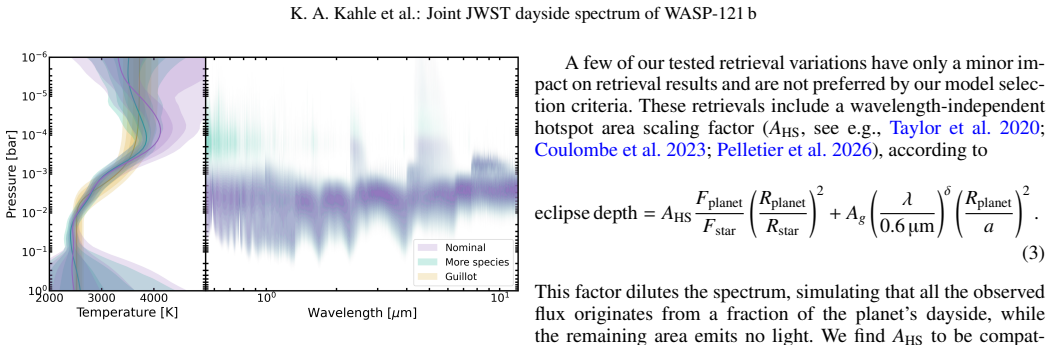
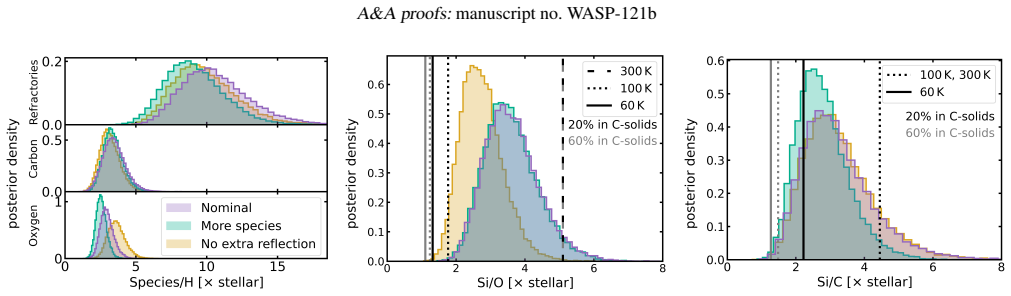
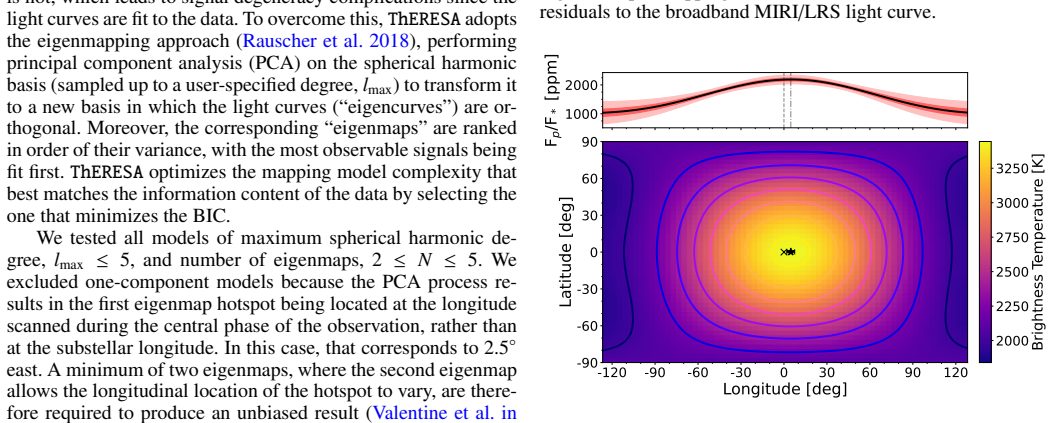
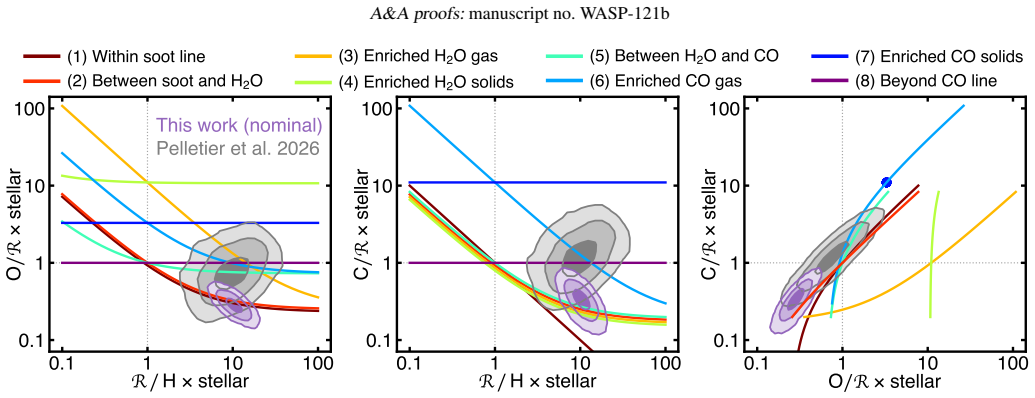
The atmosphere of WASP-121 b is enriched in both volatile and refractory species, with Si/O = 3.54^{+0.86}_{-0.69} times stellar and Si/C = 3.05^{+1.12}_{-0.80} times stellar. This enrichment pattern was shaped by accretion from multiple reservoirs, either through a mixture of solid and gas accretion interior to the water ice line or through continued solid accretion during inward migration from farther out in the disk. The dayside temperature profile shows a strong inversion layer with a complex structure, and an eclipse map indicates a small eastward hotspot offset of 4.8 degrees.
What carries the argument
The comparison of retrieved silicon-to-oxygen and silicon-to-carbon abundance ratios from the combined spectrum against stellar values and planet formation model predictions.
If this is right
- The enrichment pattern supports formation by a mixture of solid and gas accretion interior to the water ice line.
- The same pattern is also consistent with continued solid accretion while the planet migrated inward from beyond the ice line.
- The analysis confirms titanium oxide depletion and requires an additional reflected-light opacity source with geometric albedo 0.22.
- The temperature profile needs more complex structure than standard inversion parameterizations provide.
- The planet could have reached its high-obliquity orbit through a later dynamical event such as scattering or Kozai cycles.
Where Pith is reading between the lines
- Similar panchromatic observations of other ultra-hot Jupiters could test whether refractory enrichment is common to planets that formed by mixed accretion.
- Adding escape and vertical mixing to the retrieval models would clarify how much the observed ratios could differ from the original formation composition.
- The small hotspot offset and complex temperature structure suggest atmospheric dynamics worth mapping with future phase-resolved data.
Load-bearing premise
The retrieved elemental ratios reflect the bulk composition delivered during formation without significant later changes from escape, mixing, or unmodeled clouds and hazes.
What would settle it
A nightside spectrum or interior model that yields stellar Si/O and Si/C ratios after including escape and mixing effects would contradict the multiple-reservoir formation claim.
Figures




read the original abstract
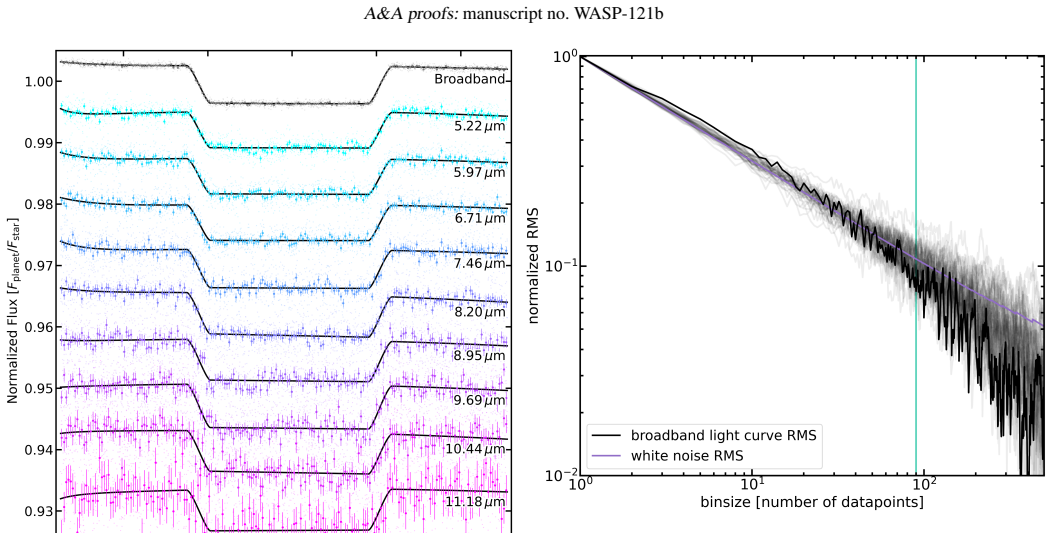
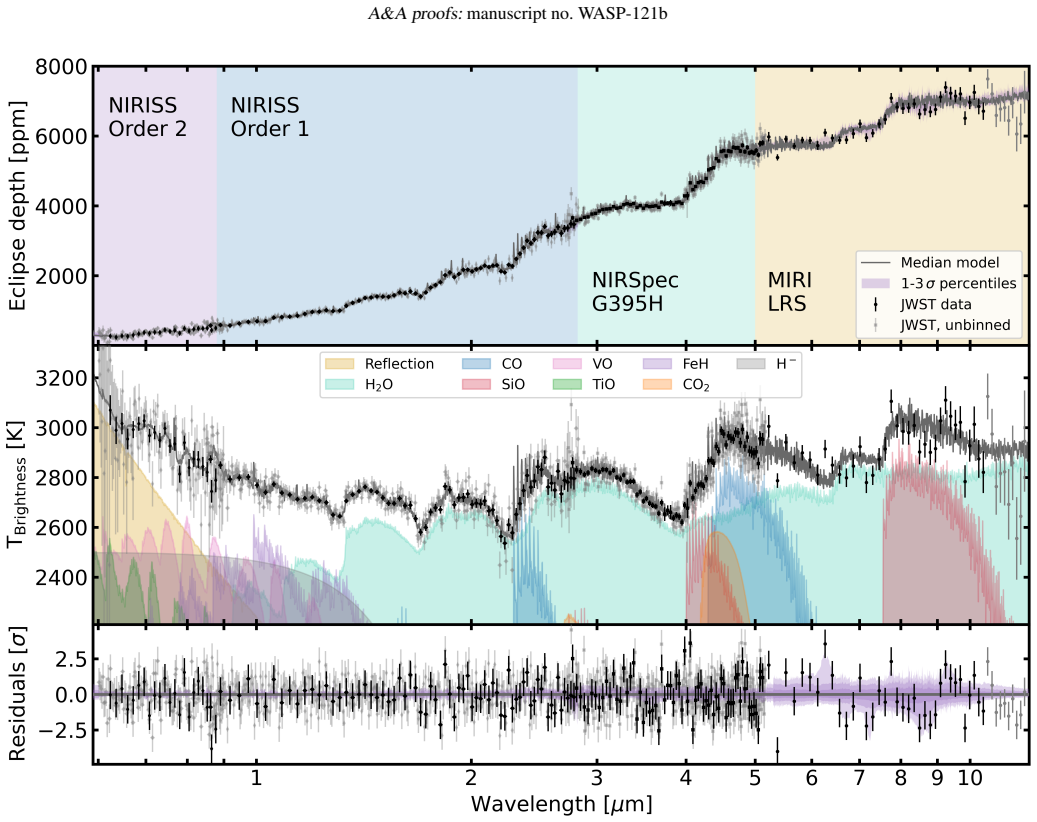
One path to understand how planets form is to link their present-day atmospheric composition to predictions from planet formation models. For the hottest planets, the abundances of refractory species can provide a useful formation tracer, complementing the traditionally used C/O and overall metallicity. Here we investigate the refractory abundance in the atmosphere of the ultra-hot Jupiter WASP-121 b, combining new JWST MIRI/LRS observations with archival NIRSpec/G395H and NIRISS/SOSS data to obtain a panchromatic dayside emission spectrum from 0.6 to 12 $\mu$m. Our retrieval analysis detects the refractory tracer SiO gas at high confidence, in addition to previously detected volatile species. The atmosphere is enriched in volatile and refractory species, with enhanced refractory-to-volatile ratios of Si/O=$3.54^{+0.86}_{-0.69}$x stellar and Si/C=$3.05^{+1.12}_{-0.80}$x stellar, relative to new stellar abundance constraints from ESPRESSO data. In addition, we confirm the depletion of TiO and the need for an additional source of reflected light opacity with a geometric albedo of $0.22\pm0.03$. The retrieved dayside temperature profile has a strong inversion layer, with a more complex structure than standard parameterizations can accommodate, and an eclipse map analysis indicates a small eastward hotspot offset of $4.8^{+2.7\circ}_{-2.8}$. Comparing our results with models of planet formation, we find that the measured enrichment pattern was shaped by accretion from multiple reservoirs, either through a mixture of solid and gas accretion interior to the water ice line or through continued solid accretion during inward migration from farther out in the disk. Finally, we model the planet's dynamical history and find that it could reach its current high-obliquity orbit as a consequence of a post-formation dynamical event, such as planet-planet scattering or von Zeipel-Lidov-Kozai cycles.
Editorial analysis
A structured set of objections, weighed in public.
Referee Report
Summary. The manuscript combines new JWST MIRI/LRS dayside emission data with archival NIRSpec/G395H and NIRISS/SOSS observations to produce a 0.6–12 μm panchromatic spectrum of the ultra-hot Jupiter WASP-121 b. Retrievals detect SiO at high confidence alongside volatile species, report enhanced refractory-to-volatile ratios (Si/O = 3.54^{+0.86}_{-0.69}×stellar and Si/C = 3.05^{+1.12}_{-0.80}×stellar) relative to new ESPRESSO stellar abundances, confirm TiO depletion, require an additional reflected-light source with geometric albedo 0.22±0.03, recover a complex dayside temperature inversion, and find a small eastward hotspot offset. These results are interpreted as evidence that the enrichment pattern arose from accretion from multiple reservoirs (solid+gas interior to the water ice line or continued solid accretion during migration), with dynamical modeling suggesting a post-formation high-obliquity event.
Significance. If the retrieved elemental ratios can be shown to map directly to the bulk composition delivered at formation, the work supplies a rare observational anchor for refractory tracers in ultra-hot Jupiter atmospheres and demonstrates the diagnostic power of panchromatic JWST coverage for distinguishing formation pathways. The multi-instrument dataset and explicit comparison to formation models are strengths that would elevate the paper’s impact in the exoplanet formation literature.
major comments (3)
- [§4] §4 (Atmospheric retrieval results): The central claim that the measured Si/O and Si/C ratios indicate accretion from multiple reservoirs requires that the retrieved abundances equal the formation-delivered bulk composition. No dedicated tests are reported that isolate the effects of atmospheric escape, vertical mixing, or unmodeled cloud/haze opacity on the apparent Si, O, and C abundances in the 0.6–12 μm spectrum; this assumption is load-bearing for the formation interpretation.
- [§3.2] §3.2 (Retrieval setup): The abstract notes that the retrieved temperature profile has a more complex structure than standard parameterizations can accommodate, yet the manuscript provides no quantitative description of the temperature parameterization, cloud treatments, or abundance priors used in the retrieval. These choices directly affect the reported SiO detection significance and the Si/O = 3.54^{+0.86}_{-0.69}×stellar ratio.
- [Table 2] Table 2 or equivalent abundance table: The reported enrichment factors are presented with 1σ uncertainties, but without an accompanying sensitivity analysis to the choice of stellar abundance constraints from ESPRESSO or to possible post-retrieval model adjustments, the robustness of the Si/C = 3.05^{+1.12}_{-0.80}×stellar value cannot be assessed.
minor comments (2)
- [Figure 3] Figure 3 (spectrum plot): The wavelength coverage labels and instrument contributions could be clarified to make the panchromatic nature of the dataset immediately visible to readers.
- [§6] The dynamical history modeling section would benefit from a brief statement of the assumed initial conditions and migration timescales to allow direct comparison with other ultra-hot Jupiter studies.
Simulated Author's Rebuttal
We thank the referee for their constructive and detailed report. We address each major comment below. Where the manuscript requires additional detail or analysis, we will revise accordingly to strengthen the presentation of our results and their interpretation.
read point-by-point responses
-
Referee: [§4] §4 (Atmospheric retrieval results): The central claim that the measured Si/O and Si/C ratios indicate accretion from multiple reservoirs requires that the retrieved abundances equal the formation-delivered bulk composition. No dedicated tests are reported that isolate the effects of atmospheric escape, vertical mixing, or unmodeled cloud/haze opacity on the apparent Si, O, and C abundances in the 0.6–12 μm spectrum; this assumption is load-bearing for the formation interpretation.
Authors: We agree that the interpretation linking retrieved abundances directly to formation-delivered bulk composition rests on an assumption that warrants explicit discussion. Our retrieval framework assumes thermochemical equilibrium and incorporates the dominant opacity sources in the 0.6–12 μm range, but we did not run dedicated sensitivity tests isolating atmospheric escape, vertical mixing, or additional unmodeled haze effects. For an ultra-hot Jupiter, the high temperatures and short radiative timescales make large deviations from equilibrium less likely in the observable photosphere, and our cloud/haze parameterization already explores a range of optical depths. In the revised manuscript we will add a dedicated subsection in §4 discussing these assumptions, their potential impact on the reported Si/O and Si/C ratios, and why the current data do not permit more exhaustive tests. We view this as a partial revision because the core retrieval results remain unchanged. revision: partial
-
Referee: [§3.2] §3.2 (Retrieval setup): The abstract notes that the retrieved temperature profile has a more complex structure than standard parameterizations can accommodate, yet the manuscript provides no quantitative description of the temperature parameterization, cloud treatments, or abundance priors used in the retrieval. These choices directly affect the reported SiO detection significance and the Si/O = 3.54^{+0.86}_{-0.69}×stellar ratio.
Authors: We acknowledge that §3.2 currently lacks the quantitative detail needed for full reproducibility and assessment of the SiO detection. In the revised manuscript we will expand this section to specify: (i) the exact temperature parameterization (number of nodes, spline order, and pressure grid), (ii) the cloud and haze models (including particle size distributions and vertical extent), and (iii) the abundance priors (uniform or log-uniform ranges and any species-specific constraints). These additions will directly address how the chosen setup influences the reported SiO significance and elemental ratios. revision: yes
-
Referee: [Table 2] Table 2 or equivalent abundance table: The reported enrichment factors are presented with 1σ uncertainties, but without an accompanying sensitivity analysis to the choice of stellar abundance constraints from ESPRESSO or to possible post-retrieval model adjustments, the robustness of the Si/C = 3.05^{+1.12}_{-0.80}×stellar value cannot be assessed.
Authors: We will add a sensitivity analysis to the revised manuscript. This will include: (i) re-deriving the enrichment factors using the full range of ESPRESSO stellar abundance uncertainties, and (ii) testing the effect of modest post-retrieval adjustments (e.g., different cloud optical-depth priors or temperature-profile smoothing). The results will be presented alongside Table 2 or in a new supplementary table, allowing readers to evaluate the robustness of the Si/C ratio. revision: yes
Circularity Check
No significant circularity; results derive from new observations and retrievals
full rationale
The paper's derivation chain begins with new JWST MIRI/LRS, NIRSpec/G395H, and NIRISS/SOSS observations plus ESPRESSO stellar abundances, proceeds through atmospheric retrieval to obtain SiO detection and Si/O, Si/C ratios, and ends with comparison to external formation models. No equations, parameters, or claims reduce by construction to prior fits or self-citations; the retrieved ratios are outputs of the data analysis rather than inputs renamed as predictions, and the formation interpretation is an external comparison rather than a self-referential derivation. The central measurements are therefore independent of the interpretive step.
Axiom & Free-Parameter Ledger
free parameters (3)
- Si/O enrichment factor
- Si/C enrichment factor
- Geometric albedo
axioms (2)
- domain assumption Atmospheric retrieval assumes local thermodynamic equilibrium and 1D plane-parallel geometry
- domain assumption Retrieved elemental ratios directly trace the composition of accreted material without post-formation alteration
Reference graph
Works this paper leans on
-
[1]
Perna, Rosalba and Menou, Kristen and Rauscher, Emily , title =. 2010 , month =. doi:10.1088/0004-637X/719/2/1421 , url =
-
[2]
Inhomogeneous magnetic coupling in exoplanets: The stop and go of WASP-18 b's atmospheric flows. , keywords =. doi:10.1051/0004-6361/202558210 , archivePrefix =. 2602.18101 , primaryClass =
-
[3]
Exploring the Effects of Active Magnetic Drag in a General Circulation Model of the Ultrahot Jupiter WASP-76b. , keywords =. doi:10.3847/1538-3881/ac3746 , archivePrefix =. 2109.13371 , primaryClass =
-
[4]
McBride, Bonnie and Zehe, Michael and Gordon, Sanford , month = sep, year =
-
[5]
Ground-based and Airborne Instrumentation for Astronomy V , year = 2014, editor =
Design and early performance of IGRINS (Immersion Grating Infrared Spectrometer). Ground-based and Airborne Instrumentation for Astronomy V , year = 2014, editor =. doi:10.1117/12.2056431 , adsurl =
-
[6]
Observing the Universe at infrared wavelengths and high spectral resolution
CRIRES ^ + on sky at the ESO Very Large Telescope. Observing the Universe at infrared wavelengths and high spectral resolution. , keywords =. doi:10.1051/0004-6361/202245217 , archivePrefix =. 2301.08048 , primaryClass =
-
[7]
Ground-based and Airborne Instrumentation for Astronomy V , year = 2014, editor =
CRIRES+: a cross-dispersed high-resolution infrared spectrograph for the ESO VLT. Ground-based and Airborne Instrumentation for Astronomy V , year = 2014, editor =. doi:10.1117/12.2054197 , adsurl =
-
[8]
Evidence of Titanate Clouds in the Dayside Atmosphere of the Ultrahot Jupiter WASP-121b. , keywords =. doi:10.3847/2041-8213/ae1c1c , archivePrefix =. 2508.20022 , primaryClass =
-
[9]
The Doppler shadow of HD 189733b
MULTINEST: an efficient and robust Bayesian inference tool for cosmology and particle physics. , keywords =. doi:10.1111/j.1365-2966.2009.14548.x , archivePrefix =. 0809.3437 , primaryClass =
-
[10]
The featureless spectrum of HD 86226 c challenges sub-Neptune atmosphere trends
The SPACE Program: I. The featureless spectrum of HD 86226 c challenges sub-Neptune atmosphere trends. , keywords =. doi:10.1051/0004-6361/202554916 , archivePrefix =. 2507.13439 , primaryClass =
-
[11]
, year = 2012, month = nov, volume =
A primordial origin for misalignments between stellar spin axes and planetary orbits. , year = 2012, month = nov, volume =. doi:10.1038/nature11560 , adsurl =
-
[12]
In situ formation of hot Jupiters with companion super-Earths. , keywords =. doi:10.1093/mnras/stab1466 , archivePrefix =. 2105.08553 , primaryClass =
-
[13]
How leaky? A large parameter study of leaky dust traps to quantify the transport of pebbles and ice in protoplanetary discs. , keywords =. doi:10.1051/0004-6361/202659705 , archivePrefix =. 2604.11925 , primaryClass =
work page internal anchor Pith review Pith/arXiv arXiv doi:10.1051/0004-6361/202659705
-
[14]
Vanadium oxide and a sharp onset of cold-trapping on a giant exoplanet. , keywords =. doi:10.1038/s41586-023-06134-0 , archivePrefix =. 2306.08739 , primaryClass =
-
[15]
Time-resolved absorption of six chemical species with MAROON-X points to a strong drag in the ultra-hot Jupiter TOI-1518 b. , keywords =. doi:10.1051/0004-6361/202453241 , archivePrefix =. 2412.01472 , primaryClass =
-
[16]
Crossfield, Ian J. M. , title =. 2023 , month =. doi:10.3847/2041-8213/ace35f , url =
-
[17]
Secular chaos and its application to Mercury, hot Jupiters, and the organization of planetary systems. Proceedings of the National Academy of Science , keywords =. doi:10.1073/pnas.1308261110 , archivePrefix =. 1311.1214 , primaryClass =
work page internal anchor Pith review Pith/arXiv arXiv doi:10.1073/pnas.1308261110
-
[18]
Yan, Dongdong and Guo, Jianheng and Huang, Chenliang and Xing, Lei , title =. 2021 , month =. doi:10.3847/2041-8213/abda41 , url =
-
[19]
The overflowing atmosphere of WASP-121 b: High-resolution He I 10833 transmission spectroscopy with VLT/CRIRES ^ +. , keywords =. doi:10.1051/0004-6361/202451003 , adsurl =
-
[20]
Advances in Space Research , year = 2010, month = jul, volume =
The soot line : Destruction of presolar polycyclic aromatic hydrocarbons in the terrestrial planet-forming region of disks. Advances in Space Research , year = 2010, month = jul, volume =. doi:10.1016/j.asr.2010.02.004 , adsurl =
-
[21]
Helled, Ravit and Stevenson, David , title =. 2017 , month =. doi:10.3847/2041-8213/aa6d08 , url =
-
[22]
Revelations on Jupiter's formation, evolution and interior: Challenges from Juno results. , keywords =. doi:10.1016/j.icarus.2022.114937 , archivePrefix =. 2202.10041 , primaryClass =
-
[23]
Lindstedt \`a l' \'e tude du mouvement des com \`e tes p \'e riodiques
Sur l'application des s \'e ries de M. Lindstedt \`a l' \'e tude du mouvement des com \`e tes p \'e riodiques. Astronomische Nachrichten , year = 1910, month = mar, volume =. doi:10.1002/asna.19091832202 , adsurl =
-
[24]
, year = 1962, month = oct, volume =
The evolution of orbits of artificial satellites of planets under the action of gravitational perturbations of external bodies. , year = 1962, month = oct, volume =. doi:10.1016/0032-0633(62)90129-0 , adsurl =
-
[25]
, year = 1962, month = nov, volume =
Secular perturbations of asteroids with high inclination and eccentricity. , year = 1962, month = nov, volume =. doi:10.1086/108790 , adsurl =
-
[26]
The Eccentric Kozai-Lidov Effect and Its Applications
The Eccentric Kozai-Lidov Effect and Its Applications. , keywords =. doi:10.1146/annurev-astro-081915-023315 , archivePrefix =. 1601.07175 , primaryClass =
work page internal anchor Pith review Pith/arXiv arXiv doi:10.1146/annurev-astro-081915-023315
-
[27]
The JADE code: Coupling secular exoplanetary dynamics and photo-evaporation. , keywords =. doi:10.1051/0004-6361/202039452 , archivePrefix =. 2103.02627 , primaryClass =
-
[28]
The JADE code: II. Modeling the coupled orbital and atmospheric evolution of GJ 436 b to constrain its migration and companion. , keywords =. doi:10.1051/0004-6361/202555239 , archivePrefix =. 2509.07938 , primaryClass =
-
[29]
HST/STIS Capability for Love Number Measurement of WASP-121b. , keywords =. doi:10.3847/1538-4357/ab616e , archivePrefix =. 1912.05889 , primaryClass =
-
[30]
Coupled Planetary Interior and Tidal Evolution. , keywords =. doi:10.3847/1538-4357/ae129d , archivePrefix =. 2509.22923 , primaryClass =
-
[31]
Observational and Dynamical Constraints on an Unseen Outer Perturber in the GJ 436 Hot Neptune System. , keywords =. doi:10.3847/1538-4357/ae606b , archivePrefix =. 2604.09834 , primaryClass =
work page internal anchor Pith review Pith/arXiv arXiv doi:10.3847/1538-4357/ae606b
-
[32]
Suppression of extreme orbital evolution in triple systems with short range forces
Suppression of extreme orbital evolution in triple systems with short-range forces. , keywords =. doi:10.1093/mnras/stu2396 , archivePrefix =. 1409.6717 , primaryClass =
work page internal anchor Pith review Pith/arXiv arXiv doi:10.1093/mnras/stu2396
-
[33]
A Hydrodynamic Study of the Escape of Metal Species and Excited Hydrogen from the Atmosphere of the Hot Jupiter WASP-121b. , keywords =. doi:10.3847/1538-4357/accd5e , archivePrefix =. 2304.07352 , primaryClass =
-
[34]
Modeling the Dynamics and Thermochemistry for the Outer Atmospheres of the Ultra-hot Jupiter WASP-121b. arXiv e-prints , keywords =. doi:10.48550/arXiv.2602.01364 , archivePrefix =. 2602.01364 , primaryClass =
-
[35]
The spin─orbit angle distribution of close-in exoplanets under the lens of tides
DREAM: II. The spin─orbit angle distribution of close-in exoplanets under the lens of tides. , keywords =. doi:10.1051/0004-6361/202245237 , archivePrefix =. 2305.00829 , primaryClass =
-
[36]
In situ enrichment in heavy elements of hot Jupiters. , keywords =. doi:10.1051/0004-6361/202346868 , archivePrefix =. 2306.01653 , primaryClass =
-
[37]
Pebble-isolation mass: Scaling law and implications for the formation of super-Earths and gas giants. , keywords =. doi:10.1051/0004-6361/201731931 , archivePrefix =. 1801.02341 , primaryClass =
work page internal anchor Pith review Pith/arXiv arXiv doi:10.1051/0004-6361/201731931
-
[38]
Dynamics of pebbles in the vicinity of a growing planetary embryo: hydro-dynamical simulations
Dynamics of pebbles in the vicinity of a growing planetary embryo: hydro-dynamical simulations. , keywords =. doi:10.1051/0004-6361/201219824 , archivePrefix =. 1208.4687 , primaryClass =
work page internal anchor Pith review Pith/arXiv arXiv doi:10.1051/0004-6361/201219824
-
[39]
The effect of gas drag on the growth of protoplanets. Analytical expressions for the accretion of small bodies in laminar disks. , keywords =. doi:10.1051/0004-6361/201014903 , archivePrefix =. 1007.0916 , primaryClass =
work page internal anchor Pith review Pith/arXiv arXiv doi:10.1051/0004-6361/201014903
-
[40]
Prograde rotation of protoplanets by accretion of pebbles in a gaseous environment , ISSN=
Prograde rotation of protoplanets by accretion of pebbles in a gaseous environment. , keywords =. doi:10.1111/j.1365-2966.2010.16309.x , archivePrefix =. 0910.1524 , primaryClass =
-
[41]
Composition of giant planets: The roles of pebbles and planetesimals. , keywords =. doi:10.1051/0004-6361/202347501 , archivePrefix =. 2310.02886 , primaryClass =
-
[42]
Cloud property trends in hot and ultra-hot giant gas planets (WASP-43b, WASP-103b, WASP-121b, HAT-P-7b, and WASP-18b). , keywords =. doi:10.1051/0004-6361/202039911 , archivePrefix =. 2102.11688 , primaryClass =
-
[43]
Powell, Diana and Zhang, Xi and Gao, Peter and Parmentier, Vivien , title =. 2018 , month =. doi:10.3847/1538-4357/aac215 , url =
-
[44]
Transmission spectral properties of clouds for hot Jupiter exoplanets
Transmission spectral properties of clouds for hot Jupiter exoplanets. , keywords =. doi:10.1051/0004-6361/201424207 , archivePrefix =. 1409.7594 , primaryClass =
work page internal anchor Pith review Pith/arXiv arXiv doi:10.1051/0004-6361/201424207
-
[45]
Turrini, D. and Schisano, E. and Fonte, S. and Molinari, S. and Politi, R. and Fedele, D. and Panić, O. and Kama, M. and Changeat, Q. and Tinetti, G. , title =. 2021 , month =. doi:10.3847/1538-4357/abd6e5 , url =
-
[46]
Disk evolution, element abundances and cloud properties of young gas giant planets
Disk Evolution, Element Abundances and Cloud Properties of Young Gas Giant Planets. Life , keywords =. doi:10.3390/life4020142 , archivePrefix =. 1403.4420 , primaryClass =
work page internal anchor Pith review Pith/arXiv arXiv doi:10.3390/life4020142
-
[47]
Pacetti, Elenia and Turrini, Diego and Schisano, Eugenio and Molinari, Sergio and Fonte, Sergio and Politi, Romolo and Hennebelle, Patrick and Klessen, Ralf and Testi, Leonardo and Lebreuilly, Ugo , title =. 2022 , month =. doi:10.3847/1538-4357/ac8b11 , url =
-
[48]
Setting the volatile composition of (exo)planet-building material. Does chemical evolution in disk midplanes matter?. , keywords =. doi:10.1051/0004-6361/201628509 , archivePrefix =. 1607.06710 , primaryClass =
work page internal anchor Pith review Pith/arXiv arXiv doi:10.1051/0004-6361/201628509
-
[49]
BOWIE-ALIGN: how formation and migration histories of giant planets impact atmospheric compositions. , keywords =. doi:10.1093/mnras/stae2362 , archivePrefix =. 2407.03199 , primaryClass =
-
[50]
A main sequence for C/O in hot exoplanetary atmospheres
Connecting planet formation and astrochemistry. A main sequence for C/O in hot exoplanetary atmospheres. , keywords =. doi:10.1051/0004-6361/201936105 , archivePrefix =. 1910.13171 , primaryClass =
-
[51]
Towards Chemical Constraints on Hot Jupiter Migration
Toward Chemical Constraints on Hot Jupiter Migration. , keywords =. doi:10.1088/2041-8205/794/1/L12 , archivePrefix =. 1408.3668 , primaryClass =
work page internal anchor Pith review Pith/arXiv arXiv doi:10.1088/2041-8205/794/1/l12 2041
-
[52]
Summary of the contents and survey properties
Gaia Early Data Release 3. Summary of the contents and survey properties. , keywords =. doi:10.1051/0004-6361/202039657 , archivePrefix =. 2012.01533 , primaryClass =
-
[53]
The Gaia mission. , keywords =. doi:10.1051/0004-6361/201629272 , archivePrefix =. 1609.04153 , primaryClass =
work page internal anchor Pith review Pith/arXiv arXiv doi:10.1051/0004-6361/201629272
-
[54]
The carbon isotope ratio of \beta\ Pic b with high-resolution spectroscopy
The carbon isotope ratio of Pic b with high-resolution spectroscopy. arXiv e-prints , keywords =. doi:10.48550/arXiv.2606.12401 , archivePrefix =. 2606.12401 , primaryClass =
work page internal anchor Pith review Pith/arXiv arXiv doi:10.48550/arxiv.2606.12401
-
[55]
Possibly distinct formation pathways of super-Jupiters and brown dwarfs
The ^ 12 CO/ ^ 13 CO isotopologue ratio of a young, isolated brown dwarf. Possibly distinct formation pathways of super-Jupiters and brown dwarfs. , keywords =. doi:10.1051/0004-6361/202141502 , archivePrefix =. 2109.11569 , primaryClass =
-
[56]
$^{13}$CO and potential variability in $\beta$ Pictoris b with GRAVITY+
^ 13 CO and potential variability in β Pictoris b with GRAVITY+. arXiv e-prints , keywords =. doi:10.48550/arXiv.2606.11972 , archivePrefix =. 2606.11972 , primaryClass =
work page internal anchor Pith review Pith/arXiv arXiv doi:10.48550/arxiv.2606.11972
-
[57]
Protostars and Planets VII , year = 2023, editor =
Setting the Stage for Planet Formation: Measurements and Implications of the Fundamental Disk Properties. Protostars and Planets VII , year = 2023, editor =. doi:10.48550/arXiv.2203.09818 , archivePrefix =. 2203.09818 , primaryClass =
-
[58]
JWST Edge-on Disk Ice (JEDIce): Program Overview and Ice Survey Results. , keywords =. doi:10.3847/1538-4357/ae5961 , archivePrefix =. 2603.18163 , primaryClass =
-
[59]
The New Generation Planetary Population Synthesis (NGPPS). IV. Planetary systems around low-mass stars. , keywords =. doi:10.1051/0004-6361/202140390 , archivePrefix =. 2105.04596 , primaryClass =
-
[60]
Planetesimal formation during protoplanetary disk buildup. , keywords =. doi:10.1051/0004-6361/201732221 , archivePrefix =. 1803.00575 , primaryClass =
-
[61]
Burned to ashes: How the thermal decomposition of refractory organics in the inner protoplanetary disc impacts the gas-phase C/O ratio. , keywords =. doi:10.1051/0004-6361/202555164 , archivePrefix =. 2505.20427 , primaryClass =
-
[62]
Extrasolar planet population synthesis. I. Method, formation tracks, and mass-distance distribution. , keywords =. doi:10.1051/0004-6361/200810301 , archivePrefix =. 0904.2524 , primaryClass =
work page internal anchor Pith review Pith/arXiv arXiv doi:10.1051/0004-6361/200810301
-
[63]
Grain opacity and the bulk composition of extrasolar planets. I. Results from scaling the ISM opacity. , keywords =. doi:10.1051/0004-6361/201321479 , archivePrefix =. 1403.5272 , primaryClass =
work page internal anchor Pith review Pith/arXiv arXiv doi:10.1051/0004-6361/201321479
-
[64]
Protostars and Planets VII , year = 2023, editor =
Planet Formation Theory in the Era of ALMA and Kepler: from Pebbles to Exoplanets. Protostars and Planets VII , year = 2023, editor =. doi:10.48550/arXiv.2203.09759 , archivePrefix =. 2203.09759 , primaryClass =
-
[65]
Giant Planet Formation by Core Accretion
Giant Planet Formation by Core Accretion. Extreme Solar Systems , year = 2008, editor =. doi:10.48550/arXiv.0710.5667 , archivePrefix =. 0710.5667 , primaryClass =
work page internal anchor Pith review Pith/arXiv arXiv doi:10.48550/arxiv.0710.5667 2008
-
[66]
The imprint of exoplanet formation history on observable present-day spectra of hot Jupiters
The Imprint of Exoplanet Formation History on Observable Present-day Spectra of Hot Jupiters. , keywords =. doi:10.3847/0004-637X/832/1/41 , archivePrefix =. 1609.03019 , primaryClass =
work page internal anchor Pith review Pith/arXiv arXiv doi:10.3847/0004-637x/832/1/41
-
[67]
On Linking Planet Formation Models, Protoplanetary Disk Properties, and Mature Gas Giant Exoplanet Atmospheres. arXiv e-prints , keywords =. doi:10.48550/arXiv.2506.00669 , archivePrefix =. 2506.00669 , primaryClass =
-
[68]
Mathematical Proceedings of the Cambridge Philosophical Society , author=
Some Tests of Significance, Treated by the Theory of Probability , volume=. Mathematical Proceedings of the Cambridge Philosophical Society , author=. 1935 , pages=. doi:10.1017/S030500410001330X , number=
-
[69]
doi:10.5281/zenodo.20058613 , url =
Bushouse, Howard and Eisenhamer, Jonathan and Dencheva, Nadia and Davies, James and Greenfield, Perry and Morrison, Jane and Hodge, Phil and Simon, Bernie and Grumm, David and Droettboom, Michael and Slavich, Edward and Sosey, Megan and Pauly, Tyler and Miller, Todd and Jedrzejewski, Robert and Hack, Warren and Davis, David and Crawford, Steven and Law, D...
-
[70]
An Absolute Mass, Precise Age, and Hints of Planetary Winds for WASP-121A and b from a JWST NIRSpec Phase Curve. , keywords =. doi:10.3847/1538-3881/ad7fe7 , archivePrefix =. 2501.03844 , primaryClass =
-
[71]
Ground-based and Airborne Instrumentation for Astronomy VII , year = 2018, editor =
IGRINS at the Discovery Channel Telescope and Gemini South. Ground-based and Airborne Instrumentation for Astronomy VII , year = 2018, editor =. doi:10.1117/12.2312345 , adsurl =
-
[72]
The Mantis Network. IV. A titanium cold trap on the ultra-hot Jupiter WASP-121 b. , keywords =. doi:10.1051/0004-6361/202244968 , archivePrefix =. 2210.12847 , primaryClass =
-
[73]
, year = 1992, month = mar, volume =
Atomic and Molecular Data for Opacity Calculations. , year = 1992, month = mar, volume =
1992
-
[74]
Monthly Notices of the Royal Astronomical Society , volume =
Bowesman, Charles A and Qu, Qianwei and McKemmish, Laura K and Yurchenko, Sergei N and Tennyson, Jonathan , title =. Monthly Notices of the Royal Astronomical Society , volume =. 2024 , month =. doi:10.1093/mnras/stae542 , url =
-
[75]
Enriching inner discs and giant planets with heavy elements. , keywords =. doi:10.1051/0004-6361/202347419 , archivePrefix =. 2309.00509 , primaryClass =
-
[76]
Leaky dust traps: How fragmentation impacts dust filtering by planets. , keywords =. doi:10.1051/0004-6361/202245512 , archivePrefix =. 2301.05505 , primaryClass =
-
[77]
Evidence of ammonium salts in comet 67P as explanation for the nitrogen depletion in cometary comae. Nature Astronomy , keywords =. doi:10.1038/s41550-019-0991-9 , archivePrefix =. 1911.13005 , primaryClass =
-
[78]
Tracing the Ingredients for a Habitable Earth from Interstellar Space through Planet Formation
Tracing the ingredients for a habitable earth from interstellar space through planet formation. Proceedings of the National Academy of Science , keywords =. doi:10.1073/pnas.1500954112 , archivePrefix =. 1507.04756 , primaryClass =
work page internal anchor Pith review Pith/arXiv arXiv doi:10.1073/pnas.1500954112
-
[79]
Influence of sub- and super-solar metallicities on the composition of solid planetary building blocks. , keywords =. doi:10.1051/0004-6361/201936463 , archivePrefix =. 1911.09725 , primaryClass =
-
[80]
Convective Mixing in Gas Giant Planets with Primordial Composition Gradients. , keywords =. doi:10.3847/1538-4357/ad8dd0 , archivePrefix =. 2407.09341 , primaryClass =
discussion (0)
Sign in with ORCID, Apple, or X to comment. Anyone can read and Pith papers without signing in.