Pre-Generation Hallucination Detection in Large Language Models via Soft-Target Attention Probing
Pith reviewed 2026-06-26 12:16 UTC · model grok-4.3
The pith
Hallucination risk before LLM generation can be estimated from prompt representations using soft-target supervision derived from sampled error rates.
A machine-rendered reading of the paper's core claim, the machinery that carries it, and where it could break.
Core claim
By treating hallucination detection as risk estimation rather than binary classification, soft-target supervision from the empirical answer error rate over stochastically sampled outputs serves as the unique unbiased minimum-variance estimator of the model's per-prompt error probability. Adapting attention probing to the pre-generation setting allows selective aggregation of hallucination-relevant prompt representations, yielding consistent improvements in detection quality when combined with the soft targets.
What carries the argument
Soft-target supervision estimator from empirical error rates, combined with attention probing on pre-generation prompt representations.
Load-bearing premise
Attention probing on prompt representations can selectively aggregate hallucination-relevant information to outperform linear probing.
What would settle it
An experiment measuring the bias or variance of the empirical error-rate estimator against the true per-prompt error probability on held-out prompts, or a comparison where attention probing does not outperform linear probing on new short-answer benchmarks.
Figures




read the original abstract
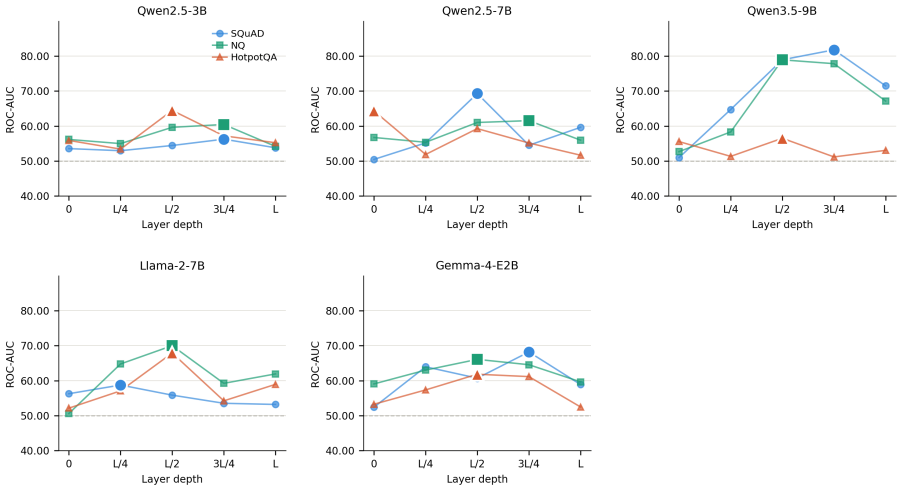
Detecting hallucination risk before generation enables abstention, retrieval augmentation, and routing decisions without incurring the cost of decoding. While prior work has shown that such risk can be estimated from a model's internal representations, existing approaches treat this as binary classification over a single decoded output. We instead formulate it as a risk-estimation problem. Under this formulation, we introduce soft-target supervision based on the empirical answer error rate over stochastically sampled outputs - an estimator we prove to be the unique unbiased minimum-variance estimator of the model's per-prompt error probability under its sampling distribution. We further adapt attention probing to the pre-generation setting, enabling the detector to selectively aggregate hallucination-relevant prompt representations. Across three question-answering benchmarks and five models, attention probing outperforms linear probing on short-answer tasks. Replacing binary labels with soft-target supervision further and consistently improves detection quality.
Editorial analysis
A structured set of objections, weighed in public.
Referee Report
Summary. The paper formulates pre-generation hallucination detection in LLMs as a risk-estimation problem rather than binary classification over a single output. It introduces soft-target supervision derived from the empirical answer error rate over stochastically sampled model outputs and proves this to be the unique unbiased minimum-variance estimator (UMVUE) of the per-prompt error probability under the model's sampling distribution. It further adapts attention probing to aggregate hallucination-relevant information from prompt representations before any tokens are generated. Experiments across three QA benchmarks and five models show that attention probing outperforms linear probing on short-answer tasks, with additional consistent gains from replacing binary labels with the proposed soft targets.
Significance. If the UMVUE proof and empirical gains hold, the work supplies a statistically grounded, parameter-free estimator for hallucination risk that avoids full decoding costs. The theoretical identification of the sample proportion as UMVUE under i.i.d. Bernoulli sampling is a clear strength, as is the consistent outperformance of attention probing over linear probing when using soft targets. These elements could support more efficient abstention, retrieval, or routing decisions in deployed LLMs.
major comments (1)
- [Abstract] Abstract: the claim of 'consistent' empirical improvements from soft-target supervision and attention probing is load-bearing for the practical contribution, yet the abstract provides no information on the number of stochastic samples per prompt, the variance of the estimator, or statistical significance tests for the reported gains; without these the robustness of the cross-model, cross-benchmark claim cannot be evaluated.
minor comments (2)
- The manuscript should clarify whether the stochastic sampling for label construction is performed with temperature >0 and how many samples are drawn in practice, as this directly affects both the variance of the soft targets and the computational overhead of the supervision pipeline.
- Notation for the error indicator and sampling distribution should be introduced explicitly in the methods section to make the UMVUE proof self-contained for readers unfamiliar with complete sufficient statistics for Bernoulli parameters.
Simulated Author's Rebuttal
We thank the referee for the detailed and constructive review. The single major comment concerns the abstract's lack of supporting experimental details. We address it below and will incorporate the requested information.
read point-by-point responses
-
Referee: [Abstract] Abstract: the claim of 'consistent' empirical improvements from soft-target supervision and attention probing is load-bearing for the practical contribution, yet the abstract provides no information on the number of stochastic samples per prompt, the variance of the estimator, or statistical significance tests for the reported gains; without these the robustness of the cross-model, cross-benchmark claim cannot be evaluated.
Authors: We agree that the abstract would benefit from these details to allow readers to assess robustness without consulting the main text. The manuscript already specifies the number of stochastic samples (Section 4.1), derives the variance of the sample-proportion estimator from the UMVUE property (Theorem 1 and proof in Appendix A), and reports statistical significance via paired tests (Section 4.3 and Appendix B). In the revision we will condense these facts into the abstract while preserving its length constraints. revision: yes
Circularity Check
No significant circularity identified
full rationale
The paper's central claim introduces soft-target supervision from empirical error rates over stochastic samples and states it is the UMVUE for per-prompt error probability. This reduces to the standard sample proportion estimator for a Bernoulli parameter under i.i.d. sampling, a result from classical statistics that does not depend on any fitted parameters, self-citations, or redefinitions internal to the paper. Attention probing is presented as an empirical adaptation without load-bearing uniqueness theorems or ansatzes smuggled via self-citation. No steps match the enumerated circularity patterns; the derivation chain is self-contained against external statistical benchmarks.
Axiom & Free-Parameter Ledger
Reference graph
Works this paper leans on
-
[1]
InFindings of the Association for Computational Lin- guistics: EMNLP 2025, pages 12413–12428, Suzhou, China
FACTCHECKMATE: Preemp- tively detecting and mitigating hallucinations in LMs. InFindings of the Association for Computational Lin- guistics: EMNLP 2025, pages 12413–12428, Suzhou, China. Association for Computational Linguistics. Akari Asai, Zeqiu Wu, Yizhong Wang, Avirup Sil, and Hannaneh Hajishirzi
2025
-
[2]
Self-RAG: Learning to Retrieve, Generate, and Critique through Self-Reflection
Self-rag: Learning to retrieve, generate, and critique through self-reflection. ArXiv, abs/2310.11511. Amos Azaria and Tom Mitchell
work page internal anchor Pith review Pith/arXiv arXiv
-
[3]
InFind- ings of the Association for Computational Linguistics: EMNLP 2023, pages 967–976, Singapore
The internal state of an LLM knows when it’s lying. InFind- ings of the Association for Computational Linguistics: EMNLP 2023, pages 967–976, Singapore. Associa- tion for Computational Linguistics. Alexandra Bazarova, Aleksandr Yugay, Andrey Shulga, Alina Ermilova, Andrei V olodichev, Konstantin Polev, Julia Belikova, Rauf Parchiev, Dmitry Simakov, Maxim ...
2023
-
[4]
Discovering Latent Knowledge in Language Models Without Supervision
Discovering latent knowledge in language models without supervision.ArXiv, abs/2212.03827. Sky CH-Wang, Benjamin Van Durme, Jason Eisner, and Chris Kedzie
work page internal anchor Pith review Pith/arXiv arXiv
-
[5]
Association for Computational Linguistics
Do androids know they’re only dreaming of electric sheep? InFindings of the As- sociation for Computational Linguistics: ACL 2024, pages 4401–4420, Bangkok, Thailand. Association for Computational Linguistics. Yung-Sung Chuang, Linlu Qiu, Cheng-Yu Hsieh, Ran- jay Krishna, Yoon Kim, and James Glass
2024
-
[6]
InProceedings of the 2024 Con- ference on Empirical Methods in Natural Language Processing, pages 1419–1436
Lookback lens: Detecting and mitigating contextual hallucinations in large language models using only attention maps. InProceedings of the 2024 Con- ference on Empirical Methods in Natural Language Processing, pages 1419–1436. Christopher Clark, Kenton Lee, Ming-Wei Chang, Tom Kwiatkowski, Michael Collins, and Kristina Toutanova
2024
-
[7]
InProceedings of the 2024 Conference on Empirical Methods in Natural Lan- guage Processing, pages 3994–4019, Miami, Florida, USA
Estimating knowledge in large language models without gen- erating a single token. InProceedings of the 2024 Conference on Empirical Methods in Natural Lan- guage Processing, pages 3994–4019, Miami, Florida, USA. Association for Computational Linguistics. Chuan Guo, Geoff Pleiss, Yu Sun, and Kilian Q. Wein- berger
2024
-
[8]
Language Models (Mostly) Know What They Know
Language models (mostly) know what they know.ArXiv, abs/2207.05221. Sai Akhil Kogilathota, Sripadha Vallabha E G, Luzhe Sun, and Jiawei Zhou
work page internal anchor Pith review Pith/arXiv arXiv
-
[9]
Erich L Lehmann and George Casella
Natu- ral questions: A benchmark for question answering research.Transactions of the Association for Compu- tational Linguistics, 7:453–466. Erich L Lehmann and George Casella. 1998.Theory of Point Estimation, 2 edition. Springer, New York, NY . Andrey Malinin and Mark John Francis Gales
1998
-
[10]
InProceedings of the 2023 Conference on Empiri- cal Methods in Natural Language Processing, pages 9004–9017, Singapore
SelfCheckGPT: Zero-resource black-box hallucina- tion detection for generative large language models. InProceedings of the 2023 Conference on Empiri- cal Methods in Natural Language Processing, pages 9004–9017, Singapore. Association for Computa- tional Linguistics. Mehryar Mohri, Afshin Rostamizadeh, and Ameet Tal- walkar. 2018.Foundations of machine lea...
2023
-
[11]
InProceedings of the 63rd An- nual Meeting of the Association for Computational Linguistics, pages 6355–6384
Adap- tive retrieval without self-knowledge? bringing un- certainty back home. InProceedings of the 63rd An- nual Meeting of the Association for Computational Linguistics, pages 6355–6384. Rafael Müller, Simon Kornblith, and Geoffrey Hinton. 2019.When does label smoothing help?Curran Associates Inc., Red Hook, NY , USA. Cheng Niu, Yuanhao Wu, Juno Zhu, Si...
2019
-
[12]
InProceedings of the 2016 Conference on Empirical Methods in Natu- ral Language Processing, pages 2383–2392, Austin, Texas
SQuAD: 100,000+ questions for machine comprehension of text. InProceedings of the 2016 Conference on Empirical Methods in Natu- ral Language Processing, pages 2383–2392, Austin, Texas. Association for Computational Linguistics. Pranab Sahoo, Prabhash Meharia, Akash Ghosh, Sri- parna Saha, Vinija Jain, and Aman Chadha
2016
-
[13]
InProceedings of the 2018 Conference on Empiri- cal Methods in Natural Language Processing, pages 2369–2380, Brussels, Belgium
HotpotQA: A dataset for diverse, explainable multi-hop question answering. InProceedings of the 2018 Conference on Empiri- cal Methods in Natural Language Processing, pages 2369–2380, Brussels, Belgium. Association for Com- putational Linguistics. Lianmin Zheng, Wei-Lin Chiang, Ying Sheng, Siyuan Zhuang, Zhanghao Wu, Yonghao Zhuang, Zi Lin, Zhuohan Li, Da...
2018
-
[14]
In Proceedings of the 37th International Conference on Neural Information Processing Systems, NIPS ’23, Red Hook, NY , USA
Judging llm-as-a-judge with mt-bench and chatbot arena. In Proceedings of the 37th International Conference on Neural Information Processing Systems, NIPS ’23, Red Hook, NY , USA. Curran Associates Inc. A Statistical learning theory justification for soft-targets Our results shows that, under cross-entropy train- ing, empirical soft targets provide an unb...
2018
-
[15]
Since input paragraphs are often too long for smaller models, we use the long answer as the context and the short answer as the gold target
contains over 300,000 Wikipedia-sourced ques- tions with both short and long reference answers. Since input paragraphs are often too long for smaller models, we use the long answer as the context and the short answer as the gold target. We sample 9,000 examples uniformly. B.2 Dataset Statistics Dataset Train Test Validation SQuAD 8456 1057 1057 HotpotQA 6...
2021
discussion (0)
Sign in with ORCID, Apple, or X to comment. Anyone can read and Pith papers without signing in.