DevoTG: Temporal Graph Neural Networks for Modeling C. elegans Developmental Connectomics
Pith reviewed 2026-06-26 12:15 UTC · model grok-4.3
The pith
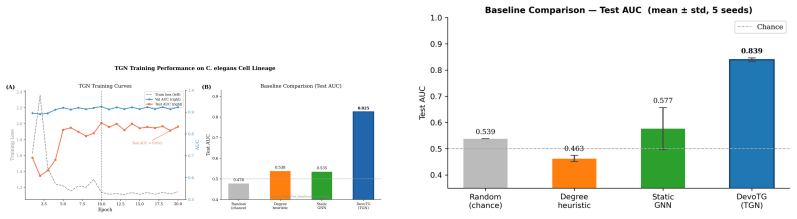
Temporal memory in graph neural networks improves C. elegans lineage prediction by 26 AUC points over static models.
A machine-rendered reading of the paper's core claim, the machinery that carries it, and where it could break.
Core claim
DevoTG shows that Temporal Graph Neural Networks applied to a continuous-time dynamic graph of cell lineage events and a discrete-time dynamic graph of the developing synaptic connectome achieve a mean test AUC of 0.839 on lineage prediction, 26 points above an identical-architecture static GNN, and that the same models can classify connections into stable, developmental, and variable classes while revealing progressive reinforcement of centrality in command interneurons across larval stages.
What carries the argument
Temporal Graph Neural Networks operating on continuous-time dynamic graphs of cell divisions and discrete-time dynamic graphs of synaptic connections.
If this is right
- Lineage prediction accuracy depends on the presence of temporal memory in the model.
- Connections in the developing connectome fall into three stability classes derived from temporal patterns.
- Hub command interneurons AVA, AVB, and AVE maintain persistent centrality that strengthens across stages.
- Temporal graph representations complement existing classifications based on individual variability.
- Interactive visualizations of the temporal graphs support generation of biological hypotheses about wiring.
Where Pith is reading between the lines
- The same temporal-graph approach could be tested on developmental data from other organisms to check whether timing effects generalize beyond C. elegans.
- The three stability classes might be used to predict which connections are most sensitive to genetic or environmental perturbations during development.
- Running the model forward in time after simulated changes in cell-division order could generate testable predictions about final connectome structure.
Load-bearing premise
A static graph neural network using the identical architecture but without any temporal component serves as a sufficient control to isolate the contribution of temporal memory.
What would settle it
A controlled replication of the lineage prediction task in which a static GNN matches or exceeds the temporal model's AUC of 0.839 would indicate that temporal memory is not required.
Figures
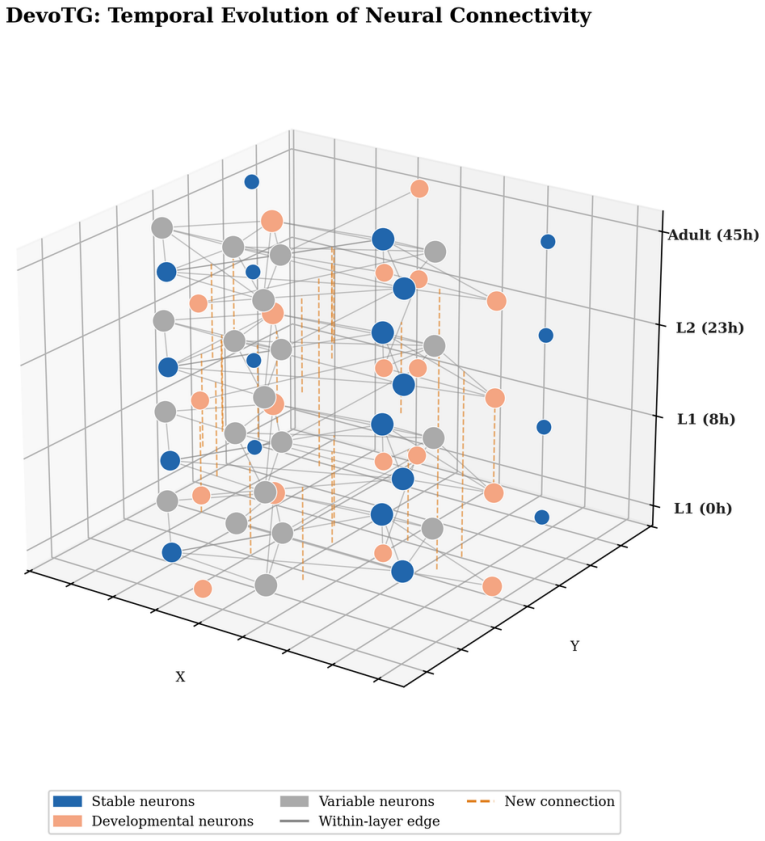
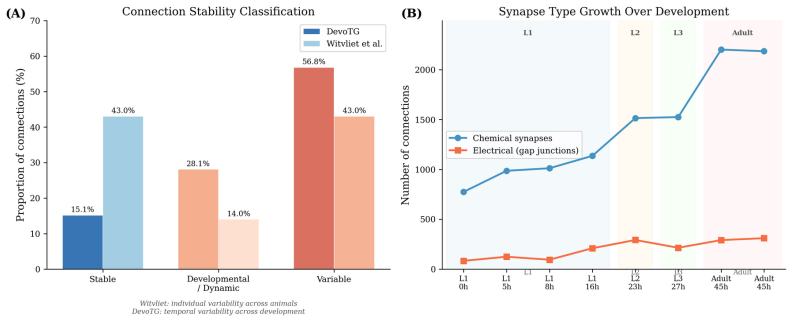
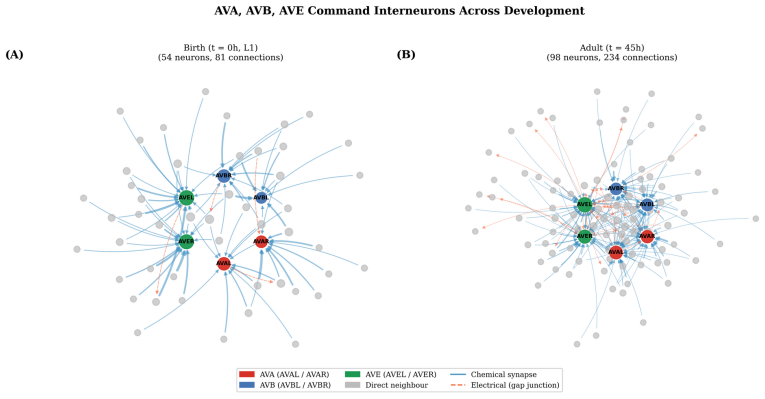
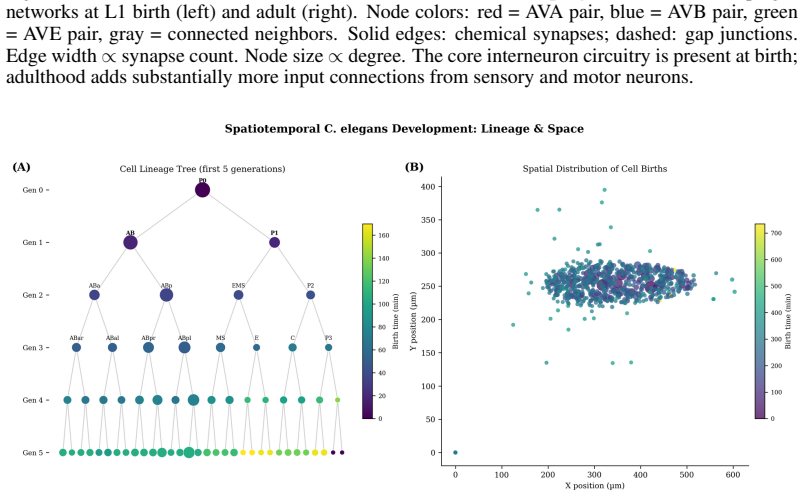
read the original abstract
Understanding how a nervous system wires itself from birth to adulthood is a fundamental challenge in developmental neuroscience. We present DevoTG, a temporal graph framework that applies Temporal Graph Neural Networks (TGNs) to two complementary representations of C. elegans neural development: a Continuous-Time Dynamic Graph (CTDG) of cell division events derived from cell lineage data, and a Discrete-Time Dynamic Graph (DTDG) of the developing synaptic connectome spanning eight reconstructed electron-microscopy datasets. On the lineage prediction task, our TGN achieves a mean test AUC of 0.839 +/- 0.007 (5 seeds; validation AUC 0.937 +/- 0.001), outperforming a static GNN with the identical architecture by 26 AUC points (0.577 +/- 0.080), demonstrating that temporal memory is the decisive factor. Applied to the connectome DTDG, DevoTG identifies three connection stability classes (stable, developmental, and variable) across 225 neurons and 858 to 2,496 connections over development (L1 birth to adult), providing a temporal-graph-theoretic complement to the individual-variability classification of Witvliet et al. Analysis of hub command interneurons AVA, AVB, and AVE reveals their persistent centrality and how their integration roles are progressively reinforced across larval stages. Accompanying interactive visualizations (3D animated networks, centrality heatmaps, and a spatiotemporal lineage graph) make developmental dynamics accessible for biological hypothesis generation. DevoTG is open-source and designed for extension to other developing nervous systems. Code is publicly available at https://github.com/DevoLearn/DevoGraph/tree/main/DevoTG.
Editorial analysis
A structured set of objections, weighed in public.
Referee Report
Summary. The paper introduces DevoTG, a temporal graph neural network framework for modeling C. elegans developmental connectomics. It represents cell lineage data as a Continuous-Time Dynamic Graph (CTDG) and the synaptic connectome as a Discrete-Time Dynamic Graph (DTDG) across eight developmental stages. On a lineage prediction task, a TGN achieves mean test AUC 0.839 +/- 0.007, outperforming a static GNN with identical architecture by 26 AUC points (0.577 +/- 0.080), which the authors interpret as evidence that temporal memory is decisive. The work further classifies connections into stability classes, analyzes hub neuron centrality trajectories, and releases interactive visualizations and open-source code.
Significance. If the performance gap is shown to arise specifically from temporal components rather than capacity or implementation differences, the framework could supply a useful computational lens for developmental neuroscience, complementing existing static connectome analyses and enabling hypothesis generation about wiring dynamics. The provision of code and visualizations strengthens potential impact for the community.
major comments (1)
- [Abstract / Results] Abstract and experimental results section: the central claim that 'temporal memory is the decisive factor' rests on the 26-point AUC gap between the TGN and the static GNN baseline described as having 'identical architecture.' No information is supplied on how equivalence was enforced (layer counts, hidden dimensions, aggregation operators, loss, optimizer, feature preprocessing, or whether time encodings were simply zeroed while preserving all other components). This detail is load-bearing for isolating the contribution of temporality.
minor comments (2)
- [Abstract] The abstract reports results over 5 seeds but does not reference a corresponding table or appendix that would allow readers to inspect per-seed variance or statistical testing.
- [Methods] Notation for the two graph representations (CTDG vs. DTDG) is introduced without an explicit equation or diagram showing how node/edge features and time stamps are encoded.
Simulated Author's Rebuttal
We thank the referee for the constructive feedback on clarifying the baseline comparison. We address the major comment below and will revise the manuscript to provide the requested implementation details.
read point-by-point responses
-
Referee: [Abstract / Results] Abstract and experimental results section: the central claim that 'temporal memory is the decisive factor' rests on the 26-point AUC gap between the TGN and the static GNN baseline described as having 'identical architecture.' No information is supplied on how equivalence was enforced (layer counts, hidden dimensions, aggregation operators, loss, optimizer, feature preprocessing, or whether time encodings were simply zeroed while preserving all other components). This detail is load-bearing for isolating the contribution of temporality.
Authors: We agree that the current manuscript lacks sufficient detail on how architectural equivalence was enforced between the TGN and static GNN. In the revised version we will expand the Methods and Experimental Setup sections to explicitly document that the static baseline uses the identical model code, layer counts, hidden dimensions, aggregation operators, loss function, optimizer, and feature preprocessing pipeline, with temporal components disabled solely by zeroing time encodings and memory states while preserving all other parameters and capacity. This will make the isolation of temporal memory explicit and reproducible. revision: yes
Circularity Check
No circularity; purely empirical comparison with no derivation chain
full rationale
The paper reports an empirical result: a TGN model achieves higher AUC (0.839) than a static GNN baseline (0.577) on a lineage prediction task, attributing the gap to temporal memory. No equations, derivations, fitted parameters presented as predictions, or mathematical reductions appear in the provided text. The performance claim does not reduce to its inputs by construction, nor does it rely on self-citation chains, uniqueness theorems, or ansatzes smuggled via prior work. The external citation to Witvliet et al. is independent. The result is self-contained against external benchmarks (held-out test AUC) and does not exhibit any of the enumerated circularity patterns.
Axiom & Free-Parameter Ledger
Reference graph
Works this paper leans on
-
[1]
Nature , volume=
Connectomes across development reveal principles of brain maturation , author=. Nature , volume=. 2021 , publisher=
2021
-
[2]
The structure of the nervous system of the nematode Caenorhabditis elegans: the mind of a worm , author=. Phil. Trans. R. Soc. Lond , volume=
-
[3]
Nature Reviews Neuroscience , volume=
Understanding neural circuit function through synaptic engineering , author=. Nature Reviews Neuroscience , volume=
-
[4]
ICML 2020 Workshop on Graph Representation Learning , year=
Temporal Graph Networks for Deep Learning on Dynamic Graphs , author=. ICML 2020 Workshop on Graph Representation Learning , year=
2020
-
[5]
Network neuroscience , volume=
The modular organization of human anatomical brain networks: Accounting for the cost of wiring , author=. Network neuroscience , volume=. 2017 , publisher=
2017
-
[6]
Raising the connectome: the emergence of neuronal activity and behavior in
Alicea, Bradly , journal=. Raising the connectome: the emergence of neuronal activity and behavior in. 2020 , publisher=
2020
-
[7]
and Kurshan, Peri T
Frankel, Elisa B. and Kurshan, Peri T. , journal=. Principles of synaptogenesis: Insights from. 2025 , publisher=
2025
-
[8]
Biosystems , volume=
Cell Differentiation Processes as Spatial Networks: identifying four-dimensional structure in embryogenesis , author=. Biosystems , volume=. 2018 , publisher=
2018
-
[9]
Computer Graphics Forum , volume=
A taxonomy and survey of dynamic graph visualization , author=. Computer Graphics Forum , volume=. 2017 , organization=
2017
-
[10]
arXiv preprint arXiv:2302.01018 , year=
Graph neural networks for temporal graphs: State of the art, open challenges, and opportunities , author=. arXiv preprint arXiv:2302.01018 , year=
-
[11]
Nature Neuroscience , volume=
Network neuroscience , author=. Nature Neuroscience , volume=. 2017 , publisher=
2017
-
[12]
International Conference on Learning Representations , year=
Dyrep: Learning representations over dynamic graphs , author=. International Conference on Learning Representations , year=
-
[13]
Advances in neural information processing systems , volume=
Variational graph recurrent neural networks , author=. Advances in neural information processing systems , volume=
-
[14]
Proceedings of the 25th ACM SIGKDD international conference on knowledge discovery & data mining , pages=
Predicting dynamic embedding trajectory in temporal interaction networks , author=. Proceedings of the 25th ACM SIGKDD international conference on knowledge discovery & data mining , pages=
-
[15]
arXiv preprint arXiv:2110.07415 , year=
Temporal graph neural networks for social recommendation , author=. arXiv preprint arXiv:2110.07415 , year=
-
[16]
Proceedings of the 14th ACM international conference on web search and data mining , pages=
Temporal heterogeneous graphs for financial fraud detection , author=. Proceedings of the 14th ACM international conference on web search and data mining , pages=
-
[17]
Artificial Intelligence in Medicine , volume=
Temporal networks in biology and medicine: a survey on models and algorithms , author=. Artificial Intelligence in Medicine , volume=. 2022 , publisher=
2022
-
[18]
nature , volume=
Collective dynamics of 'small-world' networks , author=. nature , volume=. 1998 , publisher=
1998
-
[19]
The rich club of the
Towlson, Emma K and V. The rich club of the. Journal of Neuroscience , volume=. 2013 , publisher=
2013
-
[20]
International Conference on Medical Image Computing and Computer-Assisted Intervention , pages=
Graph neural network for interpreting task-fMRI biomarkers , author=. International Conference on Medical Image Computing and Computer-Assisted Intervention , pages=. 2019 , organization=
2019
-
[21]
Frontiers in Neuroscience , volume=
Brain connectivity prediction using graph neural networks , author=. Frontiers in Neuroscience , volume=. 2021 , publisher=
2021
-
[22]
Science , volume=
Gene regulatory networks and the evolution of animal body plans , author=. Science , volume=. 2006 , publisher=
2006
-
[23]
Nature Reviews Genetics , volume=
Network motifs: theory and experimental approaches , author=. Nature Reviews Genetics , volume=. 2007 , publisher=
2007
-
[24]
Bioinformatics , volume=
Dynamic gene regulatory network reconstruction from time-series gene expression data , author=. Bioinformatics , volume=. 2017 , publisher=
2017
-
[25]
elegans neural activity , author=
Temporal dynamics of C. elegans neural activity , author=. Nature Communications , volume=. 2016 , publisher=
2016
-
[26]
Physics Reports , volume=
Temporal networks , author=. Physics Reports , volume=. 2012 , publisher=
2012
-
[27]
Proceedings of the national academy of sciences , volume=
Mapping change in large networks , author=. Proceedings of the national academy of sciences , volume=. 2010 , publisher=
2010
-
[28]
Nature , volume=
Brain mapping: The quest to decode the human brain , author=. Nature , volume=. 2016 , publisher=
2016
-
[29]
PLOS Computational Biology , volume=
Structural properties of the Caenorhabditis elegans neuronal network , author=. PLOS Computational Biology , volume=. 2011 , publisher=
2011
-
[30]
Nature , volume=
Whole-animal connectomes of both Caenorhabditis elegans sexes , author=. Nature , volume=. 2019 , publisher=
2019
-
[31]
Pareja, Aldo and Domeniconi, Giovanni and Chen, Jie and Ma, Tengfei and Suzumura, Toyotaro and Kanezashi, Hiroki and Kaler, Tim and Schardl, Tao and Leiserson, Charles , journal=
-
[32]
arXiv preprint arXiv:2311.17067 , year=
Hypergraphs Demonstrate Anastomoses During Divergent Integration , author=. arXiv preprint arXiv:2311.17067 , year=
discussion (0)
Sign in with ORCID, Apple, or X to comment. Anyone can read and Pith papers without signing in.