Curvature-Adaptive Consistency Flow Matching: Autonomous Trajectory Optimization via Reinforcement Learning
Pith reviewed 2026-06-26 10:37 UTC · model grok-4.3
The pith
CACFM uses a reinforcement learning agent to automatically prioritize boundary stages during consistency distillation for higher-fidelity few-step generation on large models.
A machine-rendered reading of the paper's core claim, the machinery that carries it, and where it could break.
Core claim
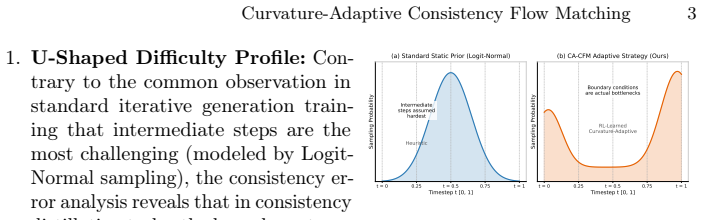
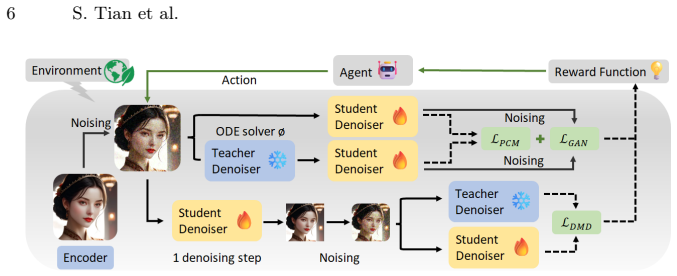
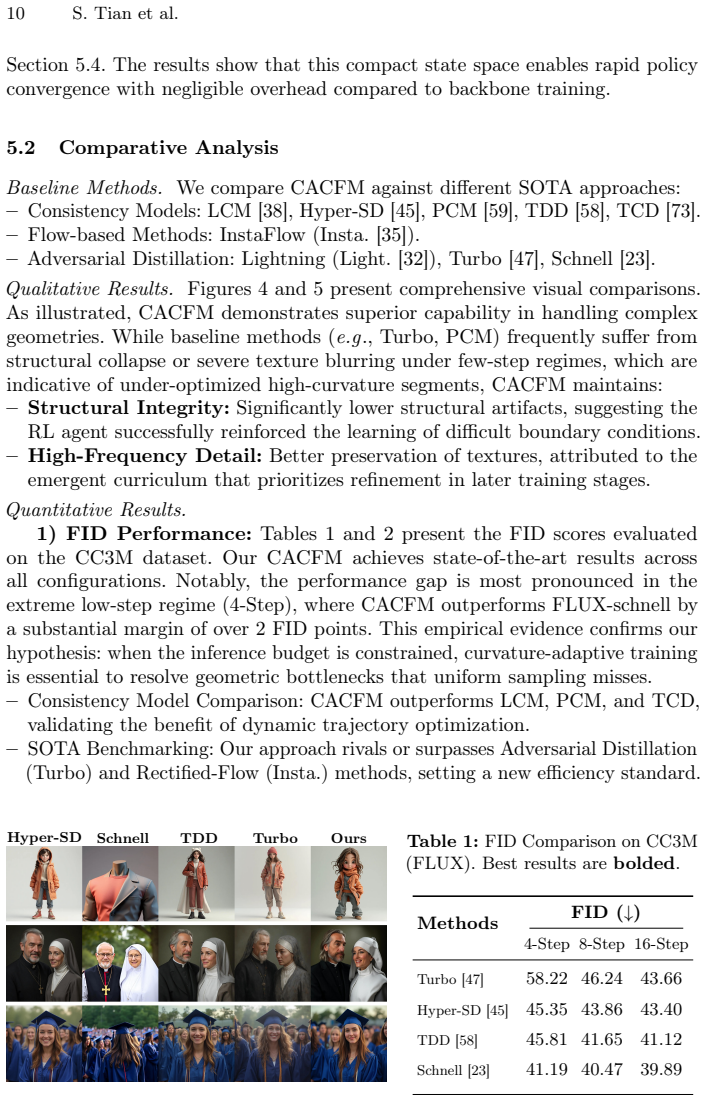
Consistency distillation exhibits a distinctly different difficulty profile from standard iterative generation, with primary optimization bottlenecks at the boundary stages. CACFM formulates distillation as a dynamic decision process and employs a lightweight Reinforcement Learning agent to actively probe Probability Flow ODE trajectories, automatically constructing an efficiency-oriented curriculum that prioritizes critical regions without manual scheduling. Integrated with a novel Flow Distribution Matching Distillation objective, the method achieves new state-of-the-art results on large-scale models such as FLUX and SDXL while mitigating structural deformities and preserving high-frequenc
What carries the argument
Curvature-Adaptive Consistency Flow Matching (CACFM), which uses a lightweight reinforcement learning agent to adaptively select sampling points along Probability Flow ODE trajectories according to evolving optimization difficulty.
If this is right
- Static sampling priors become suboptimal once the learning requirements change during distillation training.
- Manual curriculum design is no longer required to focus effort on the hardest regions.
- New state-of-the-art visual quality is reached on FLUX and SDXL in few-step regimes.
- Structural deformities decrease and high-frequency details are retained better than prior consistency methods.
Where Pith is reading between the lines
- The same RL-driven trajectory selection could be tested on other distillation techniques that also show non-uniform difficulty profiles.
- Boundary-focused adaptation may reduce the total number of training steps needed to reach a target quality level.
- Applying the agent to even larger or differently architected generative models would test whether the boundary-bottleneck pattern holds more generally.
Load-bearing premise
The primary optimization bottlenecks in consistency distillation reside at the boundary stages rather than the intermediate steps, and a lightweight RL agent can automatically identify and prioritize those regions without manual scheduling.
What would settle it
Direct measurement showing that per-stage optimization difficulty is uniform or higher in the middle of trajectories, or that a fixed static sampling schedule matches the RL agent's performance on the same models and tasks.
Figures



read the original abstract
Consistency distillation has significantly accelerated the inference of diffusion models. In this work, we reveal an intriguing asymmetry: while Logit-Normal sampling priors are highly efficacious for standard iterative generation, consistency distillation exhibits a distinctly different difficulty profile (e.g., U-shaped). We identify that the primary optimization bottlenecks reside at the boundary stages (initialization or final refinement) rather than the intermediate steps. To address the limitations of static sampling in accommodating evolving learning requirements, we propose Curvature-Adaptive Consistency Flow Matching (CACFM). By formulating distillation as a dynamic decision process, CACFM employs a lightweight Reinforcement Learning agent to actively probe Probability Flow ODE trajectories, automatically constructing an efficiency-oriented curriculum that prioritizes critical regions without manual scheduling. Integrated with a novel Flow Distribution Matching Distillation (DMD) objective, our approach achieves new state-of-the-art results on large-scale models such as FLUX and SDXL. It effectively mitigates structural deformities and preserves high-frequency details in extreme few-step regimes, achieving unprecedented visual fidelity.
Editorial analysis
A structured set of objections, weighed in public.
Referee Report
Summary. The paper claims that consistency distillation of diffusion models exhibits a U-shaped difficulty profile (distinct from Logit-Normal sampling), with primary optimization bottlenecks at boundary stages rather than intermediate steps. It proposes Curvature-Adaptive Consistency Flow Matching (CACFM), which formulates distillation as a dynamic decision process solved by a lightweight RL agent that probes PF-ODE trajectories to autonomously build an efficiency-oriented curriculum. This is integrated with a novel Flow Distribution Matching Distillation (DMD) objective, yielding claimed state-of-the-art results on large-scale models such as FLUX and SDXL by mitigating structural deformities and preserving high-frequency details in extreme few-step regimes.
Significance. If the U-shaped profile and the RL agent's ability to discover boundary prioritization without manual intervention are empirically verified, the method could offer an automated alternative to hand-crafted sampling schedules in consistency distillation, with potential benefits for scaling few-step generation in large models. The work highlights an asymmetry in learning dynamics that, if substantiated, would be a useful observation for the field. However, the absence of any supporting analysis or results in the provided manuscript limits the ability to assess whether these gains are attributable to the proposed mechanism rather than other factors.
major comments (3)
- [Abstract] Abstract: The central assertion that 'consistency distillation exhibits a distinctly different difficulty profile (e.g., U-shaped)' with 'primary optimization bottlenecks reside at the boundary stages' is presented without any referenced analysis, equations, trajectory visualizations, or quantitative evidence demonstrating this profile for the models or sampling priors discussed. This assumption directly motivates the CACFM formulation and DMD objective.
- [Abstract] Abstract: The claim that a 'lightweight Reinforcement Learning agent' can 'actively probe Probability Flow ODE trajectories, automatically constructing an efficiency-oriented curriculum that prioritizes critical regions without manual scheduling' lacks any specification of the underlying MDP (state/action spaces, reward function, or policy), making it impossible to determine whether the agent actually concentrates on the claimed boundary regions or if the performance gains reduce to the RL component fitting to the data.
- [Abstract] Abstract: The statements that the approach 'achieves new state-of-the-art results on large-scale models such as FLUX and SDXL' and 'achieving unprecedented visual fidelity' are unsupported by any metrics, baselines, ablation studies, step counts, or experimental details. Without these, the attribution of improvements to the curvature-adaptive RL curriculum cannot be evaluated.
minor comments (1)
- [Abstract] Abstract: The acronym 'DMD' (Flow Distribution Matching Distillation) is introduced without expansion or relation to prior distribution-matching distillation methods.
Simulated Author's Rebuttal
We thank the referee for the detailed and constructive comments. We address each major point below and indicate where revisions to the manuscript will be made to improve clarity and support for the claims.
read point-by-point responses
-
Referee: [Abstract] Abstract: The central assertion that 'consistency distillation exhibits a distinctly different difficulty profile (e.g., U-shaped)' with 'primary optimization bottlenecks reside at the boundary stages' is presented without any referenced analysis, equations, trajectory visualizations, or quantitative evidence demonstrating this profile for the models or sampling priors discussed. This assumption directly motivates the CACFM formulation and DMD objective.
Authors: We agree that the abstract introduces the U-shaped difficulty profile without explicit references. The full manuscript contains supporting analysis in Section 3, including PF-ODE trajectory visualizations and quantitative comparisons to Logit-Normal sampling that demonstrate the boundary-stage bottlenecks. We will revise the abstract to cite the relevant section and figure. revision: yes
-
Referee: [Abstract] Abstract: The claim that a 'lightweight Reinforcement Learning agent' can 'actively probe Probability Flow ODE trajectories, automatically constructing an efficiency-oriented curriculum that prioritizes critical regions without manual scheduling' lacks any specification of the underlying MDP (state/action spaces, reward function, or policy), making it impossible to determine whether the agent actually concentrates on the claimed boundary regions or if the performance gains reduce to the RL component fitting to the data.
Authors: The methods section defines the MDP with state space derived from local curvature estimates along trajectories, discrete actions for timestep selection, and a reward based on reduction in the DMD objective. We acknowledge the abstract is underspecified and will revise it to include a concise description of these MDP elements or a direct reference to the subsection. revision: yes
-
Referee: [Abstract] Abstract: The statements that the approach 'achieves new state-of-the-art results on large-scale models such as FLUX and SDXL' and 'achieving unprecedented visual fidelity' are unsupported by any metrics, baselines, ablation studies, step counts, or experimental details. Without these, the attribution of improvements to the curvature-adaptive RL curriculum cannot be evaluated.
Authors: The experiments section reports FID and CLIP scores on FLUX and SDXL for 1-4 step generation against baselines including standard consistency models and DMD, along with ablations isolating the RL curriculum. We will revise the abstract to incorporate key quantitative results and step counts supporting the SOTA claim. revision: yes
Circularity Check
No circularity: derivation relies on external empirical observation and RL optimization, not self-definition or fitted inputs
full rationale
The provided abstract and description present an empirical observation (U-shaped difficulty profile in consistency distillation) as motivation, followed by a proposed RL-based adaptive sampling method and a new DMD objective. No equations, self-citations, or parameter-fitting steps are shown that would reduce the claimed performance gains or curriculum construction to tautological inputs by construction. The central claims rest on external benchmarks (FLUX, SDXL) and an autonomous RL agent, which are falsifiable outside the paper's fitted values. This is the common case of a self-contained proposal without load-bearing circular steps.
Axiom & Free-Parameter Ledger
axioms (1)
- domain assumption Logit-Normal sampling priors are highly efficacious for standard iterative generation while consistency distillation exhibits a U-shaped difficulty profile with bottlenecks at boundary stages.
invented entities (1)
-
Curvature-Adaptive Consistency Flow Matching (CACFM) with Flow Distribution Matching Distillation (DMD) objective
no independent evidence
Reference graph
Works this paper leans on
-
[1]
Albergo, M.S., Vanden-Eijnden, E.: Building normalizing flows with stochastic interpolants.In:The Eleventh InternationalConference onLearning Representations (2023),https://openreview.net/forum?id=li7qeBbCR1t
2023
-
[2]
Auer, P., Cesa-Bianchi, N., Fischer, P.: Finite-time analysis of the multiarmed bandit problem. Machine learning47(2), 235–256 (2002),https://doi.org/10.1023/A: 1013689704352
work page doi:10.1023/a: 2002
-
[3]
In: Advances in Neural Information Processing Systems
Brown, T., Mann, B., Ryder, N., Subbiah, M., Kaplan, J.D., Dhariwal, P., Nee- lakantan, A., Shyam, P., Sastry, G., Askell, A., et al.: Language models are few-shot learners. In: Advances in Neural Information Processing Systems. vol. 33, pp. 1877–1901 (2020),https://arxiv.org/abs/2005.14165
Pith/arXiv arXiv 1901
-
[4]
In: Conference on Computer Vision and Pattern Recognition
Changpinyo, S., Sharma, P., Ding, N., Soricut, R.: Conceptual 12m: Pushing web- scale image-text pre-training to recognize long-tail visual concepts. In: Conference on Computer Vision and Pattern Recognition. pp. 3558–3568 (2021),https:// ieeexplore.ieee.org/document/9578388
arXiv 2021
-
[5]
In: The Thirty-eighth Annual Conference on Neural Informa- tion Processing Systems (2024),https://openreview.net/forum?id=ni3Ud2BV3G
Chen, G., Li, Y., Lin, Q.: On the impacts of the random initialization in the neural tangent kernel theory. In: The Thirty-eighth Annual Conference on Neural Informa- tion Processing Systems (2024),https://openreview.net/forum?id=ni3Ud2BV3G
2024
-
[6]
In: Proceedings of the IEEE/CVF International Conference on Computer Vision (ICCV)
Chen, J., Xue, S., Zhao, Y., Yu, J., Paul, S., Chen, J., Cai, H., Han, S., Xie, E.: Sana-sprint: One-step diffusion with continuous-time consistency distillation. In: Proceedings of the IEEE/CVF International Conference on Computer Vision (ICCV). pp. 16185–16195 (October 2025),https://doi.org/10.1109/ICCV51701. 2025.01502
-
[7]
In: International Conference on Learning Representations (2021),https://openreview
Dosovitskiy, A., Beyer, L., Kolesnikov, A., Weissenborn, D., Zhai, X., Unterthiner, T., Dehghani, M., Minderer, M., Heigold, G., Gelly, S., Uszkoreit, J., Houlsby, N.: An image is worth 16x16 words: Transformers for image recognition at scale. In: International Conference on Learning Representations (2021),https://openreview. net/forum?id=YicbFdNTTy
2021
-
[8]
In: Forty- first International Conference on Machine Learning (2024),https://openreview
Esser, P., Kulal, S., Blattmann, A., Entezari, R., Müller, J., Saini, H., Levi, Y., Lorenz, D., Sauer, A., Boesel, F., Podell, D., Dockhorn, T., English, Z., Rombach, R.: Scaling rectified flow transformers for high-resolution image synthesis. In: Forty- first International Conference on Machine Learning (2024),https://openreview. net/forum?id=FPnUhsQJ5B
2024
-
[9]
Fan, Y., Lee, K.: Optimizing ddpm sampling with shortcut fine-tuning (2024), https://arxiv.org/abs/2301.13362
arXiv 2024
-
[10]
Fan, Y., Watkins, O., Du, Y., Liu, H., Ryu, M., Boutilier, C., Abbeel, P., Ghavamzadeh, M., Lee, K., Lee, K.: Dpok: Reinforcement learning for fine-tuning text-to-image diffusion models (2023),https://arxiv.org/abs/2305.16381
arXiv 2023
-
[11]
Generative adversarial networks.Commun
Goodfellow, I., Pouget-Abadie, J., Mirza, M., Xu, B., Warde-Farley, D., Ozair, S., Courville, A., Bengio, Y.: Generative adversarial networks. Communications of the ACM63(11), 139–144 (2020),https://doi.org/10.1145/3422622
-
[12]
He, K., Zhang, X., Ren, S., Sun, J.: Deep residual learning for image recognition (2015),https://arxiv.org/abs/1512.03385
Pith/arXiv arXiv 2015
-
[13]
He, Y., Zhang, C., Chen, F., Cao, J.: Cinematte: Background matting for virtual production and beyond. In: Proceedings of the IEEE/CVF Conference on Computer Vision and Pattern Recognition (CVPR) Findings. pp. 8725–8735 (June 2026), https://arxiv.org/abs/2605.18328
Pith/arXiv arXiv 2026
-
[14]
He, Y., Zhang, W., Deng, J., Cong, Y.: Prior-knowledge-free video frame inter- polation with bidirectional regularized implicit neural representations. In: Mul- 16 S. Tian et al. tiMedia Modeling. pp. 112–126. Springer Nature Switzerland, Cham (2024), https://link.springer.com/chapter/10.1007/978-3-031-53311-2_9
-
[15]
Advances in Neural Information Processing Systems30(2017), https://dl.acm.org/doi/10
Heusel, M., Ramsauer, H., Unterthiner, T., Nessler, B., Hochreiter, S.: Gans trained by a two time-scale update rule converge to a local nash equilibrium. Advances in Neural Information Processing Systems30(2017), https://dl.acm.org/doi/10. 5555/3295222.3295408
arXiv 2017
-
[16]
Hinton, G., Vinyals, O., Dean, J.: Distilling the knowledge in a neural network (2015),https://arxiv.org/abs/1503.02531
Pith/arXiv arXiv 2015
-
[17]
Ho, J., Jain, A., Abbeel, P.: Denoising diffusion probabilistic models. Advances in neural information processing systems33, 6840–6851 (2020),https://arxiv.org/ abs/2006.11239
Pith/arXiv arXiv 2020
-
[18]
Ho, J., Salimans, T.: Classifier-free diffusion guidance (2022),https://arxiv.org/ abs/2207.12598
Pith/arXiv arXiv 2022
-
[20]
Karras, T., Aittala, M., Aila, T., Laine, S.: Elucidating the design space of diffusion- based generative models. Advances in Neural Information Processing Systems35, 26565–26577 (2022),https://dl.acm.org/doi/10.5555/3600270.3602196
-
[21]
In: The Twelfth International Conference on Learning Representations (2024),https://openreview.net/forum?id=ymjI8feDTD
Kim, D., Lai, C.H., Liao, W.H., Murata, N., Takida, Y., Uesaka, T., He, Y., Mitsufuji, Y., Ermon, S.: Consistency trajectory models: Learning probability flow ODE trajectory of diffusion. In: The Twelfth International Conference on Learning Representations (2024),https://openreview.net/forum?id=ymjI8feDTD
2024
-
[22]
In: Thirty- seventh Conference on Neural Information Processing Systems (2023), https: //openreview.net/forum?id=G5RwHpBUv0
Kirstain, Y., Polyak, A., Singer, U., Matiana, S., Penna, J., Levy, O.: Pick-a- pic: An open dataset of user preferences for text-to-image generation. In: Thirty- seventh Conference on Neural Information Processing Systems (2023), https: //openreview.net/forum?id=G5RwHpBUv0
2023
-
[23]
Labs, B.F.: Flux.https://github.com/black-forest-labs/flux(2024)
2024
-
[24]
Lai, J., Yu, Z., Tian, S., Lin, Q.: Generalization ability of wide residual networks (2023),https://arxiv.org/abs/2305.18506
arXiv 2023
-
[25]
Journal of Machine Learning Research25(82), 1–47 (2024),http://jmlr.org/papers/v25/ 23-0866.html
Li, Y., Yu, Z., Chen, G., Lin, Q.: On the eigenvalue decay rates of a class of neural-network related kernel functions defined on general domains. Journal of Machine Learning Research25(82), 1–47 (2024),http://jmlr.org/papers/v25/ 23-0866.html
2024
-
[26]
Li, Y., Yang, C., Dong, J., Yao, Z., Xu, H., Dong, Z., Zeng, H., An, Z., Tian, Y.: Ammkd: Adaptive multimodal multi-teacher distillation for lightweight vision- language models (2025),https://arxiv.org/abs/2509.00039
arXiv 2025
-
[27]
Li, Y., Yang, C., Zeng, H., Dong, Z., An, Z., Xu, Y., Tian, Y., Wu, H.: Frequency- aligned knowledge distillation for lightweight spatiotemporal forecasting. In: Pro- ceedings of the IEEE/CVF International Conference on Computer Vision. pp. 7262–7272 (2025),https://doi.org/10.1109/ICCV51701.2025.00682
-
[28]
Li, Z., Hu, Y., Chen, Z., Huang, Q., Qiu, G., Fu, Z., Liu, M.: Retrack: Evidence- driven dual-stream directional anchor calibration network for composed video retrieval. In: AAAI. vol. 40, pp. 23373–23381 (2026),https://dl.acm.org/doi/ abs/10.1145/3796712
-
[29]
Liang, G., Wang, Z., Hu, J., Zhou, H., Xue, Z., Zhang, J., Xu, D., Yu, Q.: Render- in-the-loop: Vector graphics generation via visual self-feedback (2026), https: //arxiv.org/abs/2604.20730
Pith/arXiv arXiv 2026
-
[30]
Liang, G., Wang, Z., Wang, C., Hu, J., Zhou, H., Liu, J., Zhang, J., Xu, D., Yu, Q.: Vanim: Rendering-aware sparse state modeling for structure-preserving vector animation (2026),https://arxiv.org/abs/2605.01517 Curvature-Adaptive Consistency Flow Matching 17
Pith/arXiv arXiv 2026
-
[31]
In: 2025 IEEE/RSJ International Conference on Intelligent Robots and Systems (IROS)
Lin, J., Zhang, J., Jin, G., Song, W., Liu, T., Lu, G.: 3d plant root skeleton detection and extraction. In: 2025 IEEE/RSJ International Conference on Intelligent Robots and Systems (IROS). pp. 3011–3017. IEEE (2025),https://arxiv.org/abs/2508. 08094
2025
-
[32]
Lin, S., Wang, A., Yang, X.: Sdxl-lightning: Progressive adversarial diffusion distil- lation (2024),https://arxiv.org/abs/2402.13929
Pith/arXiv arXiv 2024
-
[33]
In: The Eleventh International Conference on Learning Representations (2023),https://openreview.net/forum?id=PqvMRDCJT9t
Lipman, Y., Chen, R.T.Q., Ben-Hamu, H., Nickel, M., Le, M.: Flow matching for generative modeling. In: The Eleventh International Conference on Learning Representations (2023),https://openreview.net/forum?id=PqvMRDCJT9t
2023
-
[34]
Liu, X., Gong, C., Liu, Q.: Flow straight and fast: Learning to generate and transfer data with rectified flow (2022),https://arxiv.org/abs/2209.03003
Pith/arXiv arXiv 2022
-
[35]
In: The Twelfth International Conference on Learning Representations (2024),https://openreview.net/forum? id=1k4yZbbDqX
Liu, X., Zhang, X., Ma, J., Peng, J., qiang liu: Instaflow: One step is enough for high-quality diffusion-based text-to-image generation. In: The Twelfth International Conference on Learning Representations (2024),https://openreview.net/forum? id=1k4yZbbDqX
2024
-
[36]
In: Advances in Neural Information Processing Systems (2022),https://openreview.net/forum? id=2uAaGwlP_V
Lu, C., Zhou, Y., Bao, F., Chen, J., Li, C., Zhu, J.: DPM-solver: A fast ODE solver for diffusion probabilistic model sampling in around 10 steps. In: Advances in Neural Information Processing Systems (2022),https://openreview.net/forum? id=2uAaGwlP_V
2022
-
[37]
Lu, Y., Ren, Y., Xia, X., Lin, S., Wang, X., Xiao, X., Ma, A.J., Xie, X., Lai, J.H.: Adversarial distribution matching for diffusion distillation towards efficient image and video synthesis. In: Proceedings of the IEEE/CVF International Conference on Computer Vision (ICCV). pp. 16818–16829 (October 2025),https://doi.org/ 10.1109/ICCV51701.2025.01562
-
[38]
Luo, S., Tan, Y., Huang, L., Li, J., Zhao, H.: Latent consistency models: Synthesizing high-resolution images with few-step inference (2023),https://arxiv.org/abs/ 2310.04378
Pith/arXiv arXiv 2023
-
[39]
Mai, J., Liao, B., Zhao, Z., Zeng, Y., Li, H., Civera, J., Wu, T., Zhou, Y., Liu, P.: Neural predictor-corrector: Solving homotopy problems with reinforcement learning (2026),https://arxiv.org/abs/2602.03086
arXiv 2026
-
[40]
Oertell, O., Chang, J.D., Zhang, Y., Brantley, K., Sun, W.: Rl for consistency models: Faster reward guided text-to-image generation (2024),https://arxiv. org/abs/2404.03673
arXiv 2024
-
[41]
In: The Twelfth International Conference on Learning Representations (2024),https://openreview.net/forum?id=di52zR8xgf
Podell, D., English, Z., Lacey, K., Blattmann, A., Dockhorn, T., Müller, J., Penna, J., Rombach, R.: SDXL: Improving latent diffusion models for high-resolution image synthesis. In: The Twelfth International Conference on Learning Representations (2024),https://openreview.net/forum?id=di52zR8xgf
2024
-
[42]
In: Proceedings of the 38th International Conference on Machine Learning
Radford, A., Kim, J.W., Hallacy, C., Ramesh, A., Goh, G., Agarwal, S., Sastry, G., Askell, A., Mishkin, P., Clark, J., Krueger, G., Sutskever, I.: Learning transferable visual models from natural language supervision. In: Proceedings of the 38th International Conference on Machine Learning. Proceedings of Machine Learning Research, vol. 139, pp. 8748–8763...
2021
-
[43]
Rao, J., Liu, X., Deng, H., Lin, Z., Yu, Z., Wei, J., Meng, X., Zhang, M.: Dy- namic sampling that adapts: Self-aware iterative data persistent optimization for mathematical reasoning (2026),https://arxiv.org/abs/2505.16176
Pith/arXiv arXiv 2026
-
[44]
Rao, J., Liu, X., Yan, H., Shen, J., Mo, H., Dong, Y., Yan, Z., Wang, Z., Lin, Z., Meng, X., Yu, Z., Deng, L., Wei, J., Wang, Y., Zhang, M.: A data-centric perspective on the lifecycle of large language models. TechRxiv2025(1220) (2025),https: //www.techrxiv.org/doi/abs/10.36227/techrxiv.176620610.03288677/v1 18 S. Tian et al
-
[45]
In: The Thirty-eighth Annual Conference on Neural Information Processing Systems (2024), https://openreview.net/forum?id=O5XbOoi0x3
Ren, Y., Xia, X., Lu, Y., Zhang, J., Wu, J., Xie, P., WANG, X., Xiao, X.: Hyper- SD: Trajectory segmented consistency model for efficient image synthesis. In: The Thirty-eighth Annual Conference on Neural Information Processing Systems (2024), https://openreview.net/forum?id=O5XbOoi0x3
2024
-
[46]
In: International Conference on Learning Representations (2022),https://openreview
Salimans, T., Ho, J.: Progressive distillation for fast sampling of diffusion models. In: International Conference on Learning Representations (2022),https://openreview. net/forum?id=TIdIXIpzhoI
2022
-
[47]
Sauer, A., Lorenz, D., Blattmann, A., Rombach, R.: Adversarial diffusion distillation (2023),https://arxiv.org/abs/2311.17042
arXiv 2023
-
[48]
In: Thirty-sixth Conference on Neural Information Processing Systems Datasets and Benchmarks Track (2022),https://openreview.net/forum?id=M3Y74vmsMcY
Schuhmann, C., Beaumont, R., Vencu, R., Gordon, C., Wightman, R., Cherti, M., Coombes, T., Katta, A., Mullis, C., Wortsman, M., et al.: LAION-5b: An open large-scale dataset for training next generation image-text models. In: Thirty-sixth Conference on Neural Information Processing Systems Datasets and Benchmarks Track (2022),https://openreview.net/forum?...
2022
-
[49]
Shao, Z., Wang, P., Zhu, Q., Xu, R., Song, J., Bi, X., Zhang, H., Zhang, M., Li, Y.K., Wu, Y., Guo, D.: Deepseekmath: Pushing the limits of mathematical reasoning in open language models (2024),https://arxiv.org/abs/2402.03300
Pith/arXiv arXiv 2024
-
[50]
In: An- nual Meeting of the Association for Computational Linguistics (2018), https: //aclanthology.org/P18-1238/
Sharma, P., Ding, N., Goodman, S., Soricut, R.: Conceptual captions: A cleaned, hypernymed, image alt-text dataset for automatic image captioning. In: An- nual Meeting of the Association for Computational Linguistics (2018), https: //aclanthology.org/P18-1238/
2018
-
[51]
In: Proceedings of the 32nd International Conference on Machine Learning
Sohl-Dickstein, J., Weiss, E., Maheswaranathan, N., Ganguli, S.: Deep unsuper- vised learning using nonequilibrium thermodynamics. In: Proceedings of the 32nd International Conference on Machine Learning. Proceedings of Machine Learn- ing Research, vol. 37, pp. 2256–2265. PMLR, Lille, France (07–09 Jul 2015), https://proceedings.mlr.press/v37/sohl-dickste...
2015
-
[52]
In: The Twelfth International Conference on Learning Representations (2024),https: //openreview.net/forum?id=WNzy9bRDvG
Song, Y., Dhariwal, P.: Improved techniques for training consistency models. In: The Twelfth International Conference on Learning Representations (2024),https: //openreview.net/forum?id=WNzy9bRDvG
2024
-
[53]
In: Proceedings of the 40th International Conference on Machine Learning
Song, Y., Dhariwal, P., Chen, M., Sutskever, I.: Consistency models. In: Proceedings of the 40th International Conference on Machine Learning. pp. 32211–32252 (2023), https://arxiv.org/abs/2303.01469
Pith/arXiv arXiv 2023
-
[54]
Song, Y., Sohl-Dickstein, J., Kingma, D.P., Kumar, A., Ermon, S., Poole, B.: Score- basedgenerativemodelingthroughstochasticdifferentialequations.In:International Conference on Learning Representations (2021),https://arxiv.org/abs/2011. 13456
2021
-
[55]
Machine learning3(1), 9–44 (1988),https://doi.org/10.1023/A:1022633531479
Sutton, R.S.: Learning to predict by the methods of temporal differences. Machine learning3(1), 9–44 (1988),https://doi.org/10.1023/A:1022633531479
-
[56]
Vaswani, A., Shazeer, N., Parmar, N., Uszkoreit, J., Jones, L., Gomez, A.N., Kaiser, L., Polosukhin, I.: Attention is all you need (2023),https://arxiv.org/abs/1706. 03762
2023
-
[57]
In: Proceedings of the IEEE/CVF Conference on Computer Vision and Pattern Recognition (CVPR)
Wallace, B., Dang, M., Rafailov, R., Zhou, L., Lou, A., Purushwalkam, S., Ermon, S., Xiong, C., Joty, S., Naik, N.: Diffusion model alignment using direct preference optimization. In: Proceedings of the IEEE/CVF Conference on Computer Vision and Pattern Recognition (CVPR). pp. 8228–8238 (June 2024),https://arxiv. org/abs/2311.12908
arXiv 2024
-
[58]
In: Proceedings of the AAAI Conference on Artificial Intelligence
Wang, C., Guo, Z., Duan, Y., Li, H., Chen, N., Tang, X., Hu, Y.: Target-driven distillation: Consistency distillation with target timestep selection and decoupled guidance. In: Proceedings of the AAAI Conference on Artificial Intelligence. vol. 39, pp. 7619–7627 (2025),https://arxiv.org/abs/2409.01347 Curvature-Adaptive Consistency Flow Matching 19
arXiv 2025
-
[59]
Wang, F.Y., Huang, Z., Bergman, A., Shen, D., Gao, P., Lingelbach, M., Sun, K., Bian, W., Song, G., Liu, Y., et al.: Phased consistency models. Advances in neural information processing systems37, 83951–84009 (2024),https://arxiv.org/abs/ 2405.18407
arXiv 2024
-
[60]
Watkins, C.J.C.H., Dayan, P.: Q-learning. Machine Learning8(3–4), 279–292 (1992), https://doi.org/10.1007/BF00992698
-
[61]
Wu, W., Li, Y., Chen, G., Wang, L., Chen, H.: Tool-augmented policy optimization: Synergizing reasoning and adaptive tool use with reinforcement learning (2026), https://arxiv.org/abs/2510.07038
arXiv 2026
-
[62]
Wu, X., Hao, Y., Sun, K., Chen, Y., Zhu, F., Zhao, R., Li, H.: Human preference score v2: A solid benchmark for evaluating human preferences of text-to-image synthesis (2023),https://arxiv.org/abs/2306.09341
Pith/arXiv arXiv 2023
-
[63]
In: Proceedings of the AAAI Conference on Artificial Intelligence
Xiao, C., Dou, J., Lin, Z., Ke, Z., Hou, L.: From points to coalitions: Hierarchical contrastive shapley values for prioritizing data samples. In: Proceedings of the AAAI Conference on Artificial Intelligence. vol. 40, pp. 15995–16003 (2026),https: //ojs.aaai.org/index.php/AAAI/article/view/38633
2026
-
[64]
Xu, J., Liu, X., Wu, Y., Tong, Y., Li, Q., Ding, M., Tang, J., Dong, Y.: Imagereward: Learning and evaluating human preferences for text-to-image generation (2023), https://arxiv.org/abs/2304.05977
arXiv 2023
-
[65]
In: Advances in Neural Information Processing Systems
Yao,J.,Li,C.,Xiao,C.:Swiftsampler:Efficientlearningofsamplerby10parameters. In: Advances in Neural Information Processing Systems. vol. 37, pp. 59030–59053. Curran Associates, Inc. (2024),https://arxiv.org/abs/2410.05578
arXiv 2024
-
[66]
In: Proceedings of the IEEE/CVF Conference on Computer Vision and Pattern Recognition
Yin, T., Gharbi, M., Zhang, R., Shechtman, E., Durand, F., Freeman, W.T., Park, T.: One-step diffusion with distribution matching distillation. In: Proceedings of the IEEE/CVF Conference on Computer Vision and Pattern Recognition. pp. 6613–6623 (2024),https://arxiv.org/abs/2311.18828
arXiv 2024
-
[67]
In: 2024 IEEE International Conference on Systems, Man, and Cybernetics (SMC)
Yu, B., Liu, D., Shi, H., Chang, G., Wei, J., Sun, L., Tian, S., Bu, L.: Sam- wav2lip++: Enhancing behavioral realism in synthetic agents through audio-driven speech and action refinement. In: 2024 IEEE International Conference on Systems, Man, and Cybernetics (SMC). pp. 2999–3006 (2024),https://ieeexplore.ieee. org/abstract/document/10832087
arXiv 2024
-
[68]
Yu, Z., Chen, G., Lai, J., Li, B., Tian, S.: Branch scaling manifests as implicit ar- chitectural regularization for improving generalization in overparameterized resnets (2026),https://arxiv.org/abs/2403.04545
Pith/arXiv arXiv 2026
-
[69]
Yu, Z., Rao, J., Chen, G., Tian, S., Li, B., Wei, J., Zhang, M., Meng, X.: Mathagent: Adversarial evolution of constraint graphs for mathematical reasoning data synthesis (2026),https://arxiv.org/abs/2604.11188
Pith/arXiv arXiv 2026
-
[70]
In: The Thirteenth International Conference on Learning Representations (2025),https://openreview.net/forum?id=VEJzjAvaIy
Yu, Z., Tian, S., Chen, G.: Divergence of neural tangent kernel in classification problems. In: The Thirteenth International Conference on Learning Representations (2025),https://openreview.net/forum?id=VEJzjAvaIy
2025
-
[71]
In: Proceedings of the Computer Vision and Pattern Recognition Conference
Zhang, J., Lu, G.: Vision-language embodiment for monocular depth estimation. In: Proceedings of the Computer Vision and Pattern Recognition Conference. pp. 29479–29489 (2025),https://arxiv.org/abs/2503.16535
arXiv 2025
-
[72]
Zhao, Z., Yang, H., Liao, B., Zeng, Y., Yan, S., Gu, Y., Liu, P., Zhou, Y., Li, H., Civera, J.: Advances in global solvers for 3d vision (2026),https://arxiv.org/ abs/2602.14662
arXiv 2026
-
[73]
Zheng, J., Hu, M., Fan, Z., Wang, C., Ding, C., Tao, D., Cham, T.J.: Trajectory consistency distillation: Improved latent consistency distillation by semi-linear consistency function with trajectory mapping (2024),https://arxiv.org/abs/ 2402.19159 20 S. Tian et al. Curvature-Adaptive Consistency Flow Matching: Autonomous Trajectory Optimization via Reinfo...
arXiv 2024
discussion (0)
Sign in with ORCID, Apple, or X to comment. Anyone can read and Pith papers without signing in.