Federated Learning for Global Carbon Emission Forecasting: A Hybrid Time-Series Approach with Statistical and Neural Models
Pith reviewed 2026-06-26 10:39 UTC · model grok-4.3
The pith
A federated hybrid model integrates ARIMA, GARCH, LSTM-Attention and XGBoost to forecast carbon emissions across distributed clients without sharing raw data.
A machine-rendered reading of the paper's core claim, the machinery that carries it, and where it could break.
Core claim
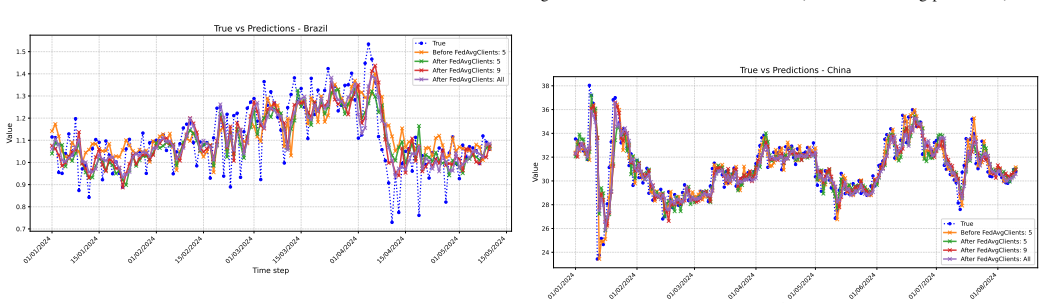
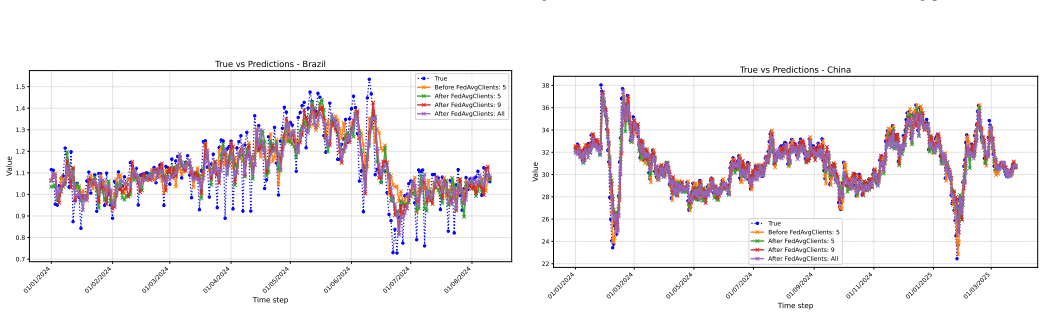
The central claim is that the proposed federated hybrid forecasting framework, integrating ARIMA-based trend modeling, GARCH-based volatility modeling, LSTM-Attention temporal representation learning, and XGBoost prediction within a privacy-preserving federated learning environment, enables collaborative learning among distributed clients without exchanging raw data and delivers forecasting performance with client R2 values between 0.50 and 0.97 (average 0.73), RMSE values from 0.06 to 2.35 (average 1.21), and MAPE values between 1.5 percent and 11.3 percent (average 6.5 percent).
What carries the argument
The federated hybrid forecasting framework that integrates ARIMA trend modeling, GARCH volatility modeling, LSTM-Attention representation learning and XGBoost prediction inside a privacy-preserving federated aggregation loop.
If this is right
- Collaborative forecasting becomes possible among countries and sectors while satisfying privacy regulations.
- Hybrid statistical-neural components can be aggregated federatedly without centralizing emission records.
- The reported performance range indicates usable accuracy for supporting mitigation policy design.
- The framework scales to additional clients provided the data distribution remains comparable.
Where Pith is reading between the lines
- Similar federated hybrids could be applied to other privacy-sensitive environmental time-series such as air-quality or energy-demand forecasting.
- Adding differential privacy noise during aggregation would provide an explicit bound on leakage risk.
- Periodic retraining on streaming data from new clients could maintain performance as emission patterns evolve.
Load-bearing premise
The 14 clients supply sufficiently representative and heterogeneous time-series data so that the hybrid federated aggregation generalizes beyond the tested set without client-specific tuning or data leakage.
What would settle it
Retraining and testing the same hybrid pipeline on a fresh collection of clients whose emission patterns differ substantially from the original 14 and observing average R2 falling below 0.5 would falsify the generalizability claim.
Figures




read the original abstract
Climate change, primarily driven by carbon dioxide (CO2) emissions, requires accurate forecasting tools to support effective mitigation policies and sustainable development strategies. Existing forecasting approaches typically rely on centralized data collection, which is often restricted by privacy regulations and the distributed nature of emission data across countries and industrial sectors. This paper proposes a novel federated hybrid forecasting framework that integrates ARIMA-based trend modeling, GARCH-based volatility modeling, LSTM-Attention temporal representation learning, and XGBoost prediction within a privacy-preserving federated learning environment. The proposed framework enables collaborative learning among distributed clients without requiring the exchange of raw data. Experimental evaluation across 14 clients demonstrates strong forecasting performance, achieving client R2 values between 0.50 and 0.97 with an average of 0.73, RMSE values ranging from 0.06 to 2.35 with an average of 1.21, and MAPE values between 1.5% and 11.3% with an average of 6.5%. The results indicate that the proposed framework provides an accurate, scalable, and regulation-compliant solution for collaborative carbon-emission forecasting.
Editorial analysis
A structured set of objections, weighed in public.
Referee Report
Summary. The paper proposes a federated hybrid time-series forecasting framework that integrates ARIMA trend modeling, GARCH volatility modeling, LSTM-Attention temporal learning, and XGBoost prediction to enable privacy-preserving collaborative carbon-emission forecasting across distributed clients. Experimental results on 14 clients report per-client R² values of 0.50–0.97 (avg. 0.73), RMSE 0.06–2.35 (avg. 1.21), and MAPE 1.5%–11.3% (avg. 6.5%), with the abstract claiming this yields an accurate, scalable, and regulation-compliant global solution.
Significance. If the hybrid components and federated aggregation can be shown to generalize beyond the evaluated clients with proper validation, the work could contribute a practical privacy-preserving method for distributed climate data analysis where centralized collection is restricted. The combination of statistical and neural elements is a reasonable direction, though the current evaluation does not yet establish this.
major comments (3)
- [Abstract / Experimental Evaluation] Abstract and experimental evaluation section: The headline claim of a 'global' and 'scalable' solution rests on the 14-client results, yet no information is supplied on client identities, data sources, time spans, sectoral or geographic coverage, or whether the clients include major global emitters. Without this, the observed metrics cannot support extrapolation to worldwide forecasting.
- [Abstract] Abstract: The reported performance numbers are presented without any baselines (centralized or alternative FL methods), ablation studies on the hybrid components, or details on how federated aggregation was implemented. This prevents verification that the metrics demonstrate an advance attributable to the proposed framework.
- [Abstract] Abstract: No error bars, confidence intervals, or statistical significance tests accompany the R², RMSE, and MAPE values, and the abstract supplies no information on how the metrics were computed across clients or time periods. This weakens the accuracy claim.
minor comments (1)
- [Abstract] The abstract would benefit from a brief statement of the federated aggregation algorithm and any hyperparameter choices to improve reproducibility.
Simulated Author's Rebuttal
We thank the referee for the constructive feedback. We address each major comment below and will revise the manuscript to strengthen the presentation of results and claims.
read point-by-point responses
-
Referee: [Abstract / Experimental Evaluation] Abstract and experimental evaluation section: The headline claim of a 'global' and 'scalable' solution rests on the 14-client results, yet no information is supplied on client identities, data sources, time spans, sectoral or geographic coverage, or whether the clients include major global emitters. Without this, the observed metrics cannot support extrapolation to worldwide forecasting.
Authors: We agree that explicit details on the clients are required to substantiate the scalability and global applicability claims. In the revised version we will expand the experimental evaluation section with a dedicated table and accompanying text describing the 14 clients (anonymized identifiers), their geographic regions, sectoral coverage, data sources (public emission inventories), and time spans. This will clarify the current scope while noting that the framework itself is designed to accommodate additional clients for broader coverage. revision: yes
-
Referee: [Abstract] Abstract: The reported performance numbers are presented without any baselines (centralized or alternative FL methods), ablation studies on the hybrid components, or details on how federated aggregation was implemented. This prevents verification that the metrics demonstrate an advance attributable to the proposed framework.
Authors: The abstract is space-constrained, but the full manuscript contains the requested elements in Sections 4.2 (baselines vs. centralized ARIMA, LSTM, and alternative FL approaches) and 4.3 (ablations isolating ARIMA-GARCH, LSTM-Attention, and XGBoost contributions). Federated aggregation is specified in Section 3.3 as a modified FedAvg procedure. We will revise the abstract to include a concise statement referencing these comparisons and will ensure the experimental section explicitly details the aggregation implementation. revision: yes
-
Referee: [Abstract] Abstract: No error bars, confidence intervals, or statistical significance tests accompany the R², RMSE, and MAPE values, and the abstract supplies no information on how the metrics were computed across clients or time periods. This weakens the accuracy claim.
Authors: We acknowledge this omission. The reported averages are computed as the mean across all client-level forecasts over the test periods. In the revision we will add standard-deviation error bars to the abstract averages, clarify the exact computation procedure in the evaluation subsection, and include paired statistical significance tests against baselines in the experimental results. revision: yes
Circularity Check
No significant circularity; empirical results are independent measurements
full rationale
The paper presents a hybrid federated framework (ARIMA + GARCH + LSTM-Attention + XGBoost) and reports forecasting performance directly from experiments on 14 clients (R2 0.50-0.97 avg 0.73, RMSE 0.06-2.35 avg 1.21, MAPE 1.5%-11.3% avg 6.5%). No equations, derivations, or self-citations are shown that reduce these metrics to fitted parameters by construction, rename known results, or import uniqueness via author overlap. The reported values are external empirical outcomes on the tested data rather than tautological outputs of the model definition itself, making the evaluation chain self-contained.
Axiom & Free-Parameter Ledger
Reference graph
Works this paper leans on
-
[1]
Climate change 2024: Synthesis report. contribution of working groups i, ii and iii,
IPCC, “Climate change 2024: Synthesis report. contribution of working groups i, ii and iii,” IPCC, Geneva, Switzerland, Tech. Rep., 2024
2024
-
[3]
Alkheder and A
S. Alkheder and A. Almusalam, “Forecasting of carbon dioxide emis- sions from power plants in water using united states environmental protection agency, intergovernmental panel on climate change, and machine learning methods,”Renewable Energy, vol. 191, pp. 819–827, 2022
2022
-
[4]
A survey on federated learning systems: Vision, hype and reality for data privacy and protection,
Q. Li, Z. Wen, Z. Wu, S. Hu, N. Wang, Y . Li, X. Liu, and B. He, “A survey on federated learning systems: Vision, hype and reality for data privacy and protection,”IEEE Transactions on Knowledge and Data Engineering, vol. 35, no. 4, pp. 3347–3366, 2023
2023
-
[5]
Challenges toward carbon neutrality in china: Strategies and countermeasures,
X. Zhao, X. Ma, B. Chen, Y . Shang, and M. Song, “Challenges toward carbon neutrality in china: Strategies and countermeasures,”Resources, Conservation and Recycling, vol. 176, p. 105959, 2022
2022
-
[6]
Co2 emissions projection in china based on var- stirpat model,
S. Wang and B. Lin, “Co2 emissions projection in china based on var- stirpat model,”Energy Policy, vol. 102, pp. 601–612, 2017
2017
-
[7]
A first look into the carbon footprint of federated learning,
X. Qiu, T. Parcollet, J. Fernandez-Marques, P. P. B. Gusmao, Y . Gao, D. J. Beutel, T. Topal, A. Mathur, and N. D. Lane, “A first look into the carbon footprint of federated learning,”Journal of Machine Learning Research, vol. 24, pp. 1–23, 2023. [Online]. Available: http://jmlr.org/papers/v24/21-0445.html
2023
-
[8]
Forecasting co2 emissions of air transport industry in shanghai: A multivariate arima model,
Y . Yang and J. F. O’Connell, “Forecasting co2 emissions of air transport industry in shanghai: A multivariate arima model,”J. Air Transport Management, vol. 87, p. 101856, 2020
2020
-
[9]
Causality between co2 emissions, energy consumption, eco- nomic growth and industrialization: Evidence from sub-saharan africa,
M. Appiah, “Causality between co2 emissions, energy consumption, eco- nomic growth and industrialization: Evidence from sub-saharan africa,” Energy, vol. 135, pp. 1049–1069, 2018
2018
-
[10]
Federated continual learning via knowledge fusion: A survey,
X. Yang, H. Yu, X. Gao, H. Wang, J. Zhang, and T. Li, “Federated continual learning via knowledge fusion: A survey,”IEEE Transactions on Knowledge and Data Engineering, vol. 36, no. 8, pp. 3832–3850, 2024
2024
-
[11]
S. Dai, D. Niu, and Y . Han, “Forecasting of energy-related co2 emissions in china based on gm(1,1) and least squares support vector machine optimized by modified shuffled frog leaping algorithm for sustainability,” Sustainability, vol. 10, no. 4, p. 958, 2018
2018
-
[12]
Forecasting carbon emissions using an improved fireworks algorithm and grnn,
D. Niu, Q. Wang, W. Wu, and X. Zhao, “Forecasting carbon emissions using an improved fireworks algorithm and grnn,”Journal of Cleaner Production, vol. 276, p. 124120, 2020
2020
-
[13]
A federated learning- enabled predictive analysis to forecast stock market trends,
S. Pourroostaei Ardakani, N. Du, C. Linet al., “A federated learning- enabled predictive analysis to forecast stock market trends,”Journal of Ambient Intelligence and Humanized Computing, pp. 1–7, 2023
2023
-
[14]
Fedhealth: Federated transfer learning for wearable healthcare,
Y . Chen, X. Qin, J. Wang, B. Yu, and W. Gao, “Fedhealth: Federated transfer learning for wearable healthcare,”IEEE Intelligent Systems, vol. 35, no. 4, pp. 83–93, 2020
2020
-
[15]
Fedkd: Communi- cation efficient federated learning via knowledge distillation,
T. Yu, T. Li, S. Sun, Y . Xu, D. Tao, and Q. Yang, “Fedkd: Communi- cation efficient federated learning via knowledge distillation,”NeurIPS, vol. 34, 2021
2021
-
[16]
Iotfla: a secured and privacy- preserving smart home architecture implementing federated learning,
U. Alvodji, S. Gambs, and A. Martin, “Iotfla: a secured and privacy- preserving smart home architecture implementing federated learning,” in 2019 IEEE Security and Privacy Workshops (SPW), 2019, pp. 175–180
2019
-
[17]
Energy demand prediction with federated learning for electric vehicle networks,
Y . Saputra, D. Hoang, D. Nguyenet al., “Energy demand prediction with federated learning for electric vehicle networks,” in2019 IEEE Global Communications Conference (GLOBECOM), 2019, pp. 1–6
2019
-
[18]
Carbon monitor, a near-real-time daily dataset of global co2 emission from fossil fuel and cement production,
Z. Liu, P. Ciais, Z. Denget al., “Carbon monitor, a near-real-time daily dataset of global co2 emission from fossil fuel and cement production,” Scientific Data, vol. 7, no. 1, p. 392, 2020
2020
-
[19]
Privacy-preserving traffic flow predic- tion: a federated learning approach,
Y . Liu, J. James, J. Kanget al., “Privacy-preserving traffic flow predic- tion: a federated learning approach,”IEEE Internet of Things Journal, vol. 7, no. 9, pp. 7751–7763, 2020
2020
-
[20]
Federated learning based energy de- mand prediction with clustered aggregation,
Y . Tun, K. Thar, C. Tiwariet al., “Federated learning based energy de- mand prediction with clustered aggregation,” in2021 IEEE International Conference on Big Data and Smart Computing (BigComp), 2021, pp. 164–167
2021
-
[21]
Federated learning with hyperparameter- based clustering for electrical load forecasting,
N. Gholizadeh and P. Musilek, “Federated learning with hyperparameter- based clustering for electrical load forecasting,”Internet of Things, vol. 17, p. 100470, 2022
2022
-
[22]
Predictions of carbon emission intensity based on factor analysis and an improved extreme learning machine from the perspective of carbon emission efficiency,
W. Sun and C. Huang, “Predictions of carbon emission intensity based on factor analysis and an improved extreme learning machine from the perspective of carbon emission efficiency,”Journal of Cleaner Production, vol. 338, p. 130414, 2022
2022
-
[23]
Advances and open problems in federated learning,
P. Kairouz, H. McMahan, B. Aventet al., “Advances and open problems in federated learning,”Foundations and Trends in Machine Learning, vol. 14, no. 1-2, pp. 1–210, 2021
2021
-
[24]
Federated Learning: Strategies for Improving Communication Efficiency
J. Kone ˇcn`y, H. B. McMahan, F. X. Yu, P. Richt ´arik, A. T. Suresh, and D. Bacon, “Federated learning: Strategies for improving communication efficiency,”arXiv preprint arXiv:1610.05492, 2016
work page internal anchor Pith review Pith/arXiv arXiv 2016
-
[25]
Fedhealth: a federated transfer learning framework for wearable healthcare,
Y . Chen, X. Qiu, J. Wanget al., “Fedhealth: a federated transfer learning framework for wearable healthcare,”IEEE Intelligent Systems, vol. 35, no. 4, pp. 83–93, 2020
2020
-
[26]
A framework for edge-assisted health- care data analytics using federated learning,
S. Hakak, S. Ray, W. Khanet al., “A framework for edge-assisted health- care data analytics using federated learning,”2020 IEEE International Conference on Big Data (Big Data), pp. 3423–3427, 2020
2020
-
[27]
Online spatio-temporal correlation-based federated learning for traffic flow forecasting,
Q. Liu, S. Sun, M. Liu, Y . Wang, and B. Gao, “Online spatio-temporal correlation-based federated learning for traffic flow forecasting,”IEEE Transactions on Intelligent Transportation Systems, 2024
2024
-
[28]
Feder- ated learning-based short-term building energy consumption prediction method for solving the data silos problem,
J. Li, C. Zhang, Y . Zhao, W. Qiu, Q. Chen, and X. Zhang, “Feder- ated learning-based short-term building energy consumption prediction method for solving the data silos problem,” inBuilding Simulation, vol. 15, no. 6. Springer, 2022, pp. 1145–1159
2022
-
[29]
A multi-task based clustering personalized federated learning method,
A. Xiong, H. Zhou, Y . Song, D. Wang, X. Wei, D. Li, and B. Gao, “A multi-task based clustering personalized federated learning method,” Big Data Mining and Analytics, vol. 7, no. 4, pp. 1017–1030, 2024. 17
2024
-
[30]
Global warming of 1.5°c an ipcc special report on the impacts of global warming of 1.5°c above pre- industrial levels and related global greenhouse gas emission pathways,
I. P. on Climate Change (IPCC), “Global warming of 1.5°c an ipcc special report on the impacts of global warming of 1.5°c above pre- industrial levels and related global greenhouse gas emission pathways,” The Context of Strengthening the Global Response to the Threat of Climate Change, Sustainable Development, and Efforts to Eradicate Poverty, 2018
2018
-
[31]
A game-theoretic federated learning framework for data quality improvement,
L. Zhang, T. Zhu, P. Xiong, W. Zhou, and P. S. Yu, “A game-theoretic federated learning framework for data quality improvement,”IEEE Transactions on Knowledge and Data Engineering, vol. 35, no. 11, pp. 10 952–10 966, 2023
2023
-
[32]
Investigating the multivariate granger causality between energy consumption, economic growth and co2 emissions in ghana,
M. Appiah, “Investigating the multivariate granger causality between energy consumption, economic growth and co2 emissions in ghana,” Energy Policy, vol. 112, pp. 198–208, 2018
2018
-
[33]
Forecasting chinese provincial carbon emis- sions using a novel grey prediction model considering spatial correla- tion,
H. Wang and Z. Zhang, “Forecasting chinese provincial carbon emis- sions using a novel grey prediction model considering spatial correla- tion,”Expert Systems with Applications, vol. 209, p. 118261, 2022
2022
-
[34]
Prediction method of green transportation carbon emission in smart city based on gray joint algorithm,
B. Gao, X. Li, and H. Yu, “Prediction method of green transportation carbon emission in smart city based on gray joint algorithm,” in2021 6th International Conference on Smart Grid and Electrical Automation (ICSGEA), 2021, pp. 30–34
2021
-
[35]
A fractional grey riccati model for co2 emissions estimation,
M. Gao, Y . Sun, and H. Li, “A fractional grey riccati model for co2 emissions estimation,”Journal of Cleaner Production, vol. 279, p. 123456, 2021
2021
-
[36]
Carbon emission prediction using lstm and grey correlation analysis,
Y . Huang, X. Li, and Q. Wang, “Carbon emission prediction using lstm and grey correlation analysis,”Applied Energy, vol. 240, pp. 619–632, 2019
2019
-
[37]
An energy and carbon footprint analysis of distributed and federated learning,
S. Savazzi, V . Rampa, S. Kianoush, and M. Bennis, “An energy and carbon footprint analysis of distributed and federated learning,”IEEE Transactions on Green Communications and Networking, vol. 7, no. 1, pp. 248–264, 2023
2023
-
[38]
Federated learning with sarima-based clustering for carbon emission prediction,
T. Cui, Y . Shi, B. Lv, R. Ding, and X. Li, “Federated learning with sarima-based clustering for carbon emission prediction,”Journal of Cleaner Production, vol. 426, p. 139069, 2023
2023
-
[39]
Islam,Data-Driven Approaches for Achieving Carbon Neutrality: Pre- dictive Models for Reducing CO2 Emissions and Enhancing Industrial Sustainability
F. Islam,Data-Driven Approaches for Achieving Carbon Neutrality: Pre- dictive Models for Reducing CO2 Emissions and Enhancing Industrial Sustainability. West Virginia University, 2024
2024
-
[40]
The performance of lstm and bilstm in forecasting time series,
S. Siami-Namini, N. Tavakoli, and A. Namin, “The performance of lstm and bilstm in forecasting time series,” in2019 IEEE International Conference on Big Data (Big Data), 2019, pp. 3285–3292
2019
-
[41]
Forecasting carbon dioxide emissions and energy sources in bangladesh using statistical and machine learning models,
M. A. Mustafa, M. Marma, M. M. Haq, M. J. Hossain, and N. Barua, “Forecasting carbon dioxide emissions and energy sources in bangladesh using statistical and machine learning models,” inProceedings of the 7th Bangladesh Conference on Industrial Engineering and Operations Management. IEOM Society International, 2024, pp. 1330–1338
2024
-
[42]
Federated multi- task learning,
V . Smith, C.-K. Chiang, M. Sanjabi, and A. Talwalkar, “Federated multi- task learning,”NeurIPS, vol. 30, 2017
2017
-
[43]
Personalized federated learning: A meta-learning approach,
A. Fallah, A. Mokhtari, and A. Ozdaglar, “Personalized federated learning: A meta-learning approach,” inNeurIPS, vol. 33, 2020, pp. 16 513–16 524
2020
-
[44]
Adaptive gradient-based meta-learning methods,
M. Khodak, M.-F. Balcan, and A. Talwalkar, “Adaptive gradient-based meta-learning methods,” inNeurIPS, vol. 32, 2019
2019
-
[45]
Fedkd: Communication efficient federated learning via knowledge distillation,
T. Yu, T. Li, S. Sunet al., “Fedkd: Communication efficient federated learning via knowledge distillation,”Advances in Neural Information Processing Systems, vol. 34, 2021
2021
-
[46]
Metafed: Federated learning with meta-knowledge,
Z. Zhu, Z. Hong, J. Xu, Q. Wang, and Q. Yang, “Metafed: Federated learning with meta-knowledge,”KDD, pp. 237–246, 2021
2021
-
[47]
Multi-center federated learning: clients clustering for better personalization,
G. Long, M. Xie, T. Shen, T. Zhou, X. Wang, and J. Jiang, “Multi-center federated learning: clients clustering for better personalization,”World Wide Web, vol. 26, no. 1, pp. 481–500, 2023
2023
-
[48]
Personalized federated clustering for depression detection,
J. Yoo, J. Kim, and S.-W. Kim, “Personalized federated clustering for depression detection,”IEEE JBHI, vol. 25, no. 12, pp. 4541–4552, 2021
2021
-
[49]
Can china achieve its 2030 carbon emissions commitment? scenario analysis based on an improved general regression neural network,
D. Niu, K. Wang, J. Wuet al., “Can china achieve its 2030 carbon emissions commitment? scenario analysis based on an improved general regression neural network,”Journal of Cleaner Production, vol. 243, p. 118558, 2020
2030
-
[50]
A per- formance evaluation of federated learning algorithms,
A. Nilsson, S. Smith, G. Ulm, E. Gustavsson, and M. Jirstrand, “A per- formance evaluation of federated learning algorithms,” inProceedings of the second workshop on distributed infrastructures for deep learning, 2018, pp. 1–8
2018
-
[51]
Decentralized federated averaging,
T. Sun, D. Li, and B. Wang, “Decentralized federated averaging,”IEEE Transactions on Pattern Analysis and Machine Intelligence, vol. 45, no. 4, pp. 4289–4301, 2022
2022
discussion (0)
Sign in with ORCID, Apple, or X to comment. Anyone can read and Pith papers without signing in.