Finite-volume scheme for first-order viscoresistive relativistic magnetohydrodynamics
Pith reviewed 2026-06-26 09:32 UTC · model grok-4.3
The pith
Finite-volume scheme incorporates BDNK first-order corrections to produce causal and stable dissipative relativistic magnetohydrodynamics, with one extra term required in the ultra-relativistic limit.
A machine-rendered reading of the paper's core claim, the machinery that carries it, and where it could break.
Core claim
First-order BDNK corrections can be incorporated into a finite-volume scheme describing the coupled dissipation of energy, momentum, and magnetic field (treated as a one-form charge) while maintaining stability and causality; a minimal set of these terms converts diffusive equations into telegrapher-type equations, yet in the ultra-relativistic limit one additional correction is required for the system to remain stable and causal, enabling an efficient primitive-variable recovery method that is validated through an analytical benchmark and various two-dimensional simulations.
What carries the argument
BDNK first-order correction terms added to the finite-volume update of energy, momentum, and magnetic one-form charge, plus one extra ultra-relativistic correction term.
If this is right
- Coupled dissipation of energy, momentum, and magnetic field occurs without extra dynamical variables.
- Minimal BDNK terms turn diffusive equations into telegrapher-type equations.
- One additional correction restores stability and causality in the ultra-relativistic limit.
- An efficient primitive-variable recovery procedure becomes available for the corrected system.
- The scheme passes an analytical benchmark and multiple two-dimensional test simulations.
Where Pith is reading between the lines
- The same correction structure could be tested in three-dimensional global simulations of neutron-star mergers or black-hole accretion.
- The one-form treatment of the magnetic field suggests a route to include resistive effects in other first-order relativistic fluid theories.
- The method might allow systematic comparison of first-order versus second-order dissipative formulations on identical grids.
Load-bearing premise
The BDNK first-order corrections can be added to the finite-volume scheme while preserving stability and causality in the ultra-relativistic limit with only one extra term.
What would settle it
A two-dimensional ultra-relativistic simulation using the reported correction set that nevertheless produces superluminal signal propagation or numerical instability.
Figures




read the original abstract
We present a numerical implementation of dissipative relativistic magnetohydrodynamics based on Bemfica-Disconzi-Noronha-Kovtun (BDNK) theory, in which first-order corrections render the equations causal without introducing additional dynamical variables. We show how these corrections can be incorporated in a finite-volume scheme describing the coupled dissipation of energy, momentum, and magnetic field, with the latter treated as a one-form charge. While a minimal set of BDNK terms can convert diffusive equations into telegrapher-type equations, we find that in the ultra-relativistic limit an additional correction is required for the system to behave in a stable and causal manner. With this set of equations, we develop an efficient method for primitive-variable recovery and validate the implementation through an analytical benchmark and various two-dimensional simulations.
Editorial analysis
A structured set of objections, weighed in public.
Referee Report
Summary. The manuscript develops a finite-volume numerical scheme for first-order viscoresistive relativistic magnetohydrodynamics based on BDNK theory. It incorporates first-order corrections to ensure causality without extra dynamical variables, treats the magnetic field as a one-form charge, derives an efficient primitive-variable recovery procedure, and reports that an additional correction term is required for stability and causality in the ultra-relativistic limit. Validation is claimed via an analytical benchmark and multiple 2D simulations.
Significance. If the stability and causality claims hold under quantitative scrutiny, the work supplies a practical numerical framework for including dissipative effects in relativistic MHD without introducing auxiliary fields, which is relevant for modeling high-energy astrophysical flows. The primitive-recovery algorithm is a concrete implementation contribution that could be adopted by other codes.
major comments (2)
- [Abstract and validation section] Abstract and § on validation: the claim of validation rests on an analytical benchmark and 2D simulations, yet no quantitative error norms, convergence rates, or L1/L2 residuals are reported; without these the central assertion that the scheme remains stable and causal cannot be assessed.
- [Ultra-relativistic limit discussion] Ultra-relativistic correction paragraph: the additional term is introduced after observing instabilities; the manuscript must supply either a systematic derivation from the BDNK stress-energy tensor or a controlled parameter study showing that the term is required independently of the specific test problems chosen.
minor comments (2)
- [Abstract and §2] Clarify throughout whether the magnetic-field evolution equation is written in conservative form or as a one-form charge; inconsistent notation appears in the abstract versus the scheme description.
- [Primitive recovery subsection] Provide the explicit algebraic expression for the primitive-recovery solver (including any iterative tolerances) so that the efficiency claim can be reproduced.
Simulated Author's Rebuttal
We thank the referee for the careful review and constructive suggestions. We provide point-by-point responses to the major comments below, indicating where revisions will be made.
read point-by-point responses
-
Referee: [Abstract and validation section] Abstract and § on validation: the claim of validation rests on an analytical benchmark and 2D simulations, yet no quantitative error norms, convergence rates, or L1/L2 residuals are reported; without these the central assertion that the scheme remains stable and causal cannot be assessed.
Authors: We agree that quantitative error measures are necessary to rigorously support the stability and causality claims. In the revised manuscript we will add L1 and L2 error norms together with observed convergence rates for the analytical benchmark. For the 2D simulations we will report quantitative diagnostics such as global conservation residuals and, where reference solutions exist, pointwise or integrated error norms. revision: yes
-
Referee: [Ultra-relativistic limit discussion] Ultra-relativistic correction paragraph: the additional term is introduced after observing instabilities; the manuscript must supply either a systematic derivation from the BDNK stress-energy tensor or a controlled parameter study showing that the term is required independently of the specific test problems chosen.
Authors: The correction was identified through numerical experiments that exhibited instabilities when only the minimal BDNK terms were retained at high Lorentz factors. A first-principles derivation of this specific term directly from the BDNK tensor is not available at present. We will therefore add a controlled parameter study that systematically varies the Lorentz factor and the dissipation coefficients across multiple problem classes, demonstrating that the term is required for stability and causality irrespective of the particular test configurations shown in the original manuscript. revision: partial
Circularity Check
Numerical implementation with external validation; no circular derivation
full rationale
The paper describes a finite-volume numerical scheme for BDNK first-order dissipative relativistic MHD, including an efficient primitive-variable recovery method and one extra term for ultra-relativistic stability. The load-bearing elements are the adaptation of existing BDNK equations into a conservative form, the recovery algorithm, and direct validation against an analytical benchmark plus 2D simulations. These steps rely on independent external theory (BDNK) and falsifiable numerical tests rather than any self-definition, fitted-parameter renaming, or self-citation chain that collapses the result to its inputs by construction.
Axiom & Free-Parameter Ledger
Reference graph
Works this paper leans on
-
[1]
ideal MHD
EQUATIONS OF MOTION In this work, we consider a relativistic magnetohydro- dynamic plasma. For simplicity, we focus on the ultra- relativistic limit where mass density does not play a role. To account for the dynamical magnetic field, we follow the one-formapproach [23, 24, 30, 31], which treats magnetic field lines as conserved string-like objects of cod...
-
[2]
Parabolicity induces a violation of causality and thereby leads to instabilities when the fluid velocity approaches the speed of light [33–35]
STABILITY AND CAUSALITY The first-order corrections of(5) make the equations of motion parabolic. Parabolicity induces a violation of causality and thereby leads to instabilities when the fluid velocity approaches the speed of light [33–35]. One possi- ble solution to this problem is to follow the Müller-Israel- Stewart (MIS) prescription [3, 4] and add n...
-
[3]
To close the finite-volume update, the primitive-variable time derivativesSI have to be recovered
and the staggered constrained transport scheme due to [45, 48]. To close the finite-volume update, the primitive-variable time derivativesSI have to be recovered. The conserved variables depend algebraically and linearly onSI through the first-order contributions given in(5). At fixed prim- itive variables PI and fixed spatial gradients, we may therefore ...
-
[4]
An overview of the performed simulations is given in Table I
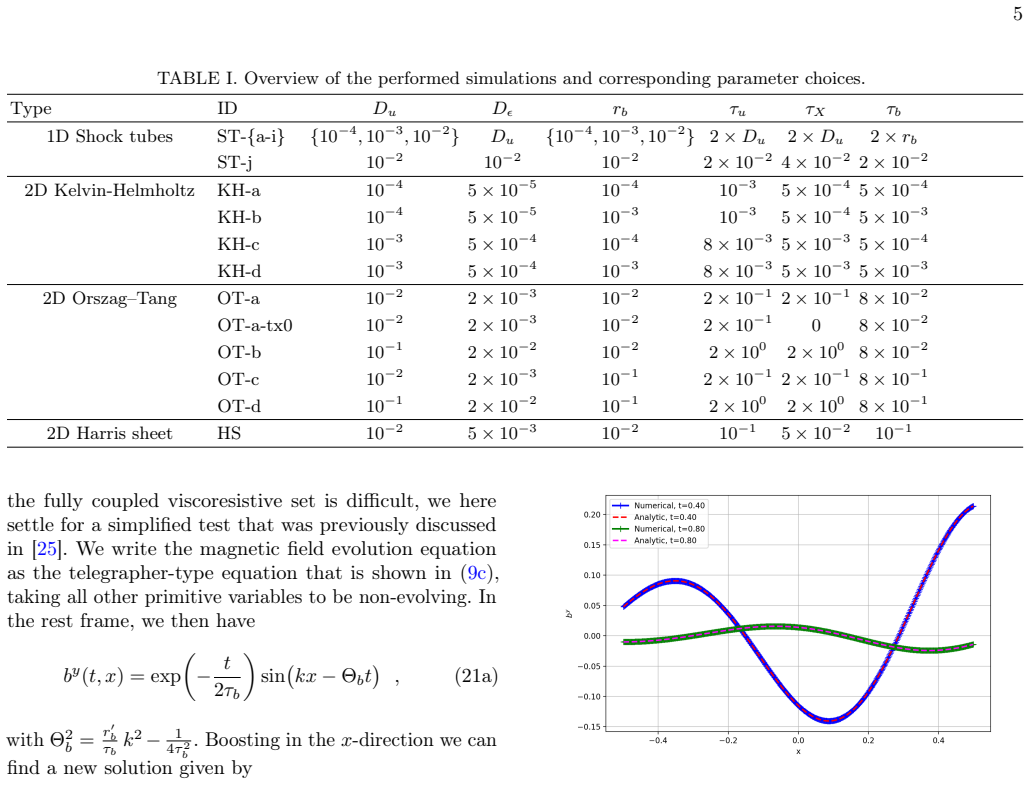
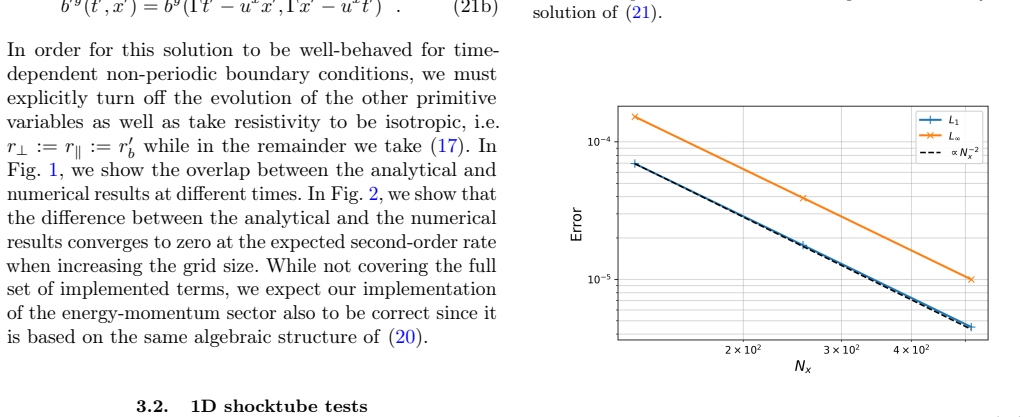
NUMERICAL EVOLUTION In this section, we discuss various benchmark problems with increasing complexity. An overview of the performed simulations is given in Table I. 3.1. Correctness and convergence To verify correct implementation, we first consider an analytical benchmark. Since finding analytic solutions for 5 TABLE I. Overview of the performed simulati...
-
[5]
Increasing energy- and momentum diffusion has a strong impact on left-moving fast and rarefaction waves and on the right-moving fast wave
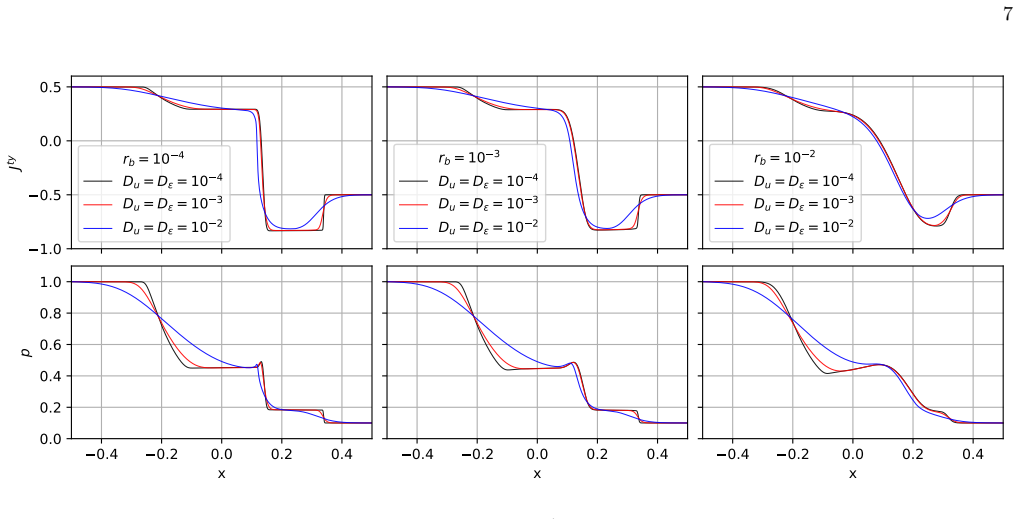
For small dissipative parameters, the solution closely resembles the known ideal MHD case [e.g.25]. Increasing energy- and momentum diffusion has a strong impact on left-moving fast and rarefaction waves and on the right-moving fast wave. The perpendicular shock atx≃ 0.15is less affected by momentum diffusion, in particular when resistivity dominates (see...
-
[6]
Harris sheet
DISCUSSION We have presented a finite-volume scheme for first-order viscoresistive relativistic magnetohydrodynamics in which viscous and resistive corrections are incorporated directly into the constitutive equations. The resulting model gives a causal extension of dissipative one-form MHD while retaining the same basic set of hydrodynamic variables. Thi...
-
[7]
Jaiswal and V
A. Jaiswal and V. Roy, Relativistic hydrodynamics in heavy-ion collisions: General aspects and recent devel- opments, Advances in High Energy Physics2016, 1–39 (2016)
2016
-
[8]
J. Hernandez and P. Kovtun, Relativistic magnetohy- drodynamics, Journal of High Energy Physics2017, 10.1007/jhep05(2017)001 (2017)
-
[9]
Israel and J
W. Israel and J. Stewart, Transient relativistic thermo- dynamics and kinetic theory, Annals of Physics118, 341 (1979)
1979
-
[10]
Müller, Zum Paradoxon der Wärmeleitungstheorie, Z
I. Müller, Zum Paradoxon der Wärmeleitungstheorie, Z. Phys.198, 329 (1967). 13
1967
-
[11]
P. Kovtun, First-order relativistic hydrodynamics is stable, Journal of High Energy Physics2019, 10.1007/jhep10(2019)034 (2019)
-
[12]
F. S. Bemfica,M. M. Disconzi,andJ. Noronha,First-order general-relativistic viscous fluid dynamics, Phys. Rev. X 12, 021044 (2022)
2022
-
[13]
Armas and F
J. Armas and F. Camilloni, A stable and causal model of magnetohydrodynamics, Journal of Cosmology and Astroparticle Physics2022(10), 039
-
[14]
R. E. Hoult and P. Kovtun, Stable and causal relativistic Navier-Stokes equations, Journal of High Energy Physics 2020, 10.1007/jhep06(2020)067 (2020)
-
[15]
density frame
Another potential resolution to the stability problem in relativistic hydrodynamics was proposed in [72] and con- sists in recasting the fluid equations in an approximate Lorentzian form and in specific choice of hydrodynamic frame - the “density frame”
-
[16]
A. Pandya and F. Pretorius, Numerical exploration of first-order relativistic hydrodynamics, Physical Review D 104, 10.1103/physrevd.104.023015 (2021)
-
[17]
Pandya, E
A. Pandya, E. R. Most, and F. Pretorius, Conservative finite volume scheme for first-order viscous relativistic hydrodynamics, Physical Review D105, 123001 (2022)
2022
- [18]
-
[19]
H. Bantilan, Y. Bea, and P. Figueras, Evolutions in first-order viscous hydrodynamics, JHEP08, 298, arXiv:2201.13359 [hep-th]
- [20]
-
[21]
G. S. Rocha, G. S. Denicol, and J. Noronha, Perturbative approaches in relativistickinetictheoryandthe emergence of first-order hydrodynamics, Phys. Rev. D106, 036010 (2022), arXiv:2205.00078 [nucl-th]
arXiv 2022
-
[22]
G.S. Rocha,C.V.P. deBrito,andG.S. Denicol,Hydrody- namic theories for a system of weakly self-interacting clas- sical ultrarelativistic scalar particles: Microscopic deriva- tions and attractors, Phys. Rev. D108, 036017 (2023), arXiv:2306.07423 [nucl-th]
arXiv 2023
-
[23]
J. Bhambure, A. Mazeliauskas, J.-F. Paquet, R. Singh, M. Singh, D. Teaney, and F. Zhou, Relativistic viscous hydrodynamics in the density frame: Numerical tests and comparisons, Phys. Rev. C111, 064910 (2025), arXiv:2412.10303 [nucl-th]
arXiv 2025
-
[24]
Y. Bea,RelativisticNavier-Stokes description ofthe quark- gluon plasma radial flow (2025), arXiv:2503.02931 [hep- ph]
arXiv 2025
-
[25]
D. Fantini and M. E. Rubio, Constraint evolution in first- order viscous relativistic fluids, Phys. Rev. D112, 063038 (2025), arXiv:2506.06430 [gr-qc]
arXiv 2025
-
[26]
N. Clarisse, E. O. Pinho, T. Patel, F. S. Bemfica, M. Hip- pert, and J. Noronha, Flux-conservative Bemfica-Disconzi- Noronha-Kovtun hydrodynamics andshockregularization, Phys. Rev. D113, 024051 (2026), arXiv:2510.16603 [gr- qc]
arXiv 2026
-
[27]
Palenzuela, L
C. Palenzuela, L. Lehner, O. Reula, and L. Rezzolla, Be- yond ideal mhd: towards a more realistic modelling of relativistic astrophysical plasmas, Monthly Notices of the Royal Astronomical Society394, 1727–1740 (2009)
2009
-
[28]
A. Dash, M. Shokri, L. Rezzolla, and D. H. Rischke, Charge diffusion in relativistic resistive second-order dissi- pative magnetohydrodynamics, Phys. Rev. D107, 056003 (2023)
2023
-
[29]
Schubring, Dissipative string fluids, Phys
D. Schubring, Dissipative string fluids, Phys. Rev. D91, 043518 (2015)
2015
-
[30]
S. Grozdanov, D. M. Hofman, and N. Iqbal, Generalized global symmetries and dissipative magnetohydrodynam- ics, Physical Review D95, 10.1103/physrevd.95.096003 (2017)
-
[31]
R. Lier, A. Jain, J. Armas, and O. Porth, Resistive rel- ativistic magnetohydrodynamics without ampère’s law, Phys. Rev. D112, 083059 (2025)
2025
-
[32]
A. J. Wright and I. Hawke, A resistive extension for ideal magnetohydrodynamics, Monthly Notices of the Royal Astronomical Society491, 5510–5523 (2019)
2019
-
[33]
R. E. Hoult and P. Kovtun, Causality in dissipative rela- tivistic magnetohydrodynamics, Journal of High Energy Physics2025, 10.1007/jhep04(2025)009 (2025)
-
[34]
Cattaneo, Sulla conduzione del calore, Atti del Semi- nario Matematico e Fisico dell’Università di Modena3, 3 (1948)
C. Cattaneo, Sulla conduzione del calore, Atti del Semi- nario Matematico e Fisico dell’Università di Modena3, 3 (1948)
1948
-
[35]
Koide, G
T. Koide, G. S. Denicol, P. Mota, and T. Kodama, Rel- ativistic dissipative hydrodynamics: A minimal causal theory, Phys. Rev. C75, 034909 (2007)
2007
-
[36]
Armas and A
J. Armas and A. Jain, One-form superfluids & magneto- hydrodynamics, Journal of High Energy Physics2020, 41 (2020)
2020
-
[37]
J. Armas and A. Jain, Magnetohydrodynamics as superfluidity, Phys. Rev. Lett.122, 141603 (2019), arXiv:1808.01939 [hep-th]
Pith/arXiv arXiv 2019
-
[38]
J. P. H. Goedbloed and S. Poedts,Principles of Magneto- hydrodynamics: With Applications to Laboratory and As- trophysical Plasmas(Cambridge University Press, 2004)
2004
-
[39]
W. A. Hiscock and L. Lindblom, Stability and causality in dissipative relativistic fluids, Annals of Physics151, 466 (1983)
1983
-
[40]
W. A. Hiscock and L. Lindblom, Generic instabilities in first-order dissipative relativistic fluid theories, Phys. Rev. D31, 725 (1985)
1985
-
[41]
Gavassino, Can we make sense of dissipation without causality?, Phys
L. Gavassino, Can we make sense of dissipation without causality?, Phys. Rev. X12, 041001 (2022)
2022
-
[42]
M. Chandra, C. F. Gammie, F. Foucart, and E. Quataert, An Extended Magnetohydrodynamics Model for Relativis- tic Weakly Collisional Plasmas, Astrophys. J.810, 162 (2015), arXiv:1508.00878 [astro-ph.HE]
Pith/arXiv arXiv 2015
-
[43]
I. Cordeiro, E. Speranza, K. Ingles, F. S. Bemfica, and J. Noronha, Causality Bounds on Dissipative General- Relativistic Magnetohydrodynamics, Phys. Rev. Lett. 133, 091401 (2024), arXiv:2312.09970 [astro-ph.HE]
arXiv 2024
-
[44]
Molnár, H
E. Molnár, H. Niemi, and D. H. Rischke, Numerical tests of causal relativistic dissipative fluid dynamics, The Eu- ropean Physical Journal C65, 615–635 (2009)
2009
-
[45]
E. R. Most and J. Noronha, Dissipative magnetohydrody- namics for nonresistive relativistic plasmas: An implicit second-order flux-conservative formulation with stiff re- laxation, Phys. Rev. D104, 103028 (2021)
2021
-
[46]
Grozdanov and M
S. Grozdanov and M. Vrbica, Algebraic structure of the gradient expansion in linearized classical hydrodynamics, Phys. Rev. D113, 065006 (2026)
2026
-
[47]
Gavassino, M
L. Gavassino, M. Antonelli, and B. Haskell, Thermody- namic stability implies causality, Phys. Rev. Lett.128, 010606 (2022)
2022
-
[48]
Krotscheck and W
E. Krotscheck and W. Kundt, Causality criteria, Commu- nications in Mathematical Physics60, 171 (1978)
1978
-
[49]
R. E. Hoult and P. Kovtun, Causality and classical dis- 14 persion relations, Phys. Rev. D109, 046018 (2024)
2024
-
[50]
W. A. Hiscock and L. Lindblom,Linear plane waves in dis- sipative relativistic fluids, Phys. Rev. D35, 3723 (1987)
1987
-
[51]
O. Porth, H. Olivares, Y. Mizuno, Z. Younsi, L. Rezzolla, M. Moscibrodzka, H. Falcke, and M. Kramer, The black hole accretion code, Computational Astrophysics and Cos- mology4, 1 (2017), arXiv:1611.09720 [gr-qc]
Pith/arXiv arXiv 2017
-
[52]
H. Olivares, O. Porth, J. Davelaar, E. R. Most, C. M. Fromm, Y. Mizuno, Z. Younsi, and L. Rezzolla, Con- strained transport and adaptive mesh refinement in the Black Hole Accretion Code,629, A61 (2019), arXiv:1906.10795 [astro-ph.HE]
arXiv 2019
-
[53]
Tóth, The ∇ ·b = 0constraint in shock-capturing magnetohydrodynamics codes, Journal of Computational Physics161, 605 (2000)
G. Tóth, The ∇ ·b = 0constraint in shock-capturing magnetohydrodynamics codes, Journal of Computational Physics161, 605 (2000)
2000
-
[54]
BalsaraandD.S
D.S. BalsaraandD.S. Spicer,Astaggeredmeshalgorithm using high order godunov fluxes to ensure solenoidal mag- netic fields in magnetohydrodynamic simulations, Journal of Computational Physics149, 270 (1999)
1999
-
[55]
P. Anninos, P. C. Fragile, and J. D. Salmonson, Cos- mos++: Relativistic magnetohydrodynamics on unstruc- tured grids with local adaptive refinement,The Astrophys- ical Journal635, 723 (2005), arXiv:astro-ph/0509254
Pith/arXiv arXiv 2005
-
[56]
Brio and C
M. Brio and C. C. Wu, An upwind differencing scheme for the equations of ideal magnetohydrodynamics, Journal of Computational Physics75, 400 (1988)
1988
-
[57]
Dionysopoulou, D
K. Dionysopoulou, D. Alic, C. Palenzuela, L. Rezzolla, and B. Giacomazzo, General-relativistic resistive magne- tohydrodynamics in three dimensions: Formulation and tests, Physical Review D88, 044020 (2013)
2013
-
[58]
Chandrasekhar,Hydrodynamic and Hydromagnetic Sta- bility, Dover Books on Physics (Dover Publications, Mine- ola, NY, 1981)
S. Chandrasekhar,Hydrodynamic and Hydromagnetic Sta- bility, Dover Books on Physics (Dover Publications, Mine- ola, NY, 1981)
1981
-
[59]
Osmanov, A
Z. Osmanov, A. Mignone, S. Massaglia, G. Bodo, and A. Ferrari, On the linear theory of Kelvin-Helmholtz in- stabilities of relativistic magnetohydrodynamic planar flows, Astronomy ’&’ Astrophysics490, 493–500 (2008)
2008
-
[60]
Ferrari, S
A. Ferrari, S. Massaglia, and E. Trussoni, Magneto- hydrodynamic Kelvin–Helmholtz instabilities in astro- physics – iii. hydrodynamic flows with shear layers, Monthly Notices of the Royal Astronomical Society198, 1065 (1982), https://academic.oup.com/mnras/article- pdf/198/4/1065/18194444/mnras198-1065.pdf
1982
-
[61]
S. A. Orszag and C. M. Tang,Small-scale structure of two- dimensional magnetohydrodynamic turbulence, Journal of Fluid Mechanics90, 129 (1979)
1979
-
[62]
Keppens, O
R. Keppens, O. Porth, K. Galsgaard, J. T. Frederiksen, A. L. Restante, G. Lapenta, and C. Parnell, Resistive magnetohydrodynamic reconnection: Resolving long-term, chaotic dynamics, Physics of Plasmas20, 092109 (2013)
2013
-
[63]
Romatschke and U
P. Romatschke and U. Romatschke, Viscosity Information from Relativistic Nuclear Collisions: How Perfect is the Fluid Observed at RHIC?, Physical Review Letters99, 172301 (2007)
2007
-
[64]
Heinz and B
U. Heinz and B. Schenke, Hydrodynamic Description of the Quark-Gluon Plasma (2024)
2024
-
[65]
M.BleicherandE.Bratkovskaya,TheQuestfortheQuark- Gluon Plasma From the Perspective of Dynamical Mod- els of Relativistic Heavy-Ion Collisions, Astronomische Nachrichten346, e70006 (2025)
2025
-
[66]
Baumann,Cosmology(2022)
D. Baumann,Cosmology(2022)
2022
-
[67]
D. A. Uzdensky, Magnetic reconnection in extreme as- trophysical environments, Space Science Reviews160, 45 (2011), arXiv:1101.2472 [astro-ph.HE]
Pith/arXiv arXiv 2011
-
[68]
J. F. Mahlmann, A. A. Philippov, V. Mewes, B. Ripperda, E. R. Most, and L. Sironi, Three-dimensional dynamics of strongly twisted magnetar magnetospheres: Kinking flux tubes and global eruptions (2023)
2023
-
[69]
Chatterjee, A
K. Chatterjee, A. Philippov, A. M. Beloborodov, K. Par- frey, B. Ripperda, and E. R. Most, Relativistic Magne- tohydrodynamic Simulations of Giant Magnetar Bursts (2026)
2026
-
[70]
Brandenburg and K
A. Brandenburg and K. Subramanian, Astrophysical mag- netic fields and nonlinear dynamo theory, Physics Reports 417, 1 (2005), arXiv:0405052 [astro-ph]
2005
-
[71]
L. S. Keeble and F. Pretorius, First-order viscous rela- tivistic hydrodynamics on the two-sphere, Phys. Rev. D 112, 124034 (2025), arXiv:2508.20998 [gr-qc]
arXiv 2025
-
[72]
H. L. H. Shum,F. Abalos,Y. Bea,M. Bezares,P. Figueras, and C. Palenzuela, Neutron star evolution with the Bemfica-Disconzi-Noronha-Kovtun viscous hydrodynam- ics framework, Phys. Rev. D113, 084029 (2026), arXiv:2509.15303 [gr-qc]
Pith/arXiv arXiv 2026
-
[73]
L. S. Keeble and J. Redondo-Yuste, Radial Oscillations of Viscous Stars (2026), arXiv:2603.23622 [gr-qc]
Pith/arXiv arXiv 2026
-
[74]
S. Bussières, J. Redondo-Yuste, J. J. Ortega Gómez, and V. Cardoso, Axial Oscillations of Viscous Neutron Stars (2026), arXiv:2604.13208 [gr-qc]
Pith/arXiv arXiv 2026
-
[75]
V. Boyanov, V. Cardoso, K. D. Kokkotas, and J. Redondo- Yuste, Dynamical Response of Viscous Objects to Grav- itational Waves, Phys. Rev. Lett.135, 151402 (2025), arXiv:2411.16861 [gr-qc]
arXiv 2025
-
[76]
J. Redondo-Yuste and V. Cardoso, Superradiant amplifi- cation by rotating viscous compact objects, Phys. Rev. D 112, L061501 (2025), arXiv:2506.13850 [gr-qc]
arXiv 2025
-
[77]
Del Zanna, O
L. Del Zanna, O. Zanotti, N. Bucciantini, and P. Lon- drillo, Echo: a eulerian conservative high-order scheme for general relativistic magnetohydrodynamics and mag- netodynamics, Astronomy and Astrophysics473, 11–30 (2007)
2007
-
[78]
J. Armas and A. Jain, Effective field theory for hydro- dynamics without boosts, SciPost Phys.11, 054 (2021), arXiv:2010.15782 [hep-th]
arXiv 2021
discussion (0)
Sign in with ORCID, Apple, or X to comment. Anyone can read and Pith papers without signing in.