Isometrization of Tensor Network States via Gauge Propagation
Pith reviewed 2026-06-26 06:59 UTC · model grok-4.3
The pith
Gauge propagation converts generic tensor network states to isometric form by approximating local tensors with an isometric factor times separable output terms.
A machine-rendered reading of the paper's core claim, the machinery that carries it, and where it could break.
Core claim
Generic tensor-network states can be approximately converted to isometric form with a fixed orthogonality center through gauge propagation; in higher dimensions a local tensor or contracted cluster is decomposed into an isometric factor multiplied by a tensor product of output-leg factors, the isometric factor is retained, and the output factors are propagated to neighboring tensors, yielding a local truncation criterion whose accuracy improves when more terms are kept or the cluster is enlarged.
What carries the argument
The structured local decomposition of a tensor or cluster into an isometric factor multiplied by a tensor product of output-leg factors, which separates the residual so it can be absorbed along propagation directions.
If this is right
- The construction supplies a local truncation criterion for gauge propagation in higher-dimensional networks.
- Refinement occurs by increasing the number of retained terms or enlarging the local cluster.
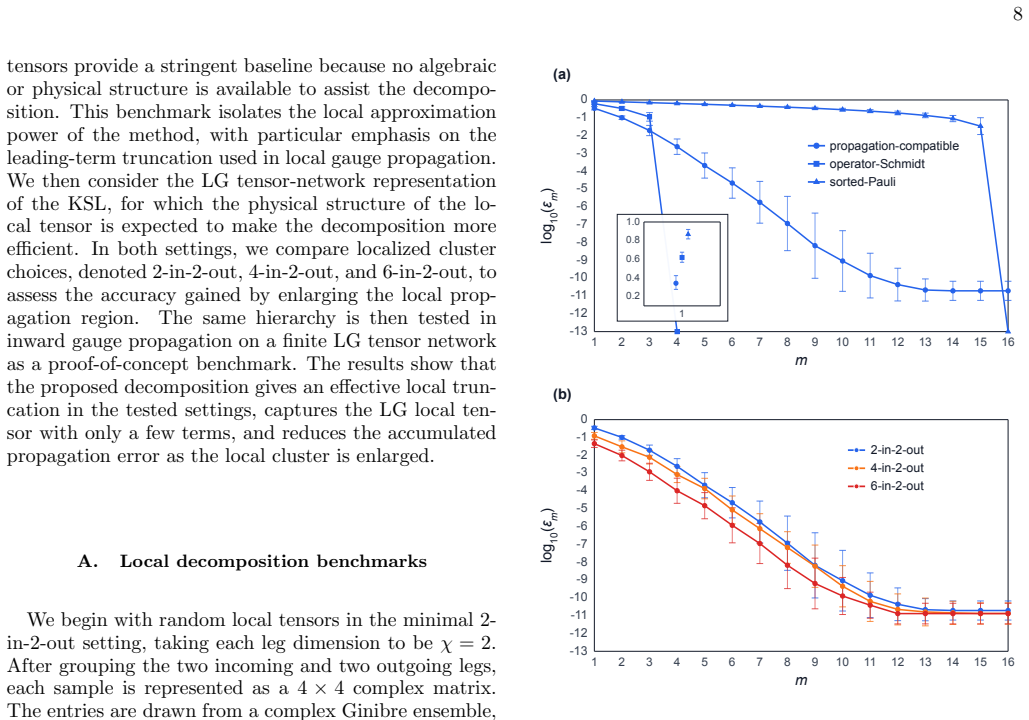
- Both local residuals and accumulated propagation errors decrease with refinement, as shown on random tensors and the Kitaev loop-gas tensor.
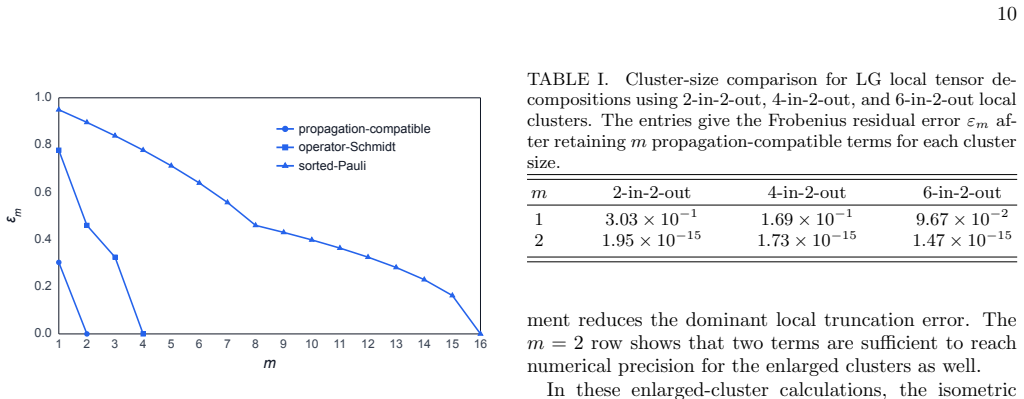
- Two structured terms suffice to reduce the local residual to numerical precision for the loop-gas tensor.
Where Pith is reading between the lines
- The same local decomposition could serve as an initializer or preconditioner for variational algorithms that target isometric tensor networks.
- Systematic enlargement of the local cluster might provide a controllable route to higher accuracy on bigger lattices.
- The approach might extend to tensor networks on geometries other than the honeycomb lattice tested here.
Load-bearing premise
A local tensor or contracted cluster can be usefully approximated by an isometric factor multiplied by a tensor product of output-leg factors without introducing uncontrolled errors that accumulate during propagation across the full higher-dimensional network.
What would settle it
Running gauge propagation on a large higher-dimensional network and checking whether accumulated errors fail to decrease when the number of retained terms is increased or the local cluster size is enlarged from 2-in-2-out to 4-in-2-out.
Figures


read the original abstract
We introduce a gauge-propagation approach for approximately converting generic tensor-network states into an isometric tensor-network state form with a prescribed orthogonality center. In one dimension, this propagation is exact because the non-isometric factor produced by a QR or singular-value decomposition is supported on a single virtual bond. In higher-dimensional networks, however, a local step can have several outgoing directions, and the residual factor is generally not separable into independent single-bond contributions. We address this local obstruction by approximating a local tensor, or a contracted local cluster, by structured terms consisting of an isometric factor multiplied by a tensor product of output-leg factors. The isometric factor is retained at the current site or cluster, while the output-leg factors are absorbed into neighboring tensors along the propagation directions. This construction provides a local truncation criterion for gauge propagation and a practical route to refinement by increasing the number of retained terms or enlarging the local cluster. Benchmarks on random tensors and on the loop-gas tensor representation of the Kitaev spin liquid show that this refinement reduces both local residuals and accumulated propagation errors. For the loop-gas tensor, two structured terms reduce the local residual to numerical precision, and enlarging the local object from 2-in-2-out to 4-in-2-out and 6-in-2-out clusters lowers both local truncation errors and accumulated errors in finite honeycomb gauge propagation. These results identify propagation-compatible local decomposition as a useful building block for approximate isometrization and as a potential initializer or preconditioner for variational isoTNS algorithms.
Editorial analysis
A structured set of objections, weighed in public.
Referee Report
Summary. The manuscript introduces a gauge-propagation method to approximately convert generic tensor-network states into isometric form with a prescribed orthogonality center. In higher dimensions, local non-separable residuals are handled by approximating a local tensor or contracted cluster as an isometric factor times a tensor product of output-leg factors; the isometric part is retained and the leg factors are absorbed into neighboring tensors. This supplies a local truncation criterion that can be refined by retaining additional terms or enlarging the cluster. Benchmarks on random tensors and on the loop-gas tensor representation of the Kitaev spin liquid show that such refinement reduces both local residuals and accumulated propagation errors on finite honeycomb lattices.
Significance. If the numerical findings hold, the construction supplies a practical, refinable building block for approximate isometrization of higher-dimensional tensor networks and a potential initializer or preconditioner for variational isoTNS algorithms. The explicit benchmarks—particularly that two structured terms already reach numerical precision on the loop-gas tensor and that enlarging the contracted object from 2-in-2-out to 4-in-2-out and 6-in-2-out clusters measurably lowers both local and accumulated errors—provide direct empirical support for the claim that the product-of-leg-factors approximation does not introduce uncontrolled accumulation.
major comments (2)
- [Numerical benchmarks] The manuscript reports reductions in local residuals and accumulated errors but supplies neither explicit error bars on the benchmark values nor a comparison against alternative local truncation schemes (e.g., plain SVD truncation of the same local object). Without these, it is difficult to assess whether the observed improvements are statistically robust or specific to the proposed structured form.
- [Gauge propagation construction] No derivation or inequality is given that relates the local truncation residual to a bound on the global propagation error across the full network. The central claim that the method supplies a usable truncation criterion therefore rests entirely on the numerical evidence rather than on an a-priori error control.
minor comments (1)
- [Abstract] The abstract and introduction would benefit from a brief, explicit statement of how the truncation threshold is chosen in practice (e.g., singular-value cutoff or residual norm) before the numerical results are presented.
Simulated Author's Rebuttal
We thank the referee for the positive assessment and the recommendation for minor revision. We address each major comment below.
read point-by-point responses
-
Referee: [Numerical benchmarks] The manuscript reports reductions in local residuals and accumulated errors but supplies neither explicit error bars on the benchmark values nor a comparison against alternative local truncation schemes (e.g., plain SVD truncation of the same local object). Without these, it is difficult to assess whether the observed improvements are statistically robust or specific to the proposed structured form.
Authors: We agree that error bars and a comparison to plain SVD truncation would strengthen the numerical section. In the revised manuscript we will report error bars obtained from an ensemble of independent random-tensor realizations and will add a direct side-by-side comparison of the structured decomposition against SVD truncation performed on the identical local tensors and clusters. revision: yes
-
Referee: [Gauge propagation construction] No derivation or inequality is given that relates the local truncation residual to a bound on the global propagation error across the full network. The central claim that the method supplies a usable truncation criterion therefore rests entirely on the numerical evidence rather than on an a-priori error control.
Authors: The manuscript presents gauge propagation as a practical, refinable approximation whose local truncation criterion is validated by controllable reduction of residuals under systematic refinement. We do not claim an a-priori global error bound; deriving a tight inequality for the non-separable higher-dimensional case lies outside the scope of the work. The reported benchmarks on both random tensors and the exactly solvable loop-gas model already demonstrate that the accumulated propagation error remains small and decreases with the same refinements that lower the local residual. revision: no
Circularity Check
No significant circularity
full rationale
The paper introduces an explicit constructive procedure for approximate isometrization via gauge propagation, defining structured local approximations (isometric factor times product of output-leg factors) and providing a truncation criterion based on retained terms or cluster size. All load-bearing claims are supported by direct numerical benchmarks on external, independent inputs—random tensors and the loop-gas tensor representation of the Kitaev spin liquid—reporting measured reductions in local residuals and accumulated propagation errors. No equation reduces a reported quantity to a fitted parameter by construction, no self-citation chain carries the central result, and the method is not derived from prior uniqueness theorems or ansatzes by the same authors. The derivation remains self-contained against external benchmarks.
Axiom & Free-Parameter Ledger
axioms (1)
- standard math QR and singular-value decompositions produce an isometric factor and a residual supported on virtual bonds
Reference graph
Works this paper leans on
-
[1]
Leading-term extraction The leading-term extraction is applied to a current tensorR, which is either the original local tensorTor a residual generated during the iterative decomposition. The task is to find the normalized structured term with the largest Frobenius overlap withR, α(R) = max F ∈C |⟨F, R⟩ F |.(34) The optimized term is denoted byF, and the c...
-
[2]
Iterative multi-term decomposition The same extraction step can be applied recursively to construct a finite-term approximation. The resulting approximation to a normalized local tensorThas the form T≃ KX k=1 αkFk,(48) where eachF k is a normalized structured term and the coefficients are real and nonnegative. We initialize the residual as R(0) =T.(49) At...
-
[3]
Or´ us, A practical introduction to tensor networks: Matrix product states and projected entangled pair states, Annals of Physics349, 117 (2014)
R. Or´ us, A practical introduction to tensor networks: Matrix product states and projected entangled pair states, Annals of Physics349, 117 (2014)
2014
-
[4]
Or´ us, Tensor networks for complex quantum systems, Nature Reviews Physics1, 538 (2019)
R. Or´ us, Tensor networks for complex quantum systems, Nature Reviews Physics1, 538 (2019)
2019
-
[5]
J. I. Cirac, D. P´ erez-Garc´ ıa, N. Schuch, and F. Ver- straete, Matrix product states and projected entangled pair states: Concepts, symmetries, theorems, Rev. Mod. Phys.93, 045003 (2021)
2021
-
[6]
S. R. White, Density matrix formulation for quantum renormalization groups, Phys. Rev. Lett.69, 2863 (1992)
1992
-
[7]
S. R. White, Density-matrix algorithms for quantum renormalization groups, Phys. Rev. B48, 10345 (1993)
1993
-
[8]
Schollw¨ ock, The density-matrix renormalization group, Rev
U. Schollw¨ ock, The density-matrix renormalization group, Rev. Mod. Phys.77, 259 (2005)
2005
-
[9]
Schollw¨ ock, The density-matrix renormalization group in the age of matrix product states, Annals of Physics 326, 96 (2011)
U. Schollw¨ ock, The density-matrix renormalization group in the age of matrix product states, Annals of Physics 326, 96 (2011)
2011
-
[10]
Fannes, B
M. Fannes, B. Nachtergaele, and R. F. Werner, Finitely correlated states on quantum spin chains, Communica- tions in Mathematical Physics144, 443 (1992)
1992
-
[11]
¨Ostlund and S
S. ¨Ostlund and S. Rommer, Thermodynamic limit of den- sity matrix renormalization, Phys. Rev. Lett.75, 3537 (1995)
1995
-
[12]
P´ erez-Garc´ ıa, F
D. P´ erez-Garc´ ıa, F. Verstraete, M. M. Wolf, and J. I. Cirac, Matrix product state representations, Quantum Information & Computation7, 401 (2007)
2007
-
[13]
M. B. Hastings, An area law for one-dimensional quan- tum systems, Journal of Statistical Mechanics: Theory and Experiment2007, P08024 (2007)
2007
-
[14]
Vidal, Efficient classical simulation of slightly entan- gled quantum computations, Phys
G. Vidal, Efficient classical simulation of slightly entan- gled quantum computations, Phys. Rev. Lett.91, 147902 (2003)
2003
-
[15]
Vidal, Efficient simulation of one-dimensional quan- tum many-body systems, Phys
G. Vidal, Efficient simulation of one-dimensional quan- tum many-body systems, Phys. Rev. Lett.93, 040502 (2004)
2004
-
[16]
Haegeman, J
J. Haegeman, J. I. Cirac, T. J. Osborne, I. Piˇ zorn, H. Ver- schelde, and F. Verstraete, Time-dependent variational principle for quantum lattices, Phys. Rev. Lett.107, 070601 (2011)
2011
-
[17]
Haegeman, C
J. Haegeman, C. Lubich, I. Oseledets, B. Vandereycken, and F. Verstraete, Unifying time evolution and optimiza- tion with matrix product states, Phys. Rev. B94, 165116 (2016)
2016
-
[18]
F. Verstraete and J. I. Cirac, Renormalization algorithms for Quantum-Many Body Systems in two and higher di- mensions (2004), arXiv:cond-mat/0407066
Pith/arXiv arXiv 2004
-
[19]
Verstraete, V
F. Verstraete, V. Murg, and J. I. Cirac, Matrix prod- uct states, projected entangled pair states, and varia- tional renormalization group methods for quantum spin systems, Advances in Physics57, 143 (2008)
2008
-
[20]
Jordan, R
J. Jordan, R. Or´ us, G. Vidal, F. Verstraete, and J. I. Cirac, Classical simulation of infinite-size quantum lat- tice systems in two spatial dimensions, Phys. Rev. Lett. 101, 250602 (2008)
2008
-
[21]
Schuch, M
N. Schuch, M. M. Wolf, F. Verstraete, and J. I. Cirac, Computational complexity of projected entangled pair states, Phys. Rev. Lett.98, 140506 (2007)
2007
-
[22]
I. L. Markov and Y. Shi, Simulating quantum computa- tion by contracting tensor networks, SIAM Journal on Computing38, 963 (2008)
2008
-
[23]
Corboz, Variational optimization with infinite pro- jected entangled-pair states, Phys
P. Corboz, Variational optimization with infinite pro- jected entangled-pair states, Phys. Rev. B94, 035133 (2016)
2016
-
[24]
Vanderstraeten, J
L. Vanderstraeten, J. Haegeman, P. Corboz, and F. Ver- straete, Gradient methods for variational optimization of projected entangled-pair states, Phys. Rev. B94, 155123 (2016)
2016
-
[25]
Nishino and K
T. Nishino and K. Okunishi, Corner transfer matrix renormalization group method, Journal of the Physical Society of Japan65, 891 (1996)
1996
-
[26]
Nishino and K
T. Nishino and K. Okunishi, Corner transfer matrix algo- rithm for classical renormalization group, Journal of the Physical Society of Japan66, 3040 (1997)
1997
-
[27]
Levin and C
M. Levin and C. P. Nave, Tensor renormalization group approach to two-dimensional classical lattice models, Phys. Rev. Lett.99, 120601 (2007)
2007
-
[28]
Z.-C. Gu, M. Levin, and X.-G. Wen, Tensor- entanglement renormalization group approach as a uni- fied method for symmetry breaking and topological phase transitions, Phys. Rev. B78, 205116 (2008)
2008
-
[29]
Jiang, Z.-Y
H.-C. Jiang, Z.-Y. Weng, and T. Xiang, Accurate de- termination of tensor network state of quantum lattice models in two dimensions, Phys. Rev. Lett.101, 090603 (2008)
2008
-
[30]
Or´ us and G
R. Or´ us and G. Vidal, Simulation of two-dimensional quantum systems on an infinite lattice revisited: Cor- ner transfer matrix for tensor contraction, Phys. Rev. B 80, 094403 (2009)
2009
-
[31]
Corboz, R
P. Corboz, R. Or´ us, B. Bauer, and G. Vidal, Simula- tion of strongly correlated fermions in two spatial di- mensions with fermionic projected entangled-pair states, Phys. Rev. B81, 165104 (2010)
2010
-
[32]
H. N. Phien, J. A. Bengua, H. D. Tuan, P. Corboz, and R. Or´ us, Infinite projected entangled pair states algo- rithm improved: Fast full update and gauge fixing, Phys. Rev. B92, 035142 (2015)
2015
-
[33]
Vidal, Entanglement renormalization, Phys
G. Vidal, Entanglement renormalization, Phys. Rev. Lett.99, 220405 (2007)
2007
-
[34]
Vidal, Class of quantum many-body states that can be efficiently simulated, Phys
G. Vidal, Class of quantum many-body states that can be efficiently simulated, Phys. Rev. Lett.101, 110501 (2008)
2008
-
[35]
Evenbly and G
G. Evenbly and G. Vidal, Algorithms for entanglement renormalization, Phys. Rev. B79, 144108 (2009)
2009
-
[36]
Evenbly and G
G. Evenbly and G. Vidal, Tensor network renormaliza- tion, Phys. Rev. Lett.115, 180405 (2015)
2015
-
[37]
M. P. Zaletel and F. Pollmann, Isometric tensor network states in two dimensions, Phys. Rev. Lett.124, 037201 14 (2020)
2020
-
[38]
S.-H. Lin, M. P. Zaletel, and F. Pollmann, Efficient simu- lation of dynamics in two-dimensional quantum spin sys- tems with isometric tensor networks, Phys. Rev. B106, 245102 (2022)
2022
-
[39]
Z. Dai, Y. Wu, T. Wang, and M. P. Zaletel, Fermionic isometric tensor network states in two dimensions, Phys. Rev. Lett.134, 026502 (2025)
2025
-
[40]
Y. Wu, S. Anand, S.-H. Lin, F. Pollmann, and M. P. Zaletel, Two-dimensional isometric tensor networks on an infinite strip, Phys. Rev. B107, 245118 (2023)
2023
-
[41]
Y. Wu, Z. Dai, S. Anand, S.-H. Lin, Q. Yang, L. Wang, F. Pollmann, and M. P. Zaletel, Alternating and gaussian fermionic isometric tensor network states, PRX Quantum 6, 040324 (2025)
2025
-
[42]
Malz and R
D. Malz and R. Trivedi, Computational complexity of iso- metric tensor-network states, PRX Quantum6, 020310 (2025)
2025
-
[43]
Kitaev, Anyons in an exactly solved model and be- yond, Annals of Physics321, 2 (2006)
A. Kitaev, Anyons in an exactly solved model and be- yond, Annals of Physics321, 2 (2006)
2006
-
[44]
Savary and L
L. Savary and L. Balents, Quantum spin liquids: a re- view, Reports on Progress in Physics80, 016502 (2017)
2017
-
[45]
Hermanns, I
M. Hermanns, I. Kimchi, and J. Knolle, Physics of the ki- taev model: Fractionalization, dynamic correlations, and material connections, Annual Review of Condensed Mat- ter Physics9, 17 (2018)
2018
-
[46]
Knolle and R
J. Knolle and R. Moessner, A field guide to spin liq- uids, Annual Review of Condensed Matter Physics10, 451 (2019)
2019
-
[47]
H.-Y. Lee, R. Kaneko, T. Okubo, and N. Kawashima, Gapless kitaev spin liquid to classical string gas through tensor networks, Phys. Rev. Lett.123, 087203 (2019)
2019
-
[48]
P. H. Sch¨ onemann, A generalized solution of the orthog- onal procrustes problem, Psychometrika31, 1 (1966)
1966
-
[49]
N. J. Higham, Computing the polar decomposition—with applications, SIAM Journal on Scientific and Statistical Computing7, 1160 (1986)
1986
-
[50]
C. F. Van Loan and N. Pitsianis, Approximation with kronecker products, inLinear Algebra for Large Scale and Real-Time Applications, edited by M. S. Moonen, G. H. Golub, and B. L. R. De Moor (Springer Netherlands, Dordrecht, 1993) pp. 293–314
1993
-
[51]
De Lathauwer, B
L. De Lathauwer, B. De Moor, and J. Vandewalle, A multilinear singular value decomposition, SIAM Journal on Matrix Analysis and Applications21, 1253 (2000)
2000
-
[52]
C. F. Van Loan, The ubiquitous kronecker product, Jour- nal of Computational and Applied Mathematics123, 85 (2000)
2000
-
[53]
T. G. Kolda and B. W. Bader, Tensor decompositions and applications, SIAM Review51, 455 (2009)
2009
-
[54]
I. V. Oseledets, Tensor-train decomposition, SIAM Jour- nal on Scientific Computing33, 2295 (2011)
2011
-
[55]
M. A. Nielsen and I. L. Chuang,Quantum Computation and Quantum Information: 10th Anniversary Edition (Cambridge University Press, 2010)
2010
-
[56]
J. E. Tyson, Operator-schmidt decompositions and the fourier transform, with applications to the operator- schmidt numbers of unitaries, Journal of Physics A: Mathematical and General36, 10101 (2003)
2003
-
[57]
Jozsa, Fidelity for mixed quantum states, Journal of Modern Optics41, 2315 (1994)
R. Jozsa, Fidelity for mixed quantum states, Journal of Modern Optics41, 2315 (1994)
1994
-
[58]
Kraus and J
B. Kraus and J. I. Cirac, Optimal creation of entangle- ment using a two-qubit gate, Phys. Rev. A63, 062309 (2001)
2001
-
[59]
Vatan and C
F. Vatan and C. Williams, Optimal quantum circuits for general two-qubit gates, Phys. Rev. A69, 032315 (2004)
2004
-
[60]
Vidal and C
G. Vidal and C. M. Dawson, Universal quantum circuit for two-qubit transformations with three controlled-NOT gates, Phys. Rev. A69, 010301 (2004)
2004
-
[61]
V. V. Shende, I. L. Markov, and S. S. Bullock, Minimal universal two-qubit controlled-NOT-based circuits, Phys. Rev. A69, 062321 (2004)
2004
-
[62]
R. Iten, R. Colbeck, I. Kukuljan, J. Home, and M. Chris- tandl, Quantum circuits for isometries, Phys. Rev. A93, 032318 (2016)
2016
-
[63]
Shirakawa, H
T. Shirakawa, H. Ueda, and S. Yunoki, Automatic quan- tum circuit encoding of a given arbitrary quantum state, Phys. Rev. Res.6, 043008 (2024)
2024
-
[64]
S. Miyakoshi, T. Sugimoto, T. Shirakawa, S. Yunoki, and H. Ueda, High-precision variational quantum SVD via classical orthogonality correction (2026), arXiv:2605.08683 [quant-ph]
Pith/arXiv arXiv 2026
discussion (0)
Sign in with ORCID, Apple, or X to comment. Anyone can read and Pith papers without signing in.