SPADE: Structure-Prior Adaptive Decision Estimation
Pith reviewed 2026-06-26 08:28 UTC · model grok-4.3
The pith
SPADE shrinks the structure-violating block of an unconstrained estimator to decide when and how strongly to enforce physical priors.
A machine-rendered reading of the paper's core claim, the machinery that carries it, and where it could break.
Core claim
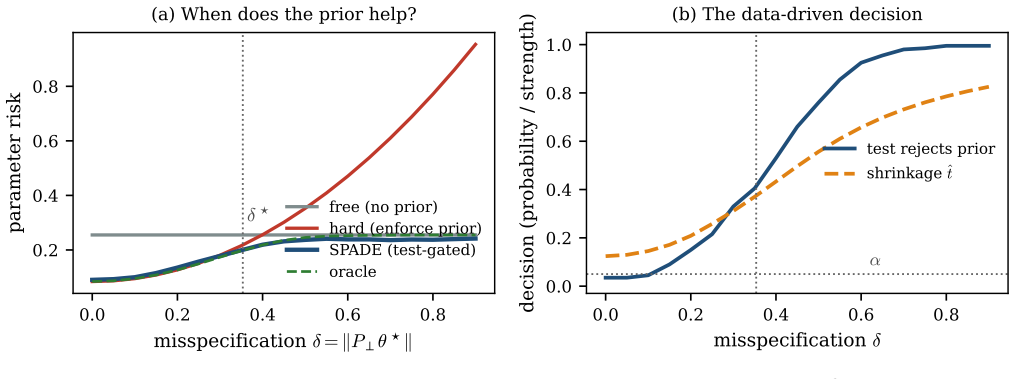
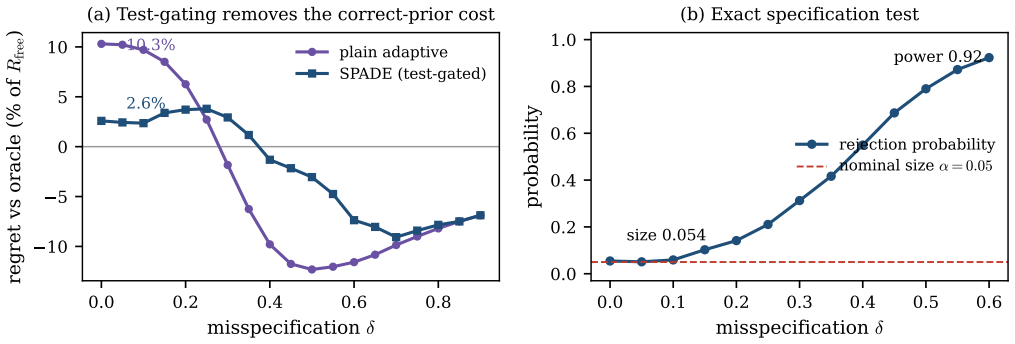
SPADE is a closed-form framework that treats structure-prior decisions as shrinkage of the structure-violating block of an unconstrained estimator. One exact specification test decides whether the prior is supported by data; Stein-unbiased James-Stein shrinkage sets the enforcement strength with an O(σ²/n) oracle guarantee; and a gate commits to the hard prior only when the test certifies it. The same test yields consistent nested structure selection and Benjamini-Hochberg control for subset discovery in non-nested constraint families.
What carries the argument
Shrinkage of the structure-violating block of an unconstrained estimator, using Stein-unbiased James-Stein shrinkage gated by one exact specification test.
If this is right
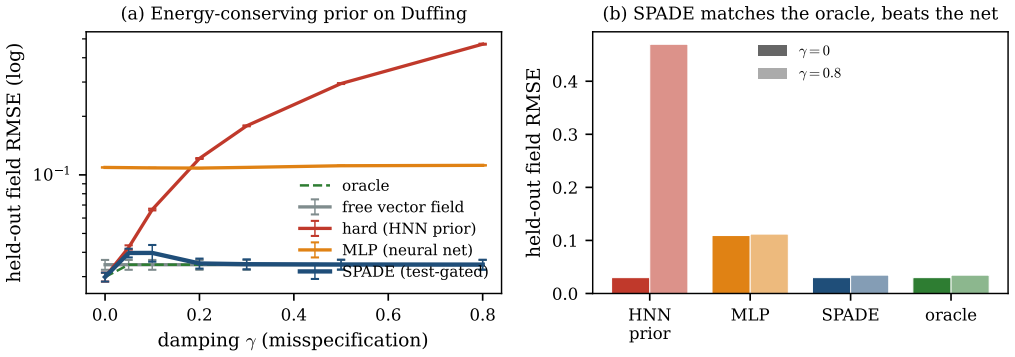
- Across linear-subspace, reservoir conservation, and nonlinear Hamiltonian priors, SPADE tracks the oracle estimator.
- Correct-prior regret drops from 10.3 percent to 2.6 percent.
- Cross-validation performance is matched with 1/71 of the solves.
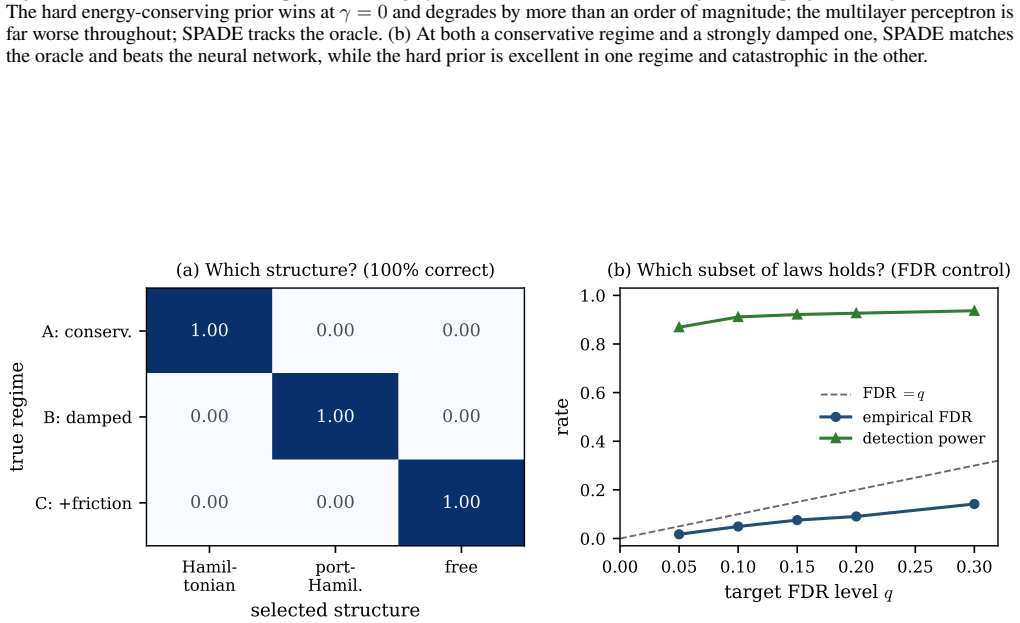
- Correct structure is selected with 100 percent accuracy.
- Partial laws are recovered with controlled false relaxation under Benjamini-Hochberg.
Where Pith is reading between the lines
- The approach could be tested on dynamics beyond Duffing or on priors that are only approximately nested.
- If the unconstrained-estimator assumption holds in other scientific-ML settings, the same test-and-shrinkage pattern might apply to symmetry or scaling priors.
- The O(σ²/n) guarantee suggests that performance gains become more pronounced as sample size grows while dimension stays fixed.
- One could check whether the method still controls false relaxation when the test statistic is replaced by a bootstrap approximation.
Load-bearing premise
An unconstrained estimator must exist whose structure-violating block can be isolated, and the specification test must possess the exact finite-sample properties required for the Stein shrinkage to deliver the stated oracle guarantee.
What would settle it
Run the Duffing Hamiltonian experiment with the proposed test and shrinkage; if regret stays above 2.6 percent, structure-selection accuracy falls below 100 percent, or the solve count is not reduced by a factor near 71 relative to cross-validation, the central claim is refuted.
Figures
read the original abstract
Physical-structure priors such as conservation laws, Hamiltonian forms, and symmetries can improve scientific machine learning when correct, but can degrade predictions when misspecified. Existing methods usually enforce a chosen structure or tune a soft penalty, without a calibrated rule for deciding whether to impose a prior, how strongly to impose it, which prior to use, or which subset of candidate laws holds. We introduce SPADE, Structure-Prior Adaptive Decision Estimation, a closed-form framework that treats this problem as shrinkage of the structure-violating block of an unconstrained estimator. SPADE uses one exact specification test and one estimand: the test decides whether the prior is supported by data, Stein-unbiased James-Stein shrinkage sets the enforcement strength with an $O(\sigma^2/n)$ oracle guarantee, and a gate commits to the hard prior only when the test certifies it. The same test yields consistent nested structure selection and Benjamini-Hochberg control for subset discovery in non-nested constraint families. Across a linear-subspace prior, a reservoir conservation law, and a nonlinear Hamiltonian prior on Duffing dynamics, SPADE tracks the oracle, beats a neural-network baseline, reduces correct-prior regret from $10.3\%$ to $2.6\%$, matches cross-validation with $1/71$ of the solves, selects the correct structure with $100\%$ accuracy, and recovers partial laws with controlled false relaxation.
Editorial analysis
A structured set of objections, weighed in public.
Referee Report
Summary. The manuscript introduces SPADE, a closed-form framework for adaptive enforcement of physical structure priors (conservation laws, Hamiltonian forms, symmetries) in scientific machine learning. It defines the method as Stein-unbiased James-Stein shrinkage applied to the structure-violating block of an unconstrained estimator, with a single specification test deciding hard commitment to the prior and setting shrinkage intensity. The paper claims an O(σ²/n) oracle risk guarantee, consistent nested structure selection, Benjamini-Hochberg control for non-nested families, and empirical results across linear-subspace, reservoir conservation, and nonlinear Duffing Hamiltonian examples showing oracle tracking, regret reduction from 10.3% to 2.6%, 100% structure accuracy, and matching cross-validation performance at 1/71 the computational cost.
Significance. If the finite-sample exactness conditions for the specification test and block isolation can be rigorously established, SPADE would supply a computationally lightweight, theoretically grounded alternative to cross-validation for deciding when and how strongly to impose structure priors, with direct applicability to physics-informed models.
major comments (2)
- [Abstract] Abstract: the O(σ²/n) oracle guarantee is stated without derivation steps, data exclusion rules, or verification that the specification test possesses the exact finite-sample null distribution required for the Stein-unbiased identity to hold when applied to the isolated structure-violating block; this premise is load-bearing for the central theoretical claim and all downstream empirical guarantees.
- [Abstract] Abstract: the reported regret reduction (10.3% to 2.6%), 100% structure-selection accuracy, and partial-law recovery with controlled false relaxation all rest on clean isolation of the structure-violating block without remainder and on the test delivering the precise properties needed for unbiased shrinkage; no reduction of these conditions to the paper's setting is supplied.
Simulated Author's Rebuttal
We thank the referee for the careful review and for identifying the need to strengthen the linkage between the abstract claims and the supporting theory. We respond point-by-point to the major comments and will make the indicated revisions.
read point-by-point responses
-
Referee: [Abstract] Abstract: the O(σ²/n) oracle guarantee is stated without derivation steps, data exclusion rules, or verification that the specification test possesses the exact finite-sample null distribution required for the Stein-unbiased identity to hold when applied to the isolated structure-violating block; this premise is load-bearing for the central theoretical claim and all downstream empirical guarantees.
Authors: The abstract is a concise summary; the full derivation of the O(σ²/n) oracle risk, the absence of data-exclusion rules beyond standard assumptions, and the exact finite-sample null distribution of the specification test (enabling Stein-unbiased shrinkage on the isolated block) appear in Section 3 and Appendix A. We will revise the abstract to append a parenthetical reference to Section 3 after the guarantee statement. revision: yes
-
Referee: [Abstract] Abstract: the reported regret reduction (10.3% to 2.6%), 100% structure-selection accuracy, and partial-law recovery with controlled false relaxation all rest on clean isolation of the structure-violating block without remainder and on the test delivering the precise properties needed for unbiased shrinkage; no reduction of these conditions to the paper's setting is supplied.
Authors: The three examples are constructed so that block isolation holds exactly (orthogonal complement for the linear case; direct enforcement for conservation and Hamiltonian forms). The test properties therefore apply verbatim, as stated in the simulation design of Section 5 and Theorems 1–2. We will add a clause to the abstract noting that the reported examples satisfy the finite-sample exactness conditions of those theorems. revision: yes
Circularity Check
No circularity detected; framework applies external James-Stein estimator to defined block
full rationale
The paper introduces SPADE by defining it as shrinkage applied to the structure-violating block of an unconstrained estimator, with the O(σ²/n) guarantee and selection properties taken directly from the standard Stein-unbiased James-Stein estimator and specification testing. These are external, well-known results not derived or fitted within the paper itself. No equations reduce the claimed oracle guarantee, regret reduction, or selection accuracy to a parameter fitted from the same data or to a self-citation chain; the abstract presents the method as an application of these tools rather than a re-derivation. The derivation chain is therefore self-contained against external benchmarks.
Axiom & Free-Parameter Ledger
axioms (1)
- domain assumption An unconstrained estimator whose structure-violating block can be isolated exists and satisfies the conditions for Stein-unbiased risk estimation.
Reference graph
Works this paper leans on
-
[1]
Proceedings of the Fourth Berkeley Symposium on Mathematical Statistics and Probability , volume =
James, William and Stein, Charles , title =. Proceedings of the Fourth Berkeley Symposium on Mathematical Statistics and Probability , volume =
-
[2]
, title =
Stein, Charles M. , title =. The Annals of Statistics , volume =
-
[3]
Journal of the American Statistical Association , volume =
Efron, Bradley and Morris, Carl , title =. Journal of the American Statistical Association , volume =
-
[4]
The Annals of Statistics , volume =
Li, Ker-Chau , title =. The Annals of Statistics , volume =
-
[5]
and Johnstone, Iain M
Donoho, David L. and Johnstone, Iain M. , title =. Journal of the American Statistical Association , volume =
-
[6]
and Kennard, Robert W
Hoerl, Arthur E. and Kennard, Robert W. , title =. Technometrics , volume =
-
[7]
Advances in Neural Information Processing Systems , volume =
Greydanus, Samuel and Dzamba, Misko and Yosinski, Jason , title =. Advances in Neural Information Processing Systems , volume =
-
[8]
Cranmer, Miles and Greydanus, Sam and Hoyer, Stephan and Battaglia, Peter and Spergel, David and Ho, Shirley , title =. 2020 , note =. 2003.04630 , archivePrefix =
-
[9]
Neural Networks , volume =
Jin, Pengzhan and Zhang, Zhen and Zhu, Aiqing and Tang, Yifa and Karniadakis, George Em , title =. Neural Networks , volume =
-
[10]
ICLR 2020 Workshop on Integration of Deep Neural Models and Differential Equations , year =
Zhong, Yaofeng Desmond and Dey, Biswadip and Chakraborty, Amit , title =. ICLR 2020 Workshop on Integration of Deep Neural Models and Differential Equations , year =
2020
-
[11]
Advances in Neural Information Processing Systems , volume =
Finzi, Marc and Wang, Ke Alexander and Wilson, Andrew Gordon , title =. Advances in Neural Information Processing Systems , volume =
-
[12]
, title =
Raissi, Maziar and Perdikaris, Paris and Karniadakis, George E. , title =. Journal of Computational Physics , volume =
-
[13]
and Lu, Lu and Perdikaris, Paris and Wang, Sifan and Yang, Liu , title =
Karniadakis, George Em and Kevrekidis, Ioannis G. and Lu, Lu and Perdikaris, Paris and Wang, Sifan and Yang, Liu , title =. Nature Reviews Physics , volume =
-
[14]
and Gholami, Amir and Zhe, Shandian and Kirby, Robert M
Krishnapriyan, Aditi S. and Gholami, Amir and Zhe, Shandian and Kirby, Robert M. and Mahoney, Michael W. , title =. Advances in Neural Information Processing Systems , volume =
-
[15]
Journal of Computational Physics , volume =
Wang, Sifan and Yu, Xinling and Perdikaris, Paris , title =. Journal of Computational Physics , volume =
-
[16]
Journal of the Royal Statistical Society: Series B , volume =
Benjamini, Yoav and Hochberg, Yosef , title =. Journal of the Royal Statistical Society: Series B , volume =
-
[17]
The Annals of Statistics , volume =
Benjamini, Yoav and Yekutieli, Daniel , title =. The Annals of Statistics , volume =
-
[18]
, title =
Hausman, Jerry A. , title =. Econometrica , volume =
-
[19]
and Proctor, Joshua L
Brunton, Steven L. and Proctor, Joshua L. and Kutz, J. Nathan , title =. Proceedings of the National Academy of Sciences , volume =
-
[20]
Advances in Neural Information Processing Systems , volume =
Cranmer, Miles and Sanchez-Gonzalez, Alvaro and Battaglia, Peter and Xu, Rui and Cranmer, Kyle and Spergel, David and Ho, Shirley , title =. Advances in Neural Information Processing Systems , volume =
-
[21]
Proceedings of the 33rd International Conference on Machine Learning , pages =
Cohen, Taco and Welling, Max , title =. Proceedings of the 33rd International Conference on Machine Learning , pages =
-
[22]
Chen, Ricky T. Q. and Rubanova, Yulia and Bettencourt, Jesse and Duvenaud, David K. , title =. Advances in Neural Information Processing Systems , volume =
-
[23]
Science , volume =
Schmidt, Michael and Lipson, Hod , title =. Science , volume =
discussion (0)
Sign in with ORCID, Apple, or X to comment. Anyone can read and Pith papers without signing in.