Observables and conformal properties of dark matter admixed isentropic neutron stars
Pith reviewed 2026-06-26 08:00 UTC · model grok-4.3
The pith
Conformality signatures previously tied to quark matter can be produced by dark matter admixture in isentropic neutron stars.
A machine-rendered reading of the paper's core claim, the machinery that carries it, and where it could break.
Core claim
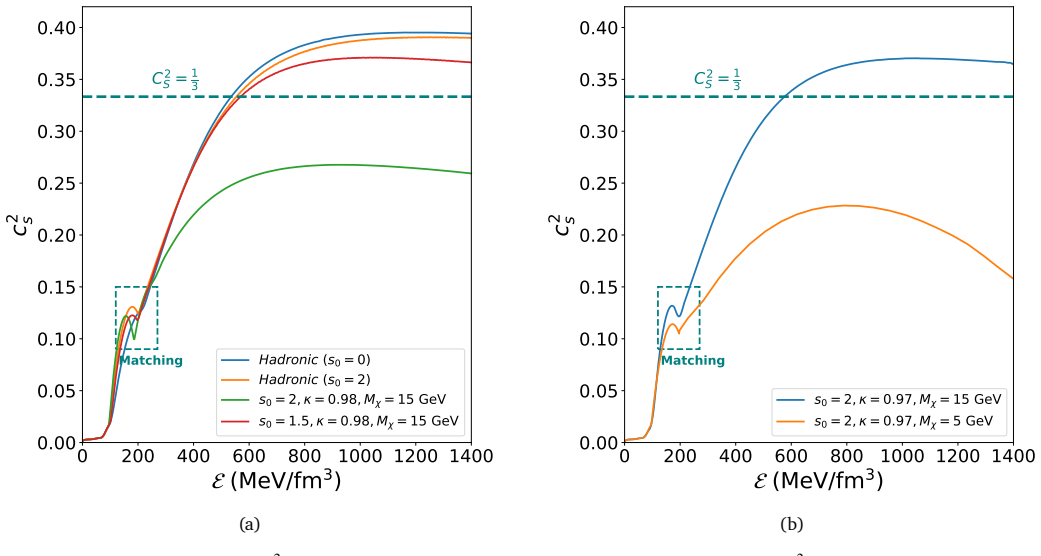
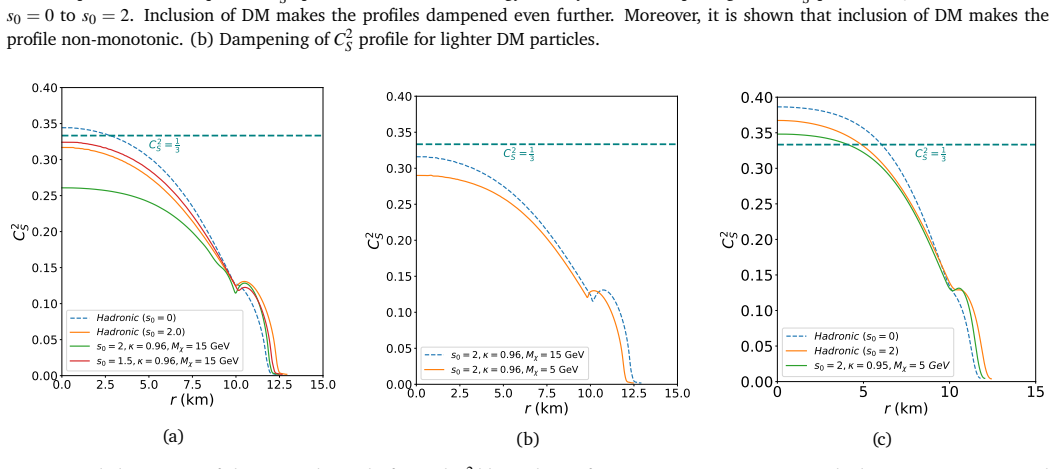
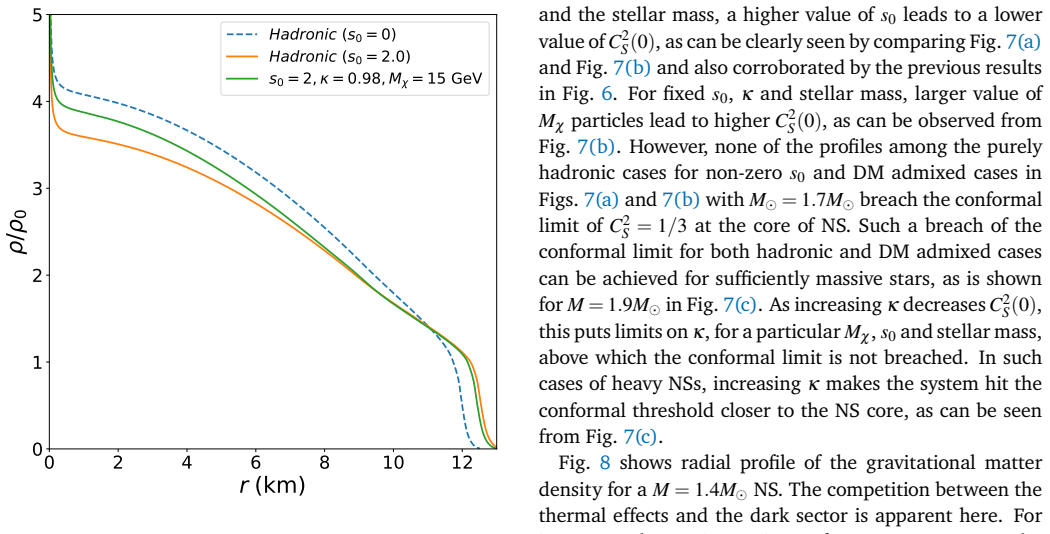
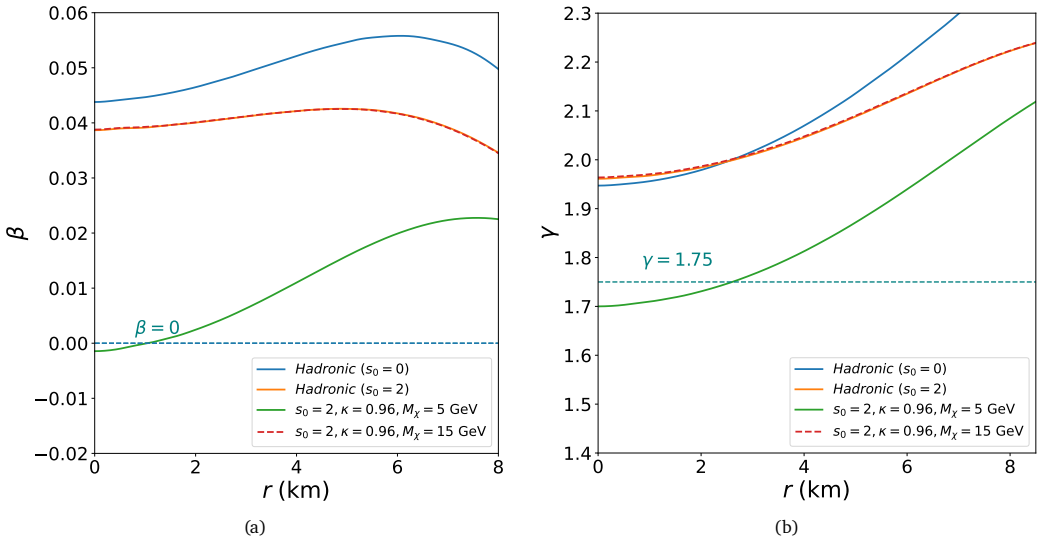
We construct an equation of state for isentropic dark-matter-admixed neutron stars with a hot core and relatively cold crust incorporating self-consistent temperature and DM density profiles for GeV-scale fermionic DM. We show that the enhancement of central stellar density due to DM accumulation remains robust. Substantial observable effects of DM accumulation arise only for sufficiently massive stellar configurations. The speed of sound profile exhibits non-monotonic behavior for sufficiently large DM density in the core. We identify a competition between thermal effects due to nonzero values of entropy per baryon and softening effects of the dark sector which drive macroscopic properties
What carries the argument
The competition between thermal effects from nonzero entropy per baryon and softening effects of the dark sector on the equation of state, speed of sound, and conformality indicators.
If this is right
- The enhancement of central stellar density due to DM accumulation remains robust even with thermal effects included.
- Substantial observable effects of DM accumulation appear only for sufficiently massive stellar configurations.
- The speed of sound profile exhibits non-monotonic behavior for sufficiently large DM density in the core.
- Macroscopic properties and conformality indicators are driven in opposite directions by the thermal and dark-sector softening effects.
- The onset of conformality near the stellar core is fixed by the balance of these competing effects.
Where Pith is reading between the lines
- Multimessenger signals from neutron star mergers might require re-analysis to separate possible dark matter content from true quark-matter phases.
- Cooling models for young neutron stars would need to track dark matter accumulation to avoid misidentifying conformality as a QCD phase transition.
- Mass-radius data from hot, massive pulsars could be compared directly against DM-admixed isentropic sequences to test the mimicry.
Load-bearing premise
A specific GeV-scale fermionic dark matter model with self-consistent temperature and DM density profiles accurately captures the competition between thermal and softening effects without other free parameters dominating the outcome.
What would settle it
A precise radius and central-density measurement for a massive neutron star whose temperature profile is independently known, showing conformality indicators but monotonic sound speed inconsistent with the predicted thermal-DM competition.
Figures

read the original abstract
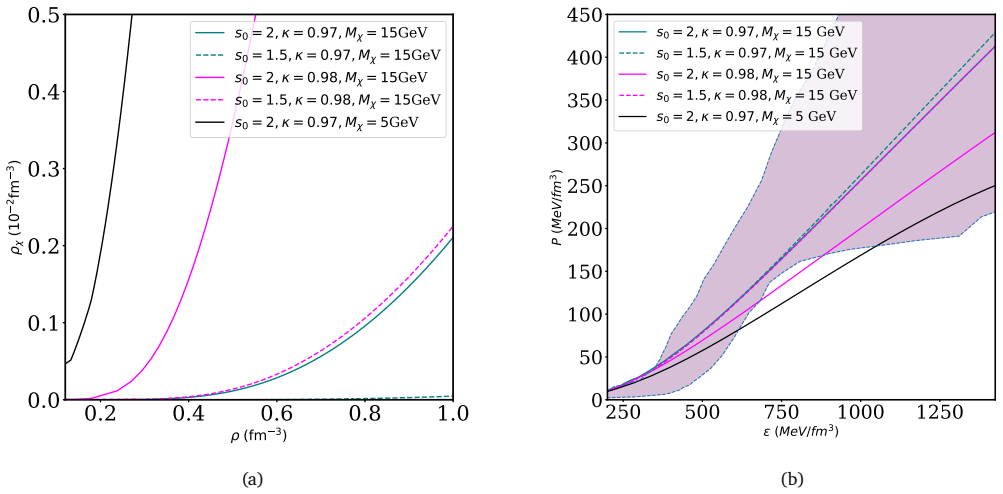
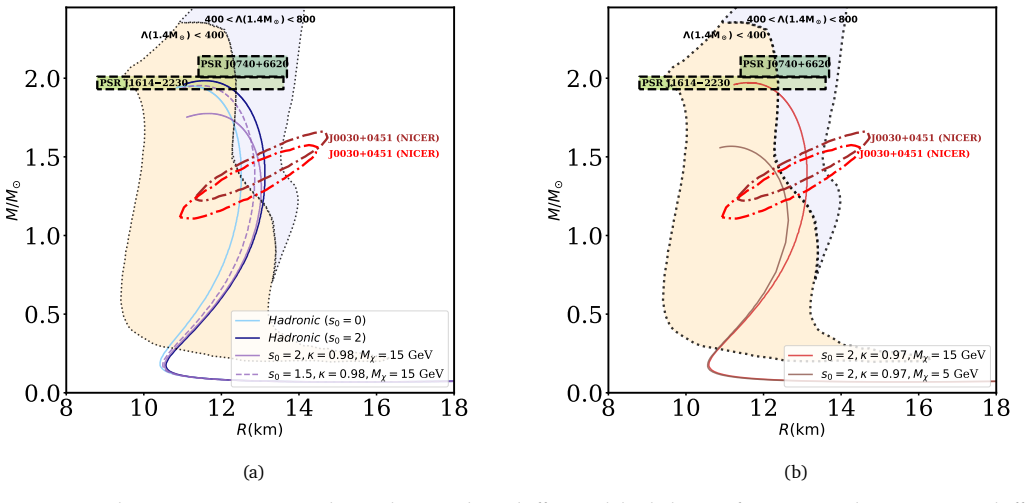
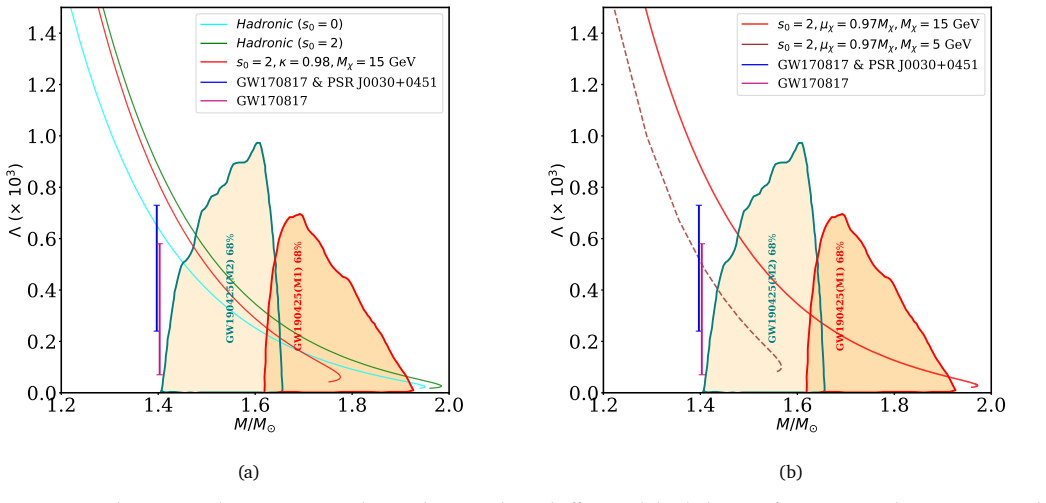
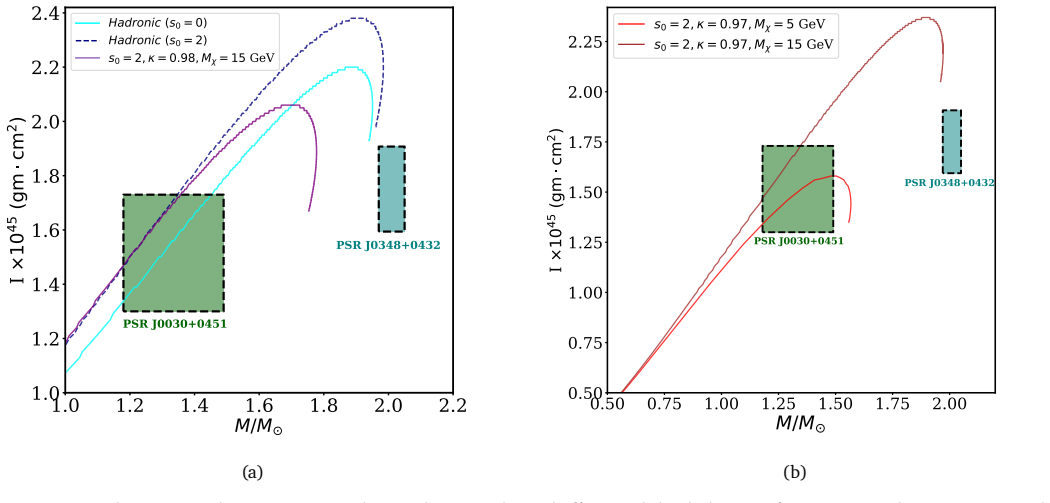
We construct an equation of state for isentropic dark-matter-admixed neutron stars (DMANS) with a hot core and relatively cold crust incorporating self-consistent temperature and DM density profiles for GeV-scale fermionic DM. We show that the enhancement of central stellar density due to DM accumulation, previously reported for cold neutron stars, remains robust. Substantial observable effects of DM accumulation arise only for sufficiently massive stellar configurations. Similar to earlier studies of cold NS, the speed of sound profile is shown to exhibit non-monotonic behavior for sufficiently large DM density in the core. We identify a competition between thermal effects due to nonzero values of entropy per baryon and softening effects of the dark sector which drive macroscopic properties and conformality indicators in opposite directions. This competition determines the onset of conformality near the stellar core and indicates that conformality signatures attributed to quark-matter in cold NS could be mimicked by DM admixture in isentropic stars.
Editorial analysis
A structured set of objections, weighed in public.
Referee Report
Summary. The paper constructs an equation of state for isentropic dark-matter-admixed neutron stars (DMANS) incorporating a hot core and cold crust with self-consistent temperature and DM density profiles for a GeV-scale fermionic DM model. It reports that DM accumulation robustly enhances central stellar density (with observable effects only in sufficiently massive stars), produces non-monotonic sound-speed profiles at high DM densities, and that competition between thermal (entropy per baryon) effects and DM softening can drive conformality indicators near the core, potentially mimicking signatures previously attributed to quark matter in cold NS.
Significance. If the central claim holds, the result would indicate that conformality indicators (such as non-monotonic sound speed near the core) are not unique to deconfined quark matter but can arise from DM admixture in isentropic configurations. This has implications for interpreting neutron-star observations and for using conformality as a probe of exotic matter. The self-consistent profile construction is a methodological strength if numerically validated.
major comments (1)
- [Abstract] Abstract: the central claim that DM admixture can mimic quark-matter conformality signatures rests on results from a single GeV-scale fermionic DM model with self-consistent profiles; no variation of DM mass, self-interaction strength, or entropy per baryon is reported, so it remains unclear whether the reported competition between thermal and softening effects (and the resulting mimicry) is generic or an artifact of the specific Lagrangian and solver choice.
Simulated Author's Rebuttal
We thank the referee for their careful reading of the manuscript and for highlighting this important point regarding the scope of our results. We address the comment below.
read point-by-point responses
-
Referee: [Abstract] Abstract: the central claim that DM admixture can mimic quark-matter conformality signatures rests on results from a single GeV-scale fermionic DM model with self-consistent profiles; no variation of DM mass, self-interaction strength, or entropy per baryon is reported, so it remains unclear whether the reported competition between thermal and softening effects (and the resulting mimicry) is generic or an artifact of the specific Lagrangian and solver choice.
Authors: We thank the referee for this observation. The central claim of the work, as stated in the abstract with the phrasing 'could be mimicked,' is that DM admixture in isentropic configurations provides a viable alternative mechanism for producing conformality indicators near the core, demonstrated explicitly within a representative GeV-scale fermionic DM model. We do not assert that the competition between thermal effects and DM softening is universal across all possible DM parameters or Lagrangians; the manuscript presents a concrete example where this competition arises and alters the onset of conformality. The self-consistent construction and the underlying physics of the isentropic EOS make the reported mechanism robust within the class of models considered, rather than an artifact of the specific choice. No revision is required, as the scope and language of the claims accurately reflect the presented results. revision: no
Circularity Check
No circularity: construction uses external DM model inputs without reduction to fitted outputs or self-citations
full rationale
The abstract describes constructing an EOS for DMANS using self-consistent temperature and DM density profiles for a specified GeV-scale fermionic DM model, then reports robustness of central density enhancement and non-monotonic sound speed as outcomes. No quoted step shows a 'prediction' that equals its input by definition, no load-bearing self-citation, and no ansatz or uniqueness claim imported from prior author work. The competition between thermal and softening effects is presented as a derived result from the model rather than a tautology. The derivation chain remains independent of its own fitted values.
Axiom & Free-Parameter Ledger
axioms (1)
- domain assumption GeV-scale fermionic dark matter with self-consistent temperature and density profiles
Reference graph
Works this paper leans on
-
[1]
Compact Stars as Dark Matter Probes,
Gianfranco Bertone and Malcolm Fairbairn, “Compact Stars as Dark Matter Probes,” Phys. Rev. D77, 043515 (2008), arXiv:0709.1485 [astro-ph]
Pith/arXiv arXiv 2008
-
[2]
Compact stars made of fermionic dark matter,
Gaurav Narain, Jurgen Schaffner-Bielich, and Igor N. Mishustin, “Compact stars made of fermionic dark matter,” Phys. Rev. D74, 063003 (2006), arXiv:astro-ph/0605724
Pith/arXiv arXiv 2006
-
[3]
Can Neutron stars con- strain Dark Matter?
Chris Kouvaris and Peter Tinyakov, “Can Neutron stars con- strain Dark Matter?” Phys. Rev. D82, 063531 (2010), arXiv:1004.0586 [astro-ph.GA]
Pith/arXiv arXiv 2010
-
[4]
Gravitational ef- fects of condensed dark matter on strange stars,
Grigorios Panotopoulos and Ilídio Lopes, “Gravitational ef- fects of condensed dark matter on strange stars,” Phys. Rev. D96, 023002 (2017), arXiv:1706.07272 [gr-qc]
Pith/arXiv arXiv 2017
-
[5]
Feeble DM-SM interac- tionvianewscalarandvectormediatorsinrotatingneutron stars,
Atanu Guha and Debashree Sen, “Feeble DM-SM interac- tionvianewscalarandvectormediatorsinrotatingneutron stars,” JCAP09, 027 (2021), arXiv:2106.10353 [hep-ph]
arXiv 2021
-
[6]
Tidal deformability of dark matter admixed neutron stars,
Kwing-Lam Leung, Ming-chung Chu, and Lap-Ming Lin, “Tidal deformability of dark matter admixed neutron stars,” Phys. Rev. D105, 123010 (2022), arXiv:2207.02433 [astro- ph.HE]
arXiv 2022
-
[7]
Dark matter effects on the propertiesofneutronstars: Compactnessandtidaldeforma- bility,
Hong-Ming Liu, Jin-Biao Wei, Zeng-Hua Li, G. F. Burgio, H. C. Das, and H. J. Schulze, “Dark matter effects on the propertiesofneutronstars: Compactnessandtidaldeforma- bility,” Phys. Rev. D110, 023024 (2024), arXiv:2403.17024 [nucl-th]
arXiv 2024
-
[8]
Impact of darkmatterontidalsignaturesinneutronstarmergerswith the Einstein Telescope,
Hauke Koehn, Edoardo Giangrandi, Nina Kunert, Rahul So- masundaram, Violetta Sagun, and Tim Dietrich, “Impact of darkmatterontidalsignaturesinneutronstarmergerswith the Einstein Telescope,” Phys. Rev. D110, 103033 (2024), arXiv:2408.14711 [astro-ph.HE]
arXiv 2024
-
[9]
Rotatingprotoneutronstaradmixedwith mirror dark matter: A two-fluid approach,
Adamu Issifu, Andreas Konstantinou, Prashant Thakur, and TobiasFrederico,“Rotatingprotoneutronstaradmixedwith mirror dark matter: A two-fluid approach,” Phys. Rev. D 112, 103026 (2025), arXiv:2507.20823 [astro-ph.HE]
arXiv 2025
-
[10]
WIMPAnnihilationandCoolingofNeutron Stars,
ChrisKouvaris,“WIMPAnnihilationandCoolingofNeutron Stars,” Phys. Rev. D77, 023006 (2008), arXiv:0708.2362 [astro-ph]
Pith/arXiv arXiv 2008
-
[11]
Dark Kinetic Heating of Neu- tron Stars and An Infrared Window On WIMPs, SIMPs, and Pure Higgsinos,
Masha Baryakhtar, Joseph Bramante, Shirley Weishi Li, Tim Linden, and Nirmal Raj, “Dark Kinetic Heating of Neu- tron Stars and An Infrared Window On WIMPs, SIMPs, and Pure Higgsinos,” Phys. Rev. Lett.119, 131801 (2017), arXiv:1704.01577 [hep-ph]
Pith/arXiv arXiv 2017
-
[12]
Heat- ing neutron stars with GeV dark matter,
Wai-Yee Keung, Danny Marfatia, and Po-Yan Tseng, “Heat- ing neutron stars with GeV dark matter,” JHEP07, 181 (2020), arXiv:2001.09140 [hep-ph]
arXiv 2020
-
[13]
Cooling of Neutron Stars admixed with light dark matter: A case study,
M. Ángeles Pérez-García, H. Grigorian, C. Albertus, D. Barba, and J. Silk, “Cooling of Neutron Stars admixed with light dark matter: A case study,” Phys. Lett. B827, 136937 (2022), arXiv:2202.00702 [hep-ph]
arXiv 2022
-
[14]
Heating neutron stars with inelas- tic dark matter and relativistic targets,
Gerardo Alvarez, Aniket Joglekar, Mehrdad Phoroutan- Mehr, and Hai-Bo Yu, “Heating neutron stars with inelas- tic dark matter and relativistic targets,” Phys. Rev. D107, 103024 (2023), arXiv:2301.08767 [hep-ph]
arXiv 2023
-
[15]
Rapid neu- tron star cooling triggered by dark matter,
Afonso Ávila, Edoardo Giangrandi, Violetta Sagun, Olek- sii Ivanytskyi, and Constança Providência, “Rapid neu- tron star cooling triggered by dark matter,” Mon. Not. Roy. Astron. Soc.528, 6319–6328 (2024), arXiv:2309.03894 [astro-ph.HE]
arXiv 2024
-
[16]
Thermalization and annihilation of dark matter in neutron stars,
Nicole F. Bell, Giorgio Busoni, Sandra Robles, and Michael Virgato, “Thermalization and annihilation of dark matter in neutron stars,” JCAP04, 006 (2024), arXiv:2312.11892 [hep-ph]
arXiv 2024
-
[17]
Cooling of dark neutron stars,
B. X. Zhou, H. C. Das, J. B. Wei, G. F. Burgio, Z. H. Li, and H. J. Schulze, “Cooling of dark neutron stars,” Phys. Rev. D 112, 123035 (2025), arXiv:2508.09704 [astro-ph.HE]
arXiv 2025
-
[18]
Dark Matter Heating in Evolving Proto-Neutron Stars: A Two-Fluid Approach,
Adamu Issifu, Prashant Thakur, Davood Rafiei Karke- vandi, Franciele M. da Silva, Débora P. Menezes, Y. Lim, and Tobias Frederico, “Dark Matter Heating in Evolving Proto-Neutron Stars: A Two-Fluid Approach,” (2025), arXiv:2511.07567 [astro-ph.HE]
Pith/arXiv arXiv 2025
-
[19]
Dark halos around neutron stars and gravitational waves,
Ann Nelson, Sanjay Reddy, and Dake Zhou, “Dark halos around neutron stars and gravitational waves,” JCAP07, 012 (2019), arXiv:1803.03266 [hep-ph]
Pith/arXiv arXiv 2019
-
[20]
Emergence of new os- cillation modes in dark matter admixed neutron stars,
Hajime Sotani and Ankit Kumar, “Emergence of new os- cillation modes in dark matter admixed neutron stars,” Phys. Rev. D111, 123013 (2025), arXiv:2505.18800 [astro- ph.HE]
arXiv 2025
-
[21]
g-mode oscillations of dark matter admixed neutron stars,
Swarnim Shirke, Debarati Chatterjee, and Prashanth Jaiku- mar, “g-mode oscillations of dark matter admixed neutron stars,” Mon. Not. Roy. Astron. Soc.3549, 3561 (2025), arXiv:2506.18892 [gr-qc]
arXiv 2025
-
[22]
Pinku Routaray, “General relativistic study off-mode oscil- lationsinneutronstarswithgravitationallybounddarkmat- ter,” (2025), arXiv:2511.02443 [nucl-th]
Pith/arXiv arXiv 2025
-
[23]
Universal relation in- volving fundamental modes in two-fluid dark matter ad- mixed neutron stars,
Hajime Sotani and Ankit Kumar, “Universal relation in- volving fundamental modes in two-fluid dark matter ad- mixed neutron stars,” Eur. Phys. J. C85, 1438 (2025), arXiv:2512.07105 [astro-ph.HE]
arXiv 2025
-
[24]
Neutron stars: New constraints on asymmetric dark matter,
O. Ivanytskyi, V. Sagun, and I. Lopes, “Neutron stars: New constraints on asymmetric dark matter,” Phys. Rev. D102, 063028 (2020), arXiv:1910.09925 [astro-ph.HE]
arXiv 2020
-
[25]
Post- inflationary dark matter bremsstrahlung,
Yann Mambrini, Keith A. Olive, and Jiaming Zheng, “Post- inflationary dark matter bremsstrahlung,” JCAP10, 055 (2022), arXiv:2208.05859 [hep-ph]
arXiv 2022
-
[26]
Search for low-mass dark matter via bremsstrahlung radiation and the Migdal effect in SuperCDMS,
M. F. Albakryet al.(SuperCDMS), “Search for low-mass dark matter via bremsstrahlung radiation and the Migdal effect in SuperCDMS,” Phys. Rev. D107, 112013 (2023), 12 arXiv:2302.09115 [hep-ex]
arXiv 2023
-
[27]
Enhancement of dark matter capture by neutron stars in binary systems,
Lionel Brayeur and Peter Tinyakov, “Enhancement of dark matter capture by neutron stars in binary systems,” Phys. Rev. Lett.109, 061301 (2012), arXiv:1111.3205 [astro- ph.CO]
Pith/arXiv arXiv 2012
-
[28]
János Takátsy, Lorenz Zwick, David O’Neill, and Jo- han Samsing, “Amplified capture rate of dark matter in compact binaries and constraints on bosonic dark mat- ter from GW170817,” Phys. Rev. D113, 023027 (2026), arXiv:2509.03272 [astro-ph.HE]
arXiv 2026
-
[29]
ThewaningoftheWIMP?Areviewof models, searches, and constraints,
GiorgioArcadi,MaíraDutra,PradiptaGhosh,ManfredLind- ner, Yann Mambrini, Mathias Pierre, Stefano Profumo, and FarinaldoS.Queiroz,“ThewaningoftheWIMP?Areviewof models, searches, and constraints,” Eur. Phys. J. C78, 203 (2018), arXiv:1703.07364 [hep-ph]
Pith/arXiv arXiv 2018
-
[30]
Francesco Grippa, Gaetano Lambiase, and Tanmay Kumar Poddar, “Searching for New Physics in an Ultradense En- vironment: A Review on Dark Matter Admixed Neutron Stars,” Universe11, 74 (2025), arXiv:2412.09381 [astro- ph.HE]
arXiv 2025
-
[31]
Search for Dark Matter Effects on Gravitational Signals from Neu- tron Star Mergers,
John Ellis, Andi Hektor, Gert Hütsi, Kristjan Kannike, Luca Marzola, Martti Raidal, and Ville Vaskonen, “Search for Dark Matter Effects on Gravitational Signals from Neu- tron Star Mergers,” Phys. Lett. B781, 607–610 (2018), arXiv:1710.05540 [astro-ph.CO]
Pith/arXiv arXiv 2018
-
[32]
Miguel Bezares, Daniele Viganò, and Carlos Palenzuela, “Gravitational wave signatures of dark matter cores in bi- nary neutron star mergers by using numerical simulations,” Phys. Rev. D100, 044049 (2019), arXiv:1905.08551 [gr- qc]
arXiv 2019
-
[33]
David E. Kaplan, Markus A. Luty, and Kathryn M. Zurek, “AsymmetricDarkMatter,”Phys.Rev.D79,115016(2009), arXiv:0901.4117 [hep-ph]
Pith/arXiv arXiv 2009
-
[34]
Asymmetric Dark Matter from a GeV Hidden Sector,
Timothy Cohen, Daniel J. Phalen, Aaron Pierce, and Kathryn M. Zurek, “Asymmetric Dark Matter from a GeV Hidden Sector,” Phys. Rev. D82, 056001 (2010), arXiv:1005.1655 [hep-ph]
Pith/arXiv arXiv 2010
-
[35]
Constraints on Scalar Asymmetric Dark Matter from Black Hole Formation in Neutron Stars,
Samuel D. McDermott, Hai-Bo Yu, and Kathryn M. Zurek, “Constraints on Scalar Asymmetric Dark Matter from Black Hole Formation in Neutron Stars,” Phys. Rev. D85, 023519 (2012), arXiv:1103.5472 [hep-ph]
Pith/arXiv arXiv 2012
-
[36]
Review of asym- metric dark matter,
Kalliopi Petraki and Raymond R. Volkas, “Review of asym- metric dark matter,” Int. J. Mod. Phys. A28, 1330028 (2013), arXiv:1305.4939 [hep-ph]
Pith/arXiv arXiv 2013
-
[37]
Asymmetric Dark Matter: Theories, Sig- natures, and Constraints,
Kathryn M. Zurek, “Asymmetric Dark Matter: Theories, Sig- natures, and Constraints,” Phys. Rept.537, 91–121 (2014), arXiv:1308.0338 [hep-ph]
Pith/arXiv arXiv 2014
-
[38]
Supernova remnants with mirror dark matter and hyperons,
AdamuIssifu,PrashantThakur,FrancieleM.daSilva,KauD. Marquez, Débora P. Menezes, M. Dutra, O. Lourenço, and Tobias Frederico, “Supernova remnants with mirror dark matter and hyperons,” Phys. Rev. D111, 083026 (2025), arXiv:2412.17946 [hep-ph]
arXiv 2025
-
[39]
Gravitational waves from the asymmetric- dark-matter generating phase transition,
Iason Baldes, “Gravitational waves from the asymmetric- dark-matter generating phase transition,” JCAP05, 028 (2017), arXiv:1702.02117 [hep-ph]
Pith/arXiv arXiv 2017
-
[40]
Asymmetric dark mat- ter from gravitational waves,
Bartosz Fornal and Erika Pierre, “Asymmetric dark mat- ter from gravitational waves,” Phys. Rev. D106, 115040 (2022), arXiv:2209.04788 [hep-ph]
arXiv 2022
-
[41]
Hiroki Nagakura, Adam Burrows, David Radice, and David Vartanyan, “A systematic study of proto-neutron star con- vection in three-dimensional core-collapse supernova sim- ulations,” Mon. Not. Roy. Astron. Soc.492, 5764–5779 (2020), arXiv:1912.07615 [astro-ph.HE]
arXiv 2020
-
[42]
Proto-neutron star evolution with improved charged-current neutrino–nucleon interactions,
A. Pascal, J. Novak, and M. Oertel, “Proto-neutron star evolution with improved charged-current neutrino–nucleon interactions,” Mon. Not. Roy. Astron. Soc.511, 356–370 (2022), arXiv:2201.01955 [nucl-th]
arXiv 2022
-
[43]
Su- pernova simulations confront SN 1987A neutrinos,
DamianoF.G.Fiorillo, MalteHeinlein, Hans-ThomasJanka, Georg Raffelt, Edoardo Vitagliano, and Robert Bollig, “Su- pernova simulations confront SN 1987A neutrinos,” Phys. Rev. D108, 083040 (2023), arXiv:2308.01403 [astro- ph.HE]
arXiv 2023
-
[44]
Tolman temperature gra- dients in a gravitational field,
Jessica Santiago and Matt Visser, “Tolman temperature gra- dients in a gravitational field,” Eur. J. Phys.40, 025604 (2019), arXiv:1803.04106 [gr-qc]
Pith/arXiv arXiv 2019
-
[45]
Bounds on the speed of sound in dense matter, and neutron star structure,
Ch. C. Moustakidis, T. Gaitanos, Ch. Margaritis, and G. A. Lalazissis, “Bounds on the speed of sound in dense matter, and neutron star structure,” Phys. Rev. C95, 045801 (2017), [Erratum: Phys.Rev.C 95, 059904 (2017)], arXiv:1608.00344 [nucl-th]
Pith/arXiv arXiv 2017
-
[46]
Ingo Tews, Joseph Carlson, Stefano Gandolfi, and San- jay Reddy, “Constraining the speed of sound inside neutron starswithchiraleffectivefieldtheoryinteractionsandobser- vations,” Astrophys. J.860, 149 (2018), arXiv:1801.01923 [nucl-th]
Pith/arXiv arXiv 2018
-
[47]
Symmetric nu- clear matter from the strong interaction,
M. Leonhardt, M. Pospiech, B. Schallmo, J. Braun, C. Drischler, K. Hebeler, and A. Schwenk, “Symmetric nu- clear matter from the strong interaction,” Phys. Rev. Lett. 125, 142502 (2020), arXiv:1907.05814 [nucl-th]
arXiv 2020
-
[48]
Speed of sound constraintsonmaximally-rotatingneutronstars,
Chrysovalantis Margaritis, Polychronis Koliogiannis Kout- miridis, and Charalampos Moustakidis, “Speed of sound constraintsonmaximally-rotatingneutronstars,”Adv.Nucl. Phys.27, 155–159 (2020)
2020
-
[49]
QCD equations of state and speed of sound in neutron stars,
Toru Kojo, “QCD equations of state and speed of sound in neutron stars,” AAPPS Bull.31, 11 (2021), arXiv:2011.10940 [nucl-th]
arXiv 2021
-
[50]
On the Sound Speed in Neutron Stars,
Sinan Altiparmak, Christian Ecker, and Luciano Rezzolla, “On the Sound Speed in Neutron Stars,” Astrophys. J. Lett. 939, L34 (2022), arXiv:2203.14974 [astro-ph.HE]
arXiv 2022
-
[51]
Infer- ence of the sound speed and related properties of neutron stars,
Len Brandes, Wolfram Weise, and Norbert Kaiser, “Infer- ence of the sound speed and related properties of neutron stars,” Phys. Rev. D107, 014011 (2023), arXiv:2208.03026 [nucl-th]
arXiv 2023
-
[52]
Sound velocity bound and neutron stars,
Paulo Bedaque and Andrew W. Steiner, “Sound velocity bound and neutron stars,” Phys. Rev. Lett.114, 031103 (2015), arXiv:1408.5116 [nucl-th]
Pith/arXiv arXiv 2015
-
[53]
Analyzing the speed of sound in neutron star with machine learning,
Sagnik Chatterjee, Harsha Sudhakaran, and Ritam Mallick, “Analyzing the speed of sound in neutron star with machine learning,” Eur. Phys. J. C84, 1291 (2024), arXiv:2302.13648 [astro-ph.HE]
arXiv 2024
-
[54]
Nontrivialfeaturesinthespeed 13 of sound inside neutron stars,
Debora Mroczek, M. Coleman Miller, Jacquelyn Noronha- Hostler, andNicolasYunes,“Nontrivialfeaturesinthespeed 13 of sound inside neutron stars,” Phys. Rev. D110, 123009 (2024), arXiv:2309.02345 [astro-ph.HE]
arXiv 2024
-
[55]
ManjiaChen, DaweiGuan, ChongjiJiang, andJunchenPei, “Speed of sound and phase transitions in neutron stars indi- cated by the thick neutron skin of Pb208,” Phys. Rev. C108, 065806 (2023), arXiv:2309.11245 [nucl-th]
arXiv 2023
-
[56]
Structure in the speed of sound: From neutron stars to heavy-ion collisions,
Nanxi Yao, Agnieszka Sorensen, Veronica Dexheimer, and Jacquelyn Noronha-Hostler, “Structure in the speed of sound: From neutron stars to heavy-ion collisions,” Phys. Rev. C109, 065803 (2024), arXiv:2311.18819 [nucl-th]
arXiv 2024
-
[57]
Average speed of sound in neutron stars,
Michał Marczenko, “Average speed of sound in neutron stars,” Phys. Rev. C110, 045811 (2024), arXiv:2407.15486 [nucl-th]
arXiv 2024
-
[58]
Arijit Das, Prashanth Jaikumar, Adarsh Karekkat, and Tanumoy Mandal, “Effects of a Brueckner-Hartree- Fock–corrected effective mass on speed of sound, con- formality, and observables of dark matter–admixed neutron stars,” Phys. Rev. C112, 055803 (2025), arXiv:2506.15328 [hep-ph]
arXiv 2025
-
[59]
Chiral and Diquark condensates at large magnetic field in two-flavor superconducting quark matter,
Tanumoy Mandal, Prashanth Jaikumar, and Sanatan Di- gal, “Chiral and Diquark condensates at large magnetic field in two-flavor superconducting quark matter,” (2009), arXiv:0912.1413 [nucl-th]
Pith/arXiv arXiv 2009
-
[60]
Neutrality of a magnetized two-flavor quark superconductor,
Tanumoy Mandal and Prashanth Jaikumar, “Neutrality of a magnetized two-flavor quark superconductor,” Phys. Rev. C 87, 045208 (2013), arXiv:1209.2432 [nucl-th]
Pith/arXiv arXiv 2013
-
[61]
Effect of tem- perature and magnetic field on two-flavor superconduct- ing quark matter,
Tanumoy Mandal and Prashanth Jaikumar, “Effect of tem- perature and magnetic field on two-flavor superconduct- ing quark matter,” Phys. Rev. D94, 074016 (2016), arXiv:1608.00882 [hep-ph]
Pith/arXiv arXiv 2016
-
[62]
Effect of strong magnetic field on competing order parameters in two- flavor dense quark matter,
Tanumoy Mandal and Prashanth Jaikumar, “Effect of strong magnetic field on competing order parameters in two- flavor dense quark matter,” Adv. High Energy Phys.2017, 6472909 (2017), arXiv:1701.02561 [hep-ph]
Pith/arXiv arXiv 2017
-
[63]
Evidence for quark-matter cores in massive neutron stars,
Eemeli Annala, Tyler Gorda, Aleksi Kurkela, Joonas Nättilä, and Aleksi Vuorinen, “Evidence for quark-matter cores in massive neutron stars,” Nature Phys.16, 907–910 (2020), arXiv:1903.09121 [astro-ph.HE]
arXiv 2020
-
[64]
Trace Anomaly as Signature of Con- formality in Neutron Stars,
Yuki Fujimoto, Kenji Fukushima, Larry D. McLerran, and Michal Praszalowicz, “Trace Anomaly as Signature of Con- formality in Neutron Stars,” Phys. Rev. Lett.129, 252702 (2022), arXiv:2207.06753 [nucl-th]
arXiv 2022
-
[65]
Stronglyinteractingmatterexhibitsdeconfinedbehaviorin massive neutron stars,
EemeliAnnala, TylerGorda, JoonasHirvonen, OlegKomolt- sev, Aleksi Kurkela, Joonas Nättilä, and Aleksi Vuorinen, “Stronglyinteractingmatterexhibitsdeconfinedbehaviorin massive neutron stars,” Nature Commun.14, 8451 (2023), arXiv:2303.11356 [astro-ph.HE]
arXiv 2023
-
[66]
Curvatureoftheenergyperparticleinneutronstars,
Michał Marczenko, Krzysztof Redlich, and Chihiro Sasaki, “Curvatureoftheenergyperparticleinneutronstars,”Phys. Rev. D109, L041302 (2024), arXiv:2311.13401 [nucl-th]
arXiv 2024
-
[67]
Gravitational-wave constraints on the neutron- star-matter Equation of State,
Eemeli Annala, Tyler Gorda, Aleksi Kurkela, and Aleksi Vuorinen, “Gravitational-wave constraints on the neutron- star-matter Equation of State,” Phys. Rev. Lett.120, 172703 (2018), arXiv:1711.02644 [astro-ph.HE]
Pith/arXiv arXiv 2018
-
[68]
Constraints on nuclear matter parameters of an Effective Chiral Model,
T. K. Jha and H. Mishra, “Constraints on nuclear matter parameters of an Effective Chiral Model,” Phys. Rev. C78, 065802 (2008), arXiv:0811.4233 [nucl-th]
Pith/arXiv arXiv 2008
-
[69]
Debashree Sen and Atanu Guha, “Implications of feebly in- teracting dark sector on neutron star properties and con- straints from GW170817,” Mon. Not. Roy. Astron. Soc.504, 3354–3363 (2021), arXiv:2104.06141 [hep-ph]
arXiv 2021
-
[70]
Relativistic Mean-Field Hadronic Models under Nu- clear Matter Constraints,
M. Dutra, O. Lourenço, S. S. Avancini, B. V. Carlson, A.Delfino, D.P.Menezes, C.Providência, S.Typel, andJ.R. Stone, “Relativistic Mean-Field Hadronic Models under Nu- clear Matter Constraints,” Phys. Rev. C90, 055203 (2014), arXiv:1405.3633 [nucl-th]
Pith/arXiv arXiv 2014
-
[71]
BeyondCol- lisionless Dark Matter: Particle Physics Dynamics for Dark Matter Halo Structure,
SeanTulin, Hai-BoYu, andKathrynM.Zurek,“BeyondCol- lisionless Dark Matter: Particle Physics Dynamics for Dark Matter Halo Structure,” Phys. Rev. D87, 115007 (2013), arXiv:1302.3898 [hep-ph]
Pith/arXiv arXiv 2013
-
[72]
Scott W. Randall, Maxim Markevitch, Douglas Clowe, An- thonyH.Gonzalez, andMarusaBradac,“Constraintsonthe Self-Interaction Cross-Section of Dark Matter from Numeri- cal Simulations of the Merging Galaxy Cluster 1E 0657-56,” Astrophys. J.679, 1173–1180 (2008), arXiv:0704.0261 [astro-ph]
Pith/arXiv arXiv 2008
-
[73]
Thebirthofneutron stars,
AdamBurrowsandJamesM.Lattimer,“Thebirthofneutron stars,” Astrophys. J.307, 178–196 (1986)
1986
-
[74]
Evolution of protoneutron stars,
J.A.Pons, S.Reddy, M.Prakash, J.M.Lattimer, andJ.A.Mi- ralles, “Evolution of protoneutron stars,” Astrophys. J.513, 780 (1999), arXiv:astro-ph/9807040
Pith/arXiv arXiv 1999
-
[75]
Composi- tion and structure of protoneutron stars,
Madappa Prakash, Ignazio Bombaci, Manju Prakash, Paul J. Ellis, James M. Lattimer, and Roland Knorren, “Composi- tion and structure of protoneutron stars,” Phys. Rept.280, 1–77 (1997), arXiv:nucl-th/9603042
Pith/arXiv arXiv 1997
-
[76]
Proto-neutron stars with dark matter admixture: A single- fluid approach,
Adamu Issifu, Débora P. Menezes, and Tobias Frederico, “Proto-neutron stars with dark matter admixture: A single- fluid approach,” Phys. Dark Univ.50, 102149 (2025), arXiv:2506.21378 [astro-ph.HE]
arXiv 2025
-
[77]
Cooling of Dark-Matter Ad- mixed Neutron Stars with density-dependent Equation of State,
Sajad A. Bhat and Avik Paul, “Cooling of Dark-Matter Ad- mixed Neutron Stars with density-dependent Equation of State,” Eur. Phys. J. C80, 544 (2020), arXiv:1905.12483 [hep-ph]
arXiv 2020
-
[78]
Stiff phases in strongly coupled gauge theories with holographic duals,
Christian Ecker, Carlos Hoyos, Niko Jokela, David Ro- dríguez Fernández, and Aleksi Vuorinen, “Stiff phases in strongly coupled gauge theories with holographic duals,” JHEP11, 031 (2017), arXiv:1707.00521 [hep-th]
Pith/arXiv arXiv 2017
-
[79]
On the sound velocity bound in neutron stars,
Shrijan Roy and Teruaki Suyama, “On the sound velocity bound in neutron stars,” Results Phys.61, 107757 (2024), arXiv:2211.07874 [astro-ph.HE]
arXiv 2024
-
[80]
Bump of sound velocity in dense 2-color QCD,
Etsuko Itou and Kei Iida, “Bump of sound velocity in dense 2-color QCD,” PoSLATTICE2022, 151 (2023), arXiv:2210.14385 [hep-lat]
arXiv 2023
discussion (0)
Sign in with ORCID, Apple, or X to comment. Anyone can read and Pith papers without signing in.