Emergent Andreev Reflection from a Lattice Duality Defect
Pith reviewed 2026-06-26 06:22 UTC · model grok-4.3
The pith
A lattice duality defect in a Majorana chain produces an emergent Andreev reflection boundary condition in the continuum.
A machine-rendered reading of the paper's core claim, the machinery that carries it, and where it could break.
Core claim
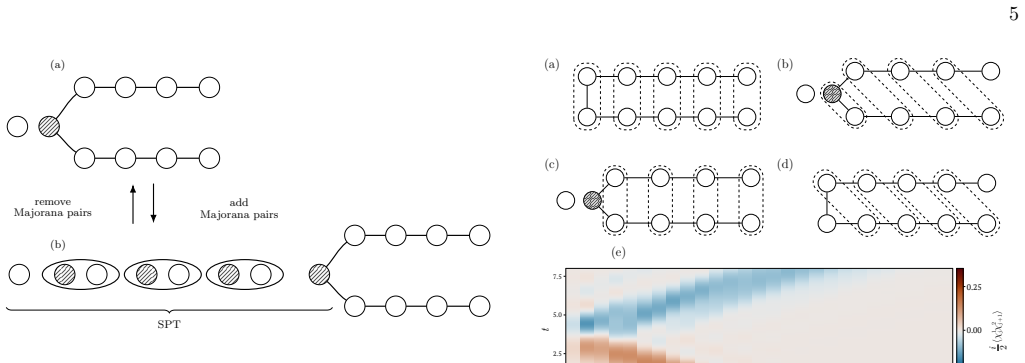
Starting from a Majorana representation of the transverse-field Ising chain, we construct a folded lattice model in which a boundary Majorana impurity implements a one-site translation of a staggered Majorana chain. In the continuum, this translation becomes a chiral fermion-parity defect: it flips the sign of the only left-moving Majorana mode while leaving the right-moving mode unchanged. When the two Majorana modes are recombined into a complex fermion in the folded geometry, this sign flip becomes the Andreev-like boundary condition.
What carries the argument
The boundary Majorana impurity that implements a one-site translation, becoming a chiral fermion-parity defect in the continuum limit.
Load-bearing premise
The one-site translation implemented by the boundary Majorana impurity maps in the continuum limit to a chiral fermion-parity defect that flips only the left-moving Majorana mode.
What would settle it
A direct calculation or simulation of the lattice model that checks whether the boundary flips the sign of only the left-moving Majorana mode while leaving the right-moving mode unchanged.
Figures


read the original abstract
Andreev reflection converts an incoming fermion into an outgoing hole and is usually tied to a superconducting interface. We show that an analogous charge-conjugating boundary condition emerges from a purely lattice duality defect. Starting from a Majorana representation of the transverse-field Ising chain, we construct a folded lattice model in which a boundary Majorana impurity implements a one-site translation of a staggered Majorana chain. In the continuum, this translation becomes a chiral fermion-parity defect: it flips the sign of the only left-moving Majorana mode while leaving the right-moving mode unchanged. When the two Majorana modes are recombined into a complex fermion in the folded geometry, this sign flip becomes the Andreev-like boundary condition. Our lattice formulation gives a microscopic interpretation of the Emery--Kivelson boundary of the two-channel Kondo problem and of Maldacena--Ludwig monopole scattering, while identifying the boundary as the interface between a Kitaev-chain SPT phase and a gapless chain. The same Majorana translation defect also provides a lattice realization of an axial $U(1)_A$-symmetric charge-flip boundary.
Editorial analysis
A structured set of objections, weighed in public.
Referee Report
Summary. The paper constructs a folded lattice model from the Majorana representation of the transverse-field Ising chain in which a boundary Majorana impurity implements a one-site translation of a staggered Majorana chain. It claims that, in the continuum limit, this translation becomes a chiral fermion-parity defect that anticommutes only with the left-moving Majorana mode (leaving the right-moving mode invariant). Upon recombination into a complex Dirac fermion, the defect produces an Andreev-like charge-conjugating boundary condition. The construction is presented as a microscopic lattice realization of the Emery–Kivelson boundary of the two-channel Kondo problem, Maldacena–Ludwig monopole scattering, the interface between a Kitaev-chain SPT phase and a gapless chain, and an axial U(1)_A-symmetric charge-flip boundary.
Significance. If the lattice-to-continuum operator mapping is rigorously established, the result supplies a concrete microscopic origin for emergent Andreev reflection arising from a duality defect rather than a superconducting interface. The explicit lattice formulation unifies several continuum boundary phenomena under a single duality construction and identifies the boundary as an SPT–gapless interface, which may aid future studies of symmetry-protected boundary states in one dimension.
major comments (2)
- [continuum limit paragraph] The central claim rests on the assertion (in the paragraph describing the continuum limit) that the one-site translation operator implemented by the boundary Majorana impurity maps to a chiral fermion-parity defect that flips only the left-moving Majorana mode. No explicit mode expansion, bosonization dictionary, or lattice-to-continuum operator correspondence is supplied to demonstrate the required left/right asymmetry; any residual staggering phase or folding-induced mixing would change the parity action and invalidate the Andreev interpretation.
- [lattice model construction] The lattice construction section defines the folded staggered Majorana chain and the impurity translation but does not report an explicit check of the defect-free limit (standard open or periodic Ising chain) to confirm that the continuum boundary condition reduces correctly when the impurity is removed.
minor comments (1)
- Notation for the left- and right-moving Majorana fields should be introduced with a clear statement of their continuum normalization and anticommutation relations before the defect action is discussed.
Simulated Author's Rebuttal
We thank the referee for their careful reading of the manuscript and for highlighting the need for greater explicitness in the continuum mapping and the defect-free limit. We address each major comment below and have prepared revisions accordingly.
read point-by-point responses
-
Referee: [continuum limit paragraph] The central claim rests on the assertion (in the paragraph describing the continuum limit) that the one-site translation operator implemented by the boundary Majorana impurity maps to a chiral fermion-parity defect that flips only the left-moving Majorana mode. No explicit mode expansion, bosonization dictionary, or lattice-to-continuum operator correspondence is supplied to demonstrate the required left/right asymmetry; any residual staggering phase or folding-induced mixing would change the parity action and invalidate the Andreev interpretation.
Authors: We agree that an explicit derivation of the left/right asymmetry is necessary to make the central claim fully rigorous. Although the mapping follows from the standard continuum limit of the staggered Majorana chain (with the translation operator acting on the lattice sites), the manuscript does not provide the mode expansion or dictionary. In the revised version we will add a dedicated subsection that performs the mode expansion, applies the known bosonization dictionary for the Ising chain, and explicitly demonstrates that the one-site translation flips only the left-moving Majorana while leaving the right-moving mode invariant, thereby confirming the chiral fermion-parity defect. revision: yes
-
Referee: [lattice model construction] The lattice construction section defines the folded staggered Majorana chain and the impurity translation but does not report an explicit check of the defect-free limit (standard open or periodic Ising chain) to confirm that the continuum boundary condition reduces correctly when the impurity is removed.
Authors: We thank the referee for identifying this omission. The construction is designed so that removing the boundary impurity recovers the standard open-boundary transverse-field Ising chain, but no explicit verification is presented. In the revised manuscript we will add a short paragraph (or appendix) that removes the impurity, recovers the open Ising chain, and confirms that the continuum boundary conditions reduce to the expected free-fermion (or open) boundary conditions without the Andreev-like charge conjugation. revision: yes
Circularity Check
No circularity: explicit lattice construction derives continuum boundary condition
full rationale
The paper begins with a Majorana representation of the transverse-field Ising chain, constructs an explicit folded lattice model with a boundary Majorana impurity that implements one-site translation of a staggered chain, and then takes the continuum limit to obtain the chiral fermion-parity defect. The Andreev-like boundary condition is obtained by recombining the Majorana modes after the sign flip on the left-mover. No step reduces by construction to a fitted parameter renamed as prediction, a self-definition, or a load-bearing self-citation chain. The mapping is presented as a derivation from the lattice model rather than an input assumption. This is a standard first-principles lattice-to-continuum argument with independent content.
Axiom & Free-Parameter Ledger
axioms (1)
- domain assumption The continuum limit of the lattice one-site translation defect corresponds to a chiral fermion-parity defect that flips only the left-moving Majorana mode sign.
Reference graph
Works this paper leans on
-
[1]
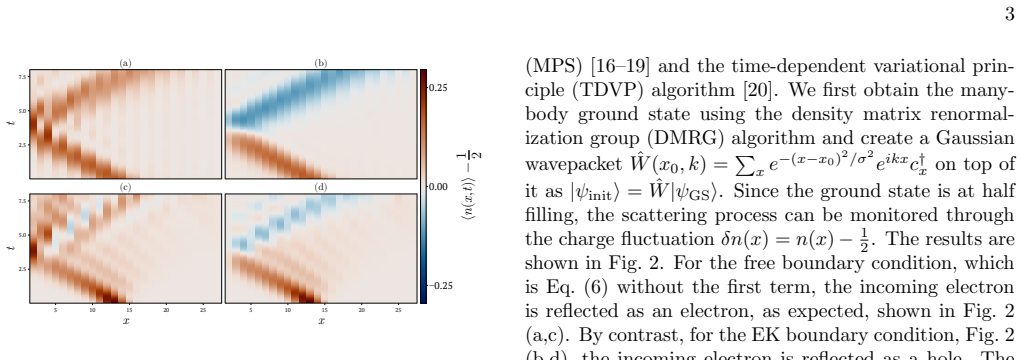
The results are shown in Fig. 2. For the free boundary condition, which is Eq. (6) without the first term, the incoming electron is reflected as an electron, as expected, shown in Fig. 2 (a,c). By contrast, for the EK boundary condition, Fig. 2 (b,d), the incoming electron is reflected as a hole. The lattice model therefore realizes precisely the desired ...
-
[2]
A single Majorana is half of a complex fermion, and there- fore carries the square-root Hilbert-space weight √
In our lattice model, this factor is visible microscopically: it is the contribution of the decoupled Majorana zero mode at the boundary. A single Majorana is half of a complex fermion, and there- fore carries the square-root Hilbert-space weight √
-
[3]
As a matter of fact, we can realize the lattice version of the Maldacena–Ludwig wall using three free boundary con- ditions and one EK boundary condition after triality on the lattice [31]. Conclusion and Outlook.In this Letter, we found that the Andreev reflection, a charge-flip boundary con- dition for incoming and outgoing chiral fermions, is re- alize...
arXiv 2025
-
[4]
Andreevet al., Sov
A. Andreevet al., Sov. Phys. JETP20, 1490 (1965)
1965
-
[5]
V. J. Emery and S. Kivelson, Phys. Rev. B46, 10812 (1992)
1992
-
[6]
J. M. Maldacena and A. W. W. Ludwig, Nucl. Phys. B 506, 565 (1997), arXiv:cond-mat/9502109
Pith/arXiv arXiv 1997
-
[7]
H. B. Nielsen and M. Ninomiya, Nucl. Phys. B185, 20 (1981), [Erratum: Nucl.Phys.B 195, 541 (1982)]
1981
- [8]
-
[9]
Pfeuty, Annals of Physics57, 79 (1970)
P. Pfeuty, Annals of Physics57, 79 (1970)
1970
-
[10]
Jordan and E
P. Jordan and E. P. Wigner, Z. Phys.47, 631 (1928)
1928
-
[11]
Kennedy, Journal of Physics: Condensed Matter2, 5737 (1990)
T. Kennedy, Journal of Physics: Condensed Matter2, 5737 (1990)
1990
-
[12]
A. Ueda, V. V. Linden, L. Lootens, J. Haegeman, P. Fendley, and F. Verstraete, Perfect Particle Transmis- sion through Duality Defects (2025), arXiv:2510.26780 [hep-th]
Pith/arXiv arXiv 2025
-
[13]
D. Aasen, R. S. K. Mong, and P. Fendley, J. Phys. A49, 354001 (2016), arXiv:1601.07185 [cond-mat.stat-mech]
Pith/arXiv arXiv 2016
-
[14]
A. Antinucci, C. Copetti, G. Galati, and G. Rizi, A Twist on Scattering from Defect Anomalies (2026), arXiv:2605.13961 [hep-th]
Pith/arXiv arXiv 2026
-
[15]
H. A. Kramers and G. H. Wannier, Phys. Rev.60, 252 (1941)
1941
-
[16]
N. Seiberg and S.-H. Shao, SciPost Phys.16, 064 (2024), arXiv:2307.02534 [cond-mat.str-el]
arXiv 2024
-
[17]
In the Ising impurity model, this is a rotation of the spin basis for the half- chain
This is a unitary transformation. In the Ising impurity model, this is a rotation of the spin basis for the half- chain
-
[18]
K. T. Law, P. A. Lee, and T. K. Ng, Phys. Rev. Lett. 103, 237001 (2009)
2009
-
[19]
S. R. White, Phys. Rev. Lett.69, 2863 (1992)
1992
-
[20]
S. R. White, Phys. Rev. B48, 10345 (1993)
1993
-
[21]
Schollw¨ ock, Annals of Physics326, 96–192 (2011)
U. Schollw¨ ock, Annals of Physics326, 96–192 (2011)
2011
-
[22]
F. Verstraete, V. Murg, and J. I. Cirac, Adv. Phys.57, 143 (2008), arXiv:0907.2796 [quant-ph]
Pith/arXiv arXiv 2008
-
[23]
Haegeman, J
J. Haegeman, J. I. Cirac, T. J. Osborne, I. Piˇ zorn, H. Ver- schelde, and F. Verstraete, Phys. Rev. Lett.107, 070601 (2011)
2011
-
[24]
T. Numasawa and S. Yamaguchi, JHEP11, 202, arXiv:1712.09361 [hep-th]
-
[25]
B. Han, A. Tiwari, C.-T. Hsieh, and S. Ryu, Phys. Rev. B96, 125105 (2017), arXiv:1704.01193 [cond-mat.str-el]
Pith/arXiv arXiv 2017
- [26]
-
[27]
S. Hellerman, D. Orlando, and M. Watanabe, Quan- tum Information Theory of the Gravitational Anomaly (2021), arXiv:2101.03320 [hep-th]
arXiv 2021
-
[28]
H. B. Thacker, Nucl. Phys. B Proc. Suppl.42, 642 (1995), arXiv:hep-lat/9412019
Pith/arXiv arXiv 1995
-
[29]
I. Horvath and H. B. Thacker, Nucl. Phys. B Proc. Suppl. 73, 682 (1999), arXiv:hep-lat/9809108
Pith/arXiv arXiv 1999
-
[30]
A. Chatterjee, S. D. Pace, and S.-H. Shao, Phys. Rev. Lett.134, 021601 (2025), arXiv:2409.12220 [hep-th]
arXiv 2025
-
[31]
The free boundary condition atj=N−1 also violates the axial symmetry
Briefly speaking, we do not have translation with a boundary. The free boundary condition atj=N−1 also violates the axial symmetry. Those can be avoided by imposing the lattice Emery–Kivelson boundary con- dition atj=Nrather than free boundary conditions
-
[32]
Affleck and A
I. Affleck and A. W. W. Ludwig, Phys. Rev. Lett.67, 8 161 (1991)
1991
-
[33]
Affleck and A
I. Affleck and A. W. W. Ludwig, Phys. Rev. Lett.68, 1046 (1992)
1992
-
[34]
Numasawa, A
T. Numasawa, A. Ueda, B. De Vos, and M. Watanabe, In preparation
-
[35]
Ohmori and M
K. Ohmori and M. Watanabe, unpublished (2022)
2022
-
[36]
Y. Tachikawa, K. Tsuji, and M. Watanabe, What hap- pens to wavepackets of fermions when scattered by the Maldacena-Ludwig wall? (2026), arXiv:2603.25508 [hep- th]
arXiv 2026
-
[37]
P. Wei and Y. Zheng, Non-invertible Symmetries in Weyl Fermions, and Applications to Fermion-Boundary Scat- tering Problem (2026), arXiv:2605.19363 [hep-th]
Pith/arXiv arXiv 2026
-
[38]
Tambara and S
D. Tambara and S. Yamagami, Journal of Algebra209, 692 (1998)
1998
-
[39]
Fu and C
L. Fu and C. L. Kane, Phys. Rev. Lett.100, 096407 (2008)
2008
-
[40]
L. Devos and J. Haegeman, Tensorkit.jl: A julia pack- age for large-scale tensor computations, with a hint of category theory (2026), arXiv:2508.10076 [cs.MS]
Pith/arXiv arXiv 2026
-
[41]
Devos, M
L. Devos, M. Van Damme, and J. Haegeman, Mpskit (2026)
2026
discussion (0)
Sign in with ORCID, Apple, or X to comment. Anyone can read and Pith papers without signing in.