Discovery of a Barred-Spiral Galaxy at z_(spec) = 3.16 I: Bar Identification and Properties
Pith reviewed 2026-06-26 08:00 UTC · model grok-4.3
The pith
A barred spiral galaxy at spectroscopic redshift 3.159 shows rotationally supported disks were already in place within 2 Gyr after the Big Bang.
A machine-rendered reading of the paper's core claim, the machinery that carries it, and where it could break.
Core claim
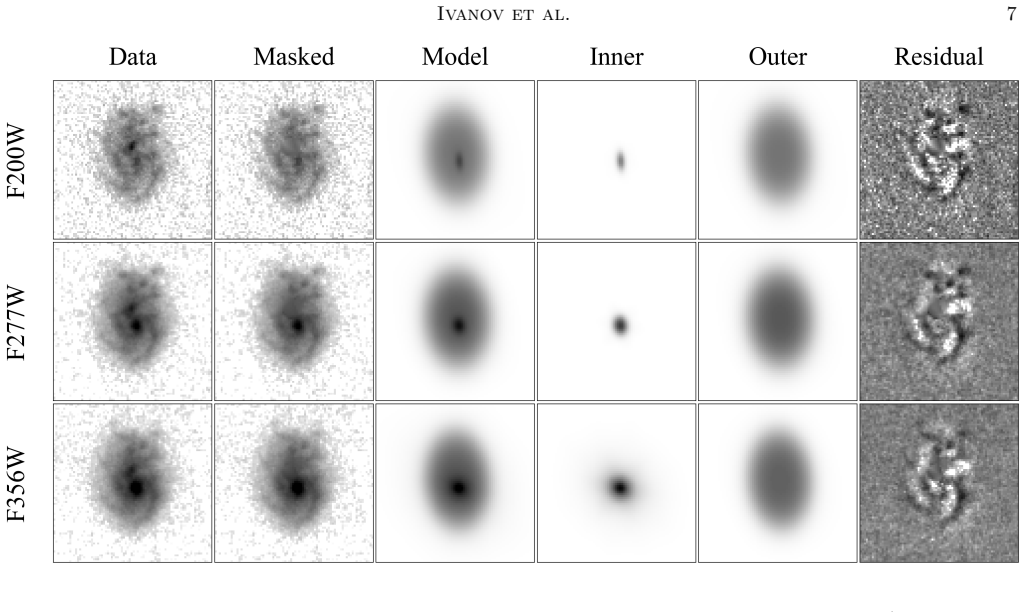
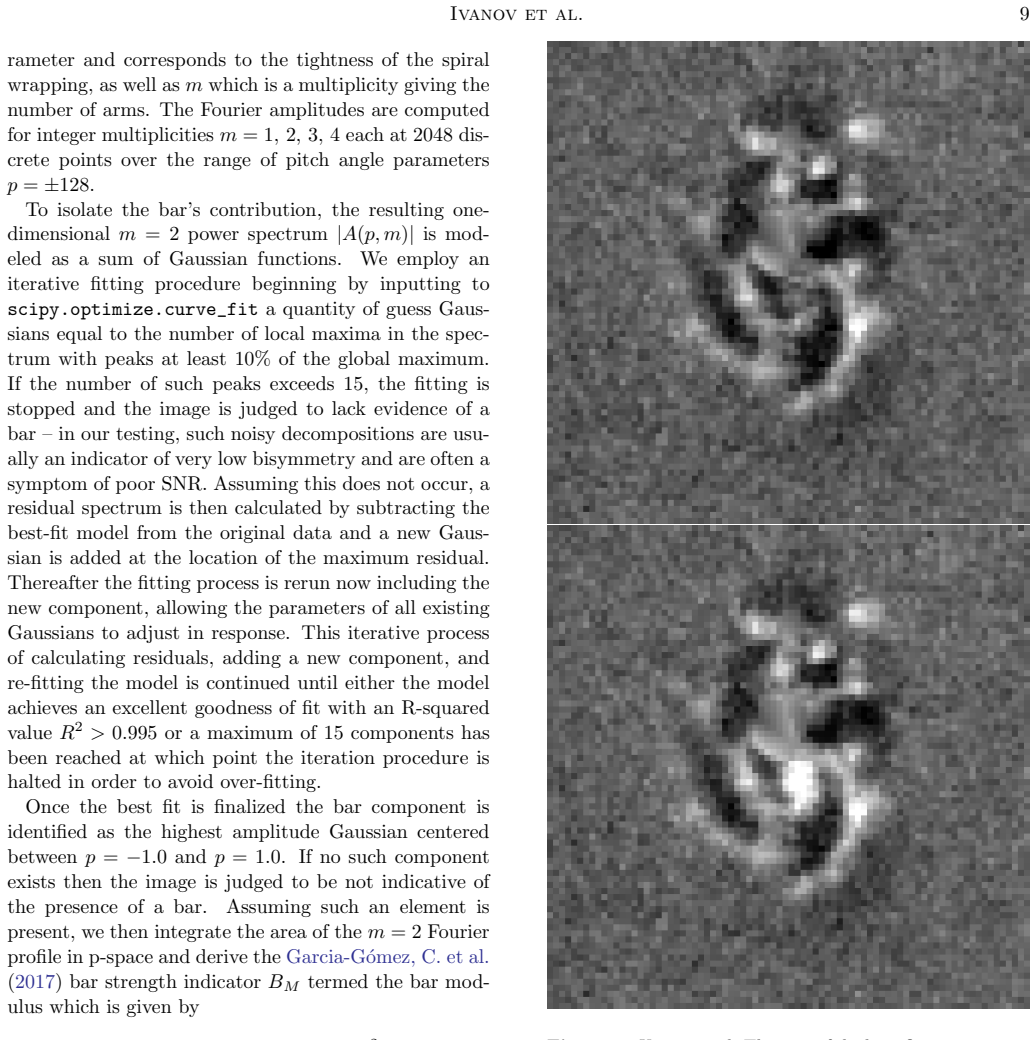
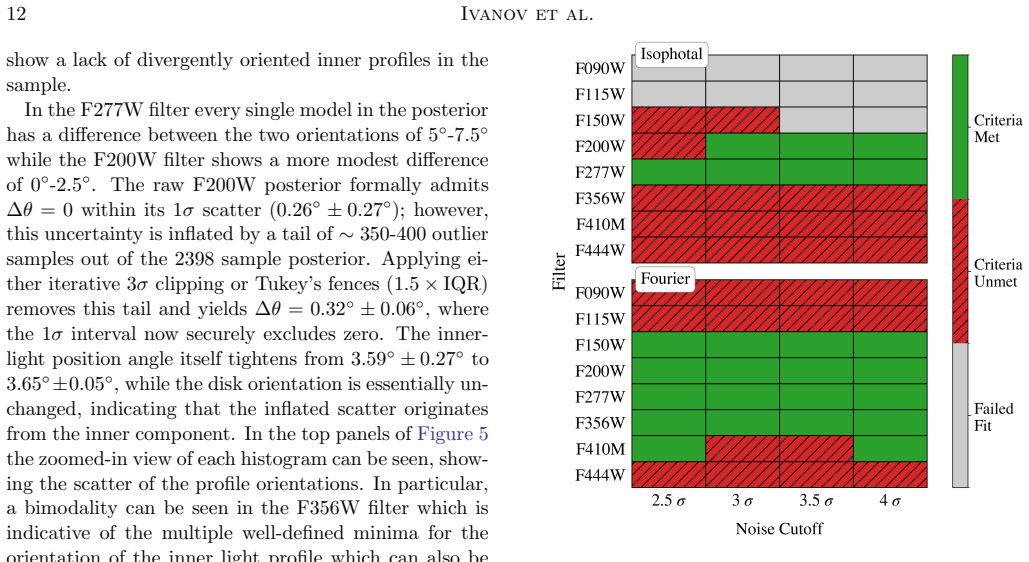
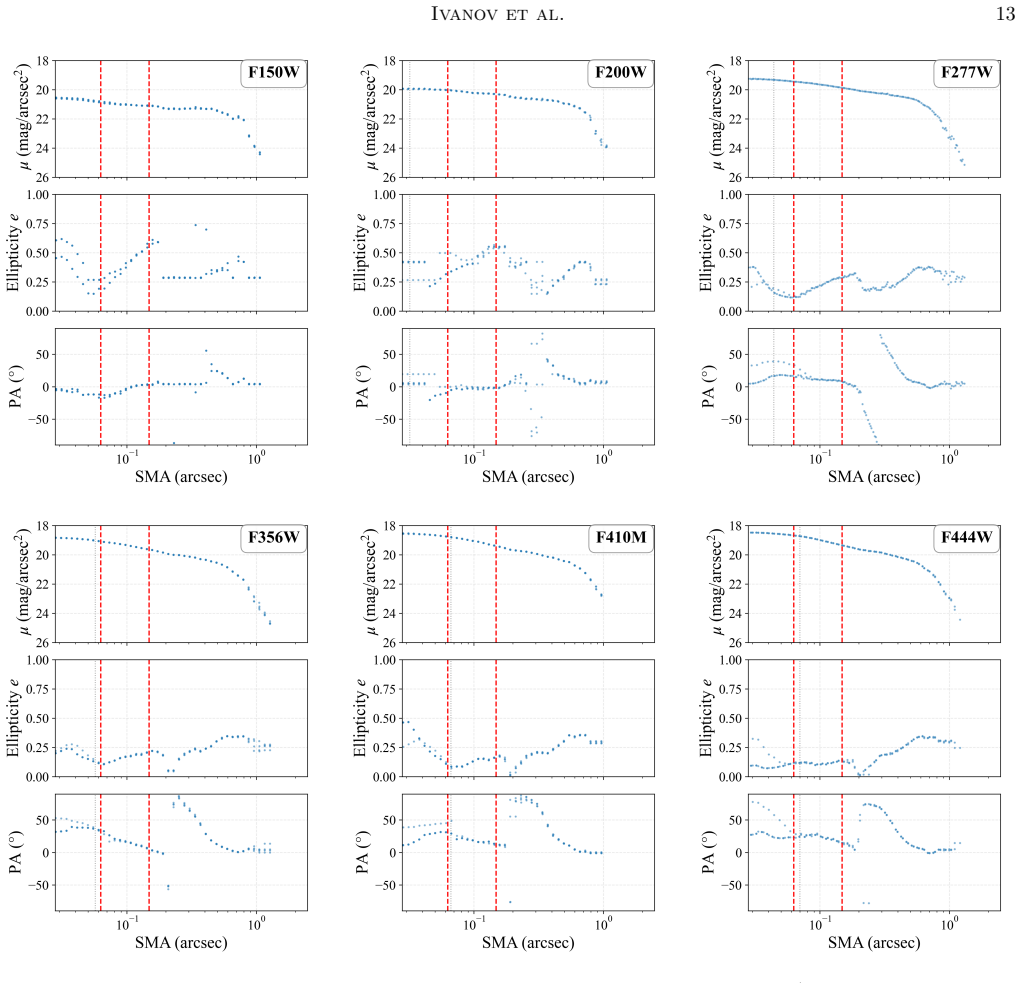
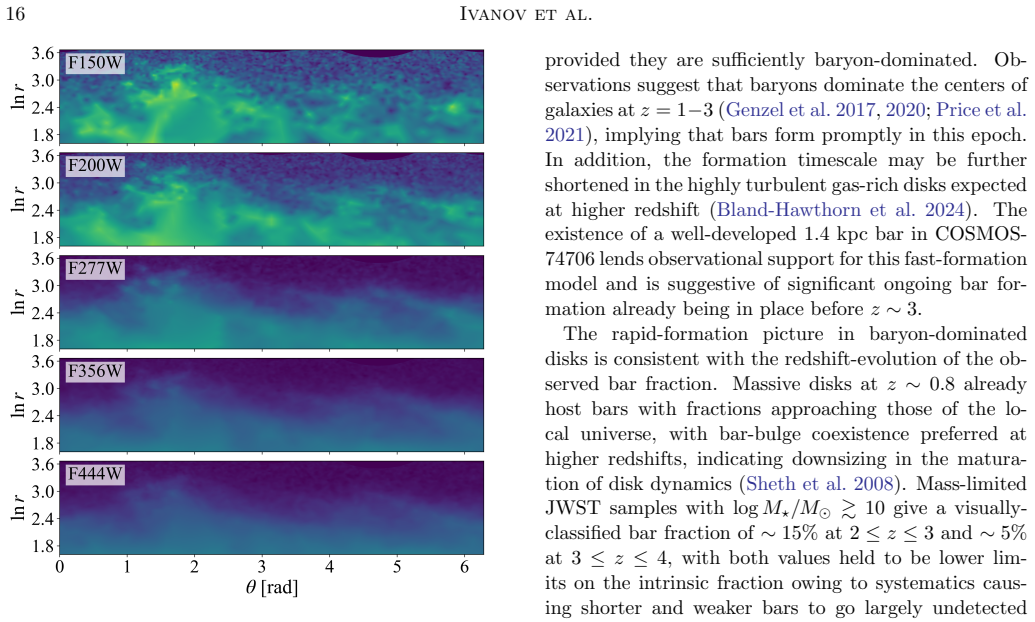
The central claim is the identification of COSMOS-74706 as an unlensed barred spiral at z_spec=3.159. The bar is established through visual inspection of Sersic-profile residuals revealing a linear feature, isophotal ellipse-fitting displaying the characteristic ellipticity and position-angle profiles of a bar, and Fourier decomposition producing a central bisymmetric mode above the strength threshold calibrated on lower-redshift barred spirals. The Keck spectrum secures the redshift, placing the galaxy at z>3 and supporting the presence of galaxies with rotationally supported disks and disk-halo properties conducive to bar formation within 2 Gyr after the Big Bang.
What carries the argument
Bar identification in COSMOS-74706 via three independent techniques on JWST/NIRCam data: Sersic residual analysis for linear structure, isophotal ellipse-fitting for ellipticity and position angle signatures, and Fourier decomposition for bisymmetric mode strength, combined with Keck spectroscopic redshift confirmation.
If this is right
- Rotationally supported disks with properties allowing bar formation existed by z=3.16.
- Secular evolution processes driven by bars began within the first 2 Gyr of cosmic time.
- Disk-halo configurations conducive to bar instabilities were already assembled at early epochs.
- Bar formation is possible in galaxies at redshifts previously thought too early for mature disks.
Where Pith is reading between the lines
- Models of galaxy disk assembly may need to incorporate bar formation as an early process rather than a late-time feature.
- Targeted JWST follow-up on other high-redshift candidates could establish how common such bars are at z>3.
- This case provides a concrete benchmark for simulations testing the conditions required for bars in young galaxies.
Load-bearing premise
The elongated central feature is a stellar bar and not a merger remnant or projection effect, and the Keck spectrum of the blue clump applies to the main galaxy body.
What would settle it
Higher-resolution imaging or additional spectroscopy demonstrating that the central feature is a tidal tail or that the main body lies at a different redshift would falsify the barred-spiral identification at z=3.16.
Figures





read the original abstract
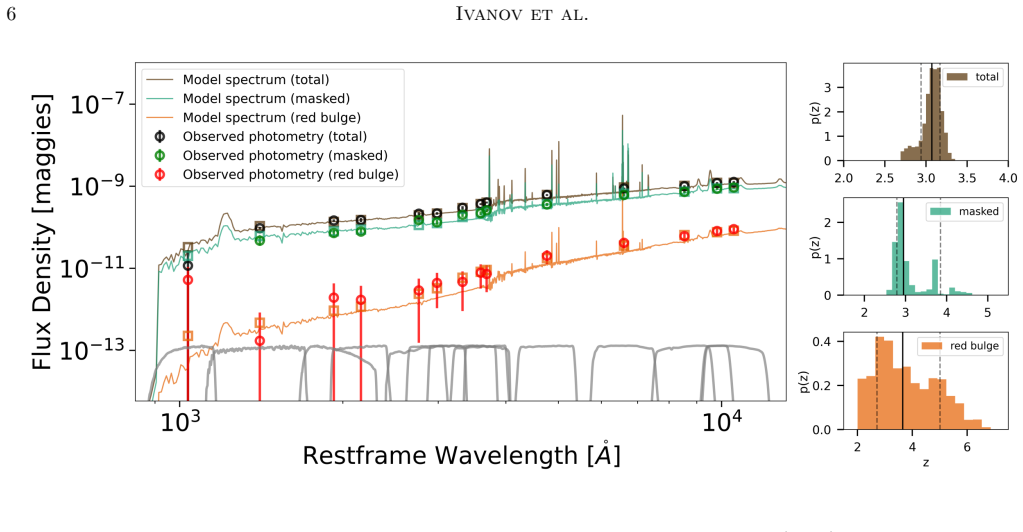
The formation of stellar bars is an important milestone in the secular evolution of spiral galaxies, which typically indicates the presence of a massive rotationally supported disk. Determining when these structures first appeared in the early universe is crucial to constraining the timeline of galactic disk assembly. Here, we report the discovery of COSMOS-74706, a barred spiral galaxy at $z_{spec} = 3.159$. Imaging of COSMOS-74706 with JWST/NIRCam indicates a disk-like morphology and spiral structure with an elongated central feature aligned between the spiral arms, most conspicuously visible in the F200W, F277W, and F356W filters. Three independent methods all support the presence of a bar: visual inspection of residuals from S\'ersic-profile fitting shows a linear structure, isophotal ellipse-fitting displays characteristic profiles of ellipticity and position angle consistent with a bar signature, and Fourier decomposition of the galaxy produces a central bisymmetric mode above a threshold strength calibrated to $z=1-3$ barred spirals. Leveraging archival Keck/MOSDEF spectroscopy overlapping with a blue clump on the edge of the galaxy, a robust redshift is inferred, with photometric constraints indicating that this structure lies at the same redshift as the main spiral. This spectroscopic evidence, placing an unlensed barred spiral at $z>3$ supports the idea that galaxies with rotationally supported disks and disk-halo properties that are conducive to bar formation were already in place within 2 Gyr after the Big Bang.
Editorial analysis
A structured set of objections, weighed in public.
Referee Report
Summary. The paper reports the discovery of COSMOS-74706, an unlensed barred spiral galaxy at z_spec=3.159. JWST/NIRCam imaging shows a disk-like morphology with spiral arms and an elongated central feature; three methods (Sersic residual inspection, isophotal ellipse fitting, and Fourier decomposition with a bisymmetric mode above a z=1-3 calibrated threshold) support bar identification. Archival Keck/MOSDEF spectroscopy of an offset blue clump yields the redshift, with photometric constraints invoked to associate the clump and main body at the same z. This is presented as evidence that rotationally supported disks conducive to bar formation existed within 2 Gyr after the Big Bang.
Significance. If the redshift association and bar identification are robust, the result would provide direct evidence for early bar formation at z>3, constraining the timeline of disk assembly and secular evolution in the early universe. The use of multiple independent bar-identification methods and archival spectroscopy adds value, though the claim's impact hinges on confirming the main galaxy's redshift.
major comments (2)
- [redshift determination] The spectroscopic redshift z_spec=3.159 is obtained exclusively from a blue clump at the galaxy edge rather than the main stellar body (see abstract and redshift paragraph). The association relies on photometric constraints, but no quantitative details (e.g., photo-z probability distributions, chi-squared values, or chance-alignment probability) are provided to demonstrate that a different redshift for the clump is ruled out at high . This association is load-bearing for the z>3 claim and the timeline argument.
- [bar identification methods] The Fourier decomposition method invokes a bisymmetric mode strength threshold calibrated on z=1-3 barred spirals (abstract), but no explicit value, uncertainty, or test of applicability at z=3.16 (where surface brightness dimming and resolution effects differ) is reported. Without this, it is unclear whether the central mode detection is robust or could be affected by noise or projection.
minor comments (2)
- [abstract] The abstract states that three methods support the bar but provides no quantitative thresholds, error bars, or comparison metrics (e.g., ellipticity peak value or Fourier amplitude). Adding these would improve clarity.
- The claim of an 'unlensed' galaxy should include a brief justification or reference to lensing models for the COSMOS field to rule out significant magnification.
Simulated Author's Rebuttal
We thank the referee for their careful and constructive review. We address the two major comments point by point below. Both concerns identify areas where the current manuscript lacks sufficient quantitative detail; we will incorporate the requested information in the revised version.
read point-by-point responses
-
Referee: The spectroscopic redshift z_spec=3.159 is obtained exclusively from a blue clump at the galaxy edge rather than the main stellar body (see abstract and redshift paragraph). The association relies on photometric constraints, but no quantitative details (e.g., photo-z probability distributions, chi-squared values, or chance-alignment probability) are provided to demonstrate that a different redshift for the clump is ruled out at high confidence. This association is load-bearing for the z>3 claim and the timeline argument.
Authors: We agree that the manuscript does not currently supply the quantitative photometric details needed to rigorously support the redshift association. In the revised version we will add the photometric redshift probability distributions for both the main galaxy and the offset blue clump, the associated chi-squared values, and an estimate of the chance-alignment probability. These additions will directly address the load-bearing nature of the association. revision: yes
-
Referee: The Fourier decomposition method invokes a bisymmetric mode strength threshold calibrated on z=1-3 barred spirals (abstract), but no explicit value, uncertainty, or test of applicability at z=3.16 (where surface brightness dimming and resolution effects differ) is reported. Without this, it is unclear whether the central mode detection is robust or could be affected by noise or projection.
Authors: The referee is correct that the explicit numerical value of the bisymmetric Fourier mode amplitude, its uncertainty, and any discussion of the calibration's applicability at z=3.16 are absent from the present text. We will revise the manuscript to report the measured mode strength with uncertainty, state its relation to the z=1-3 threshold, and include a short discussion of possible surface-brightness-dimming and resolution effects. The bar identification rests on three independent methods, so the Fourier result will be presented in that context. revision: yes
Circularity Check
No circularity: direct observational identification
full rationale
The paper reports an observational discovery using JWST/NIRCam imaging for morphology (Sersic residuals, isophotal fitting, Fourier modes) and archival Keck/MOSDEF spectroscopy for redshift, with photometric constraints to associate the blue clump spectrum with the main galaxy. No mathematical derivation chain, fitted parameters renamed as predictions, or self-citation load-bearing steps exist. The bar threshold is calibrated externally to z=1-3 samples, and the redshift association is an inference from photometry rather than a self-referential reduction. This is a standard observational result with no internal loop.
Axiom & Free-Parameter Ledger
free parameters (1)
- Fourier bisymmetric mode threshold
axioms (1)
- standard math Standard flat Lambda-CDM cosmology for converting redshift to cosmic time
Reference graph
Works this paper leans on
-
[1]
Gadotti, D
A. Gadotti, D. 2009, in Chaos in Astronomy, ed. G. Contopoulos & P. A. Patsis (Berlin, Heidelberg: Springer Berlin Heidelberg), 159–172
2009
-
[2]
Aguerri, J. A. L., M´ endez-Abreu, J., & Corsini, E. M. 2009, Astronomy & Astrophysics, 495, 491–504, doi: 10.1051/0004-6361:200810931
-
[3]
Amvrosiadis, A., Lange, S., Nightingale, J. W., et al. 2025, Monthly Notices of the Royal Astronomical Society, 537, 1163, doi: 10.1093/mnras/staf048 Astropy Collaboration, Robitaille, T. P., Tollerud, E. J., et al. 2013, A&A, 558, A33, doi: 10.1051/0004-6361/201322068 Astropy Collaboration, Price-Whelan, A. M., Sip˝ ocz, B. M., et al. 2018, AJ, 156, 123,...
-
[4]
Athanassoula, E. 1992, MNRAS, 259, 345, doi: 10.1093/mnras/259.2.345
-
[5]
Athanassoula, E. 2003, Monthly Notices of the Royal Astronomical Society, 341, 1179–1198, doi: 10.1046/j.1365-8711.2003.06473.x —. 2013, Bars and secular evolution in disk galaxies: Theoretical input, ed. J. Falc´ on-Barroso & J. H. Knapen, Canary Islands Winter School of Astrophysics (Cambridge University Press), 305–352
-
[6]
Athanassoula, E., Machado, R. E. G., & Rodionov, S. A. 2013, Monthly Notices of the Royal Astronomical Society, 429, 1949, doi: 10.1093/mnras/sts452 22Ivanov et al
-
[7]
2002, MNRAS, 334, 523, doi: 10.1046/j.1365-8711.2002.05478.x
Athanassoula, E., & Misiriotis, A. 2002, Monthly Notices of the Royal Astronomical Society, 330, 35–52, doi: 10.1046/j.1365-8711.2002.05028.x
-
[8]
Bamford, S. P., Nichol, R. C., Baldry, I. K., et al. 2009, Monthly Notices of the Royal Astronomical Society, 393, 1324–1352, doi: 10.1111/j.1365-2966.2008.14252.x
-
[9]
Barazza, F. D., Jogee, S., & Marinova, I. 2008, ApJ, 675, 1194, doi: 10.1086/526510
-
[10]
2023, ApJ, 953, 173, doi: 10.3847/1538-4357/ace2b9
Beane, A., Hernquist, L., D’Onghia, E., et al. 2023, ApJ, 953, 173, doi: 10.3847/1538-4357/ace2b9
-
[11]
2022, ApJ, 934, 52, doi: 10.3847/1538-4357/ac779b
Bi, D., Shlosman, I., & Romano-D´ ıaz, E. 2022, ApJ, 934, 52, doi: 10.3847/1538-4357/ac779b
-
[12]
2024, Turbulent gas-rich disks at high redshift: bars & bulges in a radial shear flow
Federrath, C. 2024, Turbulent gas-rich disks at high redshift: bars & bulges in a radial shear flow. https://arxiv.org/abs/2402.06060
arXiv 2024
-
[13]
2023, The Astrophysical Journal, 947, 80, doi: 10.3847/1538-4357/acc469
Freeman, K. 2023, The Astrophysical Journal, 947, 80, doi: 10.3847/1538-4357/acc469
-
[14]
Block, D. L., Buta, R., Knapen, J. H., et al. 2004, The Astronomical Journal, 128, 183–201, doi: 10.1086/421362
-
[15]
Bournaud, F., Combes, F., & Semelin, B. 2005, MNRAS, 364, L18, doi: 10.1111/j.1745-3933.2005.00096.x
-
[16]
2002, A&A, 392, 83, doi: 10.1051/0004-6361:20020920
Bournaud, F., & Combes, F. 2002, A&A, 392, 83, doi: 10.1051/0004-6361:20020920
-
[17]
2024, astropy/photutils: 2.0.2, 2.0.2, Zenodo, doi: 10.5281/zenodo.13989456
Bradley, L., Sip˝ ocz, B., Robitaille, T., et al. 2024, astropy/photutils: 2.0.2, 2.0.2, Zenodo, doi: 10.5281/zenodo.13989456
-
[18]
2019, Grizli: Grism redshift and line analysis software, Astrophysics Source Code Library, record ascl:1905.001
Brammer, G. 2019, Grizli: Grism redshift and line analysis software, Astrophysics Source Code Library, record ascl:1905.001. http://ascl.net/1905.001
2019
-
[19]
Brammer, G. B., van Dokkum, P. G., & Coppi, P. 2008, ApJ, 686, 1503, doi: 10.1086/591786
work page internal anchor Pith review doi:10.1086/591786 2008
-
[20]
Brammer, G. B., van Dokkum, P. G., Franx, M., et al. 2012, ApJS, 200, 13, doi: 10.1088/0067-0049/200/2/13
-
[21]
Buta, R. J., Knapen, J. H., Elmegreen, B. G., et al. 2009, The Astronomical Journal, 137, 4487–4516, doi: 10.1088/0004-6256/137/5/4487
-
[22]
Carles, C., Martel, H., Ellison, S. L., & Kawata, D. 2016, MNRAS, 463, 1074, doi: 10.1093/mnras/stw2056
-
[23]
Casey, C. M., Kartaltepe, J. S., Drakos, N. E., et al. 2023, ApJ, 954, 31, doi: 10.3847/1538-4357/acc2bc
-
[24]
Conselice, C. J. 2014, Annual Review of Astronomy and Astrophysics, 52, 291–337, doi: 10.1146/annurev-astro-081913-040037
-
[25]
1988, A&AS, 76, 365
Considere, S., & Athanassoula, E. 1988, A&AS, 76, 365
1988
-
[26]
Conte, Z. A. L., Gadotti, D. A., Ferreira, L., et al. 2025, The evolution of the bar fraction and bar lengths in the last 12 billion years. https://arxiv.org/abs/2510.07407
arXiv 2025
-
[27]
Costantin, L., P´ erez-Gonz´ alez, P. G., Guo, Y., et al. 2023, Nature, 623, 499, doi: 10.1038/s41586-023-06636-x
-
[28]
Cutler, S. E., Whitaker, K. E., Weaver, J. R., et al. 2024, Two Distinct Classes of Quiescent Galaxies at Cosmic Noon Revealed by JWST PRIMER and UNCOVER. https://arxiv.org/abs/2312.15012
arXiv 2024
-
[29]
Debattista, V. P., Ness, M., Gonzalez, O. A., et al. 2017, Monthly Notices of the Royal Astronomical Society, 469, 1587–1611, doi: 10.1093/mnras/stx947
-
[30]
Debattista, V. P., & Sellwood, J. A. 1998, The Astrophysical Journal, 493, L5–L8, doi: 10.1086/311118
-
[31]
Cold streams in early massive hot haloes as the main mode of galaxy formation
Dekel, A., Birnboim, Y., Engel, G., et al. 2009, Nature, 457, 451, doi: 10.1038/nature07648 D’Onghia, E. 2015, ApJL, 808, L8, doi: 10.1088/2041-8205/808/1/L8
work page internal anchor Pith review doi:10.1038/nature07648 2009
-
[32]
S., Abraham, R
Dunlop, J. S., Abraham, R. G., Ashby, M. L. N., et al. 2021, PRIMER: Public Release IMaging for Extragalactic
2021
-
[33]
Verdes-Montenegro, L. 2009, Monthly Notices of the Royal Astronomical Society, 397, 1756, doi: 10.1111/j.1365-2966.2009.15051.x
-
[34]
Elmegreen, B. G., & Elmegreen, D. M. 1985, ApJ, 288, 438, doi: 10.1086/162810
-
[35]
Erwin, P., & Sparke, L. S. 2002, The Astronomical Journal, 124, 65, doi: 10.1086/340803 Espejo Salcedo, J. M., Pastras, S., V´ acha, J., et al. 2025, A&A, 700, A42, doi: 10.1051/0004-6361/202554725
-
[36]
2026, Formation timescales for stellar bars in diverse galactic discs
Frosst, M., Obreschkow, D., & Ludlow, A. 2026, Formation timescales for stellar bars in diverse galactic discs. https://arxiv.org/abs/2602.21748
arXiv 2026
-
[37]
S., et al., & et al
Fruchter, A. S., et al., & et al. 2010, in 2010 Space Telescope Science Institute Calibration Workshop, 382–387
2010
-
[38]
Fruchter, A. S., & Hook, R. N. 2002, PASP, 114, 144, doi: 10.1086/338393
-
[39]
S., B´ edorf, J., Baba, J., & Portegies Zwart, S
Fujii, M. S., B´ edorf, J., Baba, J., & Portegies Zwart, S. 2018, Monthly Notices of the Royal Astronomical Society, 477, 1451–1471, doi: 10.1093/mnras/sty711
-
[40]
Gadotti, D. A. 2011, Monthly Notices of the Royal Astronomical Society, 415, 3308, doi: 10.1111/j.1365-2966.2011.18945.x Gaia Collaboration, Vallenari, A., Brown, A. G. A., et al. 2023, A&A, 674, A1, doi: 10.1051/0004-6361/202243940
-
[41]
1991, A&AS, 89, 159 Garcia-G´ omez, C., Athanassoula, E., Barber` a, C., &
Garcia-Gomez, C., & Athanassoula, E. 1991, A&AS, 89, 159 Garcia-G´ omez, C., Athanassoula, E., Barber` a, C., &
1991
-
[42]
2017, A&A, 601, A132, doi: 10.1051/0004-6361/201628830
Bosma, A. 2017, A&A, 601, A132, doi: 10.1051/0004-6361/201628830
-
[43]
2008, ApJ, 687, 59, doi: 10.1086/591840 Ivanov et al.23
Genzel, R., Burkert, A., Bouch´ e, N., et al. 2008, ApJ, 687, 59, doi: 10.1086/591840 Ivanov et al.23
-
[44]
Genzel, R., Schreiber, N. M. F., ¨Ubler, H., et al. 2017, Nature, 543, 397–401, doi: 10.1038/nature21685
-
[45]
Genzel, R., Price, S. H., ¨Ubler, H., et al. 2020, The Astrophysical Journal, 902, 98, doi: 10.3847/1538-4357/abb0ea
-
[46]
2023, A&A, 674, A128, doi: 10.1051/0004-6361/202245275
Ghosh, S., Fragkoudi, F., Di Matteo, P., & Saha, K. 2023, A&A, 674, A128, doi: 10.1051/0004-6361/202245275
-
[47]
Gould, K. M. L., Brammer, G., Valentino, F., et al. 2023, AJ, 165, 248, doi: 10.3847/1538-3881/accadc
-
[48]
Grogin, N. A., Kocevski, D. D., Faber, S. M., et al. 2011, The Astrophysical Journal Supplement Series, 197, 35, doi: 10.1088/0067-0049/197/2/35
-
[49]
Guo, Y., Jogee, S., Finkelstein, S. L., et al. 2023, The Astrophysical Journal Letters, 945, L10, doi: 10.3847/2041-8213/acacfb
-
[50]
2025, ApJ, 985, 181, doi: 10.3847/1538-4357/adc8a7 G´ eron, T., Smethurst, R
Guo, Y., Jogee, S., Wise, E., et al. 2025, ApJ, 985, 181, doi: 10.3847/1538-4357/adc8a7 G´ eron, T., Smethurst, R. J., Dickinson, H., et al. 2025, The Astrophysical Journal, 987, 74, doi: 10.3847/1538-4357/add7d0
-
[51]
2025, Nature, 641, 861, doi: 10.1038/s41586-025-08914-2
Huang, S., Kawabe, R., Umehata, H., et al. 2025, Nature, 641, 861, doi: 10.1038/s41586-025-08914-2
-
[52]
2023, The Astrophysical Journal Letters, 958, L26, doi: 10.3847/2041-8213/acff63
Huang, S., Kawabe, R., Kohno, K., et al. 2023, The Astrophysical Journal Letters, 958, L26, doi: 10.3847/2041-8213/acff63
-
[53]
2025, arXiv e-prints, arXiv:2502.03532, doi: 10.48550/arXiv.2502.03532
Huertas-Company, M., Shuntov, M., Dong, Y., et al. 2025, arXiv e-prints, arXiv:2502.03532, doi: 10.48550/arXiv.2502.03532
-
[54]
2024, A grand-design spiral galaxy 1.5 billion years after the Big Bang with JWST
Jain, R., & Wadadekar, Y. 2024, A grand-design spiral galaxy 1.5 billion years after the Big Bang with JWST. https://arxiv.org/abs/2412.04834
arXiv 2024
-
[55]
2006, in Physics of Active Galactic Nuclei at all Scales, ed
Jogee, S. 2006, in Physics of Active Galactic Nuclei at all Scales, ed. D. Alloin, Vol. 693, 143, doi: 10.1007/3-540-34621-X 6
-
[56]
Jogee, S., Scoville, N., & Kenney, J. D. P. 2005, The Astrophysical Journal, 630, 837, doi: 10.1086/432106
-
[57]
Jogee, S., Barazza, F. D., Rix, H.-W., et al. 2004, The Astrophysical Journal, 615, L105, doi: 10.1086/426138
-
[58]
A., & Mandel, E
Joye, W. A., & Mandel, E. 2003, in Astronomical Society of the Pacific Conference Series, Vol. 295, Astronomical Data Analysis Software and Systems XII, ed. H. E
2003
-
[59]
Koekemoer, A. M., Faber, S. M., Ferguson, H. C., et al. 2011, ApJS, 197, 36, doi: 10.1088/0067-0049/197/2/36
-
[60]
2013, Secular Evolution in Disk Galaxies
Kormendy, J. 2013, Secular Evolution in Disk Galaxies. https://arxiv.org/abs/1311.2609
Pith/arXiv arXiv 2013
-
[61]
Kormendy, J., & Kennicutt, Jr., R. C. 2004, ARA&A, 42, 603, doi: 10.1146/annurev.astro.42.053102.134024
-
[62]
Kriek, M., Shapley, A. E., Reddy, N. A., et al. 2015, ApJS, 218, 15, doi: 10.1088/0067-0049/218/2/15
-
[63]
2024, The Astrophysical Journal Letters, 968, L15, doi: 10.3847/2041-8213/ad43eb
Kuhn, V., Guo, Y., Martin, A., et al. 2024, The Astrophysical Journal Letters, 968, L15, doi: 10.3847/2041-8213/ad43eb
-
[64]
, year = 2005, month = apr, volume =
Laurikainen, E., Salo, H., & Buta, R. 2005, Monthly Notices of the Royal Astronomical Society, 362, 1319, doi: 10.1111/j.1365-2966.2005.09404.x Le Conte, Z. A., Gadotti, D. A., Ferreira, L., et al. 2024, Monthly Notices of the Royal Astronomical Society, 530, 1984, doi: 10.1093/mnras/stae921
-
[65]
Lucey, M., Pearson, S., Hunt, J. A. S., et al. 2023, Monthly Notices of the Royal Astronomical Society, 520, 4779, doi: 10.1093/mnras/stad406
-
[66]
2007, ApJ, 659, 1176, doi: 10.1086/512355
Marinova, I., & Jogee, S. 2007, ApJ, 659, 1176, doi: 10.1086/512355
-
[67]
Daniel, K. J. 2025, Monthly Notices of the Royal Astronomical Society, 537, 1475, doi: 10.1093/mnras/staf107
-
[68]
McKinney, J., Casey, C. M., Long, A. S., et al. 2024, SCUBADive I: JWST+ALMA Analysis of 289 sub-millimeter galaxies in COSMOS-Web. https://arxiv.org/abs/2408.08346
arXiv 2024
-
[69]
S., Steidel, C
McLean, I. S., Steidel, C. C., Epps, H. W., et al. 2012, in Society of Photo-Optical Instrumentation Engineers (SPIE) Conference Series, Vol. 8446, Ground-based and Airborne Instrumentation for Astronomy IV, ed. I. S
2012
-
[70]
McLean, S. K. Ramsay, & H. Takami, 84460J, doi: 10.1117/12.924794 Men´ endez-Delmestre, K., Sheth, K., Schinnerer, E., Jarrett, T. H., & Scoville, N. Z. 2007, ApJ, 657, 790, doi: 10.1086/511025 Men´ endez-Delmestre, K., Gon¸ calves, T. S., Sheth, K., et al. 2024, Monthly Notices of the Royal Astronomical Society, 527, 11777, doi: 10.1093/mnras/stad3662
-
[71]
Momcheva, I. G., Brammer, G. B., van Dokkum, P. G., et al. 2016, ApJS, 225, 27, doi: 10.3847/0067-0049/225/2/27
-
[72]
2023, in American Astronomical Society Meeting Abstracts, Vol
Mukundan, K., Nair, P., Masters, K., & Bailin, J. 2023, in American Astronomical Society Meeting Abstracts, Vol. 241, American Astronomical Society Meeting Abstracts, 177.67
2023
-
[73]
1987, Monthly Notices of the Royal Astronomical Society, 228, 635, doi: 10.1093/mnras/228.3.635
Noguchi, M. 1987, Monthly Notices of the Royal Astronomical Society, 228, 635, doi: 10.1093/mnras/228.3.635
-
[74]
1990, ApJ, 357, 71, doi: 10.1086/168892
Ohta, K., Hamabe, M., & Wakamatsu, K.-I. 1990, ApJ, 357, 71, doi: 10.1086/168892
-
[75]
Ostriker, J. P., & Peebles, P. J. E. 1973, ApJ, 186, 467, doi: 10.1086/152513 24Ivanov et al
-
[76]
Peng, C. Y., Ho, L. C., Impey, C. D., & Rix, H.-W. 2002, The Astronomical Journal, 124, 266–293, doi: 10.1086/340952 —. 2010, The Astronomical Journal, 139, 2097–2129, doi: 10.1088/0004-6256/139/6/2097
work page internal anchor Pith review doi:10.1086/340952 2002
-
[77]
Price, S. H., Shimizu, T. T., Genzel, R., et al. 2021, The Astrophysical Journal, 922, 143, doi: 10.3847/1538-4357/ac22ad Rodr´ ıguez, S., & Padilla, N. D. 2013, MNRAS, 434, 2153, doi: 10.1093/mnras/stt1168
-
[78]
Rosas-Guevara, Y., Bonoli, S., Dotti, M., et al. 2022, MNRAS, 512, 5339, doi: 10.1093/mnras/stac816
-
[79]
Ryden, B. S. 2004, ApJ, 601, 214, doi: 10.1086/380437
-
[80]
2013, Monthly Notices of the Royal Astronomical Society, 434, 1287, doi: 10.1093/mnras/stt1088
Saha, K., & Naab, T. 2013, Monthly Notices of the Royal Astronomical Society, 434, 1287, doi: 10.1093/mnras/stt1088
discussion (0)
Sign in with ORCID, Apple, or X to comment. Anyone can read and Pith papers without signing in.