Universal Dynamical Response to Slow Driving in Chaotic Systems
Pith reviewed 2026-06-26 06:13 UTC · model grok-4.3
The pith
Chaotic dynamics produces a divergence in speed-Fisher information as the driving protocol slows.
A machine-rendered reading of the paper's core claim, the machinery that carries it, and where it could break.
Core claim
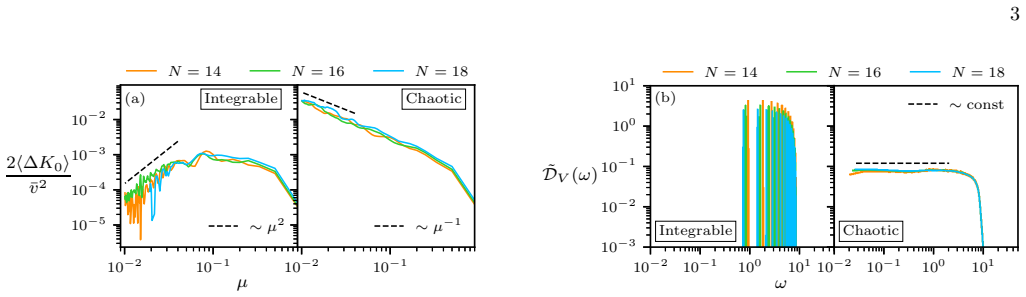
Chaotic dynamics manifests as a divergence of the speed-Fisher information with the protocol time, and this response is controlled by the perturbation's low-frequency spectral weight. The effect holds for classical and quantum Hamiltonian systems and extends naturally to non-Hamiltonian classical flows, with the divergence linked directly to irreversible entropy production.
What carries the argument
Speed-Fisher information, the susceptibility of the system to the average speed of the driving protocol, which probes stability of stationary states.
If this is right
- Chaotic systems generate diverging irreversible entropy production under slower driving protocols.
- The magnitude of the response is set by the low-frequency content of the perturbation spectrum.
- Non-chaotic systems keep finite speed-Fisher information for arbitrarily long protocol times.
- The same divergence criterion applies uniformly to classical Hamiltonian, quantum, and non-Hamiltonian flows.
Where Pith is reading between the lines
- The measure could serve as a practical diagnostic in experiments where Lyapunov exponents or spectral statistics are difficult to access directly.
- Links may exist between the low-frequency spectral weight and other chaos indicators such as level repulsion or out-of-time-order correlators.
- The framework suggests testing whether many-body driven systems exhibit analogous divergences that mark chaotic phases or heating transitions.
Load-bearing premise
The speed-Fisher information acts as a faithful universal probe that distinguishes chaotic from non-chaotic behavior through the stability of stationary states.
What would settle it
A direct computation or simulation in a known chaotic system showing that speed-Fisher information remains finite and converges as protocol time approaches infinity would falsify the central claim.
Figures



read the original abstract
We propose a unified perspective on classical and quantum chaos based on the stability of a system's stationary states under slow driving. We probe this sensitivity via the system's susceptibility to the average protocol speed, which we call the ``speed-Fisher information," and relate it to irreversible entropy production in the system. We show that chaotic dynamics manifests as a divergence of the speed-Fisher information with the protocol time, and that this response is controlled by the perturbation's low-frequency spectral weight. This approach to chaos applies to both classical and quantum Hamiltonian systems, and naturally extends to non-Hamiltonian classical flows. We illustrate this framework with simple classical and quantum examples, along with a non-Hamiltonian flow that qualitatively exhibits analogous low-frequency spectral behavior.
Editorial analysis
A structured set of objections, weighed in public.
Referee Report
Summary. The paper proposes a unified perspective on classical and quantum chaos based on the stability of stationary states under slow driving. It introduces the speed-Fisher information as the system's susceptibility to average protocol speed, relates it to irreversible entropy production, and shows that chaotic dynamics produces a divergence of this quantity with protocol time controlled by the perturbation's low-frequency spectral weight. The framework is illustrated with simple classical Hamiltonian, quantum, and non-Hamiltonian examples.
Significance. If the derivations and relations hold, the work supplies a parameter-free diagnostic that unifies classical and quantum chaos detection and extends naturally to non-Hamiltonian flows. The explicit examples and concrete illustrations of the divergence provide falsifiable support for the central claim within the regimes examined.
minor comments (2)
- [Abstract] The abstract states that the approach 'naturally extends' to non-Hamiltonian flows, but the manuscript should clarify whether this extension relies on additional assumptions not required for the Hamiltonian cases.
- [Introduction] Notation for the speed-Fisher information and its relation to entropy production should be introduced with an explicit equation in the main text before the examples are presented.
Simulated Author's Rebuttal
We thank the referee for their positive assessment of the manuscript, including the significance of the proposed framework and the recommendation for minor revision. We note that no specific major comments were listed in the report.
Circularity Check
No significant circularity detected
full rationale
The abstract and skeptic analysis indicate that the speed-Fisher information is introduced as a new susceptibility measure, explicitly related to entropy production, and then shown to diverge in chaotic regimes via concrete classical, quantum, and non-Hamiltonian examples. No equations or self-citations are visible that would reduce the central divergence claim to a fit, definition, or prior author result by construction. The argument relies on parameter-free relations and explicit illustrations that remain independent of the target result, making the derivation self-contained within the regimes examined.
Axiom & Free-Parameter Ledger
axioms (1)
- domain assumption Stationary states exist and their stability under slow driving can be probed by a susceptibility to protocol speed.
invented entities (1)
-
speed-Fisher information
no independent evidence
Reference graph
Works this paper leans on
-
[1]
Data Availability Statement – The data that sup- port the findings of this study were generated by numer- ical simulations
The authors acknowledge the use of Boston Uni- versity’s Shared Computing Cluster (SCC) for numerical simulations. Data Availability Statement – The data that sup- port the findings of this study were generated by numer- ical simulations. The data, source code, and parame- ters used to generate the simulations are publicly avail- able [ 54–57]. ∗ nachiket@bu.edu
-
[2]
Ott, Chaos in Dynamical Systems (Cambridge Uni- versity Press, Cambridge, UK, 1993)
E. Ott, Chaos in Dynamical Systems (Cambridge Uni- versity Press, Cambridge, UK, 1993)
1993
-
[3]
Lorenz, Predictability: Does the flap of a butterfly’s wing in Brazil set off a tornado in Texas? (1972)
E. Lorenz, Predictability: Does the flap of a butterfly’s wing in Brazil set off a tornado in Texas? (1972)
1972
-
[4]
Gleick, Chaos: Making a New Science (Penguin Books, New York NY, USA, 1987)
J. Gleick, Chaos: Making a New Science (Penguin Books, New York NY, USA, 1987)
1987
-
[5]
V. I. Oseledets, A multiplicative ergodic theorem. Lya- punov characteristic numbers for dynamical systems, Transactions of the Moscow Mathematical Society 19, 197 (1968)
1968
-
[6]
Bohigas, M.-J
O. Bohigas, M.-J. Giannoni, and C. Schmit, Charac- terization of chaotic quantum spectra and universality of level fluctuation laws, Physical Review Letters 52, 1 (1984)
1984
-
[7]
M. V. Berry and M. Tabor, Level clustering in the regular spectrum, Proceedings of the Royal Society of London A 356, 375 (1977)
1977
-
[8]
E. P. Wigner, On the statistical distribution of the widths and spacings of nuclear resonance levels, Proceedings of the Cambridge Philosophical Society 47, 790 (1951)
1951
-
[9]
F. J. Dyson, Statistical theory of the energy levels of complex systems. i, Journal of Mathematical Physics 3, 140 (1962)
1962
-
[10]
F. J. Dyson, Statistical theory of the energy levels of complex systems. ii, Journal of Mathematical Physics 3, 157 (1962)
1962
-
[11]
F. J. Dyson, Statistical theory of the energy levels of complex systems. iii, Journal of Mathematical Physics 3, 166 (1962)
1962
-
[12]
J. M. Deutsch, Quantum statistical mechanics in a closed system, Phys. Rev. A 43, 2046 (1991)
2046
-
[13]
Srednicki, Chaos and quantum thermalization, Phys
M. Srednicki, Chaos and quantum thermalization, Phys. Rev. E 50, 888 (1994)
1994
-
[14]
L. D’Alessio, Y. Kafri, A. Polkovnikov, and M. Rigol, From quantum chaos and eigenstate thermalization to statistical mechanics and ther- modynamics, Advances in Physics 65, 239 (2016) , https://doi.org/10.1080/00018732.2016.1198134
-
[15]
M. V. Berry, Quantum, classical, and semiclassical adia- baticity, in Theoretical and Applied Mechanics, edited by 6 F. I. Niordson and N. Olhoff (Elsevier, 1985) pp. 83–96
1985
-
[16]
P. A. M. Dirac, The adiabatic invariance of the quantum integrals, Proceedings of the Royal So- ciety of London. Series A, Containing Papers of a Mathematical and Physical Character 107, 725 (1925), https://royalsocietypublishing.org/rspa/article- pdf/107/744/725/23928/rspa.1925.0052.pdf
arXiv 1925
-
[17]
V. I. Arnold́, Mathematical methods of classical mechan- ics. 2nd ed. (Springer-Verlag, 1989)
1989
-
[18]
Messiah, Quantum Mechanics (Dover Publications, 2014)
A. Messiah, Quantum Mechanics (Dover Publications, 2014)
2014
-
[19]
Kolodrubetz, D
M. Kolodrubetz, D. Sels, P. Mehta, and A. Polkovnikov, Geometry and non-adiabatic response in quantum and classical systems, Physics Reports 697, 1 (2017) , geome- try and non-adiabatic response in quantum and classical systems
2017
-
[20]
Pandey, P
M. Pandey, P. W. Claeys, D. K. Campbell, A. Polkovnikov, and D. Sels, Adiabatic eigenstate deformations as a sensitive probe for quantum chaos, Phys. Rev. X 10, 041017 (2020)
2020
-
[21]
H. Kim, C. Lim, K. Matirko, A. Polkovnikov, and M. O. Flynn, Defining classical and quantum chaos through adi- abatic transformations, Journal of Physics A: Mathemat- ical and Theoretical 59, 075702 (2026)
2026
-
[22]
Karve, N
N. Karve, N. Rose, and D. Campbell, Adiabatic gauge potential as a tool for detecting chaos in classical systems, Phys. Rev. Res. 7, 033006 (2025)
2025
-
[23]
R. A. Fisher, On the mathematical foundations of theo- retical statistics, Philosophical Transactions of the Royal Society of London, Series A: Containing Papers of a Mathematical or Physical Character 222, 309 (1922)
1922
-
[24]
W. K. Wootters, Statistical distance and Hilbert space, Phys. Rev. D 23, 357 (1981)
1981
-
[25]
Lambert and E
J. Lambert and E. S. Sørensen, From classical to quan- tum information geometry: a guide for physicists, New Journal of Physics 25, 081201 (2023)
2023
-
[26]
Tóth, Multipartite entanglement and high- precision metrology, Phys
G. Tóth, Multipartite entanglement and high- precision metrology, Phys. Rev. A 85, 022322 (2012) , arXiv:1006.4368 [quant-ph]
Pith/arXiv arXiv 2012
-
[27]
J. Liu, H. Yuan, X.-M. Lu, and X. Wang, Quantum fisher information matrix and multiparameter estima- tion, Journal of Physics A: Mathematical and Theoretical 53, 023001 (2019)
2019
-
[28]
Gu, Fidelity Approach to Quantum Phase Tran- sitions, Int
S.-J. Gu, Fidelity Approach to Quantum Phase Tran- sitions, Int. J. Mod. Phys. B 24, 4371 (2010) , arXiv:0811.3127 [quant-ph]
Pith/arXiv arXiv 2010
-
[29]
Carollo, D
A. Carollo, D. Valenti, and B. Spagnolo, Geometry of quantum phase transitions, Physics Reports 838, 1 (2020), geometry of quantum phase transitions
2020
-
[30]
Jozsa, Fidelity for mixed quantum states, Journal of Modern Optics 41, 2315 (1994)
R. Jozsa, Fidelity for mixed quantum states, Journal of Modern Optics 41, 2315 (1994)
1994
-
[31]
M. A. Nielsen and I. L. Chuang, Quantum Computation and Quantum Information: 10th Anniversary Edition (Cambridge University Press, 2010)
2010
-
[32]
Hellinger, Neue begründung der theorie quadratischer formen von unendlichvielen veränderlichen., Journal für die reine und angewandte Mathematik 1909, 210 (1909)
E. Hellinger, Neue begründung der theorie quadratischer formen von unendlichvielen veränderlichen., Journal für die reine und angewandte Mathematik 1909, 210 (1909)
1909
-
[33]
D. Bures, An extension of Kakutani’s theorem on infi- nite product measures to the tensor product of semifinite ω∗-algebras, Trans. Amer. Math. Soc. 135 (1969), 199- 212 https://doi.org/10.1090/S0002-9947-1969-0236719-2 (1969)
-
[34]
C. W. Helstrom, Minimum mean-squared error of esti- mates in quantum statistics, Physics Letters A 25, 101 (1967)
1967
-
[35]
F. M. Surace and O. Motrunich, Weak integrability breaking perturbations of integrable models, Phys. Rev. Res. 5, 043019 (2023)
2023
-
[36]
Vanovac, F
S. Vanovac, F. M. Surace, and O. I. Motrunich, Finite- size generators for weak integrability breaking perturba- tions in the heisenberg chain, Phys. Rev. B 110, 144309 (2024)
2024
-
[37]
Vanovac, C
S. Vanovac, C. McCarthy, F. M. Surace, and O. I. Motrunich, Weak integrability breaking perturbations in classical integrable models on the lattice (2026)
2026
-
[38]
LeBlond and M
T. LeBlond and M. Rigol, Eigenstate thermalization for observables that break hamiltonian symmetries and its counterpart in interacting integrable systems, Phys. Rev. E 102, 062113 (2020)
2020
-
[39]
R. G. Pereira, S. R. White, and I. Affleck, Exact edge sin- gularities and dynamical correlations in spin- 1/2 chains, Phys. Rev. Lett. 100, 027206 (2008)
2008
-
[40]
A. J. Leggett, S. Chakravarty, A. T. Dorsey, M. P. A. Fisher, A. Garg, and W. Zwerger, Dynamics of the dissi- pative two-state system, Rev. Mod. Phys. 59, 1 (1987)
1987
-
[41]
Kullback and R
S. Kullback and R. A. Leibler, On information and suf- ficiency, The Annals of Mathematical Statistics 22, 79 (1951)
1951
-
[42]
D’Alessio and A
L. D’Alessio and A. Polkovnikov, Emergent Newtonian dynamics and the geometric origin of mass, Annals of Physics 345, 141 (2014)
2014
-
[43]
Jarzynski, Nonequilibrium equality for free energy dif- ferences, Phys
C. Jarzynski, Nonequilibrium equality for free energy dif- ferences, Phys. Rev. Lett. 78, 2690 (1997)
1997
-
[44]
A. A. Ovchinnikov, D. V. Dmitriev, V. Y. Krivnov, and V. O. Cheranovskii, Antiferromagnetic Ising chain in a mixed transverse and longitudinal magnetic field, Phys. Rev. B 68, 214406 (2003)
2003
-
[45]
Pfeuty, The one-dimensional Ising model with a trans- verse field, Annals of Physics 57, 79 (1970)
P. Pfeuty, The one-dimensional Ising model with a trans- verse field, Annals of Physics 57, 79 (1970)
1970
-
[46]
M. C. Bañuls, J. I. Cirac, and M. B. Hastings, Strong and weak thermalization of infinite nonintegrable quantum systems, Phys. Rev. Lett. 106, 050405 (2011)
2011
-
[47]
Fermi, J
E. Fermi, J. Pasta, S. Ulam, and M. Tsingou, Studies of the nonlinear problems (1955)
1955
-
[48]
Benettin, A
G. Benettin, A. Carati, L. Galgani, and A. Giorgilli, The Fermi—Pasta—Ulam problem and the metastability per- spective, in The Fermi-Pasta-Ulam Problem: A Status Report, edited by G. Gallavotti (Springer Berlin Heidel- berg, Berlin, Heidelberg, 2008) pp. 151–189
2008
-
[49]
K. A. Reiss and D. K. Campbell, The metastable state of Fermi–Pasta–Ulam–Tsingou models, Entropy 25, 10.3390/e25020300 (2023)
-
[50]
Touchette, Equivalence and nonequivalence of ensem- bles: Thermodynamic, macrostate, and measure levels, Journal of Statistical Physics 159, 987 (2015)
H. Touchette, Equivalence and nonequivalence of ensem- bles: Thermodynamic, macrostate, and measure levels, Journal of Statistical Physics 159, 987 (2015)
2015
-
[51]
E. N. Lorenz, Predictability: a problem partly solved, Seminar on Predictability, 4-8 September 1995 1, 1 (1995)
1995
-
[52]
Schiulaz, E
M. Schiulaz, E. J. Torres-Herrera, and L. F. Santos, Thouless and relaxation time scales in many-body quan- tum systems, Phys. Rev. B 99, 174313 (2019)
2019
-
[53]
H. Kim, R. Schäfer, D. M. Long, A. Polkovnikov, and A. Chandran, Confined and deconfined chaos in classical spin systems (2025), arXiv:2507.07168 [cond-mat.stat- mech]
arXiv 2025
-
[54]
Mogavero, N
F. Mogavero, N. H. Hoang, and J. Laskar, Timescales of chaos in the inner solar system: Lyapunov spectrum and quasi-integrals of motion, Phys. Rev. X 13, 021018 7 (2023)
2023
-
[55]
Karve, One-dimensional mixed-field Ising model, 10.5281/zenodo.20741776 (2026)
N. Karve, One-dimensional mixed-field Ising model, 10.5281/zenodo.20741776 (2026)
-
[56]
Karve, Driven β-Fermi–Pasta–Ulam–Tsingou system, 10.5281/zenodo.20741863 (2026)
N. Karve, Driven β-Fermi–Pasta–Ulam–Tsingou system, 10.5281/zenodo.20741863 (2026)
-
[57]
N. Karve, Semi-classical 2-spin system, 10.5281/zen- odo.20741350 (2026)
-
[58]
Karve, Lorenz-96 model, 10.5281/zenodo.20749936 (2026)
N. Karve, Lorenz-96 model, 10.5281/zenodo.20749936 (2026)
-
[59]
Karimi and M
A. Karimi and M. R. Paul, Extensive chaos in the Lorenz- 96 model, Chaos: An Interdisciplinary Journal of Non- linear Science 20, 043105 (2010)
2010
-
[60]
M. G. A. Paris, Quantum estimation for quantum technology, International Journal of Quantum Information 07, 125 (2009) , https://doi.org/10.1142/S0219749909004839
-
[61]
In regular systems, the leading finite contribution to the Fisher information may instead originate from spectral features at frequen- cies that are independent of µ
More precisely, the low-frequency contribution is sam- pled at ωmn = µx, with x in the range appreciably weighted by the driving protocol. In regular systems, the leading finite contribution to the Fisher information may instead originate from spectral features at frequen- cies that are independent of µ. Nevertheless, the low- frequency approximation abov...
-
[62]
Pozsgay, R
B. Pozsgay, R. Sharipov, A. Tiutiakina, and I. Vona, Adi- abatic gauge potential and integrability breaking with free fermions, SciPost Phys. 17, 075 (2024)
2024
-
[63]
Universal Dynamical Response to Slow Driving in Chaotic Systems
T. J. Park and J. C. Light, Unitary quantum time evolu- tion by iterative lanczos reduction, The Journal of Chem- ical Physics 85, 5870 (1986) . Appendix: Chaotic, Non-Thermalizing System – In this section, we consider a two-spin interacting model, described by the Hamiltonian: H0 = X α∈{x,y,z} −JαS1αS2α + 1 2 Aα S2 1α + S2 2α , (19) where S1 = ( S1x, S1y...
1986
discussion (0)
Sign in with ORCID, Apple, or X to comment. Anyone can read and Pith papers without signing in.