Photochemical Production of CS2 in Temperate-to-Warm Gas Giant Exoplanet Atmospheres
Pith reviewed 2026-06-26 06:53 UTC · model grok-4.3
The pith
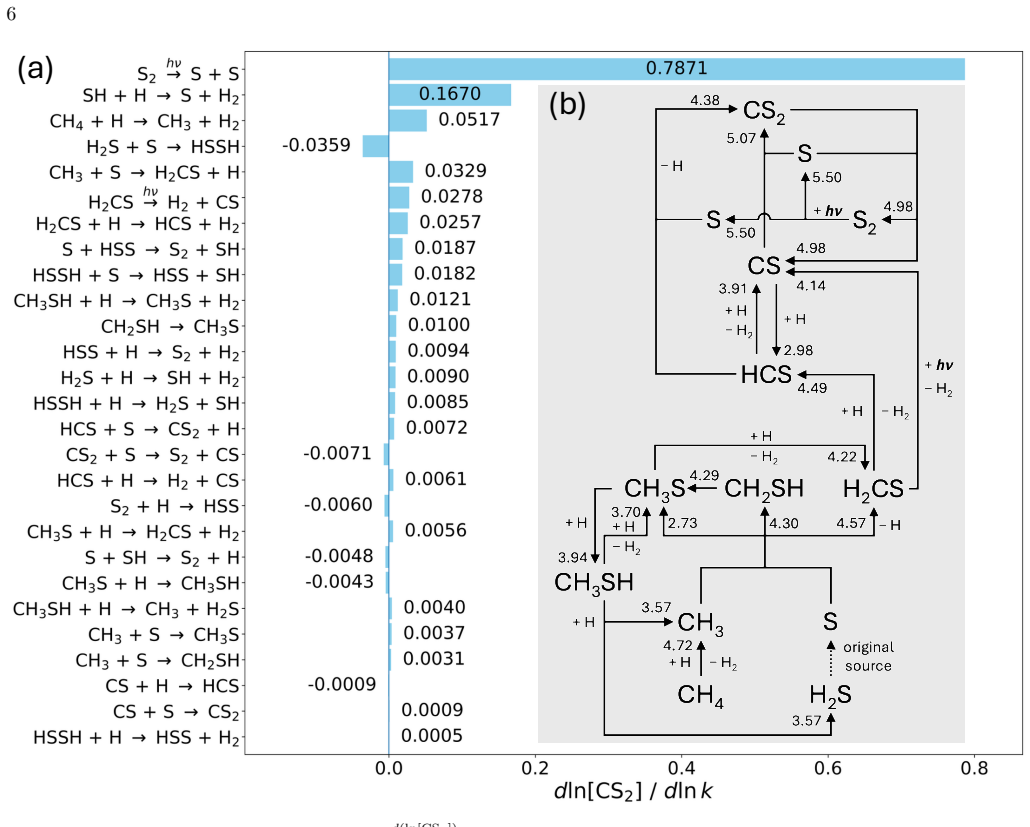
CS2 forms in gas giant atmospheres through coupled thermochemical and photochemical processes from CH4 and H2S, peaking at 500-700 K.
A machine-rendered reading of the paper's core claim, the machinery that carries it, and where it could break.
Core claim
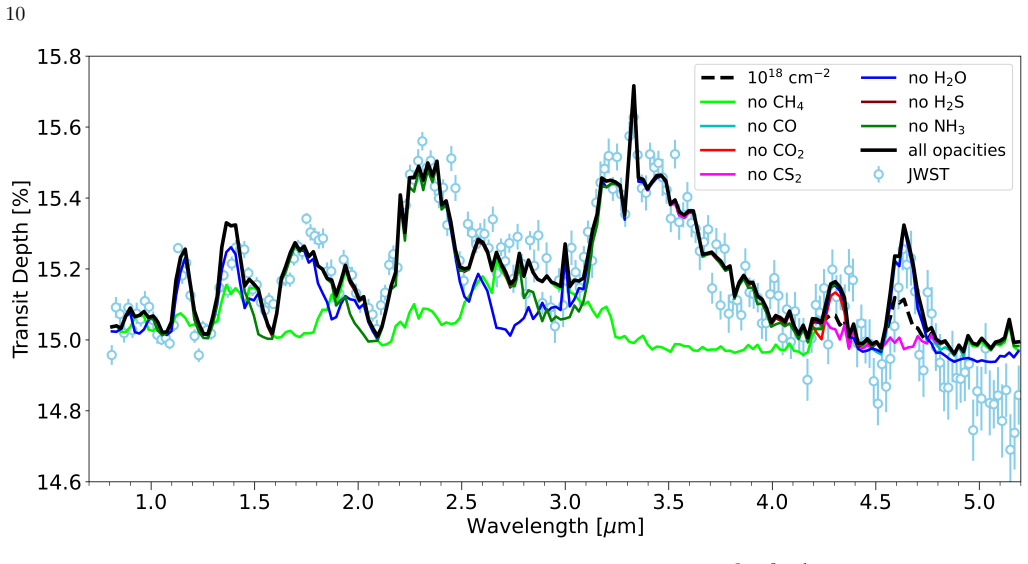
CS2 is produced through coupled thermochemical and photochemical processes involving CH4 and H2S as the primary carbon and sulfur reservoirs, with S2 photolysis driving disequilibrium sulfur chemistry. Models of TOI-6894 b reproduce the observed CS2 feature. Across a range of Teq, CS2 abundance peaks in temperate-to-warm atmospheres at 500-700 K and declines toward both lower and higher temperatures, supplying a unified explanation for current detections and non-detections.
What carries the argument
One-dimensional photochemical kinetic-transport model that couples thermochemistry with photochemistry to follow sulfur species evolution driven by S2 photolysis.
If this is right
- CS2 abundance serves as a complementary probe of sulfur inventories and atmospheric metallicity in cool gas giants.
- The 500-700 K temperature window unifies interpretations of existing CS2 observations across exoplanets.
- The models supply a self-consistent match to the CS2 feature reported in TOI-6894 b.
- CS2 is expected to decline in both colder and hotter giant atmospheres outside the peak range.
Where Pith is reading between the lines
- Targeted JWST observations of additional planets inside the 500-700 K window could test whether the modeled CS2 peak is observed.
- Three-dimensional circulation could shift the vertical profile or total column of CS2 relative to 1D predictions.
- Updated laboratory rate coefficients for key sulfur reactions might move the exact temperature of maximum CS2 abundance.
Load-bearing premise
The 1D model and its reaction network fully represent vertical transport, mixing, and all relevant sulfur reactions without important contributions from 3D dynamics or missing rate coefficients.
What would settle it
A strong CS2 detection in a gas giant with Teq above 1000 K or a clear non-detection in one with Teq near 600 K would contradict the predicted temperature dependence of the abundance peak.
Figures



read the original abstract
Sulfur chemistry has emerged as an important probe of exoplanet atmospheres in the JWST era, although observational constraints have thus far been largely limited to SO2 and H2S in warm and hot exoplanets. Recent JWST observations have revealed CS2 in several cooler gas-giant exoplanets, yielding a new tracer of sulfur chemistry. However, the detailed chemical pathways responsible for the formation of CS2 remain poorly understood. Here, we use TOI-6894 b, a temperate gas giant with evidence for CS2, as a test case for one-dimensional photochemical kinetic-transport modeling and sensitivity analyses of CS2 chemistry. We show that CS2 is produced through coupled thermochemical and photochemical processes involving CH4 and H2S as the primary carbon and sulfur reservoirs, with S2 photolysis driving disequilibrium sulfur chemistry. Our models provide a self-consistent explanation for the observed CS2 feature in TOI-6894 b. Extending our analysis to gas giant exoplanets spanning a wide range of Teq, we find that CS2 abundance peaks in temperate to warm atmospheres (Teq ~ 500 - 700 K), and declines toward both lower and higher temperatures. This temperature dependence provides a unified framework for interpreting current CS2 observations, accounting for reported detections in temperate to warm planets and the lack of detections in colder and hotter giant exoplanets. Our results establish CS2 as a complementary probe of sulfur inventories and atmospheric metallicity in cool gas giant exoplanets
Editorial analysis
A structured set of objections, weighed in public.
Referee Report
Summary. The manuscript presents 1D photochemical kinetic-transport modeling of sulfur chemistry in gas-giant exoplanet atmospheres, using TOI-6894 b as a test case. It claims that CS2 forms via coupled thermochemical and photochemical pathways with CH4 and H2S as primary reservoirs and S2 photolysis as the driver of disequilibrium chemistry; the models yield a self-consistent match to the observed CS2 feature in TOI-6894 b and show that CS2 column abundance peaks at Teq ~500-700 K before declining at both lower and higher temperatures, providing a unified interpretation of current detections and non-detections.
Significance. If robust, the result supplies a temperature-dependent chemical framework that links CS2 observations across the JWST-accessible range of cool-to-warm giants and positions CS2 as a complementary tracer of sulfur inventory and metallicity. The use of sensitivity analyses on the reaction network is a positive feature that strengthens the mechanistic interpretation.
major comments (2)
- [Modeling section (1D photochemical kinetic-transport code and eddy-diffusion profile)] The central claim that CS2 abundance peaks at Teq ~500-700 K and supplies a self-consistent explanation for TOI-6894 b rests on a single 1D photochemical kinetic-transport model. The manuscript provides no quantitative assessment of how 3D dynamical processes (horizontal advection, day-night contrasts) would redistribute CS2 or its precursors and thereby shift the reported temperature window or column densities.
- [Reaction network and sensitivity analyses] The assertion that S2 photolysis drives the disequilibrium sulfur chemistry leading to CS2 depends on the adopted reaction network containing all kinetically important channels. No dedicated sensitivity test or discussion is given for the effect of missing or temperature-dependent rate coefficients at 500-700 K that could alter the CS2 production pathway or the location of the abundance peak.
minor comments (2)
- [Abstract and §1] The abstract and introduction would benefit from a concise statement of the key model assumptions (eddy diffusion profile, T-P structure, metallicity) so readers can immediately gauge the scope of the claimed temperature dependence.
- [Figures showing abundance vs. Teq] Figure captions for the CS2 vs. Teq plots should explicitly state whether the displayed curves include the full range of sensitivity runs or only the fiducial case.
Simulated Author's Rebuttal
We thank the referee for their constructive comments and positive assessment of the work's significance. We address each major comment below, with revisions made where appropriate to strengthen the manuscript.
read point-by-point responses
-
Referee: [Modeling section (1D photochemical kinetic-transport code and eddy-diffusion profile)] The central claim that CS2 abundance peaks at Teq ~500-700 K and supplies a self-consistent explanation for TOI-6894 b rests on a single 1D photochemical kinetic-transport model. The manuscript provides no quantitative assessment of how 3D dynamical processes (horizontal advection, day-night contrasts) would redistribute CS2 or its precursors and thereby shift the reported temperature window or column densities.
Authors: We acknowledge the limitation of the 1D framework for capturing full dynamical redistribution. Our models focus on isolating the vertical chemical pathways and temperature dependence, which are governed by local thermochemical equilibrium and photolysis rates tied to Teq and UV flux. The reported peak arises from this local balance rather than transport. We have added a dedicated discussion paragraph noting that while horizontal advection and day-night contrasts could modulate absolute column densities, they are unlikely to substantially shift the 500-700 K window, as the underlying chemistry remains temperature-driven. A quantitative 3D assessment lies beyond the current scope but is identified as future work. revision: partial
-
Referee: [Reaction network and sensitivity analyses] The assertion that S2 photolysis drives the disequilibrium sulfur chemistry leading to CS2 depends on the adopted reaction network containing all kinetically important channels. No dedicated sensitivity test or discussion is given for the effect of missing or temperature-dependent rate coefficients at 500-700 K that could alter the CS2 production pathway or the location of the abundance peak.
Authors: The original manuscript includes sensitivity analyses on the reaction network. To address this specific concern, we have conducted additional dedicated tests varying key rate coefficients (including S2 photolysis and CH4-H2S related reactions) by factors of 2-10 within the 500-700 K range to bracket uncertainties in temperature-dependent rates. These confirm that S2 photolysis remains the primary driver and that the CS2 abundance peak location is robust. We have expanded the sensitivity section, added a new table summarizing the tests, and updated the text accordingly. revision: yes
Circularity Check
No circularity: results are direct outputs of 1D photochemical modeling
full rationale
The paper's central claims (CS2 formation via CH4/H2S + S2 photolysis, abundance peaking at Teq 500-700 K) are generated by running a standard 1D kinetic-transport code across a grid of Teq values with fixed reaction networks and eddy diffusion profiles. No step reduces a prediction to a fitted input by construction, renames a known result, or relies on a load-bearing self-citation whose validity is internal to the present work. The temperature dependence is an emergent simulation outcome, not a redefinition of inputs.
Axiom & Free-Parameter Ledger
Forward citations
Cited by 1 Pith paper
-
C, N, O, S, and photochemistry in a temperate giant planet orbiting a late M dwarf
Transit spectrum of TOI-6894b indicates 3-10x solar metallicity with solar C/O, N/O, and S/O ratios, similar to Jupiter and Saturn.
Reference graph
Works this paper leans on
-
[1]
Ahrer, E.-M., Stevenson, K. B., Mansfield, M., et al. 2023, Nature, 614, 653, doi: 10.1038/s41586-022-05590-4
-
[2]
R., Alam, M
Alderson, L., Wakeford, H. R., Alam, M. K., et al. 2023, Nature 14
2023
-
[3]
Philosophical Transactions of the Royal Society of London Series A , keywords =
Allard, F., Homeier, D., & Freytag, B. 2012, Philosophical Transactions of the Royal Society A: Mathematical, Physical and Engineering Sciences, 370, 2765, doi: 10.1098/rsta.2011.0269
-
[4]
K., Hofstadter, M
Atreya, S. K., Hofstadter, M. H., In, J. H., et al. 2020, Space Science Reviews, 216, 18
2020
-
[5]
2025, The Astronomical Journal, 170, 165
Barat, S., D´ esert, J.-M., Mukherjee, S., et al. 2025, The Astronomical Journal, 170, 165
2025
-
[6]
J., Welbanks, L., Schlawin, E., et al
Bell, T. J., Welbanks, L., Schlawin, E., et al. 2023, Nature, 623, 709
2023
-
[7]
2026, The Astronomical Journal, 171, 354, doi: 10.3847/1538-3881/ae4fba
Bello-Arufe, A., Hu, R., Zilinskas, M., et al. 2026, The Astronomical Journal, 171, 354, doi: 10.3847/1538-3881/ae4fba
-
[8]
Benneke, B., Roy, P.-A., Coulombe, L.-P., et al. 2024, JWST Reveals CH 4, CO2, and H 2O in a Metal-rich Miscible Atmosphere on a Two-Earth-Radius Exoplanet, https://arxiv.org/abs/2403.03325
arXiv 2024
-
[9]
Bjoraker, G. L., Larson, H. P., & Kunde, V. G. 1986, Icarus, 66, 579, doi: https://doi.org/10.1016/0019-1035(86)90093-X
-
[10]
M., Jord´ an, A., Hartman, J
Bryant, E. M., Jord´ an, A., Hartman, J. D., et al. 2025, Nature Astronomy, 9, 1031
2025
-
[11]
C., & Kasting, J
Catling, D. C., & Kasting, J. F. 2017, Atmospheric evolution on inhabited and lifeless worlds (Cambridge University Press)
2017
-
[12]
Crossfield, I. J. M. 2023, The Astrophysical Journal Letters, 952, L18, doi: 10.3847/2041-8213/ace35f
-
[13]
Crossfield, I. J. M., Ahrer, E.-M., Brande, J., et al. 2025, The Astrophysical Journal, 994, 184, doi: 10.3847/1538-4357/ae17cb
-
[14]
2026, Photochemical CS2 Gas Detected on a 20-Myr-old Exoplanet, https://arxiv.org/abs/2606.00974
Dai, F., Petigura, E., Livingston, J., et al. 2026, Photochemical CS2 Gas Detected on a 20-Myr-old Exoplanet, https://arxiv.org/abs/2606.00974
Pith/arXiv arXiv 2026
-
[15]
David, T. J., Petigura, E. A., Luger, R., et al. 2019a, The Astrophysical Journal Letters, 885, L12, doi: 10.3847/2041-8213/ab4c99
-
[16]
2023, The Journal of Physical Chemistry A, 127, 3231, doi: 10.1021/acs.jpca.2c07545
Dong, X., Pio, G., Arafin, F., et al. 2023, The Journal of Physical Chemistry A, 127, 3231, doi: 10.1021/acs.jpca.2c07545
-
[17]
2024, Nature, 625, 51
Dyrek, A., Min, M., Decin, L., et al. 2024, Nature, 625, 51
2024
-
[18]
Fortney, J. J., Visscher, C., Marley, M. S., et al. 2020, The Astronomical Journal, 160, 288, doi: 10.3847/1538-3881/abc5bd
-
[19]
2024, Nature, 632, 752, doi: 10.1038/s41586-024-07760-y
Fu, G., Welbanks, L., Deming, D., et al. 2024, Nature, 632, 752, doi: 10.1038/s41586-024-07760-y
-
[20]
Gao, C. W., Allen, J. W., Green, W. H., & West, R. H. 2016, Comput. Phys. Commun., 203, 212, doi: 10.1016/j.cpc.2016.02.013
-
[21]
Gordon, I., Rothman, L., Hargreaves, R., et al. 2026, Journal of Quantitative Spectroscopy and Radiative Transfer, 353, 109807, doi: https://doi.org/10.1016/j.jqsrt.2026.109807
-
[22]
1996, The Journal of chemical physics, 104, 848
Green, M., & Western, C. 1996, The Journal of chemical physics, 104, 848
1996
-
[23]
1997, Journal of the Chemical
Green, M., & Western, C. 1997, Journal of the Chemical
1997
-
[24]
Society, Faraday Transactions, 93, 365 Green Jr, W. H. 2007, Advances in Chemical Engineering, 32, 1
2007
-
[25]
Holland, H. D. 2020, The chemical evolution of the atmosphere and oceans (Princeton University Press)
2020
-
[26]
2023, Astronomy & Astrophysics, 675, A25
Hrodmarsson, H., & Van Dishoeck, E. 2023, Astronomy & Astrophysics, 675, A25
2023
-
[27]
Hull, A. W. 2020, PhD thesis, Massachusetts Institute of Technology
2020
-
[28]
S., Dong, X., Grinberg Dana, A., et al
Johnson, M. S., Dong, X., Grinberg Dana, A., et al. 2022, Journal of Chemical Information and Modeling, 62, 4906, doi: 10.1021/acs.jcim.2c00965 JWST Early Release Science Team, Ahrer, E.-M.,
-
[29]
2023, Nature, 614, 649, doi: 10.1038/s41586-022-05269-w
Alderson, L., et al. 2023, Nature, 614, 649, doi: 10.1038/s41586-022-05269-w
-
[30]
M.-R., Bean, J
Kempton, E. M.-R., Bean, J. L., Louie, D. R., et al. 2018, Publications of the Astronomical Society of the Pacific, 130, 114401 Kohse-H¨ oinghaus, K. 2021, Proceedings of the Combustion Institute, 38, 1
2018
-
[31]
H., Smith, M
Li, L., Baines, K. H., Smith, M. A., et al. 2012, Journal of Geophysical Research: Planets, 117
2012
-
[32]
Liu, M., Chu, T.-C., Jocher, A., et al. 2020, Int. J. Chem. Kinet., 53, 27, doi: 10.1002/kin.21421
-
[33]
Liu, M., Grinberg Dana, A., Johnson, M. S., et al. 2021, Journal of Chemical Information and Modeling, 61, 2686, doi: 10.1021/acs.jcim.0c01480
-
[34]
H., Petigura, E
Livingston, J. H., Petigura, E. A., David, T. J., et al. 2026, Nature, 649, 310
2026
-
[35]
Lodders, K. 2020, Solar elemental abundances (Oxford Research Encyclopedia of Planetary Science), doi: 10.1093/acrefore/9780190647926.013.145
-
[36]
Loyd, R. O. P., France, K., Youngblood, A., et al. 2016, ApJ, 824, 102, doi: 10.3847/0004-637X/824/2/102
-
[37]
2018, Astronomy & Astrophysics, 613, A41
Mancini, L., Esposito, M., Covino, E., et al. 2018, Astronomy & Astrophysics, 613, A41
2018
-
[38]
E., Morley, C
Mang, J., Batalha, N. E., Morley, C. V., et al. 2026, The Astrophysical Journal, 1000, 98
2026
-
[39]
A., Sivaramakrishnan, R., Tao, Y., et al
Miller, J. A., Sivaramakrishnan, R., Tao, Y., et al. 2021, Progress in Energy and Combustion Science, 83, 100886
2021
-
[40]
C., Mustill, A., Ribas, I., et al
Morales, J. C., Mustill, A., Ribas, I., et al. 2019, Science, 365, 1441 15
2019
-
[41]
2024, in 56th Annual Meeting of the Division for Planetary Sciences, Vol
Moses, J., Tsai, S.-M., Fortney, J., et al. 2024, in 56th Annual Meeting of the Division for Planetary Sciences, Vol. 56, 308–06
2024
-
[42]
Moses, J. I. 2014, Philosophical Transactions of the Royal Society A: Mathematical, Physical and Engineering Sciences, 372
2014
-
[43]
Moses, J. I., Visscher, C., Fortney, J. J., et al. 2011, ApJ, 737, doi: https://doi.org/10.1088/0004-637X/737/1/15
-
[44]
Mukherjee, S., Batalha, N. E., Fortney, J. J., & Marley, M. S. 2023, ApJ, 942, 71, doi: 10.3847/1538-4357/ac9f48
-
[45]
2025, The Astrophysical Journal, 985, 209
Ohno, K. 2025, The Astrophysical Journal, 985, 209
2025
-
[46]
2022, The Astrophysical Journal, 937, 36
Pacetti, E., Turrini, D., Schisano, E., et al. 2022, The Astrophysical Journal, 937, 36
2022
-
[47]
K., & Humphreys, C
Plyler, E. K., & Humphreys, C. 1947, J. Res. Natl. Bur. Stand., 39, 59
1947
-
[48]
Powell, D., Feinstein, A. D., Lee, E. K., et al. 2024, Nature, 626, 979, doi: 10.1038/s41586-024-07040-9
-
[49]
Rustamkulov, Z., Sing, D. K., Mukherjee, S., et al. 2023, Nature, 614, 659, doi: 10.1038/s41586-022-05677-y
-
[50]
2022, Chemical Engineering Journal, 446, 136723, doi: https://doi.org/10.1016/j.cej.2022.136723
Stagni, A., Arunthanayothin, S., Pratali Maffei, L., et al. 2022, Chemical Engineering Journal, 446, 136723, doi: https://doi.org/10.1016/j.cej.2022.136723
-
[51]
2018, The Journal of chemical physics, 148 Su´ arez Mascare˜ no, A., Damasso, M., Lodieu, N., et al
Stark, G., Herde, H., Lyons, J., et al. 2018, The Journal of chemical physics, 148 Su´ arez Mascare˜ no, A., Damasso, M., Lodieu, N., et al. 2022, Nature Astronomy, 6, 232
2018
-
[52]
Triantafillides, A., Beatty, T. G., Nixon, M. C., et al. 2026, arXiv preprint arXiv:2604.13168
Pith/arXiv arXiv 2026
-
[53]
H., Gillon, M., Ehrenreich, D., et al
Triaud, A. H., Gillon, M., Ehrenreich, D., et al. 2015, Monthly Notices of the Royal Astronomical Society, 450, 2279
2015
-
[54]
2025, SNCHO photo network 2025.txt,, https://github.com/shami-EEG/VULCAN/blob/master/ thermo/SNCHO photo network 2025.txt
Tsai, S.-M. 2025, SNCHO photo network 2025.txt,, https://github.com/shami-EEG/VULCAN/blob/master/ thermo/SNCHO photo network 2025.txt
2025
-
[55]
Tsai, S.-M., Lyons, J. R., Grosheintz, L., et al. 2017, Astrophys. J. Suppl. Ser., 228, doi: 10.3847/1538-4365/228/2/20
-
[56]
2021, ApJ, 923, 264, doi: 10.3847/1538-4357/ac29bc
Tsai, S.-M., Malik, M., Kitzmann, D., et al. 2021, ApJ, 923, 264, doi: 10.3847/1538-4357/ac29bc
-
[57]
Tsai, S.-M., Lee, E. K. H., Powell, D., et al. 2023, Nature, 617, 483, doi: 10.1038/s41586-023-05902-2
-
[58]
2021, The Astrophysical Journal, 909, 40
Turrini, D., Schisano, E., Fonte, S., et al. 2021, The Astrophysical Journal, 909, 40
2021
-
[59]
2026, A&A, 706, A260, doi: 10.1051/0004-6361/202555595
Veillet, R., Venot, O., Sirjean, B., et al. 2026, A&A, 706, A260, doi: 10.1051/0004-6361/202555595
-
[60]
Welbanks, L., Bell, T. J., Beatty, T. G., et al. 2024, Nature, 630, 836, doi: https://doi.org/10.1038/s41586-024-07514-w
-
[61]
F., Batalha, N
Wogan, N. F., Batalha, N. E., Zahnle, K., et al. 2025, The Planetary Science Journal, 6, 256
2025
-
[62]
W., Ruffio, J.-B., Chachan, Y., et al
Xuan, J. W., Ruffio, J.-B., Chachan, Y., et al. 2026, The Astrophysical Journal, 1000, 27
2026
-
[63]
2024b, The Astrophysical Journal Letters, 971, L48, doi: 10.3847/2041-8213/ad6b25
Yang, J., & Hu, R. 2024a, The Astrophysical Journal Letters, 971, L48, doi: 10.3847/2041-8213/ad6b25
-
[64]
2024a, The Astrophysical Journal, 966, 189, doi: 10.3847/1538-4357/ad35c8 17
Yang, J., & Hu, R. 2024b, The Astrophysical Journal, 966, 189, doi: 10.3847/1538-4357/ad35c8
-
[65]
Yang, J., Hyder, A., Hu, R., & Lunine, J. I. 2026, The Planetary Science Journal, 7, 2, doi: 10.3847/PSJ/ae28d5
-
[66]
Fortney, J. J. 2009, The Astrophysical Journal, 701, L20, doi: 10.1088/0004-637X/701/1/L20
-
[67]
Zhang, M., Chachan, Y., Kempton, E. M.-R., & Knutson, H. A. 2019, Publications of the Astronomical Society of the Pacific, 131, 034501, doi: 10.1088/1538-3873/aaf5ad
-
[68]
Zhang, M., Paragas, K., Bean, J. L., et al. 2024, The Astronomical Journal, 169, 38, doi: 10.3847/1538-3881/ad8cd2
discussion (0)
Sign in with ORCID, Apple, or X to comment. Anyone can read and Pith papers without signing in.