Wavelet Matrix Product States for Quantum Fields
Pith reviewed 2026-06-26 07:48 UTC · model grok-4.3
The pith
Wavelet matrix product states built on Daubechies scaling functions let standard tensor network algorithms optimize states for interacting continuum quantum field theories.
A machine-rendered reading of the paper's core claim, the machinery that carries it, and where it could break.
Core claim
Wavelet matrix product states (wMPS) are matrix product states constructed on top of Daubechies scaling functions with N at least 6. These states live directly in the continuum field theory Fock space, possess finite energy density, and can be variationally optimized with standard algorithms without restriction to free theories. The multi-resolution analysis inherent to wavelets supplies a quantum-circuit description that permits iterative refinement to arbitrarily fine length scales.
What carries the argument
The wavelet matrix product state (wMPS), formed by placing a matrix product state on Daubechies scaling functions of sufficient regularity, which embeds the discrete tensor network into continuum Fock space while preserving finite energy.
If this is right
- Standard matrix product state algorithms can be applied directly to interacting continuum models.
- Energy density and correlation functions become accessible for the Lieb-Liniger model without discretization artifacts.
- The same variational state can be refined iteratively to finer scales using the wavelet multi-resolution structure.
- The approach works for both free and interacting theories.
Where Pith is reading between the lines
- The construction may allow tensor-network studies of other one-dimensional continuum models whose critical behavior is sensitive to the ultraviolet cutoff.
- Because the states remain in the continuum Fock space, the same ansatz could be compared directly with field-theoretic renormalization-group flows.
- The quantum-circuit description of the multi-resolution step suggests a route to hybrid classical-quantum refinement protocols.
Load-bearing premise
Daubechies scaling functions with N at least 6 are regular enough that the resulting states have finite energy density when they represent interacting continuum fields.
What would settle it
An explicit computation in which the energy density of an optimized wMPS for the Lieb-Liniger model diverges or fails to converge under standard algorithms would falsify the central claim.
Figures




read the original abstract
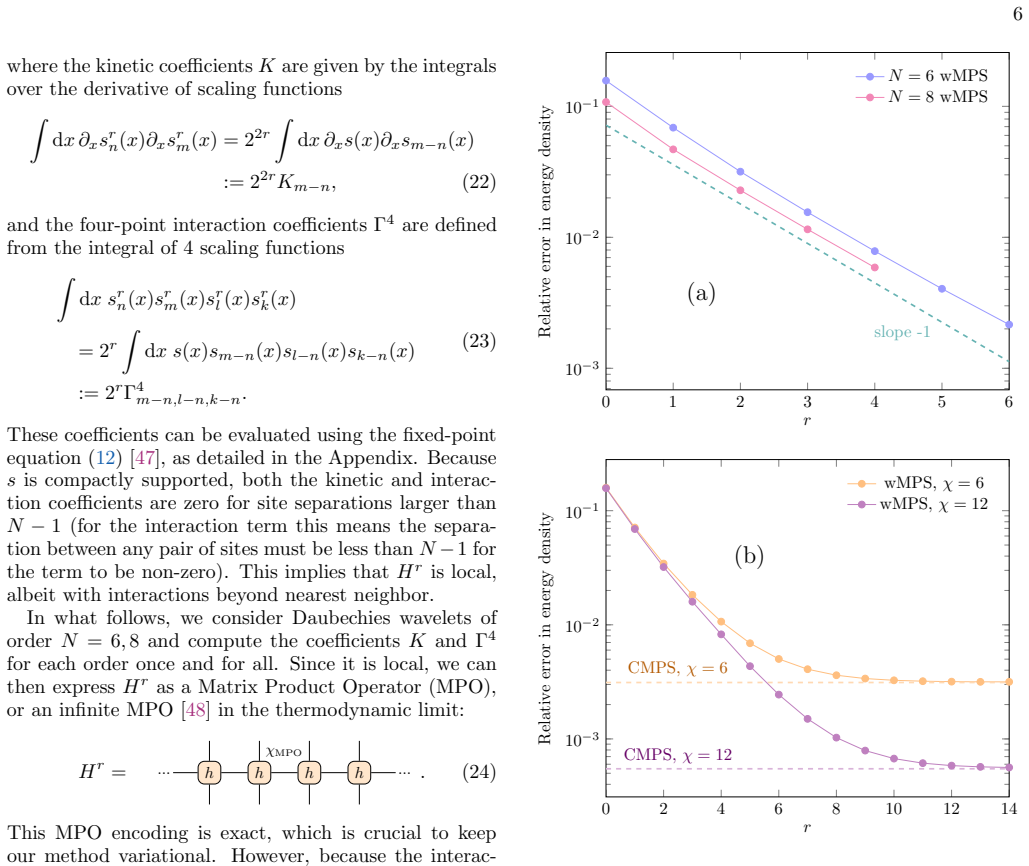
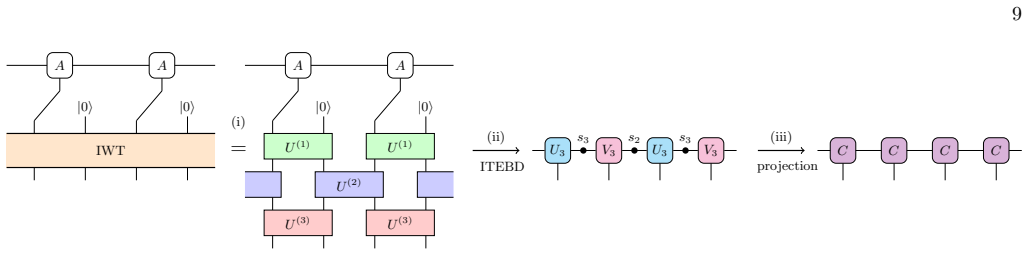
We introduce a variational method to solve continuum quantum models with discrete tensor network techniques. The method leverages wavelet matrix product states (wMPS): matrix product states built on top of sufficiently regular ($N\geq 6$) Daubechies scaling functions. These states live in the continuum field theory Fock space, have finite energy density, and can be optimized with standard algorithms, without restriction to free theories. Further, exploiting the multi-resolution analysis built into wavelets, and its quantum circuit description, we can iteratively refine wMPS to obtain accurate approximations at arbitrarily fine length-scales. We showcase the efficiency of the method on the Lieb-Liniger model, computing energy density and correlation functions.
Editorial analysis
A structured set of objections, weighed in public.
Referee Report
Summary. The paper introduces wavelet matrix product states (wMPS) as a variational ansatz for continuum quantum field theories. These are MPS constructed on Daubechies scaling functions with regularity order N≥6; the states are asserted to lie in the continuum Fock space, possess finite energy density even for interacting Hamiltonians, admit optimization by standard discrete MPS algorithms without restriction to free theories, and support iterative multi-resolution refinement via the wavelet quantum circuit structure. The method is demonstrated on the Lieb-Liniger model by computing energy density and correlation functions.
Significance. If the finite-energy-density claim for interacting models is rigorously established, the construction would provide a concrete bridge between discrete tensor-network algorithms and continuum QFT, enabling controlled variational calculations at arbitrary resolution without ad-hoc cutoffs. The use of a standard benchmark (Lieb-Liniger) and the built-in multi-resolution property are concrete strengths that would be of interest to the tensor-network and quantum-simulation communities.
major comments (2)
- [§3] §3 (or the section deriving finite energy density): the Sobolev regularity index for N=6 Daubechies scaling functions is only marginally above 1, which bounds the kinetic term but does not automatically guarantee that the interaction term (e.g., the delta-function contact interaction in Lieb-Liniger) remains finite when the variational parameters are optimized over the discrete MPS manifold. An explicit domain-of-Hamiltonian argument or UV convergence bound for the full interacting operator is required to close this gap.
- [§4] §4 (Lieb-Liniger application): the quantitative accuracy claims for energy density and correlations rest on the premise that the wMPS manifold is dense enough in the interacting continuum Hilbert space; without a convergence theorem or explicit error bound relating bond dimension, wavelet order N, and resolution level to the continuum limit, it is unclear whether the reported results are controlled or merely consistent with known values.
minor comments (2)
- Notation for the wavelet basis and the embedding into Fock space should be made fully explicit (e.g., the precise definition of the scaling-function coefficients and their relation to the field operators).
- Figure captions and axis labels in the Lieb-Liniger plots would benefit from explicit mention of the wavelet order N and bond dimension used for each data point.
Simulated Author's Rebuttal
We thank the referee for the careful reading and constructive feedback. The comments highlight important points regarding rigor in the finite-energy claim and the controlled nature of the numerical results. We address each major comment below and indicate planned revisions.
read point-by-point responses
-
Referee: [§3] §3 (or the section deriving finite energy density): the Sobolev regularity index for N=6 Daubechies scaling functions is only marginally above 1, which bounds the kinetic term but does not automatically guarantee that the interaction term (e.g., the delta-function contact interaction in Lieb-Liniger) remains finite when the variational parameters are optimized over the discrete MPS manifold. An explicit domain-of-Hamiltonian argument or UV convergence bound for the full interacting operator is required to close this gap.
Authors: The manuscript grounds the finite-energy-density claim in the Sobolev regularity (H^s with s>1) of N≥6 Daubechies scaling functions, which places the wMPS in the domain of the kinetic operator. For the 1D delta-function interaction, the local regularity and compact support of the scaling functions ensure that the quadratic form remains finite; the interaction is a relatively mild perturbation in one dimension. We agree that an expanded discussion would strengthen the presentation and will add an explicit paragraph in the revised §3 deriving the domain of the full Hamiltonian, citing standard results on 1D delta interactions in Sobolev spaces. This clarification does not alter the core construction but makes the argument more self-contained. revision: yes
-
Referee: [§4] §4 (Lieb-Liniger application): the quantitative accuracy claims for energy density and correlations rest on the premise that the wMPS manifold is dense enough in the interacting continuum Hilbert space; without a convergence theorem or explicit error bound relating bond dimension, wavelet order N, and resolution level to the continuum limit, it is unclear whether the reported results are controlled or merely consistent with known values.
Authors: Section 4 presents numerical benchmarks on the Lieb-Liniger model to demonstrate that standard MPS algorithms can be applied directly to an interacting continuum theory and that the multi-resolution structure permits iterative refinement. The manuscript does not assert a rigorous density or convergence theorem; such a result would constitute a separate mathematical contribution. The reported agreement with known values is therefore consistency evidence rather than a controlled error analysis. We will revise the text in §4 and the conclusions to state this distinction more explicitly and to emphasize that practical convergence can be assessed by increasing resolution level and bond dimension, as enabled by the wavelet circuit. No new theorem will be added. revision: partial
Circularity Check
No significant circularity detected in derivation chain
full rationale
The paper introduces wMPS as a variational ansatz on Daubechies scaling functions (N≥6) and applies standard MPS optimization plus multi-resolution refinement to the Lieb-Liniger model. No quoted step reduces a central claim to a self-referential definition, a fitted parameter renamed as a prediction, or a load-bearing self-citation chain. The finite-energy-density statement is presented as following from the regularity premise rather than being derived circularly from the method itself; the benchmark application uses an independent external model. This is the normal case of a self-contained new ansatz with external validation.
Axiom & Free-Parameter Ledger
free parameters (2)
- wavelet regularity order N
- MPS bond dimension
axioms (1)
- domain assumption Daubechies scaling functions of order N>=6 possess sufficient smoothness and vanishing moments to represent continuum field configurations with finite energy density.
invented entities (1)
-
wavelet matrix product state (wMPS)
no independent evidence
Reference graph
Works this paper leans on
-
[1]
This switch method is standard, and typically motivated by the fact that it is faster for certain benchmark models [52]
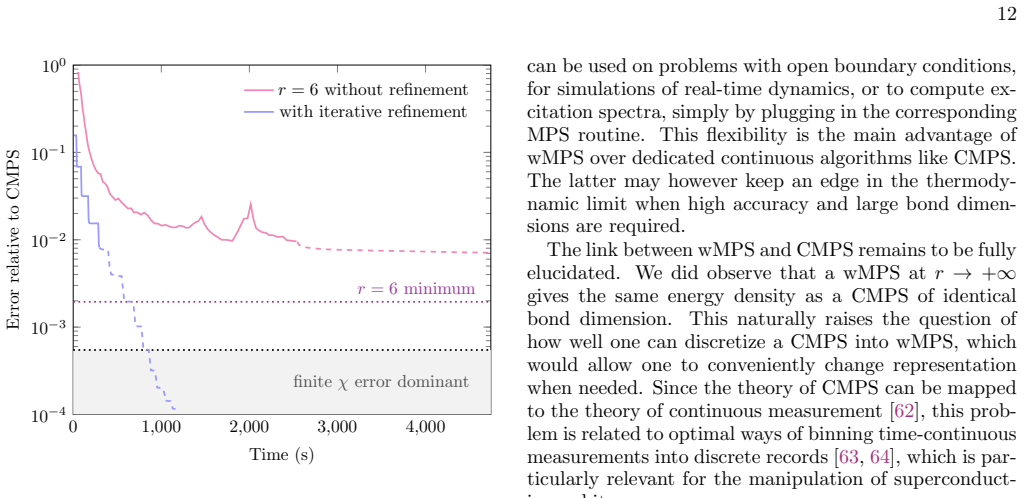
as the state nears convergence. This switch method is standard, and typically motivated by the fact that it is faster for certain benchmark models [52]. In our case, the primary motivation is that VUMPS, though fast, be- comes unstable at high resolutions when nearing conver- gence. Forr≥6, energy minimization becomes difficult 0 1 2 3 4 5 6 10−3 10−2 10−...
2020
-
[2]
S. R. White, Density matrix formulation for quantum renormalization groups, Phys. Rev. Lett.69, 2863 (1992)
1992
-
[3]
S. R. White, Density-matrix algorithms for quantum renormalization groups, Phys. Rev. B48, 10345 (1993)
1993
-
[4]
Fannes, B
M. Fannes, B. Nachtergaele, and R. F. Werner, Finitely correlated states on quantum spin chains, Communica- tions in Mathematical Physics144, 443–490 (1992)
1992
-
[5]
Schollw¨ ock, The density-matrix renormalization group in the age of matrix product states, Annals of Physics 326, 96 (2011), january 2011 Special Issue
U. Schollw¨ ock, The density-matrix renormalization group in the age of matrix product states, Annals of Physics 326, 96 (2011), january 2011 Special Issue
2011
-
[6]
J. I. Cirac, D. P´ erez-Garc´ ıa, N. Schuch, and F. Ver- straete, Matrix product states and projected entangled pair states: Concepts, symmetries, theorems, Rev. Mod. Phys.93, 045003 (2021)
2021
-
[7]
Or´ us, A practical introduction to tensor networks: Matrix product states and projected entangled pair states, Annals of Physics349, 117 (2014)
R. Or´ us, A practical introduction to tensor networks: Matrix product states and projected entangled pair states, Annals of Physics349, 117 (2014)
2014
-
[8]
F. Verstraete and J. I. Cirac, Renormalization al- gorithms for quantum-many body systems in two and higher dimensions (2004), arXiv:cond-mat/0407066 [cond-mat.str-el]
Pith/arXiv arXiv 2004
-
[9]
Corboz, Variational optimization with infinite pro- jected entangled-pair states, Phys
P. Corboz, Variational optimization with infinite pro- jected entangled-pair states, Phys. Rev. B94, 035133 (2016)
2016
-
[10]
Vanderstraeten, J
L. Vanderstraeten, J. Haegeman, P. Corboz, and F. Ver- straete, Gradient methods for variational optimization of projected entangled-pair states, Phys. Rev. B94, 155123 (2016)
2016
-
[11]
Zheng, C.-M
B.-X. Zheng, C.-M. Chung, P. Corboz, G. Ehlers, M.-P. Qin, R. M. Noack, H. Shi, S. R. White, S. Zhang, and G. K.-L. Chan, Stripe order in the underdoped region of the two-dimensional hubbard model, Science358, 1155 (2017)
2017
-
[12]
Liao, J.-G
H.-J. Liao, J.-G. Liu, L. Wang, and T. Xiang, Differ- entiable programming tensor networks, Phys. Rev. X9, 031041 (2019)
2019
-
[13]
Haghshenas, Z.-H
R. Haghshenas, Z.-H. Cui, and G. K.-L. Chan, Numerical continuum tensor networks in two dimensions, Phys. Rev. Res.3, 023057 (2021)
2021
-
[14]
Milsted, J
A. Milsted, J. Haegeman, and T. J. Osborne, Matrix product states and variational methods applied to critical quantum field theory, Phys. Rev. D88, 085030 (2013)
2013
-
[15]
M. C. Ba˜ nuls, K. Cichy, J. I. Cirac, and K. Jansen, The mass spectrum of the schwinger model with matrix prod- uct states, Journal of High Energy Physics2013, 158 (2013)
2013
-
[16]
Dempsey, A.-M
R. Dempsey, A.-M. E. Gl¨ uck, S. S. Pufu, and B. T. Søgaard, Infinite matrix product states for (1 + 1)- dimensional gauge theories, Journal of High Energy Physics2026, 181 (2026)
2026
-
[17]
F. Verstraete and J. I. Cirac, Continuous matrix product states for quantum fields, Physical Review Letters104, 10.1103/physrevlett.104.190405 (2010)
-
[18]
Haegeman, J
J. Haegeman, J. I. Cirac, T. J. Osborne, and F. Ver- straete, Calculus of continuous matrix product states, Phys. Rev. B88, 085118 (2013)
2013
-
[19]
Ganahl, J
M. Ganahl, J. Rinc´ on, and G. Vidal, Continuous matrix product states for quantum fields: An energy minimiza- tion algorithm, Phys. Rev. Lett.118, 220402 (2017)
2017
-
[20]
Tilloy, Variational method in relativistic quantum field theory without cutoff, Phys
A. Tilloy, Variational method in relativistic quantum field theory without cutoff, Phys. Rev. D104, L091904 (2021)
2021
-
[21]
Tilloy, Relativistic continuous matrix product states for quantum fields without cutoff, Phys
A. Tilloy, Relativistic continuous matrix product states for quantum fields without cutoff, Phys. Rev. D104, 096007 (2021)
2021
-
[22]
Jennings, C
D. Jennings, C. Brockt, J. Haegeman, T. J. Osborne, and F. Verstraete, Continuum tensor network field states, path integral representations and spatial symmetries, New Journal of Physics17, 063039 (2015)
2015
-
[23]
Tilloy and J
A. Tilloy and J. I. Cirac, Continuous tensor network states for quantum fields, Phys. Rev. X9, 021040 (2019)
2019
-
[24]
Daubechies, Orthonormal bases of compactly sup- ported wavelets, Communications on Pure and Applied Mathematics41, 909 (1988)
I. Daubechies, Orthonormal bases of compactly sup- ported wavelets, Communications on Pure and Applied Mathematics41, 909 (1988)
1988
-
[25]
Daubechies,Ten Lectures on Wavelets(Society for In- dustrial and Applied Mathematics, 1992)
I. Daubechies,Ten Lectures on Wavelets(Society for In- dustrial and Applied Mathematics, 1992)
1992
-
[26]
Vidal, Entanglement renormalization, Phys
G. Vidal, Entanglement renormalization, Phys. Rev. Lett.99, 220405 (2007)
2007
-
[27]
Evenbly and G
G. Evenbly and G. Vidal, Algorithms for entanglement renormalization: Boundaries, impurities and interfaces, Journal of Statistical Physics157, 931–978 (2014)
2014
-
[28]
Evenbly and S
G. Evenbly and S. R. White, Entanglement renormaliza- tion and wavelets, Phys. Rev. Lett.116, 140403 (2016)
2016
-
[29]
Haegeman, B
J. Haegeman, B. Swingle, M. Walter, J. Cotler, G. Even- bly, and V. B. Scholz, Rigorous free-fermion entangle- ment renormalization from wavelet theory, Phys. Rev. X 8, 011003 (2018)
2018
-
[30]
Evenbly and S
G. Evenbly and S. R. White, Representation and de- sign of wavelets using unitary circuits, Phys. Rev. A97, 052314 (2018)
2018
-
[31]
Witteveen, V
F. Witteveen, V. Scholz, B. Swingle, and M. Wal- ter, Quantum circuit approximations and entanglement renormalization for the dirac field in 1+1 dimensions, Communications in Mathematical Physics389, 75–120 (2022)
2022
-
[32]
Witteveen and M
F. Witteveen and M. Walter, Bosonic entanglement renormalization circuits from wavelet theory, SciPost Phys.10, 143 (2021)
2021
-
[33]
Swingle, Entanglement renormalization and hologra- phy, Phys
B. Swingle, Entanglement renormalization and hologra- phy, Phys. Rev. D86, 065007 (2012)
2012
-
[34]
Qi, Exact holographic mapping and emergent space-time geometry (2013), arXiv:1309.6282 [hep-th]
X.-L. Qi, Exact holographic mapping and emergent space-time geometry (2013), arXiv:1309.6282 [hep-th]
Pith/arXiv arXiv 2013
-
[35]
S. Singh and G. K. Brennen, Holographic construc- tion of quantum field theory using wavelets (2016), arXiv:1606.05068 [quant-ph]
Pith/arXiv arXiv 2016
-
[36]
Bulut and W
F. Bulut and W. N. Polyzou, Wavelets in field theory, Phys. Rev. D87, 116011 (2013)
2013
-
[37]
G. K. Brennen, P. Rohde, B. C. Sanders, and S. Singh, Multiscale quantum simulation of quantum field theory using wavelets, Phys. Rev. A92, 032315 (2015)
2015
-
[38]
D. S. M. Alves, Entanglement renormalization for quan- tum field theories with discrete wavelet transforms, Jour- nal of High Energy Physics2024, 81 (2024)
2024
-
[39]
M. Basak, D. Chakraborty, N. Mathur, and R. Ratabole, 14 Hamiltonian formulation of the 1 + 1-dimensionalϕ 4 theory in a momentum-space daubechies wavelet basis (2026), arXiv:2601.18449 [hep-th]
Pith/arXiv arXiv 2026
-
[40]
M. Basak, A novel hamiltonian formulation of 1 + 1 di- mensionalϕ 4 theory in daubechies wavelet basis: momen- tum space analysis (2026), arXiv:2601.22953 [hep-th]
arXiv 2026
-
[41]
Dutta, A
S. Dutta, A. Buyskikh, A. J. Daley, and E. J. Mueller, Density matrix renormalization group for continuous quantum systems, Phys. Rev. Lett.128, 230401 (2022)
2022
-
[42]
A. Shankar, K. V. Acoleyen, and J. Haegeman, Finite- element matrix product states for continuum models in one dimension (2026), arXiv:2606.14873 [quant-ph]
arXiv 2026
-
[43]
P. Schmoll, J. Naumann, A. Nietner, J. Eisert, and S. Sotiriadis, Hamiltonian truncation tensor networks for quantum field theories (2023), arXiv:2312.12506 [quant- ph]
arXiv 2023
-
[44]
Mallat,A Wavelet Tour of Signal Processing: The Sparse Way, 3rd ed
S. Mallat,A Wavelet Tour of Signal Processing: The Sparse Way, 3rd ed. (Academic Press, Burlington, MA, 2009)
2009
-
[45]
Daubechies and J
I. Daubechies and J. C. Lagarias, Two-scale difference equations. i. existence and global regularity of solutions, SIAM Journal on Mathematical Analysis22, 1388–1410 (1991)
1991
-
[46]
Daubechies and J
I. Daubechies and J. C. Lagarias, Two-scale difference equations ii. local regularity, infinite products of matrices and fractals, SIAM Journal on Mathematical Analysis 23, 1031–1079 (1992)
1992
-
[47]
J. C. Bridgeman and C. T. Chubb, Hand-waving and in- terpretive dance: an introductory course on tensor net- works, Journal of Physics A: Mathematical and Theoret- ical50, 223001 (2017)
2017
-
[48]
W. N. Polyzou, Wavelet representation of light-front quantum field theory, Phys. Rev. D101, 096004 (2020)
2020
-
[49]
D. E. Parker, X. Cao, and M. P. Zaletel, Local matrix product operators: Canonical form, compression, and control theory, Phys. Rev. B102, 035147 (2020)
2020
-
[50]
Devos, M
L. Devos, M. Van Damme, and J. Haegeman, MPSKit (2026)
2026
-
[51]
Zauner-Stauber, L
V. Zauner-Stauber, L. Vanderstraeten, M. T. Fishman, F. Verstraete, and J. Haegeman, Variational optimization algorithms for uniform matrix product states, Phys. Rev. B97, 045145 (2018)
2018
-
[52]
Vanderstraeten, J
L. Vanderstraeten, J. Haegeman, and F. Verstraete, Tangent-space methods for uniform matrix product states, SciPost Phys. Lect. Notes , 7 (2019)
2019
-
[53]
Hauru, M
M. Hauru, M. V. Damme, and J. Haegeman, Riemannian optimization of isometric tensor networks, SciPost Phys. 10, 040 (2021)
2021
-
[54]
G. Lang, F. Hekking, and A. Minguzzi, Ground-state en- ergy and excitation spectrum of the Lieb-Liniger model : accurate analytical results and conjectures about the exact solution, SciPost Phys.3, 003 (2017)
2017
-
[55]
Ristivojevic, Conjectures about the ground-state en- ergy of the lieb-liniger model at weak repulsion, Phys
Z. Ristivojevic, Conjectures about the ground-state en- ergy of the lieb-liniger model at weak repulsion, Phys. Rev. B100, 081110 (2019)
2019
-
[56]
Tuybens, J
B. Tuybens, J. De Nardis, J. Haegeman, and F. Ver- straete, Variational optimization of continuous matrix product states, Phys. Rev. Lett.128, 020501 (2022)
2022
-
[57]
S. R. White, Density matrix renormalization group algo- rithms with a single center site, Phys. Rev. B72, 180403 (2005), arXiv:cond-mat/0508709
Pith/arXiv arXiv 2005
-
[58]
C. Hubig, I. P. McCulloch, U. Schollw¨ ock, and F. A. Wolf, Strictly single-site dmrg algorithm with subspace expan- sion, Phys. Rev. B91, 155115 (2015), arXiv:1501.05504
Pith/arXiv arXiv 2015
-
[59]
A. Gleis, J.-W. Li, and J. von Delft, Controlled bond ex- pansion for density matrix renormalization group ground state search at single-site costs, Phys. Rev. Lett.130, 246402 (2023), arXiv:2207.14712
arXiv 2023
-
[60]
J.-W. Li, A. Gleis, and J. von Delft, Time-dependent variational principle with controlled bond expansion for matrix product states, Phys. Rev. Lett.133, 026401 (2024), arXiv:2208.10972
arXiv 2024
-
[61]
Vidal, Classical simulation of infinite-size quantum lattice systems in one spatial dimension, Phys
G. Vidal, Classical simulation of infinite-size quantum lattice systems in one spatial dimension, Phys. Rev. Lett. 98, 070201 (2007)
2007
-
[62]
Hauschild, Translationally invariant mps from single site dmrg,https://tenpy
J. Hauschild, Translationally invariant mps from single site dmrg,https://tenpy. johannes-hauschild.de/viewtopic.php?t=108&sid= d04236150312ee0695b2a75ded678c2f(2020), accessed: 2026-03-19
2020
-
[63]
T. J. Osborne, J. Eisert, and F. Verstraete, Holographic quantum states, Phys. Rev. Lett.105, 260401 (2010), arXiv:1005.1268 [quant-ph]
Pith/arXiv arXiv 2010
-
[64]
P. Guilmin, P. Rouchon, and A. Tilloy, Time- averaged continuous quantum measurement (2025), arXiv:2505.20382 [quant-ph]
arXiv 2025
-
[65]
N. Wonglakhon, A. Chantasri, and H. M. Wiseman, Quantum trajectories for time-binned data and their closeness to fully conditioned quantum trajectories (2026), arXiv:2601.10937 [quant-ph]
arXiv 2026
-
[66]
Shachar and E
T. Shachar and E. Zohar, Approximating relativistic quantum field theories with continuous tensor networks, Phys. Rev. D105, 045016 (2022)
2022
-
[67]
M. Rigobello and E. Zohar, Gaussian continuous tensor network states: short-distance properties and imaginary- time evolution (2026), arXiv:2602.15987 [hep-th]
arXiv 2026
-
[68]
G. Roose and E. Zohar, Continuum limit of gauged tensor network states (2026), arXiv:2511.10189 [hep-th]
Pith/arXiv arXiv 2026
-
[69]
Tiwana and A
K. Tiwana and A. Tilloy, Multifield relativistic continu- ous matrix product states, Phys. Rev. D113, L071901 (2026). Appendix: Evaluating scaling function integrals We detail the calculation ofK a in eq. (22) and Γ 4 a,b,c in eq. (23), for anyN. As described in [47], the key to evaluating these coefficients without performing any integration is the fixed...
2026
discussion (0)
Sign in with ORCID, Apple, or X to comment. Anyone can read and Pith papers without signing in.