GRACE: Gated Refinement for Accurate Causal Edge Discovery in High-Dimensional Time Series
Pith reviewed 2026-06-26 08:41 UTC · model grok-4.3
The pith
GRACE refines constraint-based causal skeletons in high-dimensional time series by training independent Hard Concrete gates with L0 regularization so that each candidate edge learns whether it improves prediction and yields a robust 0-or-1
A machine-rendered reading of the paper's core claim, the machinery that carries it, and where it could break.
Core claim
GRACE refines constraint-based discovery using Hard Concrete gates with L0 regularization: each candidate edge has an independent gate whose values concentrate near 0 or 1, yielding a clean bimodal separation that makes the binary decision robust, unlike the narrow, overlapping score distributions produced by L1 and attention-based methods. A fast linear CI skeleton provides high-recall candidates; a single gated model then prunes false positives by learning which edges genuinely improve prediction, with automatic regularization adapted to problem dimensions and skeleton density.
What carries the argument
Hard Concrete gates with L0 regularization applied to each candidate edge from a linear CI skeleton, allowing the model to learn which edges improve prediction and produce robust binary decisions near 0 or 1.
If this is right
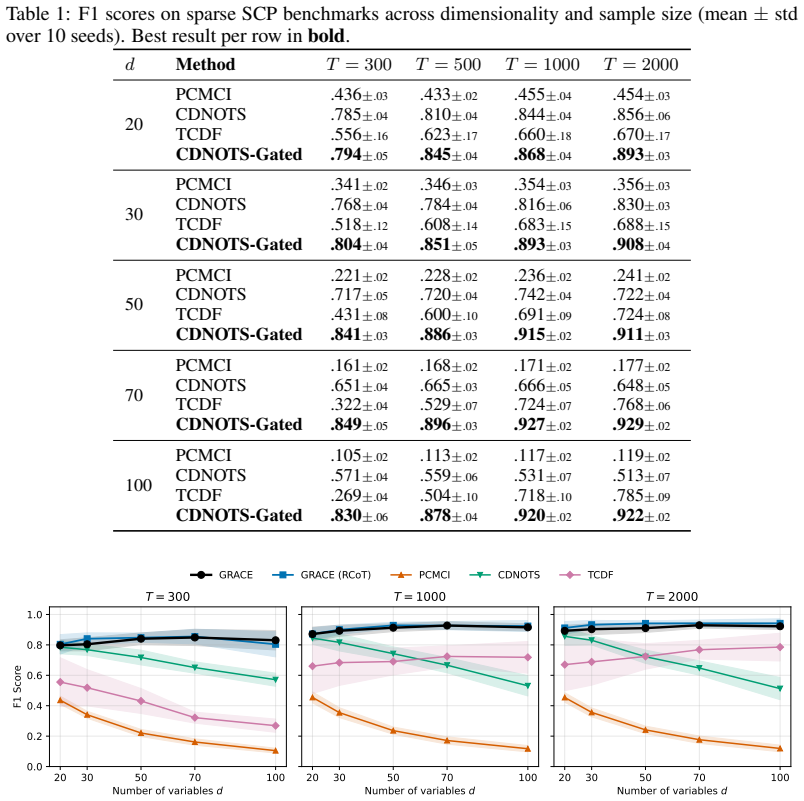
- GRACE substantially improves F1 over its base CI method while maintaining high precision across scale-free, Erdős-Rényi, and small-world graphs up to dimension 100.
- GRACE outperforms attention-based and score-based alternatives on the same benchmarks.
- GRACE matches or exceeds expensive nonlinear CI tests at approximately 75 times lower computational cost.
- On the real-world river flow dataset a temporal bootstrap variant of GRACE recovers 9 of 11 causal edges with only one false positive, reducing the skeleton's 106 false positives by 99 percent.
Where Pith is reading between the lines
- The gated refinement step could be applied after any high-recall skeleton method, not only linear CI, to improve precision in other constraint-based pipelines.
- Because the regularization adapts automatically to skeleton density, the same architecture might scale to problems larger than d=100 without manual retuning.
- The success on data with rainfall confounders and distributional shifts suggests the method may tolerate moderate violations of stationarity that defeat standard CI tests.
Load-bearing premise
A single gated model with L0 regularization can reliably learn which candidate edges genuinely improve prediction and produce robust binary decisions, with automatic adaptation to problem dimensions and skeleton density, without introducing new biases or requiring post-hoc tuning.
What would settle it
On the synthetic benchmarks with d=100 variables and scale-free topology, GRACE produces lower F1 scores than the base linear CI skeleton or lower precision than nonlinear CI tests.
Figures



read the original abstract
From climate teleconnections to gene regulation, modern time-series datasets encompass tens or hundreds of interacting variables, making causal discovery increasingly challenging. Constraint-based methods offer statistical rigor but their nonlinear CI tests are infeasible at scale, while score-based alternatives avoid CI testing but require arbitrary thresholds to binarize continuous edge scores. We propose GRACE ($\textbf{G}$ated $\textbf{R}$efinement for $\textbf{A}$ccurate $\textbf{C}$ausal $\textbf{E}$dge discovery), which refines constraint-based discovery using Hard Concrete gates with $L_0$ regularization: each candidate edge has an independent gate whose values concentrate near 0 or 1, yielding a clean bimodal separation that makes the binary decision robust, unlike the narrow, overlapping score distributions produced by $L_1$ and attention-based methods. A fast linear CI skeleton provides high-recall candidates; a single gated model then prunes false positives by learning which edges genuinely improve prediction, with automatic regularization adapted to problem dimensions and skeleton density. Systematic experiments on synthetic benchmarks, spanning diverse graph topologies (scale-free, Erd\H{o}s-R'enyi, small-world) and dimensionalities up to $d=100$, show that GRACE substantially improves F1 over its base CI method while maintaining high precision, and outperforms attention-based and score-based alternatives. GRACE matches or exceeds expensive nonlinear CI tests at a fraction of the cost ($75\times$ faster). On a real-world river flow dataset, where rainfall confounders, variable propagation lags, and distributional shifts violate standard assumptions, a temporal bootstrap variant of GRACE recovers 9 of 11 causal edges along the Elbe River with only 1 false positive ($F_1 = 0.86$, AUROC${} = 0.99$), reducing the skeleton's 106 false positives by 99%.
Editorial analysis
A structured set of objections, weighed in public.
Referee Report
Summary. The paper proposes GRACE, which starts from a high-recall linear conditional-independence skeleton and refines it via a single model using independent Hard Concrete gates under L0 regularization; each gate is intended to concentrate near 0/1 so that only edges whose inclusion measurably improves prediction are retained. Systematic synthetic experiments across scale-free, Erdős-Rényi and small-world graphs up to d=100 are reported to show F1 gains over the base CI method and over attention/score-based alternatives while remaining 75× faster than nonlinear CI tests; a temporal-bootstrap variant is shown to recover 9 of 11 true edges on the Elbe river-flow data with only one false positive.
Significance. If the gated refinement step reliably isolates direct causal edges from prediction gain without introducing new biases, the approach would supply a practical, scalable way to improve precision of constraint-based discovery in high-dimensional time series while preserving statistical grounding. The reported diversity of synthetic topologies and the real-data result constitute concrete strengths that would be valuable if the core mechanism is shown to be robust.
major comments (3)
- [Abstract and §4] Abstract and §4 (synthetic experiments): the central claim that a single Hard Concrete L0 model automatically selects only those edges whose inclusion improves prediction, without new biases or hidden tuning, is load-bearing for both the F1 gains and the 99 % false-positive reduction; yet no ablation or sensitivity analysis is provided on how the regularization strength or the Hard Concrete temperature interact with lagged confounders (explicitly present in the river-flow setting), leaving open whether prediction gain isolates direct edges or merely spurious correlations.
- [Abstract and real-data paragraph] Abstract and real-data paragraph: the reported F1=0.86 and 99 % false-positive reduction on the Elbe data rest on a temporal bootstrap variant, but the manuscript supplies neither the exact bootstrap procedure, the number of resamples, nor error bars across runs, so it is impossible to judge whether the skeleton reduction is statistically stable or sensitive to the particular temporal partitioning.
- [§4] §4 (timing comparison): the 75× speed-up versus nonlinear CI tests is presented without stating the hardware, the precise implementation of the baseline nonlinear tests, or the number of repetitions, making the computational claim difficult to reproduce or compare.
minor comments (2)
- [Methods] Notation for the Hard Concrete distribution and the precise form of the L0 penalty should be stated explicitly in the methods section rather than left to the abstract.
- [Figures in §4] Figure captions for the synthetic results should include the number of independent trials and the precise graph-generation parameters (edge probability, etc.) used for each topology.
Simulated Author's Rebuttal
We thank the referee for the constructive comments. We address each major point below and will incorporate the requested details and analyses in the revised manuscript.
read point-by-point responses
-
Referee: [Abstract and §4] Abstract and §4 (synthetic experiments): the central claim that a single Hard Concrete L0 model automatically selects only those edges whose inclusion improves prediction, without new biases or hidden tuning, is load-bearing for both the F1 gains and the 99 % false-positive reduction; yet no ablation or sensitivity analysis is provided on how the regularization strength or the Hard Concrete temperature interact with lagged confounders (explicitly present in the river-flow setting), leaving open whether prediction gain isolates direct edges or merely spurious correlations.
Authors: We agree that an explicit sensitivity analysis on regularization strength and Hard Concrete temperature would strengthen the paper, particularly with respect to lagged confounders. In the revision we will add an ablation study that systematically varies these hyperparameters on both synthetic graphs and the river-flow data, reporting effects on selected edges, F1 scores, and false-positive rates. This will directly test whether prediction gain under L0 regularization isolates direct edges. revision: yes
-
Referee: [Abstract and real-data paragraph] Abstract and real-data paragraph: the reported F1=0.86 and 99 % false-positive reduction on the Elbe data rest on a temporal bootstrap variant, but the manuscript supplies neither the exact bootstrap procedure, the number of resamples, nor error bars across runs, so it is impossible to judge whether the skeleton reduction is statistically stable or sensitive to the particular temporal partitioning.
Authors: We agree that the temporal bootstrap procedure must be described in full for reproducibility and to allow assessment of stability. In the revision we will specify the exact resampling procedure, the number of bootstrap replicates, and report variability (error bars or standard deviations) across runs for the Elbe results. revision: yes
-
Referee: [§4] §4 (timing comparison): the 75× speed-up versus nonlinear CI tests is presented without stating the hardware, the precise implementation of the baseline nonlinear tests, or the number of repetitions, making the computational claim difficult to reproduce or compare.
Authors: We agree that the timing results require additional implementation and experimental details. In the revision we will state the hardware platform, the exact libraries and parameter settings used for the baseline nonlinear CI tests, and the number of timing repetitions performed. revision: yes
Circularity Check
No significant circularity; empirical validation on external benchmarks
full rationale
The GRACE method introduces a gated refinement using independent Hard Concrete L0 gates on a high-recall linear CI skeleton to select edges that improve prediction. This is a modeling choice whose performance is assessed via experiments on synthetic graphs with known ground-truth topologies (scale-free, ER, small-world) up to d=100 and a separate real river-flow dataset. No equation or claim reduces a target metric to a fitted parameter by construction, nor does any load-bearing step rely on self-citation chains or imported uniqueness theorems. The derivation chain is self-contained against external benchmarks.
Axiom & Free-Parameter Ledger
Reference graph
Works this paper leans on
-
[1]
Andreas Gerhardus and Jakob Runge
URLhttps://arxiv.org/abs/2507.07898. Andreas Gerhardus and Jakob Runge. High-recall causal discovery for autocorrelated time series with latent confounders. InAdvances in Neural Information Processing Systems, volume 33, pages 12615–12625,
-
[2]
Chang Gong, Di Yao, Chuzhe Zhang, Wenbin Li, and Jingping Bi. Causal discovery from temporal data: An overview and new perspectives.arXiv preprint arXiv:2303.10112,
-
[3]
At the default initializationlogα 0 =−0.5, the ratioC(−0.5) = R(−0.5)/κ(−0.5)≈1.12< C(0), so the threshold for a false gate tobeginclimbing toward the boundary is lower:λ ∗ start = ∆ false ·C(−0.5)/(d·s). Forλ > λ ∗ start, false gates are pushed further closed from initialization and never reach the decision boundary, providing an additional safety margin...
2000
-
[4]
The runtime is dominated by the CDNOTS skeleton at highd; the gated training phase itself scales linearly in the number of skeleton edges
CDNOTS-Gated adds2–3.5× overhead over raw CDNOTS while achieving substantially higher F1. The runtime is dominated by the CDNOTS skeleton at highd; the gated training phase itself scales linearly in the number of skeleton edges. 14 Table 5: SHD on sparse SCP benchmarks (mean±std over 10 seeds). Best per row inbold. CDNOTS-Gated achieves the lowest SHD at ...
2000
-
[5]
Lag misspecification robustness.In practice, the true maximum causal lagLis unknown and must be specified by the practitioner
Methodd= 20d= 30d= 50d= 70d= 100 PCMCI 5 10 32 75 187 CDNOTS 4 7 20 50 138 TCDF 4 6 10 12 18 CDNOTS-Gated38 57 112 186 345 where a fixed value would overregularize.λ= 0.05already degrades atd= 100(F1 drops from 0.92 to 0.49), andλ≥0.1aggressively penalizes gates, suppressing most true edges. Lag misspecification robustness.In practice, the true maximum ca...
2019
-
[6]
Comparing with CDNOTS-Gated (Table 1), PCMCI-Gated achieves lower F1 at all configurations— e.g., 0.602 vs
into a more balanced one (59% TPR / 66% precision). Comparing with CDNOTS-Gated (Table 1), PCMCI-Gated achieves lower F1 at all configurations— e.g., 0.602 vs. 0.920 atd= 100/T= 1000—because PCMCI’s skeleton has far more false positives than CDNOTS’s. This confirms that GRACE delivers consistent and substantial gains regardless of the skeleton source—up t...
2000
-
[7]
458±.03.614±.07.697±.07.635±.08 Full CDNOTS .886±.03.915±.02.878±.04.920±.02 I Score-Based Skeleton: DYNOTEARS The preceding appendix demonstrated that GRACE improves CI-based skeletons (PCMCI). Here we test whether the same gating mechanism can refine ascore-basedskeleton produced by DYNOTEARS [Pamfil et al., 2020], which fits anL1-penalized vector autor...
2020
-
[8]
Second, the oracle threshold t= 0.05 † dramatically improves DYNOTEARS to F1 0.82–0.91, demonstrating that a good thresh- oldexistsbut requires ground truth to find
achieves F1 of only 0.13–0.24, confirming that raw LASSO coefficients without thresholding are unusable as a causal graph—the vast majority of nonzero coefficients are false positives. Second, the oracle threshold t= 0.05 † dramatically improves DYNOTEARS to F1 0.82–0.91, demonstrating that a good thresh- oldexistsbut requires ground truth to find. Third,...
1996
-
[9]
The improvement grows with bothNand T: atN= 50/T= 500the gap is small (F1 0.764 vs
Both methods share the same recall (∼0.78), confirming that GRACE prunes false positives from the skeleton without removing true edges. The improvement grows with bothNand T: atN= 50/T= 500the gap is small (F1 0.764 vs. 0.757), but atN= 100/T= 2000it is substantial (0.894 vs. 0.723). These results demonstrate that GRACE’s additive MLP decoders can effecti...
2000
-
[10]
A natural concern is whether GRACE generalizes to fundamentally different graph structures
use sparse random SCPs where edges are sampled uniformly at random. A natural concern is whether GRACE generalizes to fundamentally different graph structures. We test on three standard graph families generated viaNetworkX[Hagberg et al., 2008]: •Scale-free(Barabási–Albert,m= 2): hub-and-spoke topology with power-law degree distribution, characteristic of...
2008
-
[11]
with no preferential structure. •Small-world(Watts–Strogatz,k= 4,p= 0.3): clustered ring lattice with random rewiring, combining high local clustering with short path lengths, as observed in neural connectomes and social networks [Watts and Strogatz, 1998]. For undirected generators (BA, WS), edges are directed from lower to higher index to establish a ca...
1998
-
[12]
20 Table 16: F1 on Lorenz-96 with noisy observations (σ= 0.1), mean±std over 10 seeds
[Stein et al., 2025].Left:geographic map of 12 gaug- ing stations colored by elevation, with arrows indicating true flow direction (upstream→down- stream).Center:CDNOTS skeleton—all 11 true edges recovered (black) but buried under 106 false positives (orange).Right:GRACE-Bootstrap (N= 50,τ= 0.70)—9 true edges retained with only 1 false positive, recoverin...
2025
discussion (0)
Sign in with ORCID, Apple, or X to comment. Anyone can read and Pith papers without signing in.