Jet-ISM Interaction and Multi-channel AGN Feedback in the Post-merger Galaxy 4C+29.30
Pith reviewed 2026-06-26 00:01 UTC · model grok-4.3
The pith
A post-merger galaxy hosts both a radiatively driven galactic outflow and a misaligned radio jet, showing two AGN feedback channels operating at once.
A machine-rendered reading of the paper's core claim, the machinery that carries it, and where it could break.
Core claim
The central claim is that 4C+29.30 contains a galaxy-scale biconical ionized gas outflow misaligned by about 26 degrees from its radio jet. The outflow is characterized by broad line widths and Seyfert-like ionization ratios and is consistent with a radiatively driven wind from the central supermassive black hole, which is accreting at L_bol/L_Edd greater than or equal to 0.1. In contrast the northern radio lobe produces localized gas acceleration and elevated velocity dispersion through jet-driven shocks. The coexistence of these distinct structures demonstrates that radiative and mechanical AGN feedback channels operate concurrently within the same post-merger galaxy.
What carries the argument
The 26-degree misalignment between the axis of the biconical ionized gas outflow and the radio jet axis, together with the contrasting kinematic signatures and ionization patterns that distinguish the large-scale radiative wind from the localized jet-ISM shocks.
If this is right
- Radiative feedback can launch galaxy-scale outflows even while mechanical jet feedback operates on smaller scales in the same galaxy.
- Post-merger systems with rejuvenated nuclei provide laboratories where multiple feedback modes can be observed together.
- Misaligned structures between outflows and jets can be used to identify independent feedback channels.
- The Eddington ratio above 0.1 supplies the conditions needed for radiation to drive the observed large-scale wind.
Where Pith is reading between the lines
- Feedback prescriptions in galaxy evolution models may need to allow simultaneous radiative and mechanical effects rather than assuming one mode at a time.
- Surveys of other post-merger AGNs could test how common such misalignments are and whether they correlate with merger stage or accretion rate.
- Multi-wavelength follow-up at higher spatial resolution might reveal whether the misalignment persists on smaller scales closer to the black hole.
Load-bearing premise
That broad line widths plus Seyfert-like ionization reliably mark a radiatively driven wind while localized velocity dispersion increases mark jet-driven shocks, and that the misalignment proves the two are separate channels rather than projection effects or one mechanism.
What would settle it
High-resolution kinematic maps showing the outflow axis aligned with the radio jet within measurement uncertainty, or ionization and velocity data that fail to separate into two physically distinct processes.
Figures





read the original abstract
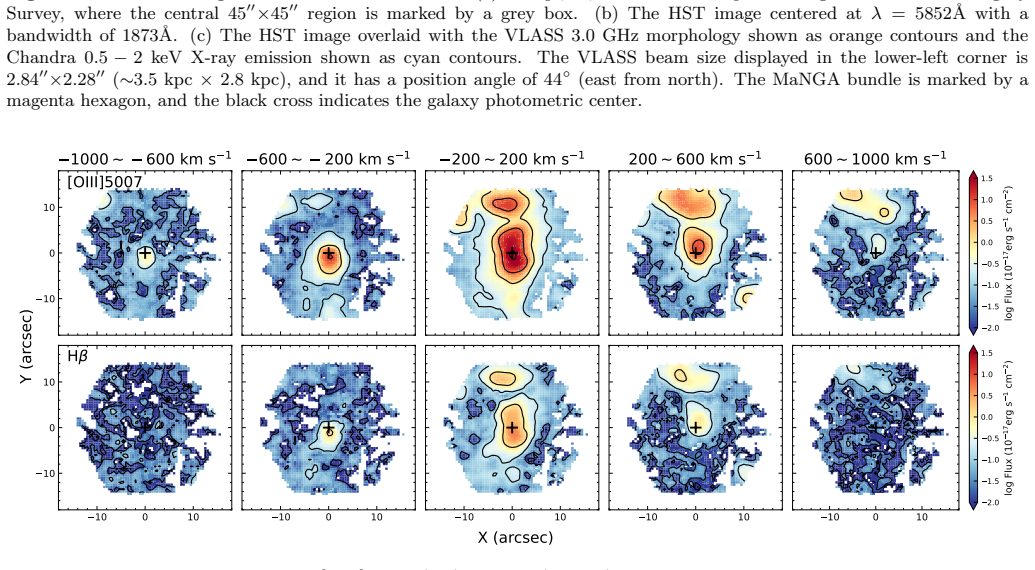
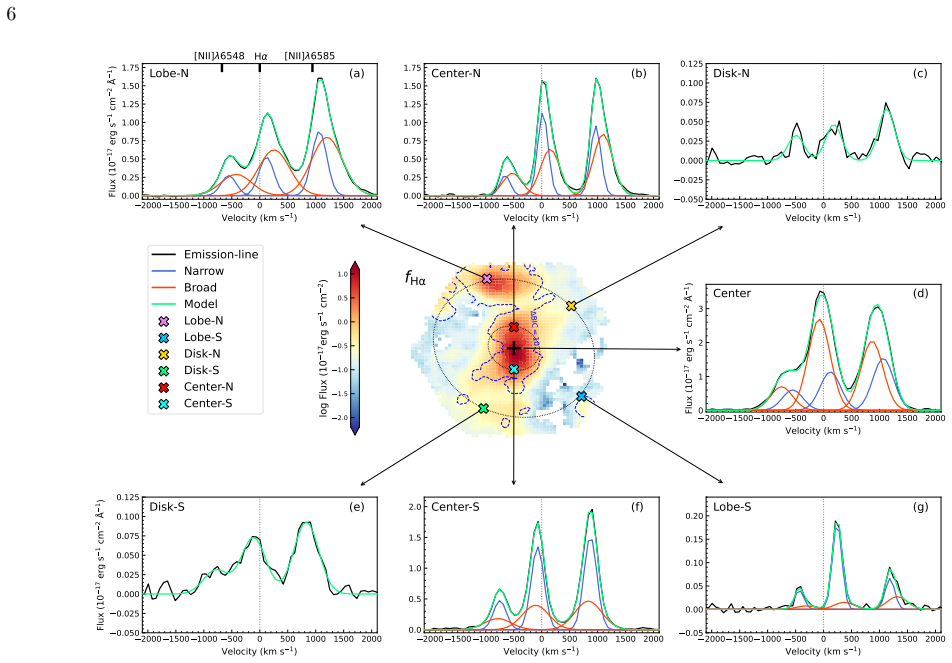
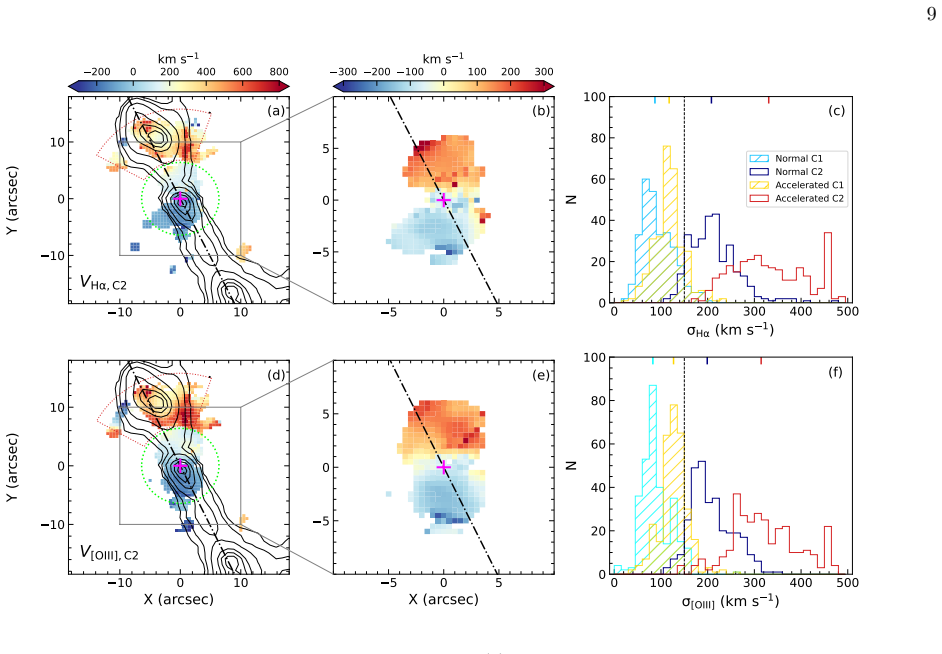
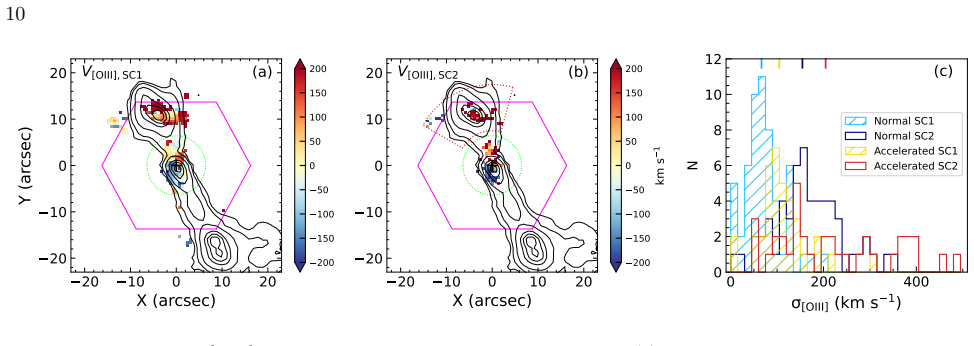
4C+29.30 is a post-merger galaxy hosting a rejuvenated active galactic nucleus (AGN) with a complex multi-scale radio morphology, making it an ideal laboratory to study the interplay between different AGN feedback modes. We present a multi-wavelength analysis combining optical integral field spectroscopy (SDSS/MaNGA and CFHT/SITELLE) with radio continuum imaging (VLASS) to map the ionized gas kinematics and ionization structure across the galaxy. We uncover a galaxy-scale, biconical ionized gas outflow whose axis is misaligned by $\sim$26$^\circ$ from the radio jet. This outflow, characterized by broad line widths and Seyfert-like ionization, is mostly consistent with a radiatively driven wind from the central supermassive black hole, which is accreting at a relatively high Eddington ratio ($L_{\mathrm{bol}}/L_{\mathrm{Edd}} \gtrsim 0.1$). In contrast, the northern radio lobe clearly drives localized gas acceleration and increased velocity dispersion, indicative of jet-driven shocks interacting with the interstellar medium, consistent with previous X-ray findings. The coexistence of a radiatively driven galactic-scale outflow and a distinct, misaligned radio jet demonstrates that multiple AGN feedback channels can operate simultaneously within the same system, providing new evidence for the concurrent action of radiative and mechanical feedback.
Editorial analysis
A structured set of objections, weighed in public.
Referee Report
Summary. The manuscript presents a multi-wavelength study of the post-merger galaxy 4C+29.30 using MaNGA, SITELLE, and VLASS data. It identifies a galaxy-scale biconical ionized-gas outflow whose axis is misaligned by ~26° from the radio jet; the outflow is characterized by broad lines and Seyfert-like ratios and is interpreted as radiatively driven, while the northern radio lobe is shown to drive localized shocks. The central claim is that these observations demonstrate the simultaneous operation of radiative and mechanical AGN feedback channels in a single system.
Significance. If the separation of feedback channels can be robustly established, the result supplies a concrete observational example of concurrent radiative and mechanical feedback, which is relevant to models of AGN-driven galaxy evolution. The combination of integral-field spectroscopy with radio imaging is a strength, though the paper does not include machine-checked derivations or parameter-free predictions.
major comments (2)
- [Abstract] Abstract: The claim that the biconical outflow is 'mostly consistent with a radiatively driven wind' while the northern lobe shows 'jet-driven shocks' is load-bearing for the multi-channel conclusion. The separation rests on broad line widths, Seyfert-like ionization ratios, and the 26° misalignment, but the manuscript does not present quantitative comparisons to shock+precursor model grids (e.g., MAPPINGS) or kinematic deprojection to demonstrate that these signatures are unique to radiative driving rather than overlapping with jet-induced shocks.
- [Ionization and kinematic diagnostics] Ionization and kinematic diagnostics (throughout): The abstract states that localized velocity dispersion increases indicate jet-ISM shocks while the extended biconical structure indicates radiative driving, yet no error analysis, data tables, or model-fit statistics are referenced to quantify the distinctness of the two components or to exclude projection effects or a single-mechanism interpretation.
minor comments (2)
- [Abstract] The Eddington ratio (L_bol/L_Edd ≳ 0.1) is cited from prior X-ray work; a brief recap of the adopted bolometric correction and uncertainty would improve traceability.
- [Methods/Observations] Figure captions and text should explicitly state the spatial resolution and seeing of the MaNGA and SITELLE data when discussing the spatial extent of the outflow versus the radio lobe.
Simulated Author's Rebuttal
We thank the referee for their careful and constructive review of our manuscript on multi-channel AGN feedback in 4C+29.30. We address each major comment below and have incorporated revisions to clarify the supporting evidence while acknowledging the limitations of the current analysis.
read point-by-point responses
-
Referee: [Abstract] Abstract: The claim that the biconical outflow is 'mostly consistent with a radiatively driven wind' while the northern lobe shows 'jet-driven shocks' is load-bearing for the multi-channel conclusion. The separation rests on broad line widths, Seyfert-like ionization ratios, and the 26° misalignment, but the manuscript does not present quantitative comparisons to shock+precursor model grids (e.g., MAPPINGS) or kinematic deprojection to demonstrate that these signatures are unique to radiative driving rather than overlapping with jet-induced shocks.
Authors: The primary basis for distinguishing the channels remains the observed spatial separation (galaxy-scale bicone versus localized northern lobe interaction), the 26° misalignment, and the ionization structure. We agree that direct quantitative comparisons to MAPPINGS grids or full kinematic deprojection are not presented. In revision we will add a paragraph in the discussion referencing published shock+precursor grids to show consistency of the extended bicone with photoionization and will explicitly note the absence of deprojection as a limitation. These additions clarify but do not alter the central interpretation. revision: partial
-
Referee: [Ionization and kinematic diagnostics] Ionization and kinematic diagnostics (throughout): The abstract states that localized velocity dispersion increases indicate jet-ISM shocks while the extended biconical structure indicates radiative driving, yet no error analysis, data tables, or model-fit statistics are referenced to quantify the distinctness of the two components or to exclude projection effects or a single-mechanism interpretation.
Authors: Line-fitting uncertainties and basic error propagation are described in the methods; however, we accept that a consolidated table of regional averages and a short discussion of projection effects would improve quantification. We will add a table of mean velocity dispersion, line ratios, and uncertainties for the biconical and northern-lobe regions, together with a brief paragraph addressing possible projection or single-mechanism scenarios. These changes will be included in the revised manuscript. revision: yes
Circularity Check
No circularity: claims rest on direct multi-instrument observations
full rationale
The paper is an observational study that maps ionized gas kinematics and ionization structure using independent datasets from MaNGA, SITELLE, and VLASS, combined with prior X-ray results. The central claim of concurrent radiative and mechanical feedback follows from measured line widths, Seyfert-like ratios, velocity dispersion increases, and the reported 26° misalignment; none of these quantities are derived from equations or parameters fitted to the same data and then re-predicted. No self-citations, ansatzes, or uniqueness theorems are invoked as load-bearing steps. The derivation chain is therefore self-contained and externally falsifiable via the raw spectra and images.
Axiom & Free-Parameter Ledger
axioms (2)
- domain assumption Broad emission-line widths and Seyfert-like ionization ratios indicate a radiatively driven wind from the central black hole.
- domain assumption Localized gas acceleration and elevated velocity dispersion at the northern radio lobe indicate jet-driven shocks interacting with the ISM.
Reference graph
Works this paper leans on
-
[1]
2025, ApJ, 984, 110, doi: 10.3847/1538-4357/adc38d
Ali, A., Sebastian, B., Kakkad, D., et al. 2025, ApJ, 984, 110, doi: 10.3847/1538-4357/adc38d
-
[2]
Allen, M. G., Groves, B. A., Dopita, M. A., Sutherland, R. S., & Kewley, L. J. 2008, ApJS, 178, 20, doi: 10.1086/589652
-
[3]
Allen, M. G., Sparks, W. B., Koekemoer, A., et al. 2002, ApJS, 139, 411, doi: 10.1086/338823
-
[4]
R., Wuyts, S., F¨ orster Schreiber, N
Avery, C. R., Wuyts, S., F¨ orster Schreiber, N. M., et al. 2021, MNRAS, 503, 5134, doi: 10.1093/mnras/stab780
-
[5]
Baldwin, J. A., Phillips, M. M., & Terlevich, R. 1981, PASP, 93, 5, doi: 10.1086/130766
-
[6]
2019, MNRAS, 490, 3830, doi: 10.1093/mnras/stz2892
Bao, M., Chen, Y.-m., Yuan, Q.-r., et al. 2019, MNRAS, 490, 3830, doi: 10.1093/mnras/stz2892
-
[7]
1991, ApJ, 373, 369, doi: 10.1086/170058 Bˆ ırzan, L., Rafferty, D
Bertola, F., Bettoni, D., Danziger, J., et al. 1991, ApJ, 373, 369, doi: 10.1086/170058 Bˆ ırzan, L., Rafferty, D. A., McNamara, B. R., Wise, M. W., & Nulsen, P. E. J. 2004, ApJ, 607, 800, doi: 10.1086/383519
-
[8]
Blandford, R. D., & Rees, M. J. 1974, MNRAS, 169, 395, doi: 10.1093/mnras/169.3.395
-
[9]
2011, AJ, 142, 31, doi: 10.1088/0004-6256/142/1/31
Price-Whelan, A. 2011, AJ, 142, 31, doi: 10.1088/0004-6256/142/1/31
-
[10]
Blanton, M. R., Bershady, M. A., Abolfathi, B., et al. 2017, AJ, 154, 28, doi: 10.3847/1538-3881/aa7567
-
[11]
Branduardi-Raymont, G., & Ashton, C. E. 2005, A&A, 431, 111, doi: 10.1051/0004-6361:20041775
-
[12]
Overview of the SDSS-IV MaNGA Survey: Mapping Nearby Galaxies at Apache Point Observatory
Bundy, K., Bershady, M. A., Law, D. R., et al. 2015, ApJ, 798, 7, doi: 10.1088/0004-637X/798/1/7
work page internal anchor Pith review doi:10.1088/0004-637x/798/1/7 2015
-
[13]
Calzetti, D., Armus, L., Bohlin, R. C., et al. 2000, ApJ, 533, 682, doi: 10.1086/308692
work page internal anchor Pith review doi:10.1086/308692 2000
-
[14]
2025, ApJL, 979, L48, doi: 10.3847/2041-8213/adaa7b
Cao, X., Chen, Y.-M., Shi, Y., et al. 2025, ApJL, 979, L48, doi: 10.3847/2041-8213/adaa7b
-
[15]
Cappellari, M., & Emsellem, E. 2004, PASP, 116, 138, doi: 10.1086/381875
-
[16]
Chandola, Y., Saikia, D. J., & Gupta, N. 2010, MNRAS, 403, 269, doi: 10.1111/j.1365-2966.2009.15854.x
-
[17]
Chartas, G., Brandt, W. N., Gallagher, S. C., & Garmire, G. P. 2002, ApJ, 579, 169, doi: 10.1086/342744
-
[18]
Chen, Y.-M., Shi, Y., Tremonti, C. A., et al. 2016, NatCo, 7, 13269, doi: 10.1038/ncomms13269 Cid Fernandes, R., Stasi´ nska, G., Schlickmann, M. S., et al. 2010, MNRAS, 403, 1036, doi: 10.1111/j.1365-2966.2009.16185.x
-
[19]
Riffel, R. A., & Morganti, R. 2020, MNRAS, 497, 5103, doi: 10.1093/mnras/staa2268
-
[20]
Crenshaw, D. M., Kraemer, S. B., & George, I. M. 2003, ARA&A, 41, 117, doi: 10.1146/annurev.astro.41.082801.100328
-
[21]
2015a, A&A, 582, A63, doi: 10.1051/0004-6361/201526581
Cresci, G., Marconi, A., Zibetti, S., et al. 2015a, A&A, 582, A63, doi: 10.1051/0004-6361/201526581
-
[22]
2015b, ApJ, 799, 82, doi: 10.1088/0004-637X/799/1/82
Cresci, G., Mainieri, V., Brusa, M., et al. 2015b, ApJ, 799, 82, doi: 10.1088/0004-637X/799/1/82
-
[23]
2006, ApJ, 647, 1040, doi: 10.1086/505526
Croft, S., van Breugel, W., de Vries, W., et al. 2006, ApJ, 647, 1040, doi: 10.1086/505526
-
[24]
, year = 2005, month = apr, volume =
Croton, D. J., Springel, V., White, S. D. M., et al. 2006, MNRAS, 365, 11, doi: 10.1111/j.1365-2966.2005.09675.x Dall’Agnol de Oliveira, B., Storchi-Bergmann, T.,
-
[25]
Morganti, R., Riffel, R. A., & Ramakrishnan, V. 2023, MNRAS, 522, 3753, doi: 10.1093/mnras/stad1076
-
[26]
Dey, A., Schlegel, D. J., Lang, D., et al. 2019, AJ, 157, 168, doi: 10.3847/1538-3881/ab089d 22
-
[27]
2019, MNRAS, 485, 3930, doi: 10.1093/mnras/stz627
Drissen, L., Martin, T., Rousseau-Nepton, L., et al. 2019, MNRAS, 485, 3930, doi: 10.1093/mnras/stz627
-
[28]
Drory, N., MacDonald, N., Bershady, M. A., et al. 2015, AJ, 149, 77, doi: 10.1088/0004-6256/149/2/77
-
[29]
2016, A&A, 593, A109, doi: 10.1051/0004-6361/201526880
Drouart, G., Rocca-Volmerange, B., De Breuck, C., et al. 2016, A&A, 593, A109, doi: 10.1051/0004-6361/201526880
-
[30]
Fabian, A. C. 2012, ARA&A, 50, 455, doi: 10.1146/annurev-astro-081811-125521
work page internal anchor Pith review doi:10.1146/annurev-astro-081811-125521 2012
-
[31]
, year = 1974, month = may, volume =
Fanaroff, B. L., & Riley, J. M. 1974, MNRAS, 167, 31P, doi: 10.1093/mnras/167.1.31P
-
[32]
2012, MNRAS, 427, 1344, doi: 10.1111/j.1365-2966.2012.22008.x
Gaibler, V., Khochfar, S., Krause, M., & Silk, J. 2012, MNRAS, 425, 438, doi: 10.1111/j.1365-2966.2012.21479.x
-
[33]
2020, NatAs, 4, 10, doi: 10.1038/s41550-019-0970-1
Gaspari, M., Tombesi, F., & Cappi, M. 2020, NatAs, 4, 10, doi: 10.1038/s41550-019-0970-1
-
[34]
Girdhar, A., Harrison, C. M., Mainieri, V., et al. 2024, MNRAS, 527, 9322, doi: 10.1093/mnras/stad3453
-
[35]
2012, in Society of Photo-Optical Instrumentation Engineers (SPIE) Conference Series, Vol
Baril, M. 2012, in Society of Photo-Optical Instrumentation Engineers (SPIE) Conference Series, Vol. 8446, Ground-based and Airborne Instrumentation for Astronomy IV, ed. I. S. McLean, S. K. Ramsay, & H. Takami, 84460U, doi: 10.1117/12.926782
-
[36]
Gunn, J. E., Siegmund, W. A., Mannery, E. J., et al. 2006, AJ, 131, 2332, doi: 10.1086/500975
-
[37]
Hardcastle, M. J., Croston, J. H., & Kraft, R. P. 2007, ApJ, 669, 893, doi: 10.1086/521696
-
[38]
Solving the cooling flow problem with combined jet-wind AGN feedback
He, A., Guo, M., Yuan, F., et al. 2025, arXiv, arXiv:2511.02796, doi: 10.48550/arXiv.2511.02796
work page internal anchor Pith review Pith/arXiv arXiv doi:10.48550/arxiv.2511.02796 2025
-
[39]
Heckman, T. M., & Best, P. N. 2014, ARA&A, 52, 589, doi: 10.1146/annurev-astro-081913-035722
work page internal anchor Pith review doi:10.1146/annurev-astro-081913-035722 2014
-
[40]
Holt, J., Tadhunter, C., Morganti, R., et al. 2006, MNRAS, 370, 1633, doi: 10.1111/j.1365-2966.2006.10604.x
-
[41]
Hubble, E. P. 1926, ApJ, 64, 321, doi: 10.1086/143018
-
[42]
Husemann, B., Bennert, V. N., Jahnke, K., et al. 2019, ApJ, 879, 75, doi: 10.3847/1538-4357/ab24bc
-
[43]
2007, MNRAS, 376, 1145, doi: 10.1111/j.1365-2966.2007.11495.x
Jamrozy, M., Konar, C., Saikia, D. J., et al. 2007, MNRAS, 378, 581, doi: 10.1111/j.1365-2966.2007.11782.x
-
[44]
Jarvis, M. E., Harrison, C. M., Thomson, A. P., et al. 2019, MNRAS, 485, 2710, doi: 10.1093/mnras/stz556
-
[45]
Joseph, P., George, K., & Paul, K. T. 2022a, A&A, 667, A88, doi: 10.1051/0004-6361/202243923
-
[46]
Joseph, P., Sreekumar, P., Stalin, C. S., et al. 2022b, MNRAS, 516, 2300, doi: 10.1093/mnras/stac2388
-
[47]
Juneau, S., Goulding, A. D., Banfield, J., et al. 2022, ApJ, 925, 203, doi: 10.3847/1538-4357/ac425f
-
[48]
Kauffmann, G., Heckman, T. M., Tremonti, C., et al. 2003, MNRAS, 346, 1055, doi: 10.1111/j.1365-2966.2003.07154.x
-
[49]
Kewley, L. J., Dopita, M. A., Sutherland, R. S., Heisler, C. A., & Trevena, J. 2001, ApJ, 556, 121, doi: 10.1086/321545
work page internal anchor Pith review doi:10.1086/321545 2001
-
[50]
Kewley, L. J., Groves, B., Kauffmann, G., & Heckman, T. 2006, MNRAS, 372, 961, doi: 10.1111/j.1365-2966.2006.10859.x
-
[51]
Kewley, L. J., Nicholls, D. C., & Sutherland, R. S. 2019, ARA&A, 57, 511, doi: 10.1146/annurev-astro-081817-051832 Krajnovi´ c, D., Cappellari, M., de Zeeuw, P. T., & Copin, Y. 2006, MNRAS, 366, 787, doi: 10.1111/j.1365-2966.2005.09902.x Kr´ ol, D. L., Fabbiano, G., Elvis, M., et al. 2025, arXiv, arXiv:2510.22447, doi: 10.48550/arXiv.2510.22447
-
[52]
Jansky Very Large Array Sky Survey (VLASS)
Lacy, M., Baum, S. A., Chandler, C. J., et al. 2020, PASP, 132, 035001, doi: 10.1088/1538-3873/ab63eb
-
[53]
Liska, M., Hesp, C., Tchekhovskoy, A., et al. 2018, MNRAS, 474, L81, doi: 10.1093/mnrasl/slx174
-
[54]
2021, MNRAS, 507, 983, doi: 10.1093/mnras/staa099
Liska, M., Hesp, C., Tchekhovskoy, A., et al. 2021, MNRAS, 507, 983, doi: 10.1093/mnras/staa099
-
[55]
2019, MNRAS, 487, 550, doi: 10.1093/mnras/stz834
Liska, M., Tchekhovskoy, A., Ingram, A., & van der Klis, M. 2019, MNRAS, 487, 550, doi: 10.1093/mnras/stz834
-
[56]
Liuzzo, E., Giovannini, G., Giroletti, M., & Taylor, G. B. 2009, A&A, 505, 509, doi: 10.1051/0004-6361/200912586
-
[57]
Mahony, E. K., Oonk, J. B. R., Morganti, R., et al. 2016, MNRAS, 455, 2453, doi: 10.1093/mnras/stv2456
-
[58]
Maiolino, R., Gallerani, S., Neri, R., et al. 2012, MNRAS, 425, L66, doi: 10.1111/j.1745-3933.2012.01303.x
-
[59]
Maiolino, R., Russell, H. R., Fabian, A. C., et al. 2017, Natur, 544, 202, doi: 10.1038/nature21677
-
[60]
2025, NatAs, 9, 907, doi: 10.1038/s41550-025-02518-6
Marconcini, C., Marconi, A., Cresci, G., et al. 2025, NatAs, 9, 907, doi: 10.1038/s41550-025-02518-6
-
[61]
The Galaxy Evolution Explorer: A Space Ultraviolet Survey Mission
Martin, D. C., Fanson, J., Schiminovich, D., et al. 2005, ApJL, 619, L1, doi: 10.1086/426387
work page internal anchor Pith review doi:10.1086/426387 2005
-
[62]
2015, in Astronomical Society of the Pacific Conference Series, Vol
Martin, T., Drissen, L., & Joncas, G. 2015, in Astronomical Society of the Pacific Conference Series, Vol. 495, Astronomical Data Analysis Software an Systems XXIV (ADASS XXIV), ed. A. R. Taylor & E. Rosolowsky, 327
2015
-
[63]
McKinley, B., Tingay, S. J., Carretti, E., et al. 2018, MNRAS, 474, 4056, doi: 10.1093/mnras/stx2890
-
[64]
McNamara, B. R., & Nulsen, P. E. J. 2012, NJPh, 14, 055023, doi: 10.1088/1367-2630/14/5/055023
-
[65]
G., & Roeser, H.-J
Meisenheimer, K., Yates, M. G., & Roeser, H.-J. 1997, A&A, 325, 57
1997
-
[66]
Mukherjee, D., Bicknell, G. V., & Wagner, A. Y. 2021, AN, 342, 1140, doi: 10.1002/asna.20210061
-
[67]
Mullaney, J. R., Alexander, D. M., Fine, S., et al. 2013, MNRAS, 433, 622, doi: 10.1093/mnras/stt751
-
[68]
Noguchi, K., Terashima, Y., Ishino, Y., et al. 2010, ApJ, 711, 144, doi: 10.1088/0004-637X/711/1/144 23 Oca˜ na Flaquer, B., Leon, S., Combes, F., & Lim, J. 2010, A&A, 518, A9, doi: 10.1051/0004-6361/200913392
-
[69]
Oosterloo, T. A., & Morganti, R. 2005, A&A, 429, 469, doi: 10.1051/0004-6361:20041379
-
[70]
E., & Ferland, G
Osterbrock, D. E., & Ferland, G. J. 2006, Astrophysics of gaseous nebulae and active galactic nuclei
2006
-
[71]
Pentericci, L., R¨ ottgering, H. J. A., Miley, G. K., et al. 1999, A&A, 341, 329, doi: 10.48550/arXiv.astro-ph/9809056
-
[72]
Pounds, K. A., Reeves, J. N., King, A. R., et al. 2003, MNRAS, 345, 705, doi: 10.1046/j.1365-8711.2003.07006.x
-
[73]
Reeves, J. N., O’Brien, P. T., & Ward, M. J. 2003, ApJL, 593, L65, doi: 10.1086/378218 Reichardt Chu, B., Fisher, D. B., Nielsen, N. M., et al. 2022, MNRAS, 511, 5782, doi: 10.1093/mnras/stac420
-
[74]
Reines, A. E., Greene, J. E., & Geha, M. 2013, ApJ, 775, 116, doi: 10.1088/0004-637X/775/2/116
work page internal anchor Pith review doi:10.1088/0004-637x/775/2/116 2013
-
[75]
2024, Galax, 12, 15, doi: 10.3390/galaxies12020015 Salom´ e, Q., Salom´ e, P., & Combes, F
Rubinur, K. 2024, Galax, 12, 15, doi: 10.3390/galaxies12020015 Salom´ e, Q., Salom´ e, P., & Combes, F. 2015, A&A, 574, A34, doi: 10.1051/0004-6361/201424932 S´ anchez, S. F., Barrera-Ballesteros, J. K., Lacerda, E., et al. 2022, ApJS, 262, 36, doi: 10.3847/1538-4365/ac7b8f
-
[76]
Siemiginowska, A., Stawarz, L., Cheung, C. C., et al. 2012, ApJ, 750, 124, doi: 10.1088/0004-637X/750/2/124
-
[77]
The multi-object, fiber-fed spectrographs for SDSS and the baryon oscillation spectroscopic survey,
Smee, S. A., Gunn, J. E., Uomoto, A., et al. 2013, AJ, 146, 32, doi: 10.1088/0004-6256/146/2/32
-
[78]
A., Siemiginowska, A., Migliori, G., et al
Sobolewska, M. A., Siemiginowska, A., Migliori, G., et al. 2012, ApJ, 758, 90, doi: 10.1088/0004-637X/758/2/90
-
[79]
Physical Models of Galaxy Formation in a Cosmological Framework
Somerville, R. S., & Dav´ e, R. 2015, ARA&A, 53, 51, doi: 10.1146/annurev-astro-082812-140951
work page internal anchor Pith review doi:10.1146/annurev-astro-082812-140951 2015
-
[80]
Swinbank, A. M., Harrison, C. M., Tiley, A. L., et al. 2019, MNRAS, 487, 381, doi: 10.1093/mnras/stz1275
discussion (0)
Sign in with ORCID, Apple, or X to comment. Anyone can read and Pith papers without signing in.